Asymco

Asymmetric Intelligence

iPhone

  1. 41 million BlackBerry users

    Research

    "Officials at the WES 2010 keynote said that RIM has redesigned all of the core applications within the BlackBerry operating system. It also revealed that there are 41 million BlackBerry users, and 90 million BlackBerrys have been sold to date."

    Apple already announced that they see 100 million iPhone OS devices sold by this summer. The installed base for iPhone OS devices is likely to be much greater than 40 million since most of the 85 million devices sold as of today were purchased less than 2 years ago. With the iPad and the iPod broadening the portfolio, the Apple mobile platform will grow more rapidly than RIM's leading to increasing network effects.

  2. iPhone OS download rate 10X Blackberry

    Research

    Today, Research in Motion co-CEO Jim Balsillie said his BlackBerry App World has 20 million registered users and nearly 1 million daily app downloads.

    via Apple Doing 10-20X As Many App Downloads A Day As BlackBerry.

    As previously stated, The App download rate increased to a record 10,753,000 per day during the last 90 days.  That makes the download rate for the iPhone platform 10x that of the Blackberry Platform.  The iPhone platform is nearing 100 million installed base.  Blackberry is citing 20 million registered users.  I think everyone is pretty clear on where this is going.

  3. Apple Business Review: Product Line Margins

    Research

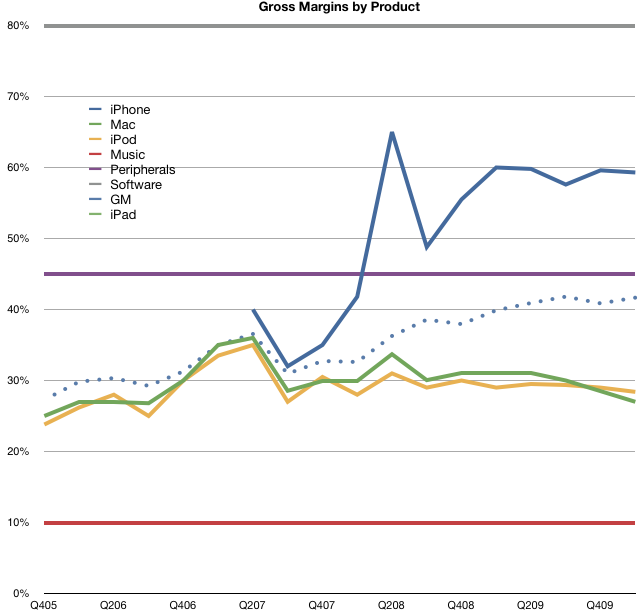
    Apple's overall gross margin reached 41.67%, the second highest ever.  The highest was 41.82% last Fall.  This should not come as a surprise as the iPhone continues to make up an increasingly larger percent of Apple's total sales.  The gross margin on the iPhone continues to be well above all its other product lines (except for software).

    Although Apple does not provide product line GM break-out, some intelligent guessing can be made.  Here are my estimates:

    • iPhone 59%
    • Mac 27%
    • iPod 28%
    • iTunes 10%
    • Periph 45%
    • Software 80%

    A historic perspective for gross growth (iTunes, Peripheral and Software sales growth) is shown in the graph below.

  4. Nokia vs. Apple phones business comparison shows comfortable lead for Apple

    Research

    Nokia reported 21.5 million converged devices sold in Q1.  The units, share, ASP, Revenues and Operating Profits are compared in the following table.

    It's once again evident that Apple captured more profits from the iPhone than Nokia did from all its devices and services operations.

    With respect to converged devices, Apple also generated more sales and had nearly triple the ASP.  Unit shares remained almost the same sequentially. Nokia did suffer more from ASP erosion sequentially as the converged ASP dropped by 24% vs. a 2.5% drop for Apple.

    What is interesting from a growth perspective is that Apple's #1 position in the share of profits from mobile phones was acquired with such a low market share.  Analyst Brian Marshall said the most interesting part of Apple's story is the international growth of the iPhone. He believes that Apple has only acquired about 1.5 percent of its international carrier partners' total postpaid subscription base of 525 million. For comparison, its penetration in the U.S. peaked in Sept. 2009 on AT&T with 5 percent.

    Sources:

    Nokia - Investors- News Release

    Apple - Investor Relations

  5. The Progress of the Platform

    Research

    The Progress of the Platform.

    On why there is a ban on intermediate layers of software development on the iPhone OS.

    But the reason isn’t technical. It’s partly business (Apple doesn’t want another company to control any important part of the iPhone platform), but it’s also in no small part grounded in aesthetics and the progress of the platform. Apple wants developers to do things the iPhone and iPad Way because they believe it will result in a better user experience and better designed apps. That’s an aesthetic, design-centered argument about how touch apps should be done. Apple has created tools customized to the iPhone and iPad; hell, they built a whole new touch-based operating system. They created a whole set of user interface metaphors that are supposed to be standard and system-wide, and they want developers to do things the new way not because Apple just loves power, but because they believe it’s necessary to force developers to think about the new world of touch-based computing correctly. All of this in service of giving users who are taking their first steps into touch-based computing a great experience.

    Developers who want to write software for the iPhone have to write iPhone-like software. To do otherwise will hinder the progress of the platform.

  6. Smartphones taking over in mobile gaming

    Research

    Smartphones are upturning the mobile gaming market, comScore found in a study today. The number of players on iPhones and other smartphones has jumped 60 percent in the past year to almost 21.4 million and has cut deeply into the portion of those using regular cellphones. Their numbers dropped a sharp 35 percent over the same period to just 29.5 million.

    via Smartphones taking over in mobile gaming | Electronista.

    More data from Flurry analytics here.

    Other game platforms vs. iPhone catalogs here.

  7. One Hundred Million (part II)

    Research · 3 comments

    My prediction is that sometime next year Apple will announce the 100 millionth iPhone OS device sold, making the iPhone the fastest selling platform in history. The iPhone will have been on the market for three years.

    One Hundred Million « Asymco. (five months ago)

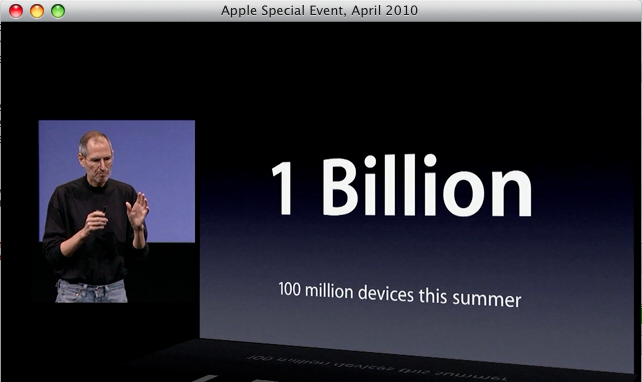
    Did anybody else see the line below the "1 Billion" header in the iPhone 4.0 Launch Event? The segment was about the 1 Billion impressions that iAd will be able to target.  Interestingly this is one of only two forward looking estimates that Apple has ever made on the iPhone.

    100 million

    The 100 million threshold in units is important in several contexts.

    First, on April 9th, 2007 Apple announced that the 100 millionth iPod had been sold, making the iPod the fastest selling music player in history. The first iPod was sold five and a half years earlier, in November 2001.  The iPhone will reach this in 3 years.

    Second, no other platform comes close.  On November 3, 2003, Microsoft announced that it intends to sell 100 million Windows Mobile devices by year 2007. Two years after that goal, in 2009, Microsoft sold 15 million units, down from 16.5 million in 2008.  It has not reached half the targeted installed base.

    Although there could be more than 100 million Symbian devices in use, they are not all running the same software, so they do not offer a targetable installed base.

  8. Daring Fireball: New iPhone Developer Agreement Bans the Use of Adobe's Flash-to-iPhone Compiler

    Research · 4 comments

    My reading of this new language is that cross-compilers, such as the Flash-to-iPhone compiler in Adobe’s upcoming Flash Professional CS5 release, are prohibited. This also bans apps compiled using MonoTouch — a tool that compiles C# and .NET apps to the iPhone. It’s unclear what this means for tools like Titanium and PhoneGap, which let developers write JavaScript code that runs in WebKit inside a native iPhone app wrapper. They might be OK. The folks at Appcelerator realize, though, that they might be out of bounds with Titanium. Ansca’s Corona SDK, which lets you write iPhone apps using Lua, strikes me as out of bounds.

    via Daring Fireball: New iPhone Developer Agreement Bans the Use of Adobe's Flash-to-iPhone Compiler.

    Nota bene:  Apple will release its own app front end that allows a simpler development environment (than XCode).

  9. Tavis McCourt of Morgan Keegan Predicts iPhone Sales

    Research

    At the event, CEO Steve Jobs noted that iPhone sales to date now tops 50 million units. Morgan Keegan analyst Tavis McCourt points out in a research note that as of the end of December, sales to date were 41.8 million. Ergo, the company sold at least 8.2 million in the March quarter, he concludes.

    Source: Barrons

    How can you count on these guys for forecasts about the future when they can't get the past right?  Total iPhones sold as announced by Apple: 42.484 million.  A more reasonable estimate is here.