Asymco

Asymmetric Intelligence

iPhone

  1. The Next Billion Users

    Research

    Five weeks ago Apple forecast 100 million iPhone OS devices will be sold by summer. This was fairly easy to predict but the question comes up: when will the next 100 million be sold? And what about after that?

    The iPhone OS three-legged platform is now the fastest growing platform ever and enjoying network effects which naturally accrue to platforms under solid custodianship. However, I am observing signals from Apple that they intend this platform to become the global standard for mobile computing, which, in today's world, means targeting 1 billion users. Here are the signals that I'm noting:

    1. Geographic and cultural universality. What plays in Peoria should play in Beijing.  As it has shown by being big in Japan, the iPhone crosses over cultural idiosyncrasies. Not long ago it was taken for granted that "mobile tastes" differ and "one size does not fit all" in mobile phones hence the need for hundreds of phone models in every portfolio. Apple has completely destroyed this myth. (One could ask why should mobile computers be polymorphous when their slightly larger cousins the laptops are rigidly monotonic?) By broadening the platform with multiple screens and connectivity options, Apple is cleverly spanning the jobs that he platform can be hired for.
    2. Avoidance of a pricing umbrella.  Note that this does not mean being low prices, but rather, the protection of their franchise through pricing. Apple has developed a way to stretch a single product across multiple price bands, and carefully builds product to price and margin targets that have strategic placement.
    3. Product cycles and product ramps. Apple has imposed upon itself a yearly product cycle for the iPhone and the iPod.  This is a brilliant move because it keeps the product fresh without having it seem disposable.  It also keeps competitors within its turning radius. However, the challenge is that the distribution network has to be filled rapidly and drained rapidly to maximize availability. This gets harder and harder as the volume grows. Imagine having to manufacture and ship into the channel a billion devices in less than a quarter.

    I would point out that all these are marketing, not technical challenges. They are thinly disguised questions about product placement, portfolio, pricing, production and distribution--classic Marketing 101. (Promotion, which is what most people equate with marketing is not particularly challenging, especially for Apple who mostly does it through PR).

    It is comforting perhaps to know that Apple is the best marketing organization in the industry today. So to answer the question, 100 million is in the rear-view mirror, 200 million will come up in no more than 2 years and 1 billion will take 5 to 8 years.

  2. Apple's Growth Scorecard

    Research

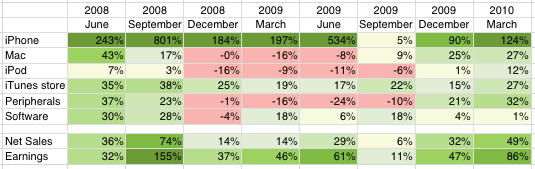
    Apple's growth and its disconnect with valuation has been a common theme on this blog. For another look at this conundrum I present here a table of Apple's year on year sales growth by product line and its top and bottom lines.

    I color coded the values so that a darker green signifies higher growth (and red, negative growth)

    I call this the growth scorecard.

    What does this scorecard say about the previous 24 months?

    • Earnings never grew slower than 30% for any quarter except for one quarter when the comp was ridiculously high at 155% (on the back of iPhone 3G launch).
    • Throughout the recession Apple grew sales.
    • The worst growth performance was on peripherals which is Apple's smallest business
    • The fastest growth was the iPhone, now Apple's largest business.
    • The iTunes store grew sales consistently throughout the previous 24 months.
    • Growth has been positive (green) across all lines for the past two quarters and has been accelerating.

    My estimate for the current (June) quarter is that Net Sales will grow by 47% y/y and Earnings will grow by 60%.

  3. Global smart phone OS shares (part II)

    Research

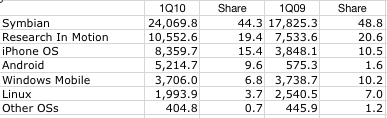
    On May 5th, I tried to fill in the blanks on Global smart phone OS shares | Asymco. I estimated that the shares for the mobile OS's were as follows (based on Canalys partial data):

    • Symbian (Nokia): 42%
    • Blackberry OS (RIM): 19%
    • iPhone OS (Apple): 16%
    • WinMo (Microsoft): 10%
    • Android (Google): 10%
    • WebOS (Palm): 2%

    Now Gartner has published their sell-through estimates:

    • Symbian (Nokia):: 44%
    • Blackberry OS (RIM): 19%
    • iPhone OS (Apple): 15%
    • Android (Google): 10%
    • WinMo (Microsoft): 7%
    • Linux: 4%
    • Other OSs: 1%

    My estimates were within 1 or 2 percent of actuals except for Windows Mobile where I over-estimated by 300 basis points.

    The analysis of Android vs. iPhone market shares (globally and within the US) which depended on this estimation does not change materially.

    The complete data from Gartner follows:

  4. iPhone has 72% of Japanese smartphone market

    Research · 3 comments

    In December I reported iPhone controls 46% of Japanese smartphone market | Asymco.  Five months later Apple's share has reached 72%.

    According the MM Research, 1.7 million iPhone were sold in the fiscal year ended March 31.  That's not a huge number relative to the 110 million subscribers in the country. But Apple's exclusive carrier Softbank has only 22 million subscribers so Apple may have penetrated over 10% of that user base.

  5. Will Apple rule the iPad market? (part II)

    Research · 12 comments

    Continuing from Will Apple rule the iPad market? | Asymco.

    The first claim is that

    it is unclear if [Apple] will end up dominating the market the way it has come to rule the digital music player market with the iPod.

    After hearing a thousand voices cry out that the iPad is nothing more than a bigger iPod touch (which, plainly, it is) it's amusing to read that its similarity with a sibling ends when it comes to market performance.

    Let me make one claim up-front: the iPad is more of an iPod than the iPod.

    The original iPod was successful because it had a significant integrated value chain bolted on. Apple disrupted music with a value chain, not a product. It changed the way music is bought, consumed and even how it is produced. It changed the economics from retail down to songwriting.

    This is why it came to dominate its market. Every competitor that took a run at it did so with a partial solution to the value chain. Often it was nothing more than a music player, and in some cases (e.g. Zune) it was bundled with some other pieces of technology, but poorly executed and too late.

    The iPad comes with an even bigger value chain bolted on: the App Store. Apple is flogging not just an "app player" but also a new way to develop and distribute software. If you cut "music" and paste "apps" you see the immediate parallel between iPod and iPad. The app ecosystem will quickly grow to be larger than the music ecosystem with the mobile software business already eclipsing the music business.

    A competitor launching a tablet device will have to somehow overcome the momentum of billions of downloads fed by hundreds of thousands of apps built by tens of thousands of developers for hundreds of millions of users.

    The iPod juggernaut pales in comparison to the iPad supernova. The iPod had no apps or dedicated developers. Its ecosystem consisted of a handful of music companies. The only thing that made it "sticky" was the tie-in with one type of content.

    The iPad on the other hand has a thousand other jobs to do for its users. It has a rich tapestry of functionality and a multi-dimensional (literally) user experience.  It's a platform. It's even powerful enough to impose new standards on the web itself and to suggest that search is a bygone activity.

    So to suggest that Asus or Dell will somehow build "iPad killers" sounds asinine. These competitors don't even grasp what the product is and what it's for.  Sony said they don't see a market for it. Microsoft, trapped in the innovator's dilemma and overshooting the market by miles, said they don't understand what the point is because users want full PCs.  Google asked what's the value of a big iPod. I could go on, but there was not a single company in the industry who recognized what they were looking at in January. Apple keeps a tight lid on new products so that competitors don't get a head-start on copying, but in the case of the iPad, advance knowledge would not have had any impact. Competitors look at the iPad and see nothing.  They'll only react once the market explodes and they start to feel belated pain.

    If, and it's a big if, they do recognize what an iPad is, their response cycle is going to be measured in years. On hardware, they were blown away with a product that had twice the power, half the bulk, twice the battery life with half the price of what they had on the shelf. They may catch up on hardware in a year or two and launch some sort of iPad-like assembly of components, but that is like making the first iPod killer in 2002.

    Then there is software. Their software supplier (Microsoft of Google) will have to build a platform that works. That will take years. Years during which the iPad will penetrate every geography, demographic and vertical market.

    Google might move more rapidly than Microsoft, but they will produce an open source poster child of a platform. Fragmented and rough around the edges to the point of looking like a hobby project. Their flea market store will also have the smell of fresh glue about it. Microsoft is so far behind the curve that I don't even think they will try to move the tiller.  Their view of the market was betrayed by the recently knifed Courier demoware. To suggest a challenge to the PC/Windows model inside Microsoft is a career-limiting move so don't expect their brightest to be lining up to propose new platforms to management.

    What about HP? Assuming they overcome the pitfall of NIH that kills 80% of integration efforts, they will still need to perform an enormous amount of heavy lifting to get WebOS to be a competitive experience on a tablet. Most opinions were that Palm came pretty close with a smartphone, but that was nowhere near enough to stay alive, never mind challenge iPhone.

    Then there is the ecosystem. Building it is just not something I can even begin to roadmap. What about developer tools, SDKs, frameworks and evangelism? With a Palm division, HP is the best positioned of the PC vendors but it has a chance at being a player as much as Creative did vs. the iPod, or needless to say, Palm vs. the iPhone.

    So the iPad challengers face five daunting obstacles:

    1. Recognition of a threat from a seemingly benign product
    2. Execution on hardware against the best integrator on the planet
    3. Execution on software against a new UI metaphor fortress surrounded by a patent moat
    4. Integration of hardware and software to a sublime whole
    5. Re-building a value chain for which they have no handle vs. a broad and deep existing universe of app/content creation distribution and consumption enjoying logarithmic network effect value.

    That does not even touch the logistics, sourcing, margin and pricing challenges of world-wide distribution of the whole value chain. Nor does it cover the lock-in of advertisers to new tools for creatives or the billions of daily views from a platform that is blindingly dazzling.

    To put it in the language of disruption, by the time the competitors launch symmetric attacks on the iPad, Apple will be the incumbent. And we all know that symmetric attacks never work against entrenched incumbents who have all the levers of power at hand to deploy in a withering counter-attack.

  6. Apple's iPhone replaces Blackberry

    Research

    British bank Standard Chartered is replacing the Blackberry, currently its standard corporate communication device, with the iPhone.

    The process of migrating corporate email services from the Blackberry to the iPhone started about a month ago, said the spokeswoman, although she did not know how many of the Asia-focused bank's 75,000 employees used company-issued Blackberries or when the switchover could be completed.

    via Apple's iPhone replaces Blackberry for some bankers | Reuters.

    I remember reading once that the iPhone was not suitable for Enterprise use.

  7. Visualizing iPhone vs Android Shares

    Research · 1 comment

    Following up on my last post on how misleading US-only share comparisons can be, I decided to draw charts to visualize the comparison.

    As Android and iPhone compete in various ways, it's hard to see which is the preferred choice given a direct comparison.  In other words, iPhone and Android devices rarely are placed next to each other with similar terms.

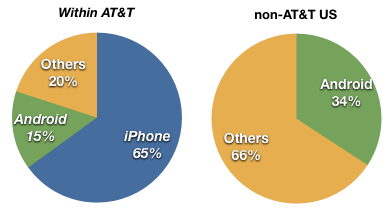
    Take the US market for example.  The overall data from NPD suggests that last quarter Android reached 28% share vs. 21% for iPhone.  Many of those Android devices were new to market or at least newer than the iPhone which in Q1 was coming to the end of its product cycle.  Second, pricing for Android devices seems to have been quite aggressive with buy one get one free sales.  But I won't dwell on tactics now; what I do want to note are the differences in share between AT&T users and non-AT&T.

    Note that within AT&T, iPhone outsells Android over 4 to 1.  iPhone also outsells "others" (mainly RIM) more than 3 to 1.  However, outside AT&T, where the iPhone is not available, Android does not outsell "others".

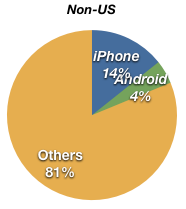
    If we exclude the US altogether, we also see that Android does not have a great distribution.

    Outside the US, the iPhone also outsells Android nearly 4 to 1, but it has a way to go before challenging Symbian which makes up the bulk of "Others".

    So in markets where Android is head-to-head with the iPhone (AT&T and non-US markets), iPhone's lead is quite high (still).  The possibility still exists that Android will overtake iPhone given the broad licensing and distribution, but it's not necessarily a given.  And in any case, iPhone is not the market share leader today and that leadership does not seem to be their objective (note the pricing).

    The bigger question is what will happen to RIM and Symbian as Android grows.

  8. NPD: iPhone is 65 percent of AT&T's smartphone volume

    Research · 4 comments

    Much ink is being spilled over Android outselling the iPhone in the US in Q1.  Here's what NPD survey data shows:

    • Q1 units for Android reached 28% vs. iPhone at 21%.
    • AT&T stated that they activated 2.7 million iPhones.  That is 31% of all iPhones sold by Apple.  Assuming NPD data is accurate, we can conclude that Android shipped 3.6 million units in the US or 65% of their total.
    • In a previous posting (Global smart phone OS shares « Asymco) I estimated, based on Canalys estimates, that global Android share reached 10% last quarter or about 5.5 million.
    • We can compute that Android captured only 4% of smartphone share outside the US while Apple obtained 14% share.
    • You can also observe that iPhone's US share increased y/y while every other platform except Android dropped (implying that Android took share from everybody but Apple.)
    • NPD claims AT&T accounted for 32% of the smartphone market, and even though AT&T carried both Android and WinMo and Blackberry devices, 21 out of every 32 phones or 65% of AT&T's volume were iPhones.
    • We can conclude that Android captured 34% of the non-AT&T US smartphone market.

    The table below combines the NPD, AT&T, and Canalys data to show units for iPhone and Android in the US, Global and non-US regions.

    One can only wonder what would happen if iPhone would be available non-exclusively.  Would iPhone achieve greater than 60% share as it did on AT&T?  Certainly that's what happened in France.

  9. Misdiagnosing Failure: Why Disruptive Innovation Models Miss on Apple

    Research · 2 comments

    In a thought-provoking article in The Motley Fool (Predicting Failure: Testing the "Disruptive Innovation" Model ) summarizing recent research in disruptive innovation, the following quote jumped out at me:

    Then again, the model is dead wrong 15 percent of the time. Lest you think Thurston won’t admit to failures, he points out several instances where his own predictions are wrong. Take the Apple iPhone, he says -- if you apply the model to this specific product, instead of the company as a whole. Apple was a new entrant in mobile phones. The iPhone provided better Internet performance and a better interface at a higher cost -- not poorer and cheaper -- yet it was very successful from the start. “When it’s wrong, it’s interesting,” Thurston says. “We hope to improve the theory.”

    This is of particular interest to me because I've always felt that Apple had a disruptive track record that was not recognized by disruption theory practitioners.  I think the reason is that casual observers place Apple's products in narrow categories rather than seeing the real jobs that the products are hired to do.

    The reason iPhone gets misdiagnosed by disruption theory is that it is placed alongside other phones and looks sustaining. That's what the quote above implies and it's a common mistake. I first did that myself. However a cursory review of how the product is used (see ComScore and Nielsen surveys on usage) shows that it's used for browsing and applications more than for mobile telephony.  These jobs it's hired to do have more in common with personal computing. Therefore, when you put an iPhone next to a computer, its disruptive potential becomes clear. This placement also leads you to think of a trajectory that predicts the iPod touch and the iPad as natural improvements for Apple.

    That is why I classify the category the iPhone competes in as Mobile Computing--a category of products that is undoubtedly disruptive (less powerful but more convenient and often cheaper) vis-a-vis traditional personal computing.

    Similar analyses for the iPad, the iPod would also reveal a pattern of new market disruption for Apple.

  10. Global smart phone OS shares

    Research

    In the free press release linked below Canalys reveals their estimates of vendor shares but not the OS shares for smartphones. However it's not hard to see the OS split due to the high degree of exclusivity of OS's to vendors.

    For example, virtually all Nokia devices are Symbian powered, all RIM devices are Blackberries and all Apple devices are iPhone OS.  Motorola is only shipping Android and HTC is the only top 5 vendor that now licenses more than one OS.  Even HTC's portfolio is now heavily Android weighted.

    We can carve out Palm (960k units shipped) from the "others" and we're left with mostly Windows Mobile.  My estimate would be about 5 to 6 millionWinMo made it out.

    That leads me to the following estimated OS shares:

    • Symbian (Nokia): 42%
    • Blackberry OS (RIM): 19%
    • iPhone OS (Apple): 16%
    • WinMo (Microsoft): 10%
    • Android (Google): 10%
    • WebOS (Palm): 2%

    If anyone knows the actual Canalys OS shares, let me know.

    Global smart phone market growth rises to 67% (Canalys press release: r2010043).

  11. iPad outsells iPhone

    Research

    Apple today announced that it sold its one millionth iPad on Friday, just 28 days after its introduction on April 3. iPad users have already downloaded over 12 million apps from the App Store and over 1.5 million ebooks from the new iBookstore.

    via Apple Sells One Million iPads.

    On March 14 I wrote:

    I will be surprised if the number of units sold in Apple’s CQ2 doesn't exceed 1 million. This will probably mean better performance with a new platform than Nokia, Google, Sony Ericsson or HTC and perhaps better than the iPhone.

    On March 9 I wrote:

    In either case, iPad will sell better than the iPhone out of the gate.

    The iPhone sold 1 million within 74 days.  The iPad sold 1 million units in less than half the time the iPhone did.