Asymco

Asymmetric Intelligence

iPhone

  1. Running a data-center AI model on a MacBook

    Nota Bene

    Supercomputer

    Data-center AI model on MacBook: Why it matters for Apple

    The implications for Apple’s competitive position in AI are significant. The dominant narrative that Apple is behind — that Siri is a joke compared to ChatGPT, that Apple Intelligence is underwhelming, that the company missed the generative AI wave — could be misleading. Woods’s experiment suggests Apple may have quietly built the right hardware all along.

    Apple silicon’s unified memory architecture lets CPU and GPU share the same high-bandwidth memory pool. And that looks like precisely the design needed for the flash-streaming technique Apple’s own researchers described. No other mainstream laptop platform has this. So MacBook Pro isn’t just a laptop that can run AI on the side. It may be the most capable personal AI computer on the market.

    While competitors race to build billion-dollar data centers, the most powerful AI model you can run might soon be the one already sitting in your bag. Apple’s chip lead, combined with techniques like these, could make local AI on Mac — private, fast and free from cloud subscriptions — a genuine reality far sooner than anyone expected.

    As Willison noted, the quality tradeoffs are still being evaluated. But we can’t overstate the breakthrough in simply getting it running. The AI race might not be won in a data center after all.

    (via Cult of Mac - Your source for the latest Apple news, rumors, analysis, reviews, how-tos and deals.)

    Source: and it changes everything via Cult of Mac

    NB: In a recent interview I said that the original iPhone was very weak...

  2. Apple Is Way Behind in AI—and Still Making a Fortune From It: WSJ

    Nota Bene

    Distribution is hard, distribution is gold.

    Apple is on pace to surpass $1 billion in artificial-intelligence revenue this year, a tidy sum that demonstrates the company’s AI advantage even as it struggles to deliver an AI strategy of its own.

    That means they typically pay the App Store tax, roughly 30% of subscription fees in the first year and 15% a year thereafter, though rates vary by country. Generative AI apps paid Apple nearly $900 million in App Store fees in 2025, according to the analysis firm AppMagic.

    Three-fourths of the revenue Apple rakes in from GenAI apps in its App Store comes from ChatGPT, according to AppMagic. Next, at about 5%, is xAI’s Grok. Apple’s revenue from GenAI apps rose from about $35 million in January 2025 to a high of $101 million in August. Sales have fallen from their peak, partly because ChatGPT downloads have declined, according to the data.

    Source: Wall Street Journal

    NB: I always thought Apple would take 20% of all AI spending…

  3. The biggest surprise of the MacBook Neo

    Research · 2 comments

    Remembering the PC market

    Almost 10 years ago I said "Managing the Mac product line must be one of the most challenging problems at Apple. That may not be obvious given the product’s success." I pointed out that although the company grew the Mac into a redeemed and prosperous platform, "The big change in computing has not been a growing Mac vs. declining PC. It has been a huge surge in mobile device use vs. a decline in PC use overall."

    It's time to revisit this observation.

    First, a status update:

    • The Mac is in its 32 42nd year of market presence. A longevity that is (still) unmatched by any other PC maker.
    • Apple reached a top five four position in the ranking of PC vendors. This was achieved far along in the evolution of the market.
    • With about $23 $33 billion in revenues per year, Apple places among the top four three PC vendors in terms of revenue.
    • With an estimated $5.5 $13.8 billion in operating margin Apple is the most profitable PC vendor, capturing over 60% of the available PC hardware profits.
    • The product has retained an average selling price of over $1200 ($1400 last year) for at least a decade. At the same time the average pricing of Personal Computers has more than halved.
    • Volumes increased by about 20% over a decade.

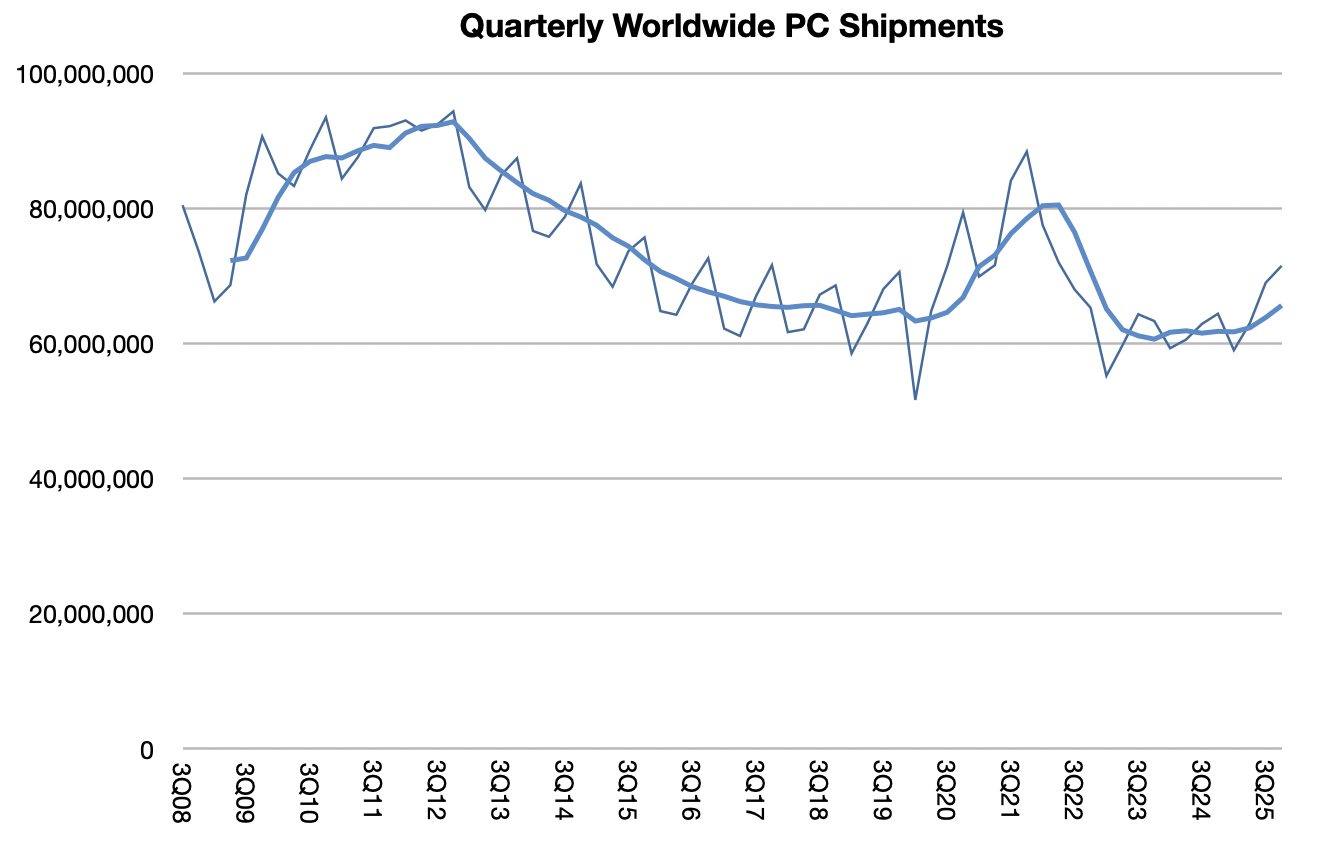
    The overall picture of the market is shown the following graphs. First, the overall quarterly shipments.

    Note the Covid-era surge during 2020 and 2021 but overall decline from peak in 2012. Yearly shipments were 262 million in 2025 vs. 371 million in 2012. The install base of users is largely unchanged. Microsoft has cited "over 1 billion" to 1.4 billion monthly active devices, with figures varying between official statements. My estimate has been 1.2 billion PC users with an additional 250 million Mac users, more about this later.

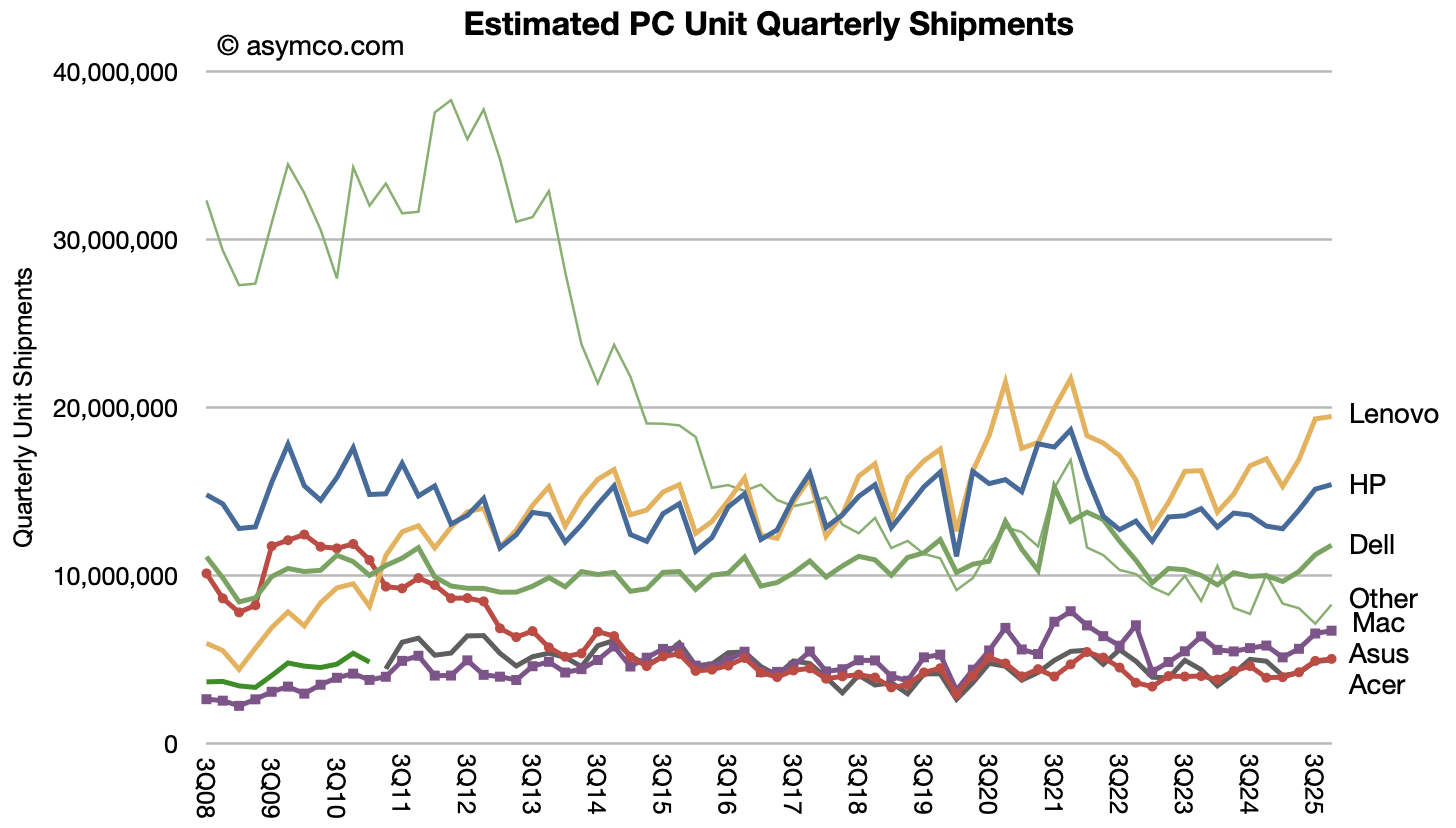
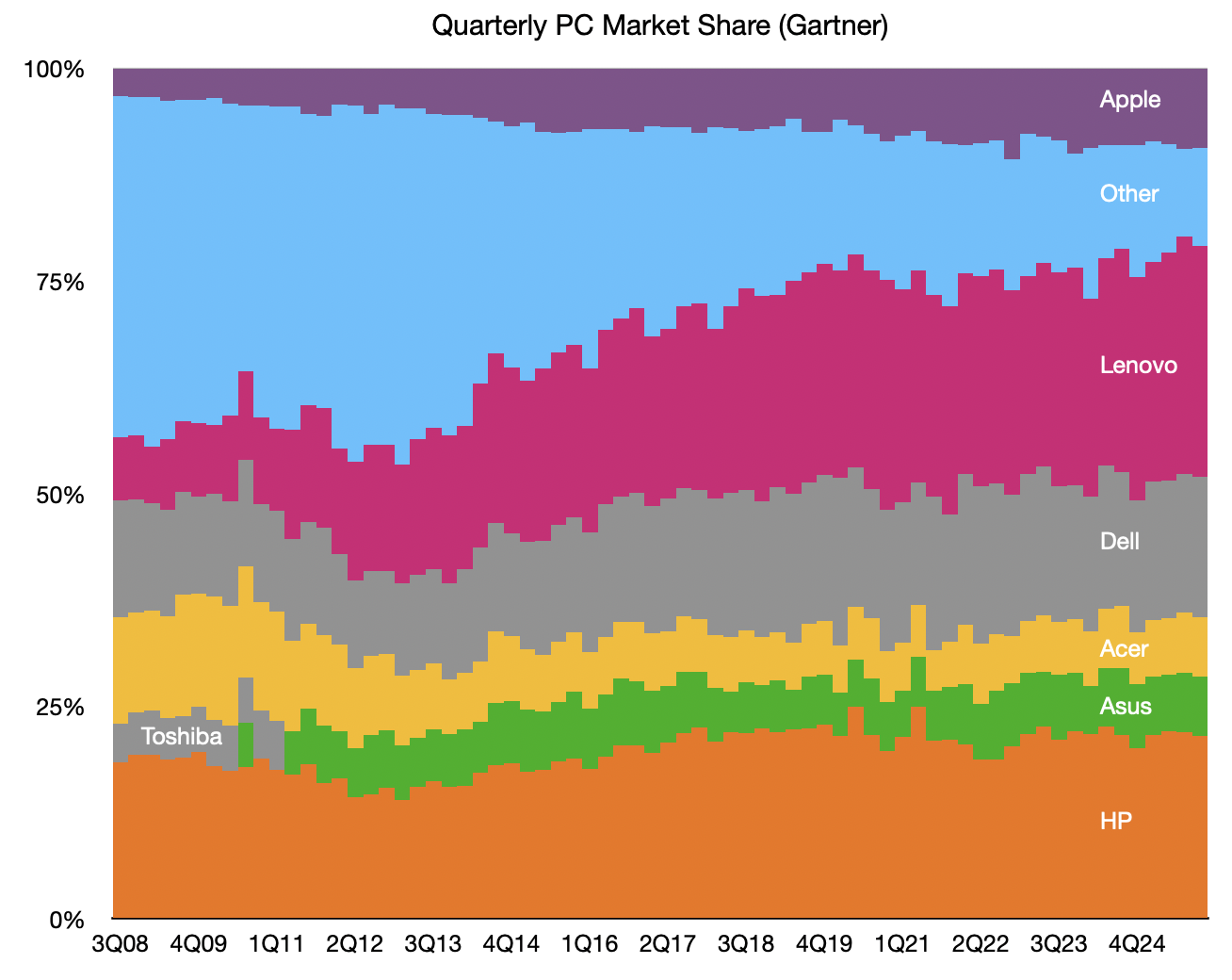
    The shipments data provided by Gartner over the last 17 years is shown below:

    Notable are the declines in "other" vendors and the gains from Lenovo and Apple. Broadly speaking, "other" are assumed to be mostly consumer markets and that has either declined or been captured by Mac with consolidation around Lenovo. Lenovo, HP, Dell are likely to maintain enterprise accounts serving large customers and that has been a steady but low margin business for decades.

    Mac has grown to fourth place but still a way to go to third place Dell. Apple may overtake "other" combined in a year or two.

    Quarterly PC Market Shares by Vendor

    The market share data shows how "other" has been squeezed between Lenovo and Apple while the other players have largely held steady. Acer and Asus somehow managed to survive.

    So what does this mean for the future? What is Apple's strategy with the MacBook Neo. Or for that matter, for Studio and iMac and Mac Mini and MacBook Air and MacBook Pro?

    The Neo was such a surprise for many given its incredible price/performance ratio and the overall quality and affordability (and distribution potential). I've read many reviews suggesting it will "disrupt" the market and that Windows PCs are just no longer competitive.

    Will the MacBook Neo move the needle? Will it take share from the Windows world (or for that matter from the Chromebook and even iPad?)

    One more thing: Apple's sales of about 24 million Macs for a base of 260 million users implies a life span for Macs of nearly 11 years. However, all the other PCs sold add up to 238 million for a user base of 1.2 billion. That means the life span for the non-Mac PC is only 5 years.

    This is, of course, reflected in the price difference but with the MacBook Neo, the potential for a 10 year old life for a $500 laptop puts the Neo price at $50/yr or 14c/day. Based on data for 2025, the average selling price of a new Windows PC is estimated to be $600 to $900 for consumer models. At $700 for a life span of 5 years makes the PC cost $140/yr or 38c/day.

    This means that the average PC is more than twice the cost of the MacBook Neo. Now that is a surprise.

  4. Asymco Bulletin 004 - Mar 15, 2026

    Bulletin

    Asymco Bulletin is a digest of all the work we have published for the week ending Mar 15, 2026.

    Research

    The most brilliant move in corporate history?

    In a bold departure from its Big Tech peers, Apple sidestepped the $650 billion AI infrastructure spending frenzy. While Amazon, Google, Microsoft, and Meta funneled cash into data centers, bleeding cash flow and adding debt, Apple maintained a consistent $14 billion capital budget. This strategic choice reflects Apple’s belief that AI models are rapidly commoditizing, as evidenced by DeepSeek’s $6 million model rivaling $100 million counterparts. Instead of building proprietary models, Apple licensed Google’s Gemini, reserving the option to switch vendors as superior models emerge.

    Apple’s genius lies in leveraging its ecosystem—2 billion devices transforming into a distributed AI powerhouse. Apple silicon on device enables local AI processing, bypassing the need for colossal server farms. This approach not only conserves capital but also amplifies customer loyalty, as Apple uniquely protects privacy. Ultimately, Apple bets on owning the customer experience, positioning itself to thrive regardless of infrastructure ownership. →

    Is Apple Pivoting?

    Apple's recent product launches, including the 17e and MacBook Neo, have sparked speculation about a strategic shift towards low-end markets. However, this view overlooks Apple's fundamental approach to market segmentation, which eschews simplistic price categorizations. Instead, Apple focuses on the "job-to-be-done," understanding that consumer purchases are driven by desired outcomes rather than affordability alone. This perspective reveals that performance and quality are crucial, transcending income levels. For instance, affluent individuals may opt for simpler devices, while budget-conscious consumers might invest in high-performance tools to meet specific needs, like content creation.

    Historically, Apple has aimed to deliver superior experiences to a broad audience, refusing to compromise on quality with budget-friendly products like Chromebooks. While cost can limit access, as seen with the Vision Pro, Apple prioritizes profitability as a validation of its value proposition. The MacBook Neo exemplifies this ethos, leveraging efficient mobile chipsets to redefine laptop capabilities at a competitive price point. This innovation blurs the lines between mobile and traditional computing, underscoring Apple's commitment to crafting products tailored to diverse tasks. Ultimately, Apple's strategic depth, powered by Silicon advancements, positions it to serve an expansive global market by addressing a wide array of functional needs. →


    Nota Bene

    Rosenblatt Lifts Price Target on Apple by $1, Maintains Netural Rating → On March 5, Rosenblatt's Barton Crockett slightly raised Apple's price target to $268 while maintaining a Neutral stance, optimistic about Apple's budget product launches and steady high-end performance, despite trading at a modest premium compared to peers, as analysts foresee robust revenue growth for FY2026. →

    How many employees does Apple have? What do they do? → Apple, despite its marketing reputation, is fundamentally an engineering powerhouse with nearly half its workforce dedicated to engineering roles, driving its substantial revenue growth and global employment expansion. →

    First footage of X-Plane 12 on Vision Pro → X-Plane 12 on Apple Vision Pro leverages ARKit to seamlessly integrate physical controls into a mixed reality flight simulation streamed from a Mac, showcasing advanced professional-grade AR capabilities. →

    iPhone production in India increases by 53% in 2025 → Apple's strategic shift to ramp up iPhone production in India by 53% last year, aiming not just to sidestep tariffs but to cultivate a vast new customer base, underscores a long-term vision mirroring its successful penetration of the Chinese market. →

    Qualcomm faces loss of Apple business, rated ‘Underperform’ by Bank of America → Qualcomm's dominant era in smartphone chips wanes as Apple and others pivot to internal solutions amid costly licensing disputes. →

    MacBook Neo May Boost Revenue By 0.5% While Expanding Into Student Market – Gene Munster → The MacBook Neo, targeting both education and broader markets, could modestly boost Apple's revenue by $2 billion annually without impacting margins, potentially revitalizing the Mac segment akin to Covid-era growth. →

    Apple’s AI Hardware Blitz Could Send The Stock 33% Higher, Says Wedbush’s Dan Ives → Apple's hardware blitz prioritizes product refreshment over AI emphasis, potentially setting the stage for future growth, though its $350 stock target faces external market challenges. →

    China’s Android shipments plunge as inventory builds in contrast to iPhones: Jefferies → "China's Android market faces a perfect storm of rising inventories, soaring memory costs, and renewed iPhone strength, hinting at a potential tipping point." →


    To gain full access to these articles, subscribe to Asymco One.

    Use code BULLETIN for a discount.

    Feedback: Have questions or comments? Reach out to us at contact@asymco.com. We’d love to hear from you.


  5. Rosenblatt Lifts Price Target on Apple by $1, Maintains Netural Rating

    Nota Bene · 3 comments

    From $267 to $268

    On March 5, TheFly reported that Barton Crockett of Rosenblatt Securities increased the price target on Apple Inc. from $267 to $268, maintaining the Neutral rating on the iPhone maker.

    Crockett remains positive on Apple following the company’s recent event, in which it launched its MacBook Neo, tapping into the lower end of the laptop market. Apart from that, a lower-end iPhone 17e also adds to the company’s lineup in the budget hardware category. The analyst also mentioned that Apple’s high-end products account for a modest percentage of build-to-order, which could lead to in-line performance with its March-quarter guidance.

    On January 30, Reuters reported that, according to the LSEG, Apple expects Q2 FY2026 revenue to increase by 13% to 16%, compared with analysts’ 10% growth rate. Despite strong performance, Crockett highlighted that Apple trades at a meaningful premium.

    A majority of 52 analysts out of 54 have rated AAPL a Buy, while only two analysts rate the stock as a Hold. The average price target of $302.5 highlights an upside of over 16%, while Rosenblatt’s price target implies a modest increase of almost 3% as of March 10.

    Source: Yahoo Finance

    NB: Apple expects revenue to increase by 13% to 16%, compared with analysts' 10%??

  6. iPhone production in India increases by 53% in 2025

    Nota Bene · 1 comment

    Years in the making

    According to Bloomberg, Apple increased iPhone production in India by about 53% last year and assembled around 55 million devices in 2025. That’s up from 36 million in 2024,

    The company now produces roughly one-quarter of its iPhones in India.

    Globally, Apple manufactures about 220-230 million iPhones each year; India's share is rising quickly.

    Apple currently assembles all models of its latest iPhone 17 lineup in India, including the Pro and Pro Max versions. At the same time, suppliers such as Foxconn Technology Group, Tata Electronics, and Pegatron Corp also manufacture earlier models, such as the iPhone 15 and iPhone 16, for domestic sales and exports.

    The company is also expanding local supplier partnerships in India to produce components such as lithium-ion cells, device enclosures, and accessories, including AirPods.

    Source: Bloomberg

    NB: The article suggests this is a some tariff-dodging effort. Obviously it's not.

  7. Qualcomm faces loss of Apple business, rated 'Underperform' by Bank of America

    Nota Bene · 3 comments

    Writing of the wall faded after years in the sun

    The analysts see Qualcomm as a leader in smartphone processors, but noted the handset chip market has matured and faces potential headwinds, including higher memory prices and a decline in business from Apple. They added that the company faces the well-known imminent ~$7 billion to $8 billion loss of Apple business.

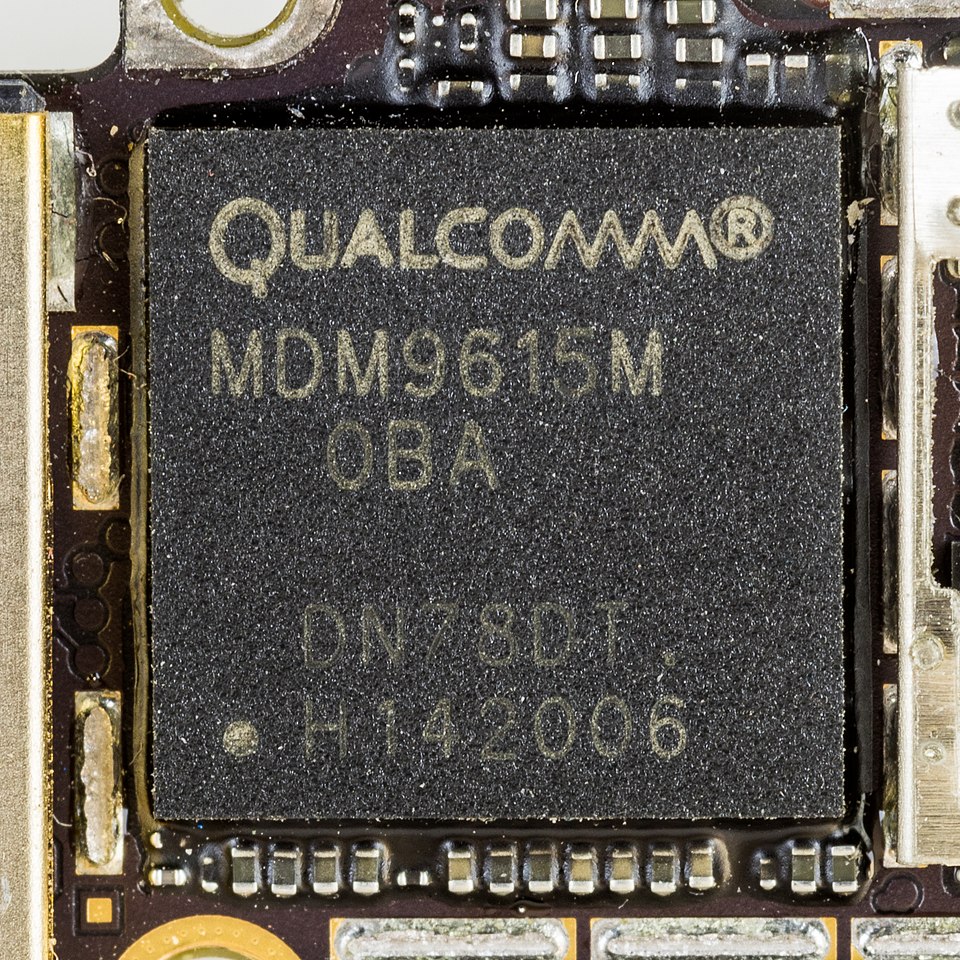
    Apple has historically been one of Qualcomm’s largest modem customers, but the bank expects the relationship to wind down as the iPhone maker shifts to its own internally developed chips. “QCOM's modems will be completely phased out of iPhones by Fall 2027 as top customer Apple shifts to internal modems,” they wrote.

    The report also highlighted a broader trend of smartphone manufacturers investing in their own semiconductor capabilities. Samsung has reduced Qualcomm’s share of processors used in its Galaxy lineup, while Chinese smartphone maker Xiaomi has committed about $7 billion toward internal silicon research and development.

    Source: Yahoo Finance

    NB: It's not just Apple that is bailing…

  8. China's Android shipments plunge as inventory builds in contrast to iPhones: Jefferies

    Nota Bene

    China smartphone shipments fell 16% in Jan as Android inventory swells; iPhone stays healthier.

    China's shipments of smartphones fell 16% in January, due in part to escalating inventory, which was in sharp contrast to Apple iPhones demonstrating a slight month-over-month decline in rolling six-month inventory days, according to data by Jefferies.

    "Since our checks indicate smartphone sell-through in Jan. fell 22% (partly due to Chinese New Year timing), we estimate Android's rolling 6-month inventory days have risen by 26 (down by 3 days in Dec.), while iPhone is down by 2," said Jefferies analysts, led by Edison Lee, in a Thursday investor report.

    The iPhone's healthier inventory reflects strong demand along with several months of shipment declines.

    Jefferies also noted an increase in promotional discounts for Android phones in China as opposed to iPhones.

    "Our tracking shows consistently limited promotional discounts on iPhones," Lee said. "PDD (PDD), being the most aggressive platform according to our tracking, has been offering only mid-single-digit discounts on the iPhone 17 series, while there has been no discount on Tmall. However, we saw double-digit % discounts across key eCommerce platforms on Android flagship models, including Huawei Mate 80, vivo X300, OPPO Find X9, and Xiaomi 17."

    The average discount on PDD for Android flagship models has increased to an average of 24%.

    "That shows the pressure for key brands to reduce inventories," Lee added. "However, as memory costs are skyrocketing, it would create more pressure for Chinese OEMs to cut shipments in order to rely on selling inventories and thus protect margin."

    Source: Seeking Alpha

    NB: Inventory is a fundamental evil.…

  9. Is Apple Pivoting?

    Research · 3 comments

    No.

    After the flurry of new product launches this week, I've read a few comments suggesting that this is a new strategy for Apple, or a pivot of sorts. The premise is that the 17e and the MacBook Neo are new low-end products that are intending to compete in markets that have been either uninteresting or unattractive to Apple in the past. Thus the company is now turning to either addressing affordability, memory costs or competitive pressures.

    The flaw with this argument is that there is an assumption that Apple segments its markets by price. The bigger assumption is that *all* markets are segmented by price. This is naive in the narrow and broad sense. If you ask me, any marketer that segments by price is not very good at their job.

    Remember, when you segment, you are making an explicit causal statement describing a purchase decision. In other words you are specifying the reason people buy a product. Price segmentation suggests that the reason for any purchase is that it reflects what the buyer can afford. Rich people buy expensive versions of a product and poor people buy cheap versions of the same product. The problem is that I've known many poor people who buy expensive things (actually most luxury brands sell to the less affluent) and many rich people buy cheap things (shunning conspicuity). The correlation is poor and the causation is actually nonexistent. Most importantly, you are missing the ability to create any new products because "new" simply implies higher or lower price.

    In the case of technology products, performance is also a factor. Here again, there might or might not be correlation between performance and price and customer income/net worth. Many people of means buy low performance products and many who are constrained financially will pay for performance. For instance, a non-wealthy aspiring YouTube influencer may very well purchase a high performance computer for video editing. And a millionaire pensioner could well opt for a MacBook Neo to communicate with grandchildren.

    So what is causation for technology, or, for that matter, any product or service? The answer that comes closest is the "job-to-be-done". What outcome is desired and circumstances are present when a purchase decision is made? What are the forces pulling and pushing the decider? It might be tempting to generalize and say that the young are poor but it would be wrong to generalize that they don't demand performance.

    So what does this mean for Apple's portfolio?

  10. Asymco Bulletin 003 - Mar 8, 2026

    Bulletin

    Asymco Bulletin is a digest of all the work we have published for the week ending Mar 8, 2026.

    Editor's Note

    It's been about a month since we launched Asymco One, and we are elated with the response from the community. Most recently, we held our first Office Hour, where we discussed the impact of Apple's latest products and answered questions in front of a live, Asymco One subscribers. We'd like to thank you for your support.

    We continue to make improvements in how we create and deliver our content. Please bear with us while we renovate our infrastructure. Should you have any issues or have questions, please reach us at contact@asymco.com.

    Finally, if you are on the fence about committing to Asymco One for a whole year, we've introduced the Asymco One monthly subscription. Try it today!


    Research

    Apple Services in Europe: Scale and Growth

    Since October 2023, Apple has been transparently reporting App Store user metrics across 27 EU nations, updating these figures biannually. This initiative spans a population over 450 million, offering a granular yet rounded down to the nearest million, potentially skewing figures slightly downward. To mitigate this undercounting bias, adjustments are factored into trend analyses.

    Through three sampling intervals from 2023 through July 2024, a market landscape emerges. The aggregated data hints at subtle shifts and growth patterns. →

    Stairway Update

    The iPhone 17e emerges as an incremental refinement—"the new low end, same as the old low end, but better." Apple has streamlined its lineup by axing the mid-memory "e" model, leaving us with two price points. This simplification might appear reductive, yet it strategically consolidates offerings while enhancing value. Notably, the base model's memory has doubled, a move that defies the prevailing DRAM scarcity narrative, suggesting Apple's adept supply chain management and perhaps a bit of market leverage.

    By trimming excess and boosting core features, the 17e exemplifies a nuanced approach to product evolution. →


    Nota Bene

    Apple introduces iPhone 17e → Apple's iPhone 17e offers double storage at the same $599 price, boosting profit margins. →

    Apple introduces the new iPad Air, powered by M4 → Apple's new iPad Air with M4 chip and increased memory boosts performance, enhancing versatility. →

    Apple announces new MacBook Air with M5 and MacBook Pro with M5 Pro and M5 Max → Apple's latest MacBook lineup offers the affordable, efficient M5-powered Air, the mid-range balanced performer, and the high-end, powerhouse M5 Pro and Max models for demanding professionals. →

    Apple unveils new Studio Display and all-new Studio Display XDR → Apple's Studio Display XDR boasts a 27-inch 5K Retina screen with mini-LED, 2000 nits brightness, and 120Hz refresh, ideal for professionals. →

    Say hello to MacBook Neo → Apple launched the MacBook Neo, a budget-friendly laptop with premium features, priced at $599, amid concerns over shrinking margins in the Windows laptop market. →

    Apple’s strategy is actually genius if you think about it → "Apple's strategic pivot to on-device AI could dismantle the AI boom by making models redundant and controlling the distribution gateway." →


    Office Hours

    Apple Q&A: Horace Dediu & Ben Bajarin discuss implications of Apple’s March 4, 2026 rollout →

    We convened our first Office Hours on March 4 to review Apple's latest releases, where we answered questions from a live audience of subscribers, and dissected Apple's latest and strategies. Topics covered:

    • MacBook Neo's Market
    • iPhone Pricing tiers
    • Apple's Margin Strategy
    • Siri and Apple's AI Strategy
    • Spatial Computing: Ergonomics, AI
    • Apple's AI and Spatial Computing
    • Cellular Modems and Laptops
    • Premium vs. "cheap"
    • Changes to Smartphone Market Dynamics
    • Product Cannibalization

    Full recording and transcript is available to Asymco One subscribers.


    Asymco One gives you full access to our research, analysis, and commentary. Subscribe with code BULLETIN for a discount.

    Feedback: Have questions or comments? Reach out to us at contact@asymco.com. We’d love to hear from you.
  11. Apple’s strategy is actually genius if you think about it

    Nota Bene · 4 comments

    I did think about it. Three years ago.

    the real bear case for this AI boom isn’t a bubble or a recession.

    It’s your iPhone.

    Baker says in 3 years, a bulked up iPhone will be able to run a pruned version of a frontier model.

    Think future Gemini, Grok, ChatGPT at 30–60 tokens per second, on device, no cloud is needed and it’s free.

    That’s exactly Apple’s strategy, don’t win the model war, become the distributor of AI.

    Make it private, local and safe.

    If that happens, most everyday AI use rewriting, summarizing, basic reasoning never touches a data center.

    The AI capex boom gets cut off at the source.

    Model builders become interchangeable and apple owns the gateway.

    That’s the bear case Gavin is warning about.

    The real threat to the AI boom isn’t that the models fail.

    It’s that Apple makes them run on your phone and keeps all the power for itself.
    The richest company on Earth just watched its rivals light $650 billion on fire.

    And did nothing.

    This might be the most brilliant move in corporate history.

    Source: X (formerly Twitter)

    NB: Apologies for linking to X. Edge computing is as old as the hills...