Four out of 10 sales of the iPhone are made to enterprise users. When the iPhone came out, what most people heard in the first year from ‘07 to ‘08 was oh my God, it’s not BlackBerry secure. This is not going to work on the enterprise space.
At the end of the day, it’s just software. That’s all it is. And by the time the 3G came out in ‘08 they had solved about 80% of the security issues.
So enterprises today view the iPhone as a mobile computer. It happens to have a voice application on it.
Microsoft and Nokia have formed a global alliance to design, develop and market mobile productivity, communications and collaboration solutions.
Under the terms of the agreement, the two companies will begin collaborating immediately on the design, development and marketing of productivity solutions for the mobile professional, bringing Microsoft Office Mobile and Microsoft business communications, collaboration and device management software to Nokia’s Symbian devices.
In 2007, 14% of Britons' online time was spent on IM, according to the UK Online Measurement company - but that has fallen to just 5%, the firm says, basing its findings on the habits of a panel of 40,000 computer users.
The study was released shortly after AOL sold its ICQ instant messaging service $187.5m (£124m) - less than half what the company paid for it in 1998.
And in September 2009, a survey of internet use by the New York-based Online Publishers Association found that the amount of time spent by surfers on traditional communications tools, including IM and e-mail, had declined by 8% since 2003.
In other news today Yahoo and Nokia announced a worldwide partnership. Yahoo will provide e-mail and chat services on Nokia phones. The services will be co-branded.
On May 5th, I tried to fill in the blanks on Global smart phone OS shares | Asymco. I estimated that the shares for the mobile OS's were as follows (based on Canalys partial data):
Symbian (Nokia): 42%
Blackberry OS (RIM): 19%
iPhone OS (Apple): 16%
WinMo (Microsoft): 10%
Android (Google): 10%
WebOS (Palm): 2%
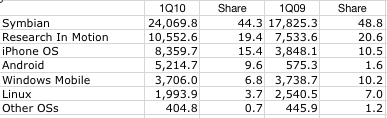
Now Gartner has published their sell-through estimates:
Symbian (Nokia):: 44%
Blackberry OS (RIM): 19%
iPhone OS (Apple): 15%
Android (Google): 10%
WinMo (Microsoft): 7%
Linux: 4%
Other OSs: 1%
My estimates were within 1 or 2 percent of actuals except for Windows Mobile where I over-estimated by 300 basis points.
In my assessment of Nokia's competitive response to the mobile computing disruption I had anticipated an effective re-organziation to begin in 2013, so it came as no surprise that a stay-the-course plan is still being supported at this stage.
This is to be expected because a disruption, by definition, discourages a symmetric response from the incumbents. Indeed, management would face serious scrutiny and probable dismissal if they did address the challenge head on. A symmetric response would begin with a declaration that the entire asset base of the company is a sunk cost to be written off. That would include its products, distribution network, development processes, resources and priorities. Such a response can only come about from a near-death experience.
You can certainly see the dilemma: It would be absurd for management to declare that their top rank position in the mobile phone market is an undesirable situation to be in. It would be even more absurd if they suggested scrapping their entire world-leading volume business to re-focus on a new business--doing basically what Motorola has done when they were facing oblivion. The chances are, however, that this is precisely what needs to be done, and the sooner the better.
So being sensible is the path always chosen. Being bat-shit crazy is not an endorsable strategy.
Essentially, management is paid and incentivized to protect an eroding asset, not to destroy and replace it.
In the free press release linked below Canalys reveals their estimates of vendor shares but not the OS shares for smartphones. However it's not hard to see the OS split due to the high degree of exclusivity of OS's to vendors.
For example, virtually all Nokia devices are Symbian powered, all RIM devices are Blackberries and all Apple devices are iPhone OS. Motorola is only shipping Android and HTC is the only top 5 vendor that now licenses more than one OS. Even HTC's portfolio is now heavily Android weighted.
We can carve out Palm (960k units shipped) from the "others" and we're left with mostly Windows Mobile. My estimate would be about 5 to 6 millionWinMo made it out.
That leads me to the following estimated OS shares:
Symbian (Nokia): 42%
Blackberry OS (RIM): 19%
iPhone OS (Apple): 16%
WinMo (Microsoft): 10%
Android (Google): 10%
WebOS (Palm): 2%
If anyone knows the actual Canalys OS shares, let me know.
A queue is forming to get on board the clue train but, instead of getting in line, Finland seems to be sitting and watching incredulously how the line grows.
The Finnish newspaper article continues:
The media often takes a blindly uncritical view of all Apple's doings, such that the positive attention paid to the company's products is in no way proportionate to the weight of the products themselves.
A good example is Apple's iPad tablet, the commercial success of which is still a large question-mark. This has nevertheless not prevented journalists over the Atlantic from writing profusely and ecstatically about the newcomer.
If Nokia keep believing this their competitiveness problem will surely not go away.
Additional thoughts on the likely response process from Nokia here.
Nokia reported 21.5 million converged devices sold in Q1. The units, share, ASP, Revenues and Operating Profits are compared in the following table.
It's once again evident that Apple captured more profits from the iPhone than Nokia did from all its devices and services operations.
With respect to converged devices, Apple also generated more sales and had nearly triple the ASP. Unit shares remained almost the same sequentially. Nokia did suffer more from ASP erosion sequentially as the converged ASP dropped by 24% vs. a 2.5% drop for Apple.
What is interesting from a growth perspective is that Apple's #1 position in the share of profits from mobile phones was acquired with such a low market share. Analyst Brian Marshall said the most interesting part of Apple's story is the international growth of the iPhone. He believes that Apple has only acquired about 1.5 percent of its international carrier partners' total postpaid subscription base of 525 million. For comparison, its penetration in the U.S. peaked in Sept. 2009 on AT&T with 5 percent.
"Getting a strong Intel backing here could be an important advantage," says MKM Partners analyst Tero Kuittinen, who sees the Nokia tablet as part of an array of mobile computers.
No doubt Nokia's tablet plans preceded the launch of the iPad--product cycles being what they are. And the relationship with Intel is certainly a big part of this push (vs. on the handset side where Intel has no cards to play).
However, the elephant in the room is what software will run on this Tablet. Any discussion on competitive potential of iPad competitors must include a view on the software/platform and ecosystem that tablet will rest on.
This is not a hardware business. In fact, the hardware is designed to get out of the way.
The hardware is so understated — it’s just a screen, really — and because you manipulate objects and interface elements so smoothly and directly on the screen, the fact that you’re using an iPad falls away. You’re using the app, whatever it may be, and while you’re doing so, the iPad is that app. Switch to another app and the iPad becomes that app. If that’s not magic, I don’t know what is.
The problem will be in using some comparable as a measure of reference. This is a problem because first, there is no equivalent product in history, second, there are few similar products that are pre-ordered and sold without user samples being available, and third it's being sold through a very limited channel (on-line Apple Store). Lastly, the number includes only delivered units vs. reservation for pick-up.
Nevertheless, the figure is intriguing. One class of comparable products might be new smartphone products from companies that were launching on new platforms.
One example is the Android G1--the first Android device. It sold 663k units in the launch quarter. Another is the Nokia 5800, Nokia's first touch capable device. It sold 536k units in the first quarter (up to 1 million in the first 3 months). Sony Ericsson's first Windows Mobile device was the X1. It sold 237k units in the first quarter of sales. The first Sense UI HTC device (the Diamond) sold about 1 million units. The RIM Storm, RIM's first touch device sold 1.6 million units. Finally the iPhone which sold 1.1 million units in the first full quarter of sales (about 1.4 million if we include the weekend sales that fell outside the first quarter).
The iPad does seem to be doing rather well relative to these products. Again, their figures were for a full 90 days of sales and were sold through physical retail channels in a variety of geographic markets.
I will be surprised if the number of units sold in Apple's CQ2 don't exceed 1 million. (Apple will book all these sales only on delivery which means they won't appear in CQ1 sales figures). This will probably mean better performance with a new platform than Nokia, Google, Sony Ericsson or HTC and perhaps better than the iPhone.
Nokia did not take advantage of any of the opportunities that it had by being in first place. It failed to leverage its partnerships with carriers, manufacturers, software developers, and content companies.
When disrupted, large incumbents invariably fail to respond adequately to the threat.
You can only blame management if the threat is symmetric and they fail to take up the challenge. This failure almost never happens.
Asymmetric competition is intractable in almost all instances. This failure always happens. A response in kind by management is usually worthy of dismissal "for cause".
Well, I don't want to talk about any specific company. I'm just making a general statement that we think competition is good. It makes us all better. And we are ready to suit up and go against anyone. However, we will not stand for having our IP ripped off, and we'll use whatever weapons that we have at our disposal. I don't know that I could be more clear than that.
Tim Cook, my favorite Apple exec, in January 2009.
One thing should be obvious: the accusations against HTC are aimed at Google and Microsoft or more broadly still, they are aimed at any mobile software competitor that intends to use touch and gesture inputs.
When Jobs said in 2007
We've been pushing the state of the art in every facet of this design. We've got the multi-touch screen, miniaturization, OS X in a mobile device, precision enclosures, three advanced sensors, desktop class applications, and the widescreen video iPod. We filed for over 200 patents for all the inventions in iPhone and we intend to protect them.
he implied that Apple had approached this new input method with much more care than when they introduced the mouse and windowing interfaces in 1984.
Unlike the fight over Windows, which was a copyright debate, this will be all about patents. Apple ultimately lost the GUI fight over the MasOS windowing interface, which is why I think they are much more prepared this time.
Given this strategic intent, the only questions were how the war would be engaged and on what terms. A few skirmishes caused some head fakes.
First, came apparent threats against Palm. Apple was certainly debating going after Palm, but I think they realized it would not be a good strategy. Mostly because the signal would be weak. There would be few consequences to Palm being punished. Palm's integrated model is not employed by many of the larger device vendors. Except for Nokia, all other vendors license their OS, Samsung, LG, Sony Ericsson and Motorola would not be infused with anxiety over Plam taking a hit.
Second, came the pre-emptive attack from Nokia. Apple was not ready to go after Nokia last year because Nokia did not yet have a UI "worthy of being infringing". In other words, there was no target to shoot at. Nokia's suit was pre-emptive in that it centered on their desperate wish to have a cross-license agreement--trading GSM patents for touch patents.
That skirmish should not detract from what's the real goal here: securing monopoly rights to mobile computing interfaces.