Asymco

Asymmetric Intelligence

Nokia

  1. Platform Bonanza! Three new Platforms in one Day

    Research

    Delivering precisely what the world needs today:

    • Samsung launched Bada
    • Microsoft launched Windows Phone “7 Series”
    • Nokia and Intel jointly announced MeeGo.

    Three new ambitious platforms starting with zero installed bases and no applications are going up against the following:

    • Symbian with more than 200 million users and 20k apps
    • WebOS with less than 3 million users and about 1k apps
    • Windows Mobile with 30 million users and about 2k apps
    • iPhone OS, about 75 million users and 150k apps
    • Android with 3 to 5 million users and approx. 20k apps
    • Blackberry OS with more than 50 million users and a few thousand apps.

    It should be noted that Microsoft’s new Windows Phone “7 Series” will compete with Microsoft’s Windows Mobile 6.5 which will continue as a product line.

    MeeGo will also compete with Nokia’s existing Symbian OS for developers, replacing Maemo.

    Most of these new platforms will not have products shipping for at least 6 months during which time another 50 million (at least) new users will join existing ecosystems.

    There are now nine smartphone platforms, but who’s counting? I’ve been hearing predictions of consolidation for years and although platforms have come and gone (PalmOS, SavaJe), the total number continues to increase.

    If nothing else, this seems to indicate that the industry is not in any state of maturity or point of “over-service” where commoditization takes place.

  2. Nokia back on top

    Research

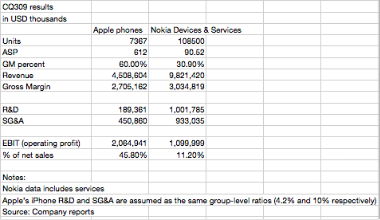
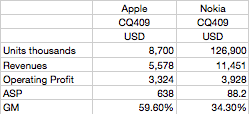
    Nokia regained top spot in operating profit. I'll leave net profit assumptions aside this time, but Apple is sure to have beat by having far lower R&D as percent of sales.

    Nokia Smartphones had a good quarter due to new launches. I show also share and ASP comparisons for smartphones in both companies.

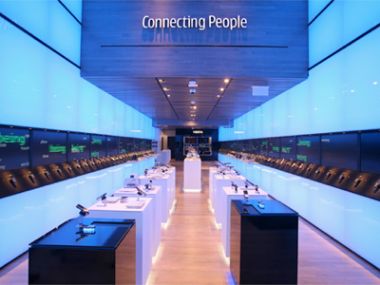
  3. Nokia shutters U.S. flagship stores

    Research · 1 comment

    In other news:

    • Nokia shutters flagship Regent Street store in face of Apple retail’s domination - December 08, 2009
    • Nokia sees flat market share as Apple gains - December 02, 2009
    • Nokia Chief Strategist: Apple will remain a niche player in smartphones, just like in computers - November 30, 2009
    • Nokia to cut another 330 R&D jobs - November 20, 2009
    • To understand market share vs. profits, look no further than Nokia vs. Apple - November 11, 2009
    • How Apple passed Nokia to become the world’s most profitable handset vendor - November 11, 2009
    • Strategy Analytics: Apple passes Nokia to become world’s most profitable handset vendor - November 10, 2009
    • Nokia sues Apple claiming iPhone infringement of Nokia GSM, UMTS and WLAN patents - October 22, 2009
    • Nokia posts loss of 559 million euros on weaker smartphone sales - October 15, 2009
    • Nokia’s earnings plummet 66 percent - July 17, 2009
    • Jim Cramer: The problem with Dell and Nokia is that no one wants their products; Buy Apple - July 17, 2009
    • Nokia’s failures vs. Apple’s vibrant iPhone platform puts market share at risk - June 24, 2009
    • Nokia Ovi Store launch a complete disaster - May 26, 2009
    • Nokia ships 19% fewer phones in Q1, bleeds more share - April 16, 2009
    • Nokia axes 1700 jobs worldwide - March 17, 2009
    • Nokia halts sale of iPhone killer; 5800 handset plagued with major problems - March 02, 2009
    • Nokia hops on bandwagon, unveils knockoffs of Apple’s iTunes Store, App Store - February 16, 2009
    • Nokia profit collapses 69% in fourth quarter 2008 - January 22, 2009
    • Nokia’s profits plummet 30 percent - October 16, 2008
    • Nokia’s fatally flawed ‘Comes With Music’ service no Apple ‘iTunes Store killer’ - October 03, 2008
    • Nokia fumbles iPhone lookalike-not-workalike launch in U.S. and Europe - October 02, 2008
    • Nokia sputters that iPhone ‘not worthy of discussion’ - August 13, 2008
    • Apple takes top spot from Nokia on AMR Research’s 2008 Supply Chain Top 25 list - May 30, 2008
    • Nokia shares slammed in wake of miss; Nokia CEO calls Apple iPhone ‘niche product’ - April 17, 2008
    • The knockoff parade continues: Nokia exec shows Apple iPhone lookalike ‘Tube’; dismisses Apple - April 08, 2008
    • Nokia previews blatant Apple iPhone knock-off (with video) - August 29, 2007
    • Nokia CEO challenges Apple over iPhone - February 13, 2007

    http://www.macdailynews.com/index.php/weblog/comments/nokia_shutters_us_flagship_stores_as_floundering_cellphone_maker_fails/

  4. Version Arithmetic

    Research

    Remember when I laid out the timeline for Nokia's response to the iPhone? Still checking off the milestones: http://www.thestreet.com/_yahoo/story/10636833/1/nokia-outlook-another-year-in-limbo.html?cm_ven=YAHOO&cm_cat=FREE&cm_ite=NA

    Let's also do some version arithmetic:

    Nokia is already on the 5th version of Maemo, a platform which by any measure is non-functional but already 5 years in the making. After this investment, only one product is shipping and it's something of a science experiment--a pre-beta product. Nokia is also on the 9th version of Symbian, a functional but outdated platform stuck in the 90s. Promising big things in the 10th version to be re-branded Symbian ^2--I guess double digit version numbers are not confidence inspiring.

    Microsoft meanwhile is working hard on the 7th major version of Windows Mobile. World waiting with bated breath.

  5. Maemo

    Research

    Insipid and irrational politics are symptomatic to a company trapped by rigidity of response to asymmetric attack (and you can quote me on that.)

    Nokia, the world's leader in total mobile phone sales seems to be having new problems deciding on its OS strategy. There were some murmurings about embracing Android last summer, but Nokia seems to have decided against it. Stefan Constantinescu had this to say about the results of Nokia World 2009:

    "The [new] software, Maemo 5, is a pain in the ass for developers since Nokia has admitted in public that Maemo 6 will come out in a year and it will break compatibility due to a switch from the GNOME environment to Qt. The browser, built on top of Mozilla technology, the same code that powers Firefox, is a step away from WebKit, the browser engine that powers Safari in the iPhone, the browser in Symbian, the browser in Nokia’s dumbphone OS known as S40, the browser in Android and soon the browser in RIM BlackBerry devices. Why is Nokia supporting something contrary to what the industry has already accepted as best in class? What’s the strategy?"

    Technical mistakes and internal politics can sink a company in an intense competitive environment. Mr. Constantinescu didn't perceive a coherent strategy. There may not be one.

    http://www.macobserver.com/tmo/article/iphone_competitor_forecast_stormy_with_a_chance_of_fail/

  6. Serving the Needs of IT

    Research

    An interesting note in the latest Canalys Smartphone quarterly summary (http://www.canalys.com/pr/2009/r2009112.htm):

    "...in our October study of 600 European decision makers in medium and large enterprises, more than 20% said they expect the iPhone to be the dominant smart phone platform for running business applications in their organisation within the next 3 to 5 years. In France, the iPhone was ahead of Windows Mobile and RIM in this regard – a remarkable result.”

    This short quote brought back to mind the recently formed partnership between Nokia and Microsoft to deal with RIM. One fruit of this relationship is a recent job posting atcareers.microsoft.com which seeks Symbian developers to work for Microsoft:

    Job Category: Software Engineering: Development Location: India, Hyderabad Job ID: 702365 Division: Microsoft Business Division

    The Office team is looking for a self-motivated and highly passionate Developers to contribute in building a new team and drive discipline excellence in the delivery of Office Mobile and Communication experiences for Nokia’s Symbian smartphones.

    Microsoft and Nokia have formed a global alliance to design, develop and market mobile productivity, communications and collaboration solutions.

    Under the terms of the agreement, the two companies will begin collaborating immediately on the design, development and marketing of productivity solutions for the mobile professional, bringing Microsoft Office Mobile and Microsoft business communications, collaboration and device management software to Nokia’s Symbian devices. These solutions will be available for a broad range of Nokia smartphones starting with the company’s business optimized range, Nokia Eseries. The two companies will also market these solutions to businesses, carriers and individuals.

    This project builds on the existing relationship with Nokia who is optimizing access to email and other personal information with Exchange Activesync. Next year, Nokia intends to start shipping Microsoft Office Communicator Mobile on their smartphones, followed by other Office applications and related software and services in the future.

    (related job description)

    While the iPhone wins hearts and minds in IT through sheer brilliance Nokia tries to become a supplier to IT departments through a strategy deeply rooted in the 1980s: the manipulation and exertion of control over file formats. As IT has diminished in importance (to the point of ceasing to matter to some) it's hard to understand this misplaced alliance with Microsoft over something so inconsequential.

  7. Is Mobile Computing Good Enough?

    Research · 1 comment

    This new "mobile computing" use case that smartphones try to serve is not going to be satisfied with solutions that are built from modular components.

    The reason is simple: as the solutions are not good enough (because it's early days), they need to be improved. If they are to be improved, competitive pressure will compel those who try to do so as rapidly as possible. The fastest climb up the trajectory of performance will get the bulk of the benefits. Modular implementations are simply not fast enough in cycle time of iteration in comparison to the integrated approaches.

    This is why Apple will grow faster than Google, Nokia and Windows Mobile.

    How does this relate to the ecosystem?

    Many have been commenting that Google's (or Nokia's or Microsoft's) ecosystems are more "open" or "flexible" with respect to Apple's. And that in the long run that is the right architecture. That may be, however implementing loose ecosystems coupled loosely to modular devices and operating systems and services as a whole will not be competitive. They will be too late, too slow and too hard to use. They will be awkward to position and the benefits will be impossible to explain to end users. They will be sold through a distribution channel that is too long and with poor information feedback. Too many "vested" interests will dilute the product's reason for being. The pricing of the integrated player will cause poor economies for the modular cohort. I could go on but it suffices to say that the modular approach will fail to be competitive.

    Footnote: the arguments for the imminent explosion of Android are all based on a forecast from Ken Dulaney at Gartner. It was also Ken who in 2004 forecast that Windows Mobile will dominate business devices and that RIM would never gain share leadership. Here is why he is wrong now as he was wrong then:

    Ken and his peer group are implicitly and explicitly owned by the customers he tries to serve. What I mean is that Ken is hired by those who have the money but not the competence to think by themselves. His clients are the incumbent device vendors who are signaling to him that they will increasingly license Android (as they signaled that they will license WinMo before). He adds up all the signals he gets and multiples by random numbers to get a forecast. It's a supply-side forecast assuming "Porter's five forces" is still at work. In that sense, he is selling back to his clients what they've already told him. He is hired to validate their assumptions and that's what he delivers. Rinse, repeat.

  8. Apples vs. Nokia in North America

    Research · 1 comment

    Comparing US sales of iPhones vs. Nokia's NA device business.

    AT&T iPhones activated in Q3: 3.2 million

    Nokia phones sold in North America Q3: 3.1 million

    (obviously, Nokia's figures include Canada and Apple might have sold a few more phones in the US than AT&T activated so Apple outsold Nokia by a significant margin in units in the US.)

  9. On Units and Platforms

    Research

    When thinking about the number of devices shipping out of Apple, and the relative value of those units compared to the competition you have to always think of the platform.

    The market leader Nokia claimed to have sold 16+ million smartphones in the quarter. When comparing platforms, to whatever Apple ships in iPhones you have to add the iPod touch units. I see that number being about half of the iPhone numbers or about 4 million. Let's say 10 to 12 million as a range for the platform. Already this is within striking range of Nokia.

    It may sound that Apple has some catching up to do, however the important thing is that most of the Nokia devices are not uniformly addressable by developers because they are different platforms and the Symbian platform itself will be broken next year as it has been broken many times before. This is also true for Blackberry and Windows Mobile and will become true for Android as vendors fork and splinter the code to differentiate.

    This already puts Apple in the pole position today in terms of contiguous addressable units volumes.

    I cannot over-emphasize the importance of this platform effect. It's what made Windows dominant and it should be the most important issue in the planning of new mobile products, but it clearly isn't for Apple's competitors. Either product planners are ignorant of history or completely hamstrung by other constraints on their businesses (I expect the latter).

    As a result it's inevitable that Apple will have a dominant platform. The numbers in apps and consumption of apps already are telling this story, and devs are voting with their code in a landslide. But going into 2010, this will become evident in the units and Apple share numbers will accelerate toward lead position.

    The bogie therefore is to look for contiguously addressable installed base. On this basis of competition, I expect at least 100 million for Apple at the end of next year and less than 10 million for any competitor. At that point the game will be officially over.

  10. Comes With Trouble

    Research

    I can't believe this. http://musically.com/blog/2009/10/15/comes-with-music-107k-users-worldwide/

    For kicks, I looked up what I wrote about Comes With Music (CWM) a year ago:

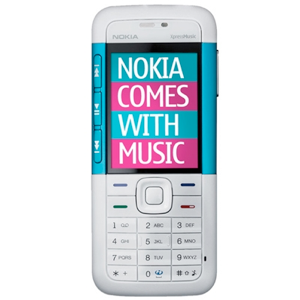
    Trouble Comes With Music By Horace Dediu on October 3, 2008 12:18 PM The troubles that CWM will face: The model is complex and the value prop is convoluted with users discouraged from making informed purchase decisions. CWM is firmly embedded in a value network that is in the final stages of disruption. Profits have evaporated and participants are in a state of defensive rigidity that prevents investment in innovative business models. To some buyers (esp. parents who will pay), the concept may sound more like "music sold as hardware" than "hardware loaded with music". Music sold as hardware is what the CD is/was but this new hardware is bound to wither away and become disposable in a year, PC copies notwithstanding (as transfers between PCs are limited). Therefore, the limitations of perishable music persist and comparisons to durable media are unfavorable. Competitiveness with pirated music is often cited as the goal. The means to that goal is the advantage of having "unlimited" content available vs. "60,000 songs on your hard drive". The unstated assumption is that new music is always more desirable over a rich, but dated back catalog. Long tail theory says that's not true for an increasingly larger group of consumers. Finally, the bet is that users will upgrade devices as if they were a subscription. This becomes "music sold as hardware subscriptions". As "music as a subscription" has not taken off, it does not bode well. One reason is that subscribed music is hired for a different job than owned music--one of discovery and casual listening--a job we used to hire Radio for. A job that is now obsolete in the era of social networking.

    Nokia's official comments one year hence:

    the official blog on which Nokia is celebrating CWM’s first birthday acknowledges: “Sure, it didn’t start out that rosy, with lots of folk not really certain about what Comes With Music offered ... we never shied away from the important education process that is needed in order to fathom that you can download and forever-keep as many tracks as you like – but the past 365 days have seen a much greater understanding and appreciation for the service emerge.”

    Subs numbers:

    • UK – 32,728 (launch date: Oct 08)
    • Singapore – 19,318 (Feb 09)
    • Australia – 23,003 (Mar 09)
    • Brazil – 10,809 (Apr 09)
    • Sweden – 1,101 (Apr 09)
    • Italy – 691 (Apr 09)
    • Mexico – 16,344 (May 09)
    • Germany – 2,673 (May 09)
    • Switzerland – 560 (Jun 09)

    For comparison: Spotify has 6 million users and iTunes has 120 million registrations.