Asymco

Asymmetric Intelligence

operator

  1. Nokia a trop écouté les réseaux télécoms

    Research · 70 comments

    My thanks to Robert van Apeldoorn, journalist for Trends Tendances Magazine, for asking good questions. My responses are reproduced below. The article (in French) is titled "Nokia a trop écouté les réseaux télécoms" and can be found in the June 23rd edition of the magazine along with more details in the article "Comment Nokia peut-il renaître?".

    -About your post “Does the phone market forgive failure”, that puts forward the idea that all mobile device vendors experiencing losses never really recover… It seems that this possible “rule” is more severe than in the computer industry. If Digital Equipement, Compaq, WordPerfect did fail, IBM and, yes, Apple, did survive failure and rebound strongly. Do you think that there is a difference between the industries? What makes the failures more lethal in the mobile device market ?

    The observation is unique to the mobile phone market and even there it's only an observation not a rule. It could be that Nokia will be the first mobile phone company that will recover from severe crisis, but history shows it to be very unlikely. I try to shed some light on the reasons why it's unlikely and what makes the mobile phone market so unforgiving. I think much of the problem rests with the fact that mobile phones are sold indirectly, through intermediaries who are amplifying both success and failure. A company like Apple was able to recover in the computer industry because it launched new products like iPod which could be sold directly to consumers. It had to convince the consumer and only the consumer. Having to convince a distributor, retailer, value added reseller, operator and consumer would be much more difficult. These intermediaries are "institutional" buyers who are risk averse and have low tolerance for untested ideas. Institutional buyers need to think about dealing with other people's money not just their own so they are doing the right thing from their point of view.

    Nokia needs to persuade first operators, then distributors and then consumers that its new products are great (even though maybe the old ones were not so great.) That's tough. Apple works in the other direction. It creates consumer demand then "sells" that demand to the intermediaries as needed.

    These intermediaries (which Steve Jobs famously called "orifices" to the market) amplify the success and failure of a company. For a long time after a product may lose favor with consumers, it will still be sold out of momentum of the channel. But it works the other way as well. If you're out of the channel, getting in is much harder even if the product may have favor with consumers. This is Microsoft's problem with Windows Phone. Surveys show that it's well liked by users, but because Microsoft relies on a long chain of intermediaries, it's still very hard to get started. Microsoft (and Nokia) rely on momentum to carry them once they get some traction and they plan to spend a lot of money ($ billions) to ensure they get some traction.

    -You are absolutely not optimistic at all about the Microsoft partnership (see “in memoriam” post). What could be the best solution? To enhance Symbian platform? Go for Android?  To create a new market with a new kind of device (cf book “How new ideas can win fast”)? Or to go back in the tire business ;-) ?

    I only observe and record data and then try to have a theory of why it happens that way. The empirical data shows that Microsoft has been very unsuccessful with mobile. Their partners seem to all have failed and the list is long. So the question is why. Is it just bad luck? Is there something wrong with management? Is it that perhaps there is a failure in strategy or business architecture?  All these are possible hypotheses but I believe the problem is that Microsoft has chosen not to integrate products and to rely on intermediaries at a time when that strategy leads to uncompetitive products. One can understand why they went with this strategy: They believe the scale of the market is so large that they cannot address it like they did with Xbox (building their own complete solution). However, that also means that they are likely to be uncompetitive during the time when integrated products/ecosystems are still not good enough and can iterate more quickly to capture the market. This was true for the iPod where Microsoft tried to license technology to device makers. It was true during the time of Windows Mobile when Microsoft's OS could not compete with either Blackberry or Symbian and it may still be true today with iPad which redefined what a computer could be.

    -What and when, precisely, Nokia did fail to understand how to be remain the market leader and innovator?

    I think the answer goes beyond the failures in execution or software development. Being late or sloppy with Symbian evolution is a symptom not a cause of the failure. What Nokia failed to understand is that software and data-oriented products would be built and sold and valued differently than voice-oriented products. Nokia listened very carefully to its best customers, the operators. Operators saw data as a sustaining improvement to their core business and steered Nokia into building "voice-plus" products. Every technology that came out of the laboratories was used to enhance the phone *as a terminal* in a network. Nokia never framed the product as a computer using the network as an accessory the way modern smartphones are valued (or if they did as with Maemo, it was a half-hearted effort). Users today are glued to apps and local media storage and see network access as a necessary inconvenience. The network is only valued in terms of being available.

    The re-framing of the device from being a terminal to being the center of user's focus is the "disruption" which is sweeping aside all the incumbents in the phone space. They all did what was expected of the best managers: they listened very closely to their best customers. That also leads to blindness when the industry itself is being ripped apart by disruptive forces.

    -In many aspects, Nokia developed many innovations (email on the phone, music store, smartphone with applications, tv on the phone,..). I remember visiting a Nokia exhibition four or five years ago, in Nice, with a broad and incredible new services range that I almost never see on the Belgian market. Many of the innovations were related (dependant) to a deal with telcos, as network device vendor. Blackberry (RIM) or Apple were more successful. Is it because they had nothing to sell as network device vendors ?

    This is answered by the previous answer as well. All of Nokia's services were designed to help operators improve their business. Operators were the best customers and they ensured Nokia would sell large volumes. But consumers did not see it that way. When a competitor came with an alternative, consumers defected en masse. By then it was too late to change the strategy. It takes years. Nokia still perseveres with this operator-first strategy. Elop continues to say they will do what operators need first. The first thing he did when on the job was visit every major operator. The decision on Windows Phone was based on whether operators saw it as a viable third alternative to the iOS/Android duopoly. Strategy is a matter of priorities not capabilities.

    -How is the Nokia strategic problem perceived in Finland ?

    The problem is very deeply felt in Finnish society. Nokia was a source of pride for the country and also a large employer both directly and indirectly. I think the impact is felt more psychologically than financially. There was a sense of betrayal when Symbian was publicly "terminated". Many people criticize present and past management, but I think that anger is misplaced. The failure of a company rarely comes from the failure of character or intelligence. It's usually a failure of being too rational, too reliant on best practices. What Finns need is a dose of independence in thought and a re-assertion of their willingness to take risks.

    The Finnish character is one of independence and perseverance in face of adversity. If Nokia loses its independence then it will need to deal with a lot more adversity. I believe however that innovation will continue. Case in point: Rovio, the maker of Angry Birds is a Finnish company.
  2. A new era is only a new state of mind

    Research · 51 comments

    The following interview was conducted by Bruno Ferrari a writer about technology for EPOCA, the weekly magazine of Organizações GLOBO, the largest Brazilian media company on March 30 2011. The article (published in Portuguese here) is an edited subset of the following exchange.

    Q: In your analyses, you mention tablets as part of a new era, the “Post PC era”. Why do you think the PCs will be replaced by tablets?

    This is not quite correct. Post PC does not mean the end of the microcomputer. The way to think about it is this: The stone age did not end because we stopped using stones. Same with the iron age and the industrial era. The era of jet travel did not end automobile or even ship travel (though that changed to recreation rather than transportation for passengers.) Each phase of technology does not fully replace its predecessor. It offers a new set of solutions and perhaps a slightly different way of solving old problems. We'll still have PCs but we will use a new type of computer, an even more personal computer. The world still uses the microcomputer's technological ancestors.

    In terms of what new jobs will we hire the tablets to solve, they will vary greatly from what we used PCs for. Just like we used microcomputers for different things than we used time-shared minicomputers and mainframe computers. I expect social interaction, media consumption and entertainment will move from a PC to a tablet. New uses will emerge from the vast experiment that is the app phenomenon.

    Q: What are the new ways to interact with machines? With gestures? How will this change the market?

    Each major disruption of computing came from a new generation of input and/or output methods. Terminals (vs. punch cards) enabled minicomputers. The GUI enabled the rise of the microcomputer and touch is enabling the rise of the tablet. Perhaps this era will last decades perhaps only years, but there will be new input and output methods available. The world's research laboratories are filled with ideas from projection screens (from high brightness LEDs) to motion sensing (as implemented partly by Kinect) and even novel voice control methods. I believe that each major innovation will create a new wave of growth and, if coupled with a new business model, a new set of companies and platforms.

    Q: What are the main differences between PC and Post PC era?

    The main difference will be in the context in which the product will be used. Tablets and smartphones allow "computing" to be done in previously non-consuming contexts: while standing, while in the active company of others, while commuting or while lying back and relaxing. It will also allow more individual use. Like the transistor radio allowed teenagers to listen to rock-and-roll out of hearing range of their parents who had control over the family stereo, a truly personal computer will allow people to "escape" into a world of more intimate consumption and communication.

    Q: Do you think physical keyboards and mouse will be extinct?

    Even physical keyboards have been evolving dramatically. If you look back to the earliest IBM PC keyboards, they were mechanically complex and had a rich feel. Modern laptop keyboards are flimsy things with barely any feedback. Early PC keyboards were patterned after the needs of professional typists (aka secretaries). Current keyboards are designed around space constraints. Same with mice. They went from two to three to one to no buttons. With laptops we ended up with track balls,  little knobs in the middle of the keyboard or with trackpads. Users adjusted over time.

    What changed with tablets is the removal of an on-screen pointer. The pointer was there because the mouse/touchpad was one layer of abstraction for controlling what was on screen. Without a pointer you have direct manipulation. I'm sure many people who never used a mouse would find the direct method more intuitive and in a generation people will wonder how we put up with mice. Conversely, those who are used to a mouse will find it uncomfortable at first. Remember that in the 80s many keyboard experts found mice something that slowed them down.

    So I believe that people will adjust to a world without mouse pointers. I suspect children born today will grow up without ever using a mouse (or a phone with a wire permanently attached to the bottom).

    Q:  Apple has more than 90% of tablet market worldwide. Do you think Apple will be the leader of technology market in the next few years?

    The challenge for Apple is that they cannot serve the whole world. They can only grow so fast. On one hand we have their inability to meet demand and on the other we have alternative products which can. Market leadership may not be sustainable just because the market is so big and no single company can supply it. I do believe that Apple is not sitting on its hands however. Their culture promotes pushing forward.

    Q: At smartphone market, do you believe on a risk of a new duopoly, Apple-Google? Some analysis says that they’ll control the channel sales of software, content and hardware. The conclusion is companies like RIM, Nokia and HP (Palm) will not be able to keep up.

    Analysts differ in their opinions. IDC just released a forecast that shows Microsoft growing beyond iOS in four years. I don't try to make this type of prediction. At least not to a high degree of precision. I do believe that there will be more than two platforms. This is because the market is so large and so diverse and there are so many ways to reach customers (through operators, through retail stores, through online).

    Q: Can we compare the beginning of the tablets with PCs? Apple developed the interface and made ​​the first computers nice and easy to use. But Windows has allowed hardware manufacturers to invade the market, popularizing it. This will be repeated with Android? Or with other systems?

    Innovations are always copied. Even when protected by all sorts of laws or patents. What makes a company successful with innovation long term is to always keep innovating. Often coming up with the next big thing means damaging the old thing. That's hard to do for many companies so they don't do it and somebody else does. This is why great companies end up as formerly-great companies. As I pointed out above in the discussion about input methods, innovations are always bubbling up. As long as Apple takes these ideas and polishes them and brings them to market, they'll do all right.

    Q; How about Microsoft? Do you think the company will lose the podium in Post PC era?

    Microsoft already has lost its position as leader in personal technology. The end actually came in about 2000. Once Windows became "good enough" and did not crash so much, they have had a hard time finding something to improve. If you go back and watch every CES keynote that Microsoft presented since then it's been a litany of dead end ideas.

    Every major innovation since 2000 has been in consumer technology and that's never been an attractive business for Microsoft (with the exception of XBox which was really aimed at Sony and Nintendo without the intention of creating a new market.) Microsoft struggles not because they lack talent (engineering or management) but rather because their business model is relatively rigid. They make money through software licensing. You can see how that's a hard thing to sell to consumers ("I'm buying what?") Consumers tend to pay Microsoft through the purchase of another product. If the market demands hardware/software integration (like in a phone or tablet) or making money by giving software away (like Google), they struggle. This business model rigidity is present in almost all companies, so Microsoft is not uniquely troubled.

    Q: Most of the tablets will use mobile networks to connect to the internet. Do you think the world is ready with an infrastructure that supports this growth in access via mobile networks?

    This is a good question because the growth of mobile broadband is a major enabler (or constraint) on growth. Fortunately, the roll-out of mobile broadband is fairly predictable and it looks good. There are some challenges for operators long term in paying for the infrastructure, but they don't lack for financing today and the business case for more infrastructure seems to be very attractive. It will take time and it won't be even globally, but the incentives are clearly there. A lot of value is being created with mobile computing and much of that value will end up paying for the bandwidth.

    Q: How about the App Market. You posted recently a chart showing how fast developers are buying thickets for both Google and Apple developer events. You said that it is one signal of the Post PC Era. What will be the importance of apps on the next years. Do you think Apps market will be more important than hardware, content and OS market?

    Developers are one more sign that something big is happening. It's not the only sign and may not be the cause of the change, but it's yet another signal. But apps are a phenomenon that will result in something bigger than we can imagine. The way to think about apps is as a new medium, similar to the emergence of radio, television, cinema and even books. The app is a new art form as well as something that provides functional value. We don't know whether the app phenomenon will be tied to one platform or will evolve to something like HTML5, a common standard. But the value of having an app for everything is plainly evident. The economics, creative energy and dynamism of apps cannot be overestimated. I will write more about this subject as I think it's one of the most important consequences of the post-PC era.

    Q: What’s the destiny of the PC? Are they on their last years?

    Again, it's not so much that PCs will disappear any more than mainframes or servers have disappeared. What is more likely is that they will be used for isolated, focused jobs. The "end of an era" is the end of growth, not the end of existence. The PC has arguably reached end of growth in most developed markets. There is still strong growth in emerging economies but even there, much of that growth will probably be replaced with smart devices growth.

    Q: We had the Mainframe Era, the Terminal Era, the MiniPC Era, The PC Era and now we starting the PostPC Era. Do you imagine what Era we'll se after the tablets? When do you think is it going to happen?

    I don't try to be a futurist who can see with clarity technological change. I try to see the patterns of markets through the motivation of companies. With that in mind, my answer will be that large companies will acquire promising new technologies from start-up companies and implement products with global distribution. To see the future you therefore need to look at what small companies are doing today. I note that there is a lot of innovation in new communication methods (social media) and new input methods around gestures and display technology. I am skeptical about the power of voice controls.

    I'm most confident that there will be a re-definition of television, a "socialization" of almost all media. So I'll abstain from answering directly what happens after the Tablet Era. Perhaps something more personal and more of a companion than a tool.

  3. The American Wireless Galapagos Syndrome: How the industry set itself up for a rout

    Research · 193 comments

    AT&T's intent to acquire T-Mobile USA is subject to regulatory approval. Will regulators look at the deal through the lenses of sustaining the traditional industry's profit allocation or through the lenses of device-led disruption?

    In theory, regulators are to make a determination on whether the deal will reduce customer choice. But the question is really choice of what? The focus is presumably on the choice of service plans. That's understandable, however coupled to that choice is the choice of devices and even more importantly, the choice of platforms.

    The trouble is that US consumers have never had much choice and the US wireless marketplace has been a minefield of incompatibilities and obstacles to market forces.

    To begin with, US carriers maintain multiple incompatible network standards. Phones which work on one network do not work on any other. A Sprint phone won't work on AT&T or on Verizon. In fact, some Sprint phones won't work on all of Sprint's network as it still uses the iDen standard legacy from the Nextel acquisition. Even the iPhone which is designed for the AT&T network does not handle T-Mobile's version of 3G. So a consumer cannot make a decision on devices independent of a decision on carrier. This is a phenomenon unique to the US[1].

    Secondly, in the US carriers charge for incoming minutes and have shunned pre-paid customers. There was a time when SMS messages were not compatible between networks, which led to the emergence of RIM as the only wireless messaging solution available, though initially not to the average teenager.

    Thirdly, because of the multiple incompatible standards, network coverage in the US is still abysmal. Each carrier has had to build out parallel (incompatible) networks at great expense using non-standard equipment over a vast landmass. The result is not only a very expensive network whose capex demands high service fees, but a very poor quality network which is always both spotty and capacity constrained. Operators are therefore keen to lock customers in to post-paid plans to ensure cash flows that drive capital allocations. This is essentially an upmarket flight which does not encourage low end innovation.

    These idiosyncrasies are rooted in historical regulatory rulings that led operators to create a uniquely American wireless market. The key regulation was that the US shall have no single wireless standard. In the spirit of laissez-faire this may make sense. But the result has been failure of the common good. This is sharply contrasted with other developed countries which (with notable exceptions) deliver superior service with high efficiency.

    The US is so unique that it developed its own "Galapagos syndrome". Few global brands can be bothered to invest in it. Vodafone tried to play in the US with Verizon, but its minority position offered no leverage because Verizon spent the better part of a decade avoiding global networking standards. Now T-Mobile is desperate for an exit after trying to leverage the foothold it paid dearly for and failing to offer devices that capture users' imaginations (because they were railroaded into another incompatibility with 3G). Conversely, no US brands have been able to expand internationally. US operators are non-entities abroad, even in what would be natural expansion territories like Latin America or the Caribbean.  Those markets belong to European investors today.

    Given this background, it's very likely that regulators will look at the deal in terms of balancing what is essentially a deeply flawed, cobbled together industry.  Companies can argue that they are rationalizing through consolidation but regulators can argue that "choice" is decreasing. These arguments are mostly moot. The problem is that the US wireless market is balkanized and byzantine.

    It's therefore perhaps stunning that the platforms that are currently winning in mobile computing are American: iOS and Android[2]. Note further that none of these winners came from the world of wireless or telecom. These new points of profit condensation in the industry entered from a different industry: computing. But are they now pursuing telecom-compliant strategies? Arguably no. I choose to call them mobile computing and not phone platforms specifically because they will tolerate the cellular regimes as long as they need to, and no longer. Once they will reach the perch of power, the industry will conform to them, not vice versa.

    ---

    Notes:

    1. Japan has a similar problem but less pronounced.
    2. Microsoft is still in the running as is Palm, both American.
  4. iOS distribution: do operators hold the keys?

    Research · 31 comments

    As iPad shipment volumes increase and as the iPod touch becomes the de-facto iPod, it's time to look at the overall split between iOS devices.

    I will focus the discussion between iPhone and iOS "others" because I believe the two categories differ greatly in terms of their positioning and market strategy due to the different channels.

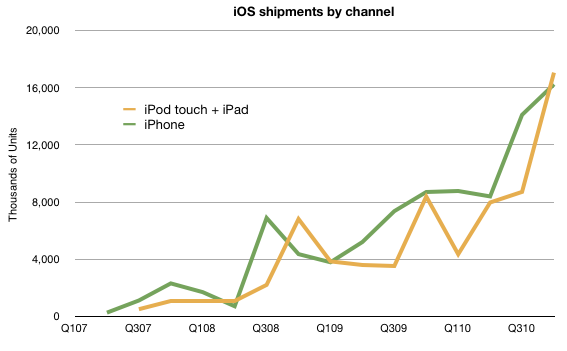
    The company does not provide iPod touch units shipment data but it can be estimated that, based on overall iOS numbers released in September, iPod touch represents approximately 50% of iPod units sold.

    If we put all we know together about volumes, we have the following chart:

    Note that iPod touch has, occasionally outsold the iPhone. The pattern of approximately equal volumes for the two types of products is likely to continue depending greatly on the growth rates.

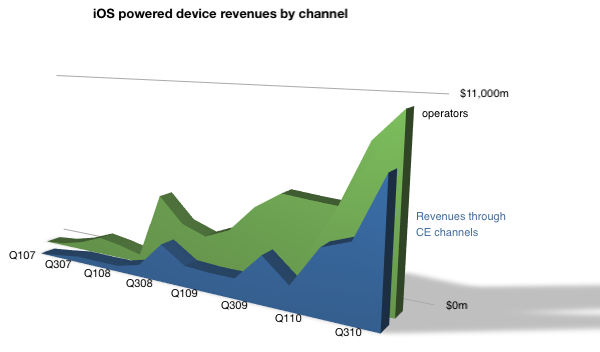
    Next, I turn the spotlight on revenues.


    Over $10 billion flowed in from Operators, and a bit under $8 billion from other channels.

    Note that I labeled the iPod touch and iPad as non-operator channel (Consumer electronics) distribution. Although this is not entirely true (and conversely iPhones are often sold through Apple stores) this gives a rough indication of split.

    The iPhone business is staying ahead of the other iOS businesses but the gap is narrowing.

    As previously noted, the iPhone is a unique product in Apple's portfolio. It depends on a distribution channel that no other product was designed around. This has advantages and disadvantages. The advantage is a high margin due to service revenue sharing but the disadvantage of network incompatibilities, politics and a range of telecom-related regulations.

    What I believe is that the non-operator channel will grow as a proportion of iOS revenues. This is both as iPad grows to disrupt personal computing and as the iPad emerges as a communications tool.

    As time passes, I believe Apple is motivated to also move revenues to its traditional channels. Whether, or to what extent, cellular phones will move in that direction remains to be estimated.

  5. Why operators will find it hard to sell tablets

    Research · 107 comments

    On the eve of iPad 2.0, it's time to think again about this curious new computer. My intuition tells me that this product category will behave very differently from the iPhone and will not be subject to the same sales ramp.

    The iPad has been on the market for less than a year but it's still a puzzle for many. It's a product that's often seen as an iPhone product line extension. From a hardware point of view, it certainly seems to be. It has an almost identical internal architecture and uses almost the same software. An engineer would look at it and reasonably say it's the same thing.

    However, from the way it's used and the way it's sold, it has very little in common with its smaller cousin. There are plenty of experts who can detail how the products are used differently, but I would highlight the portability of the iPhone makes it suitable for a completely different set of tasks than the less portable but more immersive iPad.

    But what I want to dwell on here is how differently the products are sold.

    I'll build the case from evidence that Apple provides. The most important observation is that the iPad is an unlocked product. Although you can hire an operator to provide you with data services for it, the product is designed not to rely on that. As a result the product is effectively "divorced" from the operator channel. This means it does not typically benefit (or suffer) from subsidy.

    This may seem an interesting side-note to the iPad story, but I think this is a central pillar of the market strategy. The iPhone was designed around a high-ARPU data plan. I've even suggested that the iPhone is nothing more than a data plan wrapped in glass and polished metal. Because it was designed to enable migration of cellular voice users to data plans, it's priced to skim profits from the migration. At some future point in time when a skimming strategy is no longer optimal, the iPhone might be re-positioned for penetration, but that time is not now.

    As part of a skimming strategy, the iPhone has a limited distribution channel. It's only sold through special agreement with selected operators. Again, timing is crucial. That channel is expanding, but for nearly four years the product has not been positioned for sale through any channel other than Apple retail and Operator retail.

    On the other hand, the iPad is marketed for penetration. It had a low price and an unlimited distribution strategy. It could be sold through any consumer electronics product point of sale. And then some. It could conceivably be sold through as many if not more points of sale as the iPod (i.e. tens of thousands.)

    It can be sold in any country, can be distributed through middlemen and can be priced arbitrarily [1]. It can be bought in bulk by companies or schools or hospitals. It can be re-sold in a secondary market. It is essentially a perfectly liquid commodity.

    Now we can step back and ask why and what are the implications for competitors.

    The reason the iPad was positioned asymmetrically to the iPhone is, I believe, because it could be. I believe that the iPhone is sold the way it is (through operators) because that's the only way it could be sold effectively. Cellular products have always come with lots of fine print, footnotes and asterisks rooted in the regulatory environment that underlies the industry.

    The iPad is a product built and sold along the lines of the Mac and the iPod--unrestricted by orifices and aligned with the unregulated environment that computers have always enjoyed. Essentially, for the iPhone, Apple chose to go along with the telecom industry's rules but as soon as it had a product that did not need to comply to those rules, it ran back to its comfort zone: control.

    If we take this to be the cause, the implications for competitors become clearer. Apple is more in its element selling the iPad than it is in selling the iPhone. Other tablet contenders however are in an opposite strategic stance. Almost all the credible tablet alternatives rely on the telecom channel for distribution. The rush to build iPad alternatives is as predictable as the derision that was poured on the product when it was launched.

    But the alternative products are positioned in different ways. They are positioned as big phones.

    Which brings me to my final point: selling big phones is hard.

    These products are not compliant with what users expect from an operator: a service plan. As a result they are also not competitively priced with the iPad. Apple engineered a price for the iPad that makes comparisons extremely favorable. Buyers know the thing they are buying is not a phone so they look at the price carefully.

    But the most crucial weakness of alternative vendors is the fact that operators don't know how to sell tablets. Tablets are small computers. They are bought in the same way that buyers buy laptops: in-store testing. Notice that except for the iPhone operators only provide phone mockups in their stores. This is because they want buyers to discuss their purchase with a sales rep. This is not the way laptop hunters shop. Another tell-tale sign of a disconnect between operators and tablets is that operator shops are physically tiny. PCs (and tablets) need large tables for users to look, touch, heft and fondle. Just on square feet alone, operators and tablets are not a good match.

    If you need any more evidence, consider the plight of operator-subsidized netbooks.


    ---

    Notes:

    1. I realize that this is not currently true and the distribution is limited but that's only a matter of supply constraints. There is no theoretical positioning limitation.


  6. The end of exclusivity doesn't change the price operators pay for the iPhone

    Research · 55 comments

    AT&T does not pay a higher price for iPhone exclusivity | asymco.

    At the risk of repetition, there are three instances in conference calls that Apple management has stated that the iPhone has a fixed price for all operators and resellers.

    The first was in October 20, 2009:

    “So when you go from exclusive to multiple, you don’t change the charge to the carrier?”

    Cook answered: “Correct.”

    The second was a year later, October 18, 2010:

    Chris Whitmore – Deutsche Bank:  And what is your experience then when you’ve gone non-exclusive from a subsidy and margin standpoint on the phone, have you had to give anything up in the past?

    Tim Cook: We don’t give specific information out on the margins. But I think you can look at our ASPs and see that they’ve generally stayed above $600, and that’s despite opening up several markets from an exclusive market to a non-exclusive market.

    And the third was a few days ago on January 8, 2011:

    Toni Sacconaghi - Bernstein Research:  You've said on previous earnings calls that the move to iPhone non-exclusivity in regions of the world has had no impact on your ASPs. Can you comment on whether that is it still the case today and whether we should expect any impact in the migration away from U.S. exclusivity?

    Timothy Cook: I don't envision the overall iPhone ASP decreasing from the December quarter that we just completed to the March quarter that we're currently in.

    But, as always, we can confirm and validate using the data on pricing we have available.

    In this case in the financial reports (take iPhone revenue and divide by units sold):

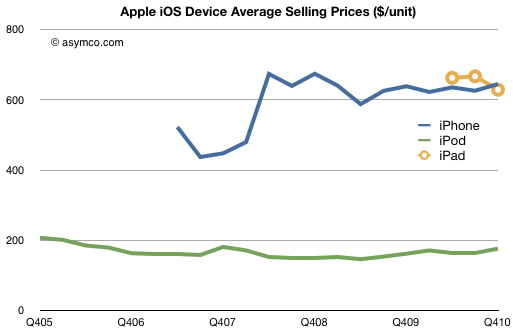
    You can see that after the first iPhone "2G" which had a peculiar pricing that included revenue sharing with the operator and which showed up differently in the accounting, the iPhone has had a steady price slightly above $600 for over two years[1].

    This is despite having more than 60% sales outside the US and being non-exclusive multi-operator in many countries. Despite being available locked, unlocked and everything in-between.

    We can even confirm what one particular operator paid exactly. In October 2008 AT&T reported that they had paid $900 million for 2.4 million iPhones. That's $375 per phone. Assuming a mix of $199 and $299 3G phones that gives something around $600--below the global ASP for that quarter of about $676. Here exclusivity would imply a discount to average price! The reason for the discount is most likely volume as AT&T was by far the largest buyer of iPhones globally.

    Still unconvinced? Try shopping for an unlocked iPhone at any of various retail locations where it's available unlocked. Accounting for VAT or other taxation, the price is always the same and is a slight mark-up to the operator ASP due to retail margins.

    Judging from comments on this site, the myth that loss of exclusivity in the US will change profit margins for Apple still persists no matter how many times I repeat this story.

    -----

    Notes:

    1. The steadiness of the price should give another huge clue as to the effect of competition on the product.
  7. The PC clones of the post-PC era

    Research · 28 comments

    Since I spend most of my time thinking about what will happen, at the end of each year, rather than looking forward I like to look back to see how wrong I've been. The great thing about being wrong is that you learn something. Especially if you use a foundational theory to tie concepts together. Theory building is all about finding anomalies that adjust and improve it.

    Fortunately, exactly one year ago, on December 30 2009 I wrote an article asking if Android was disruptive. It turned out to be the right question to ask for 2010.

    What have I learned since?

    My main argument in late 2009 was aimed at the reaction of the recently launched Nexus One. A product hailed as disruptive to mobile operators. I did not see it that way. In that respect I was right. The distribution juggernaut any phone platform faces stopped the Nexus One dead in its tracks.

    I wrote:

    Here’s the problem: since mobile broadband is by all accounts not good enough, it cannot be disrupted. Operators are very critical in building out this new mobile computing future and they are investing and will reap rewards. Bitpipe models will only emerge after 4G when there will be ubiquitous high speed networks and competition will shift away from coverage and more to price and convenience of plans.

    What is happening instead of operator disruption is that mobile voice which is more than good enough is being disrupted. Businesses built around mobile voice (e.g. handset vendors who have not developed a viable business model around data) will simply evaporate and their profits will condense around entrants who have mobile computing platforms.

    So the operators are as strong as ever. But the Android platform lived to fight on, regardless of the Nexus one. And it grew in ways I did not anticipate. I had expected integrated players to maintain a large share because they would be able to improve the product more rapidly than modular vendors (and assuming that the product needed improving).

    Google is moving on this opportunity but they are not executing in a way that ensures they control the future platform due to the their being on the wrong side of the modular/integrated dichotomy.

    So Android grew but it's not yet creating profits. It is perhaps laying the foundation for future profits and defending existing profits for Google but it is not yet a big profit center[1]. That is a cause for worry. Disruptors need to be hungry for profits and patient for growth.

    I concluded:

    Android will disrupt but I expect it will take 10 to 15 years. The life cycle of a new global network generation rollout is about 10 years. We’re in the middle stage of the 3G cycle that traces its beginnings to early this decade. 4G will take another 10 years.

    Given what's happened this year does this forecast still hold?

    Mainly yes. I stand by the notion that operators will be in the driver's seat for a few years to come. However Android has grown in an unexpected way: adoption by unbranded or relatively unknown vendors selling in emerging markets.

    The Grey (market) Elephant in the room

    Until 2010, it was very difficult to sell a phone without a recognizable brand. This is because brands helped overcome purchase anxiety for those buying a device for the first time. Brands mean trust and the lack of brand meant risk. Those who cannot afford to make purchase mistakes are more likely to lean on brands than the affluent.

    But 2010 has seen a shift away from device brand value and more toward platform and function value. This shift was largely unforeseen and is very disruptive.

    The fact one in three phones are sold from "other" unbranded vendors like ZTE, Huawei and G'Five is a bombshell. Right now they're all selling voice products, but I predict that will not last long.

    All those vendors are likely to adopt Android and in doing so will explode the low end of the market. They may even crush the branded voice-oriented market.

    This growth can be slowed by operators but market forces will be very strong. These devices sell in grey markets and are often unlicensed, unbranded, untaxed and unregulated (and may even be illegal due to the absence of IMEI numbers).

    So this is the real wild card for 2011: unbranded devices running Android could be the PC clones of the post-PC era. Will this phenomenon last or will the brands fight back? If they fight, the only weapon they could wield is innovation.

    ---

    [1] Mobile efforts at Google are generating over $1 billion in revenues per quarter however these efforts include various other assets including AdMob which was acquired for $750 million. Furthermore, the headcount for Android and these other efforts is not small. I've heard as many as 3000 people are devoted to Google's mobile efforts.

  8. G'Five overtakes Samsung in India: What does this mean for your favorite mobile OS?

    Research · 63 comments

    With a market share of 31.5 percent, Nokia is still the largest vendor of handsets in the Indian market, followed by Chinese brand G'Five with about 10 percent share, IDC said on Wednesday.

    via PCWorld.

    No, I haven't heard of G'Five either. The article goes on to say that there are 68 new vendors in the market accounting for 41% of total shipments. There were only five new vendors with a share of 1% in the first quarter of 2008.

    It was not long ago that Nokia held over 70% of the Indian market. That market is now larger but the share for Nokia has dropped by half at least. The share was not lost to Samsung but to 63 new entrants. They managed to capture 40% of the market, roughly equal to what Nokia lost.

    These new vendors will launch Android phones next year or the year after that. According to IDC, Android obtained 9.4% in the third quarter up from 2.9% y/y. The number of Android models went from 2 to 19 in the same time frame.

    What does this mean for Your favorite mobile OS?

    I'm sure many will use the Indian example as evidence of the inevitable ubiquity of Android. However, I would note that data networks are still very sparse in India and 3G has not reached a level of penetration that makes mobile broadband a common experience [citation needed].

    The funny thing is that this lack of connectivity is not likely to be an obstacle to Android as it wasn't an obstacle to Symbian in the pre-3G era in Europe. More than half of Nokia's smartphones were selling without data plans in Europe well into 2009. Nearly all were selling without data in Africa, Middle East and India. Smartphones without data plans are just high end feature phones. They can be used for picture/video taking, listening to music/video, FM radio and, if they have a keyboard, for more productive text messaging. In emerging markets dual SIMs, FM radio and removable storage are killer features. Mobile browsing isn't.

    A lack of broadband is however an obstacle to the iPhone. Here's why:

    With the exception of those seeking "luxury" phones (a very small minority), the iPhone is too expensive in markets without subsidy. That's because the price Apple sets is very high (€630 or well over $800 at retail). This is not entirely because the product is inherently more expensive. Much of that extra cost is margin for Apple. What makes it popular is that much of that extra cost is paid by the operator who accounts for it as a subsidy. Don't pity the operator though. That subsidy is there for a reason: because the product entices users to data-oriented consumption at a higher monthly service fee.

    The entire business model for the iPhone is to wrap a high-ARPU mobile broadband service plan with shiny metal and glass.

    Put another way, an iPhone without a broadband connection is just a voice phone with an integrated iPod touch. You're better off getting a cheap phone and an iPod, or maybe an Android or Nokia phone.

    When the iPhone 3G launched in India in 2008 with a price near $1000 it flopped. Many were quick to note that Apple did not understand the market. However few pointed out that the "3G" in the product's name was not just a marketing ploy. It was its Raison d'être.

    To study the impact of iPhone in emerging markets you need to first plot out the penetration of mobile broadband.

  9. Verizon Strikes Out in Smartphones [Updated]

    Research · 91 comments

    [Updated]

    [ITG sent an explanation of their methodology and there is no indication that the data represents inside information.]

    ITG Investment Research analyst Matthew Goodman is forecasting monthly sales record for all of Verizon's devices "based largely on our proprietary daily point-of-sale data from thousands of independent wireless retailers across the US."

    Assuming the data is accurate, we are going to dive into it but I will state up-front that without confirmation, the conclusions below should be taken with a grain of salt. All statements should be read with a preceding "if the data is accurate..."

    So, if the data is accurate, here is what I conclude [1]:

    Verizon Has three strikes against them:

    1. The iPhone has stolen their growth
    2. They are facing the prospect of a single OS platform supplier
    3. Android is not competitive vs. iOS

    The iPhone has stolen Verizon's growth

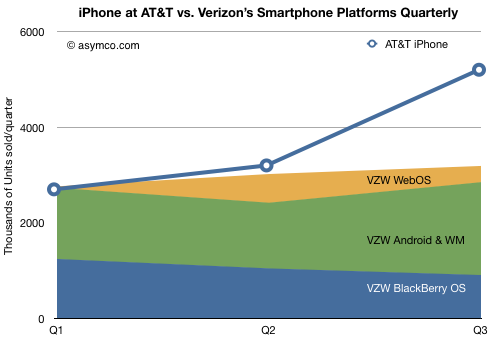
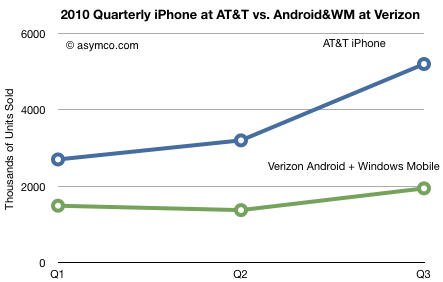
    The chart below shows the performance of all of Verizon's smartphones vs. the iPhone at AT&T. The area chart shows how Verizon's volumes grew from 2.7 million in Q1 to 3.3 million in Q3. Not a bad story in itself. However, the iPhone at AT&T went from 2.7 million to 5.3 million in the same time frame. Relative to just the iPhone, Verizon has been underperforming over the last quarter.

    Those additional 2.4 million iPhone/AT&T activations in Q3 could be due to replacements but the same could be said for Verizon's volumes. The fact remains that iPhone alone is nearly twice the volume of all of Verizon's smartphone activations.

    Just to be clear, this is a direct, apples-to-apples comparison. AT&T and Verizon smartphone performance figures are highly comparable. The two operators are highly representative of the US market. AT&T and Verizon Wireless raked in 75% of all mobile data revenue in Q2 of 2010 and account for 62% of the U.S. wireless customer base.

    In addition, Verizon enjoys a larger customer base (has 92.1 million subs vs. AT&T's 90.1 million.)  Over the time frame of the data the overall market did not increase dramatically therefore the conclusion that AT&T's win is Verizon's loss is plausible.

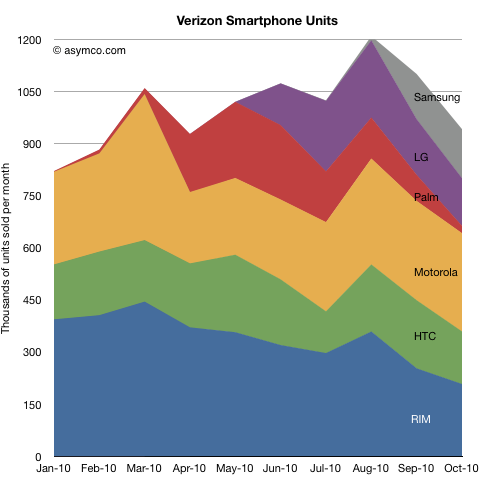
    I used quarterly data so that iPhone at AT&T could be compared. But if we look at monthly data, the story gets worse:

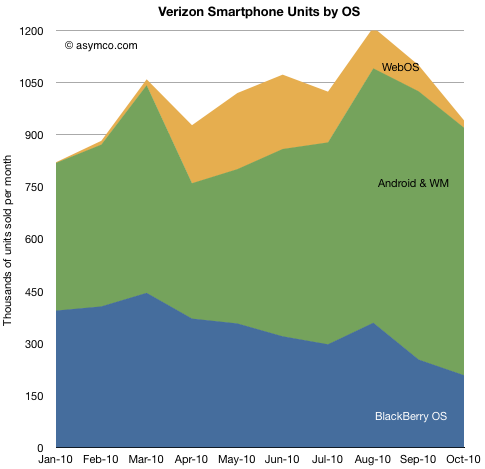
    These are absolute volume figures. You can see how RIM's fade was replaced to some degree by new vendors. However, growth hit a wall in August. Following widespread iPhone 4 availability, sales dropped. Coincidence? Perhaps, but the drop happened even with the addition of Samsung volumes.

    That's strike one.

    Verizon is facing diminished degrees of strategic freedom

    The other notable is that even though Verizon doubled the number of vendors selling smartphones, it seems they are growing their smartphone base slower than the overall market.

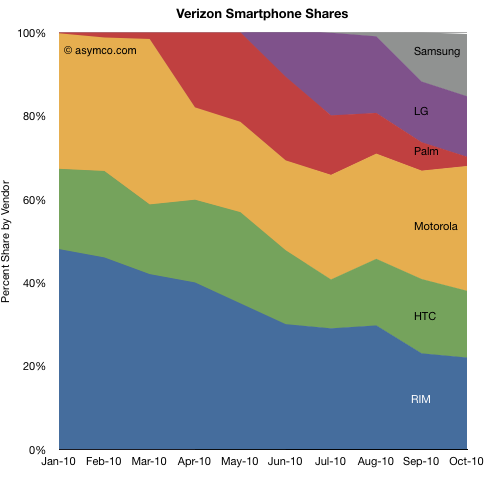
    Consider each vendor's share is shown below:

    From three vendors to six. Shares are roughly evenly split (except for Palm) but none of these vendors are able to drive volume growth.

    Consider that Motorola Droid is outselling RIM. This should be rightly noted as amazing. It plainly shows the power of Android. However that power is not something Verizon will benefit from. Quite the opposite.

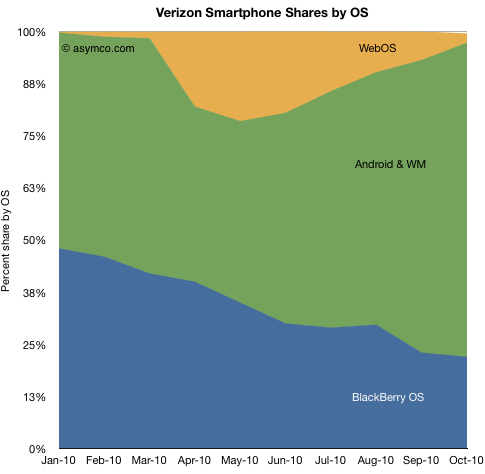
    Consider the share map by units and share of each OS:

    Android (and WM, though that's likely to be a very tiny part of the green area) made up 75% of all smartphones sold in October. It's possible that the share could grow to 90% as RIM continues to fade.

    For Verizon this would be a serious problem. Although Verizon used to have a disproportionate share of RIM's products, that OS was not enabling an ecosystem like Google's. It was a product narrowly defined around messaging. Verizon is facing the prospect of a single OS supplier who may or may not maintain alignment with Verizon's core profit algorithm. If they diverge, Verizon's bargaining power will be strictly limited.

    Strike two against Verizon.

    Android is barely enough to keep the battle with AT&T from becoming a rout.

    In an apples-to-apples comparison, in Q3 the iPhone at AT&T outsold Android at Verizon (remember, same addressable market) by a factor of 2.5. This is with a variety of devices and vendors thrown in the market. We hardly ever get to see this finely grained a comparison when looking at platforms.

    I wrote this up as a lack of competitiveness. It may seem provocative, but I define competitiveness narrowly: the competition is for a purchase decision on equal terms. These purchase decisions are fiendishly complex to predict, but the data speaks: whether it's due to brand, visibility or performance and in spite of "antennagate" the iPhone is cleaning up.

    That's strike three.

    The devil they know

    By 2009, Verizon was probably optimistic that they could head off AT&T (and Apple) at the pass. With the vast array of vendor Android roadmaps laid out in front of them they saw a way to stem the flood of defections. I think that optimism dissipated sometime this year and was replaced by a more dreadful prospect than what iPhone presented in 2007.

    It is perhaps coincidental that the rumors of a Verizon deal with Apple seem to have started in earnest right after August. It's thin, circumstantial evidence, but the only evidence we have to corroborate the data above is that Verizon has been signaling more desperation.

    Reading further into the data, I would say Verizon faced these problems and decided that they had to throw in the towel. Apple may be the devil, but so could be Google. Apple was predictably evil. But Google? The devil you know is perhaps better than the one you can't predict.

    What's more, the devil Apple seems to be helping your worst enemy way too much and the unpredictable one does not seem to help all that much.

    Final question: how many iPhones will Verizon sell

    I think this data shows that Verizon has another reason to sell the iPhone. The underperformance of their smartphone franchise is not the only determinant, but it is perhaps another straw on the camel's back.

    What would happen if (or more likely when) Verizon sells the iPhone? I believe they will sell them at the same rate as AT&T does.

    The data shows that Verizon sold, on average, about 3 million smartphones per quarter during the first nine months. That's about 1 million a month. That was based on three platforms, six vendors and widespread promotion.

    The iPhone sold almost 4 million a quarter over the same time period.

    Verizon users bought smartphones at a lower rate than AT&T users bought iPhones. This is even though the two carriers have approximately the same subs base which churns very slowly. Since a mass-market product will appeal equally to statistically equivalent populations the product should be taken-up with similar vigor.

    So the question is not whether Verizon can sell iPhones at the rate of 4 million a quarter. The question is only whether these 4 million will be in addition to the 3 million that are currently buying non-iPhones.

    My guess is that the 3 million run rate for non-iPhones will drop, but not to zero.

    The impact on the other vendors supplying Verizon may be strongly negative depending on the level of promotion Verizon puts on the product. That promotion budget is usually fixed as a percent of sales. What Verizon applies to iPhone will be taken out of what is spends on Droid. I have always said that operators will be motivated to balance their supplier power. The promotion budget is the primary instrument to meet that end.

    On the other hand, the overall market will grow so 2010's 3 million/Q will be 2011's 6 million/Q. There is plenty of room for multiple platforms.

    So my conclusion remains that iPhone will find at least 8 million new users with Verizon. The analysis above give me confidence to increase the upper bound to possibly 12 million.

    Verizon striking out means they need to change the way they play. The iPhone is a new ball game.

    ------

    [1] To assemble this discussion I used only the data provided in the article linked above and the officially published iPhone activation numbers from AT&T. Obtaining specific smartphone vendor volumes is a matter of reverse engineering the share chart and cross-referencing it to the table of vendor sales.

  10. Smartphone parochialism: How operator policies prevent or promote platform adoption

    Research · 42 comments

    When comparing smartphone platforms it's tempting to consider the global market as unified and commonly addressable. However, when you look at individual countries some strange patterns of behavior emerge:

    • Indonesia, the fourth most populous country in the world (230 million people) loves Nokia's Communicator. It's the ultimate mobile status symbol.
    • Japan had one of the largest installed bases of Symbian phones. The version running in Japan is not compatible with versions elsewhere. Famous for its Galapagos mobile culture, the iPhone is changing what the Japanese consider the basis of phone performance.
    • The iPhone just became Korea's favorite smartphone even though hegemonic Samsung and LG are doing a roaring trade selling Android phones elsewhere.
    • The US has four incompatible 3G network technologies in widespread use. No widely distributed smartphone phone works with any two. Blackberry ruled supreme until AT&T started promoting the iPhone and Verizon started promoting Android.
    • Latin America loves BlackBerry. BBM is wildly popular as an SMS alternative.
    • Saudi Arabia loves BlackBerry. When face-to-face conversations are taboo, the BlackBerry is a social lubricant.
    • Australia loves the iPhone. Android is almost non-existent.
    • Italy has more smartphones per capita than the US. The majority are made by Nokia.
    • China uses two incompatible 3G technologies. The most popular (TDSCDMA) is not available anywhere else. WiFi was illegal in phones until this year.
    • Germany has a disproportionally large installed base of Windows Mobile
    • There are no Blackberries in Finland.

    Although some of these idiosyncrasies may be cultural (like the Indonesian penchant for large devices) most of them are due to operator decisions. In some cases operators choose incompatible network technologies to protect from competition. In others they promote local vendors or price certain products out of reach.

    Sometimes big bangs take place and demand explodes for "banned" technologies or vendors. However, it's just as easy to see how the pendulum can swing against free market choice.

    Ultimately users and device vendors are at the mercy of operator decisions. In the long term operator control over platforms might diminish but it will take many years.

  11. When markets are supply constrained purchase decisions are not based on product performance

    Research · 26 comments

    The difficulty in analyzing the smartphone market lies in its extremely rapid growth. With the market growing at 90% (and 400% in some areas like China) the forces of demand and supply are disconnected. It's impossible to discern whether a purchase decision is made from a choice of comparable alternatives or if it's made from a choice between buying nothing and some alternative.

    Furthermore, another problem lies in distribution inefficiencies. The global phone market is nominally serving 4.6 billion consumers but they are not all participating in the same market.  Devices and the services they are bundled with are not fungible globally.  You cannot buy a phone is one country and easily couple it with service in another. You can't even transfer one bundle from one owner to another within the same country. Products are available only in some countries or some operators and not in others.

    Commentators focusing on mobile OS platform shares assume a zero sum game and a liquid, efficient market. Both assumptions are false. They also assume that the platform is a basis for the choices made (rather than the device, the pricing illusion attached to the device, the service plan, availability, point of purchase and network switching costs, etc.)

    There is data where competition for a single purchase decision by two comparable products with comparable specs and price plans can maybe show a preference. However that data is not public. Only an operator like AT&T who sells both Android and iPhone through the same channel has that data and they're not sharing.

    The closest I came to analyzing this was in a blog post last May. However, that data is obsolete. Since then Android growth has accelerated rapidly as vendors who were not making smartphones (Samsung, Asian second tier, Motorola and Sony Ericsson in that order) began making smartphones in volume. Their only choice in entering the market was Android. This supply-side view of the market is much more relevant than demand-side assumptions because the market is supply constrained.

    Another way to see it is this: If there is a shortage of bananas, you can't make a case for Costa Rican bananas being preferred over Honduran bananas. People will buy whatever bananas they can get (even if one may be preferred over the other). If Honduras can produce twice as many as Costa Rica then they will sell them all and it says nothing about their quality or end user preference or whether that volume advantage will be sustainable once the shortage abates.