Today marks the 16th anniversary of when Apple released the first-generation iPad. After Steve Jobs announced the iPad on January 27, 2010, it launched a few months later on April 3, 2010.
The iPad was the first device that Apple released with a custom-designed chip, the Apple A4.
The concept of a tablet device like the iPad actually predated the iPhone, and Apple had a prototype project in the works in 2004. Then-Apple CEO Steve Jobs wanted to prioritize the iPhone, so the iPad was put on hold until after the iPhone was established.
Apple priced the iPad at $499, and Jobs called it a "magical and revolutionary device at an unbelievable price." Like the iPhone, the iPad dominated the tablet space, and it still continues to do so today. Apple sold a million iPads in the first month, and while competitors like Microsoft and Samsung quickly came out with competing tablets of their own, the iPad has no match.
Apple has led the global tablet market for over a decade and no competitor comes close to matching its tablet market share. As of the fourth quarter of 2025, Apple's market share was 44.9 percent, with Samsung the next closest at 14.7 percent.
Apple has expanded its iPad lineup over the years, and we now have multiple sizes at multiple price points.
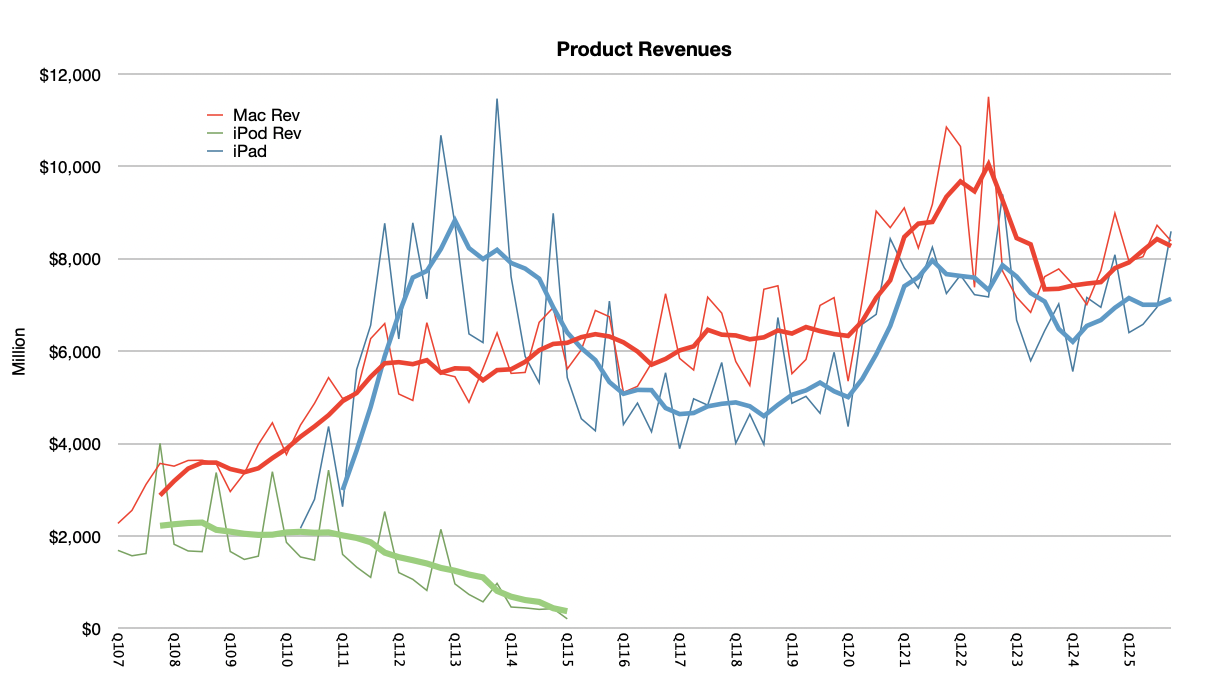
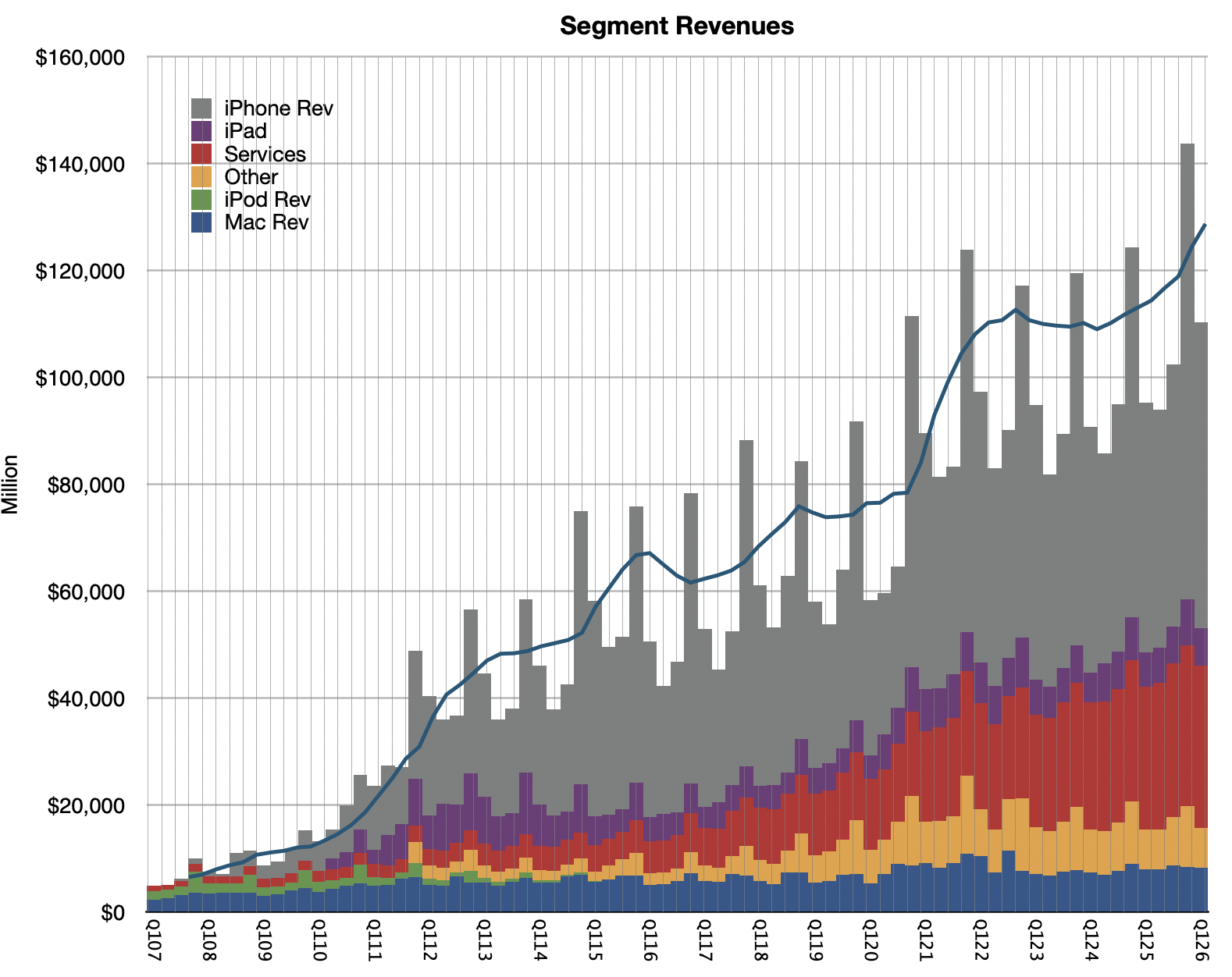
The graph above shows the iPad revenues compared to the Mac and the iPod. I included the iPod since the iPad was originally dismissed as a "big screen iPod touch". On the other hand, it was also seen as a PC or Mac substitute. To many, including Alan Kay, the tablet form factor makes much more sense than the PC form factor. It's more approachable, more intuitive and certainly smaller and more portable. As the graph shows, quickly after launch, the iPad overtook sales of the Mac.
What iPad has done is carved a niche that is resilient. After 16 years, I reckon about 910 million have been sold with about 70 million more sold each year. The product has a particularly long lifespan in use and may continue to be used for as long as 10 years. Total lifetime revenuel has been over $403 billion with about $29 billion last year. The total user base is between 400 and 450 million users. In the U.S., the iPad is highly prevalent, with over 40% of Americans owning an iPad in 2024.
Neither killer nor killed, the iPad is just a great "in between" product with plenty of value. I have no doubt that it will still be popular 16 years from now.
Both the Mac and iPad marketshare in China grew year-over-year in 2025, according to new data from the Omdia research group.
Apple sold 700,000 Macs in the fourth quarter of 2025 for 6% market share. That compares to sales of 600,000 Macs and 5% market share in the fourth quarter of 2024. That’s 14% annual growth.
Apple sold 2.3 million iPads in the fourth quarter of 2025 for 25% market share. That compares to sales of 2 million iPads and 24% market share in the fourth quarter of 2024. That’s 16% annual growth.
Looking ahead, China’s PC and tablet markets face significant headwinds. Omdia forecasts PC shipments in China will decline to 37.9 million units in 2026. This decline will be more pronounced in the consumer segment, which is expected to contract 12% compared to 2025. Tablet shipments are also projected to fall 11% to 32 million units in 2026, following elevated performance in 2025.
Global notebook shipments are showing clear signs of further weakening, according to TrendForce’s latest findings on the notebook industry. Subsequently, TrendForce has revised its 2026 full-year shipment forecast downward from -9.2% to -14.8% YoY amid expectations of deteriorating end-market demand and rising supply chain costs, reflecting a deeper industry correction.
TrendForce estimates that Apple’s notebook shipments will grow 7.7% YoY in 2026, outperforming the broader market trend. This is based on Apple’s ability to expand into lower price segments, adopt a proactive pricing strategy, and maintain stronger chain control than its peers.
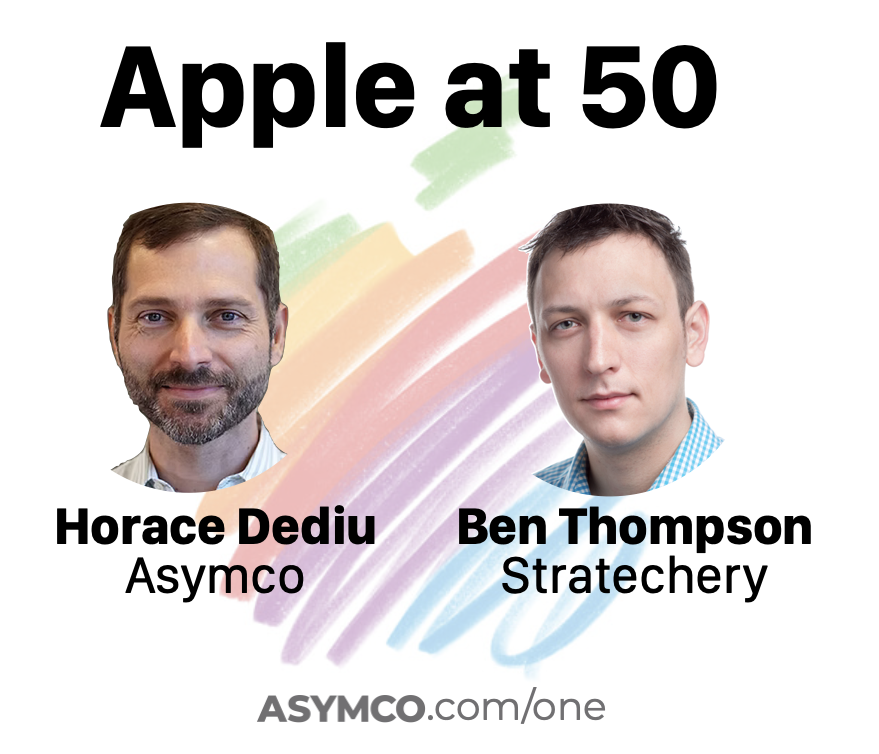
Ben Thompson of the Stratechery interviews Horace on the Stratechery Plus Podcast to discuss Horace's journey to become an influential tech analyst: early career in research, business school under Clayton Christensen, and his time at Nokia during the rise of the iPhone.
The conversation further explores Disruption Theory in the context of both smartphones and AI, why Christensen misjudged Apple, and whether AI could challenge today’s tech giants. It also marks the launch of Dediu’s new paid service Asymco One and reflects his continued conviction in Apple Inc. at its 50-year milestone.
A new analysis of computers used in the enterprise finds that Macs and iPhones last much longer and have far fewer problems.
Macs in enterprise settings typically last for five years, besting the three-year lifespan for Windows PCs, according to a company that makes software to help businesses manage their computers.
But the really shocking revelation from the report is that more than half of Windows PCs used in big business get replaced within a year.
While factors like software compatibility, IT familiarity and customization options also play a role, upfront hardware cost remains the biggest driver for most organizations.
By comparison, Macs are often seen as premium products, which can make them harder to justify at scale (although the recently released $599 MacBook Neo is changing that equation).
Companies making these sorts of computer buying decisions should pay attention to a new report from Omnissa.
“Compared to Windows, 6.5x more Macs are seen in service into year 6, and 3.3x more Macs are seen in service into year 3+,” noted Omnissa’s report.
“Only 17% of macOS devices were replaced within one year, compared to 54% of Windows devices, reducing disruption tied to frequent hardware replacement,” said the analysis.
Macs are far less likely to crash. The benefits of using Apple computers don’t stop at longevity, though. Employees using Macs also run into far fewer bugs.
“The telemetry reveals that Windows devices exhibit 3.1x more total forced shutdowns (including system crashes and unexpected restarts) than macOS devices,” said Omnissa. “Windows devices experience 2.2x more app crashes and a staggering 7.5x more app hangs (unresponsive software states) than Macs.”
“A forced shutdown is much more than an IT support ticket — it’s a disruption to an employee’s work that translates directly into lost work hours,” said Omnissa.
Apple’s lifespan advantage extends to iPhones as well. When compared to Android handsets, “the data suggests that iOS devices display longer service life, with twice as many devices in service into year 6,” said Omnissa.
“iOS is updated 8.1 times faster than Android,” said Omnissa. “macOS is updated 1.5 times faster than Windows.”
The long-term cost benefits of using macOS or iOS in the enterprise are starting to overcome companies’ habit of making buying decisions based on short-term savings.
In Apple’s first 50 years it shipped 5.13 billion computers. This shipment total is higher than any other computer company in its first 50 years. There actually are no other PC makers that are 50 years old. But all these things were true also 40 years ago. So what are we celebrating now that we did not celebrate at Apple 40? The answer is Services, the consistency in growth in user base and the potential trajectory of growth to never-before imagine audiences. The biggest change is a change of horizons. →
Says Neal Stephenson who first coined the term “metaverse” This revelation came soon after Meta canceled the Metaverse. Let’s look into Neal Stephenson’s mea culpa:
When I was working at Magic Leap, and people asked me why I thought that [Metaverse] was a good idea, I would ask the rhetorical question: “do you really think that twenty years from now everyone is still going to be going around all day staring at little rectangles in their hands?” →
How everyone is wrong about AI. The newspaper was an unexpected development It was not a product that anyone asked for. Like many innovations, it wasn’t an invention. It was not patented or discovered in a laboratory. It emerged as a result of the convergence of three disparate technologies: continuous roll printing presses, the telegraph, and the railroad. This convergence occurred by the 1830s, facilitated by a business model aptly named “the penny press”. Stepping back, the printing press was initially developed in the 1450s, 40 years before Columbus’ voyage. It went through numerous evolutions. The big change was moving →
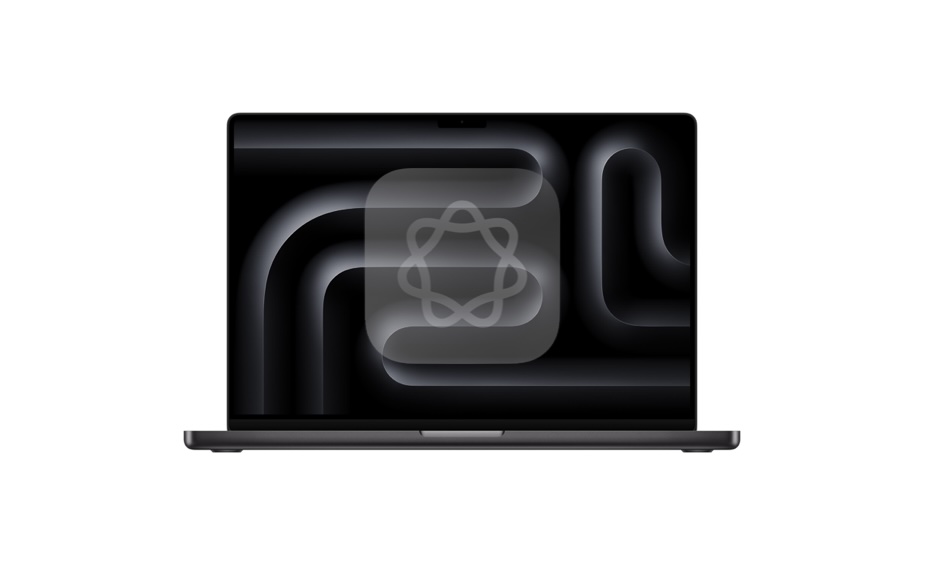
Running a data-center AI model on a MacBook → Apple's MacBook Pro, with its unique Apple silicon architecture, could revolutionize personal AI by enabling powerful AI models to run locally without relying on cloud data centers, potentially shifting the competitive landscape in Apple's favor despite current perceptions of lagging behind in AI advancements. →
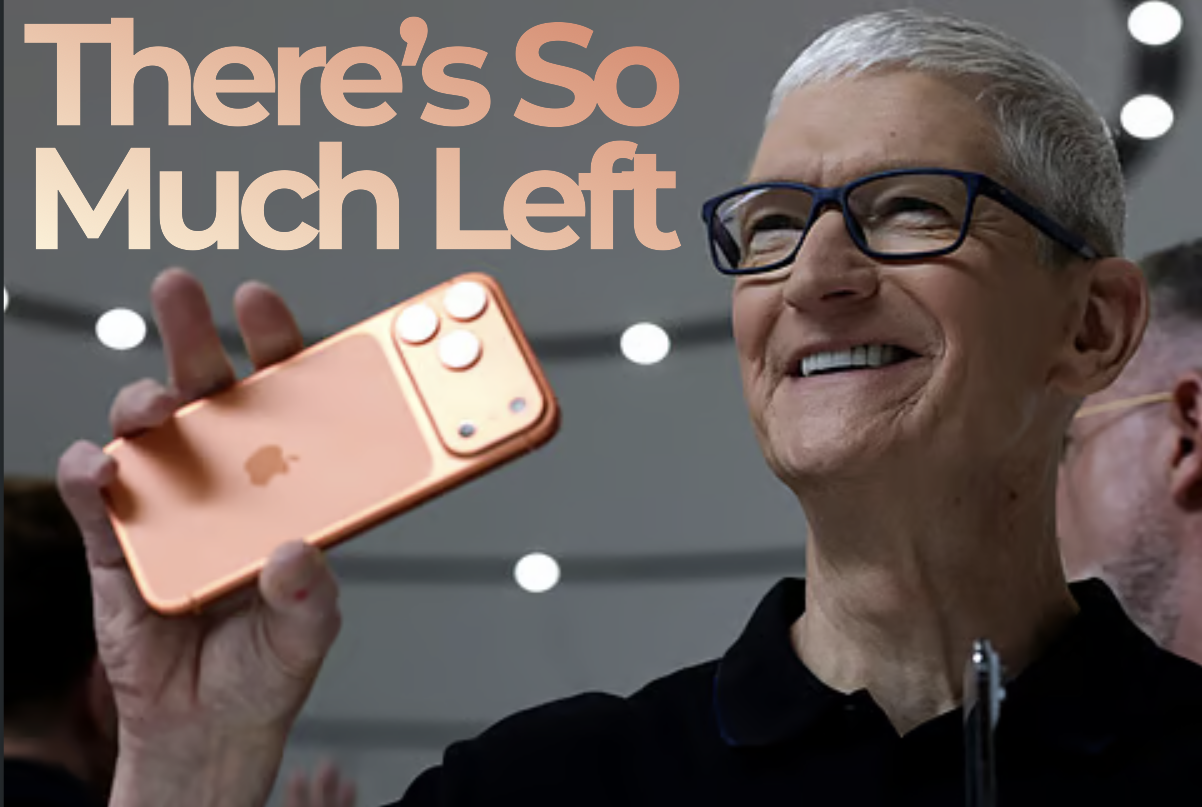
“There’s So Much Left” in iPhone: Tim Cook → Apple's relentless focus on user-centric innovation, epitomized by the ever-ascendant iPhone, underscores its enduring dominance and untapped market potential. →
Amazon developing a new phone more than a decade after its first → Amazon's renewed attempt at a smartphone, "Transformer," aims to integrate AI and deepen Prime ecosystem ties, learning from past Fire failures by addressing trust, scale, and developer engagement challenges. →
Mac fastest growing PC brand in India in Q4 2025 → In 2025, India's PC market soared to a record 15.9 million units, with Mac sales impressively up 24% year over year, hinting at a bright future despite looming 2026 challenges. →
Apple TV is a categorization failure → Apple TV, launched in 2007, struggled for 19 years as a misunderstood, underappreciated gateway to content, overshadowed by Apple's product-centric reputation. →
Apple’s Custom Silicon Opens up Potential for a Cellular MacBook → "Apple's C1X modem not only matches Qualcomm's performance but also reshapes the economic landscape for always-connected MacBooks, hinting at a future where seamless cellular integration redefines portable computing." →
Survey shows record upgrade interest for iPhones → Morgan Stanley forecasts Apple as the sole major smartphone vendor to gain market share in 2026, driven by strong upgrade intent and advanced features, while Android struggles with rising costs and declining loyalty. →
MacBook Neo Market Impact: Analysts weigh in → Market analysts predict the MacBook Neo will disrupt the low-end PC market, especially in education, by leveraging Apple's higher margins and user-centric design, despite challenges from price-sensitive K-12 sectors dominated by Chromebooks. →
World’s most respected Apple Analyst. —Macfilos
Like what you read? Get more from Asymco One: full access to Asymco's research, analysis, and commentary.
Francisco Jeronimo, Vice President of Client Devices at IDC, told Benzinga, "The MacBook Neo will have a significant impact on the low-end PC segment, particularly in education, which accounts for 6.7% of global PC shipments, or 13.4 million units in 2025."
He said that the market is currently dominated by Windows notebooks, with an average selling price of $682 and Chromebooks, which average at $362.
"Apple's ASP in Education was $1,425 in 2025 and accounted for only 5% of the segment," he said.
He echoed the statements by the above analysts while adding that MacBook Neo will allow Apple to acquire users early in their digital lives.
"Omdia’s February 2026 forecast shows Windows OEMs facing component cost increases of $90 to $165 per unit, pushing average notebook selling prices from approximately $850 toward $915," the research firm stated.
It went on to say that to maintain margins after these cost increases, many Windows laptops would need to be priced above $1,000 to "stay profitable."
On the other hand, Apple benefits from higher margins, making it easier for the iPhone-maker to sell the product at low-cost while still maintaining profitability.
In the education segment, the $499 price for students removes the cost barrier. However, the firm noted that the price isn't the only hurdle.
"Displacing Chrome in K-12 would require Apple to match Google’s admin tooling and institutional relationships, not just its price point," Canalys stated.
David Naranjo, associate director at Counterpoint, told Benzinga that Apple's real opportunity lies in higher education.
It is because the launch comes when Google continues to dominate the K-12 sector through Chromebooks, Google Workspace and school-managed devices.
"The MacBook Neo is unlikely to displace Chromebooks at scale in the K-12 market in the near term. Schools remain highly price-sensitive and deeply integrated into the Google ecosystem," Naranjo stated.
“Apple is moving into attack mode. They see the memory crisis as an opportunity to gain share,” said Francisco Jeronimo, Vice President at IDC. “All other smartphones in this price range will have to increase prices,” he added, noting that the shift could accelerate migration from Android to iOS, and from Chromebooks or traditional PCs to Mac devices.
The impact is expected to be most severe in the low-end Android segment, where profit margins are already thin. PC and Chromebook markets face similar challenges, with shipments forecast to decline by 11%.
50 already? It seems only a blink of an eye since I wrote Apple at 40. Let's try copy & paste.
In Apple’s first 40 50 years it shipped 1,591,092,250 5,126,211,000 computers[1].
This shipment total is higher than any other computer company in its first 40 50 years. Actually there are no other PC makers that are 40 50 years old. One computer maker (IBM) is older but they only sold PCs for 24 years and what they still sell they don’t sell in high numbers.
That does not make Apple the top seller in a given year. Looking at only the Mac, Apple’s traditional form factor personal computer, Apple is fifth fourth in market share. If including the iPad, it was the top computer vendor in 2011 and, including the iPhone, it was first in 2009.
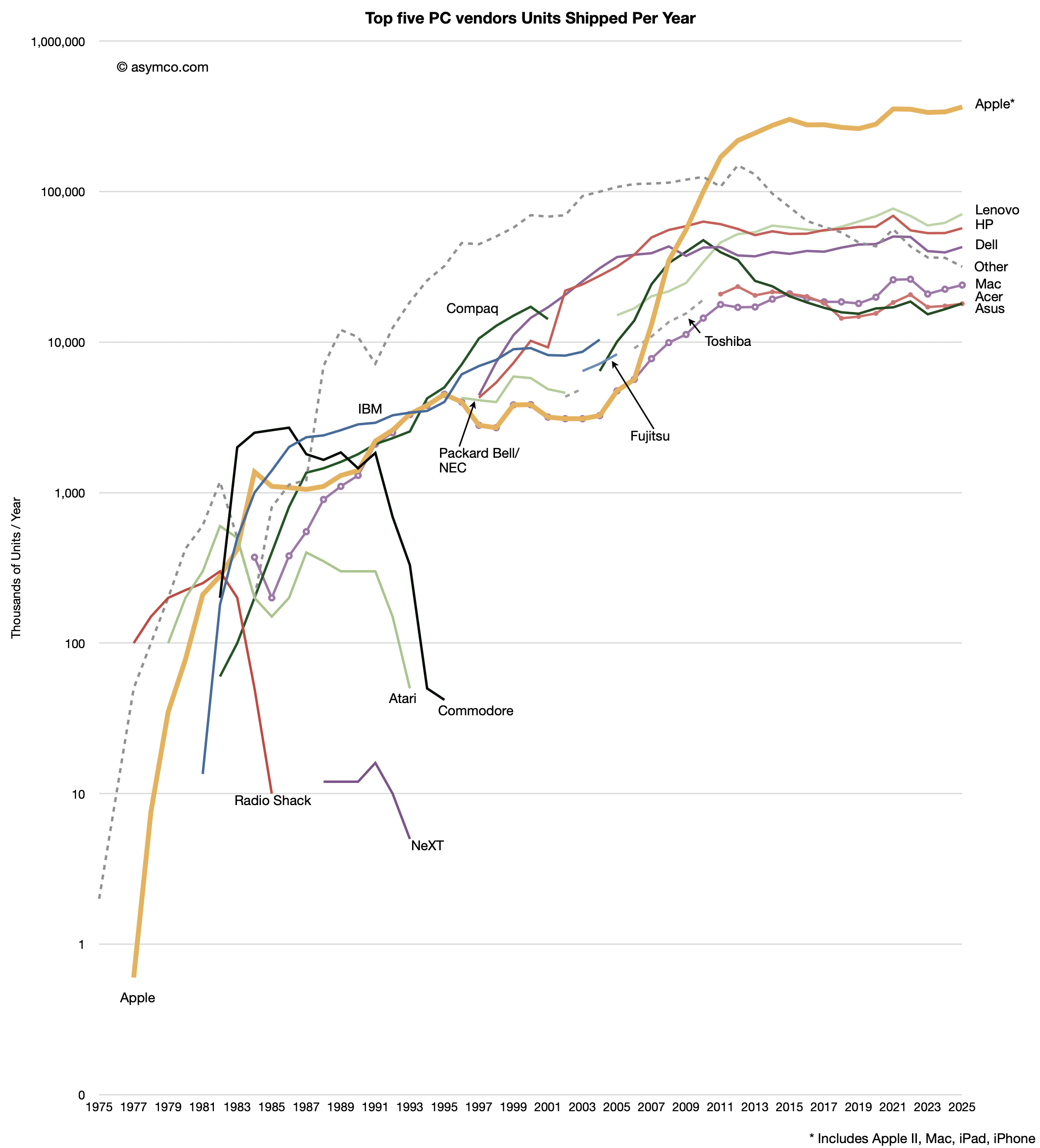
The following graph shows the top computer makers by units sold since 1975, a year before Apple was founded. (Click on the graph to see a higher resolution.)
Note that the graph is log scale and in multiples of 1000. Following the yellow Apple line we can see how it started with fewer than 1000 units shipped in its first year to today when it is shipping more than 1 million computers every day[2]. It's also quite remarkable to count how many other companies have come and gone in this top five list and imagine how many came and went in the "other" category.
Who remembers Atari, Commodore, Packard Bell, Compaq? Few said that they were doomed while they were in the running. Going back to Apple at 40,
After having a 40 50 year run and after selling more computers than all American and Japanese computer companies put together, how should we think about the next 40 50 years?
First, clearly Apple shifted from being a “computer company”. It has already changed its name to exclude the word “Computer.” That [came to mean that] it sells devices (which happen to also include computers.) We don't use computers to compute anyway. We use them to make decisions, keep track of things, speed things up and to communicate and to entertain.
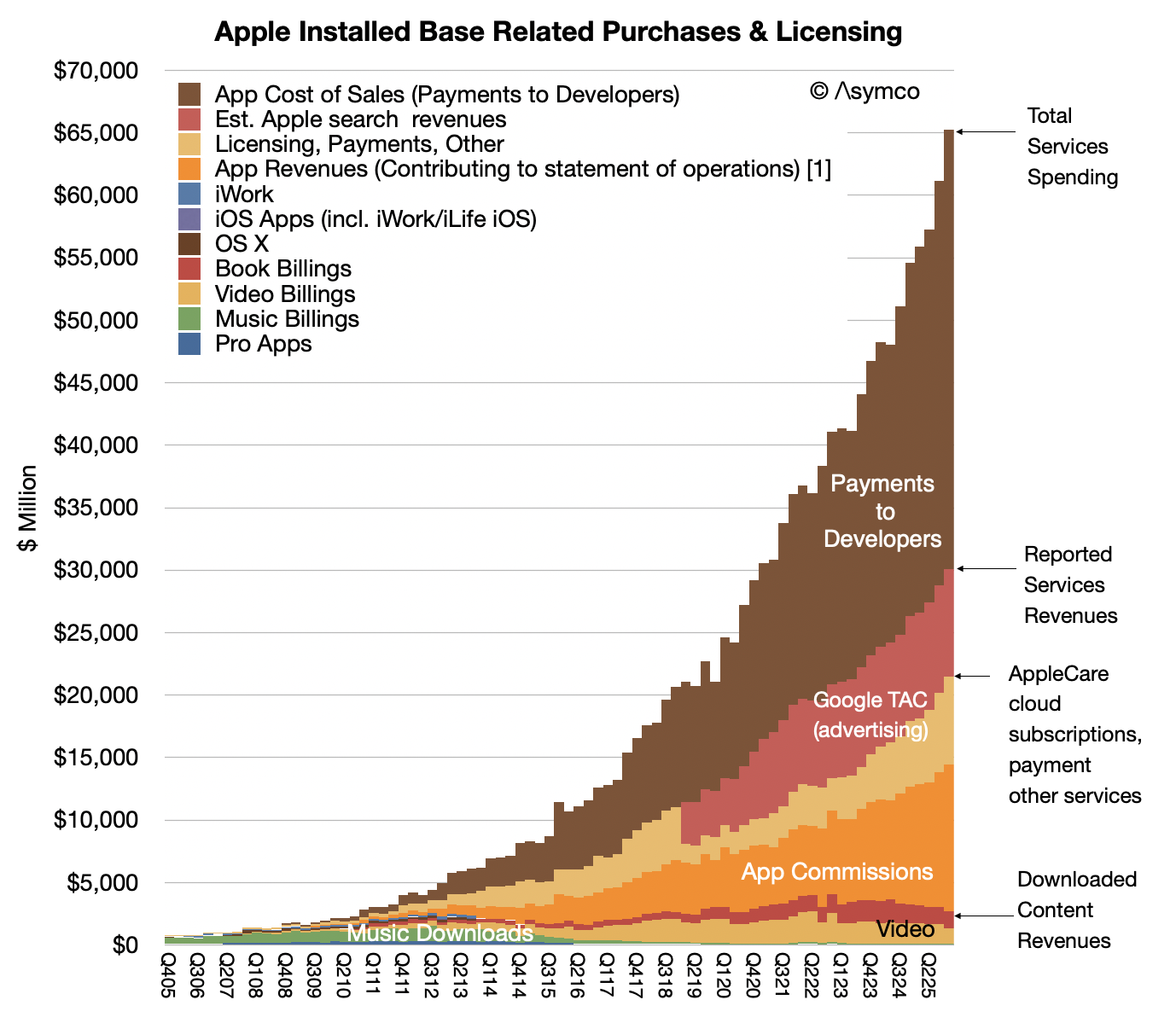
After convincing the world that it's a not just a computer company, the next challenge has been to convince the world that it's also not just a product company. It did so by launching Services as a group (formerly known as iTunes Software and Services) and then separating the financial reporting so that Services can be measured with its own gross margin. Year after year management emphasized Services growth in its commentary. Services has grown into the second largest segment, 26% of total revenues ($112.8 billion out of 435.6 billion in calendar 2025.)
Services, if it stood alone, would be number 40 in the Fortune 500 list of largest companies by sales. It has been impossible to ignore it. Considering how much customers actually spend on Apps, Content and Services, the total is even bigger at $240 billion last year[3]. As a result, some, perhaps most, recognize Apple as a Products & Services company.
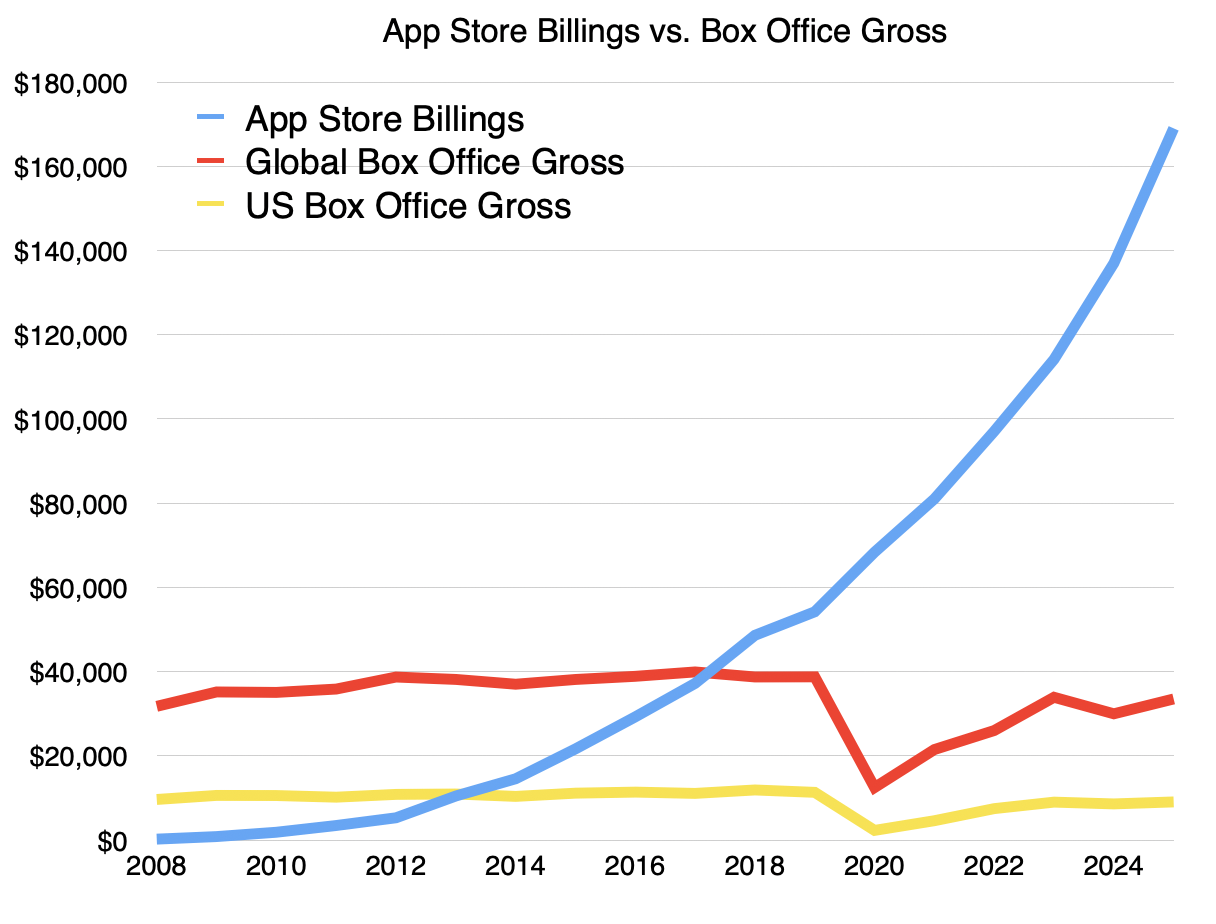
The App store alone attracts $169 billion in spending per year (2025) and that is now 5x what theatrical movie sales bring in world-wide.[4]
So if Apple is today at least a bundle of Products and Services then what will Apple be 50 years from now?
Again from Apple 40:
My simple proposal is to think of Apple as a customer creator. It creates and maintains customers. The more it creates, the more it prospers. The more customers it preserves the more it’s likely to persevere. This measure of performance for a company is not easy to obtain. It’s not a line item in any financial report.
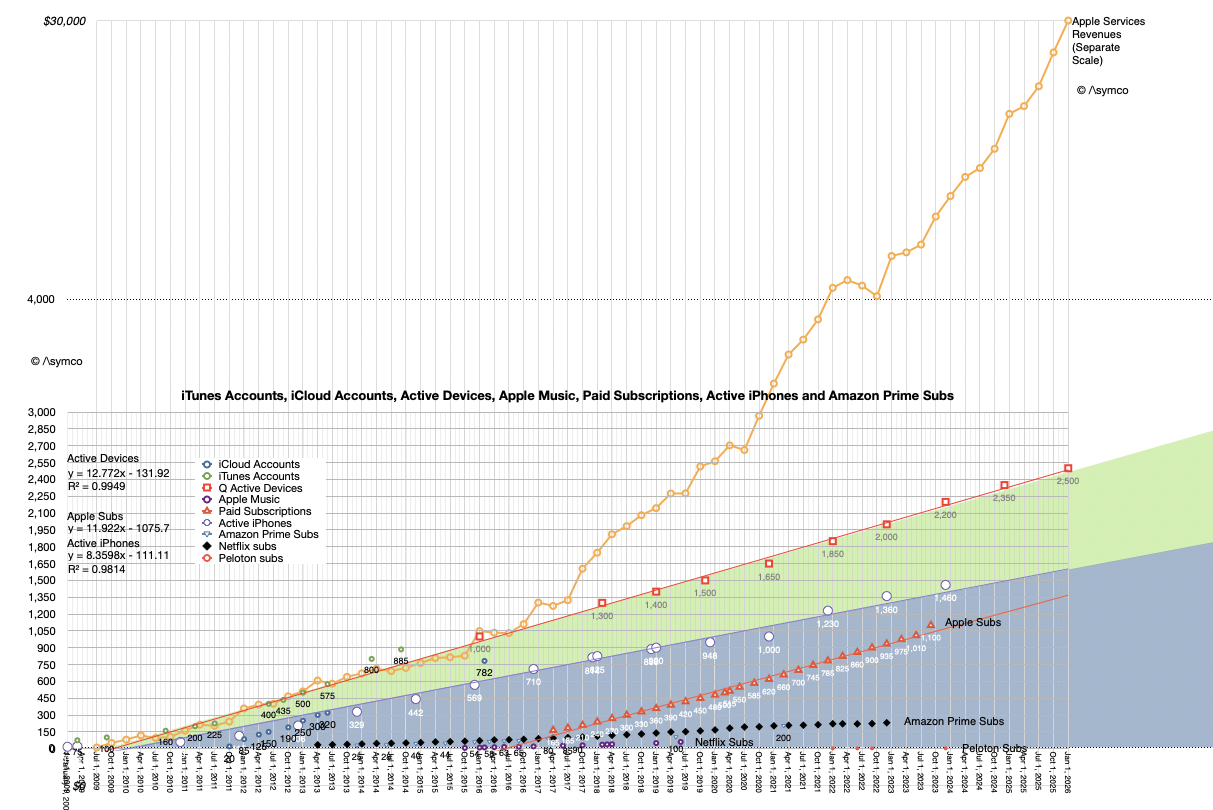
The closest figure we have is that today Apple has one 2.5 billion active devices in use. It has around 1.1 billion users [5]. Using the devices as a proxy, we can say that this audience has more than doubled in the last decade.
So we know that at least Apple has created a large number of customers. Knowing total devices sold and number in use means that we can be sure that 63% of all the computers Apple sold are still in use. This means that most customers are recent customers. Are they going to come back?
If we then factor in the size and persistence of Apple’s audience (customer base) we might conclude that there are factors which will allow it to grow rather than shrink. My analysis based on public data shows that the customer base has been increasing steadily.
And here is a graph showing the size of device base and implications for subscriptions. services and comparisons with other consumer aggregators. Note the forward looking nature of a linear extrapolation of the historical data.
10 years ago, I continued:
Combining the history of customer creation and customer preservation with the value obtained from each customer implies that the next 40 years will be about creating another large tranche of customers whose willingness to spend on whatever Apple creates will be relatively unchanged.
We don’t know the limit. One billion was hard to imagine even one year ago. We might see two billion devices in short order. Perhaps not. Perhaps as we have a multitude of devices about us all day the number will become less meaningful. But if the number of middle class customers grows and as Apple keeps its products within their reach, there is no reason to think that there will be a reversal of the last 40 years in terms of customer acquisition.
This analysis contradicts the current perception of the company as reflected by its stock price. That price assumes the audience will wither ((With a P/E ratio of 11, without a change in revenue per user, the only justification would be the audience shrinking by more than 90% over the next 20 years.)) That is not insanity. It is what we could expect if Apple were unexceptional.
We did see 2 billion. We actually saw 2.5 billion. The assumption of a company in distress as reflected by the P/E ratio of 11 is gone. It's safe to say that Apple is exceptional.
But note that we are only 10 years into that 40 year forecast from a decade ago. Do we still feel confident that the company can last 30 more years given what we've seen so far? If one company could get through the next 30 I would say it is Apple. And if it is so then I think it will get through the next 50.
One more Thing
So, the plan is to make more of the same. It's more than enough.
Including Apple II, Mac, iPhone, iPad and iPod touch; excluding Apple Vision Pro, Apple TV and other iPods. Includes Q1 shipments estimated
2025 shipments were above 364.9 million excluding Apple Vision Pro, Apple TV, Apple Watch.
A Fortune 15 ranking. This would be the case if payments to developers were counted as sales but that is not the case for accounting reasons. As a result Services margins are an extraordinary 76%, on the order of a software only business like Microsoft Office.
As an aside, when I first started tracking this data it was early 2015. The App store had just overtaken US Box Office revenues and the outrage at my comparison and the skepticism that this sustainable was impressive. Much of the outrage was due to my choice of the headline "Bigger Than Hollywood". You can still read the 72 comments. App store billings are now nineteen times bigger than US Box office billings. I still stand by the idea that the App Store is Bigger than Hollywood. It is in fact bigger than many other forms of entertainment combined--more about this later
Stay tuned for a detailed exposition of this audience
In December, the company lost AI chief John Giannandrea, its top lawyer and a key design executive in a single week. Other recent headlines: “Apple faces unprecedented executive exodus”, “Apple rocked by executive departures, with chip chief at risk of leaving next.” “Apple home devices executive leaves for Finland’s Oura” “Lisa Jackson is set to retire late January 2026, while Kate Adams will retire in late 2026”. That’s just the names we hear about. They represent senior executives. But the harsh truth is that Apple lost tens of thousands of talented developers, marketers and mangers last year.
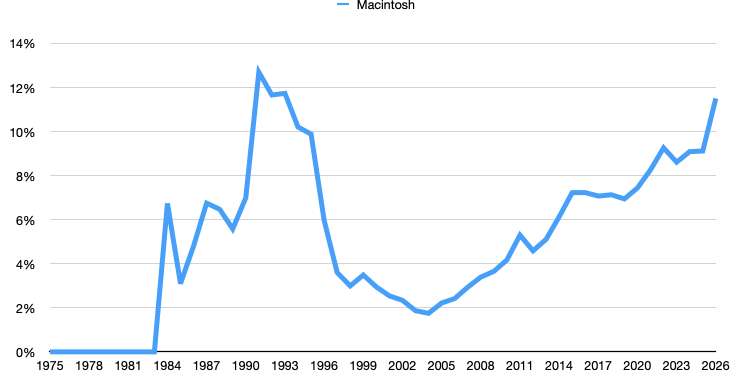
Almost 10 years ago I said “Managing the Mac product line must be one of the most challenging problems at Apple. That may not be obvious given the product’s success.” I pointed out that although the company grew the Mac into a redeemed and prosperous platform, “The big change in computing has not been a growing Mac vs. declining PC. It has been a huge surge in mobile device use vs. a decline in PC use overall.” It’s time to revisit this observation. First, a status update: The Mac is in its 42nd year...
How to read the history of the Mac and how to look at market share gains potential. Also: why the Mac has always been a cheaper alternative for buyers. →
Running a data-center AI model on a MacBook → The article discusses how Apple's MacBook Pro, with its unique Apple silicon architecture, could revolutionize personal AI by enabling powerful AI models to run locally without relying on cloud data centers, potentially shifting the competitive landscape in Apple's favor despite current perceptions of lagging behind in AI advancements. →
Lobster Boil → "OpenClaw, a revolutionary open-source AI agent by Peter Steinberger, transforms personal computing by autonomously managing tasks across platforms, sparking a Mac Mini craze and hinting at a future where AI agents are integral to daily life." →
‘No Near-Term Catalyst,’ KeyBanc on Apple Stock → Near-term catalysts may not sway long-term investors, but if Apple's valuation seems steep, critique the pricing, not its promising 14% revenue growth forecast. →
Harmful chemicals found in popular headphones → Apple's AirPods Pro 2 and JBL's Tune 720BT topped the safety charts, while budget brands like Temu raised red flags for hazardous chemical exposure. →
When does Apple split its stock? → Apple's stock split history shows a pattern of adjusting high share prices to maintain accessibility, with splits occurring around $100-$650 thresholds, potentially hinting at a $300 minimum for future splits. →
Almost 10 years ago I said "Managing the Mac product line must be one of the most challenging problems at Apple. That may not be obvious given the product’s success." I pointed out that although the company grew the Mac into a redeemed and prosperous platform, "The big change in computing has not been a growing Mac vs. declining PC. It has been a huge surge in mobile device use vs. a decline in PC use overall."
It's time to revisit this observation.
First, a status update:
The Mac is in its 32 42nd year of market presence. A longevity that is (still) unmatched by any other PC maker.
Apple reached a top five four position in the ranking of PC vendors. This was achieved far along in the evolution of the market.
With about $23 $33 billion in revenues per year, Apple places among the top four three PC vendors in terms of revenue.
With an estimated $5.5 $13.8 billion in operating margin Apple is the most profitable PC vendor, capturing over 60% of the available PC hardware profits.
The product has retained an average selling price of over $1200 ($1400 last year) for at least a decade. At the same time the average pricing of Personal Computers has more than halved.
Volumes increased by about 20% over a decade.
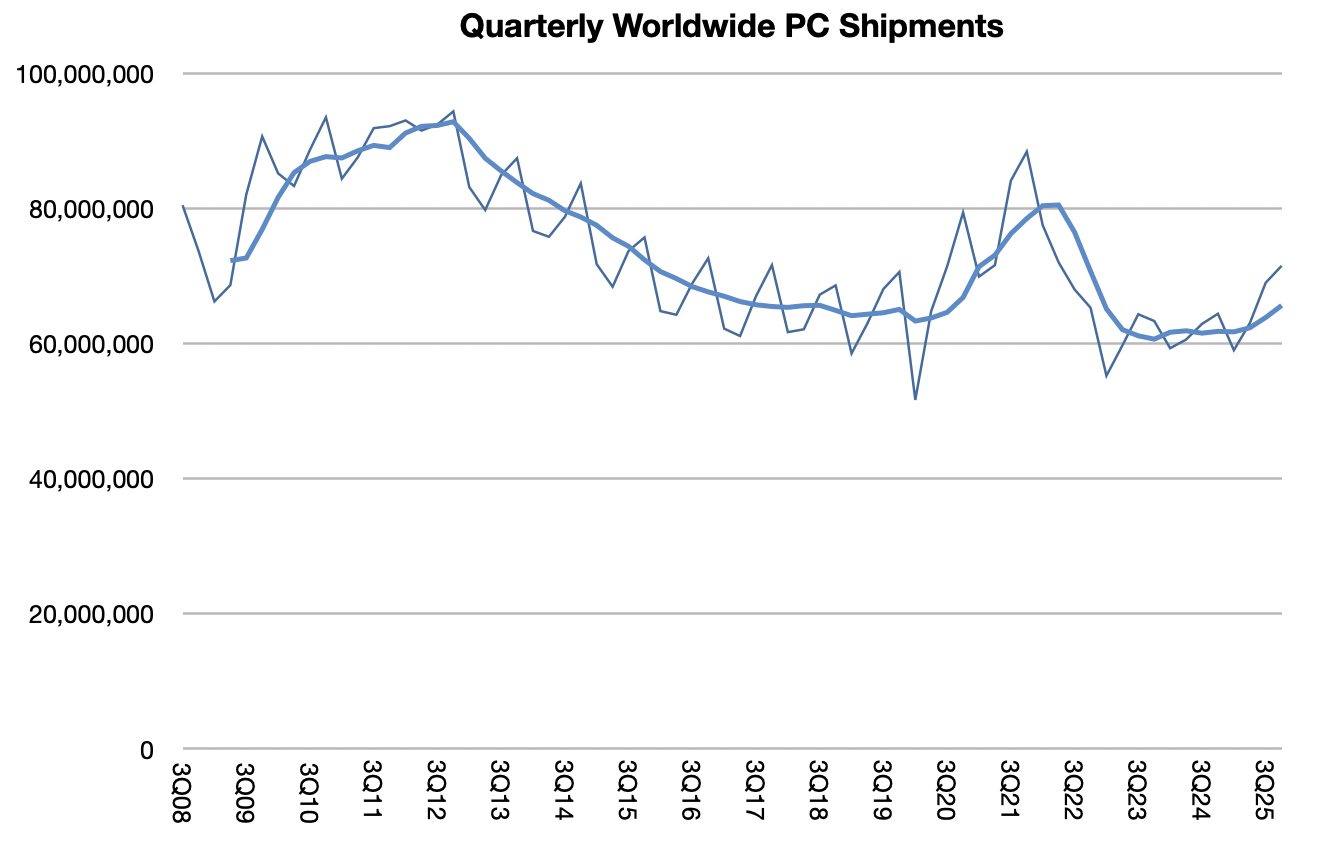
The overall picture of the market is shown the following graphs. First, the overall quarterly shipments.
Note the Covid-era surge during 2020 and 2021 but overall decline from peak in 2012. Yearly shipments were 262 million in 2025 vs. 371 million in 2012. The install base of users is largely unchanged. Microsoft has cited "over 1 billion" to 1.4 billion monthly active devices, with figures varying between official statements. My estimate has been 1.2 billion PC users with an additional 250 million Mac users, more about this later.
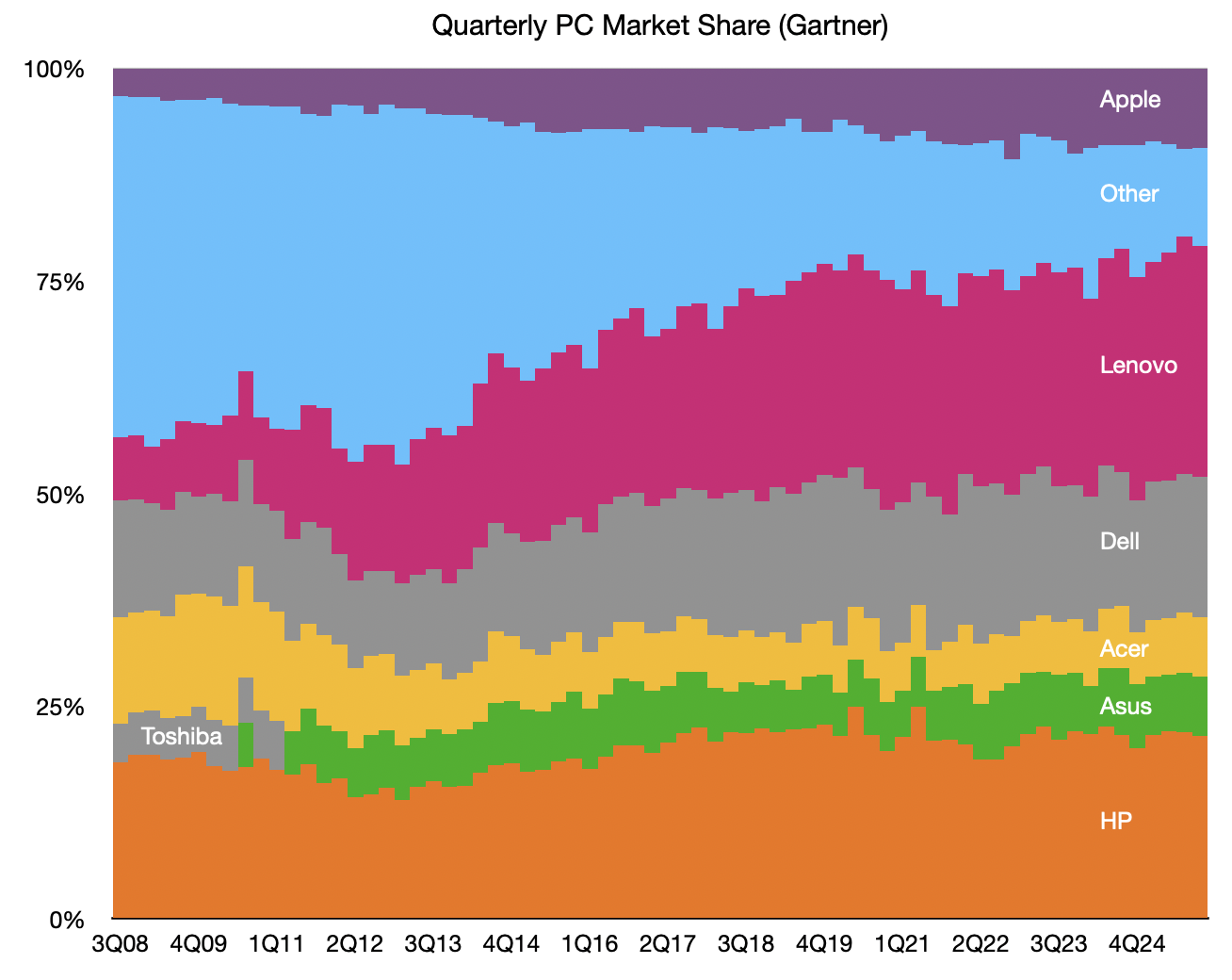
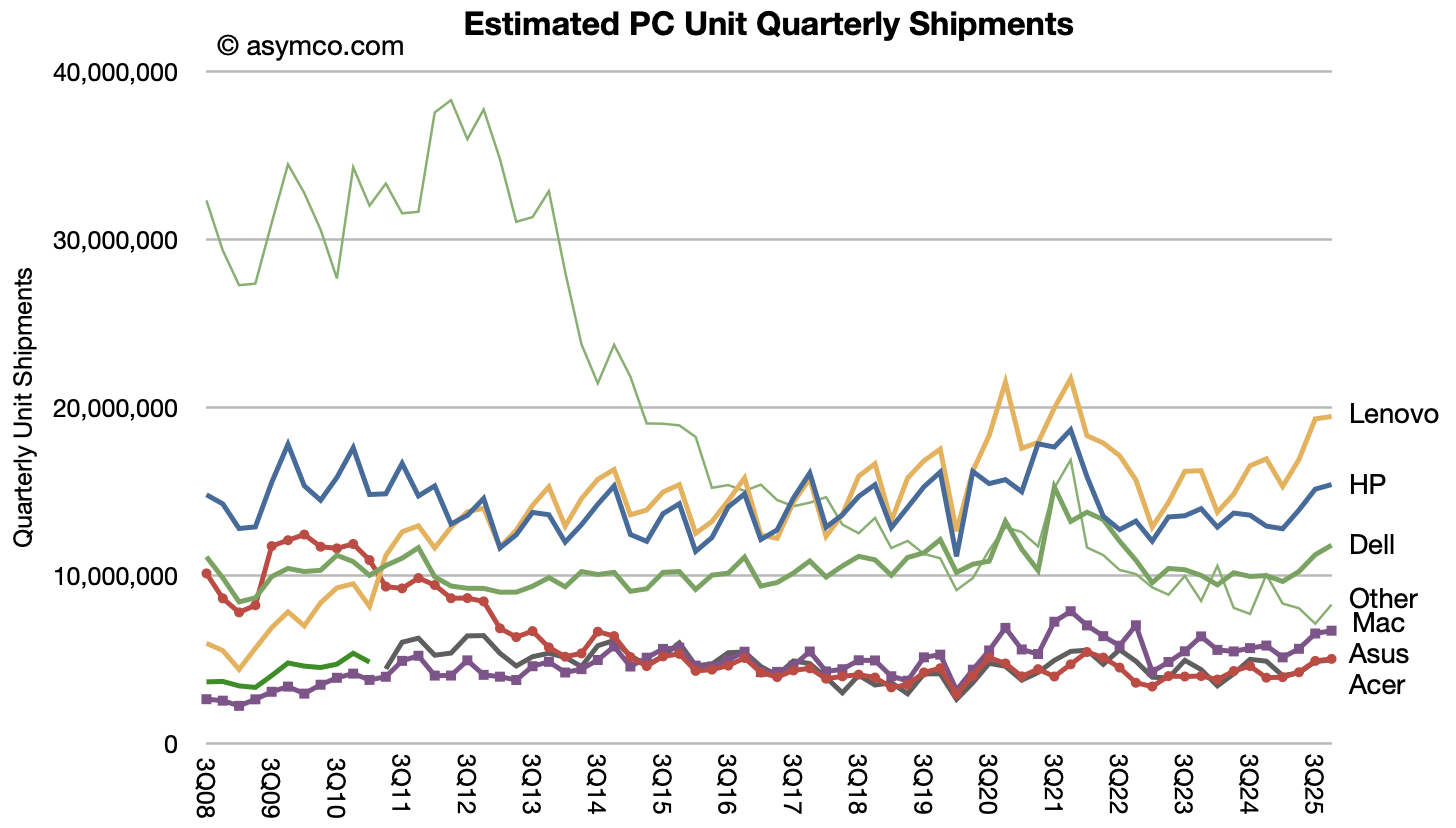
The shipments data provided by Gartner over the last 17 years is shown below:
Notable are the declines in "other" vendors and the gains from Lenovo and Apple. Broadly speaking, "other" are assumed to be mostly consumer markets and that has either declined or been captured by Mac with consolidation around Lenovo. Lenovo, HP, Dell are likely to maintain enterprise accounts serving large customers and that has been a steady but low margin business for decades.
Mac has grown to fourth place but still a way to go to third place Dell. Apple may overtake "other" combined in a year or two.
The market share data shows how "other" has been squeezed between Lenovo and Apple while the other players have largely held steady. Acer and Asus somehow managed to survive.
So what does this mean for the future? What is Apple's strategy with the MacBook Neo. Or for that matter, for Studio and iMac and Mac Mini and MacBook Air and MacBook Pro?
The Neo was such a surprise for many given its incredible price/performance ratio and the overall quality and affordability (and distribution potential). I've read many reviews suggesting it will "disrupt" the market and that Windows PCs are just no longer competitive.
Will the MacBook Neo move the needle? Will it take share from the Windows world (or for that matter from the Chromebook and even iPad?)
One more thing: Apple's sales of about 24 million Macs for a base of 260 million users implies a life span for Macs of nearly 11 years. However, all the other PCs sold add up to 238 million for a user base of 1.2 billion. That means the life span for the non-Mac PC is only 5 years.
This is, of course, reflected in the price difference but with the MacBook Neo, the potential for a 10 year old life for a $500 laptop puts the Neo price at $50/yr or 14c/day. Based on data for 2025, the average selling price of a new Windows PC is estimated to be $600 to $900 for consumer models. At $700 for a life span of 5 years makes the PC cost $140/yr or 38c/day.
This means that the average PC is more than twice the cost of the MacBook Neo. Now that is a surprise.