Asymco

Asymmetric Intelligence

platform

  1. The American Wireless Galapagos Syndrome: How the industry set itself up for a rout

    Research · 193 comments

    AT&T's intent to acquire T-Mobile USA is subject to regulatory approval. Will regulators look at the deal through the lenses of sustaining the traditional industry's profit allocation or through the lenses of device-led disruption?

    In theory, regulators are to make a determination on whether the deal will reduce customer choice. But the question is really choice of what? The focus is presumably on the choice of service plans. That's understandable, however coupled to that choice is the choice of devices and even more importantly, the choice of platforms.

    The trouble is that US consumers have never had much choice and the US wireless marketplace has been a minefield of incompatibilities and obstacles to market forces.

    To begin with, US carriers maintain multiple incompatible network standards. Phones which work on one network do not work on any other. A Sprint phone won't work on AT&T or on Verizon. In fact, some Sprint phones won't work on all of Sprint's network as it still uses the iDen standard legacy from the Nextel acquisition. Even the iPhone which is designed for the AT&T network does not handle T-Mobile's version of 3G. So a consumer cannot make a decision on devices independent of a decision on carrier. This is a phenomenon unique to the US[1].

    Secondly, in the US carriers charge for incoming minutes and have shunned pre-paid customers. There was a time when SMS messages were not compatible between networks, which led to the emergence of RIM as the only wireless messaging solution available, though initially not to the average teenager.

    Thirdly, because of the multiple incompatible standards, network coverage in the US is still abysmal. Each carrier has had to build out parallel (incompatible) networks at great expense using non-standard equipment over a vast landmass. The result is not only a very expensive network whose capex demands high service fees, but a very poor quality network which is always both spotty and capacity constrained. Operators are therefore keen to lock customers in to post-paid plans to ensure cash flows that drive capital allocations. This is essentially an upmarket flight which does not encourage low end innovation.

    These idiosyncrasies are rooted in historical regulatory rulings that led operators to create a uniquely American wireless market. The key regulation was that the US shall have no single wireless standard. In the spirit of laissez-faire this may make sense. But the result has been failure of the common good. This is sharply contrasted with other developed countries which (with notable exceptions) deliver superior service with high efficiency.

    The US is so unique that it developed its own "Galapagos syndrome". Few global brands can be bothered to invest in it. Vodafone tried to play in the US with Verizon, but its minority position offered no leverage because Verizon spent the better part of a decade avoiding global networking standards. Now T-Mobile is desperate for an exit after trying to leverage the foothold it paid dearly for and failing to offer devices that capture users' imaginations (because they were railroaded into another incompatibility with 3G). Conversely, no US brands have been able to expand internationally. US operators are non-entities abroad, even in what would be natural expansion territories like Latin America or the Caribbean.  Those markets belong to European investors today.

    Given this background, it's very likely that regulators will look at the deal in terms of balancing what is essentially a deeply flawed, cobbled together industry.  Companies can argue that they are rationalizing through consolidation but regulators can argue that "choice" is decreasing. These arguments are mostly moot. The problem is that the US wireless market is balkanized and byzantine.

    It's therefore perhaps stunning that the platforms that are currently winning in mobile computing are American: iOS and Android[2]. Note further that none of these winners came from the world of wireless or telecom. These new points of profit condensation in the industry entered from a different industry: computing. But are they now pursuing telecom-compliant strategies? Arguably no. I choose to call them mobile computing and not phone platforms specifically because they will tolerate the cellular regimes as long as they need to, and no longer. Once they will reach the perch of power, the industry will conform to them, not vice versa.

    ---

    Notes:

    1. Japan has a similar problem but less pronounced.
    2. Microsoft is still in the running as is Palm, both American.
  2. Which mobile users will platforms harvest first?

    Research · 23 comments

    When tallying up the race to a billion users, I noted that both iOS and Android seem to have the potential to reach that size of user base. However, that raises the question of where those users will come from. We have to note the fact that there aren't a billion users to be captured today.

    If not today, then how soon, and where are they?

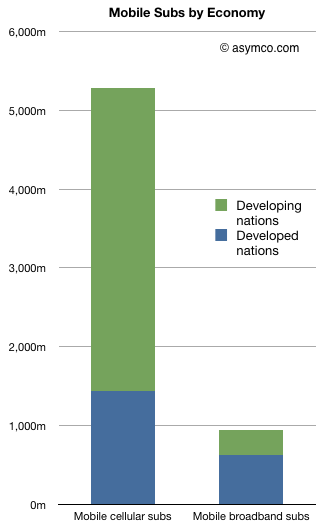
    The first question is who is addressable. If we stick with mobile cellular subscribers, there seem to be plenty of users (at least 5.3 billion as of October 2010 according to the ITU). However, the number of "mobile broadband" (i.e. 3+G network subs) is about 940 million. The chart to the left shows the difference and adds the subdivision between developed and developing economies.

    Over half (51.1%) of developed nations' populations have signed up for mobile broadband while only 5.4% of developing country populations are on 3G. And whereas developing countries have added 2.6 billion mobile subs in 5 years, they added only 293 million mobile broadband (MB) subs. Developed nations added 574 million MBs in the same time frame.

    As a result, two thirds of mobile broadband subscribers reside in developed nations as of 2010. This number will decrease rapidly as MB penetration reaches saturation in developed countries, however the race to a billion is being run in these markets first.

    Which leads back to the question of platform potential. Platforms that target developing nations have the challenge of low broadband availability in the near term in addition to the challenge of device pricing. There are still 800 million developed country subscribers who have yet to upgrade to mobile broadband.

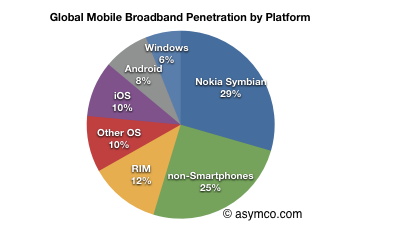
    At the time these statistics and knowing the platform sales histories, my estimate is that only 18% of mobile broadband subscribers were using either iOS or Android. 25% were not even using a smartphone and 29% were using Symbian. (See pie chart).

    But existing smartphone users are not the most attractive market to target with a new platform device.

    A new smartphone user could come from the following groups of users:

    1. Existing smartphone users:  700 million. This is tough head-to-head competition for every new user.
    2. Existing mobile broadband users who are not smartphone users: 240 million. The easiest group to switch to using smartphones.
    3. Developed nation mobile subs who don't have mobile broadband or smartphones: 800 million. This seems very attractive since they can be mostly upgraded using subsidized phones into an available 3G network.
    4. Developing nation mobile subs who don't have mobile broadband or smartphones: 3.5 billion. This is a very tough market because the availability of 3G will take time and until it appears, the buyers are unlikely to adopt devices that are useful only though a 3G data plan. They are also a difficult market to target with high ARPU phones/plans.

    To assess the timing, one could assign some probability weights to these categories to create various scenarios for adoption. My own guess is that the next 500 million smartphone users are easily within reach in the next two years without a significant amount of inter-platform rivalry (See stacked bar chart to the left).

    Only after two years will existing smartphone users become attractive for poaching and even that assumes that developing nation networks will still be largely unaddressable.

  3. Star-crossed partners

    Research · 36 comments

    Until very recently, we believed our competitive position in smartphones could be improved with Symbian, as well as MeeGo, and our strategy based on those platforms. We are now of the view, however, that for the longer term our Symbian platform is not sufficiently competitive in leading markets.

    Nokia's SEC Form 20F.

    The company's fiscal year, which ended in June, was one of the worst to date for the mobile space. Although in development since 2008, the Kin was pulled after just over six weeks of sales and amounted to a $240 million write-off before including the $500 million to buy Danger. Windows Mobile's ramp down is partly intentional as Microsoft is rebooting the platform with Windows Phone 7 and is investing $500 million in marketing to spark new interest.

    Microsoft CEO bonus cut for Kin flop, lack of iPad rival | Electronista One irony is inescapable: the world's largest device company can't build commercially successful software and the world's largest software company can't built commercially successful devices.

    Another irony is that the competitive threats that both companies face came from challengers that were not perceived as such a few years ago.

    Google was not a platform vendor three years ago and Apple was not a phone vendor four years ago.

    The largest incumbents in separate industries sought salvation in each other after the market they strove to build went to unforeseen challengers. All in a span of three years.

    I cannot think of a more succinct testament to the process of disruption.

    One can only speculate about the probability of success of this pairing, however, I struggle to find a historic precedent where this type of relationship succeeded.

  4. The Race to a Billion

    Research · 22 comments

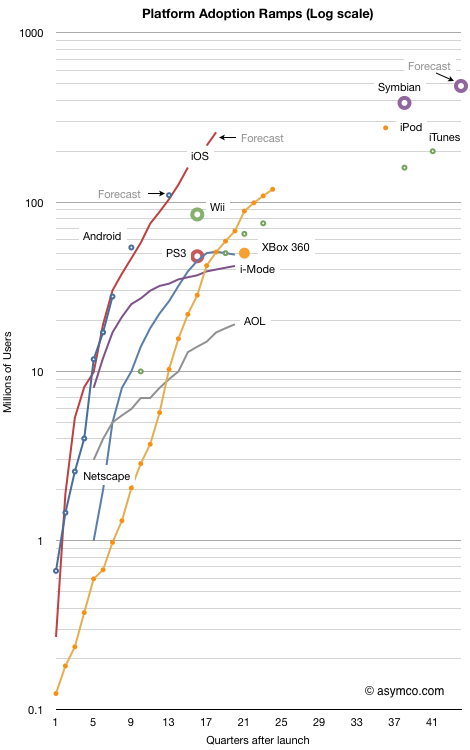
    I last looked at the race to a billion in September 2010. I've now added a few more data points to the tracked platforms and also added points for the major console game platforms and Symbian.

    The chart shows the cumulative number of users (approximated by units sold) for 11 platforms indexed to the same starting date. The horizontal axis is the number of quarters since a platform launched. Every fourth quarter is numbered so each number on the axis represents a new year. The last number on the axis represents 10 years.

    The vertical axis is the cumulative number of users on a logarithmic scale. Each number of the vertical axis is 10x more users than the previous number. The top of the graph represents a billion users.

    The overall chart shows how quickly a platform has grown and is bounded by a billion users and a decade of usage.

    When judging the performance of a platform, the adoption slope and sustainability over time is perhaps the most interesting measure.

    One can see how many platforms slow down before reaching 100 million and so far none have hit the billion mark (Windows has but not in the 10 year time frame of this chart.) Looking at game consoles also shows the limits of a narrowly focused platform. They performed better than i-Mode and Netscape but not as well as iTunes or iPod which themselves have growth limits.

    If you're looking for the "fastest growing" title, it's a toss-up. Both iOS and Android are following almost identical trajectories.[see Notes]

    The absolute highest cumulative sales total is Symbian, though now that it's been deprecated, it's set to be bypassed.

    It does appear that Android and iOS each have the potential to reach a billion users in less than a decade. Perhaps Android will do so faster but the mobile computing platform race will not play out as the personal computing platform race did.

    ---

    Notes:

    1. For Android I used my own summary data for historic performance except for the last estimate and forecast which came from IMS Research.
    2. iOS forecasts are my own.
    3. Symbian data comes from VisionMobile. Forecast is based on Nokia's 150 million additional sales prediction.
    4. Game console data is current as of end of 2010 via Wikipedia.
    5. Other data sourced from Morgan Stanley.
  5. The skill of strategy analysis: Uncovering company priorities

    Research · 86 comments

    John Siracusa dusted off an interesting quote from a former Microsoft employee.

    Spolsky: But synergy…there are also negative synergies. In the case of Microsoft they call it "strategy tax." Where, like, the Internet Explorer team is not allowed to fix the DHTML editor because it might compete with Word. So they’re forced to make that continue to be bad.

    Via: The Apple strategy tax

    The notion is an interesting one and is a reframing of the metaphorical expression that those who live by the sword die by the sword: Building a business a certain way will, in the end cause it to perish by that way.

    In the case of Microsoft, the focus on their platform lock-in strategy binds them into avoiding compelling opportunities and, even more tellingly, keeps them from improving existing products.

    It's tempting to suggest that this "strategy tax" also applies to a company like Apple when it seems to act irrationally or sub-optimally to some arbitrary definition of optimality.

    However, what if Apple's motives are not "strategic"? What if Apple actually does act in a way to optimize what they perceive to be important: the end user experience or as I like to call it "the product".

    What if "the product" is dogma and nothing is allowed to compromise it?

    This question is not designed to glorify or defend any one approach, but rather to ask what is to be compromised. In Microsoft's case dogmatic "strategy" means the installed base and channel cannot be compromised. In Apple's dogmatic product approach, is the relationship with partners subject to compromise? Is the platform itself compromised?

    I would argue that yes, the product-focused company has to "pay a tax" for its product priority. It uses an approach with a huge built-in opportunity cost. But I would also argue that every company has some tax to pay for its priorities.

    Ultimately, every company needs to decide what is important and to pay the tax for not doing what is unimportant. Business management, like engineering, is about compromise and the choice of trade-offs. Outside observers, unaware of what the company's priorities really are, will always find it puzzling why companies do what they do. But to insiders, the puzzle is why anybody would do anything else.

    The most important skill for an analyst, and that which separates her from the casual observer, is to determine what the company's priorities really are. Interestingly, many companies don't clearly state their priorities and may not even be aware themselves of what they implicitly are.

    I believe that there are deterministic ways of uncovering priorities and categorizing companies according to them. I believe that knowledge of priorities leads to a more precise understanding of strategy and competition. I hope that within this forum, I can share and provoke debate over these methods so that these skills can become more commonplace.

  6. The platform as a promise

    Research · 39 comments

    In a recent answer on quora, I wrote that I did not believe developers are tempted primarily by economic incentives when choosing which platforms to work on. I suggested that they hire platforms because of their star-making potential and that star-making value is not a something that money can buy. Using Hollywood as an example I suggested that subsidies decrease the perceived value of a talent-oriented platform.

    The notion that a platform signals meaning to developers led me to think about how mobile platforms signal meaning to consumers. I have a hypothesis that platforms can and should be treated as brands. This point of view allows platform orchestrators to develop a comprehensive market-driven strategy for platforms that transcends technical debate.

    First a word about what a brand is.

    Brands are vaguely defined. They are identities, names, symbols or attitudes or all of the above. Marketers struggle to define brand value because they are trying to encapsulate what they sell into a single symbolism. The problem is that there are vast varieties of things being sold. Every product or service has different meaning to buyers and it cannot be captured the same way. Because I cannot rely on a single definition I have to create a specific definition of brand to the context of mobile platforms.

    I choose to define brand in this context of platforms as the "promise of the platform". A platform is a promise that the products will function in ways beyond what's "written on the box"; that the product is extensible and has value provided by an ecosystem bigger than the original vendor.

    For example, although the iPhone is based on iOS platform, iOS is not the brand. "iPhone" encompasses the platform brand and it's a promise to users that they can expect apps and content and an extended flow of innovation to continue well beyond the initial purchase of the device. This brand value is attached to iPod touch and iPad even though it's not communicated as a unified platform. In other words, consumers don't look for "iOS inside" but the implicit value of "there's an app for that" covers all the products.

    When looking at platforms as promises or brands, we can observe how some are more powerful than others.

    Symbian or Series 60 was never marketed as a brand and Nokia users are generally unaware of what OS or platform their phone runs. Does Symbian make a promise of an "extended flow of innovation to the device" after the time of purchase? It's hard to make that promise when you can't communicate clearly anything but device specs.[1]

    Conversely, Android has become a strong brand. The Android label (and mascot) is frequently used by device vendors to signal platform brand value.

    How did Google achieve in a year this value with Android while Nokia continued to squander any brand goodwill around Symbian for a decade? The answer lies in marketing decisions. Nokia wanted to focus on the hardware as value (and the Nokia brand as the way that value is encapsulated). Google and Android OEMs wanted to lift their own device brands into becoming smartphone brands and attached the value of Android branding to them.

    Which brings me to the question of how to design platforms as powerful brands. Creating awareness of extensible value is the way to signal to developers and all members of an ecosystem that a platform is valuable. Apple did this very well with their iPhone ads which focused on the app value of the product. They showed the product in use and did not rely on metaphors. Developers saw other specific apps being advertised by Apple and it engendered huge star value in the platform. Every developer wanted a shot at being featured in an iPhone ad. The iPhone could and did make stars.

    But you can't make the great promise of the platform without the ensuring consistency, reliability and longevity. Fragmentation, malware, copyright infringement and arbitrary termination amount to the confiscation of platform value by the orchestrator. Poor custodianship results in the destruction of both ecosystem and end user value.

    --

    Notes:

    1. The lack of platform promise for Symbian may also explain why Nokia believes they can sell 150 million Symbian devices which have a deprecated platform. Those devices could be sold as feature phones, not platform products. The challenge for them will be to get a smartphone price for a feature phone product.
  7. Nokia's Burning Ships strategy

    Research · 84 comments

    In the recent series of exposés on Nokia's new strategy I sought to paint a background for what caused such a dramatic decision:

    This gives a backdrop to the decision, but it does not explain the most crucial part of the decision: why did Stephen Elop decide to maintain an exclusive platform for Nokia rather than a multi-platform approach as chosen by successful competitors such as HTC, Samsung and Sony Ericsson.

    Going from backing one "burning" platform exclusively to backing another "ice cold" alternative without bothering with a hedging alternative is very risky. This may be the biggest puzzle and mystery for outside observers.

    Here I put forward a few reasons why exclusivity attracted Nokia:

    1. The lessons of product focus (see why focusing on a few products is hard).
    2. The costs associated with Symbian and Meego were unreasonably high. (see Nokia employs as many people to develop its smartphone software as Apple does to develop all its products).
    3. The psychology of change management.

    This last one may be the most crucial of all.

    What has to be appreciated is how bloated Nokia has become. It has 140 thousand employees. It's been organized and re-organized countless times and is completely intractable even to insiders. Cutting headcount can only accomplish so much. It deals with costs, but not with motivation. What management needs to do is also incentivize the survivors.

    This is where exclusivity comes in as a motivational tool.

    To explain we need to dip into a new metaphor. Conquistador Hernan Cortés landed in Mexico with the intention to conquer it. Legend has it that as soon as he landed, he burned his ships to prevent his men from retreating and motivating them that conquest their only option.[1]

    Leaders motivating their followers by removing the means to surrender or retreat is not uncommon. It's harsh and brutal. It's not a natural thing do do: destroying perfectly useful options is value destructive and generates outrage, even mutiny.

    In Nokia's case, institutional inertia with a vestigial Symbian effort would compel the organization to maintain the current platform while treating the new alternative as a pathogen.

    Counter-distruption theory states that the response to a disruption requires a focused approach through an autonomous challenger protected from corporate antibodies by the CEO herself. In this case, the autonomous organization is outside the company (Microsoft). Protecting the new effort was not possible with a Chinese wall. The only alternative was to simply get rid of the old and start with a clean slate.

    While there are times it makes sense to burn ships to eliminate any ideas of retreat, there are other times when doing so is reckless. You can do the calculation on the basis of cost of being wrong and levels of uncertainty [2], but even when armed with all the data linked above, this decision can hardly become something that can be quantified.

    It's a gut-level decision.

    I would say that Nokia's new CEO did not just jump off a "burning platform" but that once he jumped he made sure it kept burning so that nobody thought of going back on board.

    ---

    Notes:

    1. There is a Microsoft precedent to this story. See Amazon.com: Burning the Ships: Transforming Your Company's Culture Through Intellectual Property Strategy (9780470432150): Marshall Phelps, David Kline: Books Burning the Ships recounts the decision that forced Microsoft to face its own 'succeed or die' moment. It's a lesson in strategy and survival that speaks about the courage required to embrace radical business transformation.
    2. See also: Burning Ships
  8. Platform sunk (cost): What is the value of a quarter billion Symbian users?

    Research · 38 comments

    In the quarterly smartphone summary published here, I noted the significant acceleration of Android sales at the expense of "other" and Windows Mobile/Phone. Some share was also lost to Symbian. This might be seen as justification for the "platform jump" that Nokia undertook.

    In a second discussion, I published the history and life cycles of the smartphone platforms, identifying 10 platforms (out of 16) still in the market. This challenged the view that it was a two horse race today and that it will become no more than a three horse race in the future.

    Questions came up about the "quality" of these platforms. Clearly some are barely viable while some are thriving. To explain the value of a platform, one metric we can use is the cumulative sales which allows us to derive the installed base.

    The following charts do just that.

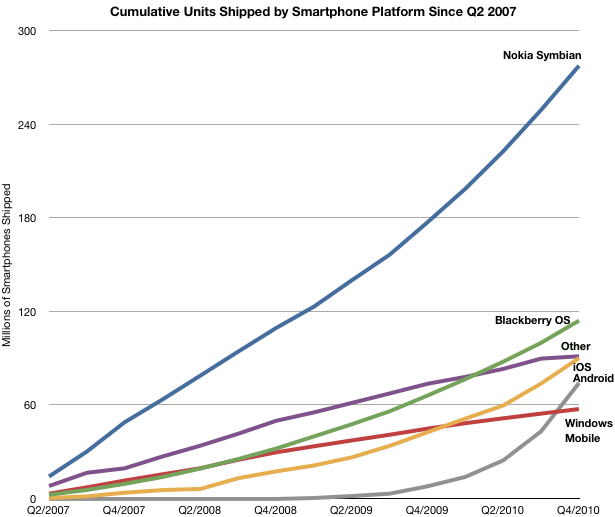
    This first chart shows the cumulative total of units sold since Q2 2007. This is the sum of all smartphones sold in the last 3.5 years. There are some interesting patterns here, but right now we want to focus on the installed base.

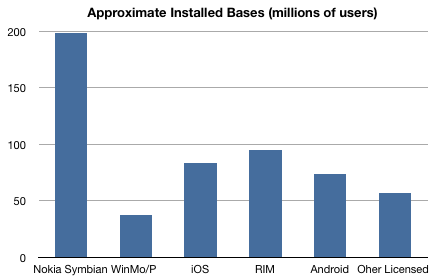
    3.5 years of cumulative sales is an upper bound on the installed base. We can get a better estimate the phones in use by subtracting from the base phones older than 2.5 years. This is shown in the second chart below:

    As of the last quarter, Nokia's Symbian is likely to have 200 million in use. Apple may have about 85 million iPhones in use (this excludes iPod touch and iPads) and Android about 75 million. RIM is around 95 million and Windows Mobile less than 40 million.

    What's interesting is that of these installed bases, the largest is the one that's just been abandoned, and the smallest was chosen as its replacement. Even that's not quite fair since Windows Mobile is not a valid replacement. It's Windows Phone that was chosen and that probably has an installed base of about 1 million [Unlike the measurement of units shipped, Microsoft reported two million licenses were sold to OEMs who had to build those into phones which would be shipped to carriers and distributors. One million may be a generous estimate.]

    The bottom line is that there are about 5 Windows Phone users for every 1000 Symbian users. In other words, Nokia jumped from the "burning" 200 million user Symbian platform to the "ice cold" 1 million user Windows Phone platform.

    The disposal of such a large installed base must count among the largest divestitures in technology history and, when coupled with the adoption of the least-tested alternative as a replacement, elevates platform risk-taking to a new level. It may seem bold, but there is a fine line between courage and recklessness.

    I'll do my own "dive" into the possible justification for this in a future posting.

  9. The lives and deaths of mobile platforms

    Research · 68 comments

    When Stephen Elop said that Nokia and Microsoft sought to create a "three horse race" he implied that there were only two viable mobile ecosystems today. With that statement he sought to deprecate or declare "end of life" two platforms: Symbian and MeeGo, implying that Nokia's efforts at being the third way failed.

    However, he also implicitly declared irrelevant a larger set of market participants. In fact, the market is awash with platforms. Far more than the three or five that Stephen considered.

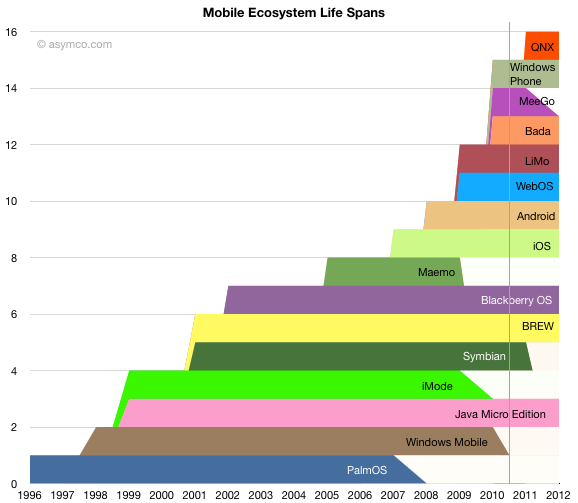
    To illustrate I built the following chart showing the history of all major mobile platforms. The are ranked by launch date (earliest at the bottom). A vertical line marks the present. End dates are approximate and based on declarations of end of life rather than end of usage.

    There have been 16 total mobile platforms[1], 10 of which are still (or soon will be) on the market. Of the six that were terminated, three had replacements built by the same orchestrating company (Windows Mobile begat Windows Phone; Maemo begat MeeGo, and PalmOS eventually led to WebOS.) Only three reached end of life with no known descendant (iMode, MeeGo[2] and Symbian).

    Operating systems that were launched in the 1990s or early 2000s have mostly been withdrawn/replaced with the exception of Java and BREW.  "Modern" operating systems all emerged after 2007 (following iOS). A total of eight such new OSs were introduced in four years[3].

    What I find noteworthy is that there is an implied peculiar fatalism about the market when only two platforms are considered viable, neither of which are more than 3 years old. While visiting the Mobile World Congress, I sensed this jumping to conclusions about platforms was eerily similar to that of a few years ago when new entrants like Apple and Google were declared dead on arrival.

    I can only conclude that there is a great deal of groupthink going on in the industry. A perfect setting for a disruptive entrant to change everything, all over again.

    ---

    Notes:

    1. I excluded some platforms like Motorola's Linux, SavaJe and perhaps some others (Openmoko, Qtopia) which did not gain significant traction. I also excluded any embedded OSs which did not have native APIs.
    2. The end of MeeGo is speculative. Intel is still defending it and may continue developing it.
    3. Android variants like Tapas could be considered new platforms, but I maintain them as part of one OS for the time being.
  10. Where is the Windows Phone Tablet?

    Research · 78 comments

    The Windows Phone platform currently has hardware specifications that imply a cellular phone device. What is interesting in light of the new WebOS TouchPad, the newly announced Android tablets, the RIM Playbook and the iPad is that this supposed "third horse" of Windows Phone has no hint of present or future presence in the tablet form factor.

    That might have something to do with the plans to move Windows to the tablet form factor. Perhaps Microsoft thinks that pocket size devices deserve a separate operating system, platform and ecosystem than portable mobile computers. Perhaps Microsoft plans to have two separate interfaces for these tablets (slates vs. tablets?) Then again, Ballmer held up a Windows Phone and said "This is Windows too."

    It gets confusing.

    The bottom line is that without a tablet implementation, Windows Phone developers and content providers will find that the WP ecosystem will have a limited addressable market and will not be suitable for all forms of media or apps. Tablets are currently expected to grow even more rapidly than smartphones did and so there will be significant numerical advantages to those platforms that support multiple screen sizes and form factors.

    Now that Nokia has anointed the Windows Phone platform as its exclusive conveyance to the device market, the question in the headline becomes: Where is the Nokia tablet?

  11. In memoriam: Microsoft's previous strategic mobile partners

    Research · 223 comments

    Microsoft's new "strategic partnership" with Nokia is not its first. For a decade the software company has courted and consummated relationships with a variety of companies in mobile and telecom. Here are the ones I can remember:

    • LG. In February 2009 Microsoft Corp. signed a multiyear agreement for Windows Mobile to be included on devices from LG Electronics Inc. LG would use Windows Mobile as its "primary platform" for smartphones and produce about 50 models running the software.

    What happened? LG made a few Windows Mobile devices but with WinMo uncompetitive, they abandoned the platform and moved to Android losing years of market presence and all their profits.

    • Motorola. In September 2003, Motorola  and Microsoft announced an alliance. "Starting with the introduction of the new Motorola MPx200 mobile phone with Microsoft Windows Mobile software, the companies will collaborate on a series of Smartphone and Pocket PC wireless devices designed to create a virtual "remote control" for the Web-centric, work-centric, always-on-the-go mobile professional." In addition, the alliance includes cooperation on joint marketing and wireless developer programs.

    What happened? Motorola launched a series of Windows Mobile phones culminating in the Motorola Q "Blackberry killer". As Motorola hit the rocks in profitability new management reached for the Android liferaft. The company now relies exclusively on the Droid franchise.

    • Palm. In September 2005 Palm and Microsoft announced a strategic alliance to "accelerate the Smartphone market segment with a new device for mobile professionals and businesses. Palm has licensed the Microsoft Windows Mobile operating system for an expanded line of Treo Smartphones, the first of which will be available on Verizon Wireless’ national wireless broadband network."

    What happened? Palm shipped a few Windows Mobile, famously dismissing Apple's potential entry as something "PC guys" could never achieve. A new CEO, a private placement and an acquisition later the company is a division of HP making its own operating system.

    • Nortel. When Steve Ballmer was famously laughing at the iPhone and saying that he likes the Windows Mobile strategy "a lot" he was sitting next to the then-CEO of Nortel (Mike Zafirovski formerly of Motorola) with whom the company had just closed a strategic deal.  "an alliance between Microsoft and Nortel announced in July 2006 ...  includes three new joint solutions to dramatically improve business communications by breaking down the barriers between voice, e-mail, instant messaging, multimedia conferencing and other forms of communication".

    What happened? Nortel declared bankruptcy two years later.

    • Verizon. In January 2009 "Verizon Wireless has selected Microsoft Corp. to provide portal, local and Internet search as well as mobile advertising services to customers on its devices. The five-year agreement will go into effect in the first half of 2009 when Microsoft Live Search is targeted to be available on new Verizon Wireless feature phones and smartphones." The deal would ensure Bing distribution to all of Verizon's smartphone customers.

    What happened? Bing did ship on some devices but in October 2009 Droid came to Verizon.

    • Ericsson. In September 2000, "Ericsson and Microsoft Corp. today launched Ericsson Microsoft Mobile Venture AB. This previously announced joint company will drive the mobile Internet by developing and marketing mobile e-mail solutions for operators. The first solutions are expected to be on the market by the end of the year. The company is part of a broader strategic alliance between Ericsson and Microsoft"

    What happened? Ericsson divested itself of the mobile division forming a joint venture which would go on and make more strategic alliances with Microsoft over Windows Mobile culminating in a loss of profits and eventual flight to Android.

    • Sendo. In February 2001, Microsoft announced a partnership, in which Microsoft bought $12m of Sendo shares and a seat on the board. Sendo was to be Microsoft's "go to market partner" for the Stinger smartphone platform that would become Smartphone 2002.

    What happened? Sendo after litigating IP issues with Microsoft went bankrupt in 2005.

    And finally,

    • Nokia. No, not this OS deal, but in August 2009 "The worldwide leader in software and the world’s largest smartphone manufacturer have entered into an alliance that is set to deliver a groundbreaking, enterprise-grade solution for mobile productivity. Today, Microsoft Business Division President Stephen Elop and Nokia’s Executive Vice President for Devices Kai Öistämö announced the agreement, outlining a shared vision for the future of mobile productivity. This is the first time that either company has embarked on an alliance of this scope and nature."

    The plan was to bring "Microsoft Office Mobile and Microsoft business communications, collaboration and device management software to Nokia’s Symbian devices."

    What happened? One and a half years later the same Stephen Elop announced that Symbian will be deprecated.