Since reporting on the 18th, I've mostly finished going over the the fourth quarter Apple data. Here is a quick summary of the articles that covered the financial and product performance:
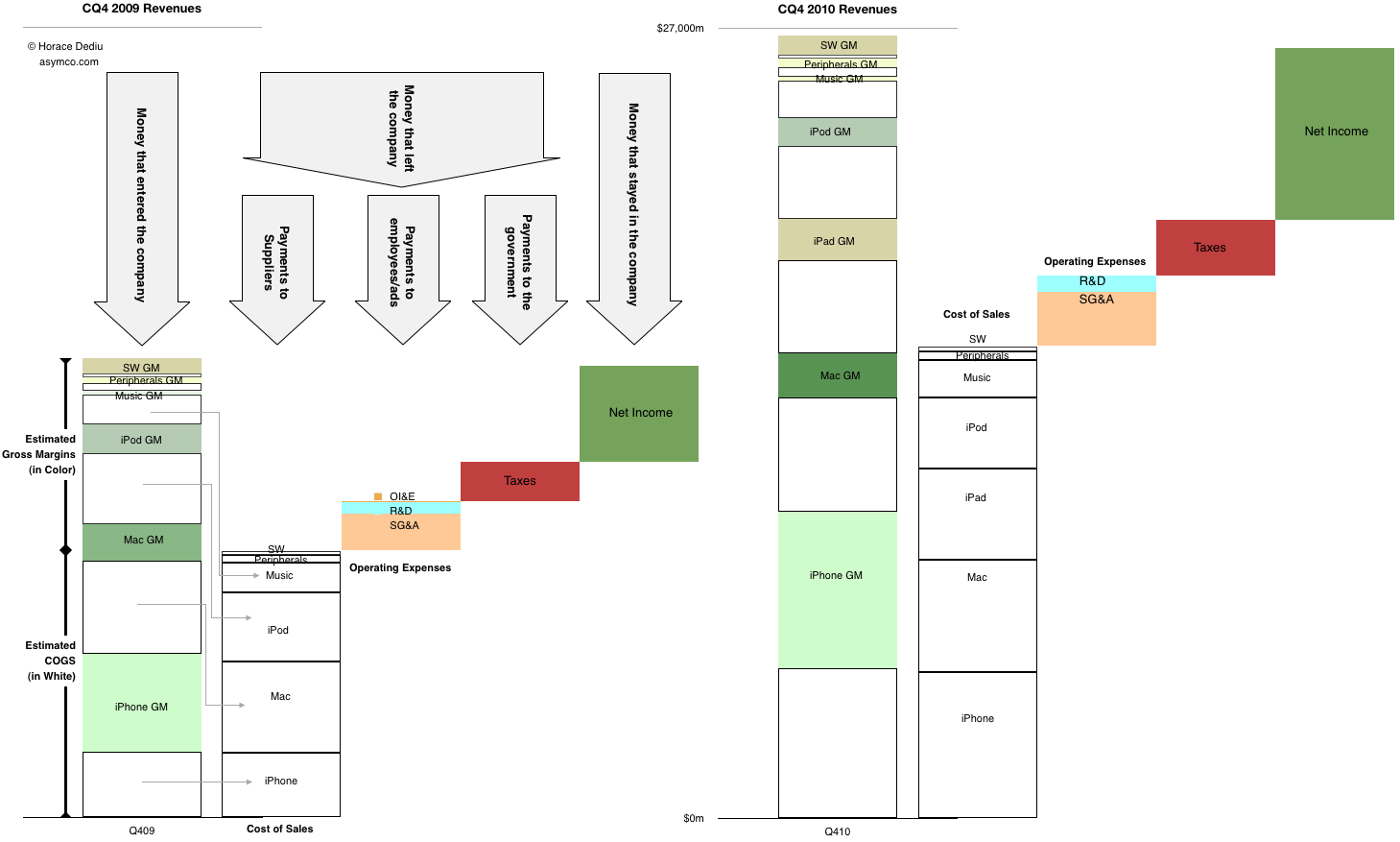
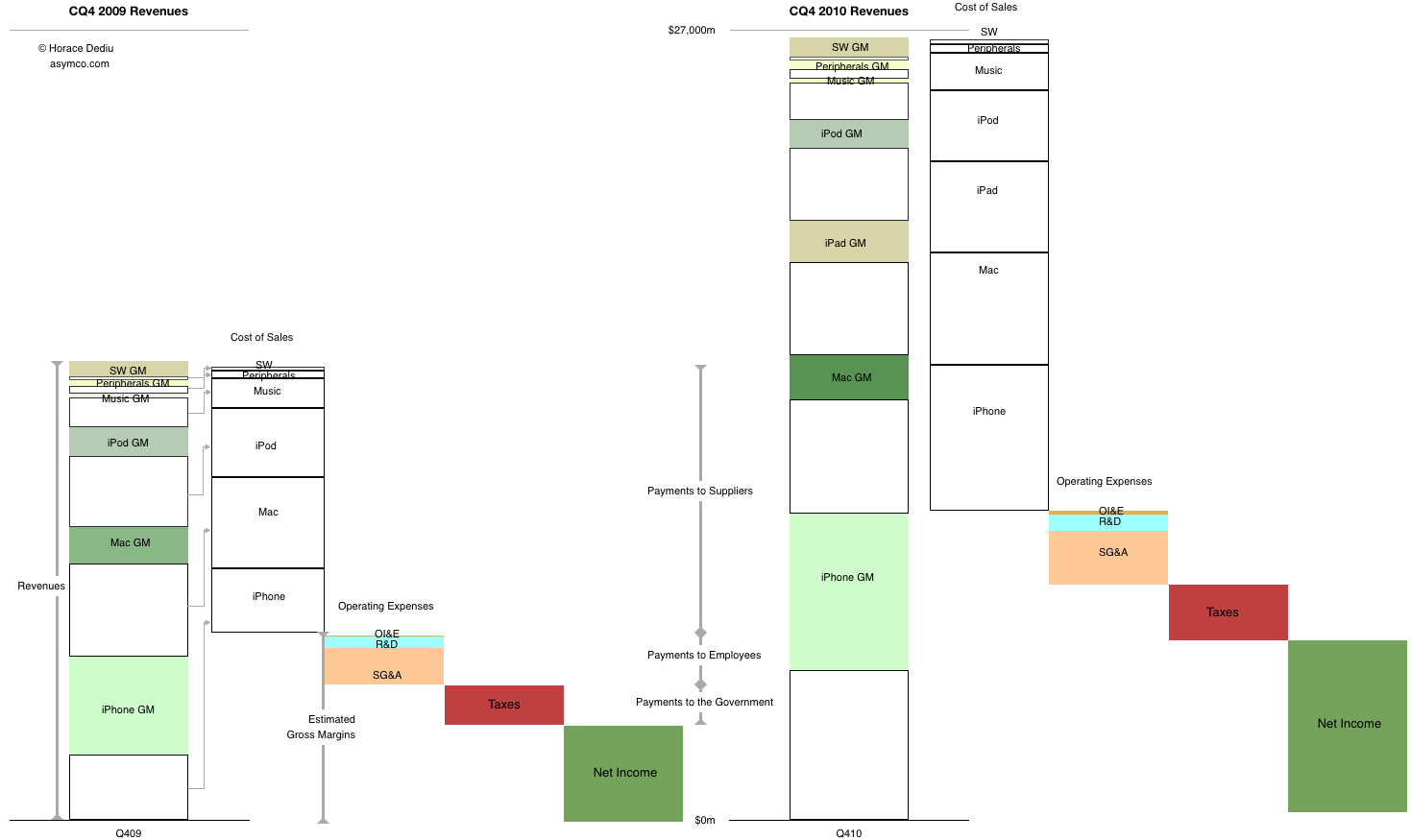
After introducing it last quarter, this is a chart that I'm trying to improve and use as a single snapshot of growth, product mix, profitability, cost structure and overall sales. The purist in me likes to see the chart clean but it can be a puzzle to some. So for the sake of explanation, this time I've added some annotations to the year-ago quarter.
The left half shows flows in the same quarter a year ago and the right side shows the flows in the fourth quarter just ended December 2010. You can see where sales came from, how much of each product's sales went to suppliers and how much was available to pay employees (and who got what). You can also see how much was paid in taxes and what was retained.
Please click on the figure (requires no scrolling when viewed on screens wider than 1464 pixels).
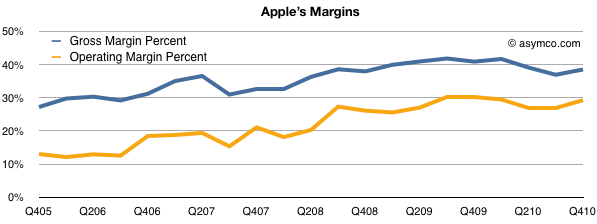
As the highly profitable iPhone makes up an increasingly larger proportion of Apple's sales, the overall gross margin would be expected to grow.
Sure enough that's what's been happening.
The gross margin percent, which measures the direct or variable costs of production vs. price, shows a healthy rise in the last five years from slightly below 30% to around 40%. The Operating Margin, which also includes the overhead or fixed costs like R&D and SG&A, shows a similar rise, reaching about 30%.
Margin expansion while sales quadruple is a good indicator that a company is producing real value not just trading sales volume for profit.
Focusing attention on individual product lines, it's clear that the iPhone is the largest component of sales and of profits. We don't have specific product line-item gross margins from management, but we can estimate a figure for the iPhone by several means.
First, we can work out roughly what every other product line's margin is due to their longer histories. (Mac and iPod have reliable profitability estimates). What's left can be deduced to make up the iPhone's margin.
Alternatively, we can get estimates of the bill of materials and add in some of the other direct expenses like manufacturing, warranties, shipping and incidentals to get an estimate of the cost of production.
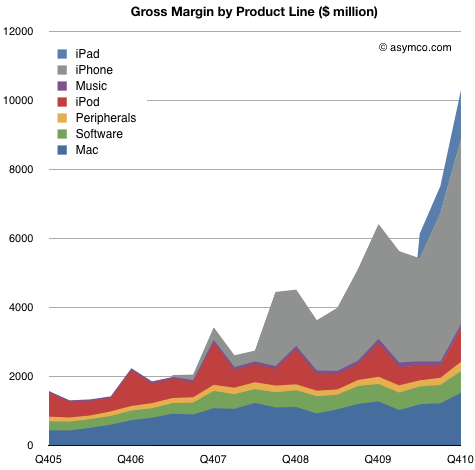
These methods allow me to guess at a margin for the iPhone of about 50% for the last quarter. Based on these inputs we can plot the gross margins for the entire company's product lines:
Overall, gross margins have reached over $10.3 billion in the quarter, increasing 543% from five years ago and 61% from a year ago.
That's great, but by knowing product line profitability we can get a better feel how the company changed strategically.
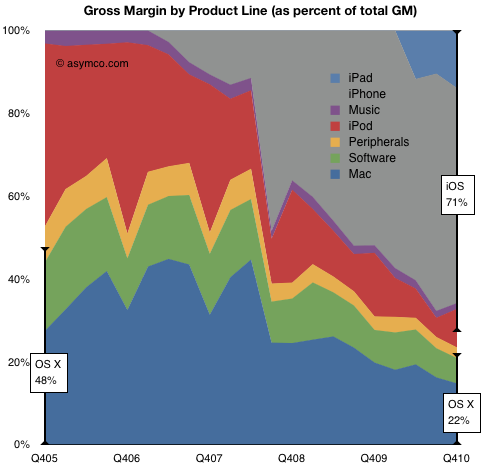
In the following chart I show the percent of gross profit captured by each product line.
What we can observe is that at the end of 2005, OS X based products made up nearly half the profits. The rest was mostly the iPod, which was not a software platform product.
A short five years later, OS X products which, although having grown in volume, made up only 22% of total margin. The rest was mostly iPhone but with significant contributions from iPad and iPod. What's most important to note is that the non-OS X profits are almost all powered by iOS.
iOS powers about 70% of Apple's current gross profits. Combined with OS X, 93% of profits are from platform products.
So again the question about Apple being a software, hardware or media company comes back. Perhaps, those categories are not relevant. Perhaps Apple is a platform company.
Motorola—like HTC—is thus a bellwether for makers of Android phones, whose sales have now caught up with those of the iPhone—about 300,000 a day worldwide. Some industry analysts doubt that it will be able to create a big market for its devices and make enough profits before cheaper providers move in. If they are right, the smartphone market may eventually become like that for personal computers: a handful of huge competitors with tiny margins. The difference will be that these firms will hail from around the world rather than being mainly American.
When I argued that the meek shall inherit Android, the profitability data was the core evidence. That argument, made in August, was:
So here we have the real challenge to Android: partnership with defeated incumbents whose ability to build profitable and differentiated products is hamstrung by the licensing model and whose incentives to move up the steep trajectory of necessary improvements are limited.
In other words, Android’s licensees won’t have the profits or the motivation to spend on R&D so as to make exceptionally competitive products at a time when being competitive is what matters most.
The surge in emerging market Android entrants has been the latest setback for branded Android vendors. What should be the long term strategy for companies like Motorola and Samsung?
Paradoxically, Motorola, being the weaker, has the best chance for successful recovery. The clue lies in both what Palm (now HP) and Microsoft did: starting with a clean sheet of paper and building their own platforms.
This might seem futile given the network effects that current platforms are gaining, and there is a big execution risk, but the alternative is no alternative at all. The big incumbents cannot fight against the clone makers.
Technically, building a new platform is not as daunting a challenge as it used to be. Palm, a small company, managed to do it in about 2 years. Microsoft, a large company, took 18 months. Google built theirs in about 2 years.
They all took advantage of existing code bases (Linux or Windows CE). They also rely on web standards for their APIs (.NET or Java or HTML5).
The challenge is bigger in attracting developers, though again, some core set of apps and developers can be obtained on the promise of brand power alone. Intel and Nokia is using this power for MeeGo.
Motorola's advantage today is its new autonomy and singular focus on mobility. It has hit the reset button. There is no better time to be courageous and there are no sunk costs to confuse investment priorities. Android was a necessary stop-gap measure and the Droid timing was very good (before the clones and before iPhone distribution expanded). However, now would be a good time to start building a Motorola platform for the future.
At this year's CES two unthinkable things happened:
The abandonment of Windows exclusivity by practically all of Microsoft's OEM customers.
The abandonment of Intel exclusivity by Microsoft for the next generation of Windows.
Many of Microsoft's customers chose to use an OS product from Microsoft's arch enemy. Some chose to roll their own. Microsoft, in turn, chose to port its OS to an architecture from Intel's arch enemy.
These actions confirm the end of the PC era. Although most people would characterize the era as exemplified by a particular form factor or market, for me the definition of that era is the way the value chain was structured and hence how profits were captured.
That era was marked by the condensation of profits around two companies, Intel and Microsoft, with the simultaneous evaporation of profits from all other participants in the value chain.
To achieve this, Microsoft maintained a monopoly on the distribution of operating systems and Intel maintained a monopoly as the single supplier of chip architectures for that operating system.
These monopolies are both over. And they both ended at the same time. And it happened this week.
Since I spend most of my time thinking about what will happen, at the end of each year, rather than looking forward I like to look back to see how wrong I've been. The great thing about being wrong is that you learn something. Especially if you use a foundational theory to tie concepts together. Theory building is all about finding anomalies that adjust and improve it.
Fortunately, exactly one year ago, on December 30 2009 I wrote an article asking if Android was disruptive. It turned out to be the right question to ask for 2010.
What have I learned since?
My main argument in late 2009 was aimed at the reaction of the recently launched Nexus One. A product hailed as disruptive to mobile operators. I did not see it that way. In that respect I was right. The distribution juggernaut any phone platform faces stopped the Nexus One dead in its tracks.
I wrote:
Here’s the problem: since mobile broadband is by all accounts not good enough, it cannot be disrupted. Operators are very critical in building out this new mobile computing future and they are investing and will reap rewards. Bitpipe models will only emerge after 4G when there will be ubiquitous high speed networks and competition will shift away from coverage and more to price and convenience of plans.
What is happening instead of operator disruption is that mobile voice which is more than good enough is being disrupted. Businesses built around mobile voice (e.g. handset vendors who have not developed a viable business model around data) will simply evaporate and their profits will condense around entrants who have mobile computing platforms.
So the operators are as strong as ever. But the Android platform lived to fight on, regardless of the Nexus one. And it grew in ways I did not anticipate. I had expected integrated players to maintain a large share because they would be able to improve the product more rapidly than modular vendors (and assuming that the product needed improving).
Google is moving on this opportunity but they are not executing in a way that ensures they control the future platform due to the their being on the wrong side of the modular/integrated dichotomy.
So Android grew but it's not yet creating profits. It is perhaps laying the foundation for future profits and defending existing profits for Google but it is not yet a big profit center[1]. That is a cause for worry. Disruptors need to be hungry for profits and patient for growth.
I concluded:
Android will disrupt but I expect it will take 10 to 15 years. The life cycle of a new global network generation rollout is about 10 years. We’re in the middle stage of the 3G cycle that traces its beginnings to early this decade. 4G will take another 10 years.
Given what's happened this year does this forecast still hold?
Mainly yes. I stand by the notion that operators will be in the driver's seat for a few years to come. However Android has grown in an unexpected way: adoption by unbranded or relatively unknown vendors selling in emerging markets.
The Grey (market) Elephant in the room
Until 2010, it was very difficult to sell a phone without a recognizable brand. This is because brands helped overcome purchase anxiety for those buying a device for the first time. Brands mean trust and the lack of brand meant risk. Those who cannot afford to make purchase mistakes are more likely to lean on brands than the affluent.
But 2010 has seen a shift away from device brand value and more toward platform and function value. This shift was largely unforeseen and is very disruptive.
All those vendors are likely to adopt Android and in doing so will explode the low end of the market. They may even crush the branded voice-oriented market.
This growth can be slowed by operators but market forces will be very strong. These devices sell in grey markets and are often unlicensed, unbranded, untaxed and unregulated (and may even be illegal due to the absence of IMEI numbers).
So this is the real wild card for 2011: unbranded devices running Android could be the PC clones of the post-PC era. Will this phenomenon last or will the brands fight back? If they fight, the only weapon they could wield is innovation.
---
[1] Mobile efforts at Google are generating over $1 billion in revenues per quarter however these efforts include various other assets including AdMob which was acquired for $750 million. Furthermore, the headcount for Android and these other efforts is not small. I've heard as many as 3000 people are devoted to Google's mobile efforts.
One of the most popular themes running through the mobile phone industry this year has been the unprecedented growth in Android adoption. I've argued that the adoption was initiated on the supply side by vendors and operators, but demand has certainly manifested itself.
Android is almost viral in the way it spreads. With no constraints on intellectual property, pricing, contracts, modification or terms of distribution, the incentives to push product out are phenomenal. It even works, mostly.
One hypothesis of the consequences of this viral adoption is that there will be a "commoditization" of smartphones with rapid price erosion to follow. This in turn might even lead to lower margins for Apple and RIM and most major vendors, including those selling Android itself.
In order to test this hypothesis, we need to look at what has been happening to prices. If prices have started tipping down at more than their usual rate then maybe commoditization is happening.
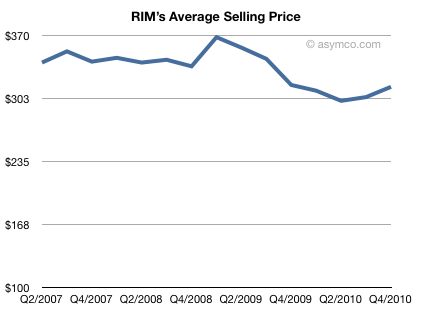
We can begin this test with the industry's canary in the coal mine: RIM. RIM has been struggling for growth in the very market where Android has been growing the fastest. Is RIM's pricing under pressure?
Interestingly, no. Their ASP (average selling price) decline, from an average of $350 to $310 in late 2009, came before the Android avalanche. During this year, the ASP has held steady, even rising in the last two quarters to $315 while Android activations reached 300k/day.
So I don't see a big problem with RIM, yet.
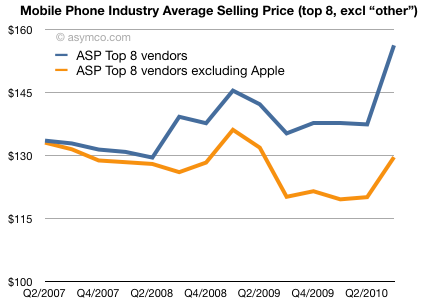
What about the industry as a whole? Can we see patterns that suggest imminent commoditization? Using the top 8 vendors (Nokia, Motorola, Samsung, Sony Ericsson, LG, RIM, Apple and HTC) and using volume-weighted ASP (total device sales divided by total units sold) we have the following chart:
Since the second half of 2007 the "industry ASP" (blue line) has actually increased. This is even though there was a huge recession in the middle of the time period.
This should be only slightly surprising. If you suspected that the iPhone may have a lot to do with that, you would be right. If you remove Apple from the mix, the second line (in orange) shows that the top vendors (ex-Apple) had some, but quite quite mild erosion (from an ASP of $133 to $129)[1].
This is far milder than what's been happening in the PC sector where prices are dropping catastrophically (According to NPD the average selling price of all Windows portable PCs has fallen from $659 in Oct. 2008 to $519 in Oct. 2009).
So Apple was a big contributor to the industry increasing its pricing power.[2] but even without Apple the industry has been holding on.
But is this just a lull?
Is Android going to stop the growth?
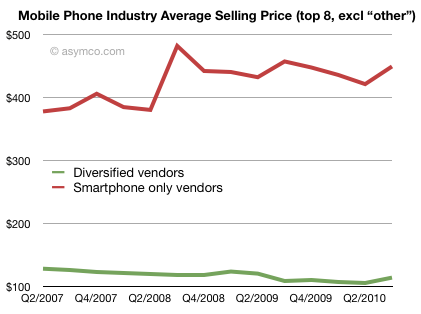
We can look at the pricing data one more way: If we separate the eight companies into two cohorts, the "diversified" vendors who sell both smartphones and regular phones vs. the "pure play" smartphone-only vendors, we get the following price history.
What is happening is that the diversified (Nokia, Samsung, LG, Sony Ericsson, Motorola) saw modest price declines (from $128 to $114) while the pure-players saw price appreciation (from $378 to $449). This is with the early impact of Android priced in. Unfortunately I don't have a chart showing non-smartphone prices in isolation, but I would be willing to bet it would be a significant negative slope.
In these two lines Android is not an independent variable. Android was adapted by some of the diversified vendors (all but Nokia), but in different ways. The thing is that Motorola and Sony Ericsson had great increases in ASP with Android. Among the pure-play vendors only HTC adopted Android and its performance is undistinguished vs. RIM which didn't.
So what, if anything, has Android done to pricing?
I argue that there is no evidence in the pricing data of a coming commoditization of smartphones. Android vendors were able to use the platform to move to higher pricing and the more they switched their portfolio to Android the more they got a better average price. At the same time those vendors who built smartphones without Android also saw strong price supports.
The only correlation with pricing power is whether you build smartphones or dumb phones. The more smartphones you build, the more price you can charge. This is regardless of platform.
The reason for this is that the smartphone market is growing so rapidly (90% y/y). There is limited direct competition between smartphones and a lot of competition between non-smartphones and smartphones--a battle smartphones are winning handily, irrespective of price. Smartphones seem to be what everyone wants.
So the real question that should be asked is:
Why do vendors bother making any dumb phones at all?
If you look at the third chart above you can see how attractive it must be for the diversified vendors to abandon the non-smart market to ZTE, Huawei et. al. Perhaps Nokia can still make a small profit there but to do so you need to run faster and faster toward extraordinarily low costs and prices. A point where phones cost less than everyday consumables. What keeps Samsung and LG in that game? Motorola and Sony Ericsson left once they hit profit warnings. Is that what it takes to drop what seems to be a loser business? I think not.
My bet is that by the end of 2012, it will be hard to find any branded phones which won't run a smartphone OS. Demand and supply of smartphones will race each other to overwhelm portfolio logic at the largest companies. The zero (visible) cost of Android will snowball this effect. What's even more provocative is that I believe the "others" will follow and abandon voice-oriented phones for smartphones almost immediately after the larger group.
I've long argued that the phone market should be studied as a whole because the competition is not between platforms but between smart and non-smart. Pricing is a leading indicator of what drives decision making inside vendors and it leads margin, and thence portfolio discussion. Android is expanding the market without crushing pricing. The margin expansion is what attracts more vendors and creates more demand. It's a virtuous cycle.
In a way, this is all good news--even for Apple. A world full of smartphone users is a better addressable market for iPhones than one filled with voice products. iPhone's traction was always in markets which had been seeded by some smartphones: the US with RIM and Europe with Symbian. Such a smartphone-soaked world will have better mobile broadband infrastructure, users with more demanding tastes and awareness of the value that a smart device can bring.
---
[1] The effect of "other" vendors not among the 8 listed is a big unknown. It's been estimated that they now make up as much as 30% of total volumes and that they are beginning to ship significant volumes with Android. Without visibility into that part of the market, we should be cautious. However, the eight vendors sampled here are still a significant cohort and the conclusions still appear reliable.
[2] This industry had, until 2007 suffered from chronic price erosion. Each sustaining innovation drove a mild burst of pricing power but it never seemed to last. From color screens to bluetooth, to 2.5G to 3G to MMS, to cameras to music playback, each hardware advance was not enough to keep the erosion away. The tipping point seems to be the iPhone and the shift to software as the component that drives price power.
The release of the iPhone is rightly acclaimed as a watershed event in the history of telecom. It was a sensation. But it was also a product that was widely underestimated and dismissed. Even today expert opinion is divided. The critics of the product transitioned directly from labeling it a superfluous bauble to an obvious and copyable sustaining innovation. Advocates of the product describe it as revolutionary and dazzling with the potential for capturing significant profit share due to premium pricing and positioning.
So which is it?
I'll argue that it's none of the above. The iPhone is not superfluous, not easily copied, not revolutionary and not a premium product. What it is is disruptive.
First, we have to quickly define disruptive potential.
A product is disruptive if it competes with an existing, incumbent set of products on a new basis. It competes along a new measure of performance. That means it's either "low end" and hence cheaper, simpler, more modular and conformable, or it creates a "new market" where completely new measures of performance or quality are relevant.
In both "low end" and "new market" disruptions the product is usually wrapped in a business model that insulates it from incumbent response due to inherent asymmetries. Incumbents will find the economics of the entrant product unattractive and will be motivated to ignore it or actively avoid copying it.
The consequences of disruptive product entires are often catastrophic for the incumbents because, over time, the disruptor product vacuums up all the profits in the industry, robbing the incumbents of the fuel to respond by the time they become motivated to do so. In essence, the transfer of value to the new basis of competition happens so slowly that the threat is imperceptible until it's too late.
If we look at this definition, it's startling that the iPhone does not seem to fit.
As a phone, it's not cheaper, nor modular and hence not "low end". It did not create a new market. As a phone, although it did recruit more regular phone users into becoming smartphone users, it was not the first or last phone to do so. Its phone business model was not a radical departure. It was not ignored by the mobile phone incumbents who reacted with various degrees of urgency and vigor. It was actively copied in every way from the UI to the ecosystem to the pricing model and distribution.
The only thing that seems to have happened according to the disruptive formula was the transfer of profits from incumbents to Apple, at least temporarily.
So the iPhone seems to be correctly classified as a sustaining innovation. Something that moves the phone market forward and which, except for a temporary misallocation of profits, will entrench the incumbents after they manage to copy it effectively.
However, here is where we have to dig a little deeper.
Market analysis easily becomes myopic when looking only at a market defined by a product. I've argued in the past that strategic insight comes from looking at products that cross over their market boundaries. Especially products that are hired to do different jobs than the same products in their categories. The iPod may seem like an MP3 player but it caused catastrophic profit collapse in multiple industries. It knocked out the CD business, it crippled the component audio system "Hi-Fi" industry, it razed the music retail business and affected the entire music value chain. It's still pounding at the gates of video and TV production. And, almost as a side-show, it crushed the Walkman.
Even though it was a music player, the MP3 device market was the smallest target for the iPod. It turned out to be far more dangerous to ancillary industries. The reason is subtle: it competed as an integrated ecosystem. You hired the iPod to serve you music everywhere, not just in your living room. And it did the job in an integrated way from source to earbuds taking what was a hodgepodge of modular components built around analog music and smoothly integrated them to deliver music in new, non-consuming contexts.
The lesson is therefore that when looking at the iPhone one has to look at ancillary industries not just at phones.
Phones have always been a component in a wider inter-related telecom value network. Even today they are often called "terminals" in the industry meaning that they are the end points of a network. Similar to the PC, the iPhone enables a migration of intelligence away from the center toward the edge of the network resulting in a de-valuation of the network itself.
I argue that the real disruption of mobile computing (i.e. iPhone) is made possible not by the smartphone technologies but by mobile broadband. Once broadband became mobile with 3G the smartphone could shift its focus (jobs it's hired to do) from voice to data. That shift is disruptive to incumbents because they built their businesses around operator distribution and operator service economics. With apps, mobile computing brings with it services which allow all communications to be independent of operators. Selling ringtones, maps, email and video-on-demand are all dead business plans today. But operators clung on to these hopes for many years and forced vendors to comply to this strategy.
The incumbents relied so much on the telecom value chain, where the value flows from the monthly service charge, that they would not deploy technologies or business models that were asymmetric to operator business models. This is the root cause for Nokia and Samsung and Motorola and LG "missing the boat" on smartphones. All the vendors had the pieces of technology on their shelves. But when they took these technologies to their customers, the customers rejected the package.
This is why entrants like RIM and Apple could easily gain a foothold and grow. They had modest volumes, sold new concepts like business email and new UIs with iconic designs, but did not go after the core business model. This is similar to how iPod/iTunes got a toehold with the record labels. By the time the disruption took hold, operators were addicted to the new high-ARPU being generated even though they were all pure bitpipe plans. A bird in the hand is worth two in the bush, so the new device brands stuck.
Do the incumbents still have time to respond effectively? It's less and less likely. They cannot build the new computing ecosystem without the distribution power of operators. Note that iPhone 'clones' in Android are still sold via operators and that nobody is interested in making either iPod touch clones or iPad clones sold independent of the operator channel/subsidy model. This is not because of technical or economic reasons but because of a lack of distribution (and lack of integrated content).
When you step back and look at the phone in the context of the network business model as well as the shifts in consumer jobs to be done you realize the potential is far greater than taking share from incumbents. The iPhone is not divided into a portfolio of different phones, but it's a part of a portfolio of new mobile computing products. It just happens to be the only one which still depends on the cellular operator distribution network.
Seen as part of a new mobile computing paradigm and following the trajectory of the mainframe, mini-computer, PC and laptop, the iPhone is an essential, non-superfluous device for a vast population of new users.
Seen as an integrated app ecosystem with strong network effects, it's not easily copied. Responses that only account for it as a glass and metal object of desire will fall way short of being competitive. As the hardware was always available to competitors, it's not a revolution in hardware or even in user experience.
Most importantly, seen as a computing alternative merged with a communication appliance, it and its siblings are not premium products. The pricing and service structure around it make it seem a low cost alternative for solving the jobs it's hired to do.
When the iPhone vs. Android rhetorical war heats up, both sides bring up the history of Macs vs. Windows PCs. The commonly held thesis is that Windows triumphed as the PC was commoditized (and modularized). This triumph was at the expense of the over-serving and over-priced Mac.
This is a largely accurate view of what happened during the 90s. But the problem with this thesis is that (1) the PC's job has been slowly changing in the last decade (2) the Mac keeps growing faster than the PC and (3) Apple keeps capturing a vast portion of the profits in the PC industry.
These anomalies or contradictions to the thesis imply that something changed. What changed and can these changes turn the tables on the market and create an opportunity for a new computing disruption?
The PC of the 90s was hired first by companies as a productivity boosting tool and second by consumers as a way to duplicate their work productivity and communications in their personal lives.
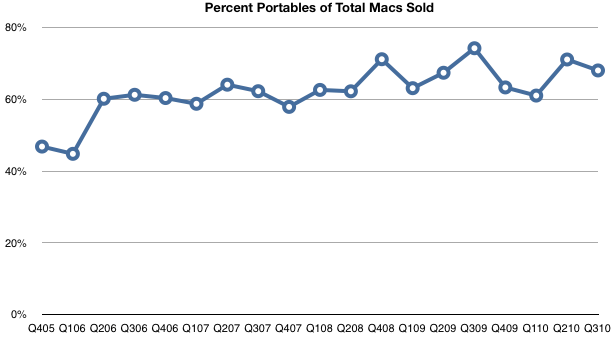
However something changed with PCs when the laptop became "good enough". With portable computing, the job the PC was hired to do evolved. It was more important that the product be well designed (for aesthetic value, usability and reliability) than just fast and spacious. The microprocessors were plenty fast but what mattered more was low power consumption, a low profile and tighter integration with software.
The product was also purchased in a different way. A desktop could be purchased on specs alone, sight unseen, from a catalog. But a laptop had to be touched, hefted and the screen had to be observed and the whole design contemplated before a purchase decision was made. The product had an integrated keyboard, display, touchpad and storage. It was not easily serviced by end users. It was, in a word, re-integrated.
You can see how portability changed the job and therefore everything else as well. Consumer tastes became important, retail distribution became necessary and R&D resources had to be applied to solve what was no longer good enough: the whole package.
Vendors which did not prioritize design, retail and R&D were left flat-footed.
At the same time, systems software became more commoditized and productivity software became portable. The old measures of performance were being over-shot while the new measures of performance were under-served.
While this shift was underway on the hardware side, Microsoft continued to improve their product to serve more demanding business productivity jobs. Their software was not getting optimized for this new portable consumer job. They left the new market open to disruption.
In stepped the MacBook with good enough (and improving) office productivity. With excellent appeal along the dimensions of performance consumers demand most of all. It was priced higher than other laptops but the price points were affordable and, inflation-adjusted, lower than they'd ever been. It should not be a surprise that Apple was one of the first vendors to see its portables line become bigger than its desktop lines. The market evolved to the point where what Apple had was what the buyers needed.
The shift to portability is a compelling story for Apple as disruptor in the PC market. It may not result in a complete reversal of the PC hegemony but it allows Apple to grow a product line at triple the growth rate of the market. A market that was considered completely dominated by entrenched incumbents with an unbreakable profit formula.
But with the iPad Apple is clearly also aiming at disrupting the Mac (and, transitively, the PC as a whole.) The iPad can be seen as an evolution toward seamless portability; the mobile computing paradigm shift.
People throw around the idea of things being or becoming "commodities" but there is little clarity about what "commodity" status implies.
If you look up the word, it has nothing to do with technology or innovation. In economics, a commodity is something that is substitutable (fungible) and roughly equal to competing versions of the same thing. A mineral good (oil) or agricultural product (pork bellies) is roughly of equal value regardless of where it comes from or who produces it. Commodities also have very liquid markets and are therefore easily priced according to demand.
Commodities have a "fixed" quality which cannot be and most likely never was improved. It's a product that is essentially frozen in terms of innovation.
But in technology and especially in terms of complex, rapidly improving and evolving products with uneven distribution a commodity is not easy to identify and there can be a lot of arguing about what is and isn't.
So here is another way to define it:
In terms of innovation, a product can be defined as a commodity if it reaches a point where improvements do not create additional value. As the product gets better, it reaches a point where customers can no longer absorb the improvements and therefore they become unwilling to pay for them. Thus the price of the product cannot be increased or maintained in the face of competition.
In other words, you can't get a premium price for a better product.
If you can't improve the product, one consequence is that you can no longer differentiate it. Becoming commoditized is a natural result of the improvement of a product beyond the customer's ability to utilize that progress.
So we're back to the debate about whether a product is good enough. You can argue that commodity status is that point where it over-shoots the market. Before that point is reached the product can obtain a price premium for technology innovation. After that point, the product becomes a "commodity".
How does this relate to the mobile market today? Again, it's important to ask what is the basis of competition. Is hardware not good enough? Is software? Or is the whole widget?
For those who say that smartphones are commodities, they have to also account for the inevitable consequence: that improvements will not be valued and hence will not be implemented. It also means that profits will evaporate from the current incumbents to new models of profit capture.
This is the essential argument for Android. But I'm still struggling with what the argument implies. That the product as it exists today is all that will ever exist.
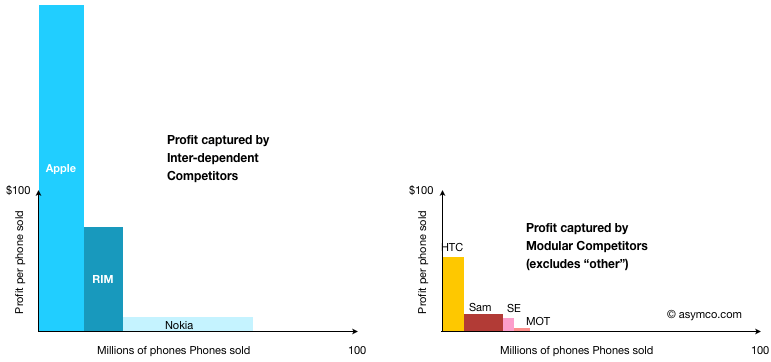
Following-up on the profitability discussion for the top eight vendors, I built a chart to show estimated profit capture from smartphones, further dividing the vendors into inter-dependent (own OS) and modular (licensed OS)[1].
The areas shown represent total profits by vendor and architecture. The totals:
Inter-dependent: $3.83 billion
Modular: $0.59 billion
Most of the modular profits came from selling Android devices.
[1] Samsung and Nokia profits from Smartphones are not directly available and are estimated.
In previous posts I detailed shares for units, sales and profits. I also offered different ways to look at the data like rankings and profit "area" maps.
This article is about the absolute numbers. What is the total market in terms of units sold, sales and operating profits.
The time frame remains from the second quarter in 2007 to the third quarter of 2010. The same eight vendors are analyzed (with "Other" available for units analysis only).
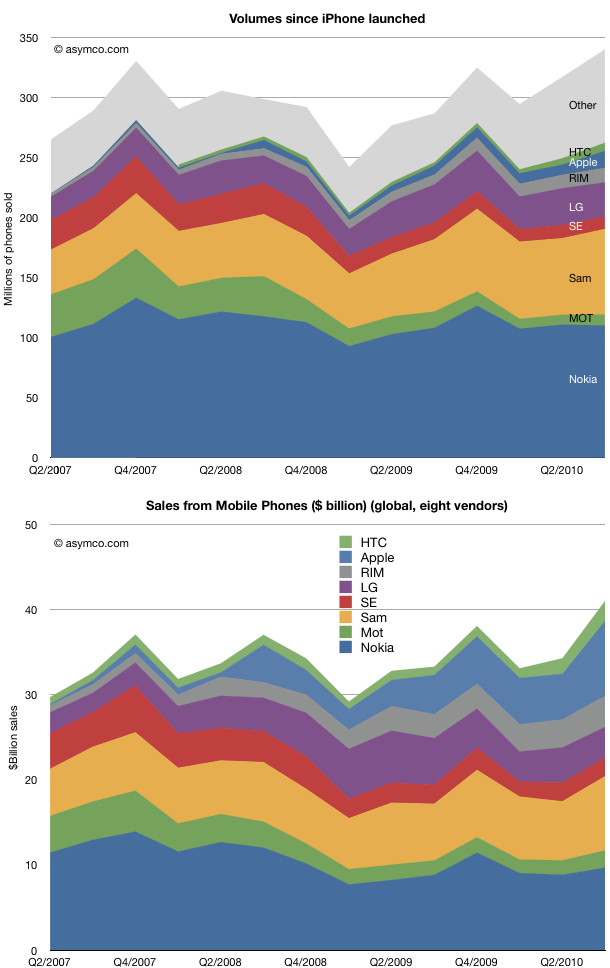
The first observation is that the market grew to new heights in Q3. 340 million phones in the quarter means that we might be looking at a very good holiday season. The market was range-bound due to the recession and its over-hang, but there seems to be a good indicator of macro-level recovery
On an individual competitor basis, the share snapshot pictures we saw earlier gave a good summary of the condition of competitors. Here we see the evolution of absolute units and sales over time. It's instructive to scan the two charts as a pair to see how units and sales are affecting the positions of the participants.
I clustered the "pure smartphone" vendors at the top of the charts so you can visually separate them from the broader portfolios of the others.
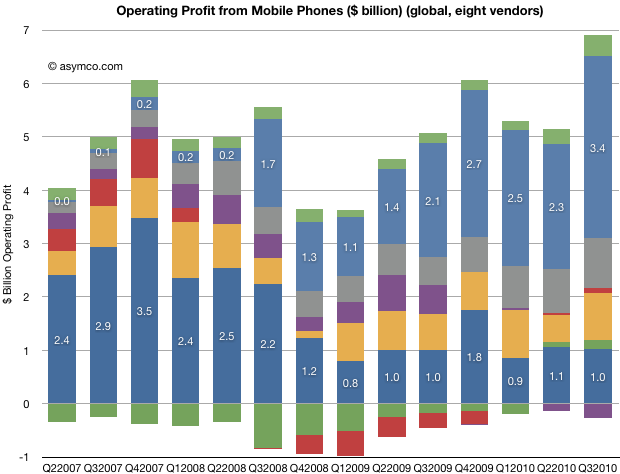
Finally, here is the evolution of total profitability (operating) for the participants. I annotated Nokia and Apple for calibration.
(note the color coding legend in the pervious charts).
What is most impressive is how LG, Motorola and Sony Ericsson seem to be in the same boat. At the same time, Apple, RIM and HTC are outstanding in performance. And Nokia and Samsung are stuck in a dilemma. On the other hand, every vendor is different in many ways, and it's inaccurate to paint them with the same brush.
Overall, we see a pattern of increased absolute value in the market. All but one vendor is profitable, and sales are increasing. A large part of the growth is due to the transition of the market to smartphones.