14.2 million devices shipped, sell-through: 12.3 million
expect to ship 14.5 to 15 million units in the next quarter
ASP of approximately $315
US, UK and Canada are 56% of sales
US represented 34% of the total revenue
Last year US represented 57% of revenue
BlackBerry Torch launched in over 75 new markets, Torch launched with the $99 pricing from AT&T
BlackBerry Curve 3G launched with 118 carriers in 48 countries
China Mobile introduced BIS for small-to-medium sized businesses. The service starts at $14 per month
App World applications grew 60%
More than 16,000 applications available
2 million downloads daily
1,000 vendors registered for PlayBook apps
Revenue: $5.5 billion
Net subscriber additions: 5.1 million
Top three customers: 12%, 9%, and 9% of revenue
The same quarter a year ago: 25%, 13% and 10% of revenue
Service revenue in Q3: $835 million
Software revenue: $78 million
Gross margin in the quarter was 43.6%
Cash: $2.5 billion
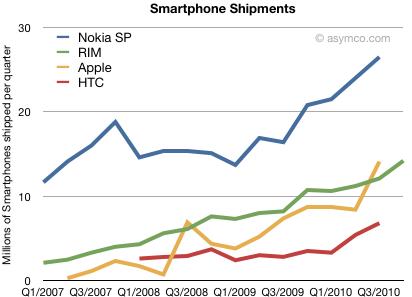
For comparison, here are a select few vendors' smartphone reported shipments. RIM is the first to report and we'll be hearing the the rest by the end of January.
The number most RIM "bears" focus on is the new subscriber additions. At 5.1 million out of 14.2 million units sold implying that the new subscribers added per unit sold is 0.34, a new low.
The bulls will argue that the gross margin is healthy and slightly higher than anticipated.
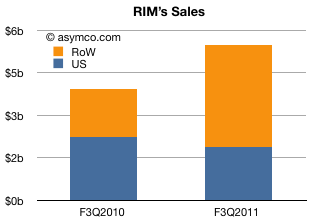
My observation is that the company is finding growth outside its traditional markets. Given the figures above, the US went from $1.65b in revenue to $1.87b; a mere 13% growth while the company experienced 89% overall growth in revenues.
The following chart illustrates the situation:
Of the total increase in sales ($1.6 billion), the US contributed -15% while the rest of the world accounted for 112%.
This can be seen as positive news since RIM has been weak internationally for many years and they really need to penetrate world markets. However, a -15% growth in the US is implies significant share loss in a rapidly growing and traditional stronghold.
[ITG sent an explanation of their methodology and there is no indication that the data represents inside information.]
ITG Investment Research analyst Matthew Goodman is forecasting monthly sales record for all of Verizon's devices "based largely on our proprietary daily point-of-sale data from thousands of independent wireless retailers across the US."
Assuming the data is accurate, we are going to dive into it but I will state up-front that without confirmation, the conclusions below should be taken with a grain of salt. All statements should be read with a preceding "if the data is accurate..."
So, if the data is accurate, here is what I conclude [1]:
Verizon Has three strikes against them:
The iPhone has stolen their growth
They are facing the prospect of a single OS platform supplier
Android is not competitive vs. iOS
The iPhone has stolen Verizon's growth
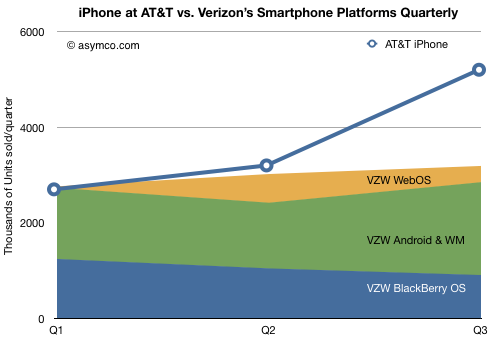
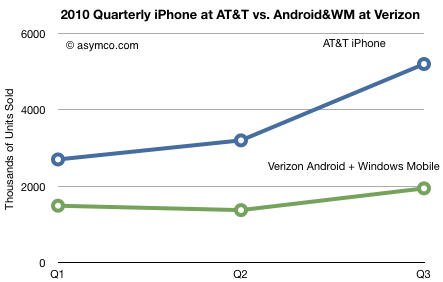
The chart below shows the performance of all of Verizon's smartphones vs. the iPhone at AT&T. The area chart shows how Verizon's volumes grew from 2.7 million in Q1 to 3.3 million in Q3. Not a bad story in itself. However, the iPhone at AT&T went from 2.7 million to 5.3 million in the same time frame. Relative to just the iPhone, Verizon has been underperforming over the last quarter.
Those additional 2.4 million iPhone/AT&T activations in Q3 could be due to replacements but the same could be said for Verizon's volumes. The fact remains that iPhone alone is nearly twice the volume of all of Verizon's smartphone activations.
Just to be clear, this is a direct, apples-to-apples comparison. AT&T and Verizon smartphone performance figures are highly comparable. The two operators are highly representative of the US market. AT&T and Verizon Wireless raked in 75% of all mobile data revenue in Q2 of 2010 and account for 62% of the U.S. wireless customer base.
In addition, Verizon enjoys a larger customer base (has 92.1 million subs vs. AT&T's 90.1 million.) Over the time frame of the data the overall market did not increase dramatically therefore the conclusion that AT&T's win is Verizon's loss is plausible.
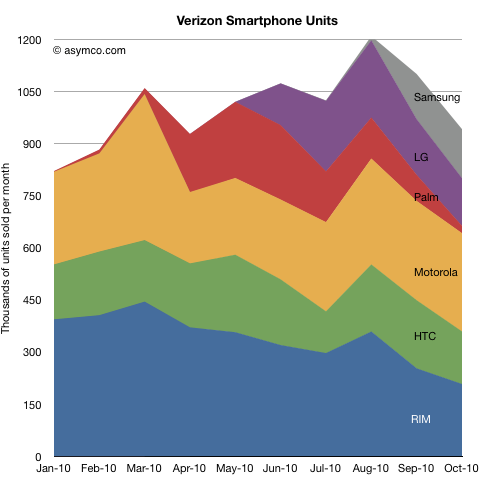
I used quarterly data so that iPhone at AT&T could be compared. But if we look at monthly data, the story gets worse:
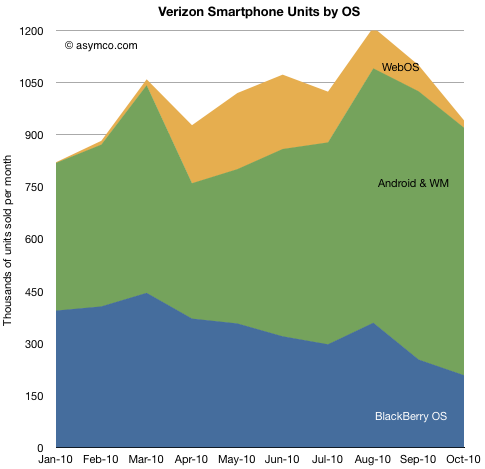
These are absolute volume figures. You can see how RIM's fade was replaced to some degree by new vendors. However, growth hit a wall in August. Following widespread iPhone 4 availability, sales dropped. Coincidence? Perhaps, but the drop happened even with the addition of Samsung volumes.
That's strike one.
Verizon is facing diminished degrees of strategic freedom
The other notable is that even though Verizon doubled the number of vendors selling smartphones, it seems they are growing their smartphone base slower than the overall market.
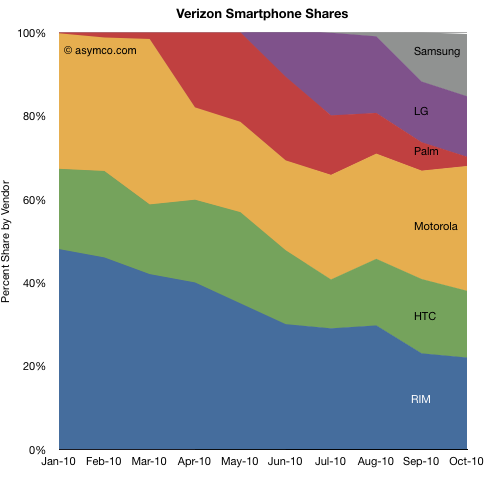
Consider each vendor's share is shown below:
From three vendors to six. Shares are roughly evenly split (except for Palm) but none of these vendors are able to drive volume growth.
Consider that Motorola Droid is outselling RIM. This should be rightly noted as amazing. It plainly shows the power of Android. However that power is not something Verizon will benefit from. Quite the opposite.
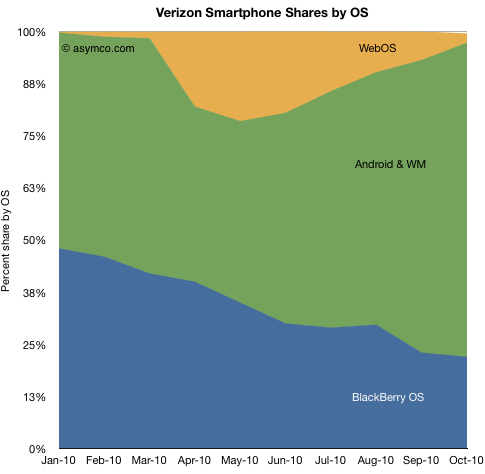
Consider the share map by units and share of each OS:
Android (and WM, though that's likely to be a very tiny part of the green area) made up 75% of all smartphones sold in October. It's possible that the share could grow to 90% as RIM continues to fade.
For Verizon this would be a serious problem. Although Verizon used to have a disproportionate share of RIM's products, that OS was not enabling an ecosystem like Google's. It was a product narrowly defined around messaging. Verizon is facing the prospect of a single OS supplier who may or may not maintain alignment with Verizon's core profit algorithm. If they diverge, Verizon's bargaining power will be strictly limited.
Strike two against Verizon.
Android is barely enough to keep the battle with AT&T from becoming a rout.
In an apples-to-apples comparison, in Q3 the iPhone at AT&T outsold Android at Verizon (remember, same addressable market) by a factor of 2.5. This is with a variety of devices and vendors thrown in the market. We hardly ever get to see this finely grained a comparison when looking at platforms.
I wrote this up as a lack of competitiveness. It may seem provocative, but I define competitiveness narrowly: the competition is for a purchase decision on equal terms. These purchase decisions are fiendishly complex to predict, but the data speaks: whether it's due to brand, visibility or performance and in spite of "antennagate" the iPhone is cleaning up.
That's strike three.
The devil they know
By 2009, Verizon was probably optimistic that they could head off AT&T (and Apple) at the pass. With the vast array of vendor Android roadmaps laid out in front of them they saw a way to stem the flood of defections. I think that optimism dissipated sometime this year and was replaced by a more dreadful prospect than what iPhone presented in 2007.
It is perhaps coincidental that the rumors of a Verizon deal with Apple seem to have started in earnest right after August. It's thin, circumstantial evidence, but the only evidence we have to corroborate the data above is that Verizon has been signaling more desperation.
Reading further into the data, I would say Verizon faced these problems and decided that they had to throw in the towel. Apple may be the devil, but so could be Google. Apple was predictably evil. But Google? The devil you know is perhaps better than the one you can't predict.
What's more, the devil Apple seems to be helping your worst enemy way too much and the unpredictable one does not seem to help all that much.
Final question: how many iPhones will Verizon sell
I think this data shows that Verizon has another reason to sell the iPhone. The underperformance of their smartphone franchise is not the only determinant, but it is perhaps another straw on the camel's back.
What would happen if (or more likely when) Verizon sells the iPhone? I believe they will sell them at the same rate as AT&T does.
The data shows that Verizon sold, on average, about 3 million smartphones per quarter during the first nine months. That's about 1 million a month. That was based on three platforms, six vendors and widespread promotion.
The iPhone sold almost 4 million a quarter over the same time period.
Verizon users bought smartphones at a lower rate than AT&T users bought iPhones. This is even though the two carriers have approximately the same subs base which churns very slowly. Since a mass-market product will appeal equally to statistically equivalent populations the product should be taken-up with similar vigor.
So the question is not whether Verizon can sell iPhones at the rate of 4 million a quarter. The question is only whether these 4 million will be in addition to the 3 million that are currently buying non-iPhones.
My guess is that the 3 million run rate for non-iPhones will drop, but not to zero.
The impact on the other vendors supplying Verizon may be strongly negative depending on the level of promotion Verizon puts on the product. That promotion budget is usually fixed as a percent of sales. What Verizon applies to iPhone will be taken out of what is spends on Droid. I have always said that operators will be motivated to balance their supplier power. The promotion budget is the primary instrument to meet that end.
On the other hand, the overall market will grow so 2010's 3 million/Q will be 2011's 6 million/Q. There is plenty of room for multiple platforms.
So my conclusion remains that iPhone will find at least 8 million new users with Verizon. The analysis above give me confidence to increase the upper bound to possibly 12 million.
Verizon striking out means they need to change the way they play. The iPhone is a new ball game.
------
[1] To assemble this discussion I used only the data provided in the article linked above and the officially published iPhone activation numbers from AT&T. Obtaining specific smartphone vendor volumes is a matter of reverse engineering the share chart and cross-referencing it to the table of vendor sales.
When mobile platforms are discussed, the conversation frequently turns to market share battles between Android and iOS. I've pointed out before that the problem with this reasoning is that market share in a market that's growing at 90% is a false measure of performance.
The more important measure is how much of the non-smartphone market is being taken by smartphones and how fast the whole phone market is growing. Competition with non-consumption is very different from platform warfare.
But even when discussing the rivalry between current platforms, the Blackberry and Symbian are often overlooked as contenders. Windows Phone and iOS come in and out of discussion only on the basis of press releases. The truth is however that Symbian, Windows, Blackberry are not going to disappear anytime soon. Why is that?
The reason is that when you stop framing the market as rivalry between platforms, you see that many buying decisions are driven by specific device value propositions or jobs that the products are hired to do. For many years smartphones were purchased because they had the best cameras or the best keyboards and users never downloaded any apps or even used data plans.
Later, smartphones were purchased because they allowed for browsing and gameplay. Very rarely did buyers opt for "iOS" or "Symbian". Most buyers don't even know what these words mean. Phones are rarely advertised according to their platforms. (As an aside, the mention of Windows in a PC ad is made possible by Microsoft funding, the same as "Intel Inside." So for platform recognition, someone needs to fund the promotion and that implies some revenue to justify it.)
To illustrate, consider the Blackberry: A product that continues to grow despite a completely different basis of competition from the large screen touch competitors. It comes down to being good at some very specific jobs. RIM continues to grow in certain markets like Latin America and the Middle East on the basis of BBM (RIM’s sales outside the U.S. climbed 94 percent last quarter from a year earlier.)
“A 15-year-old boy who likes a 15-year-old girl, sends her a BBM and he’s able to measure how important he is to her based on the speed of response after the letter turns to an R,” meaning it’s been read, he says. “No one else runs an end-to- end service plan like we do. That’s killer and is why it’s almost a social phenomenon.”
or
BBM is also popular in socially conservative Saudi Arabia where its speed -- messages are typically sent in less than two seconds, according to Morgan Keegan -- has made it a way for teenagers to communicate in a country where religious police bar unmarried couples from meeting in public.
You could argue that the other platforms also allow for free messaging (through free texting apps) but the combination of a low cost device, a data plan and attention to detail (like Message Read notification) gives the Blackberry an edge.
The general purpose smartphone that Google and Microsoft and Apple promote is still not the prevailing view of mobile usage for most buyers. One could also argue that many if not most Nokia smartphones are still being "hired" to do feature phone jobs.
The fact that all these devices are classified as smart and therefore competing misses the point that they are hired for different things.
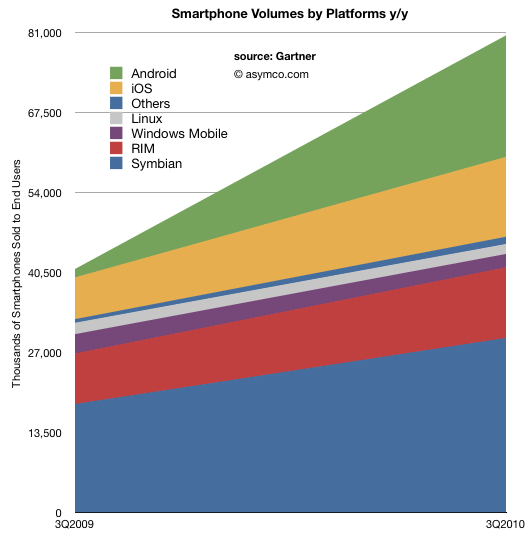
None of this should come as major surprises, but Gartner's data allows for a bit more granular detail in the overall view of the market. Here are new points derived from Gartner's sell-through data:
The smartphone market is growing at nearly 100% (96%).
The overall market is growing at 35%.
The non-smartphone market is growing at 25%.
Android grew at 1,340% y/y. iOS grew at 92%, Symbian at 61% and RIM at 40%.
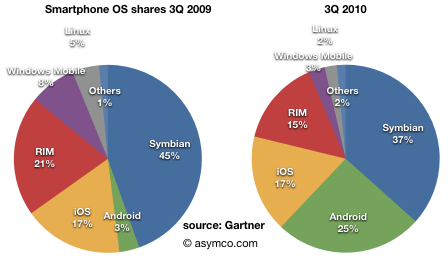
Platform market shares (below) shows a more even distribution of platform volumes between four main platforms:
Non-branded mobile phones grew to 33% of the market, with 141% unit growth. This is an alarming figure for the low-end of the market. The unbranded market excludes ZTE and Hauwei which grew below the overall market growth (9.8%, 27% respectively). The implications were most dire for Motorola (-36% units growth), Sony Ericsson (-23%) and LG (-14%). Nokia grew but, at 3.5%, well below market growth.
In 3Q 2009 41 million smartphones were sold. In 3Q 2010 80.5 million were sold. If we were to split the growth among platforms, nearly half the growth was Android. 27% of the additions were Symbian and 16% were iOS. Only 8.3% of the growth was RIM devices.
Windows Mobile and Linux were the only smartphone platforms to shrink volumes. However, even though the platform is deprecated, 2.2 million Windows Mobile devices were still sold last quarter -- more than Android sold a year earlier.
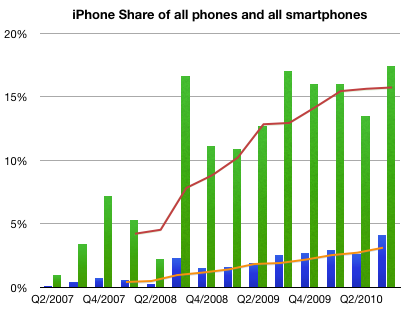
There is some confusion with the latest Canalys teaser press release. The implication is that Apple has lost smartphone platform share due to the Android surge.
Using the published data, it's easy to see that Apple has continued to increase share in both smartphones and handsets as a whole.
I used green bars to represent quarterly share of smartphones and blue bars to represent quarterly share of all phones.
I used orange line to show trailing four quarters (TTM) share in regular phones and red for smartphones.
Here are the Q2 to Q3 changes in share for the vendors whose data is published:
Nokia 38.4% to 32.7%
Motorola 4.32% to 4.7%
Samsung 5.11% to 9.71%
RIM 18% to 15%
Apple 13.5% to 17.4%
HTC 8.65% to 8.41%
Other 12% to 12%
Sequentially, Nokia lost 5.6% of share, Samsung gained 4.6%, RIM lost 3% and Apple gained 4%, Motorola, HTC and Other remained largely unchanged.
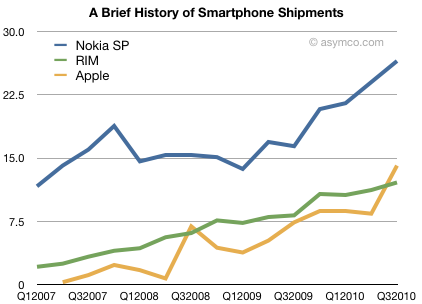
A complete market overview will follow when all the top tier vendors report the last quarter, but in the mean-time here are some data that are available:
Smartphone volumes for Nokia, Apple and RIM:
Whereas Nokia is often criticized for being weak in smartphones, the fact is that they have grown at a decent rate over the last two years. In fact, they've opened a gap with RIM. Apple has increased share but it will take quite a while to overtake Nokia.
So why is Nokia's smartphone performance so under-valued? Partly it's because ASPs have been dropping. A lower price and lower margin is sometimes seen as a sign of weakness. But Nokia has had a strategy of expanding into more price brackets in their core markets (i.e. outside the US). Half of Nokia's smarpthones are sold through distributors not operators and probably end up being sold unlocked and unsubsidized. Price matters in those markets.
The other problem that Nokia takes a beating over is that their products don't get used as smartphones. Many are sold without data plans at all which makes one wonder what exactly makes their phones "smart". So many of these 100+ million/yr. smartphones are really hired to do a feature phone job. They're "overqualified" and thus underutilized. The statistics in terms of app downloads, browser and ad impressions all lag as a result. The ecosystem suffers.
Lastly, they are all but absent from the US. Due to accidents of history (CDMA) and various mistakes, Nokia never got a foothold in what turned out to be the most important mindshare market. A decade ago the US was a mobile data backwater, with lower data ARPU than Nigeria. It was not a market Nokia felt particularly deserving of investment. In hindsight, this was a big mistake.
But these knocks against Nokia still should not detract from the fact that they do sell a lot of Symbian phones. Distribution still matters as does having 600 operator customers. And in many parts of the world, Nokia is synonymous with mobile phone. Many of those buyers will migrate to future Symbian devices.
My mobile platform thesis has been that as long as penetration is not 80% and as long as operators are still in the value chain, mobile platforms will remain fragmented and split shares. The graph above shows exactly how that has evolved among the top three smartphone vendors.
Before proclaiming the death of a company or product it's important to understand what makes it live. I'll illustrate with a personal experience.
I was once asked to comment on a product designed to be a "Blackberry killer". Much like the latest Droid Pro, the product looked like a Blackberry. It had a monoblock keyboard and a nearly square screen. It was, in other words, a product designed for thumb typing emails.
The backstory is that, like many phones, the requirements came from operators. At the time, RIM was growing extremely quickly and was causing some consternation at operators over an upstart's increasing reach into the relationship with end-users (sounds familiar?)
The rigidly predictable response was to call all phone vendors and task them with developing Blackberry alternatives (aka killers). Of course, each vendor was called independently so they all got excited about having this opportunity to be assassins.
So when I looked at the product my employer was building as a "killer" I asked: "Well, what makes Blackberry live?" This was not just rhetorical. I felt it was critical to the success of the product. Unfortunately it was not a question on anybody else's list. My cursory review of RIM's business would show that the product Blackberry was popular because it enabled a service, not because of the design of the device.
RIM was like a barkeeper who enabled socializing on his premises by selling beer. The product he sold was not really beer but meeting services. A brewer looking enviously at the high margin beer being sold there might try to compete by launching "Pub-style beer" but the product won't help people socialize any more if they drank it at home. Bar patrons were paying the high price of bar beer because it had an implicit rent attached for using the meeting site.
So no matter how much a brewer tried, unless they got into the business of managing taverns, they won't ever put the barkeeper out of business.
But the rush to copy the design was in full force. Not only Nokia (E 61), but HTC (T-Mobile Dash), Motorola (Q), Samsung (Blackjack) and even Sony Ericsson (M600) rushed similar products out. And they all reached the market at about the same time. (Evidence that not only were they all asked to make products by operators at the same time, but that their product development cycles were roughly the same.)
The deluge of keyboard monoblock Blackberry killers led to lots of comments predicting the imminent demise of RIM by way of powerful entrenched incumbent responses.
RIM's market share actually grew after these launches.
This is because none of the products addressed the real question of what makes Blackberry live and thrive. They were just pub-style beer, not thinly disguised meeting places.
So next time you hear about the imminent demise of an upstart due to the reaction of suddenly awakened incumbents, ask whether the reaction is to the product or to the way the product makes money.
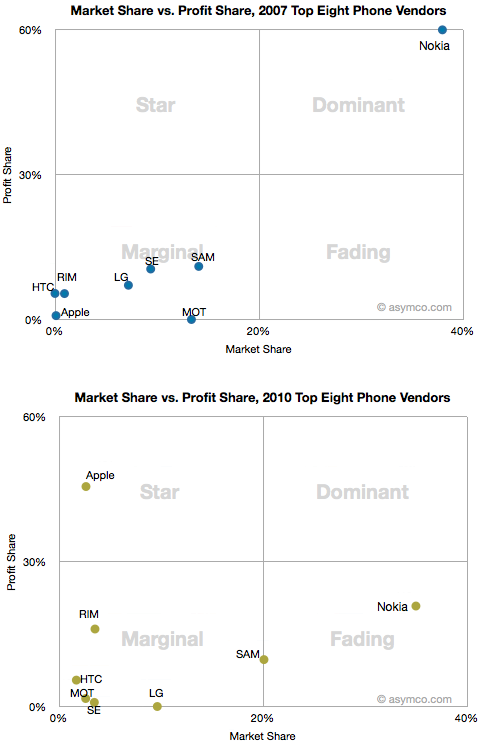
I plotted the vendors on share of market and share of profit axes in two different points in time: Q2 2007 and Q2 2010. I further broke the chart into four quadrants as shown:
I chose to label the quadrants to indicate the possible categorization of the companies.
Dominant: large market share and large profit share
Star: low market share with large profit share
Fading: high market share with low profit
Marginal: low market share and low profit
It's interesting to note the shift over the time period of the eight vendors. Whereas Nokia moved from Dominant to Fading, only Apple rose from Marginal to Star. The Marginal players dispersed their placement with Samsung moving laterally toward Nokia while RIM followed in the Apple trajectory and increased profit share while maintaining relatively low share.
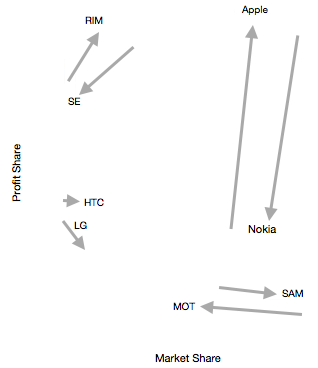
Thinking about motion around these two dimensions could be reduced to a vector model. If each vendor is represented by an arrow showing direction and distance moved, we can compare each vendor vs. a symmetric competitor which might account for the loss or gain of share.
The vectors can be paired as follows:
Although the data does not contain all market participants, the shifts in share are quite closely conserved with the vector magnitude (arrow length) and angle (direction) paired. Note how Nokia and Apple swapped Profit without too much impact in Units volume. Similarly, RIM and Sony Ericsson traded profits and volumes quite symmetrically. Samsung also took volume while Motorola lost it. HTC and LG did not change positions dramatically.
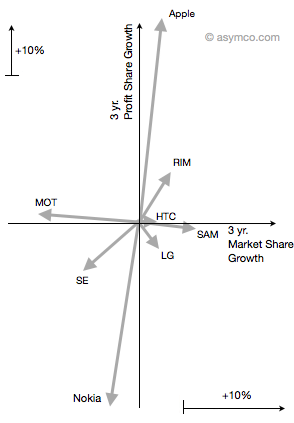
Finally, moving all vectors to the same origin leads to this view of share gain/loss over three years in two dimensions:
It becomes quite easy to see who the winners and losers are and by how much.
This model is only an observation of the shifts in market power and is not conclusive about where share was gained or lost, however there is compelling symmetry which also matches the intuition of observers.
With QNX now firmly roadmapped at RIM and Android spreading among vendors like a virus, I wanted to point out that these operating systems share one ancestor: Unix.
A technical triumph
Technically Linux, which underlies Android, among others, is walled off from Unix from an IP point of view, but the philosophical and architectural lineage goes back to 1969's Unix. It was an amazingly well thought-out operating system which has stood the test of time mostly due to its modular architecture. It was not always clear that Unix would make it this far, and in many ways it was written off.
There is some poetic justice in its comeback. Unix could have become a default for desktop computers. When Windows emerged from the shadow of DOS, Microsoft had the option to base NT on a flavor of Unix. But Bill Gates, no doubt motivated by license fee considerations, hired a group of developers from Digital Equipment Corporation and many elements of the NT design reflect earlier DEC experience with VMS and RSX-11. Microsoft went with that new architecture rather than Unix and that code lives on even in the current Windows 7.
So Unix missed a chance to become the core of the desktop experience throughout the 1990's. It was relegated to the perilous high end: Sun workstations, servers and supercomputers. It seemed to be at a dead end. Fortunately, in stepped open source. Linux picked up the pieces and forged ahead to become a serious server operating system but never got beyond a toehold in the desktop.
The death of Unix(tm) was also forestalled because of the efforts of others. Sun, IBM and even a startup called NeXT kept development alive. When NeXT was acquired by Apple, OS X was born and in 2000 Unix was once again on the desktop.
Meanwhile, the Linux kernel also became device friendly and it was embedded into an increasing number of vertical applications while powering most of the new web servers that fed the dot com era.
Now we've entered a new decade of devices where Unix(-like) operating systems will, on a CPU basis, probably out-install Windows. Not only is iOS based on Unix, but Android and MeeGo and even Bada are based on Linux as are QNX and WebOS. Google, Apple, HP, RIM, Samsung and Nokia are all now betting heavily on Unix or Unix-like implementations. The success is so overwhelming that there are really only two hold-outs: Microsoft and the rapidly depreciating Symbian.
Value Chain Evolution
There is more to this than a sentimental technology riches to rags to riches story. The history of kernel adoption is evidence of the evolution of value chains and the tension between modular and integrated business architectures. It also supports a hypothesis of why Microsoft could not respond to a tectonic shift of power.
As a kernel, Unix was modular which allowed it to scale both down to devices and up to mainframes. It could conform to the applications above it (like being a server or being an embedded controller) and did so far more readily than Windows. In fact, Windows could not conform to applications outside its core PC and server domain.
For Unix, the point of modularity was reached early in the 1990's and, through the Linux implementation, it allowed the lowest layers of the software to become commoditized (and free). This commodity status was actually what Microsoft tried to avoid by integrating Windows with the layers above it. This was a conscious and deliberate decision which also led to trouble with anti-trust regulators. The decision seemed to have paid off. Microsoft won.
However, the very strategy which Microsoft used to maintain a monopoly caused its rigidity of response to a new, post-PC market. Unix fit right in with the new shift in the basis of competition: toward more personal, portable and conformable computing. Windows did not. Microsoft had to build a completely new OS to deal with devices (Windows CE has little if any shared code with Windows NT et. al.). The dual OS strategy continues to hobble Microsoft as each is stretched into new dimensions: the desktop Windows being dragged into the high end and into tablets while the device Windows is re-written to accommodate new input methods.
The modular Unix just keeps conforming to new applications. It helps that it's open source but the open sourcing is a result of the modularity not the cause for it. So far, it looks like there is no stopping the revenge of Unix. It's been a long journey for Unix and I, for one, am cheering the comeback.
With the launch of RIM's tablet computer based on QNX and HP's confirmation that WebOS will not be licensed, we have
Apple the largest tablet and music player company,
HP the largest PC company,
RIM the largest smartphone company in the US, and
Nokia largest smartphone company in the world
avoiding Android.
These are the companies which today are profitable and enjoy large market shares. Why did they choose integrated (aka "closed") software with their hardware vs. the modular (aka "open") approach offered by Google and Microsoft?
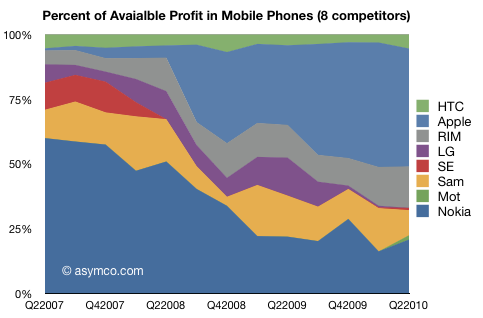
A quick update on the analysis of mobile phone profits. If the available profit[1] (i.e. excluding losses) were summed and each vendor's profit were measured as a percent of this total, this chart would tell the story of the last three years:
Note that profit share has mostly shifted from Nokia to Apple, though Sony Ericsson and LG were also casualties and Motorola has not had anything to lose.
Some assume that the future belongs to the Koreans but we see that the relatively small amount of profit that Samsung has (less than RIM actually) has not changed much. HTC is also shown to be a steady performer but not having displaced much from competitors.
Will Android change this picture? As I've argued before, Android is most attractive to the unprofitable and the strategically constrained. Can having undifferentiated new products change this? As Nokia is unlikely to license Android, and RIM seems very unlikely and Apple is out of the picture, the only possible contenders are Samsung, LG, HTC, Motorola and Sony Ericsson.
Motorola and Sony Ericsson have both returned to profitability but with a very small volume Android strategy. However the incumbents fielding Android are really facing a far more sinister threat: the smaller local brands in China (e.g. ZTE) and emerging markets.
On profitability, the smaller challengers are unlikely to make a large impact, but they will constrain the profits of other licensees. The distribution of phones on a global scale is challenging without a brand, and brands are very expensive to build. It's still possible over a longer timer frame that a small brand like HTC can emerge on a global stage. But in terms of profit capture, challengers will mostly "steal" from the already constrained big brands running with Android.
--
[1] Profit is not the only measure of success and can sometimes be a deceptive indicator. For this reason I look at a longer time frame so that anomalies, seasonality and business cycles are smoothed over. As flawed as it is as a measure, the most important reason to pay attention to profit is that it's the only fuel for growth in the long term. Companies that are consistently unprofitable (e.g. Motorola) face diminishing degrees of strategic freedom further lubricating a downward slope toward financial distress.