Asymco

Asymmetric Intelligence

RIM

  1. If RIM did not exist today and someone were to suggest it, could it ever get funded?

    Research · 22 comments

    Consider what RIM had to overcome to even be: It was an outsider entering the mobile phone business at a time when incumbent market power was far more concentrated. It evolved from data-only pagers awkwardly adapted to carry voice without pandering to the fashion consciousness of its contemporaries obsessed as they were with the RAZR. Its foothold market was the most difficult market to enter, the US; and within it, in most difficult sector--business users.

    RIM's solution has no architectural elegance and their non-standard approach to email using their own servers and protocols defied all IT policies regarding security and the entrenched use of Exchange. Even after Microsoft offered a cleaner solution (Exchange push) that avoided the RIM back end, businesses otherwise committed to Microsoft stuck with RIM for mobile email. In spite of various government opposition, RIM continues to grow internationally.

    Even its acceptance may be an accident of history.

    The absence of interoperable SMS in the US early last decade meant that there was no reliable way to send text from one mobile to another across CDMA and GSM networks. The Blackberry was hired to to the same job that SMS was hired to do anywhere else, but by the time SMS was working in the US, the use of Blackberry increased irrespectively.

    It should be no wonder then that the company can be considered both disruptive and a dead end. Analysts have been split about it from day one. Gartner advised against adoption by any self-respecting IT shop.

    Equities analysts are still split into bulls and bears more evenly than any other company in this space. See: RIMM: Street Split Sharply On The Stock; Avian Cuts Rating (Updated) - Tech Trader Daily - Barrons.com

    The arguments are pretty straight forward:

    • Competitive pressure from 'better' architectures, uninspiring products, lower growth

    vs.

    • Fierce loyalty of users, continuing international expansion, continuing growth

    The market has largely voted with the bears as the price shows absurdly low valuation (4.3x EV/EBITDA) but the company continues to show growth quarter after quarter.

    My own point of view has been for some time that RIM's disruptive days are over because the engineer in me says that their code base is a dead end. But the disruptive analyst in me leads me to be hesitant in proclaiming their imminent demise. The fact remains that their product is good enough for a subset of the users who want nothing more than a messaging phone. I will add however that this subsets unlikely to grow especially relative to the number of users who will opt for more highly functional devices.

    So the riddle of RIM remains: rumors of its death has been exaggerated but it's not an unforeseeable growth story anymore. As a result the company is in limbo.
  2. RIM Quarterly update: just the numbers

    Research · 11 comments

    Noteworthy data (with my notes in parentheses.)

    • 12.1 million phones shipped, 11 million sold through (estimated iPhones for this Q range from 11 to 13 million)
    • Net subscriber account additions were 4.5 million which was lower than anticipated (41% of units sold through were to new subscribers which implies nearly 60% were to existing users)
    • Revenue grew 31% over the same quarter last year and GAAP earnings grew 76%.
    • The BlackBerry subscriber account base grew 56% year-over-year to over 50 million
    • RIM has shipped approximately 115 million handhelds to date. (note: 120 million iOS to date)
    • BlackBerries are available through over 565 carrier and distribution partners in approximately 175 countries and international markets (vs. 150 carriers and 88 countries for the iPhone)
    • Approximately 52% of revenue in the quarter was generated outside the United States and over 45% of BlackBerry subscriber account base is outside of North America. (70% of iPhones were sold outside the US through the first half of this year)
    • Torch was launched with one carrier but will expand to 75 next quarter
    • To date over 35 million BlackBerry Smartphones have downloaded App World at an average of over 1.5 million Apps are being downloaded every day which is up 40% sequentially (iOS apps are running at 17 million downloads per day)
    • Average selling price for RIM devices was $304 (vs. $600 for the iPhone)
    • Gross margin was 44.5% (upward of 50% for the iPhone)

    Research In Motion CEO Discusses F2Q2011 Results - Earnings Call Transcript -- Seeking Alpha

  3. Gartner Predicts Mobile OS Market Share

    Research · 15 comments

    Lots of people apparently think it’s a big deal that Gartner is predicting Android will surpass iOS for second place. But why is that necessarily a good thing, given that they’re predicting Symbian will remain in first place? Who thinks Symbian is actually doing well? Nokia’s board sure doesn’t.

    via Daring Fireball Linked List: Gartner Predicts Mobile OS Market Share.

    I also noted with amusement that by 2014 "other" is slated to sell 85 million units or nearly 10% share, up from 6.1% in 2009. These "others" will be selling more than twice what Apple is expected to sell this year. Is "other" WebOS, Bada, MeeGo, LiMO? If so they're in for a healthy future.

    But dwelling on details like these is missing the point. To see how improbable this prediction is, let's go back to 2006 and ask what Gartner was forecasting would happen now.

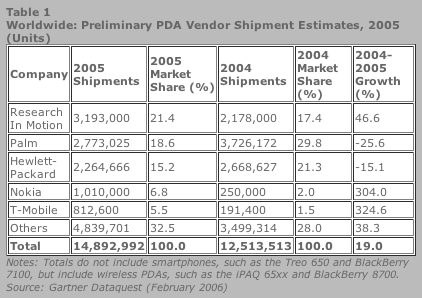
    First thing to note is that in 2006 Gartner was busy tracking PDA sales. You might wonder why this is relevant. The reason is because a significant proportion of RIM's Blackberries counted as wireless PDAs and were therefore considered to compete with Palm's Treos, HP's iPaq and Dell's famous Axim. Nokia was in the running with its Communicators. Here is how Gartner characterized the equivalent market in early 2006:

    So I'll just come out and say it: In 2006 Gartner did not have a clue what a smartphone was. By their admission:

    Gartner defines a PDA as a data-centric handheld computer weighing less than one pound that is primarily designed for use with both hands. These devices use an open market operating system supported by third-party applications that can be added into the device by end users. They offer instant on/off capability and synchronization of files with a PC. A PDA may offer WAN support for voice, but these are data-first, voice-second devices.

    In other words, in 2006 Gartner was splitting phones with operating systems into two separate markets: data-oriented wireless PDAs and voice-oriented smartphones. The split was mostly based on the judgement of the analyst on whether a device was "voice" or "data" oriented. I suppose they used the primary input method as a proxy: numeric keypads meant the device was one-handed and therefore voice-oriented. If the device had a full keyboard and/or a stylus-actuated touch screen then it was a two-handed data-oriented device. But even this proxy was not quite enough, sometimes devices were classified whimsically.

    To make it more complicated, they bundled non-cellular but Wi-Fi enabled PDAs with wireless PDAs. This made some sense from a corporate IT point of view (their primary customer base) as these data-oriented devices would be used either on a LAN or a WAN (Wide Area Networks: what Gartner anachronistically called cellular networks.)

    The presence or absence of a cellular radio did not enter into their view of these devices. So if you asked Gartner in 2006 to forecast smartphones (as we know them now) in 2010, I suppose you'd get what they forecast for "data-centric" devices.

    So assuming that today's smartphones are mostly "data-centric" we would have to look back on their view of that market and not the voice market which was seen as an entirely different thing. Their answer should have had something to do with the market leaders and participants in 2006. As the table above shows Gartner showed that RIM, Palm and HP led in 2005 with Nokia and T-Mobile[1] pulling up the rear.

    However, from a platform point of view, at the beginning of 2006

    Microsoft Windows CE was the No. 1 PDA operating system (OS) in 2005 as 7.05 million PDAs were loaded with the OS, up 33 percent from 2004 shipments of 5.28 million units. Palm OS PDA shipments declined 34 percent to 2.96 million units in 2005.

    In late 2006, Gartner made further predictions for the year:

    In 2006, Gartner expects the PDA market to increase by 6.3 percent to 16 million units. The market will continue to be driven by broader availability of cellular-enabled PDAs from wireless carriers. Gartner estimates that 53 percent of all PDAs shipped in the first half of 2006 featured integrated cellular capability, up from 46 percent during the same period in 2005. “The share of PDAs purchased by enterprises will continue to increase; it accounted for 49 percent of all PDA shipments in the second quarter of 2006 and Gartner expects that the enterprise market will account for 52 percent of all PDA shipments in 2006,” said Todd Kort.

    At this time I have not yet dug up a Gartner "Wireless PDA OS" four year forecast from the year 2006 but I suspect it would not show devices running Google's Android operating system or any running something called iOS.

    I also seem to remember that they were suggesting that Windows would be the leading mobile platform. Although it was trailing in 2006, Gartner was quite bullish on the disruptive challenger from Redmond.

    [1] T-mobile is in the list because it was common practice in 2006 for operators to market Pocket PC Phone Edition devices made by HTC under their own name. Orange, Vodafone and Verizon also had own-brand HTC Windows touch-based devices. Now what does that strategy remind me of?

  4. RIM Torch on pace for 500k units in August

    Research · 8 comments

    “In our view, investors are missing the way BlackBerries are eating into Nokia’s messaging phone share in Europe, Latin America and Southeast Asia now that the E-series demand is slowing,” he writes. “We believe the Torch is on pace for 500K units in August,

    via Research In Motion: MKM Still Bullish; Cites Growth Outside U.S. - Tech Trader Daily - Barrons.com.

    Torch selling 500k units a month may be good news to RIM but it's hardly a barnburner.

    The news about Nokia losing share to RIM is another curious data point. First, because it identifies two competing smartphone classes (E-series and Blackberries) as "messaging phones". That's like saying that HP is losing share to Dell in the "email PC" business. Though the classification of general purpose devices by single uses is probably fair here since these devices are not much good for anything else.

  5. HTC: How They Compare

    Research · 17 comments

    In the last mobile market update series I wrote of  the evolution of market share, the shift in where dollars are spent, the tale of ASP erosion, profitability ratios over time and EBIT share over time.

    I did not include all vendors for various good reasons. The first survey (market share) did include an "others" category that made the volume data complete, but in the financial data sets, I chose to include the top 7 vendors that make up 80% of device volumes.

    One noteworthy vendor that was not included was HTC. HTC is an important vendor for several reasons:

    • it's a pioneer in smartphones having made the first Windows Mobile devices and the first Android devices
    • at one point it sold 80% of all Windows Mobile devices
    • even if it did not brand its devices, it was the name behind many re-branded or white-label operator branded phones
    • it has a brand of its own today and is expanding its reach

    HTC has been around building devices since 2001 and so it would be a pity to exclude them from any analysis of the effect of iPhone on the market or any discussion on the effect of smartphone disruption on feature phones.

    The challenge with HTC was that historically their branded devices and white label devices were not reported by the company separately. This matters because white label devices are valued differently. Typically these devices are not marketed by the original manufacturer so SG&A is not applied to their cost base. Operating margins, ASPs and hence profitability is not directly comparable with other OEMs.

    But HTC has recently changed its reporting. Thanks to a reader I discovered that, since 2008, HTC has been listing its ASP and Operating Margin making direct comparisons possible. I still don't have all the data, but enough to add HTC to the analysis.

    So, here are the 5 industry performance criteria, now with eight vendors listed.

    Volumes

    Note that HTC volumes start in 2008.

    The volume of units HTC sold has been increasing at about the rate of market growth.

    As a result, HTC's share has not increased as dramatically as those of the other smartphone entrants.

    Sales

    A similar story in the sales picture. Although a consistent performer, the growth has not matched that of RIM and Apple.

    ASP

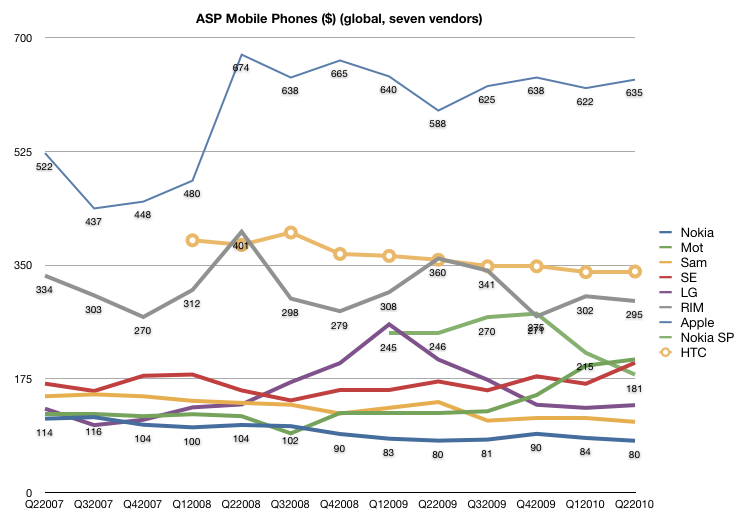
    The pricing story is also a mixed one. Although HTC lies between RIM and Apple in price, the erosion is more consistent with RIM and the rest of the industry.

    Margin

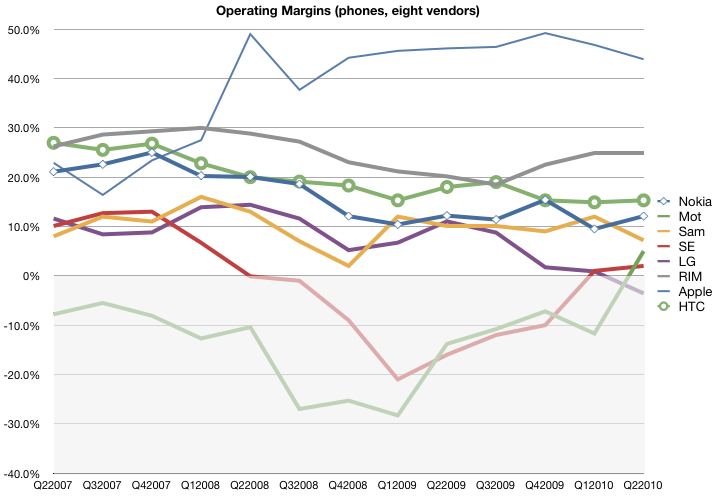
    The margin story is also not as positive as one might expect. The margins for HTC started out above Apple and RIM but have dropped to closer to industry average. This is not what one might expect from an exclusive smartphone vendor.

    Earnings

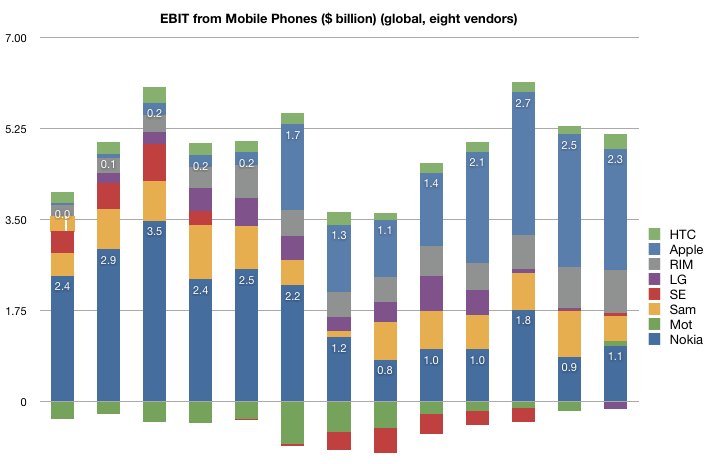
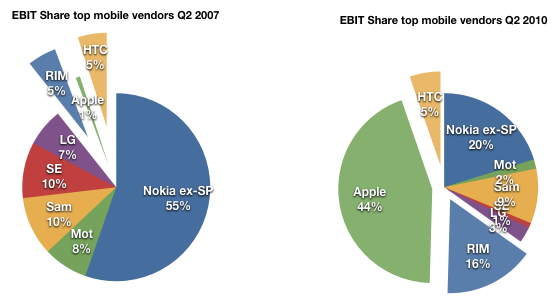
    The share of earnings has remained unchanged at 5% over the period of iPhone presence. It's perhaps a credit to HTC that they did maintain their position in the market with the massive change that has come to pass.

    However, here we also have to ask if HTC is riding a disruptive wave.

    When I wrote the last series, my definition of “loser” was a company that had faced a long series of operating losses and has no viable software assets of its own, making it vulnerable to Android (and Windows Mobile). Motorola first, Sony Ericsson second and LG now coming into the picture. Nokia is not a loser in this sense since it has remained profitable and does maintain an investment in software. Same with RIM and Samsung (now with Bada). When/if they do have the near death experience, they might opt for the Android lifeline (flimsy as it is).

    However HTC does not fit the mold of either "winner" or "loser". It's the Goldilocks company, not too hot, not too cold.

    But I would add that HTC is not an example of a winner because of its adoption of Android. HTC’s dependence on Windows Mobile made their move to Android the most desperate of all. Unlike the larger OEMs, who had their low end devices to fall back on, they are completely dependent on a smartphone OS vendor. When WinMo was showing the first signs of crisis in 2007, they were the first to flee to Android (think of why they would risk the wrath of Microsoft for something so fragile as Android in 07). They are also trying hard to escape the dependence by building up their own UI (SenseUI) and I would not be surprised if they move to their own OS in the future. Being associated with Android does not confirm them as "winners" but in fact, shows their vulnerability.

    What does this all say about Android?

    Again here my thesis is that Google chose to sustain the industry rather than try to upend it. I don't judge their motives, but the fact is that with Android, Google is not in a position to disrupt telecom. There were high hopes dashed with the Nexus One and hearts broken with net neutrality and now there are patent wars to be fought. Android, with its licensees, is still at the mercy of operators.

  6. Android's Pursuit of the Biggest Losers

    Research · 170 comments

    The mobile phone market is intertwined with the telecommunications industry which is vast and there are numerous competitors which are much more dynamic and better capitalized than the moribund PC or music player vendors. It’s also a regulated and fragmented global market with 1.2 billion units and 5 billion consumers—far greater than any of the markets Apple played in for its first 30 years.

    Nevertheless, the iPhone has had a huge impact on the industry. To show just how much of an impact, I dove in and pulled over 500 data points on three years’ financial performance of seven competitors responsible for 80 percent of units being shipped today. The time frame covers the iPhone’s participation in the market so it allows for “before-and-after” comparisons.

    I divided the findings into five articles:

    1. Unit Volumes. The evolution of market share.
    2. Revenues. The shift in where dollars are spent.
    3. Selling prices. The tale of ASP erosion.
    4. Operating margin. Profitability ratios over time.

    Now I turn my attention to draw a bottom line from all the data above, namely the operating earnings (EBIT or Earnings before Interest and Taxation).

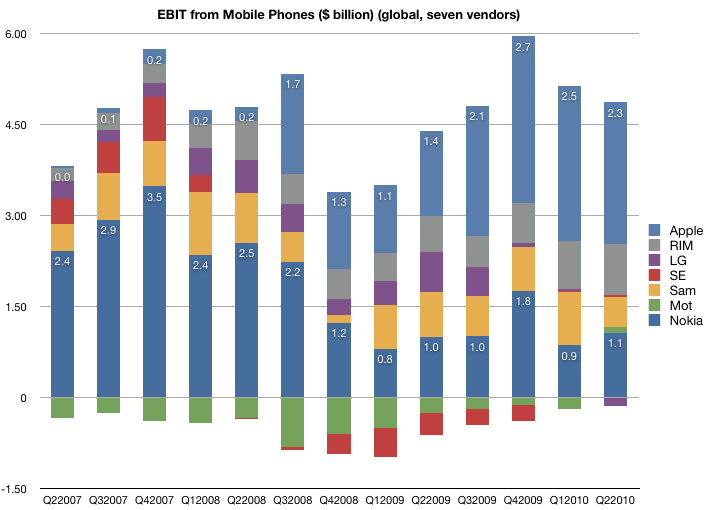
    The first chart shows the EBIT from the top seven vendors of mobile phones since the quarter when the iPhone launched. I annotated Nokia and Apple's bars to give perspective.

    The total available profits in the industry dipped to a bit under $4 billion at the trough of the recession, and have recovered to nearly $6 billion in the holiday quarter last year. However, not all vendors are profitable. As you might expect from looking at the operating margins, Motorola and Sony Ericsson have been generating losses for most of this time period. They have both reached profitability in the last quarter, though at very low levels and after having lost a large part of their sales. LG has turned negative this past quarter after being a modest earner for some time. Samsung has maintained a fairly even consistency in its profit capture, though with its expanding market share, it seems to have come at the cost of pricing.

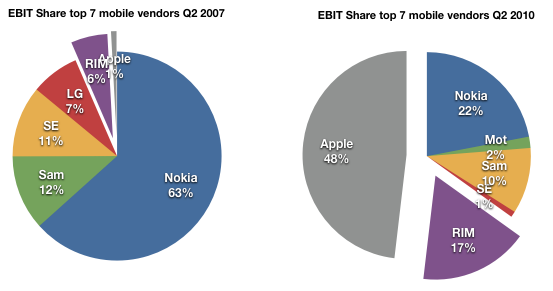
    Finally, looking at the pure smartphone vendors RIM and Apple, the picture is nothing short of astonishing. This before-and-after share-of-available-profit chart shows that the two entrants went from about 7% profit share to 65% in three years.

    Apple in particular is capturing about half of the available profits with three percent of the units. It dwarfs all the other vendors, more than double the nearest (Nokia). All that in three years and with the added burdens of only three models, a recession and limited distribution.

    What does it all mean?

    Here are my conclusions, enumerated:

    1. The lack of a real response. The recurring theme in this series of articles has been that giant multinational incumbents in a vast and rapidly growing industry, enjoying all the advantages that size and incumbency, have had their profits taken from them. And they don't seem to have put up much of a fight.
    2. It's all wealth transfer. Note the total amount of profit available has not increased markedly; this is not about incumbents growing the pie. Two thirds of what should have rightly been theirs moved from the incumbent shareholders to the entrant shareholders.
    3. Speed. This shift of profit occurred over an unprecedentedly short period of time.  Three years is no more than two product cycles in the industry and it's an order of magnitude faster than what happened historically to other industries.
    4. Disruption is the diagnosis here. The incumbents were caught in the headlights. Disruptive innovation leads to asymmetric competition and this is what we just witnessed. History has shown that the shift of profits is usually the last stage of disruption and is usually irreversible because the change in business models cannot happen at the rate of change of profit transfer.

    Which leads me to one final point.

    When analyzing the potential for challengers to the new winners, the most cited is Android. Can Android affect this redistribution of profit once again? And to whom?

    If Android is to become the dominant platform, does it depend on the success of its licensees? Who are these licensees and what are the chances that they will be able to align their businesses to what Android offers (a new revenue model based on services and advertising).

    One problem I see is that Google is making a bet on those same vendors who are now squeezed in the middle of that last pie chart: Samsung, LG, Motorola and Sony Ericsson. Nokia, Apple and RIM will certainly not take the OS over what they already have as it dilutes their differentiation and margins. That means Android is aligned with the biggest losers in the industry.

    So how likely are these disrupted ex-giants to recover and take Android forward? My bet: slim to none. Android does not offer more than a lifeline. It is not a foundation for long-term profitability as it presumes the profits accrue to the network and possibly to Google. Profit evaporation out of devices to Google may be a possibility at some time in the future, but only if the devices don't need too much attention to remain competitive. But because they're still not good enough (and they won't be for years to come), it's certain that attention to detail is what will be most important to stay abreast of Apple.[1]

    So here we have the real challenge to Android:  partnership with defeated incumbents whose ability to build profitable and differentiated products is hamstrung by the licensing model and whose incentives to move up the steep trajectory of necessary improvements are limited.

    In other words, Android's licensees won't have the profits or the motivation to spend on R&D so as to make exceptionally competitive products at a time when being competitive is what matters most.

    [1]: I would argue the same lack of symmetry with licensed software vendor Microsoft is what led the the failure of the same incumbents to make a dent in the industry with Windows Mobile [2003 to 2010].

  7. Phone incumbents' average operating margin: 4.5%. RIM and Apple: 34%

    Research · 10 comments

    After ASP, Sales, and Unit Volumes we look at the three year history of operating margins for the seven most significant mobile phone vendors (Nokia, Samsung, LG, Motorola, Sony Ericsson, RIM and Apple).

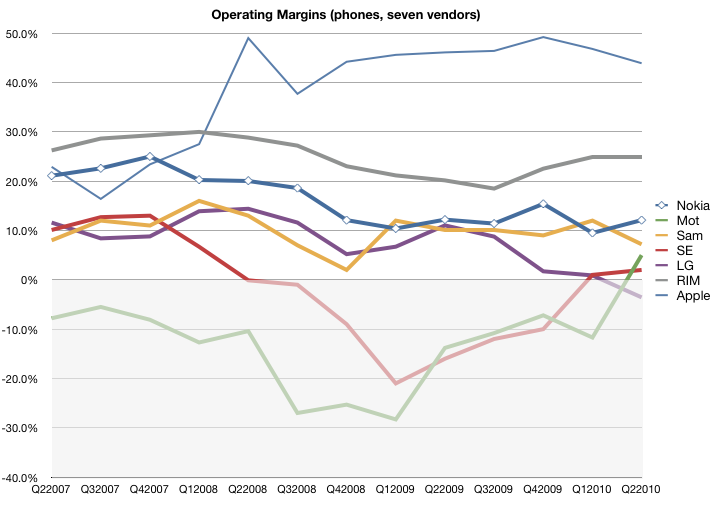
    The following chart shows the OM from mobile phone sales. These figures are as reported by the companies with the exception of Samsung and Apple. Samsung reports OM for its telecommunications unit as a whole and we have to assume that it's largely accurate for mobile phones. Apple does not report margins for its iPhone but it's possible to estimate gross margin percent for the iPhone and then subtract its overall OPEX as percent of sales. This assumes that OPEX is allocated to the iPhone in proportion to sales, which is the best assumption we can make at this time.

    The data shows that the iPhone has been considerably more profitable, due mostly to a high ASP, than other vendors. Motorola and Sony Ericsson have been "underwater" with respect to margin for much of the time period, with LG recently dipping into the red.

    Nokia's margin erosion is a source of significant angst but note that it has just reached Samsung's historic level (around 10%). LG, long seen as an up-and-coming vendor who took over the number three spot from Motorola is shown to have done so with moderate-to-low profit margins.

    Overall, the phone incumbents have an unweighted average operating margin of 4.5%, down from 8.6% three years ago. In contrast, RIM and Apple have an average OM of 34%, up from 24%.  In other words, profitability has halved for the volume leaders while it has increased nearly by half for the entrants.

    This goes a long way toward explaining the "smartphone gap" which is being filled by Android. As vendors see their unit growth, ASP and operating margins under pressure from low end disruptors, there is a tendency to flee to the high end that smartphones represent. Android offers an irresistible siren's song.

  8. Is an iPhone worth 8 Nokia phones or 2 Blackberries?

    Research · 4 comments

    Pricing is a leading indicator of value. Some might argue price and value are often out of whack but, in the long term the two converge.

    So it's instructive to measure how a vendor creates value by what it's able to charge for its goods. In the case of mobile phones, price is summarized by something called ASP (average selling price) which is measured each quarter across a vendor's entire portfolio.

    Again, there might be local fluctuations, but the trend is your friend here.

    Take a look at these charts I prepared based on the group of seven vendors I previously analyzed in terms of their sales and volume performance.

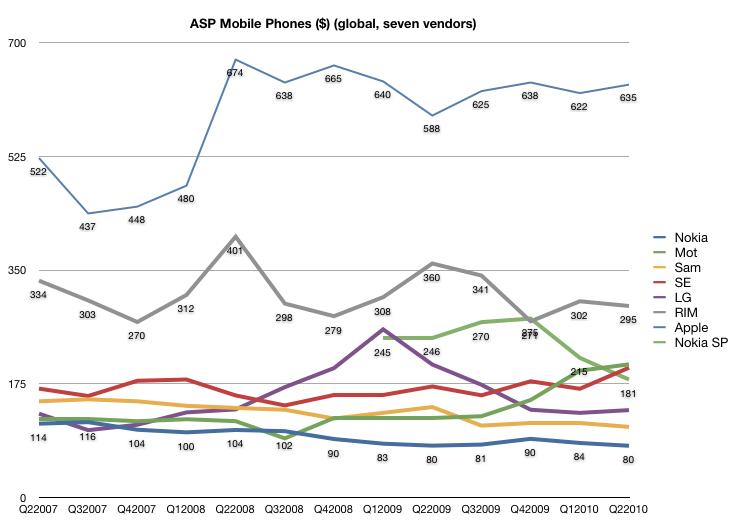
    First, a history of pricing since Q2 2007. All figures are in US dollars current as of time of reporting.

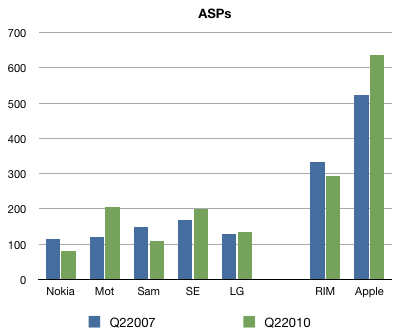
    Here we see the ASP erosion inherent in the large incumbents with Nokia and Samsung both seeing price slides. LG went through a phase of price growth but has returned to a point near to where it started three years ago.

    While Sony Ericsson and Motorola were following the downtrend until 2008, they reversed and began an ASP climb while fleeing upmarket (at the expense of volumes).

    Finally we have RIM and Apple both holding the line on pricing while growing volumes. Not only are the lines steady (with Apple slightly increasing and RIM slightly decreasing) but they are way above their competitors; Apple's shockingly so.

    Here is the before-and-after view:

    During the three year window we're looking at, Apple and RIM showed ASP durability while incumbents showed ASP erosion.

    Pile these data points on top of the volume and sales data and we can move forward.

    (In answer to the question in the headline, the answer is: Yes.)

  9. In phone sales, RIM plus Apple equals Nokia

    Research

    Following up from the last article on the global phone units sold over the last three years (Visualizing the winners and losers of three years of smartphone share growth), we take a look at the sales in dollar terms over the same period.

    Remember that in the article on units, the pure-play smartphone entrants HTC, RIM and Apple grew from a combined unit share of 1.3% in Q2 2007 to a combined unit share of 7.7% in Q2 2010.  That's a 6 fold increase in volume share. Quite remarkable for companies lacking the vast resources and industry connections of the incumbents.

    However, when we look at their performance in value (dollar sales) vs. units sold, the performance of the entrants begins to look miraculous.

    The sales figures can be obtained from the company reports, though I caution that not all vendors publish data and data published is in local currencies. Fluctuations in exchange rates may lead to differences in reports of sales from different sources.  For the sake of consistency, I omit all "other" vendors and focus on the top seven: Nokia, Samsung, Motorola, LG, Sony Ericsson, RIM and Apple.

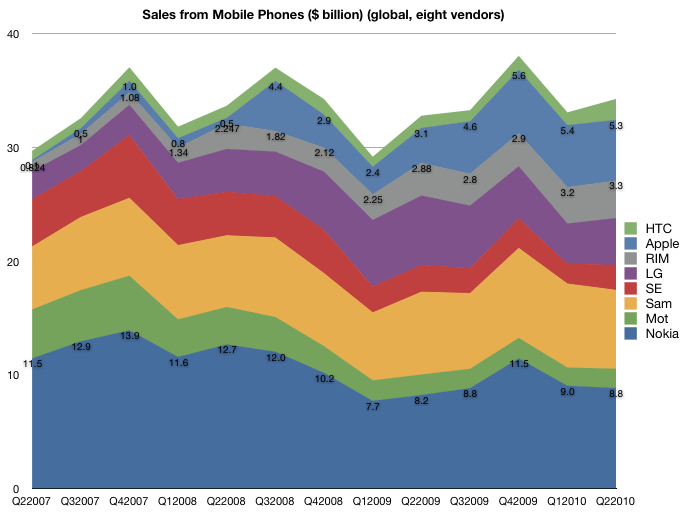
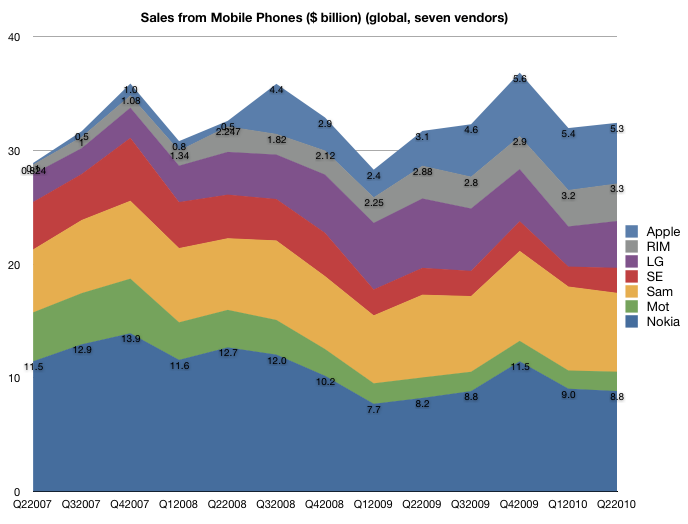
    First, the cohort's overall performance is shown in the following graph:

    I again annotated Nokia and RIM and Apple with actual sales (USD) figures for some perspective.

    The first thing to note here is that the whole industry sees a low rate of growth (unlike in the units picture). Total sales in Q2 2007 were $29 billion and total sales in Q2 2010 were about $32 billion. A mere 12% growth over three years and only 4% compounded over three years. Total units in Q2 2007 were 255 million and total units in Q2 2010 were 318 million, or 24% over three years and 6.2% compounded. This means industry-wide sales growth is half the units growth.

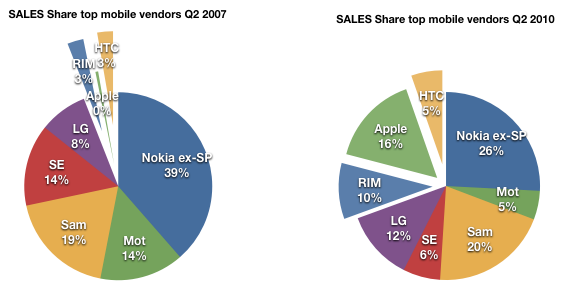
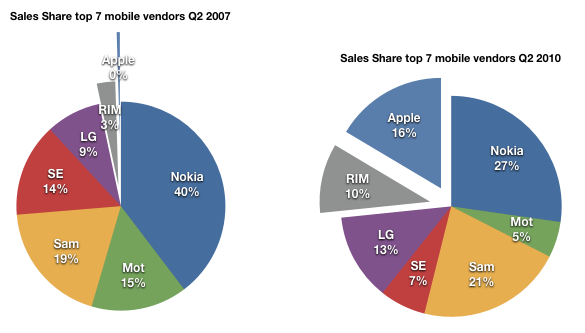
    The second thing to note is that the Apple+RIM group grew from 3.3% share of cohort to 26.6%.  That means that more than 1 in 4 dollars sent to these 7 companies was spent on Blackberries and iPhones!

    Jointly, Apple and RIM took $8.6 billion and Nokia took $8.8 billion.  Compare that with three years ago when Nokia took 40% of the income and RIM + Apple took 3%.

    So whereas the entrants increased units share by 6x in this time period, at least in this large subset of the market, they increased revenue share by 8x.

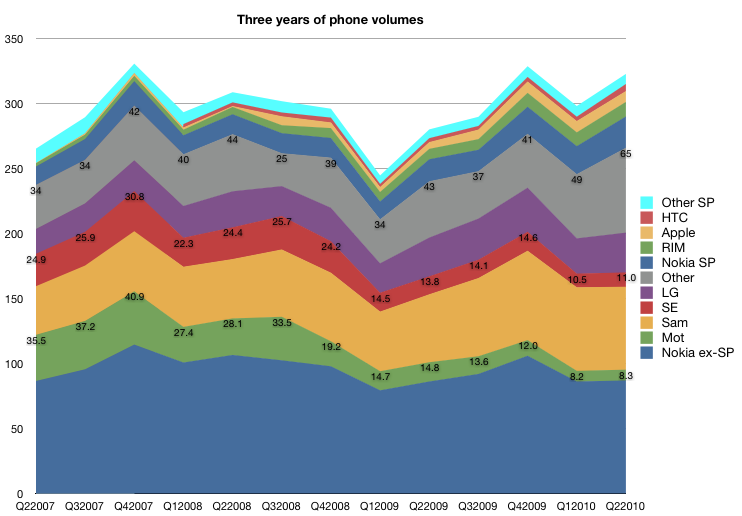
  10. Visualizing the winners and losers of three years of smartphone share growth

    Research · 2 comments

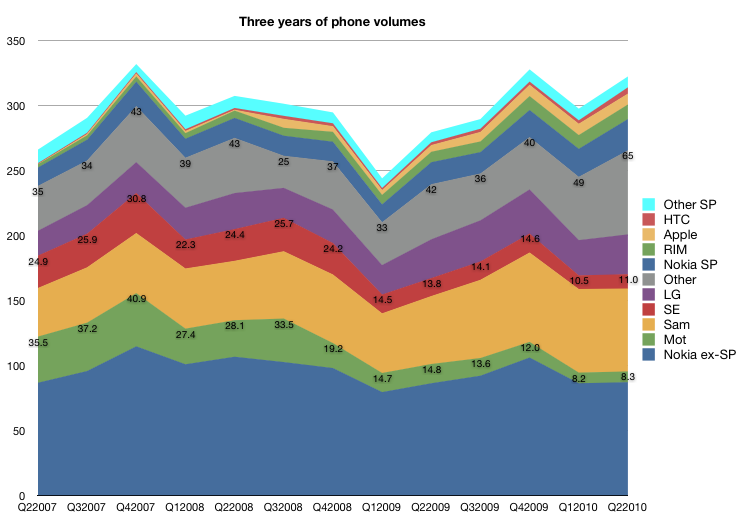
    Many consider June 2007 to have been a pivotal moment in the history of mobile phones. Apple's entry with the iPhone has re-defined the market in many ways. However, there was a smartphone market before then. About 28 million smartphones shipped the quarter when Apple launched out of an overall phone market of 265 million. Apple's entry with 270k phones was a drop in the bucket.

    I thought it would be instructive to chart what happened between that quarter, exactly three years ago and today. I collected the data from IDC, Gartner and Canalys and company reports to paint a few pictures.

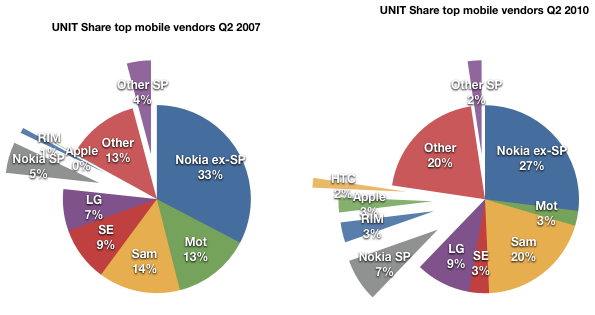
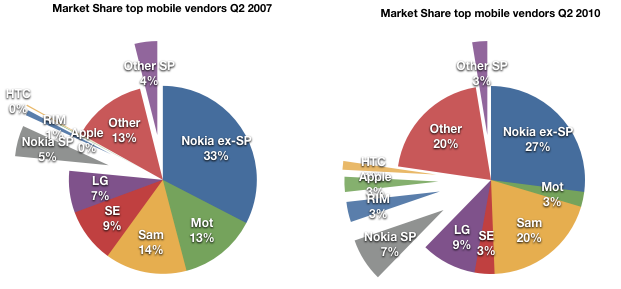
    First, the market shares (by units) of the top mobile vendors, Q207 vs. Q210. I highlighted the smartphone vendors by separating their wedges from the pie. Note that I also separated Nokia's smartphones from Nokia's regular phones as two separated wedges--Nokia ex-SP for no smartphones and Nokia SP as their "converged" units. I did the same with "other".

    The first thing to note (beside the large increase in smartphone share) is that "other" non-smartphones are a huge part of the pie. At 20%, the share of "other" is now equal to the share of Samsung. Other consists of a group of mostly low cost Chinese vendors. The growth of the low end "other" went from 35 million units in Q207 to 65 million in the last quarter. It's this competition that is driving profit out of the core businesses of Nokia, Samsung and LG and forcing a flight to smartphones (more about this later).

    The second thing to notice is that Motorola and Sony-Ericsson are highly visible victims of the last three years. Sony Ericsson shipped 25 million devices in Q207 and only 11 million three years later going from 9% share to 3%, on par with RIM and Apple. Motorola did even worse, shipping 35.5 million in Q207 and a mere 8.3 million last quarter, losing 10 out its 13 points of share.

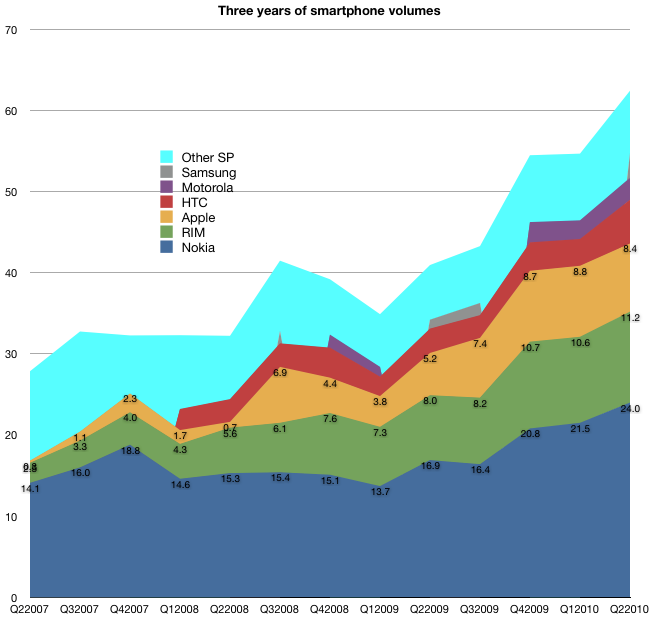
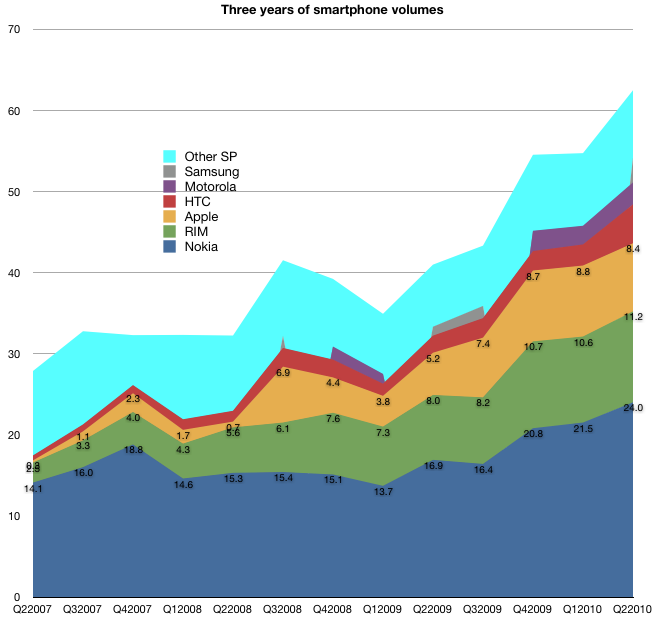
    Viewing the overall units market, one can see the gouge in units that the recession took out. The following graph shows three years of volumes by the top vendors with the smartphones separated at the top (Nokia SP, RIM, Apple, HTC and Other SP--everything above the grey band are smartphones).

    However, separating out the smartphones, one can see their volume increased with barely a ripple during the recession. Although Nokia retains the top share spot, the entrants have jointly grown much faster.  I have annotated a few of the competitors' volumes with the actual values.

    One thing to note is that "other smartphones" has traditionally consisted of Windows Mobile licensees but that is quickly shifting now to Android. I also had only fragments of data for Samsung and Motorola, so their bands are incomplete.  However, one could note how minimal their participation has been in the market.  LG has been practically absent from this market.  For these latecomers to smartphones, it's clear what Android offers: a chance to stay in the game.

  11. RIM's decomposing innovation

    Research · 4 comments

    It's hard to get excited about the new RIM Blackberry Torch.  It's not exciting in a positive way and not exciting in a negative way. It's just more of the same and the same is not all that bad. Then again, the same is not all that good either. Every piece of the Torch product is playing catch-up with others' innovations without enhancing the core innovation RIM itself brought into the market years ago.

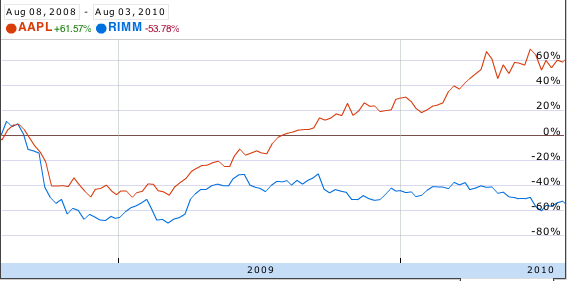
    RIM has a significant but deteriorating share and is a company that has done very well as an entrant in a space dominated by larger incumbents.  But there is a strong smell of Palm about it.  The musty smell of decomposing innovation. Wall Street seems to smell it too (two year stock price chart relative to AAPL below)

    The problem seems to be that, like in Palm's case, mobile computing is a game for big companies.  If you ask why Palm and RIM became uncompetitive you get two different reasons. Palm could not do hardware and distribution well and RIM can't do software well. But these reasons have remedies which neither company can bring to bear: resources and processes. Palm did not have the resources for distribution and production and RIM did not have the processes to be a software platform company.

    Their values and priorities are adequate but competitiveness today, in this market, requires projecting market and development power.

    I can only conclude that RIM is simply too weak to make it in the long run.