Asymco

Asymmetric Intelligence

RIM

  1. Android is a BlackBerry killer

    Research · 2 comments

    Much has been made of the potential for Android to reduce the growth of iPhone. The iPhone seems to be doing very well and continuing to be supply rather than demand constrained.

    RIM however seems to be under significant pressure.  A Goldman Sachs analyst first pointed this out in her last report and placed a "Sell" on RIMM.  The fact is that most of RIM's sales are in the US on the carriers other than AT&T.  In those very same carriers, Android is being pushed hard as a customer retention strategy, so iPhone is pressuring RIM only indirectly through Android.

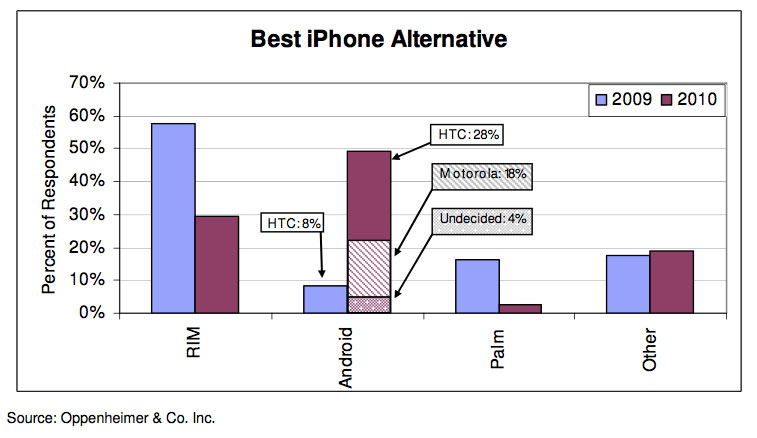
    The evidence is also in survey data.  In the graph below, we see how iPhone buyers are considering Android as the most credible alternative to the iPhone whereas they considered BlackBerry the best alternative a year ago.  In terms of vendors, what RIM lost HTC gained.
    One can only wonder what will happen when the iPhone enters unrestricted distribution in the US.  The results in other markets speak for themselves.

    AppleInsider | Apple's recurring revenue stream: 77% of iPhone 4 sales were upgrades.
  2. RIMM near 52 week low

    Research · 1 comment

    RIMM shares dropped more than 5% after hours after company reported "light" units and a 20% rise in profit with a 24% rise in revenue.

    RIMM sold 11.2 million units (of which 4.9 million were new subscribers and the rest replacement units--a deterioration in replacement rate). This represents 43% growth. The unit growth is nearly double the revenue rise implying a lower ASP ($300--half the iPhone) and margin (45.4%).

    RIM passed another milestone: 100 millionth BlackBerry was sold during the quarter. We've noted before that Apple will also pass its 100 millionth iOS device this month. RIM sold 20 million units as of October 2007, right on the heels of the iPhone launch. That means that iOS grew 100 million to BlackBerry OS growing 80 million in the same time frame.

    So why are shares at a P/E of 13? 20% EPS growth would be respectable numbers, but the smartphone market is growing faster than that. The implication is that RIMM is losing share and everyone is expecting that loss to accelerate.

    Simona Jankowski from Goldman Sachs repeats her Sell rating. “RIM has now missed top-line expectations for three of the last four quarters, in our view demonstrating the building competitive pressures on its business from the iPhone and more recently from Android,” she writes. “We estimate that net subscriber additions in North America declined on a sequential basis, which we attribute primarily to the success of Android-based phones, such as the Motorola Droid and the HTC Incredible at Verizon.”

    Research In Motion Limited (USA): NASDAQ:RIMM quotes & news - Google Finance.

  3. iPhone takes share from RIM, Android takes share from Windows Mobile

    Research

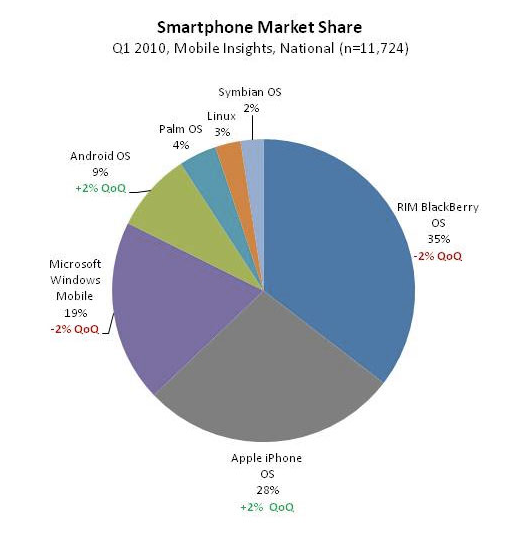
    Data tracking firm Nielsen Co.’s quarterly survey found that, in the U.S. the iPhone added two percentage points for a 28% market share in the three months ended in late March compared to the previous quarter. RIM still had the biggest market share at 35% but it lost two percentage points in that period.

    Phones that run on Google Inc.’s Android operating system also gained two percentage points for a market share of 9% over the same period, while Microsoft Corp.’s Windows Mobile phones lost two percentage points for a 19% share.

    via Appetite for IPhone Continues Undiminished - Digits - WSJ.

    Although Android is often considered in competition with the iPhone, as we've shown in the past, the two are seldom competing for the same purchase decision.  From a distribution and business model point of view, the platforms are mostly non-overlapping.

    The installed base data above shows that in their respective areas of competition: in the US, with the current operator channel, the iPhone is taking share from a similarly positioned platform (RIM) while Android is taking share from a similarly licensed alternative (Windows Mobile).

  4. Global smart phone OS shares (part II)

    Research

    On May 5th, I tried to fill in the blanks on Global smart phone OS shares | Asymco. I estimated that the shares for the mobile OS's were as follows (based on Canalys partial data):

    • Symbian (Nokia): 42%
    • Blackberry OS (RIM): 19%
    • iPhone OS (Apple): 16%
    • WinMo (Microsoft): 10%
    • Android (Google): 10%
    • WebOS (Palm): 2%

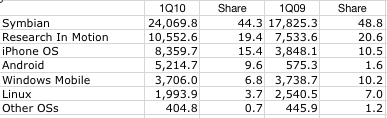
    Now Gartner has published their sell-through estimates:

    • Symbian (Nokia):: 44%
    • Blackberry OS (RIM): 19%
    • iPhone OS (Apple): 15%
    • Android (Google): 10%
    • WinMo (Microsoft): 7%
    • Linux: 4%
    • Other OSs: 1%

    My estimates were within 1 or 2 percent of actuals except for Windows Mobile where I over-estimated by 300 basis points.

    The analysis of Android vs. iPhone market shares (globally and within the US) which depended on this estimation does not change materially.

    The complete data from Gartner follows:

  5. Visualizing iPhone vs Android Shares

    Research · 1 comment

    Following up on my last post on how misleading US-only share comparisons can be, I decided to draw charts to visualize the comparison.

    As Android and iPhone compete in various ways, it's hard to see which is the preferred choice given a direct comparison.  In other words, iPhone and Android devices rarely are placed next to each other with similar terms.

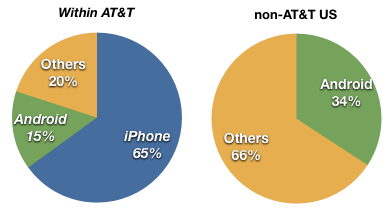
    Take the US market for example.  The overall data from NPD suggests that last quarter Android reached 28% share vs. 21% for iPhone.  Many of those Android devices were new to market or at least newer than the iPhone which in Q1 was coming to the end of its product cycle.  Second, pricing for Android devices seems to have been quite aggressive with buy one get one free sales.  But I won't dwell on tactics now; what I do want to note are the differences in share between AT&T users and non-AT&T.

    Note that within AT&T, iPhone outsells Android over 4 to 1.  iPhone also outsells "others" (mainly RIM) more than 3 to 1.  However, outside AT&T, where the iPhone is not available, Android does not outsell "others".

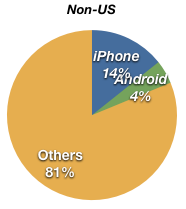
    If we exclude the US altogether, we also see that Android does not have a great distribution.

    Outside the US, the iPhone also outsells Android nearly 4 to 1, but it has a way to go before challenging Symbian which makes up the bulk of "Others".

    So in markets where Android is head-to-head with the iPhone (AT&T and non-US markets), iPhone's lead is quite high (still).  The possibility still exists that Android will overtake iPhone given the broad licensing and distribution, but it's not necessarily a given.  And in any case, iPhone is not the market share leader today and that leadership does not seem to be their objective (note the pricing).

    The bigger question is what will happen to RIM and Symbian as Android grows.

  6. Global smart phone OS shares

    Research

    In the free press release linked below Canalys reveals their estimates of vendor shares but not the OS shares for smartphones. However it's not hard to see the OS split due to the high degree of exclusivity of OS's to vendors.

    For example, virtually all Nokia devices are Symbian powered, all RIM devices are Blackberries and all Apple devices are iPhone OS.  Motorola is only shipping Android and HTC is the only top 5 vendor that now licenses more than one OS.  Even HTC's portfolio is now heavily Android weighted.

    We can carve out Palm (960k units shipped) from the "others" and we're left with mostly Windows Mobile.  My estimate would be about 5 to 6 millionWinMo made it out.

    That leads me to the following estimated OS shares:

    • Symbian (Nokia): 42%
    • Blackberry OS (RIM): 19%
    • iPhone OS (Apple): 16%
    • WinMo (Microsoft): 10%
    • Android (Google): 10%
    • WebOS (Palm): 2%

    If anyone knows the actual Canalys OS shares, let me know.

    Global smart phone market growth rises to 67% (Canalys press release: r2010043).

  7. 41 million BlackBerry users

    Research

    "Officials at the WES 2010 keynote said that RIM has redesigned all of the core applications within the BlackBerry operating system. It also revealed that there are 41 million BlackBerry users, and 90 million BlackBerrys have been sold to date."

    Apple already announced that they see 100 million iPhone OS devices sold by this summer. The installed base for iPhone OS devices is likely to be much greater than 40 million since most of the 85 million devices sold as of today were purchased less than 2 years ago. With the iPad and the iPod broadening the portfolio, the Apple mobile platform will grow more rapidly than RIM's leading to increasing network effects.

  8. RIM chief competing for "Most out of touch CEO" award

    Research

    RIM's co-chief Mike Lazaridis downplayed many of Apple's efforts today in a keynote at the TD Newcrest technology conference in Toronto. The executive was concerned that there wasn't necessarily a market for tablets like the iPad and that any devices would have to be put in the context of computers and smartphones. Many companies ask new hires to choose either a new smartphone or a new notebook, and if the tablet is simply a substitute for a notebook it may not have an easy answer, Lazaridis said.

    He added that smartphones are getting more powerful and more computer like, and by extension would reduce the need for a tablet.

    The company leader also dismissed the importance of touchscreen phones. While it's important to give customers what they want, touch-only phones like the iPhone aren't that popular, Lazaridis argued. He claimed that most of the people buying touchscreen phones are going back to phones with hardware QWERTY keyboards, like those that made RIM "famous."

    He pointed out that it was the experience and not the features that determined a phone's success, and that the most popular BlackBerry was actually the starter Curve 8520. It not only lacks touch but 3G and a high-resolution screen.

    via RIM chief: no market for tablets, touch-only phones | Electronista.

    Jobs must be thinking: with enemies like these, who needs friends.

  9. Sony Ericsson and RIM reach market share parity

    Research

    [Sony Ericsson] said it shipped 10.5 million units in the quarter, a 28 percent decrease compared with the same three months in 2009. It was down from the 14.6 million units shipped in the fourth quarter.

    via Mobile phone maker Sony Ericsson posts Q1 profit - Yahoo! News.

    A few weeks ago RIM said it shipped 10.5 million devices.

    With Apple claiming 85 million installed base of iPhones and iPod touches vs. 75 million last quarter, it's safe to assume at least 10 million Apple smart devices shipped in Q1.

    By units at least, SEMC, RIM and Apple are neck and neck.

  10. RIM Reactions: Goldman Downgrades to 'Sell'

    Research

    Goldman Sachs: “Evidence that the structural competitive issues are starting to weigh on its growth prospects. We estimate that RIM’s U.S. business declined 15% [quarter-on-quarter]—the second q-o-q decline in a row, and the first [year-over-year] decline. While RIM attributed that to an inventory reduction at a North America customer, we think the magnitude of the decline points more to lower demand at Verizon as a result of its endorsement of Android; our checks showed a dramatic reduction in the number of RIM [models] at Verizon last quarter and better sales for Motorola’s DROID than for RIM at many Verizon stores.”

    via RIM Reactions: Goldman Downgrades to 'Sell' - MarketBeat - WSJ.

    RIM remains the best feature phone company out there.  Too bad that feature phones are not going to survive against mobile computers.