An Office Hours question asked by Roger S., June 9, 2026.
Q: Beyond selling more capable hardware — phones, Macs, iPads — is there real monetization in all of this AI?
Absolutely. They gave us an architecture: it’s about intent, about orchestration, about routing a request through multiple models and input types, and then deciding whether it goes through an app or back to Siri. Where’s the money? My answer is: follow the compute.
If this works on-device, the user is happy buying the device, with the memory it needs, and Apple bundles all of that into the purchase price. Developers still sell their apps, but they’re not selling extra compute. But if a result requires heavy computation in the cloud, through an app, then trace it: who sends you the bill? That invoice comes from somewhere. If it’s a developer or a model supplier, it isn’t free — they’ll ask you to subscribe to get the answer, priced as a fixed fee or variable. Apple gets its usual commission, thirty percent or fifteen, somewhere in between.ssss
If Siri depends on services that don’t go through an app, then Siri charges back through iCloud for the compute. So all they’ve really done is take the exact same business model — Services with subscriptions — and either fold compute into existing subscriptions or add new ones. Apple gets the same distribution commission it always has. Nothing changes. In fact, the absence of any commentary from Apple about new economics is, to me, a tacit acknowledgment that nothing different is needed.
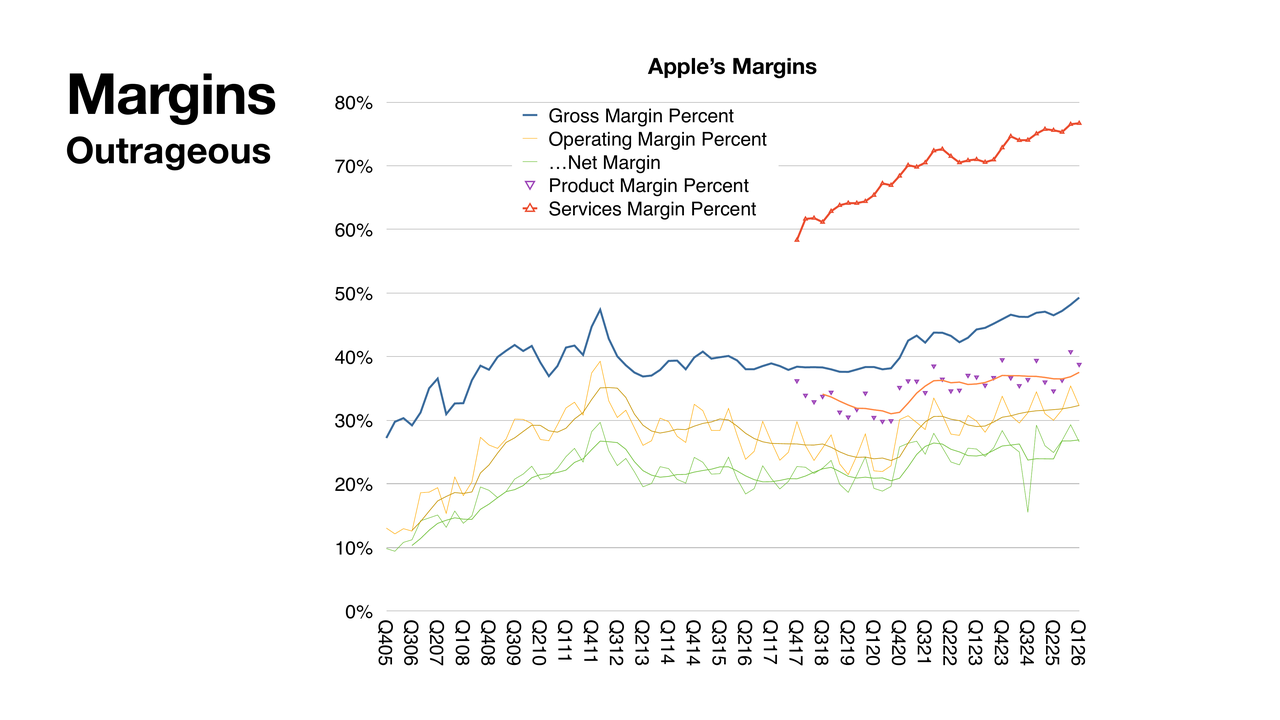
That means the App Store, and if anything economically interesting happens, you’ll see another kink in its trajectory — the way we saw a kink when subscriptions became dominant. To users, it’s invisible. Maybe the monthly services bill rises ten percent; maybe they add a couple of subscriptions and drop one. It all reflects in Services, at a 72%+ gross margin, with a hardware uptick alongside. I reckon it’s a ten-year cycle before half of the Apple base are AI active daily, paying something for it. Developers will just see more of the same, only bigger.
Recording and transcript of the June 9, 2026 Asymco One Office Hours, recorded the day after Apple's WWDC 2026 keynote. Horace Dediu shares his impressions of the event and takes questions from Asymco One subscribers.
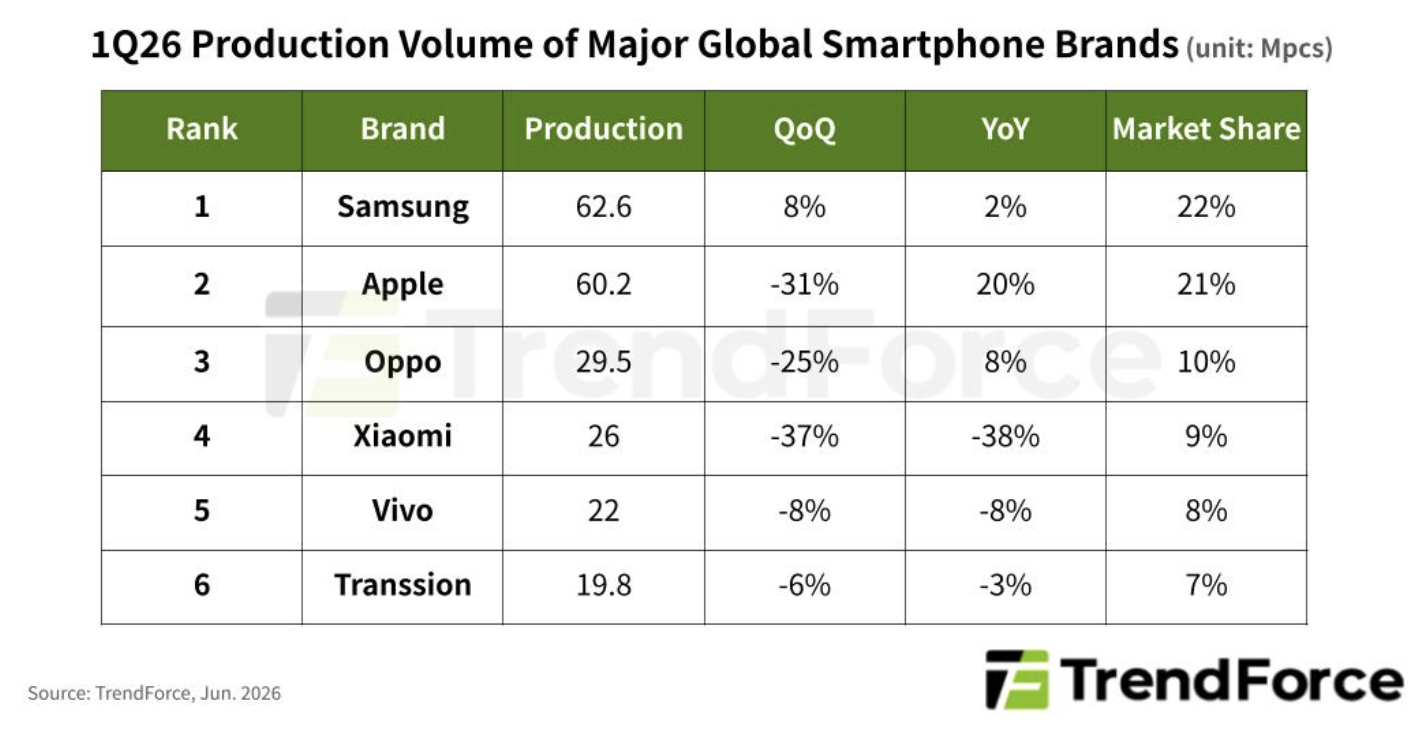
TrendForce’s latest figures reveal that global smartphone production reached around 284 million units in the first quarter of 2026, marking a 1.7% YoY decline. Despite a sharp rise in memory prices since the second half of 2025, the effect on production was minimal because brands still held inventories of cheaper memory components. Additionally, consumer expectations of higher prices in the future have helped sustain short-term demand, cushioning the impact of rising memory costs on production during the quarter.
However, as low-cost memory supplies are gradually exhausted and significant ongoing increases in memory prices reduce profits, most smartphone brands have begun adjusting production in the second quarter.
Looking ahead, TrendForce forecasts global smartphone production to decline approximately 16.2% YoY to 1.051 billion units in 2026. Under a more severe scenario, the annual decline could become even more pronounced if memory price increases remain elevated and brands are forced to raise retail prices repeatedly.
TrendForce notes that Samsung is relatively well-positioned to withstand the current cost inflation cycle thanks to strong financial backing from the broader Samsung Group and a sizable premium product portfolio. Nevertheless, its significant exposure to lower-end models remains a concern—particularly amid weakening consumer sentiment—making end-market demand a key factor to monitor.
Apple ranked second with its production of approximately 60.2 million units during the quarter. In addition to ongoing production ramp-up for new iPhone models, output was supported by the launch of the iPhone 17e, resulting in 19.7% YoY growth.
Compared with competitors that have already entered a margin-protection phase, Apple remains better positioned to absorb higher memory costs while maintaining profitability. TrendForce believes Apple is more likely to prioritize market share expansion during the current downturn as it lays the groundwork for future growth in recurring software and services revenue.
Xiaomi, Oppo, and Vivo focus on preserving profitability as production plans face greater uncertainty
First quarter production declined seasonally among the major Chinese smartphone brands, including Oppo (29.5 million units), Xiaomi (26 million units), and Vivo (22 million units). These three brands ranked third through fifth globally by production volume.
While all three delivered strong market share gains in previous years, surging memory costs are now weighing heavily on profitability, creating significant uncertainty around their 2026 production plans. As a result, production targets may be revised downward if cost pressures persist.
Transsion produced approximately 19.8 million units in 1Q26, roughly flat compared with the same period last year, placing sixth among global smartphone brands.
The brand has been particularly vulnerable during the current memory price supercycle given its smartphone portfolio is heavily concentrated in entry-level and budget segments—where profit margins are already thin. Limited access to low-cost component inventories has further amplified the impact.
NB: Counterpoint tracks sales, Trendforce tracks production. The production data may include inventory build-up not shown in sales while sales may include drawdowns not shown in production. The two analyses however agree on a market under significant supply-side stress. Profitability is a big concern and availability of components is critical. As noted previously in response to Counterpoint reports, the 2026 full year volumes will probably show the worst decline in decades.
AI sales are booming. AI FCF not so much. So what new cash flows does Apple Intelligence unlock?
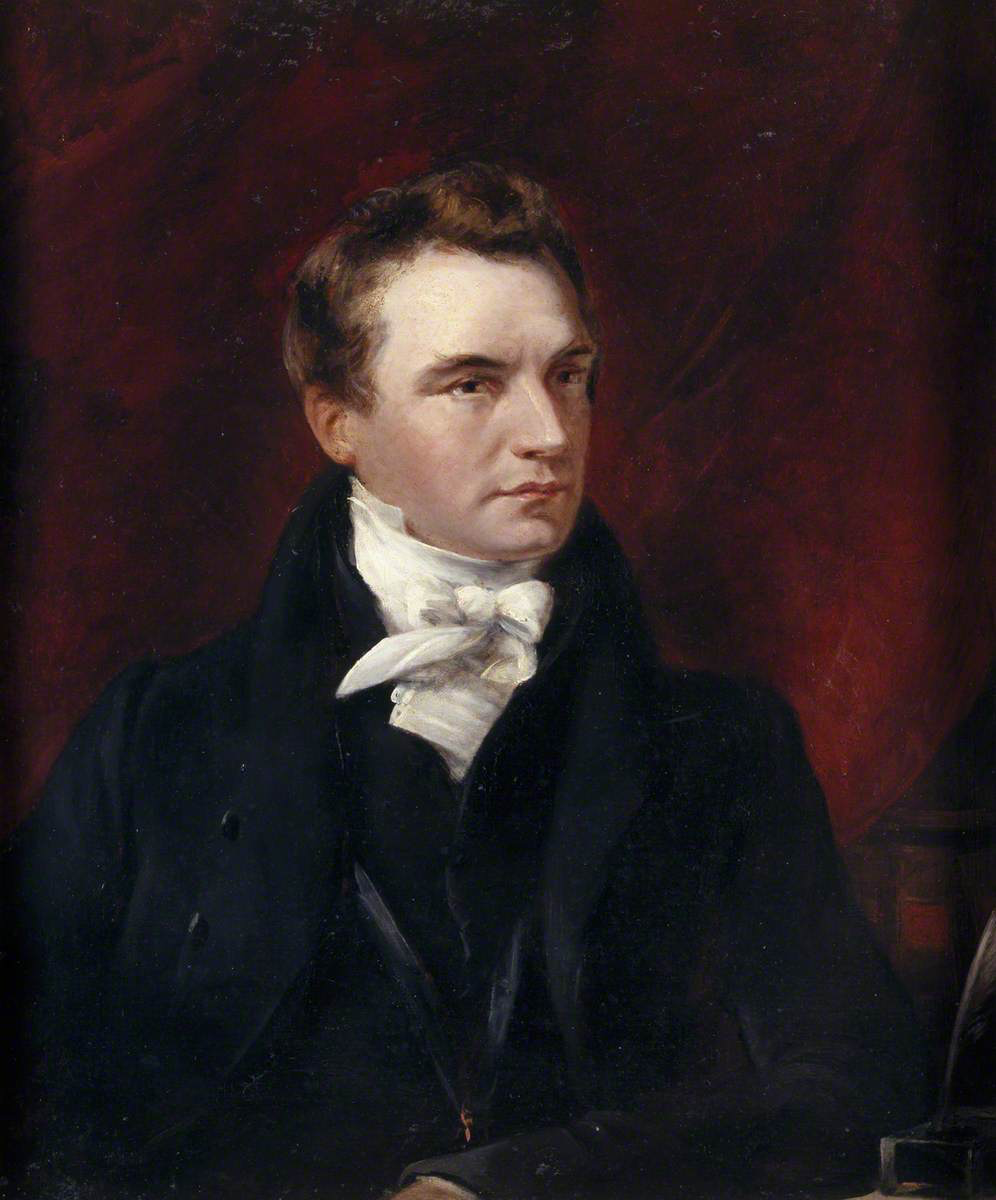
Portrait of Charles Babbage (c. 1820)
Apple's release of a new framework for AI at WWDC26, centered mainly on new layers in the device/OS which process intent to either on-device or world models and couple it to experiences which are system-wide, including apps.
This is how the data and the inferences flow but what about the cash?
I am writing without a full picture in mind, and perhaps one does not yet exist, but my assumption for at least three years has been that the value of AI will split between the creation of (frontier) models and their distribution. Apple chose to focus on local models, license or partner for frontiers and stitch together the means for distributing both.
That is until on-device will be good enough to perhaps bring all models in-house.
But distribution is always where it's at. So how do the new announcements affect this?
Let's follow the money. The costs of inference will be partly borne by Apple for what they keep in private cloud but mainly by apps and hence subscriptions which will include marginally increasing compute costs. This will lead to increasing or new subscription pricing and the usual commissions for App Store distribution.
The fact that this is all implied rather than explicitly stated should be seen as a tacit acknowledgment that the Services business will not change much, if at all. It will perhaps benefit from an uplift if the new AI-powered apps are very popular.[1] This new AI might create more demand or expand existing demand. That will all depend on the innovations developers come up with.
But the elephant in the monetization conference room is hardware. AI demands a huge step-function increase in computing resources--both compute and storage and integrated memory. The minimum requirements are already leaving two to three year old hardware behind.[2]
Again, if AI is compelling enough, users will need to upgrade. Not just their phones but the Macs, iPads, Vision Pros, Watches, probably AirPods too. Then there is Home which is seeing foreshadows of a significant AI enabled upgrade. This means HomePods but also probably new devices altogether. Rumors of spectacles coming are par for the course. Health will also be revolutionized.
This idea that AI is monetized through hardware should hardly be a surprise…
Services has a lot of headroom for growth as non-consumption is still pretty competitive
But don't worry, adoption curves being what they are, and regional/political obstructionism will imply a decade or more before perhaps half the install base is using Apple Intelligence with some frequency.
René Descartes, who published the phrase I think, therefore I am" in Discourse on the Method, in 1637
Apple isn't measured by revenue or profit, at least not primarily. The measure is always satisfied customers. The application of services, software and computing hardware to improve lives has always been the modus vivendi and the resulting customer creation has always been the metric of success. Revenues and profits follow customer creation in a 1:1 relationship.
WWDC seems to attract attention as a catharsis for product and strategy announcements but it was never intended to be this. It's about developers (the D in WWDC) and what matters to them: APIs, operating system updates, languages, SDK, and other tooling. It's also a chance to reveal the economic value proposition for those developers who are following their part of the $2 trillion ecosystem.
And so the measure of WWDC should be how developers are created and satisfied. The products, which come later, are important but what matters more is developer opportunity, productivity and satisfaction.
So here is what I'm looking forward to:
New developer opportunity with AI. This is via easier integrations, more choices perhaps in terms of back ends and possible hooks into different parts of the ecosystem. To wit: Swift extensions, *Kit extensions with hooks to smart home, exercise/fitness, accessibility.
New developer productivity tools: How is AI going to improve the toolchain for developers.
New developer business models: how agents can be built and integrated into privacy and safety that only Apple can guarantee.
As Apple has shown with accessibility improvements (foreshadowing!), AI can be used to make people's lives better especially those who cannot perform due to disability. AI can lift those "below the median" in terms of many forms of ability: below median communications, below median health and below median mobility. Those with more limited ability can be "enhanced" into at least median ability. By definition, half of humans are below the median so helping them is as useful as helping those above the median.
This is in contrast to the narrative that AI makes supermen. The opportunity is not mainly about taking over high ability tasks and forcing human effort to be displaced. it's much more about making the less able become more abled. (Characteristic of GenAI output is the "averageness" of it. For those of exceptional ability it feels worse/erroneous and irritates. For those of less ability it's empowering. AI pushes toward the median, both from below and above.)
Below the median here does not necessarily mean below the median income or wealth. Ability is not always correlated with income. There are many Apple customers and potential Apple customers who can use help. I surely can use help in many areas of life.
WWDC is about the scaffolding upon which these grand problems can be solved. Scaffolding is not pretty to look at and most look away in disappointment if that's all that is revealed. But no matter how well regarded, no great building has ever been built without scaffolding.
Why the most common measure for valuation is inadequate in an age of AI
Software and services companies like Google, Microsoft, Amazon, Meta are spending on Capital Expenditures at the rate of heavy industry manufacturing. This defies their description as "asset light" business models which depend on services, distribution or platform economics.
The problem isn't just semantic. It is that for their entire existence, these companies were valued for their profitability and measured in terms of a P/E ratio and earnings growth. The situation has changed dramatically. Their revenues are up, the earnings are up and growth is up and share prices are way up. But not their P/E ratios. Why is this?
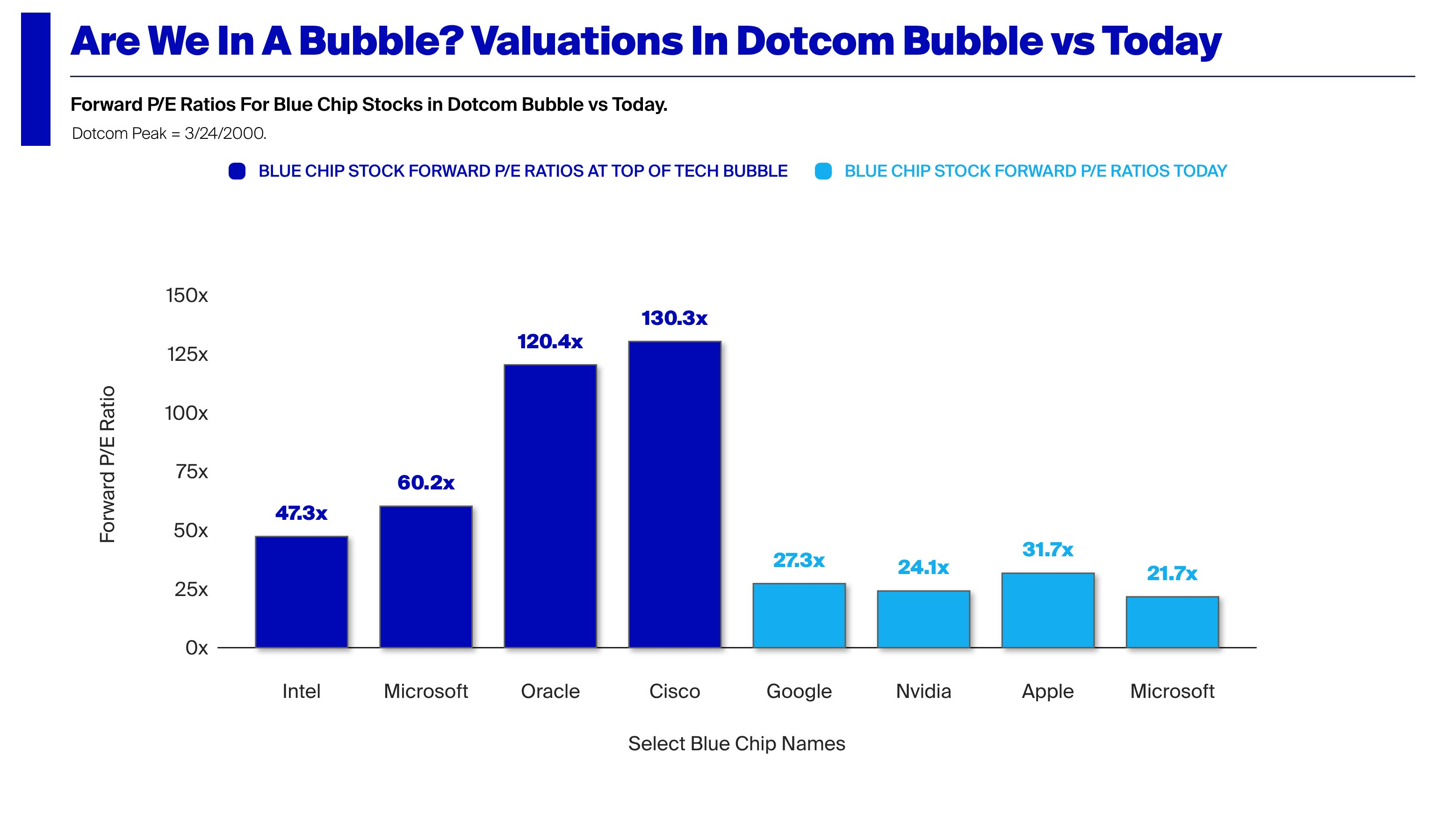
Consider the graph below showing the (forward) P/E ratios of the Dot Com market leaders vs. the market leaders today.
This even as share prices and value concentration have risen even faster than in the Dot Com era. Seen from the P/E basis, it does not look like we are in a bubble. Earning growth is way up so the share prices are not outrageous on that basis. That is contrary to 1999 when P/E ratios in the hundreds were considered normal. Expectations of an internet fueled boom were speculative. Expectation of an AI earnings boom seem well founded.
But these companies could still be over-valued. The P/E ratio is not the full picture. It is in fact a simplifying shortcut which ignores significant pockets and omissions of value.
For this analysis I'll use a sample including some of the largest market caps in the world with two exceptions. The exceptions are Lilly (LLY), Berkshire Hathaway (BRK-B) which are on the list but not in the top 10 (though in top 15) and Saudi Aramco and Broadcom which are in the top 10 but not on the list[1].
Company
Market Cap
NVDA
$5,709,746,405,376
AAPL
$4,379,916,369,920
GOOG
$4,811,891,146,752
MSFT
$3,041,424,048,128
AMZN
$2,874,514,866,176
TSM
$2,166,463,135,744
TSLA
$1,664,912,326,656
META
$1,569,837,154,304
BRK-B
$1,044,046,610,432
LLY
$897,716,060,160
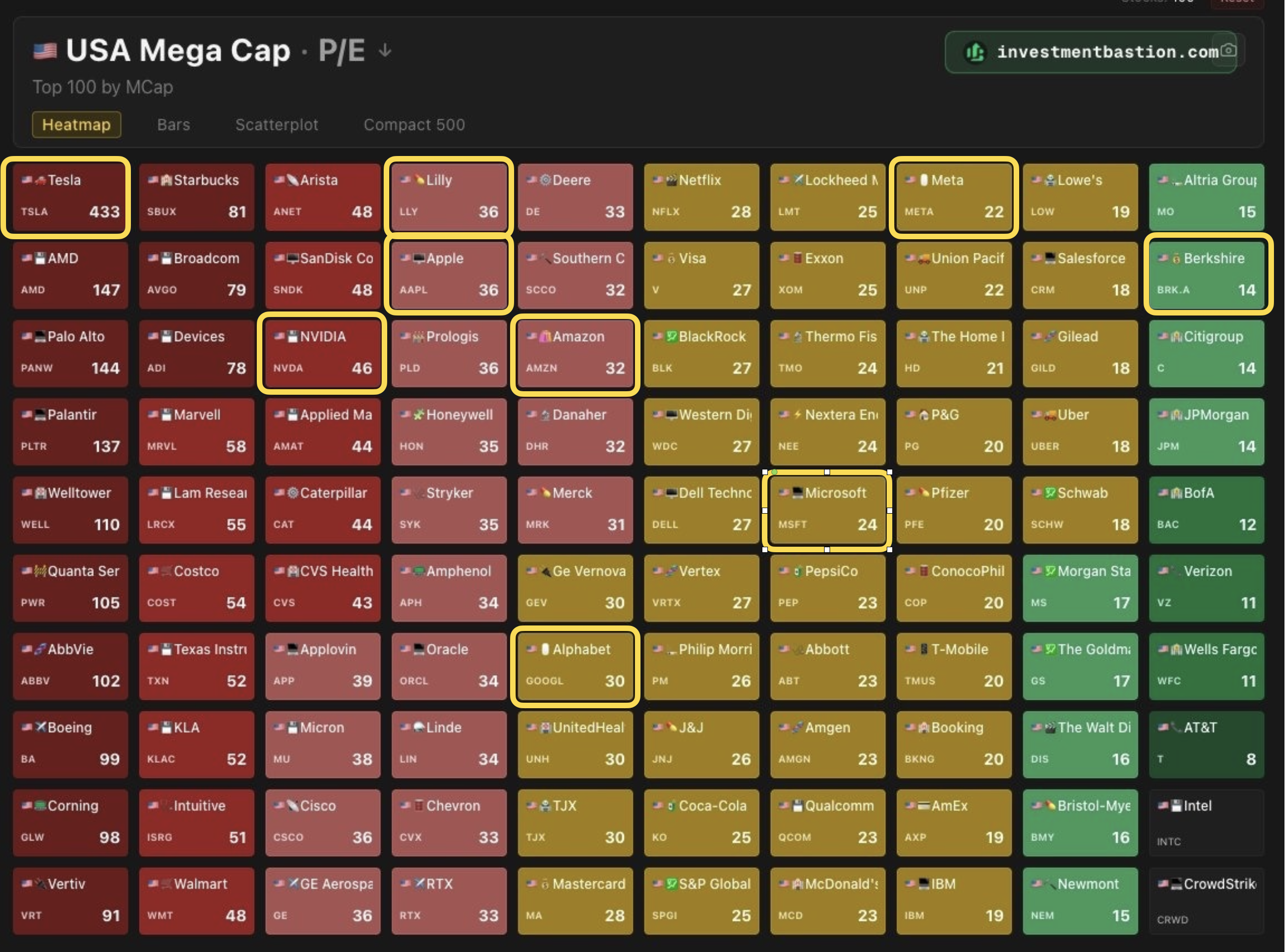
The following diagram shows the P/E ratios of the sample relative to the top 100 US market caps[2]. Note that, with one exception, the companies are not in the dark red zone with above P/E of 60. The exception is, of course, Tesla, which, at P/E of 400+ is 14x the average multiple.
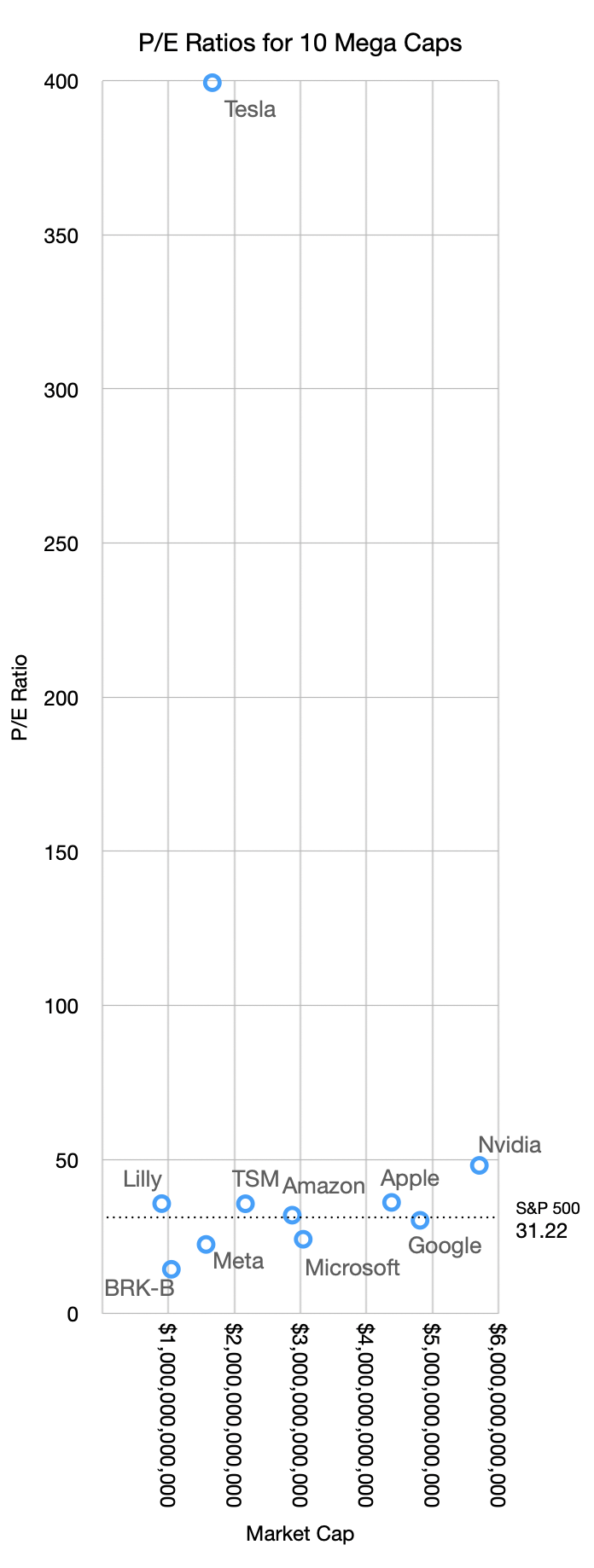
Moreover, compared with the S&P 500, these P/E ratios are in-line with the median. The following graph shows the sample set with P/E ratio vs. Market Cap.
Excluding the one anomaly the relationship seen is that higher market caps roughly correspond to higher P/Es. Nvidia has a market cap over $5.7 trillion with a P/E of 48 while Meta has a market cap of $1.5 trillion and a P/E of 22.5.
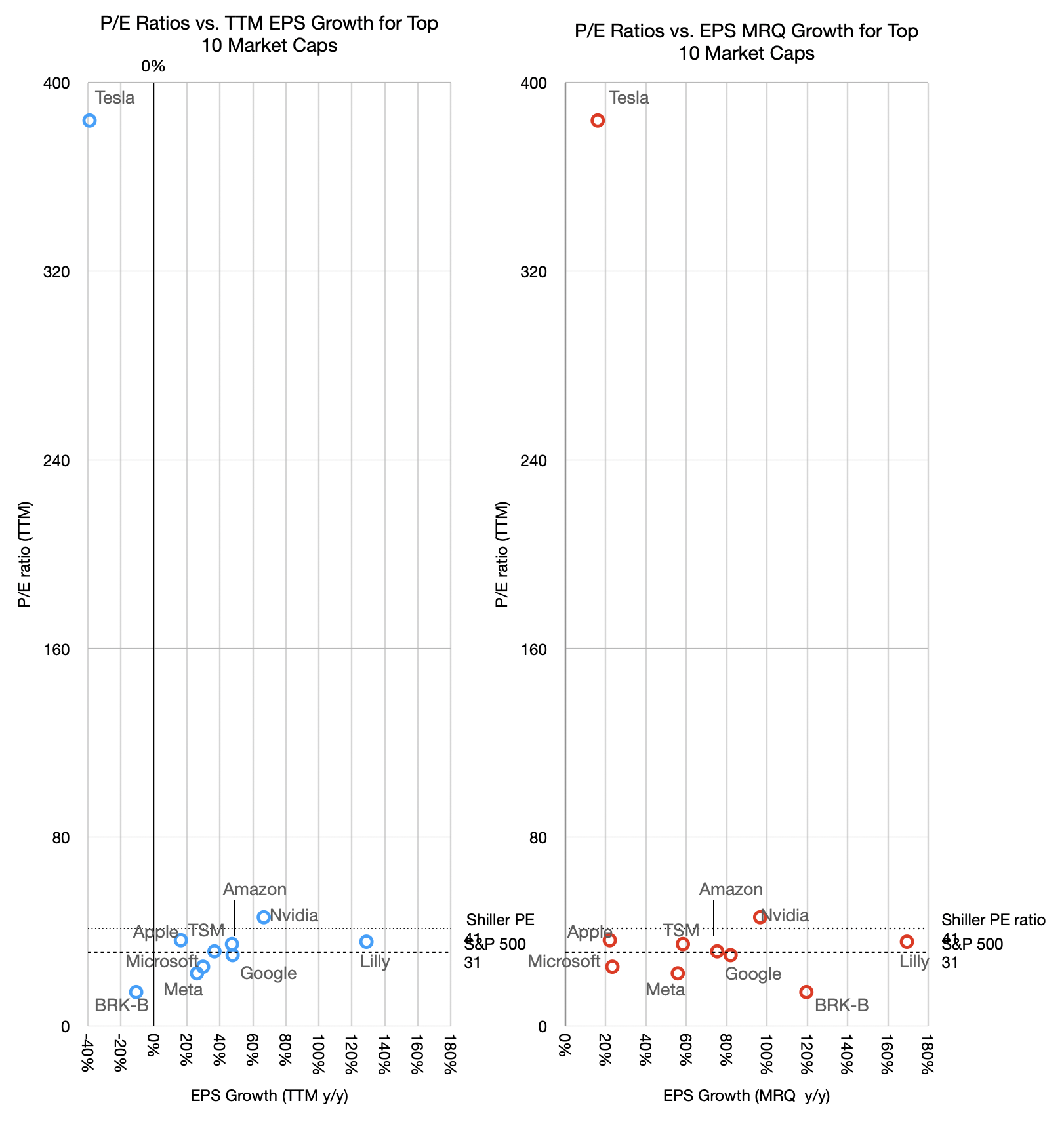
Higher P/Es should also correspond to higher growth rates. The graph below shows the relationship between P/E and growth, both in the most recent quarter (MRQ) and trailing twelve months (TTM).
There is a loose relationship between P/E and TTM growth but not with last quarter's growth. The one anomaly is even more prominent as it shows negative growth with exceptional valuation. Fundamentally however the relationship between P/E and growth is weak. Companies having widely divergent growth show similar P/E ratios. Alphabet for example has seen its P/E ratio in the 20s with growth in the 80s TTM and 50s MRQ.
This might sound familiar. From 2008 to 2020 Apple was trading at a P/E ratio in the teens and low 20s while growing as fast as 80%. The logic was captured by my analogy of the goose that lays the golden eggs. Apple was able to create extraordinary products but the market considered such hits fleeting. It valued consistency over heroism. Getting on base vs. home runs. And so the P/E began to rise only once Services became more prominent. Regardless of how foreseeable this pattern was, it took a decade and is still ongoing for the pricing to catch up.
But the situation with AI companies (that is, all the big tech companies but Apple) is that their earnings today are somewhat an illusion.
An old maxim that says "earnings are an opinion while cash flow is a fact.[3]"
This is because Net income can be manipulated by accounting abstractions, whereas cash flow is based on bank transactions.
To wit: Net income (earnings) is calculated using accrual accounting, which relies heavily on judgment calls rather than bank balances. Companies recognize revenues the moment a contract is signed, even if the cash won't be collected for months. Or they can dial in a delay as they desire.
Because of varying accounting policies, two identical companies with the exact same physical business can report vastly different earnings figures.
Cash flow is objective and simply tracks the actual movement of money in and out of the business. Real dollars either enter the bank account or they don't. A company can look highly profitable on an income statement but still go bankrupt if its cash is trapped in unpaid invoices or unsold inventory.
Finally, cash flow can be strongly negative while earnings are strongly positive. This is because investment in capital equipment does not appear in the income statement.
Therefore true economic value is determined by the cash a company can actually distribute or reinvest rather than how it declares profitability based on accounting abstractions.
AI companies are not necessarily hiding behind suspect earnings but their extraordinary capital expenditures are draining their cash and thus what investors have access to.
Earnings seem to be soaring so the ratio P/E suggests a modest valuation. This is based on opinion or at least incompleteness.
We should look at a better indicator. It's the EV/FCF ratio. We will look at this next.
The top 10 ranking can change rapidly and it makes analysis difficult over longer time periods. The inclusion of LLY and BRK-B allow for visibility outside of the tech sector and they were in the list mid 2025. Saudi Aramco is in a completely different environment influenced by non-economic factors.
TSMC is absent from the table as it is US only companies. It is notable perhaps that of the top 15, three are not US companies (TSMC, Samsung and Saudi Aramco). Furthermore the top Chinese company, Tencent is 25th, valued at $532 billion and the top European company is ASML at 21st and $610 billion.
We expect our June quarter total company revenue to grow by 14%-17% year-over-year, which comprehends our best view of constrained supply. On iPad, keep in mind, we face a difficult compare driven by the launch of the A16-powered iPad in the prior year. We expect services revenue to grow at a year-over-year rate similar to what we reported in the March quarter after removing the favorable year-over-year impact from foreign exchange tailwinds. Keep in mind, during the March quarter, FX was a 2.5 percentage point tailwind to the total company growth rate, and for services, that impact was slightly more favorable.
We expect gross margin to be between 47.5% and 48.5%. We expect operating expenses to be between $18.8 billion and $19.1 billion. We expect OINE to be around $250 million, excluding any potential impact from the mark-to-market of minority investments, and our tax rate to be around 17%. With that, Tim and I will take questions.
- Kevan Parekh, CFO
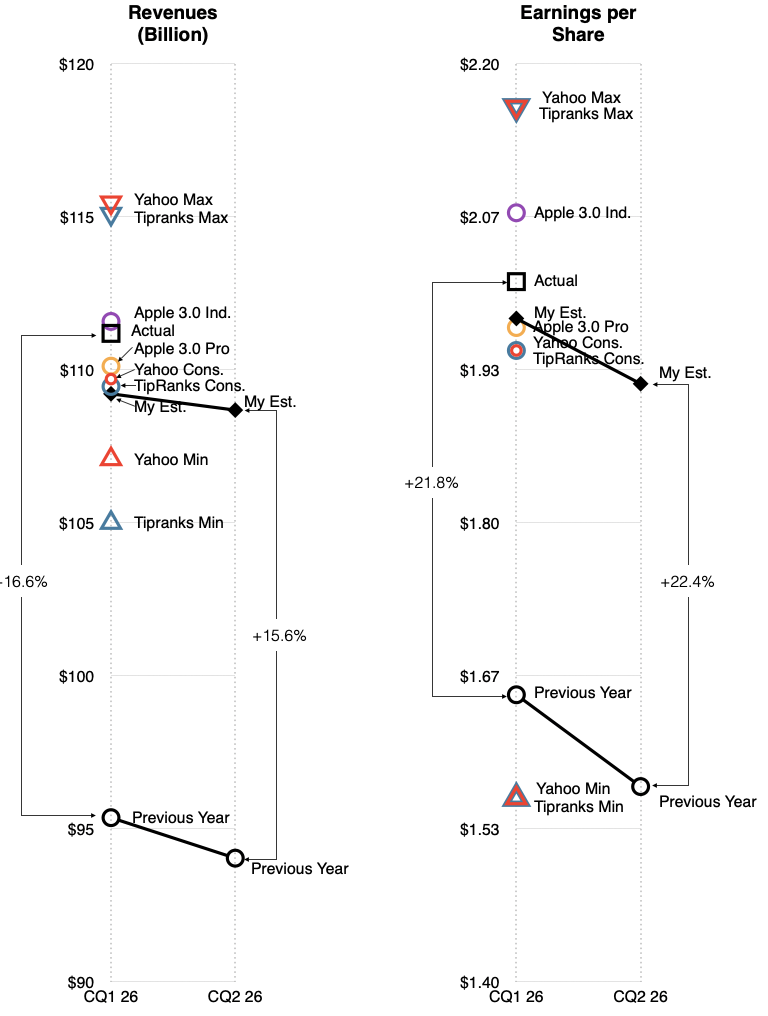
Based on the above, here are the estimates for Revenues and Earnings per Share
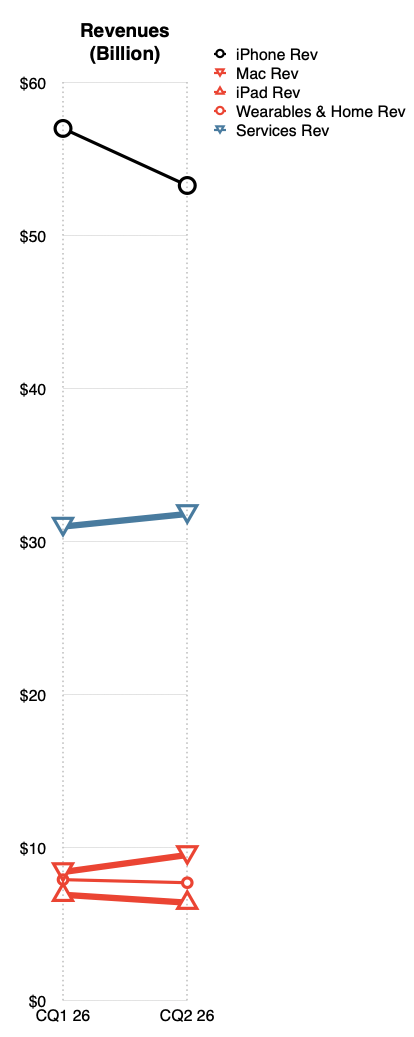
Sequential change in segment revenues:
My Revenues and EPS expectations in table form:
My segment revenues and growth expectations in table form:
Note that the revenue expectations are for 15.6% growth while guidance is at 14% to 17%. Chances are that they will hit the upper end of the range and I may revise these estimates to reflect that as we get more data.
Takeshi Narabe On the secret of Apple's success, you have previously noted that the key to Apple's success was its ability to integrate hardware, software, and services to create products that are perfectly hired for a specific job to be done. You also highlighted how they moved beyond mere devices to lock customers into an ecosystem like iOS, iCloud and Apple stores. So this analysis is now very well known. So do you still think this is one of the biggest reasons of Apple's success?
Horace Dediu Yes, we have to recognize Services has only been a story for the last 10 years. And arguably integration of software hasn't been really all that important before 1998 when Apple brought Steve [Jobs] back and with him came NextStep, which was [an] operating system based on Unix. And that was much more robust and much more focused around software engineering than the original MacOS. Or, what I would say [constituted] version 1 of Apple, which began in 1970s until the 1990s.
Most people tend to think of Apple as one continuous story for 50 years. [But] it's at least two major stories. I would say pre-98 and post-98. And post-98, it's been so different. And it's much more, I would say, something [that can be studied] as a theory.
I think in the first decades Apple was more, let's say, a story of people. There were people who were brilliant. There were people who were celebrated [as they are] now. But the second half of Apple is much more about building a business that has longevity, [that] can last a long time. It's an unusual priority.
I think for many companies in the world, they don't think about longevity. And that is why, even Tim Cook recognizes that it's the next 50 years that are more important [than the last 50 years]. So thinking about a century is really important and I think [that] is core to the current culture of Apple. Now, of course, this means, as you said, integration, and that is one of the key things. But fundamentally, beneath all that, there's this point about culture.
Takeshi Narabe Culture?
Horace Dediu Culture in the sense of what are the priorities? What do we concentrate on and to what degree do we need to focus? They [management] repeat these things all the time. Focus, focus. What means this? It means saying no to many things, but it also means saying yes to the things where you can bring great things to bear. It's where Apple has a unique advantage. And that means saying no to a lot of things.
We know about the car business that they eventually rejected even though they worked on it for many years. I think ultimately that decision was based on a realization that they couldn't bring enough contribution. And that's not just an economic decision. Of course they could have made money. There are even phone companies in China that make cars today. But it isn't what they thought of as important.
Takeshi Narabe All right, thank you. So you also mentioned to what extent do you attribute Apple's dominance to the ability to tap into non-consumption addressing latent demands that consumers themselves hadn't yet realized.
Horace Dediu So this is also one of the keys indeed. i learned about this by listening to my professor Clayton Christensen, who observed that great companies not only compete effectively, but they also create their own markets. They create their own demand.
[It's an] Extraordinary idea. And when you look at Apple, you do see that they use a different language. They talk about customers not asking for the product. But they also fundamentally build something that compels the user to buy it. When it was something that wasn't conceivable. Steve Jobs famously said, the customer hires us to find out what they want. So this is a fundamental thing.
And there are many examples. And I think one of the struggles today, for example, is Vision Pro, a product that is very difficult to find how it's going to solve problems. But at the same time, it's an extraordinary product. I think the jury is still out on the Vision Pro, but there are many other examples where I think initially they thought things would go in one direction and they went in another direction.
But even the iPhone, I like to repeat the fact that when the iPhone was introduced, Steve Jobs said it was three things. That it was a widescreen iPod, that it was an internet communicator, and it was a phone. But I point out that these days, those three jobs of being a music player, being a telephone, and being a browser, are not among the most popular things people do with it.
So it's fascinating how they introduced it as a blank slate. [It was] software, written by third parties [that discovered the compelling uses], and it developed in its own ecosystem. That is also a very interesting lesson there.
But it is fundamentally about really being humble. I think, again, it's a cultural trait, being humble and saying, maybe we don't know fully what to do, but to concentrate on quality and concentrate on doing at least something useful for people. And then later, new things will appear.
— This is the first part of a series of excerpts from an interview with Asahi Shimbun newspaper on Apple & Innovation.
Q: What's the potential legal regulatory risk to the Apple enterprise combining both products and services? You can make a case that services growth over top of the monopoly in hardware is an illegal monopoly. That seems to be the way regulators are going. And forcing a split between services and products could definitely damage Apple as a whole.
Sure. So let me take a European — not just point of view, but sort of a language. The language is that of being a gatekeeper, and a gatekeeper has a responsibility not to exclude competitors, because if you're big enough as a gatekeeper, you effectively are a platform for millions and millions. And so it matters how many. It's not just a gatekeeper per se, but a gatekeeper with a sufficient audience. And the logic there is that you can't bundle your own services and therefore exclude — especially by putting yours as a default, then the others have a hard time competing.
And that is an antitrust logic. May or may not agree with it. I certainly don't, but I'd say it's a clear argument when seen through this gatekeeping phrase.
Now, the difference — what you're asking is in business. Well, that doesn't fall under the same restriction. Usually, because antitrust is about consumer protections. There's a lot of businesses which get into complex deals that are tolerated because it doesn't affect the mass population. Now, of course, collusion and other things are still illegal. But I think you get a little bit more of a pass if you're solving the problem for businesses. There's one reason why Microsoft got away with what they were doing for so many decades. It's only when, in the late 90s, consumer personal computing became so prominent that there arose an antitrust argument about bundling everything into the operating system that got them into trouble.
So I think Apple's bundling hardware and services for business users is probably going to be okay for a while. I would just say it's a question of quantity rather than the logic at this moment, so I wouldn't worry about it yet.
But there are ways around it. Even if you do want to worry about it, there are ways around it which basically deal with providing provisions for alternatives, and that's what Apple's done to comply over and over again. Bending over backwards, providing alternatives, providing options. But then nobody uses those options, because they're far more complicated.
The law is futile on this, because it doesn't take into consideration user satisfaction. It doesn't take into consideration the ease of things as opposed to the existence of things. It's nice to have options, but if it's complicated and annoying and expensive, you don't use the options. And so they have a very crude mechanism to try to enforce some utopian view of economic benefit. It just tends to create unnecessary penalties for consumers and producers, and as a result, they're just tripping over themselves. It just leads to all kinds of dysfunction.
Quality is what Apple's always said — quality, experience, ease of use. And bureaucracies are not oriented around either quality, efficiency, or delighting anything. It's incompatible with all of the work people do at Apple. And so it ends up being a net negative, overall, in my opinion.
This was one of the questions asked by the participants in Asymco's May 2026 Office Hours live Q&A sessions, open to Asymco One subscribers.
Asymco Bulletin is a digest of all the work we have published for the week ending May 3, 2026.
Editor's Note: Starting next week, we will be sending Asymco Bulletin to Asymco One subscribers only. You will still receive Updates when new posts are published per your notification settings.
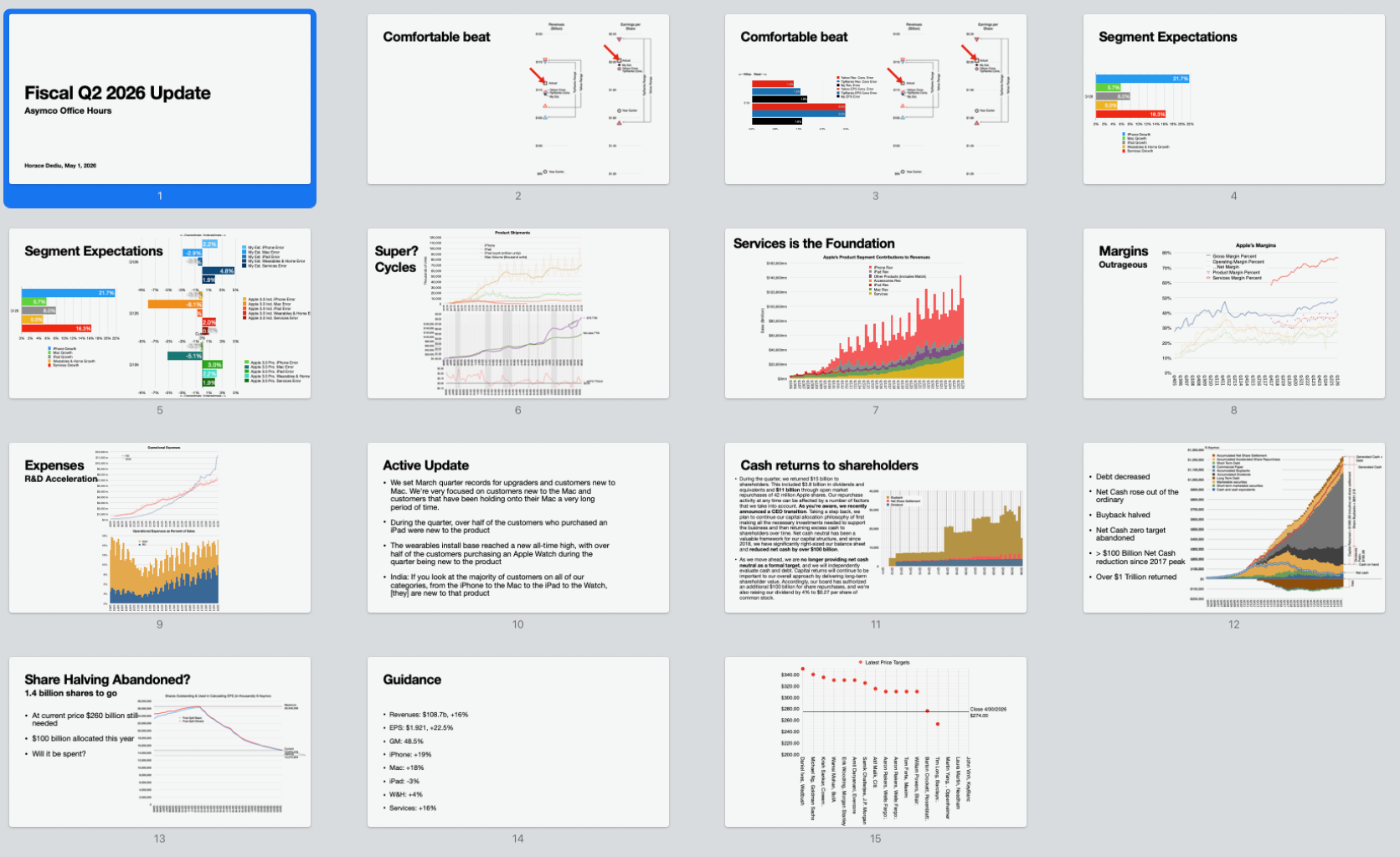
In Asymco One's May 1, 2026 Office Hours session, review of Apple's Q2 2026 earnings, segment growth: iPhone at 22%, Services at 16%, iPad at 8%, Mac at 5.7%, and wearables at 5%. Steady, foundational growth of Services, Gross margins reached nearly 50%, R&D spending surged, a shift in Apple's capital return strategy showing perhaps the hand of John Ternus. Guidance suggests 16% revenue growth, 22% EPS growth. Analyst sentiment turned positive post-earnings, with most price targets rising above $310. Apple's evolving identity as an engineering-centric company was the focus of many questions. →
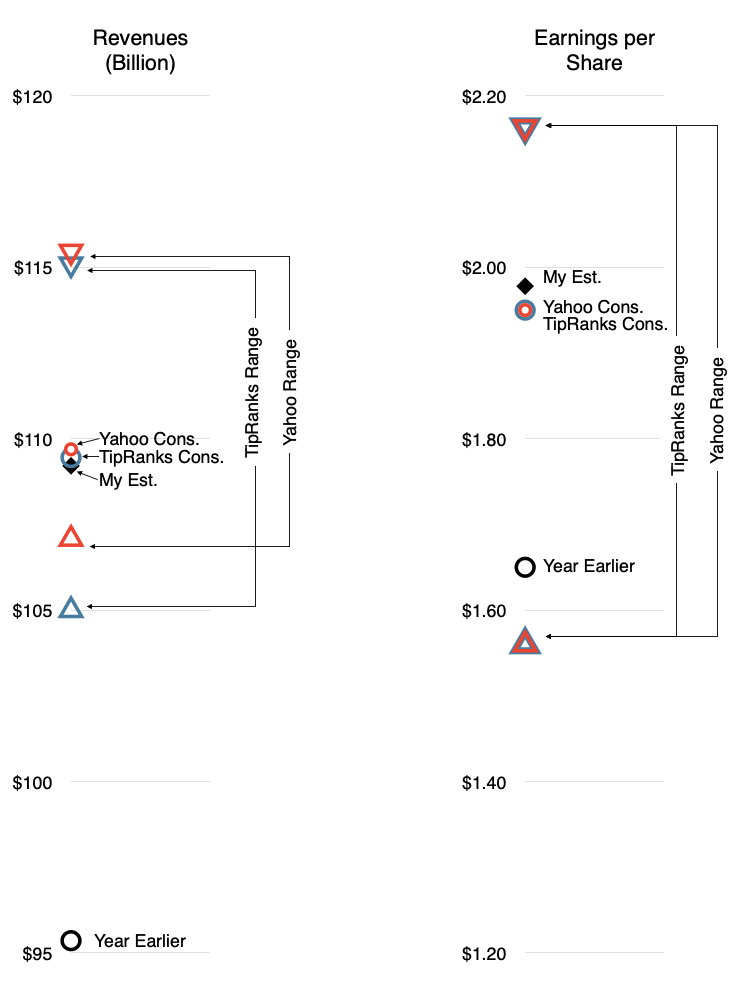
Revenue and EPS consensus, year-ago results and my expectations Yahoo Finance Yahoo Finance’s revenue estimate for Apple in Q2 stems from 31 analysts. As of April 25, the average estimate is $109.69 billion, with a low of $107.08 billion and a high of $115.37 billion. For the earnings per share estimate, 32 analysts put it at an average of $1.95. The low is $1.56 and the high is $2.16. TipRanks TipRanks also does its own analyst polling on Apple’s quarter. In its forecast as of April 19, its consensus is for a revenue of $109.45 billion, with a high of →
TD Cowen: 15% revenue growth, 10% growth guidance → Apple is projected to gain market share in both smartphones and PCs, driven by strong iPhone 17 demand and the new MacBook Neo, with anticipated revenue growth of over 15% in Q3 and positive sentiment ahead of earnings.
Morgan Stanley forecasts fiscal second-quarter EPS of $1.74→ Despite memory pricing pressures, Apple's strong iPhone sales, potential AI and foldable iPhone announcements, solid free cash flow, and favorable market conditions position it for better-than-expected earnings and a possible stock rise to $300 by September.
Is Apple borrowing Samsung’s Market Expansion Strategy?→ Bernstein SocGen maintains optimism on Apple's strategic pricing and ecosystem strength, forecasting EPS growth and potential market share gains, while Samsung faces smartphone profit challenges but thrives in memory.
Separately, it’s been reported that Samsung might see its first operation loss from its phone division, resulting in Apple capturing 100% (or more) of global smartphone profits. Simultaneously, Samsung is seeing huge profit gains from memory, even overtaking Nvidia’s profitability. This is remarkable…
Apple share of the smartphone SoC market grew from 15% to 19% in Q1 → In Q1 2026, global smartphone SoC shipments fell 8%, but Apple thrived in the premium market by leveraging its efficient supply chain and passing costs to consumers, boosting its market share from 15% to 19%.
Google to sell TPU chips as Gemini shows returns → Why pour cash into Nvidia when you can craft your own cutting-edge chips like Google, and then turn that innovation into a lucrative side hustle by selling them to tech giants like Meta and Anthropic?
The Vision Products Group Expanding → Gurman's 2025 dissolution claim clashes with 2026's active Vision Products Group hiring spree. The Vision Products Group posted 14 new senior roles last week.