A month ago ComScore reported that in October 2010 25% of Americans above the age of 13 used smartphones. The latest report shows that share to have risen to 26.3%.
That means there are 24 percentage points of penetration to go until the majority of Americans are smartphone users. In absolute numbers this implies about 56 million additional users (and hence units sold).
The rate of penetration growth was 1.3 percentage points per month. Assuming no acceleration in this figure and assuming we rely on ComScore (vs. Nielsen which reports higher figures) then majority share is 18 months away, or mid-2012.
However, assuming some acceleration and a different sampling method, I still believe that we could see this figure by end of this year.
There is an assumption floating around the debates in this and other forums that the "battle" between mobile platforms is a land grab. The unspoken implication of this assumption is that once a user is captured she is permanently locked into the chosen platform never to move to another again as long as she lives.
many people's first smart phone will be android. android can take them "cradle to grave." android will be there with a higher end solutions when they can afford it
This is a strong but untested claim. It may be true but we owe it a bit of thought.
A long time ago I tried to model platform growth is by using a version of Metcalfe's law. I suggested that the value of a network is proportional to n log (n) where n is number of nodes in that network[1]. This was somewhat based on common sense as it measures the possible links between n nodes with degradation due to the limits of social graphs.
The value the network creates is what developers as well as all the other participants in the ecosystem are able to tap into. The platform vendor gets to capture a share as well of course. As the value grows it tends to create network effects or a self-reinforcing cycle.
What I'm saying then is that we can treat a platform as a network, where each node is linked to another node by the commonality of experience.
The proxy of the model was Windows. Twenty years ago, having Windows meant that you could exchange files with other Windows users simulating a sort of network protocol. You could also ask your peer group for help and get software tips and new consumption ideas. So the more people used Windows the more likely it was that you also had to use it. Avoiding Windows limited your ability to be part of productive society (this is no longer true by the way, which is one reason Microsoft is in trouble).
If we fast forward to the mobile post-PC world, when it comes to platforms the shared experience is that of apps. People can communicate their app experiences and their usage better if they have the same platform. They can also learn from each other how to better use the products and how to solve problems. The more people that use a mobile platform, them more value it generates for platform participants.
The other factor determining value is that a platform also creates sunk costs. Usually called "investments" by users these are costs that are incurred and have a potential for future value. This means that the apps purchased and time spent learning and adjusting to the platform are sunk costs which users are reluctant to abandon. (Notwithstanding the fact that as sunk, these costs should be ignored when comparing the value of another platform,--psychology is what keeps users loyal even if it's not in their best interest.) This "sunk" factor of value is not as powerful as the sharing of experiences value since it does not scale with the number of users. That cost is a constant multiplier on top of the n log (n).
So the overall "value" of a platform is K n log(n). Where K is the stickiness of sunk costs.
Can this be stated plainly without the math?
When you compare two platforms you have to ask how contiguous users (n) grows and how stickiness (K) grows. The issue with fragmentation is that it actually cuts n. Many people won't be able to share experiences if their devices don't work the same way. Same with geographic density of a platform. If, as was the case with Symbian, there are few segments that became saturated with the platform then n is reduced.
The issue with a lack of paid or compelling apps is that it cuts stickiness, so that you don't have any sunk costs. Similarly the presence of ported or common apps means that K is reduced for any single platform. Nokia's Symbian has a serious problem with both consistency and with commonality of experience. RIMM depends too much on the commonality of messaging which is quickly becoming a commodity due to portability of the experience.
So in the end it's not just about how big the user base n is (which is the only thing that is measurable). It's how contiguous n is and how compelling the content.
This is too sketchy a model to be practically applied but it offers a thought experiment: does any given platform have
A large, contiguous user base with strong concentrations of users in the same demographic or psychographic segments?
A significant set of unique content (apps) which require costs from the user (in terms of data, time or cash)
It's not a clear cut case in my mind that Android benefits from these as much as iOS does. If that's the case, users are more likely to be moving on a one-way street between these two: from Android to iOS and not vice versa. The same thought experiment can be engaged in between any two platform contenders.
---
[1] Metcalfe's law is actually an n*n growth curve but recent research indicates that social networks scale in value as n log (n).
[Samsung] said it has sold around 4 million Galaxy S smartphones in North America, 2.5 million in Europe, and around 2 million in South Korea in the past seven months.
Samsung's US Android sales are very similarly allocated to Apple's iPhone sales: 40%. But at 20%, South Korea represents a very large portion of their sales (2 million phones sold in 7 months into a country of 48 million). This is understandable given Samsung's distribution power in its home country. However it also implies that Samsung's [high end] Android sales in Asia excluding South Korea are tiny. Only 1.5 million were allocated to outside Europe, US and South Korea--a market that includes the whole of Asia, Africa, Middle East and Latin America.
If we believe that Android is activated at the rate of 300k units per day, then Samsung represents around 40k of that. (10 million over seven months, linear extrapolation.) So where are those remaining 260k units/day going? Gartner calculated that in Q3 Samsung was the leading Android brand (about one third of all units). The Samsung figures make these share numbers very obsolete because 40k/300k is only 13.3%.
It's hard to pin down the market because the share shifts are dramatic and the market's growth is not linear. Nevertheless, intuition and guesswork leads to me believe that Android activations are to a large degree (perhaps two thirds) in Asia. This in turn implies that Samsung is not a major participant in that market.
Since neither LG (who does not have a strong Android portfolio) nor Sony Ericsson or Motorola which have low volumes, (nor obviously Nokia, RIM or Apple) are supplying the Asian Android market, the question is who is? Only HTC remains a contender but it's not big enough to account for the difference and they too are focused on the established Western markets (except for a modest presence in China).
We are left again with circumstantial evidence that "Other" lower tier vendors are carrying the Android torch in Asia. Pdadb.net shows 277 Android models available. Brands like ZTE, Huawei, Acer, Notion Ink, Linx, TMN, FirsOne, Ziss, Kogan, Highscreen, Saygus, Haier and Forsa are selling Android devices (though not all in Asia).
Not that there's anything wrong with that
If there is a worry it is perhaps that Samsung might find it hard to maintain the top spot in supplying Android once the unbranded vendors make it through the distribution obstacle course (as HTC did when it reached 80% of the Windows Mobile share.)
If one is to argue that Android empowers the desperate incumbents, then one has to also agree that it also empowers the more nimble entrants--inevitably leading to even more desperation.
[Updated: thanks to reader @UVStaska who noticed on glaring error in the analysis. I had failed to see the "S" in the original quote and been assuming the 10 million figure represented all Samsung Android sales. The Galaxy brand is the Android brand but the "S" model is only one product within the line-up. Samsung Android sales are likely much higher than the 1.5 million I assumed.
Back to the drawing board with the question of Samsung's strength in Asia. One does still wonder how well they are doing relative to entrants.]
With a market share of 31.5 percent, Nokia is still the largest vendor of handsets in the Indian market, followed by Chinese brand G'Five with about 10 percent share, IDC said on Wednesday.
No, I haven't heard of G'Five either. The article goes on to say that there are 68 new vendors in the market accounting for 41% of total shipments. There were only five new vendors with a share of 1% in the first quarter of 2008.
It was not long ago that Nokia held over 70% of the Indian market. That market is now larger but the share for Nokia has dropped by half at least. The share was not lost to Samsung but to 63 new entrants. They managed to capture 40% of the market, roughly equal to what Nokia lost.
These new vendors will launch Android phones next year or the year after that. According to IDC, Android obtained 9.4% in the third quarter up from 2.9% y/y. The number of Android models went from 2 to 19 in the same time frame.
What does this mean for Your favorite mobile OS?
I'm sure many will use the Indian example as evidence of the inevitable ubiquity of Android. However, I would note that data networks are still very sparse in India and 3G has not reached a level of penetration that makes mobile broadband a common experience [citation needed].
The funny thing is that this lack of connectivity is not likely to be an obstacle to Android as it wasn't an obstacle to Symbian in the pre-3G era in Europe. More than half of Nokia's smartphones were selling without data plans in Europe well into 2009. Nearly all were selling without data in Africa, Middle East and India. Smartphones without data plans are just high end feature phones. They can be used for picture/video taking, listening to music/video, FM radio and, if they have a keyboard, for more productive text messaging. In emerging markets dual SIMs, FM radio and removable storage are killer features. Mobile browsing isn't.
A lack of broadband is however an obstacle to the iPhone. Here's why:
With the exception of those seeking "luxury" phones (a very small minority), the iPhone is too expensive in markets without subsidy. That's because the price Apple sets is very high (€630 or well over $800 at retail). This is not entirely because the product is inherently more expensive. Much of that extra cost is margin for Apple. What makes it popular is that much of that extra cost is paid by the operator who accounts for it as a subsidy. Don't pity the operator though. That subsidy is there for a reason: because the product entices users to data-oriented consumption at a higher monthly service fee.
The entire business model for the iPhone is to wrap a high-ARPU mobile broadband service plan with shiny metal and glass.
Put another way, an iPhone without a broadband connection is just a voice phone with an integrated iPod touch. You're better off getting a cheap phone and an iPod, or maybe an Android or Nokia phone.
When the iPhone 3G launched in India in 2008 with a price near $1000 it flopped. Many were quick to note that Apple did not understand the market. However few pointed out that the "3G" in the product's name was not just a marketing ploy. It was its Raison d'être.
To study the impact of iPhone in emerging markets you need to first plot out the penetration of mobile broadband.
[ITG sent an explanation of their methodology and there is no indication that the data represents inside information.]
ITG Investment Research analyst Matthew Goodman is forecasting monthly sales record for all of Verizon's devices "based largely on our proprietary daily point-of-sale data from thousands of independent wireless retailers across the US."
Assuming the data is accurate, we are going to dive into it but I will state up-front that without confirmation, the conclusions below should be taken with a grain of salt. All statements should be read with a preceding "if the data is accurate..."
So, if the data is accurate, here is what I conclude [1]:
Verizon Has three strikes against them:
The iPhone has stolen their growth
They are facing the prospect of a single OS platform supplier
Android is not competitive vs. iOS
The iPhone has stolen Verizon's growth
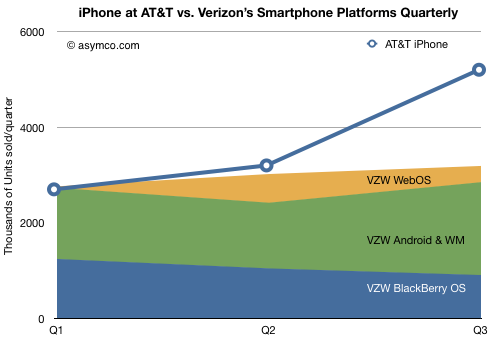
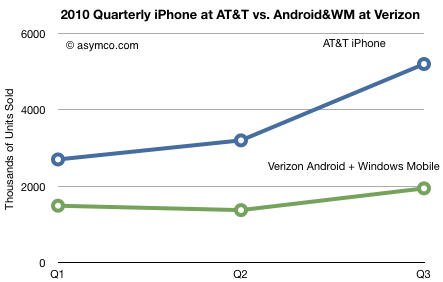
The chart below shows the performance of all of Verizon's smartphones vs. the iPhone at AT&T. The area chart shows how Verizon's volumes grew from 2.7 million in Q1 to 3.3 million in Q3. Not a bad story in itself. However, the iPhone at AT&T went from 2.7 million to 5.3 million in the same time frame. Relative to just the iPhone, Verizon has been underperforming over the last quarter.
Those additional 2.4 million iPhone/AT&T activations in Q3 could be due to replacements but the same could be said for Verizon's volumes. The fact remains that iPhone alone is nearly twice the volume of all of Verizon's smartphone activations.
Just to be clear, this is a direct, apples-to-apples comparison. AT&T and Verizon smartphone performance figures are highly comparable. The two operators are highly representative of the US market. AT&T and Verizon Wireless raked in 75% of all mobile data revenue in Q2 of 2010 and account for 62% of the U.S. wireless customer base.
In addition, Verizon enjoys a larger customer base (has 92.1 million subs vs. AT&T's 90.1 million.) Over the time frame of the data the overall market did not increase dramatically therefore the conclusion that AT&T's win is Verizon's loss is plausible.
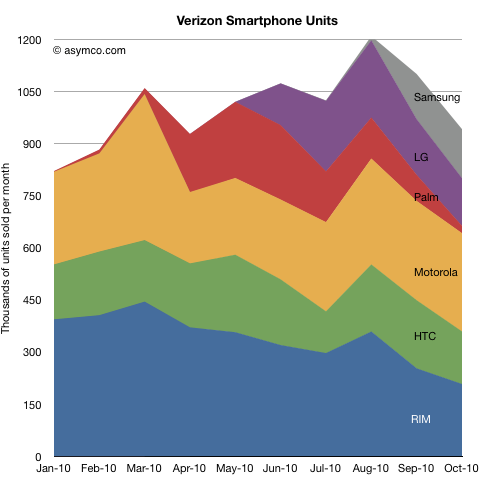
I used quarterly data so that iPhone at AT&T could be compared. But if we look at monthly data, the story gets worse:
These are absolute volume figures. You can see how RIM's fade was replaced to some degree by new vendors. However, growth hit a wall in August. Following widespread iPhone 4 availability, sales dropped. Coincidence? Perhaps, but the drop happened even with the addition of Samsung volumes.
That's strike one.
Verizon is facing diminished degrees of strategic freedom
The other notable is that even though Verizon doubled the number of vendors selling smartphones, it seems they are growing their smartphone base slower than the overall market.
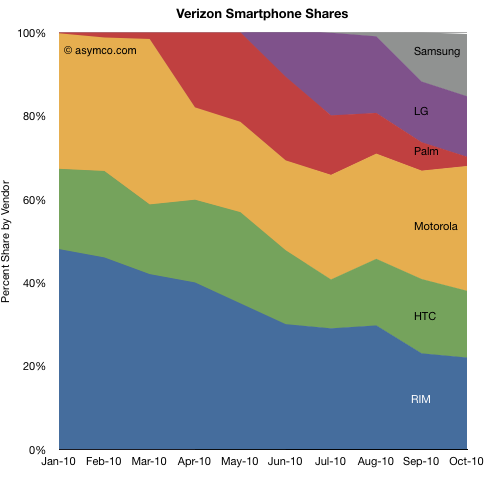
Consider each vendor's share is shown below:
From three vendors to six. Shares are roughly evenly split (except for Palm) but none of these vendors are able to drive volume growth.
Consider that Motorola Droid is outselling RIM. This should be rightly noted as amazing. It plainly shows the power of Android. However that power is not something Verizon will benefit from. Quite the opposite.
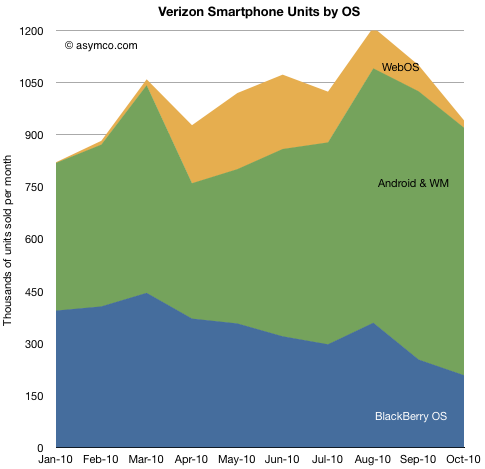
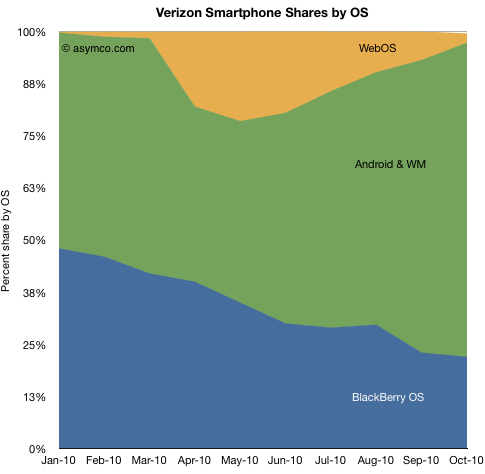
Consider the share map by units and share of each OS:
Android (and WM, though that's likely to be a very tiny part of the green area) made up 75% of all smartphones sold in October. It's possible that the share could grow to 90% as RIM continues to fade.
For Verizon this would be a serious problem. Although Verizon used to have a disproportionate share of RIM's products, that OS was not enabling an ecosystem like Google's. It was a product narrowly defined around messaging. Verizon is facing the prospect of a single OS supplier who may or may not maintain alignment with Verizon's core profit algorithm. If they diverge, Verizon's bargaining power will be strictly limited.
Strike two against Verizon.
Android is barely enough to keep the battle with AT&T from becoming a rout.
In an apples-to-apples comparison, in Q3 the iPhone at AT&T outsold Android at Verizon (remember, same addressable market) by a factor of 2.5. This is with a variety of devices and vendors thrown in the market. We hardly ever get to see this finely grained a comparison when looking at platforms.
I wrote this up as a lack of competitiveness. It may seem provocative, but I define competitiveness narrowly: the competition is for a purchase decision on equal terms. These purchase decisions are fiendishly complex to predict, but the data speaks: whether it's due to brand, visibility or performance and in spite of "antennagate" the iPhone is cleaning up.
That's strike three.
The devil they know
By 2009, Verizon was probably optimistic that they could head off AT&T (and Apple) at the pass. With the vast array of vendor Android roadmaps laid out in front of them they saw a way to stem the flood of defections. I think that optimism dissipated sometime this year and was replaced by a more dreadful prospect than what iPhone presented in 2007.
It is perhaps coincidental that the rumors of a Verizon deal with Apple seem to have started in earnest right after August. It's thin, circumstantial evidence, but the only evidence we have to corroborate the data above is that Verizon has been signaling more desperation.
Reading further into the data, I would say Verizon faced these problems and decided that they had to throw in the towel. Apple may be the devil, but so could be Google. Apple was predictably evil. But Google? The devil you know is perhaps better than the one you can't predict.
What's more, the devil Apple seems to be helping your worst enemy way too much and the unpredictable one does not seem to help all that much.
Final question: how many iPhones will Verizon sell
I think this data shows that Verizon has another reason to sell the iPhone. The underperformance of their smartphone franchise is not the only determinant, but it is perhaps another straw on the camel's back.
What would happen if (or more likely when) Verizon sells the iPhone? I believe they will sell them at the same rate as AT&T does.
The data shows that Verizon sold, on average, about 3 million smartphones per quarter during the first nine months. That's about 1 million a month. That was based on three platforms, six vendors and widespread promotion.
The iPhone sold almost 4 million a quarter over the same time period.
Verizon users bought smartphones at a lower rate than AT&T users bought iPhones. This is even though the two carriers have approximately the same subs base which churns very slowly. Since a mass-market product will appeal equally to statistically equivalent populations the product should be taken-up with similar vigor.
So the question is not whether Verizon can sell iPhones at the rate of 4 million a quarter. The question is only whether these 4 million will be in addition to the 3 million that are currently buying non-iPhones.
My guess is that the 3 million run rate for non-iPhones will drop, but not to zero.
The impact on the other vendors supplying Verizon may be strongly negative depending on the level of promotion Verizon puts on the product. That promotion budget is usually fixed as a percent of sales. What Verizon applies to iPhone will be taken out of what is spends on Droid. I have always said that operators will be motivated to balance their supplier power. The promotion budget is the primary instrument to meet that end.
On the other hand, the overall market will grow so 2010's 3 million/Q will be 2011's 6 million/Q. There is plenty of room for multiple platforms.
So my conclusion remains that iPhone will find at least 8 million new users with Verizon. The analysis above give me confidence to increase the upper bound to possibly 12 million.
Verizon striking out means they need to change the way they play. The iPhone is a new ball game.
------
[1] To assemble this discussion I used only the data provided in the article linked above and the officially published iPhone activation numbers from AT&T. Obtaining specific smartphone vendor volumes is a matter of reverse engineering the share chart and cross-referencing it to the table of vendor sales.
60.7 million people in the U.S. owned smartphones during the three months ending in October, up 14 percent from the preceding three month period, representing 1 out of every 4 mobile subscribers.[...] Despite losing share to Android, most smartphone platforms continue to gain subscribers as the smartphone market overall continues to grow.
29.7 percent of U.S. mobile subscribers now own smartphones that run full operating systems.
The most popular smartphones are the Apple iPhone and RIM Blackberry, which are caught in a statistical dead heat with 27 percent of smartphone market share in the U.S. Twenty-two percent of smartphone owners have devices with the Android operating system.
I've been tracking the Nielsen data and using it as a basis for forecasting the penetration of smartphones. While most coverage of this data focuses on splits between current OS platforms, I will look at competition with non-consumption and the impact on operator services.
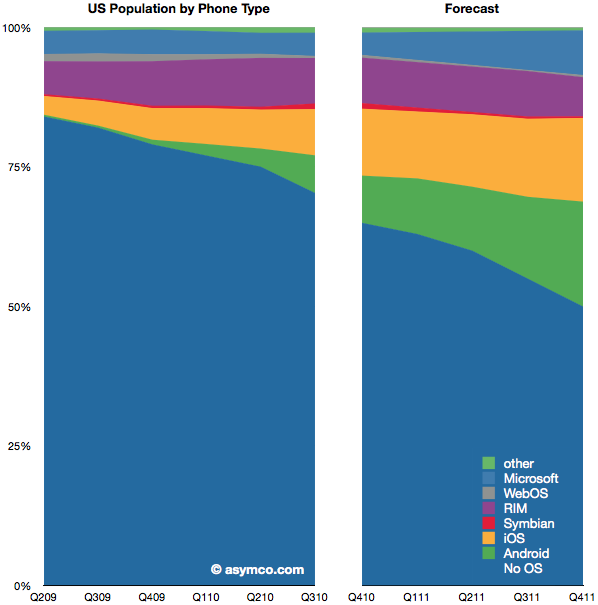
The chart on the left shows the historic penetration of smartphones since mid-2009 based on Nielsen's reports. The chart on the right is my forecast. This is an update from the last quarter's chart here. My forecast was fairly accurate with respect to platform shares in the last quarter so I've had to make only small adjustments and extended the forecast one quarter further out. [1]
If my forecast is correct, smartphones will make up 50% of all phones in use by the end of 2011. That's up from nearly 30% today and 18% a year ago.
One in three of all phones in use will be either iOS or Android. That adds up to about 80 million users; up from 35 million today. Overall, 120 million Americans will be using smartphones.
Now consider the consequences for how services are delivered by operators. The most popular product operators will be selling will be unlimited data plans. One year hence, by 2012, unlimited data plans may become the largest service revenue generator for mobile operators in the US. Pricing and competition will inevitably be in a state of extreme flux. I leave the consequences to the imagination of the reader.
---
[1] Note that the charts show share of phones in use, not phones sold in a particular point in time. In other words, this is measuring platform consumption, not units sold.
The release of the iPhone is rightly acclaimed as a watershed event in the history of telecom. It was a sensation. But it was also a product that was widely underestimated and dismissed. Even today expert opinion is divided. The critics of the product transitioned directly from labeling it a superfluous bauble to an obvious and copyable sustaining innovation. Advocates of the product describe it as revolutionary and dazzling with the potential for capturing significant profit share due to premium pricing and positioning.
So which is it?
I'll argue that it's none of the above. The iPhone is not superfluous, not easily copied, not revolutionary and not a premium product. What it is is disruptive.
First, we have to quickly define disruptive potential.
A product is disruptive if it competes with an existing, incumbent set of products on a new basis. It competes along a new measure of performance. That means it's either "low end" and hence cheaper, simpler, more modular and conformable, or it creates a "new market" where completely new measures of performance or quality are relevant.
In both "low end" and "new market" disruptions the product is usually wrapped in a business model that insulates it from incumbent response due to inherent asymmetries. Incumbents will find the economics of the entrant product unattractive and will be motivated to ignore it or actively avoid copying it.
The consequences of disruptive product entires are often catastrophic for the incumbents because, over time, the disruptor product vacuums up all the profits in the industry, robbing the incumbents of the fuel to respond by the time they become motivated to do so. In essence, the transfer of value to the new basis of competition happens so slowly that the threat is imperceptible until it's too late.
If we look at this definition, it's startling that the iPhone does not seem to fit.
As a phone, it's not cheaper, nor modular and hence not "low end". It did not create a new market. As a phone, although it did recruit more regular phone users into becoming smartphone users, it was not the first or last phone to do so. Its phone business model was not a radical departure. It was not ignored by the mobile phone incumbents who reacted with various degrees of urgency and vigor. It was actively copied in every way from the UI to the ecosystem to the pricing model and distribution.
The only thing that seems to have happened according to the disruptive formula was the transfer of profits from incumbents to Apple, at least temporarily.
So the iPhone seems to be correctly classified as a sustaining innovation. Something that moves the phone market forward and which, except for a temporary misallocation of profits, will entrench the incumbents after they manage to copy it effectively.
However, here is where we have to dig a little deeper.
Market analysis easily becomes myopic when looking only at a market defined by a product. I've argued in the past that strategic insight comes from looking at products that cross over their market boundaries. Especially products that are hired to do different jobs than the same products in their categories. The iPod may seem like an MP3 player but it caused catastrophic profit collapse in multiple industries. It knocked out the CD business, it crippled the component audio system "Hi-Fi" industry, it razed the music retail business and affected the entire music value chain. It's still pounding at the gates of video and TV production. And, almost as a side-show, it crushed the Walkman.
Even though it was a music player, the MP3 device market was the smallest target for the iPod. It turned out to be far more dangerous to ancillary industries. The reason is subtle: it competed as an integrated ecosystem. You hired the iPod to serve you music everywhere, not just in your living room. And it did the job in an integrated way from source to earbuds taking what was a hodgepodge of modular components built around analog music and smoothly integrated them to deliver music in new, non-consuming contexts.
The lesson is therefore that when looking at the iPhone one has to look at ancillary industries not just at phones.
Phones have always been a component in a wider inter-related telecom value network. Even today they are often called "terminals" in the industry meaning that they are the end points of a network. Similar to the PC, the iPhone enables a migration of intelligence away from the center toward the edge of the network resulting in a de-valuation of the network itself.
I argue that the real disruption of mobile computing (i.e. iPhone) is made possible not by the smartphone technologies but by mobile broadband. Once broadband became mobile with 3G the smartphone could shift its focus (jobs it's hired to do) from voice to data. That shift is disruptive to incumbents because they built their businesses around operator distribution and operator service economics. With apps, mobile computing brings with it services which allow all communications to be independent of operators. Selling ringtones, maps, email and video-on-demand are all dead business plans today. But operators clung on to these hopes for many years and forced vendors to comply to this strategy.
The incumbents relied so much on the telecom value chain, where the value flows from the monthly service charge, that they would not deploy technologies or business models that were asymmetric to operator business models. This is the root cause for Nokia and Samsung and Motorola and LG "missing the boat" on smartphones. All the vendors had the pieces of technology on their shelves. But when they took these technologies to their customers, the customers rejected the package.
This is why entrants like RIM and Apple could easily gain a foothold and grow. They had modest volumes, sold new concepts like business email and new UIs with iconic designs, but did not go after the core business model. This is similar to how iPod/iTunes got a toehold with the record labels. By the time the disruption took hold, operators were addicted to the new high-ARPU being generated even though they were all pure bitpipe plans. A bird in the hand is worth two in the bush, so the new device brands stuck.
Do the incumbents still have time to respond effectively? It's less and less likely. They cannot build the new computing ecosystem without the distribution power of operators. Note that iPhone 'clones' in Android are still sold via operators and that nobody is interested in making either iPod touch clones or iPad clones sold independent of the operator channel/subsidy model. This is not because of technical or economic reasons but because of a lack of distribution (and lack of integrated content).
When you step back and look at the phone in the context of the network business model as well as the shifts in consumer jobs to be done you realize the potential is far greater than taking share from incumbents. The iPhone is not divided into a portfolio of different phones, but it's a part of a portfolio of new mobile computing products. It just happens to be the only one which still depends on the cellular operator distribution network.
Seen as part of a new mobile computing paradigm and following the trajectory of the mainframe, mini-computer, PC and laptop, the iPhone is an essential, non-superfluous device for a vast population of new users.
Seen as an integrated app ecosystem with strong network effects, it's not easily copied. Responses that only account for it as a glass and metal object of desire will fall way short of being competitive. As the hardware was always available to competitors, it's not a revolution in hardware or even in user experience.
Most importantly, seen as a computing alternative merged with a communication appliance, it and its siblings are not premium products. The pricing and service structure around it make it seem a low cost alternative for solving the jobs it's hired to do.
Apple has been contemplating a SIM card that would make carrier switching a lot easier. Sounds great, doesn't it?
"Apple is relenting," said Rodman Renshaw analyst Ashok Kumar. "They are now completely backing away from their plan to take the carrier out of the equation," said Kumar,.
This brings to mind a recent article I wrote that any talk of mobile dominance by platform vendors is bunk.
... no single platform can win a disproportionate share because it would threaten the balance of control the operators require. So talk of “dominance” of one platform or another is hyperbole. The most likely scenario is an even distribution of share between 4 or 5 competitors.
The power of distributors in the mobile phone value chain cannot be ignored. It's not fair, it's not convenient and it's not consumer friendly, but as long as networks are not good enough for mobile computing, mobile computers cannot commoditize the network.
The consequence (for those of us who try to foresee the platform game) is that operators will continue to play platforms off against each other leading to the scenario I suggest above.
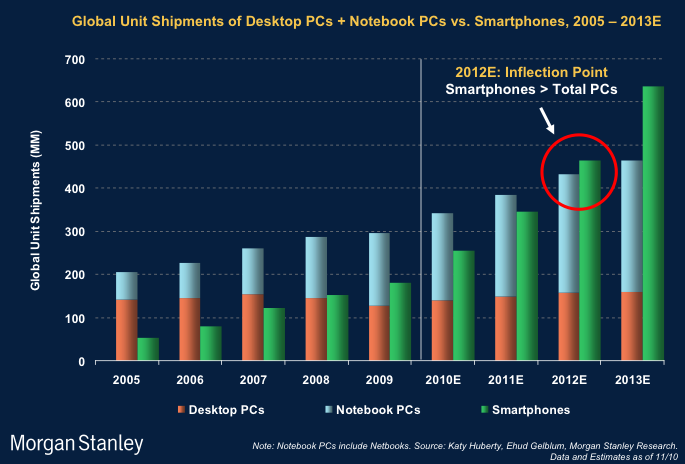
Morgan Stanley's Web 2.0 update came out yesterday and it's full of nice charts. Here is one:
Note that the expectation for smartphones to overtake all PCs (including netbooks) will happen when smartphones sell more than 450 million units per year.
In 2013 nearly 650 million smartphones are forecast to be shipped.
My estimate for the iPhone in that year is 180 million. That would give iPhone (excluding iPad and iPod) about 28% share. The last quarterly figure is around 17%.
Perhaps 180 million iPhones per year will be defined as failure by those who consider over 80% share as a threshold for success but I still think it will be a healthy business.
Even assuming a cut in ASP to about $350, Apple will still be able to get about $62 billion in sales from phones (a bigger number than 2009 total sales for the whole company).
I would also add that by the end of 2013 Apple will have sold about 470 million iPhones. Though many will be out of use by then, the installed base will not be small (I'd guess about 300 million). Including all iOS devices, 500 million is a credible estimated audience for developers.
It's entirely possible that Android variants, offshoots and forks will add up to a bigger number by then, but to pre-emptively declare the platform "war" won because the also-ran Apple will only have half a billion users seems disingenuous.
When mobile platforms are discussed, the conversation frequently turns to market share battles between Android and iOS. I've pointed out before that the problem with this reasoning is that market share in a market that's growing at 90% is a false measure of performance.
The more important measure is how much of the non-smartphone market is being taken by smartphones and how fast the whole phone market is growing. Competition with non-consumption is very different from platform warfare.
But even when discussing the rivalry between current platforms, the Blackberry and Symbian are often overlooked as contenders. Windows Phone and iOS come in and out of discussion only on the basis of press releases. The truth is however that Symbian, Windows, Blackberry are not going to disappear anytime soon. Why is that?
The reason is that when you stop framing the market as rivalry between platforms, you see that many buying decisions are driven by specific device value propositions or jobs that the products are hired to do. For many years smartphones were purchased because they had the best cameras or the best keyboards and users never downloaded any apps or even used data plans.
Later, smartphones were purchased because they allowed for browsing and gameplay. Very rarely did buyers opt for "iOS" or "Symbian". Most buyers don't even know what these words mean. Phones are rarely advertised according to their platforms. (As an aside, the mention of Windows in a PC ad is made possible by Microsoft funding, the same as "Intel Inside." So for platform recognition, someone needs to fund the promotion and that implies some revenue to justify it.)
To illustrate, consider the Blackberry: A product that continues to grow despite a completely different basis of competition from the large screen touch competitors. It comes down to being good at some very specific jobs. RIM continues to grow in certain markets like Latin America and the Middle East on the basis of BBM (RIM’s sales outside the U.S. climbed 94 percent last quarter from a year earlier.)
“A 15-year-old boy who likes a 15-year-old girl, sends her a BBM and he’s able to measure how important he is to her based on the speed of response after the letter turns to an R,” meaning it’s been read, he says. “No one else runs an end-to- end service plan like we do. That’s killer and is why it’s almost a social phenomenon.”
or
BBM is also popular in socially conservative Saudi Arabia where its speed -- messages are typically sent in less than two seconds, according to Morgan Keegan -- has made it a way for teenagers to communicate in a country where religious police bar unmarried couples from meeting in public.
You could argue that the other platforms also allow for free messaging (through free texting apps) but the combination of a low cost device, a data plan and attention to detail (like Message Read notification) gives the Blackberry an edge.
The general purpose smartphone that Google and Microsoft and Apple promote is still not the prevailing view of mobile usage for most buyers. One could also argue that many if not most Nokia smartphones are still being "hired" to do feature phone jobs.
The fact that all these devices are classified as smart and therefore competing misses the point that they are hired for different things.
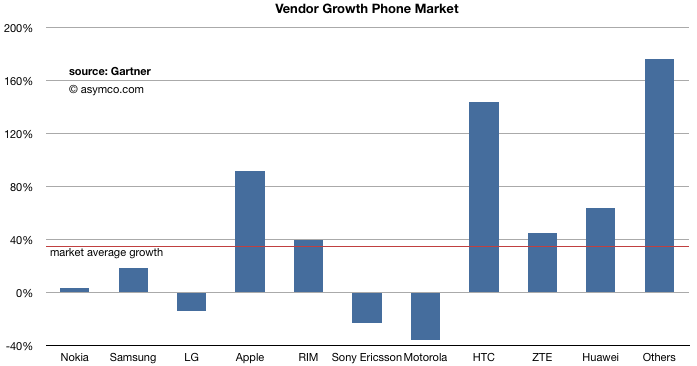
The latest mobile phone estimates from Gartner made a startling claim that "Others" vendors increased share from 16% a year ago to 33%. Doubling share in a year is possible if you're at 1% share but to double from a base of 16% is sounding improbable. They allege that the "Others" now sell more phones than Nokia. And Others don't even include ZTE and Huawei, the prototypical low end challengers.
They emphasize this point in their discussion and state that the incumbent vendors are being pressured by these low end entrants. They go on to explain that the same set of vendors will probably use Android to enter the smartphone space.
To illustrate, the growth of individual companies is shown here (all phones).
Also puzzling is that ZTE and Huawei did not share in this boom. They barely beat market growth and were growing at half of "Others". Until recently ZTE and Huawei were themselves Others, so the new vendors are truly unbranded "white box" vendors.
To put it in perspective, their year-on-year growth is astronomical: 176%, selling 87 million more phones this third quarter than last year's. This is equivalent to saying that a new company was born in the last year and has already become the second largest in the world. The growth in volumes is higher than the total units Samsung sold!
Mind the gap
Extraordinary claims require extraordinary evidence. Can we check what other analysts estimated and do some form of validation of the claims?
Yes we can.
IDC reports the same data and they only reported 340.5 million phones sold (vs. Gartner's 417 million). Excluding ZTE and Huawei the total share for "Others" in IDC would be about 20%.
20% share vs. 33% share is a big gap.
IDC and Gartner both agree on smartphones, so the difference is even more glaring when you consider the "non-smart" comparisons:
Non-smart phones:
Total Market: millions of units sold____
3Q2009______
3Q2010
Gartner
268
337
IDC
244
260
For added emphasis, I added a comparison of last year's quarter. Last year the Gartner total estimate was about 10% higher than IDC. This year they are 30% higher.
How could the difference in the total phones sold be so big: 77 million phones?
If Gartner is right, how could IDC miss 77 million phones. If IDC is right how did Gartner conjure up 77 million phones in one quarter? That number is nearly as big as all the smartphones sold (81 million). This is not within any margin of error for whatever sampling method they use.
Perhaps they need to clarify this because until they do, neither is credible.
--
Note: My own models are built from individual company public reports. The only data I depend on from IDC and/or Gartner is this total market size which allows me to back out what the "Others" are doing. If the total market estimates disagree so much, I'll be forced to throw out the "Others" all together.