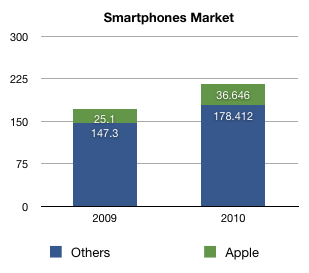
Gartner sees smartphone market volume growing a whopping 46 percent from 172.4 million sold last year, boosted by cheaper models. The most affordable now cost just over $100 excluding operator subsidies.
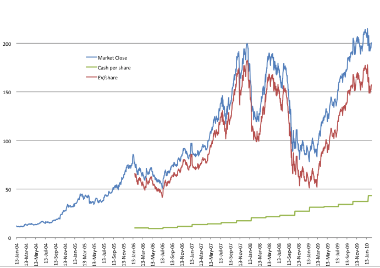
On Christmas Eve 2007 to be precise. That’s when the Enterprise Value/share was $181.5. These days it’s around $150. The Enterprise Value (EV) measures the value of future cash flows excluding current assets and is a better indicator of the potential of a company than its current overall value.
As you can see in the graph above, the cash per share (in green) has grown to $43 while back in late 2007 it was less than half that. As a result, although the market value for Apple peaked at $215 on 19th January this year (the blue line), the EV/share was only about $178 (the red line), below the all-time-high in 2007.
As Apple’s cash continues to grow, the gap between EV and MV will also grow. If the MV remains low (as the P/E is indicating) then the Enterprise Value, i.e. the net present value value of future cash flows, drops.
Did Apple’s prospects peak in 2007--six months after the iPhone was first launched--or is the current valuation still a function of sentiment of the overall economy, independent of the company’s fundamentals?
I calibrate my growth rates on the assumption that Apple will overtake the combined share of the two money-losing handset vendors.
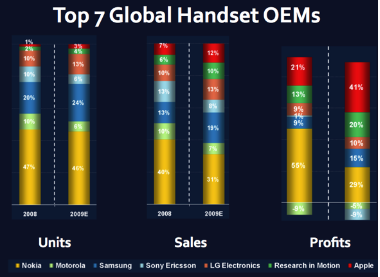
Sony Ericsson and Motorola are the weakest competitors in terms of portfolio and competence with software. Their sales, units and profits shares for 2008/2009 are shown in the graph above (source: Morgan Stanley).
Therefore, my thesis is that Apple could beat these two weakest competitors in 3 more years.
Here is the basic top-down view:
In 2009 174 million smartphones were sold out of a total of 1.13 billion phones (IDC, Strategy Analytics). Using a 10% CAGR on this figure gives 1.65 billion phones in 2013
Apple obtained 2.1% share in 2009 and about 1.5% share in 2008. My forecast share for Apple:
2010: 3%
2011: 4.1%
2012: 5.5%
2013: 7.5%
During the last quarter, Sony Ericsson held 4.5% share and Motorola 3.7% therefore my 2013 target for Apple is a little less than the sum of what these two hold today.
This results in unit sales for Apple of 125 million units for 2013 and a compound annual growth rate of 50% a year.
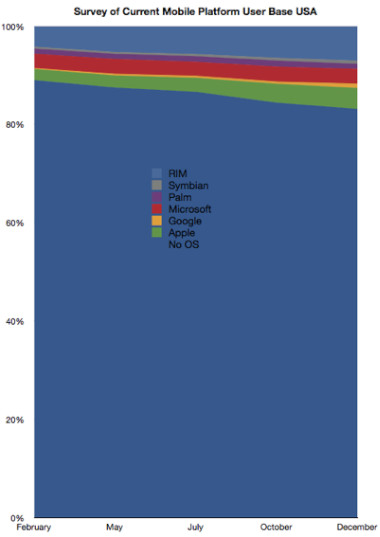
Comscore revealed their latest survey resultsfor the US mobile subscriber market. From the latest data and the data previously released in October we can put together a few insights.
The number of smartphone users increased by 3.2 million, growing at over 1 million new users per month.
Apple and Android added about 1 million users each. RIM added 1.4 million with Symbian adding about 200k users. Palm lost 441k users and Microsoft lost about 44k users.
Non-smartphones lost 2.1 million users and 1 million subscribers were added to the top line.
The non-smartphones lost 1% share in the quarter and 6% since February. Smartphones make up 17% of all users.
Google has overtaken Symbian to rise from last place in the platform installed base and is closing on Palm.
At 5% share erosion per year, the non-smartphone market will completely disappear in about 14 years, though I feel 10 years is a more likely target with 5 years until the market is 50% penetrated.
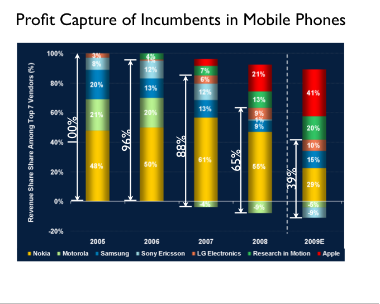
In 5 years, Incumbent profits from the mobile phone industry went from 100% share to 39% share. If this is not indicative of a successful (i.e. disruptive) entry, I don't know what is.
Growth within the siloed Apple ecosystem will actually stifle the grass-roots innovation
It's interesting that this comment came on the day after Rob Glaser left Real Networks. Let's take a stroll down memory lane of Glaser quotes:
(in 2003) “It’s absolutely clear now why five years from now, Apple will have 3 (percent) to 5 percent of the player market. … The history of the world is that hybridization yields better results.”
“Apple’s (market) share will go down if they continue to do this. The only way to presently put songs on an iPod is to (buy) them from iTunes.”
The (unforeseen) standard that emerged from the iPod is iTunes marketplace. It allowed Apple to establish itself as the premier and dominant merchant of all media including disruptive new media like apps. The iPod was "closed", "siloed" and "locked-in" users. But it worked and grew and grew to the point where it set the standard.
The same arguments raised against the iPhone were raised against the iPod and Windows before it. Last I checked iPod had 70% share 9 years after the launch and Windows has 90% share 20 years after launch. iTunes sells more songs than any other retailer on the planet and more apps that anyone imagined possible.
Perhaps this data bears repeating:
140,000 apps - made by over 28,000 developers
Users downloaded an average of 3.7 apps each in December.
One Quarter of apps downloaded are paid. Average cost of $2.59/app.
Each iPhone user spends an average of $10/mo.
There are over 75 (est.) million active users
200 million apps are being downloaded every month
$500 million in revenues each month. 70% to developers or $385 million
All these numbers are increasing and accelerating. iPhone Platform Fastest Ecosystem Ramp in History.
There is an implied message in Android advocacy that once more licensees join in, volumes will be distributed among a broad set of companies benefiting from a healthy rivalry. This broad licensing will be a boon for volumes and for user choice and the platform itself will prosper.
I'm going to argue here that there will be no healthy distribution of volumes or profits in the Android platform.
History shows that volumes for an openly licensed mobile platform concentrate in the hands of a single vendor. To illustrate, I attached a list of all the devices which shipped (to date) with a flavor of Windows Mobile. The list includes 911 different phone models (search on your own on pdadb.net under the pdamaster tab--search criteria are on the last page of the PDF).
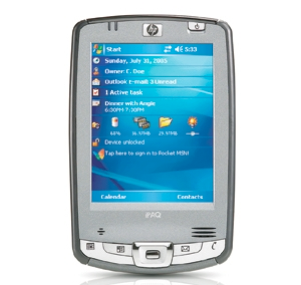
The Windows Mobile platform "took off" and had hundreds of concurrent licensees in the middle of this decade. In spite of this wide adoption, one vendor captured 80% of the volumes for all instances of the platforms: HTC. Having started with the iPaq as a PDA and followed by being the first to market with a WinMo device, HTC dominated Windows Mobile volumes even when faced with literally hundreds of competitors. These competitors included all the big names: from PC vendors like HP, Dell and Toshiba, to cellular incumbents like Motorola, Sony Ericsson, Samsung, LG and every ODM and OEM in between. The reason HTC won is mundane: they have the experience and the distribution to make an impact and they iterate rapidly and are intimate with the details of making a tough-to-integrate product work. They basically worked their way up the value chain from a contract design shop to a branded top tier vendor.
But if you exclude HTC, dividing the number of units of WinMo shipping at any given time by the number of licensed products in the market at that time, one gets about 50,000 units/licensee. Think about that: except for HTC, an average licensee could hope to ship 50k units for any phone they engineer and market. And they also need to prepay Microsoft the minimum license fee of $10/unit (approx) for a minimum order of 50k units or half a million dollars.
This is actually a paradox. Put yourself in the shoes of a business manager at one of the potential licensees. Consider the situation where there are 200 competitors in a market all shipping undifferentiated products, and one competitor has 80% share. Would you want to be the 201st? Saying yes implies hoping to split the remaining 20% 200 ways or obtaining, on average, 0.1% share? But this is not a share of all phones, it's a share of that platform, which itself is, at best 10% of all smartphones which make up maybe 20% of all phones. So you are committing a few million dollars to pursue (.2*.1*.001=) .00002 of a market. That target is 3 orders of magnitude less than what Apple obtained in 2 years (without the margins). It never adds up unless you expect your entry to blow out of the 20% ghetto and take on the incumbents.
As it turned out there were dozens upon dozens of business managers who opted to be the 201st (or 301st). Unsurprisingly, the result was that every Windows Mobile business plan failed (except that of HTC). Every decision to join this ecosystem on the device side was a value destroying decision, repeated 900 times.
Why?
I don't have an answer as to why so many are taken in by this. I have a hypothesis that it has to do with excess R&D capacity (e.g. idle engineers) that compels small companies to build product with no hope of market penetration, but I cannot prove it. They may also couple the low barrier to entry to the premise from the platform vendor that a no-name licensee could be the next Dell/Acer/HTC if the platform "takes off".
Regardless of the cause, the proliferation of WinMo SKUs did nothing for the success of the platform overall. For consumer products, it does not matter what jockeying for position happens within the value chain if the end user/developer experience is painful and uncompetitive.
Android will win or lose on the user/developer experience. It will not win or lose on the proliferation of licensees.
This prediction says that WinMo and Symbian are out at Samsung. Not a big surprise there.
The real news is some new "proprietary" OS is to take a majority share of the portfolio moving Android out of the picture gradually after 2011.
You will infer from my previous comments that the reason any deep pocketed vendor would shun Android is the same as why they would shun WinMo: no "control" over the whole product and hence no differentiation vis-a-vis an integrated competitor.
The Android devotees would then have to depend on their platform reaching critical mass without Nokia, Samsung, Apple, Palm and RIM, all of which will be shipping integrated products. LG got bought off by Microsoft and they will wallow in the mire.
Where does that leave Android? Moto and SE? They barely make up 10% of all devices and negligible smartphone share today and both are borderline going concerns.
That just leaves HTC, which shipped 80% of all WinMo. My bet is that they will ship 80% of Android, but that still tops them out at 10% share WW.
Looking at the platform game top-down and bottom-up you get the same story.
So Dell is making Android mobile phones while Nokia is making Windows PCs. A curious confluence of poor management decisions.
Why is all this dilution of core competence happening? Average punditry would suggest it's all about "convergence" and the overlapping of mobile and until-recently-fixed computing.
Er, not quite.
The economics of plastic bits shipped in cardboard boxes has not changed. It's as lousy a business as it has always been, whether the plastic bits are small or large. Some would argue that the gross margins of mobile devices are higher than those of computers, but that's not true on average. The gross margin on average mobile phones is just as low (<10%) as it is on PCs. There are about the same number of competitors and rivalry and global marketplace.
If indeed, margins were the only story, why would Nokia choose to chase the low margin PC business while holding (albeit very tentatively) 50% global share in "smartphones"? Similarly, why would RIMM choose to chase the low end consumer business (link: Blackberry Pearl et. al.) while having the fat margins of thinly penetrated business devices to wallow in? Finally, why would there be hundreds (literally link: www.pdadb.net) Windows Mobile smartphone licensees, the vast majority of which don't manage to sell more than the 50k minimum volume licenses they are obliged to order?
The fact of the matter is that the money being chased by device vendors is not being paid for devices, but for the service plans those devices enable. More precisely, these businesses are concerned with capturing a share of ARPU uplift from mobile data services. As such, they are mostly offering hardware as enticements for the *change* in ARPU that mobile broadband creates. Success depends on the power of that hardware to compel users to switch to higher data service fees.
The first proponent in his "hardware as ARPU booster" was actually Microsoft back in 2003 when they entered the mobile OS market. One of their value propositions was that Windows Mobile would boost data ARPU. The reality was not so compelling however as WinMo turned out to be too awkward to use for most users and the power of the platform lay fallow. In reality, the first successful hardware ARPU booster was RIM. In the middle of this decade, RIM showed that a Blackberry user could be worth between $5000 and $8000 in NPV ARPU to an operator. For that juicy pie, RIM was handsomely rewarded with a small "cut" that boosted their margins to above 50% making them the most profitable device vendor on the planet.
The realization only began to set in about 2007 as every other vendor began applying resources to deliver ARPU boosters. Apple took note early and executed beautifully with the iPhone, mastering the "get paid for ARPU" game, and in the process capturing 50%+ gross margins and (depending on the quarter) up to 30% of all profits in the device industry.
To forecast how this game will be played and how sustainable this boosterism is, we need to segment or categorize the market according to ARPU. The way to visualize this is what I call the "wedding cake" model. Each cake layer represents the population of users in that ARPU segment and the thickness of that layer represents the delta of ARPU to the layer below.
The base layer is huge (billions of customers) and represents the prepaid voice market. The average "thickness" of this layer is about $10/mo.
The next layer is smaller and represents the postpaid voice market. The thickness is about $30, representing the "boost" over prepaid.
The next layer is smaller still and represents the postpaid voice+data market where the data is a-la-carte. This is typical of plans where the buyer pays separately for certain data services (e.g. email, navigation, etc.) and pays on a per-megabyte basis for browsing. The ARPU differential is about $20.
Finally the top layer is the unlimited data plan packaged with bucket voice and SMS. Here the ARPU differential is another $30.
At its highest, the cake is about $100/mo., though the width of the top layer and hence the population of paying customers at that price point is quite small relative to the other layers.
Now each layer is covered with a "frosting" which is the device hardware revenue. Obviously the frosting gets a bit thicker the higher the layer, but it's a relatively thin layer compared to the "cake" thickness. In the higher layers the trend is in fact to make the frosting as thin as possible (<$99 NPV or <$4/mo. for a 24 mo. contract.) The devices which enable the top layers are clearly more complex and expensive to make, but the end-user pricing is trending down. The trick is therefore to convince the operators to pay a piece of the "cake" to the device vendor in exchange for migrating users to these higher layers.
Nokia's latest quarterly results and forecast caused a 15% drop in the share price on a day when the S&P rose by about 1%. The drop was the largest single day change in the company's valuation since 2004. The cause for the drop was not macroeconomics or performance in the previous quarter, but the guidance provided.
The shock was in an unchanged low margin and a flat market share. Both of these measures of performance were expected to improve as the overall market improved. What Nokia is saying, in effect, is that it will perform no better than the market average. Naturally, its value should therefore be no higher than the market average.
The trouble is that the "market" for mobile phones is abysmally free of value and hence of profits. Taking the sum of profits for all the major incumbents (Nokia, Samsung, LG, Sony Ericsson and Motorola) we find that net profits for the entire industry are, at best, flimsy, at worst, negligible. But this begs another question: why is value missing in mobile devices--a market that seems to be growing faster than almost any other technology market?
First a few facts:
Focusing only on Devices & Services, Nokia did make a net profit of EUR763 million on sales of 103.2 million phones. That's EUR 7.39 average operating profit per phone. In Q1 Nokia Devices made about EUR 6 per phone, so a slight improvement, but down from about EUR 20 a year ago.
Sony Ericsson entered its fourth quarter of losses.
Motorola entered its 9th consecutive quarter of losses.
Samsung and LG are at about break-even.
So if one were to look at the incumbents, the ~1 billion phones they sell a year seem to be generating barely EUR2 per phone, most of it in the hands of Nokia.
The exceptions are, of course, the entrants RIM and Apple with EUR 60 and EUR 120 profits respectively per phone, orders of magnitude above average.
Nokia seems to be the best of a bad lot. Can Nokia expect to join the entrant cohort or sink with the incumbents? Answering this question forces us to go through a deep examination of what correlates with value in the new device market.