Asymco

Asymmetric Intelligence

share

  1. NPD: iPhone is 65 percent of AT&T's smartphone volume

    Research · 4 comments

    Much ink is being spilled over Android outselling the iPhone in the US in Q1.  Here's what NPD survey data shows:

    • Q1 units for Android reached 28% vs. iPhone at 21%.
    • AT&T stated that they activated 2.7 million iPhones.  That is 31% of all iPhones sold by Apple.  Assuming NPD data is accurate, we can conclude that Android shipped 3.6 million units in the US or 65% of their total.
    • In a previous posting (Global smart phone OS shares « Asymco) I estimated, based on Canalys estimates, that global Android share reached 10% last quarter or about 5.5 million.
    • We can compute that Android captured only 4% of smartphone share outside the US while Apple obtained 14% share.
    • You can also observe that iPhone's US share increased y/y while every other platform except Android dropped (implying that Android took share from everybody but Apple.)
    • NPD claims AT&T accounted for 32% of the smartphone market, and even though AT&T carried both Android and WinMo and Blackberry devices, 21 out of every 32 phones or 65% of AT&T's volume were iPhones.
    • We can conclude that Android captured 34% of the non-AT&T US smartphone market.

    The table below combines the NPD, AT&T, and Canalys data to show units for iPhone and Android in the US, Global and non-US regions.

    One can only wonder what would happen if iPhone would be available non-exclusively.  Would iPhone achieve greater than 60% share as it did on AT&T?  Certainly that's what happened in France.

  2. Global smart phone OS shares

    Research

    In the free press release linked below Canalys reveals their estimates of vendor shares but not the OS shares for smartphones. However it's not hard to see the OS split due to the high degree of exclusivity of OS's to vendors.

    For example, virtually all Nokia devices are Symbian powered, all RIM devices are Blackberries and all Apple devices are iPhone OS.  Motorola is only shipping Android and HTC is the only top 5 vendor that now licenses more than one OS.  Even HTC's portfolio is now heavily Android weighted.

    We can carve out Palm (960k units shipped) from the "others" and we're left with mostly Windows Mobile.  My estimate would be about 5 to 6 millionWinMo made it out.

    That leads me to the following estimated OS shares:

    • Symbian (Nokia): 42%
    • Blackberry OS (RIM): 19%
    • iPhone OS (Apple): 16%
    • WinMo (Microsoft): 10%
    • Android (Google): 10%
    • WebOS (Palm): 2%

    If anyone knows the actual Canalys OS shares, let me know.

    Global smart phone market growth rises to 67% (Canalys press release: r2010043).

  3. Nokia vs. Apple phones business comparison shows comfortable lead for Apple

    Research

    Nokia reported 21.5 million converged devices sold in Q1.  The units, share, ASP, Revenues and Operating Profits are compared in the following table.

    It's once again evident that Apple captured more profits from the iPhone than Nokia did from all its devices and services operations.

    With respect to converged devices, Apple also generated more sales and had nearly triple the ASP.  Unit shares remained almost the same sequentially. Nokia did suffer more from ASP erosion sequentially as the converged ASP dropped by 24% vs. a 2.5% drop for Apple.

    What is interesting from a growth perspective is that Apple's #1 position in the share of profits from mobile phones was acquired with such a low market share.  Analyst Brian Marshall said the most interesting part of Apple's story is the international growth of the iPhone. He believes that Apple has only acquired about 1.5 percent of its international carrier partners' total postpaid subscription base of 525 million. For comparison, its penetration in the U.S. peaked in Sept. 2009 on AT&T with 5 percent.

    Sources:

    Nokia - Investors- News Release

    Apple - Investor Relations

  4. Apple continues to trade at a discount to growth

    Research

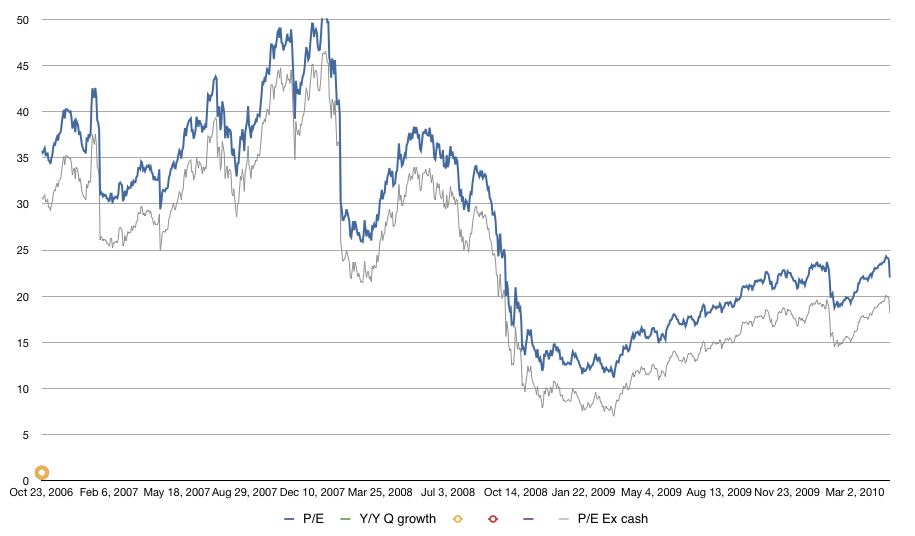
    Apple's latest earnings showed growth of nearly 90% (following a nearly 50% growth the previous quarter.)

    Normally, growth like this is rewarded with a significant P/E ratio of 30 to 40.  Apple enjoyed P/E of 50 as recently as 2007.  However Apple's P/E ratio dropped to about 22 after earnings.

    Although higher than during the worst of the recession, this low P/E either reflects continuing pessimism in the overall sustainability of the economy or a continuing discounting of Apple's potential growth.

    Excluding the nearly $45/share cash and looking at a forward twelve months earnings of 15, the forward P/E is an almost embarrassing 14.

    It's possible that after a few quarters of above 50% growth Apple's P/E and hence its valuation will return to more normal (PEG ~1.0) levels.  A P/E of 30 at today's trailing 12 months earnings would put the stock above $350/share.

  5. Google and Microsoft swap mobile share

    Research

    according to a report published Monday. ComScore reported that Google's share of smartphone subscribers rose to 9%, compared to 3.8% at the end of November. Meanwhile Apple's share fell 0.1 points to 25.4%, while Microsoft's share fell 4 points to 15.1%.

    via Google's share of mobile market grows: report - MarketWatch.

    Seems Google's gain is Microsoft's loss.

    BlackBerry, saw its share rise 1.3 points to 42.1%, according to the data. The number of owners of smartphones rose 21% in the U.S. in the three months ended in February compared to the prior period.

  6. Smartphone impressions triple in a year

    Research

    link: Smartphone traffic is up 193% in a year - Apple 2.0 - Fortune Brainstorm Tech

    What is important to observe is not the share numbers in the link above but the absolute growth and trend.

    Doing a bit of algebra from the data Admob provided we can calculate that:

    1. The overall traffic admob handled was 14.1b up from 6.6b a year ago. (114% growth)
    2. Smartphones generated 6.78b impressions in February, up from 2.3b a year ago. (193% growth). The iPhone OS generated 3.4b impressions.
    3. Feature phones generated 4.9b, up from 3.5b (43% growth)

    Although it's dangerous to equate "usage" to these impression numbers, the overall trend is that most of the growth is happening on smartphones. Of those, the iPhone OS and Android are taking 75% share of eyeballs, at least on Admob's network.

    The iPhone platform generated as many impressions in February as all feature phones generated a year ago. It does not seem a stretch to predict that iPhone will overtake all feature phones in overall impressions in the near future.

  7. Analyst: Palm at 10k Units a Week

    Research

    Cusick says his checks find Palm is getting only about 1% share of handset sales at Verizon Wireless, or about 10,000 units a week, versus 400,000 units that were sold in to the company. At this rate, he says, there is “no prospect of Verizon follow-through” in the May quarter - and he sees weak sell-in at AT&T in the quarter as well. (AT&T has said plans to launch a Palm phone, but no timetable has been announced, I would add.) He sees Sprint launching other new smart phones soon, “which would reduce Palm’s share even further.”

    link: Palm: Macquarie Downgrades; Cuts Target To $4, From $10 - Tech Trader Daily - Barrons.com

    Stepping back into the wayback machine to read analyst commentary from 6 months prior to the launch of WebOS (June 27th, 2008):

    In a report form Deutsche Bank’s (Sell rating). They noted that 38% of the shares were sold short, while 10 holders account for almost 70% of the shares outstanding.

    In Deutsche Bank’s view, Palm’s future would be “entirely dependent on their new products, services and operating system,” all due next year. “If these turn out to be good, then the stock could do well,” he says. “If the new entries are not attractive, then Palm risks bankruptcy.”

  8. Blackberry Loves U2

    Research

    BlackBerry - BlackBerry Loves U2

    Last year U2 chose Research in Motion as the main sponsor for its tour.

    Read More: Wired.com

    Blackberry might love U2 but does Bono still like Palm?

    You might know Elevation for its most famous partner, U2's Bono. In the summer of 2007, the firm committed $325 million to Palm in exchange for a 25% stake in the ailing handheld computing pioneer. By the following winter, the partners would up their investment by another $100 million.

    Elevation has since sold some of its preferred stock, but according to Palm's SEC filings, it still holds enough common and preferred shares to account for roughly 30% of the business.

    Others who bought around the same time as Elevation are struggling with a 33% loss, and that's after accounting for a $9-per-share dividend.

    Read more: fool.com

    Maybe Bono should pick up his Blackberry in between gigs and work on a deal between RIM and Palm.

  9. Palm: Pacific Crest Downgrades; Merrill Cuts Target To $5; Needham Fears “Oblivion”

    Research

    Palm: Pacific Crest Downgrades; Merrill Cuts Target To $5; Needham Fears “Oblivion” - Tech Trader Daily - Barrons.com

    Palm unveiled the webOS and Pre on Jan. 8th, and the stock skyrocketed from $3.30/share the day before to $7.14/share on Jan. 15th.

    January 2009 predictions for Palm by Morgan Keegan:

    About Palm at Sprint: Storm/iPhone-type Success At Sprint For the Palm Pre Would Lead to About 630k-1mm/quarter

    Our 450k/quarter Estimate For Pre Look Wholly Realistic Based On Success Of Other "Hero" Campaigns

    Your correspondent, January 2009:

    Now that the land grab is over, expect Bono to get his payoff as Palm gets acquired by a hardware vendor desperate for relevance. As Motorola is on its knees, my bet would be on Samsung, though a bidding war with Sony Ericsson would not be a surprise.

    Now I'm not so sure. Faucette of Pacific Crest today:

    While we believe that Palm could ultimately be a very attractive acquisition target, we are concerned that if the company is not prudent in maintaining balance-sheet resources, any potential acquirer may be content to just wait until things become even more desperate.

  10. Kathryn Huberty Predicts Apple Performance

    Research · 7 comments

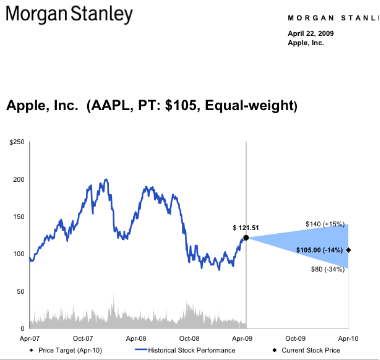
    10 months ago Ms. Huberty released her price target for April 2010 (see graph) at between $100 and $105. The stock was trading at $121 then and her forecast was for a 14% decline.

    She wrote:

    Investment Conclusion: The combination of a March quarter beat and positive management tone is likely to keep AAPL shares in its recent trading range. Valuation is not stretched by any means but at 21x our adjusted C09 EPS, the market already assigns AAPL a 16% premium to RIMM which credits AAPL for lower risk given its large cash balance and a more diversified revenue model. We remain Equal-weight AAPL shares.

    We note that the stock is currently trading above $200 at a P/E of 19x. She had forecast a price of $100 on a P/E of 21x Calendar 2009 Earnings Per Share. The implication is that EPS would have been $100/21 or $4.7 for calendar 2009.

    She already had one quarter of data ($1.79 for CQ1) therefore she forecast $4.7-$1.79 = $2.97 for the remainder of the 2009 calendar year.

    In reality, Apple earned $10.24 for 2009 and $8.45 for CQ2 through CQ4. That makes her error ($8.45-$2.97)/$2.97 = 184%.

    We see today that she has a new forecast for $225 a share which leads us to conclude that she still has a job.