Asymco

Asymmetric Intelligence

social media

  1. The Story of Japanese Innovation

    Research · 1 comment

    The Asahi Shimbun Interview Part 2

    Narcissus (1597–99) by Caravaggio 

    Horace Dediu / Takeshi Narabe & Dylan Weir / Asahi Shimbun Interview, April 2026

    Takeshi Narabe • 06:41
    So you also compared [Apple] with the Japanese companies. Actually Japanese companies are very keen on marketing and doing some anchors many times. And I think [historically] they didn't know what consumers want. But you mentioned that is also […] their advantage […] because they only made what [management] wanted. But on the other hand, Apple exceeds the consumer's expectation or make a new market.

    Horace Dediu • 07:37
    The story of Japanese innovation is fascinating and I hope you give me a little bit of time to reflect upon this because I think it is also part of the story of Apple. I have a great admiration for the history of Japanese innovation. And it was something that, again, Professor Christensen taught me and made me appreciate.

    Of course, during the 1970s, and maybe even earlier, but at least from the 70s onward, Japanese innovation was the world leader. It was in consumer electronics, it was in automotive, it was in many heavy industries, it was phenomenal. And the reason a lot of that happened was because Japan was constrained. Japan didn't have access to as much capital or as much land or as much resources as a lot of the industrial nations at the time. And those constraints taught it to be lean and efficient and how to think about "just in time", the Toyota production system, etc. And that wisdom came from a constraint.

    As a result, Japan [began to] teach the world during the 90s and onward about how to do better manufacturing. And they taught Apple. Apple at the time was in awe. Steve Jobs was in awe of Japan. Nobody could come close. Also, Sony was a phenomenon. In fact, in interviews with executives; I was just watching an interview with [Jon] Rubinstein, who was at the time heading the iPod.… He said they were absolutely paralyzed with fear that Sony would beat them at this game. Even though [Apple] were by far the market leader, […] it wasn't Microsoft, it wasn't Motorola, it was Sony that was the worry.

    Now, what happened? I think one of the things that Christiansen doesn't say--[which I do] because I come from a software engineering background--one thing that I think Japan didn't understand starting in the late 90s was the power of software. And I think it's a cultural problem. Software has a different culture fundamentally. The software engineers in general are like cats. You know, managers want to manage dogs because dogs are predictable and they tend to follow the instructions. People who do software tend to be very much more independent, but they need to be coordinated.

    So it's a very difficult management problem, and it doesn't fit so well, perhaps, with corporate culture in Japan, at least at the time we're speaking of. And so one of the aspects, I think, that was critical in the late 90s was this, I would say, cultural crisis. By the way, it's also a problem in Europe. One of the reasons Europe did not succeed with software was precisely because of the cultural aspects as well.

    But that's one element and I think it's not the only element but you address the question of customer understanding and this is very crucial as well. I think the Japanese were for many decades thinking that if you build good things, especially as they were better than what was in the market, then customers will buy. Simply focus on quality and the customer will decide eventually to switch.

    That's a very logical decision, a very logical plan. And you don't have to worry too much about marketing and branding and all of these aspects, which are again, perhaps a cultural difference. Or you could hire someone to do that for you, but fundamentally the management inside Japan couldn't think in the same kind of marketing ways that American marketers would think.

    But as far as the customer discovery problem, this is true. And it is something even American companies don't know how to do, or European companies don't know how to do. […] The way Apple suggested they do it (this is what they've told us,) is that they have to talk amongst themselves. They talk to each other as they did about the iPhone and said: "What do we dislike about our phones? How can we make them so more usable?"

    And this fundamentally is because they always had this inquiry internally about why are things hard to use? Why can't we make things easy? Some of that is evident in Japan, but I think it wasn't thought of through the lens of interfaces. It was thought of more like being compact, being portable, being good [to the touch]. But it wasn't as much about how do you interact visually with something. A lot of things go into that. Obviously, you have to have a different sensibility about the two-dimensional display and so on. [1]

    And so my point is that the Japanese weren't stepping back enough and asking these, what Christiansen would call, jobs-to-be-done questions. "What do people really want to accomplish with products", even if we haven't yet envisioned what they are? How do we work, how do we think about these design questions. Designers, by the way, say "we don't just make things look good. We think about how they are to be used". You know that philosophy of deeply understanding the user behaviors that is part of the Jony Ive philosophy. But it wasn't just him. It was before him and after him. [Apple designers] have been thinking the same way.

    So it's a design philosophy. It's a real introspection, asking yourself, how should the world be? How should we improve the lives of people? And that's hard to really be very concise about. So I apologize, I'm [going on] so long about it. But it is part of the decision, part of the culture, again, of Apple, where they are looking at themselves.

    Famously, by the way, this is another anecdote about Apple. It is that they don't do focus groups. They don't obtain that [product] knowledge by surveys. They don't obtain it by asking even indirectly what the customer wants or gathering loads and loads of market data. Lots of [research] companies will sell you market data and tell you all kinds of insights, cutting everything into demographics, into segmentations of various kinds.

    The theory of jobs[to be done] is that usually you need to ask [only] five people. You don't need a large sample. You don't need to survey 10,000 people to find out that there's a desperate need for companionship. Should a machine be a companion? That's a very basic question.

    A question which is, by the way, answered by AI. A lot of AIs are just hired as companions. But you don't discover this by surveying what people own today or what they're buying today, [or] what they ask for. You observe and you maybe do a little bit of inquisition on the spot and you just tease the customer's intentions.

    I said many times, many of the best [product] ideas are taboo[2]. [For instance] People do things on social media which were once considered not just impolite, but sinful. You know, the idea of being vain is a sin. The idea of bragging and being boastful is considered sinful or [at least impolite]. And I used to say that all the social media can be segmented on the seven deadly sins that were part of the [moral] conversation centuries ago.

    It was the church who would say these are bad things you shouldn't do them. Gluttony or covet thy neighbor. Every single social media is positioned precisely on [one] sin. Now, the discovery of this wasn't because Facebook surveyed what people do as sinful and provided it to them. Rather, they gave options and then the algorithm discovered it in a way. Apple [by the way] chose, I think [wisely], to stay out of there.

    But you can see how the discovery of social media didn't come from a process of surveying people, asking them what would they like. They would have said "I want to have communications" or "I want to have cheap communications." They wouldn't say I want to send selfies, (which by the way didn't exist,) of myself doing everything all day long.[3]

    Next in series: Part 3: Low-end, Game consoles, Secondary Markets, Displays and AI

    Previous in series: Part 1: Integration, culture and market creation

    Interview as published: 聞 Asahi Shimbun on Apple & Innovation

    1. What I was trying to say here was that the Japanese approach to the display of two dimensional information is different due to the writing style. Japanese visual layouts are denser and more information-rich--some would argue more beautiful. There is less of an expectation by the consumer for simplicity which implies an acceptance or even appreciation of complexity.
    2. By taboo I mean unspoken prohibition, something implicitly forbidden or embarrassing. To which nobody would admit to or request.
    3. Narcissism is an observed behavior predating Christianity and the 7 sins. It was named after the Greek mythological figure Narcissus who fell in love with his own reflection, popularized at least by Ovid before 8 AD.
  2. Teen Survey Update: What happens when teens grow up?

    Research

    What's the role of fashion in tech choice?

    Apple's iPhone continues to be incredibly popular with U.S. teens, according to Piper Sandler's latest biannual teen survey. 88 percent of teens surveyed said that they own an ‌iPhone‌, and 88 percent said they intend to purchase an ‌iPhone‌ as their next device.

    Teen ‌iPhone‌ ownership numbers have increased three percent since April 2024, and are near record highs. The ‌iPhone‌ has long been the most popular smartphone among teens in the United States, and there has been steady growth in teen ownership. 10 years ago in April 2015, 66 percent of teens surveyed owned an ‌iPhone‌.

    Though teen interest in the ‌iPhone‌ is high, other Apple products and services are not as popular. Apple has not made inroads with Apple TV+, and it continues to trail Spotify as the most popular music service among teenagers.

    45 percent of teens surveyed have a paid Spotify subscription, while Apple Music is the second most popular streaming service with 30 percent of teens reporting an ‌Apple Music‌ subscription. Because Spotify has a free tier, it's still the most popular service overall, with 65 percent of teens using it. ‌Apple TV‌+ is not popular with teens, and less than one percent say they watch ‌Apple TV‌+ shows. Netflix and YouTube were most popular with 31 percent and 26 percent of teens reporting usage, respectively.

    Approximately 31 percent of teens own a virtual reality device, but most of those have an Oculus (25 percent). Just one percent of teens have an Apple Vision Pro, which is not a surprise given the price of Apple's device. Of teens that have a VR device, 60 percent said that they seldom use it, with just four percent reporting being a frequent daily user.

    Piper Sandler surveyed 6,455 teens across 43 states for the spring 2025 report.

    This data was collected in the spring of last year.

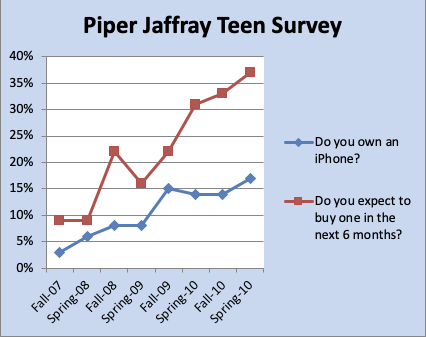
    I found the above in my archives. Ownership in 2010 was about 18%, 2015 it was 66% and 2025 it was 88%. The saturation at 88% (for both ownership and intent) was achieved relatively quickly but most importantly, it remains steady.

    Now consider that the teens of 2007 are having kids of their own. A 15 year old in 2007 is now 34 and a 19 year old is now 38 and some have a teen of their own.

    At 19 years, the iPhone brand has transitioned across one generation with not only resilience but with deeper entrenchment. This cannot be said for other contemporary technologies, e.g. social media. While elders use Facebook the young have moved on. Perhaps to Instagram (25-34, 76% 18-29) or perhaps to TikTok (16-24) which has the strongest position for younger, Gen Z users.

    Here are some additional data points on predisposition for social media:

    Facebook (25-49): Largest group is 25-34 (31.1%), but also high usage among 30-49 year olds.
    LinkedIn (30-49): Professional focus, ideal for B2B and adults 30-49.
    YouTube (18-64+): Broad, with the highest usage (93%) in the 18-29 bracket.
    Pinterest (30-49): Popular with older, female audiences.

    There is quite a lot of divergence and only YouTube seems to be fairly steady across age groups.

    Moreover, as the Piper Sandler survey suggests, Apple Services is not the same as the iPhone. The adoption of Music and TV are not a broad-based and that has a lot to do with disposable income. The mechanism for adoption should be the family plan whereby teens are automatically enrolled through their parents in to Music and TV+. After all, teen iPhones are likely purchased by parents. That services bundling is where Apple must focus its effort.

  3. Of bits and big bucks

    Research · 90 comments

    Exactly one year ago, on January 7th, 2013, Apple announced that the App Store reached 40 billion downloads ((Unique downloads excluding re-downloads and updated)). Here are additional data points from that release:

    • 20 billion downloads in 2012
    • 2 billion downloads in December 2012
    • 500 million active iTunes accounts
    • 775,000 apps
    • sold in 155 countries
    • 300,000 native iPad apps
    • over $7 billion in developer payments

    This year, on January 7th, 2014, Apple announced a new set of data points:

    • $10 billion spent on the App Store in 2013
    • $1 billion in December 2013
    • 3 billion app downloads in December 2013
    • 1,000,000 apps
    • sold in 155 countries
    • 500,000 native iPad apps
    • $15 billion in developer payments

    The obvious:

    1. 225,000 apps were added in 2013
    2. 200,000 native iPad apps added in 2013
    3. App download rate for December increased by 50%
    4. No new countries were added in 2013
    5. $8 billion was paid to developers in 2013 (more than in all previous years put together)

    The less obvious:

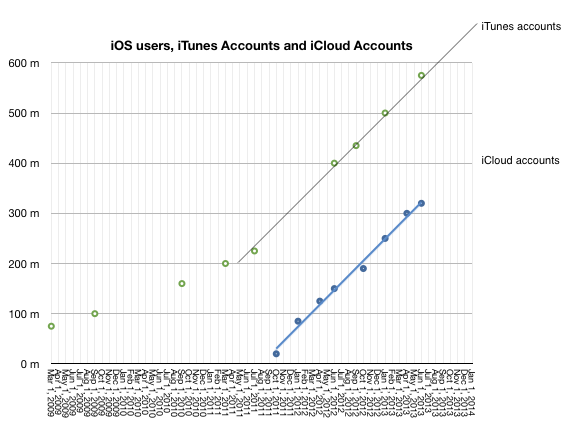
    1.  No update on iTunes accounts this time but there was a mid-year update (June 10th) which put iTunes accounts at 575 million. iTunes accounts have grown linearly since mid 2011 so it's quite probable that the current total is above 650 million. 
    Screen Shot 2014-01-08 at 1-8-9.28.41 AM
    1. Given mid-year updates to earnings/revenue and the October 22nd update that 60 billion total apps were downloaded and the May 15th update that 50 billion total apps were downloaded it's possible to estimate with confidence that there are now 68 billion total apps downloaded and that were about 27 billion app downloads in 2013. This is an increase of 35% in the yearly download rate. As noted above, the December growth alone was 50%.
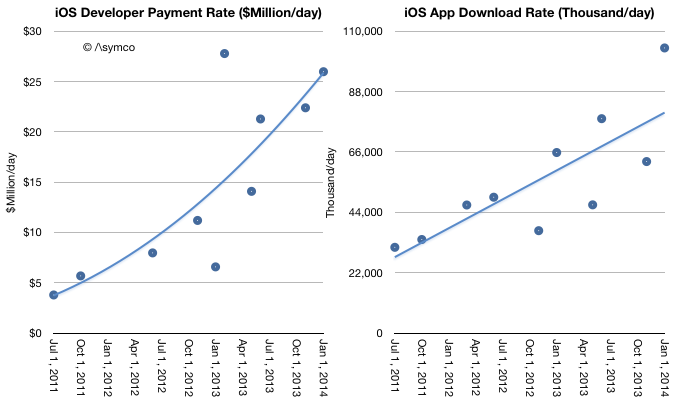
    2. Given mid-year updates on developer payments, and download rates we can estimate revenues per app have increased. As in-app purchasing has taken off it's no longer meaningful to assign a "purchase value" to each download. The rate of payments to developers is increasing faster than the download rate. Currently $26 million is paid out every day while about 100 million apps are downloaded daily. Note that the trend lines below are arbitrary: 
    Screen Shot 2014-01-08 at 1-8-9.41.18 AM
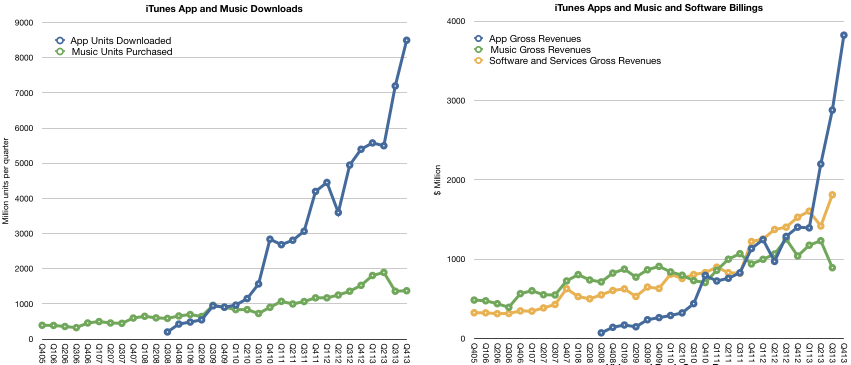
    1. As other reports have noted, there was a decrease in music downloads in 2013. This is also evident when backing into a download total for music given the earnings data and the above evidence of app growth. My estimates below may be overly generous for music unit downloads as they also assume lower pricing. Overall gross music revenues through the iTunes music store ((Excluding new iTunes radio and revenues from services such as Match)) are flat for the year and may even have begun declining precipitously. App revenues are more than compensating for this. 
    Screen Shot 2014-01-08 at 1-8-9.50.37 AM
    1. The iTunes content economy is grossing about $17.5 billion/yr. Apple's own software and services (reported as part of the iTunes segment) add another $6.2 billion/yr. The combined total of $23.7 billion/yr. is slightly lower than what Apple net sales were during its fiscal 2007 year or what Amazon sold in 2009.
    2. A complete report on the iTunes economy and pro-forma iTunes income statement is available for purchase at store.asymco.com.

    So much for the data. What is really happening?

    First, it's tempting to look at music and suggest that music downloads are suffering from streaming, just as it was tempting to suggest that CD buying was suffering from piracy (and later, downloads.) But this is falling into the trap of defining a product's use by the metrics used to measure transactions. These metrics are but a proxy for what consumers are actually doing with their time.

    Consumers have a fixed time budget, a more rigid constraint than their spending budget. Competition for a slice of a consumer's time budget is far tougher than competition for a slice of a consumer's wallet. So what's amazing is that apps have successfully grabbed a share of this time budget. I believe that the reason they succeeded is that they initially fit into niche time slices that were previously unoccupied. ((Interestingly, this was how music, especially digital music as enabled by the iPod, gained traction))

    Downtime or "boredom" was filled with app interaction. This includes some social media consumption. These are not immersive experiences. They are "casual",  inconsequential and trivial. At first anyway. And that's the rub. As apps enter a consumer's world they initially take on non-consumption, which is easy to beat. But as the experiences become increasingly compelling they "move upmarket" and compete more aggressively with existing media consumption patterns.

    For instance, one might allow casual gaming to take root in non-consuming contexts such as commuting, waiting, and escaping time niches. But if the experience becomes addictive, the gaming takes over time previously spent watching TV or using console games. The same can be observed for app-based experiences of social media, shopping and chatting.

    This is the insidious march of a disruptor. It gains a foothold in a context where it has no competition and then relentlessly gets better, eventually displacing the far better suited alternatives. This is what I believe is happening with apps. They are asymmetric in their competition with established media and as a result they are easily ignored and brushed off as irrelevant competition. That is until the incumbent media sees a sudden drop in consumption. Even then, the culprit blamed is not the upstart but some structural issue.

    Music would appear less vulnerable to this app-based substitution because it's an eyes-free experience and can be easily consumed concurrent with another activity. There is however, a subtle de-emphasis and hence devaluation of the experience as it fades into the background. The "job it's hired to do" changes.

    Second, and relatedly, the other meta-observation is that apps are media. They are produced, marketed and priced in ways analogous to other media types. This has implications for the artist/producer/creator. For them movement into apps is natural and effortless. It's how developers moved into them without thinking twice. Trouble is that this transition is not at all simple for those who distribute media.

    I tweeted that the media industry deplored the shift of "digital pennies for analog dollars" ((Original quote was made by Jeff Zucker, president of NBC Universal, in 2008 in reference to the future of TV)) as the packaging of their product changed. The angst and trauma suffered by the media industry when dealing with what could be seen as a trivial change in the encoding of content are the stuff of lore and legend. Moving to apps could be even more troubling. Mainly because there is already a distribution channel in place. And it's owned by a set of companies whose motives and business models are completely different.

    The app economy shows that there are big opportunities in "digital pennies" and that the figures are beginning to match even the "analog dollars". In fact, I suspect eventually digital pennies will dwarf analog dollars. The trouble is that these pennies will not be earned at the same control points. Bits are already big bucks. They're just not the bits we are used to.


  4. What's an Active User worth?

    Research · 86 comments

    Apple has sold 700 million iOS devices. Google claims one billion Android device activations. Microsoft has about 1.5 billion Windows users and Facebook about 1.19 billion. LinkedIn has 259 million users and Twitter has 232 million. Amazon has 215 active account holders and PayPal 137 million.

    Markets place a value on these users implicitly when company shares are priced. For example, Twitter whose users are worth about $110 or FaceBook's $98 and LinkedIn at $93.

    This consistency suggests a universally accepted value per social media user but what is the value of an ecosystem user? Apple, Google, Microsoft and even Amazon aspire to enable ecosystems which should be seen are more valuable than mere communities. Ecosystems enable a higher level of economic activity because they are unbounded by the medium itself. Any number of media can be created. Or so the theory goes.

    If we could determine a value for an ecosystem user we could test it against the going value of a social media user. Fortunately we have enough data to do so.

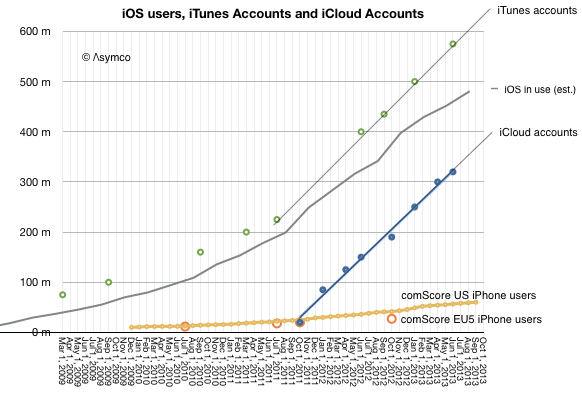
    The total number of iOS devices sold per quarter allows us to measure the install base of device users. With some assumptions regarding the retirement and attrition rate we can get the following history:

    Screen Shot 2013-11-11 at 11-11-11.52.34 AM

    Since the total number of iTunes accounts is updated with some regularity I've added it to the graph. I've also shown on the same graph the total number of iCloud accounts. For calibration, I included survey data showing the number of iPhone users in two regions (US and EU5).

    These combined graphs give us an upper bound of active users (iTunes accounts) and a lower bound (iCloud) calibrating our device-based estimate. The regional iPhone data offers some additional test on growth.

    The result is "about 500 million" ((482 million by my count but with quite a bit of margin of error)) with a growth of about 11 million per month.

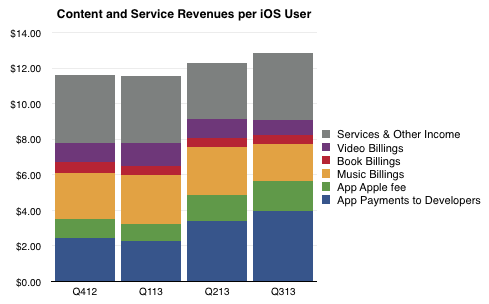
    So if we know with some confidence that there are about 500 million active users as part of the iOS ecosystem, how do we know how much value they generate? The answer is in the consolidated iTunes revenues as reported by Apple: $4.26 billion/quarter. With some attention to the reported media retail and purchases, the following picture of the average iOS user's quarterly spending emerges:

    Screen Shot 2013-11-11 at 11-11-11.50.23 AM

    The bottom line is that in the last 12 months the average iOS user contributed  about $48/yr to the ecosystem via Apple's own properties. They also bought the device and paid for cellular service in most cases. They may also have engaged in quite a bit of browsing and online purchases which fed other ecosystems. But as far as Apple is concerned, it transacted about $48 per user.

    As Twitter revenues last year were $317 million, the Twitter user today generates about $1.36 of revenue per year or one thirty-fifth of what an iOS user generates through iTunes and iCloud alone. And note that the number of iOS users is about twice that of Twitter.

    Of course one could argue that the iOS user's participation is not profitable for Apple. It does obtain massive cash flow from iTunes which finances its fashionable data centers and bandwidth but it does not presume to value itself primarily through this revenue.

    Or at least the market doesn't think so. We don't hear much about how Apple is worth so many dollars per user. ((I suppose the corollary to this is that Apple users are disloyal or fickle or fleeting, and quite contrary to observed behavior.))

    The paradox is that while the device which enables this commerce is where Apple guides the consumer's perception of value, markets discount devices and bid up services. In other words, users continue to pay for the devices which delight them enough to participate in services (especially the monthly billable kind) but markets walk right by these shiny baubles and and shower money on services which have negligible sales and even fewer profits. There must be some serious misdirection going on here. The question is who's being fooled.