Asymco

Asymmetric Intelligence

software

  1. The Progress of the Platform

    Research

    The Progress of the Platform.

    On why there is a ban on intermediate layers of software development on the iPhone OS.

    But the reason isn’t technical. It’s partly business (Apple doesn’t want another company to control any important part of the iPhone platform), but it’s also in no small part grounded in aesthetics and the progress of the platform. Apple wants developers to do things the iPhone and iPad Way because they believe it will result in a better user experience and better designed apps. That’s an aesthetic, design-centered argument about how touch apps should be done. Apple has created tools customized to the iPhone and iPad; hell, they built a whole new touch-based operating system. They created a whole set of user interface metaphors that are supposed to be standard and system-wide, and they want developers to do things the new way not because Apple just loves power, but because they believe it’s necessary to force developers to think about the new world of touch-based computing correctly. All of this in service of giving users who are taking their first steps into touch-based computing a great experience.

    Developers who want to write software for the iPhone have to write iPhone-like software. To do otherwise will hinder the progress of the platform.

  2. Nokia Tablet?

    Research

    "Getting a strong Intel backing here could be an important advantage," says MKM Partners analyst Tero Kuittinen, who sees the Nokia tablet as part of an array of mobile computers.

    via Nokia Aims a Tablet at Apple: Exclusive | Technology | Financial Articles & Investing News | TheStreet.com.

    No doubt Nokia's tablet plans preceded the launch of the iPad--product cycles being what they are.  And the relationship with Intel is certainly a big part of this push (vs. on the handset side where Intel has no cards to play).

    However, the elephant in the room is what software will run on this Tablet.  Any discussion on competitive potential of iPad competitors must include a view on the software/platform and ecosystem that tablet will rest on.

    This is not a hardware business.  In fact, the hardware is designed to get out of the way.

    The hardware is so understated — it’s just a screen, really — and because you manipulate objects and interface elements so smoothly and directly on the screen, the fact that you’re using an iPad falls away. You’re using the app, whatever it may be, and while you’re doing so, the iPad is that app. Switch to another app and the iPad becomes that app. If that’s not magic, I don’t know what is.

    source: http://db.tidbits.com/article/11152

  3. Tim Bray hates the idea that hardware guys can kick software guys around

    Research · 8 comments

    Tim Bray Throws His Hat Into The Android Ring Because He Hates The iPhone

    Sorry Tim, get used to it. Your idea that software writers should have the right to put their software on anybody's hardware is coming to an end. That is a privilege not a right.

    No vendor has the right to put their product on the shelf of any retailer in the world. It takes a lot of hard work and no small amount of luck to have your product distributed. The software world will be no different.

  4. Music. Sweet music

    Podcast · 37 comments

    iPad Death Watch : AAPLinvestors

    You can't go wrong betting against this bunch.

    (link above reproduced below due to bandwidth issues with their servers.)

    “Any tablet computer, including Apple’s eagerly anticipated iPad, will face serious problems in generating big sales. Tablets look cool, but the reality is they don’t do anything new.” Michael Comeau, Minyanville, 5 March 2010

    Dvorak:”I’m telling you, look at this product coming out of India called the Adam.” Curry: “A-D-A-M?” Dvorak: “Yeah.” Curry: “And it’s a what it’s a pad?” Dvorak: “It’s an iPad Killer. And I hate to use that term since the iPad is probably dead anyway.” No Agenda Podcast, Adam Curry & John C. Dvorak, 25 February 2010

    “Fewer capabilities (than a netbook) but a similar size? Not a good start.”Lee Gomes, Forbes Asia Magazine, 5 March 2010

    “We of course build plastic mock-ups that we show (to customers)…we had a slate form factor. The feedback was that for (our) customers it will not work because of the need to have (a physical) keyboard. These were 14-year-old kids, who, I thought, would be most willing to try a virtual keyboard but they said no, we want the physical keyboard.” Mika Majapuro, Worldwide Sr. Product Marketing Manager, Lenovo, 22 February 2010

    “The Apple iPad is not going to be the company’s next runaway best seller.” John Dvorak, MarketWatch, 12 February 2010

    “It’s a nice reader, but there’s nothing on the iPad I look at and say, ‘Oh, I wish Microsoft had done it.’” Bill Gates, Microsoft, 10 February 2010

    “The rally has been especially kind to seemingly racy stocks such as Apple and Google. Both have pole-vaulted to market-surpassing gains over the past 12 months, despite the fact that the former’s hamster-wheel of innovation (to borrow an apt phrase from my Fool colleague Joe Magyer) may have hit a snag with the iPad. ” Shannon Zimmerman, The Motley Fool, 10 February 2010

    “It’s not a tablet, it’s an extension of the iPod Touch. It has some new kinks, but generally speaking it’s using the iPhone OS. It’s more like a smart phone than a personal computer. It’s the Newton reborn. What’s missing most is the communications aspect.” Andreas Haas (former Apple executive), CEO, Axiotron (Modbook), 7 February 2010

    Before Jan 20th, 49 percent of people said they didn’t think they needed an Apple Tablet. That number jumped to 61 percent after the announcement. Fifty-nine percent of buyers wouldn’t pay extra for 3G coverage. Whether this device becomes a big hit is anyone’s guess but based on this study it sure looks doubtful.” Retrevo, 5 February 2010

    “Yet it’s hard to see how the iPad, in the form unveiled last month, will come close to transforming daily life as much as the iPod or iPhone. The challenge with the iPad will be less about improving an established market than building a new one.” Arik Hesseldahl, BusinessWeek, 5 February 2010

    “I added it up and … like 800 people are going to buy the iPad. . . . It’s not that the iPad is a failure. It’s just a product ahead of its time. No one should actually buy this iPad — between its inevitable first-generation bugs, fulfillment problems, and buyer’s remorse over added features and price drops, it’s heartbreak waiting to happen.” Molly Wood, CNet, 31 January 2010

    “It was a bigger iPod Touch. I question whether those features would be enough to get people to buy new machines.” Satoru Iwata, President, Nintendo, 29 January 2010

    “The company once notorious for its ability to upend convention and revolutionize markets may no longer have what it takes, worry some technology journalists. Call it the iPad or the iPlod, but the message seems clear: Apple may have lost its mojo.” Jeremy A. Kaplan, FOXNews.com, 28 January 2010

    “What’s the single most worrisome thing about the iPad? It’s Apple’s monopoly on distribution of applications. ” Harry McCracken, Tecnologizer.com, 29 January 2010

    “The tablet market has only succeeded as a niche market over the years and it was hoped Apple would dream up some new paradigm to change all that. From what I’ve seen and heard, this won’t be it.” John Dvorak, MarketWatch, 29 January 2010

    “It is a humorous world in how Microsoft is much more open than Apple,” Frank Shaw, Microsoft, Corporate VP, Corporate Communications, 29 January 2010

    “When Steve Jobs first demonstrated the Apple Mac, he used the words “insanely great” to demonstrate the full graphical display of the computer. It’s a tag that has stuck around to this day among Apple fans. But, today’s comments from Jobs that the iPad is a “magical, revolutionary” device ring hollow.”Dan Wayne, apc mag, 28 January 2010

    “All the people (including me) who felt underwhelmed by the iPad initially might have missed its true potential. Put another way: the iPad is all about software. Forget the sleek form factor – that’s just a prerequisite. Ironically, it’s the software and services that Microsoft never ‘got’, that Apple totally does get.” Dan Wayne, apc mag, 12 February 2010

    “Nothing from the iPad specs that I’ve seen really shows any great cause for celebration. Unless Apple has also developed some new type of power source, such as nuclear cells or magical hamsters on tiny spinning wheels for the iPad, don’t expect the claims about battery life to hold true. ” John Breeden II, Government Computer News, 28 January 2010

    “Ultimately, the iPad is a large iPod touch: a great device to draw your inspiration from, but perhaps not the seismic shift in technology that we were expecting.” Claudine Beaumont, The Telegraph, 28 January 2010

    “Behold: The Apple iFlop Neither “truly magical” nor “revolutionary,” the cluelessly named Apple iPad tablet device has dropped like a shiny wedge into the gadget game, dividing tech watchers in to opposing views — the critical and the adoring.” Scott Moritz, TheStreet.com, 28 January 2010

    “9 Worst Things About The Apple Tablet: 1. No Flash 2. Its screen 3. Its price 4. Closed App Store 5. Its name 6. No multitasking 7. No camera 8. No USB 9. AT&T deal Bianca Bosker, Huffington Post, 29 January 2010

    “What do the new Apple iPad and Google’s Nexus One have in common? Both were DOA: Disappointing On Arrival. Why is the iPad a disappointment? Because it doesn’t allow us to do anything we couldn’t do before. Sure, it is a neat form factor, but it comes with significant trade-offs, too. No 16:9 widescreen, for example.” David Coursey, PC World, 28 January 2010

    “E-readers will outsell iPads because of the simple economics of the consumer device market. It’s triple the weight and 30% thicker than an e-reader. You need two hands to hold it. It’s got a backlit screen, and it’s too expensive to give one to everyone in your house.” Russ Wilcox, CEO E-Ink (makers of Amazon’s Kindle), 28 January 2010

    “It seems like a high priced, unnecessary trinket to me.” Paul Thurrott, SuperSite for Windows, 27 January 2010

    “Apple iPad - failure, joke or fiasco? Pick one” Linen DeFiller, MillionFace.com, 27 January 2010

    “The press weren’t cheering and whooping. I didn’t see anybody pee their pants … Not one! The only people I saw cheering were the people who work at Apple down in the front two rows … Al Gore was going crazy. I wanted to see more. It’s a big iPod. What is there to do there? Play a video game on a bigger screen? I thought it [iPad] was ‘paving the cow path’ (enshrining a makeshift solution).” Dan Lyons aka Fake Steve Jobs, 27 January 2010

    “Let’s face it, the Internet was designed for the PC. The Internet is not designed for the iPhone. That’s why they’ve got 75,000 applications — they’re all trying to make the Internet look decent on the iPhone.” Steve Ballmer, Microsoft, 21 October 2009

  5. Palm's Forecast

    Research

    full-year revenue would be "well below" its previous target of $1.6 billion to $1.8 billion. Wall Street was expecting $1.6 billion

    If we assume $1 billion/yr. revenues, that works out to about 3 million smartphones a year out of a market that Gartner just forecast to be 215 million this year. That gives Palm just 1.4% share of smartphones.

    The WebOS is a fine piece of code, but one has to understand that success in this business is not just doing something right. You have to do everything right:

    • Nokia has great distribution and logistics, not so good software or platform story
    • Palm has great software, not so good distribution or platform
    • RIM has great distribution and service, not so great software
    • Android has good software but not great integration of solution
    • Apple's software and platform are great, but distribution is still weak
    • Microsoft has nothing good at all

    The question of acquisition invariably comes up. The obvious answer would be to pair Palm with somebody who needs what they have and who has what they don't. Unfortunately no perfect fit arises.

    UPDATE 3-Palm cuts revenue view on weak phone sales | Reuters

  6. Estimating iPhone’s Nosebleed Gross Margins

    Research

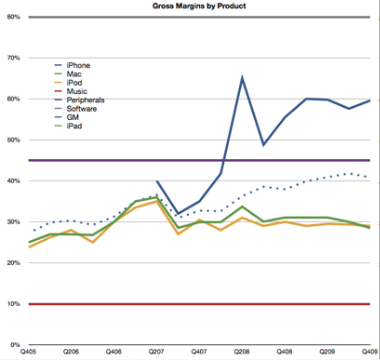
    Apple’s latest re-statement of financial statements eliminated subscription accounting for the iPhone not just for the past quarter but for the entire history of the product, back to mid-2007. This allows a more precise estimate of the gross margin of the product and the results are eye-watering.

    Apple does not reveal the margin for any product. They do provide an overall margin for the company (shown in the dotted line above).

    The only challenge is to “back into” the GM for iPhone based on what we know of the margins for the other product lines and filling in the iPhone as the last piece of the puzzle.

    To do so, we need to have some idea of what the other products’ margins are. Fortunately, this is not that hard.

    We start with the easiest and work up:

    The Software products business line ($2.4 billion last year) is easily the most profitable on a unit basis as software does not require much cost in manufacturing. A solid ballpark estimate is 80% GM (which is what Microsoft typically gets.)

    Next, Music ($4.2 billion revenues). The estimate for music is fairly straight-forward. Apple and the industry have leaked the terms many years ago. Apple pays the labels most of the revenue of the music and keeps about 10% to operate the store. On the App Store there is a 30% margin off the selling price but that is offset by higher direct costs (shipping billions of free apps and free updates). I stick with 10% margin for the Music business line.

    Third, Peripherals. The peripherals business is not particularly large for Apple, but they do a fair amount of peripherals with $1.5 billion last year. My estimate for peripherals margin is 45% based on some comparables.

    Fourth, the iPod ($8.1 billion). The iPod has had a fairly well understood cost structure. The main variable is the cost of the memory, which, as a commodity, varies greatly quarter to quarter. Nevertheless, there is a strong consensus that iPod margins have kept around 29% to 30% over a few years. Teardown analysis coupled with spot pricing for memory chips gives a consistent average.

    Fifth, the Mac ($14.7 billion). The Mac is a difficult product to estimate margins for due to the relatively wide variety of SKUs in the market, the complex components, various quality/warranty issues, transportation costs and the point in the life cycle of any given Mac. The best estimates however hover around the same as the iPod: 30%.

    Once these values are available, and knowing the proportion of sales attributable to the iPhone vs. the other products, we can get an estimate of the gross margin.

    Recent GM estimates are all shown in the graph attached. Here are a few observations:

    1. The overall GM was tied very closely to the Mac/iPod prior to the iPhone.
    2. Gross Margin has been increasing since the iPhone
    3. The iPhone GM is consistently above 60% and is chiefly the reason for the increasing of the overall GM

    The expanding margin for the whole of Apple is quite a story in itself (especially vis-a-vis the tragicomedy of the other PC vendors). However, what really stands out is how high the iPhone margin is.

    Knowing why it stays so high in the face of an assault of “iKiller” devices is a clue to how Apple creates value.

  7. Apps are not Applications

    Research

    Understanding the new world of apps. Apps are not Applications.

    That should have been the first sign that the software market was changing. It’s obvious in retrospect; people were buying software that would make them laugh. This runs counter to the common understanding of an Application. An Application represents the developer’s best effort at creating software that applies the capabilities of the device to solving a specific problem. Making people laugh is not a problem an Application can solve; it’s not about the device it’s about the person using it.

    Lots more clues here:

    http://kickingbear.com/blog/archives/67

    I always said that the App is a new art form. As much art as desktop publishing and web design and home videos done by the masses. It's not pretty but it's real.

  8. Serving the Needs of IT

    Research

    An interesting note in the latest Canalys Smartphone quarterly summary (http://www.canalys.com/pr/2009/r2009112.htm):

    "...in our October study of 600 European decision makers in medium and large enterprises, more than 20% said they expect the iPhone to be the dominant smart phone platform for running business applications in their organisation within the next 3 to 5 years. In France, the iPhone was ahead of Windows Mobile and RIM in this regard – a remarkable result.”

    This short quote brought back to mind the recently formed partnership between Nokia and Microsoft to deal with RIM. One fruit of this relationship is a recent job posting atcareers.microsoft.com which seeks Symbian developers to work for Microsoft:

    Job Category: Software Engineering: Development Location: India, Hyderabad Job ID: 702365 Division: Microsoft Business Division

    The Office team is looking for a self-motivated and highly passionate Developers to contribute in building a new team and drive discipline excellence in the delivery of Office Mobile and Communication experiences for Nokia’s Symbian smartphones.

    Microsoft and Nokia have formed a global alliance to design, develop and market mobile productivity, communications and collaboration solutions.

    Under the terms of the agreement, the two companies will begin collaborating immediately on the design, development and marketing of productivity solutions for the mobile professional, bringing Microsoft Office Mobile and Microsoft business communications, collaboration and device management software to Nokia’s Symbian devices. These solutions will be available for a broad range of Nokia smartphones starting with the company’s business optimized range, Nokia Eseries. The two companies will also market these solutions to businesses, carriers and individuals.

    This project builds on the existing relationship with Nokia who is optimizing access to email and other personal information with Exchange Activesync. Next year, Nokia intends to start shipping Microsoft Office Communicator Mobile on their smartphones, followed by other Office applications and related software and services in the future.

    (related job description)

    While the iPhone wins hearts and minds in IT through sheer brilliance Nokia tries to become a supplier to IT departments through a strategy deeply rooted in the 1980s: the manipulation and exertion of control over file formats. As IT has diminished in importance (to the point of ceasing to matter to some) it's hard to understand this misplaced alliance with Microsoft over something so inconsequential.

  9. Assessing Nokia’s Competitive Response

    Research · 11 comments

    When the iPhone was announced in January 2007 I tried to envision the competitive response from Nokia. The method involved some knowledge of the product development cycle that I was faintly aware of.

    Here is what I predicted:

    • 2007.There would be no response within the first year, meaning there would be no perceived threat of any kind. No process change, No roadmap changes and no business review. Apple is not considered a competitor.
    • 2008.There would be plans made to respond with press releases, dismissing the challenge as a non-threatening "positive" for the industry. No process changes, no product plan changes, no business model changes. Apple would not be considered a competitor except in "high end multimedia" (invisible in any of the segments Nokia uses to define markets).
    • 2009.In the third year, product development teams would be asked to begin roadmapping some of the hardware features that would keep Nokia ostensibly competitive (unfortunately for Nokia, hardware is not what sells iPhones). Results from these efforts would emerge in 18 to 24 months. Apple not considered a competitor except in "high end converged devices" (i.e. a few consumer segments/categories are considered vulnerable).
    • 2010.Realization that iPhone is a threat from new dimensions (user experience). Planning begins on reshaping the software base as a market-driven (not technology-driven) asset (5 year cycle). Apple begins to be evaluated as a competitor in devices and services, although still not compliant with current market definitions.
    • 2011.The realization that the iPhone competes as a platform. Planning begins on repositioning Symbian/Ovi. Products planned in 2009 begin shipping--this means first capacitive touch screens but crude, almost unusable software.
    • 2012.The realization that the iPhone is an integrated product and that integration is a key to competitiveness enters management consciousness. Planning begins on organizational change and a realignment of incentives to account for this new threat. Crude shuffling of internal assets and management musical chairs begins. Organizational change amounts to mostly new names for old departments. Touch screen phones with slightly better software begin shipping (similar in feel to Blackberry Storm from 2008). Incentives are added for employees (in across-the-board performance objectives) to hit user experience targets.
    • 2013.Management begins planning a new organization structure that takes into consideration the fundamental causes of iPhone's success: integration, software, user experience over the objections of sales and markets org that depends on shipping plastic to distributor. Another reorganization that is slightly more rational and aligned with the market is initiated. The plan is to have the assets in place by 2019 to compete effectively as a platform.
    • 2014.First products that are roughly comparable with iPhone version 1 begin shipping. The required software redesign started in 2010 is coupled with the integration efforts. Nokia's response to the iPhone has begun.

    I tried to revisit the prediction to update it with anecdotal evidence but so far there has been little activity that has affected the trajectory.

    1. Note 1: Whether an iPhone v1.0 shipping in 2014 would be competitive is left as an exercise to the reader.
    2. Note 2: The N97 shipping in 2009 is the result of work begun in 2007, it has had no influence at all from the iPhone.
    3. Note 3: The Microsoft response cycle is slightly shorter (perhaps 5 years vs. 7) but they lose a year in efforts to integrate with licensees. As neither MSFT nor GOOG are able to integrate products, they will never be able to actually deliver a competitive product. In this regard, Nokia has an advantage.
    4. Note 4: The key takeaway from this analysis is that the industry standard product cycle for an integrated, platform based product is 5 to 8 years and if one competitor can achieve a 2 to 3 year cycle, then the more nimble competitor can "turn inside" the industry and, within two cycles, dominate it. Although smaller competitors are able to turn product faster, they are usually unable to sustain the platform heavy lifting (which takes an order of magnitude more effort/assets).