Takeshi Narabe On the secret of Apple's success, you have previously noted that the key to Apple's success was its ability to integrate hardware, software, and services to create products that are perfectly hired for a specific job to be done. You also highlighted how they moved beyond mere devices to lock customers into an ecosystem like iOS, iCloud and Apple stores. So this analysis is now very well known. So do you still think this is one of the biggest reasons of Apple's success?
Horace Dediu Yes, we have to recognize Services has only been a story for the last 10 years. And arguably integration of software hasn't been really all that important before 1998 when Apple brought Steve [Jobs] back and with him came NextStep, which was [an] operating system based on Unix. And that was much more robust and much more focused around software engineering than the original MacOS. Or, what I would say [constituted] version 1 of Apple, which began in 1970s until the 1990s.
Most people tend to think of Apple as one continuous story for 50 years. [But] it's at least two major stories. I would say pre-98 and post-98. And post-98, it's been so different. And it's much more, I would say, something [that can be studied] as a theory.
I think in the first decades Apple was more, let's say, a story of people. There were people who were brilliant. There were people who were celebrated [as they are] now. But the second half of Apple is much more about building a business that has longevity, [that] can last a long time. It's an unusual priority.
I think for many companies in the world, they don't think about longevity. And that is why, even Tim Cook recognizes that it's the next 50 years that are more important [than the last 50 years]. So thinking about a century is really important and I think [that] is core to the current culture of Apple. Now, of course, this means, as you said, integration, and that is one of the key things. But fundamentally, beneath all that, there's this point about culture.
Takeshi Narabe Culture?
Horace Dediu Culture in the sense of what are the priorities? What do we concentrate on and to what degree do we need to focus? They [management] repeat these things all the time. Focus, focus. What means this? It means saying no to many things, but it also means saying yes to the things where you can bring great things to bear. It's where Apple has a unique advantage. And that means saying no to a lot of things.
We know about the car business that they eventually rejected even though they worked on it for many years. I think ultimately that decision was based on a realization that they couldn't bring enough contribution. And that's not just an economic decision. Of course they could have made money. There are even phone companies in China that make cars today. But it isn't what they thought of as important.
Takeshi Narabe All right, thank you. So you also mentioned to what extent do you attribute Apple's dominance to the ability to tap into non-consumption addressing latent demands that consumers themselves hadn't yet realized.
Horace Dediu So this is also one of the keys indeed. i learned about this by listening to my professor Clayton Christensen, who observed that great companies not only compete effectively, but they also create their own markets. They create their own demand.
[It's an] Extraordinary idea. And when you look at Apple, you do see that they use a different language. They talk about customers not asking for the product. But they also fundamentally build something that compels the user to buy it. When it was something that wasn't conceivable. Steve Jobs famously said, the customer hires us to find out what they want. So this is a fundamental thing.
And there are many examples. And I think one of the struggles today, for example, is Vision Pro, a product that is very difficult to find how it's going to solve problems. But at the same time, it's an extraordinary product. I think the jury is still out on the Vision Pro, but there are many other examples where I think initially they thought things would go in one direction and they went in another direction.
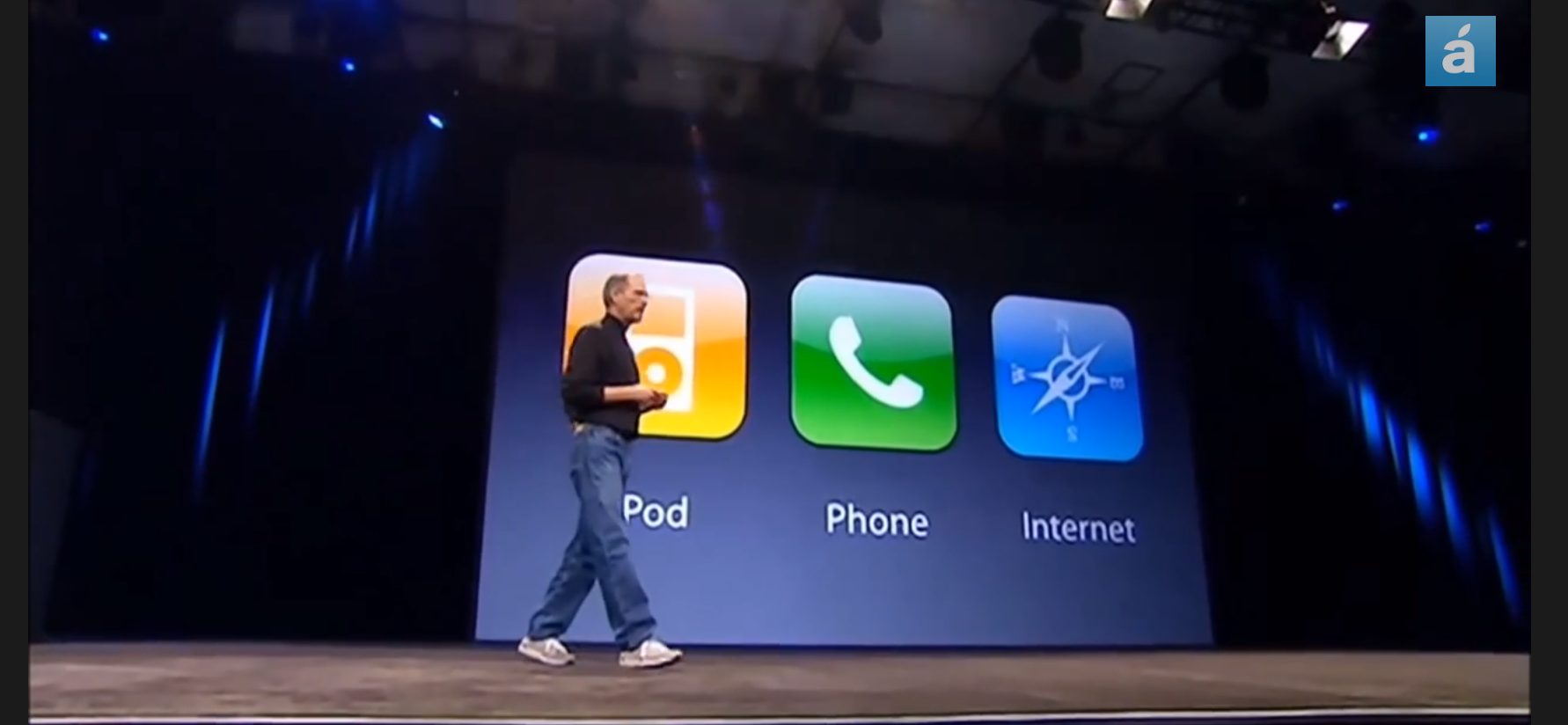
But even the iPhone, I like to repeat the fact that when the iPhone was introduced, Steve Jobs said it was three things. That it was a widescreen iPod, that it was an internet communicator, and it was a phone. But I point out that these days, those three jobs of being a music player, being a telephone, and being a browser, are not among the most popular things people do with it.
So it's fascinating how they introduced it as a blank slate. [It was] software, written by third parties [that discovered the compelling uses], and it developed in its own ecosystem. That is also a very interesting lesson there.
But it is fundamentally about really being humble. I think, again, it's a cultural trait, being humble and saying, maybe we don't know fully what to do, but to concentrate on quality and concentrate on doing at least something useful for people. And then later, new things will appear.
— This is the first part of a series of excerpts from an interview with Asahi Shimbun newspaper on Apple & Innovation.
A transcript of the May 1, 2026 Asymco One Office Hours, recorded one day after Apple's Fiscal Q2 2026 earnings call. Horace Dediu presents his analysis of the quarter and takes questions from Asymco One subscribers. Hosted by Horace Dediu and Farshad Nayeri.
Horace Dediu: So I'll do a short presentation, and then we're going to open it up for questions. We are speaking approximately one day after Fiscal Second Quarter 2026 earnings call. Let's dig into it and see if we can understand it even better.
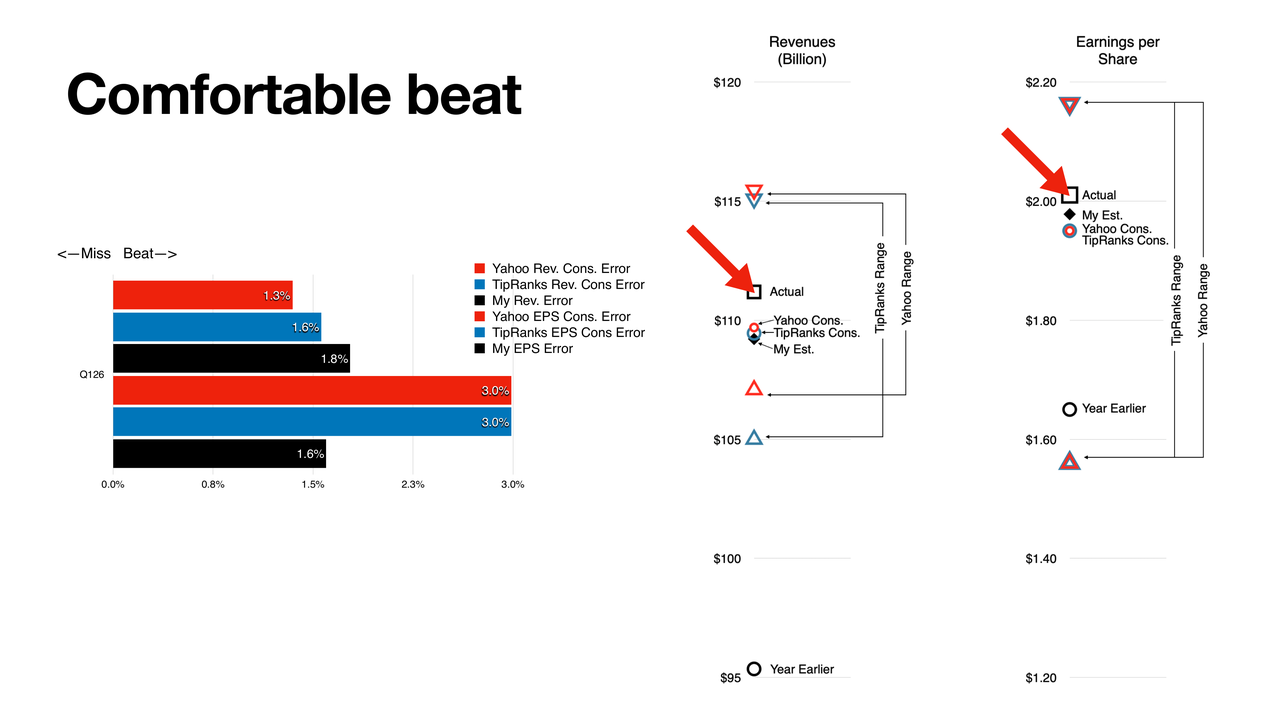
First, I think that there was a comfortable beat from already a highly elevated expectation.
So we had a range of estimates— I collected those from Yahoo and TipRanks, each one had about 30 [analysts], probably a lot of overlap between them. So we had a range of about 105 to 115 in terms of revenues in billion, and then we had EPS in a range of about 1.6 to about 2.15.
And not only did it beat the consensus, but also you can see what happened a year earlier, which is the circle at the bottom of the graph. So the beat was from already a pretty high growth rate expected from the year before.
So we have a measure of how each of us, myself included, performed relative to the actual results.
I was about 1.8% under revenues delivered, and 1.6% on EPS. And then you can see red is Yahoo and blue is TipRanks.
So speaking for myself, I was perhaps a little bit too conservative on my revenues, and I was a little bit more accurate, relatively speaking, on EPS. Roughly speaking, again, I think these are not big errors, 1% to 2%. Worst case, 3% on the consensus basis.
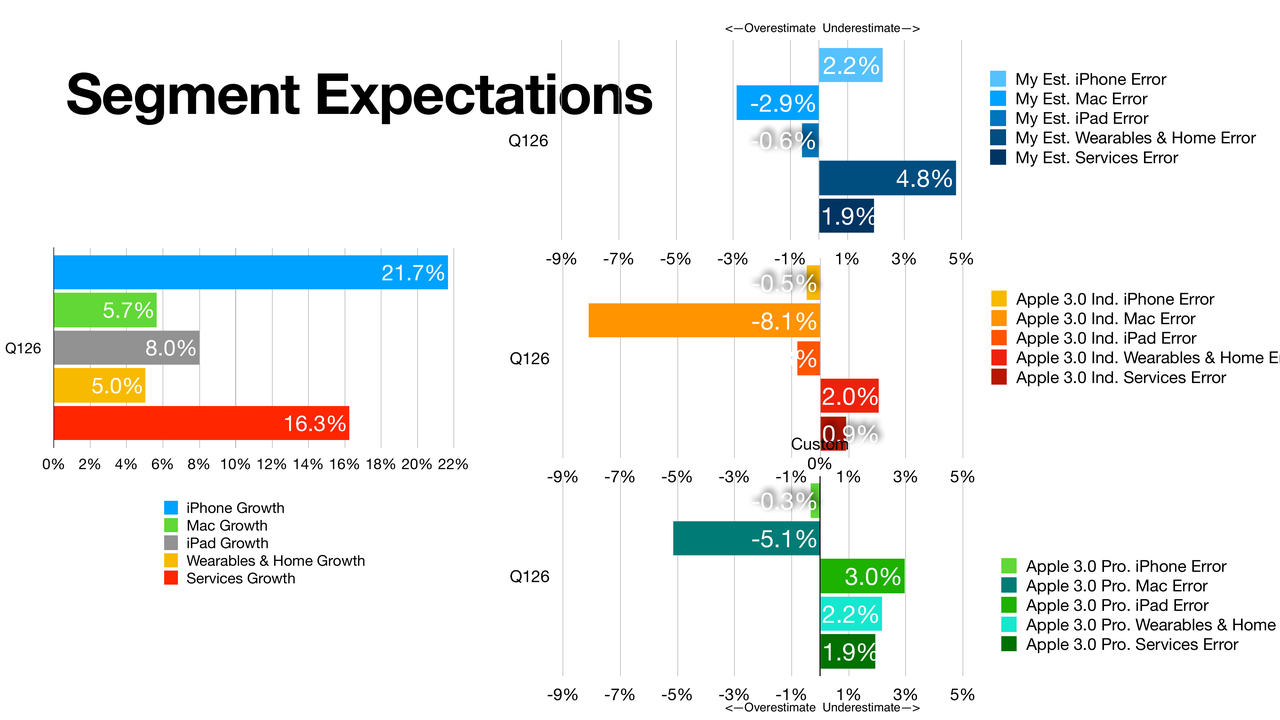
Now, on the segments, these are the actual growth that we ended up with, iPhone almost 22%, 16% on services, 8% on the iPad, which is impressive. 5.7 on the Mac, we'll talk about that a little bit, and 5% on wearables and growth.
Segment level, again, the worst case, you're looking at an 8% overestimation on the Mac. The Mac— I think a lot of people, once they saw the Neo come out, once they heard about the Mac mini stockouts, when they heard about the Claude bots, you know, everybody buying up all these Macs, there was an expectation of a big boom in the Mac, but those all happened fairly late in the quarter. My expectation was a little bit over, but not as much. I was off about 3% on that estimate. So although we saw 5.7% growth, some people expected double digits. Also, the pros had the same fault there.
Overall, though, I think these are pretty impressive. I didn't break out the geographic segments. China grew extremely well. Rest of the world, that grew very well. Management also pointed out that they're doing very well in developing markets. So overall, regionally, there were some extraordinary performances. But as we see here, just the iPhone was incredible, 22%. Very similar to performance in the previous holiday quarter, where, again, unprecedented growth, or at least in the near history of the product.
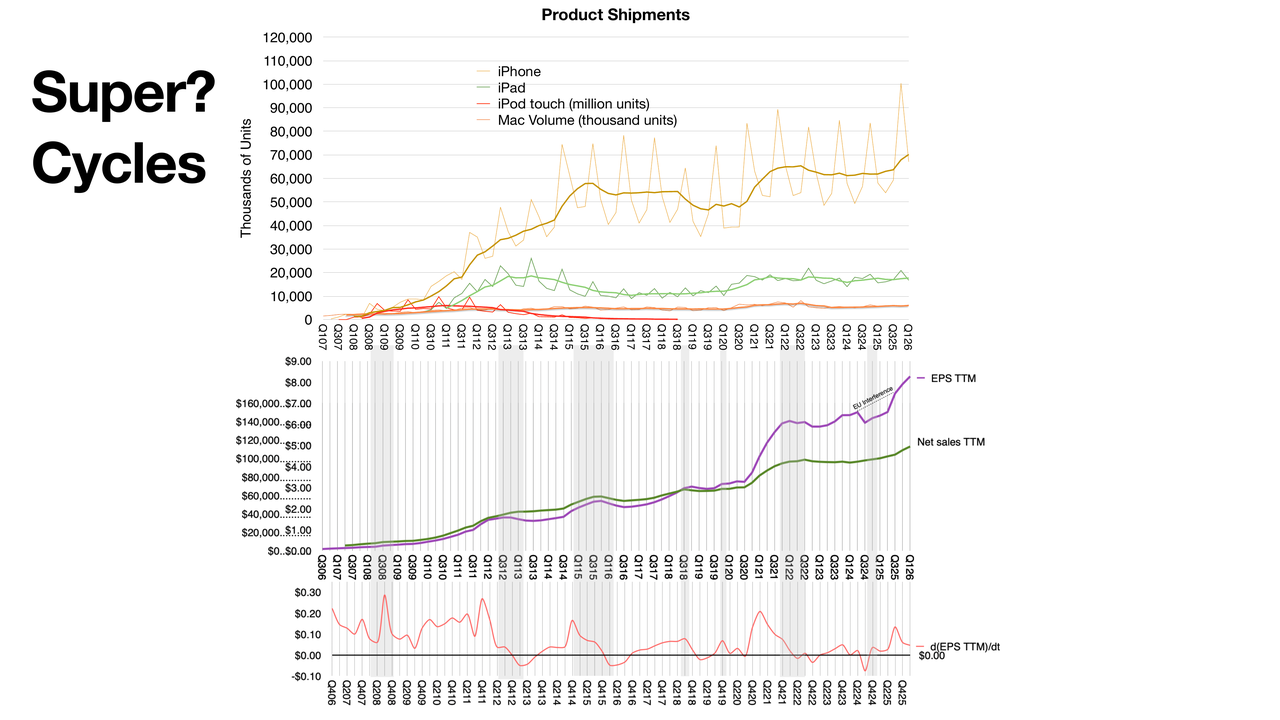
And we'll get into some reasoning why that is. People talk about super cycles, people talk about the assumption that we have these giant surges once in a while. Well, here's how to look at it.
There are two graphs here. The bottom graph shows in green the net sales, but trailing 12 months, so it's smoothed out, so we don't see the spikes on the holidays. That's the green line. Above that, we have the EPS line. Now you'll see how they tracked very similarly for a while, and then they began to diverge. That occurred around COVID. It also occurred during the surge in services, especially subscriptions and services. But still, there's a similar pulse, if you will, a cyclicality to it.
I mean, part of that has to do with the introduction of a new form factor. This has been true all the way back since 2012. When a new iPhone comes, especially a new, distinctive-looking iPhone, people will go out, especially in China, buy it for showing off that they have the latest, which there's nothing wrong with that. But then the second year usually is not the same, the phone is not new, it's the same form factor. That has to do a lot with tooling. That's a long, old story, that the tooling is depreciated on a two-year schedule, so you're going to produce roughly the same look a couple of years in a row, and then by the next cycle, you'll see people upgrading or replacing their older phones. So you're going to have this— I guess what they used to call a super cycle.
And you see it also in the upper graph, where I try to separate out of sales just the phones. Now this is an estimate because we have no unit sales for the phones since 2018, so some of that is an estimate. But you'll see again, once you smooth out the cyclicality, you'll see these surges once in a while. Now, again, this is a valid observation, but I don't think it's the main driver. The oscillation isn't huge, it might be significant, but it's a blend of many things.
The bottom graph is particularly interesting. The gray areas are when the stock price fell. And the red line represents the derivative of EPS. And you'll see how, when that is about to dip, there's usually a stock price sale going on. I wouldn't say it's predictive, but it's an interesting pattern to go through.
So what's happening now? You'll see from the iPhone, there's a new surge happening. Now, when Tim has been asked this question, he says that, well, the iPhone 17's really nice, people really love it, and that's a good answer, but the fact is, it's a distinctive-looking product. Some say it's the orange color, but it's certainly attractive. So we're seeing this pattern, a nice surge.
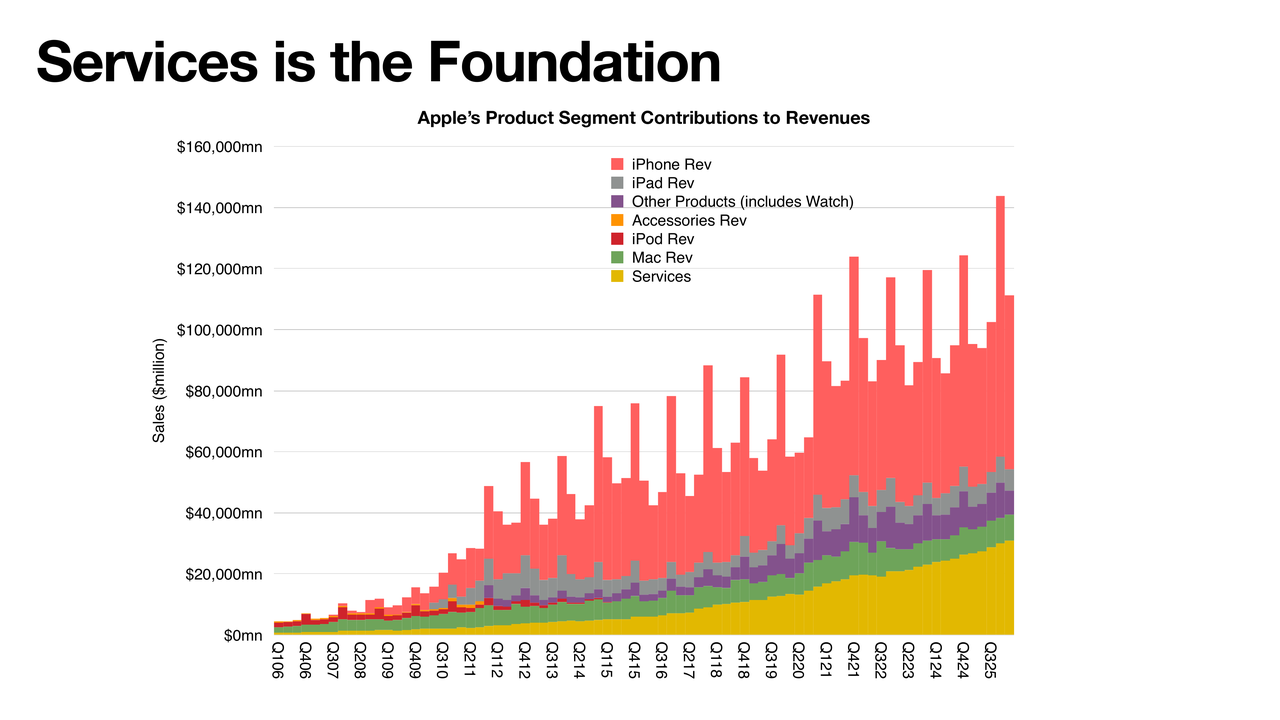
We'll get into the guidance in a minute, and that actually demonstrates that we're in some kind of an acceleration. But here's the thing, underneath all that, services is just absolutely steady growth, compound growth, and as a result, it just lifts the whole story.
Here, services is at the bottom. Normally, in a graph like this, you want to put the oldest products at the bottom and the newer ones at the top, but I wanted to highlight the fact that services is foundational, in the sense of showing how it holds up everything else.
Most people put it the other way, they say the iPhone holds everything up, but services is looking more and more to be the thing that keeps people in the ecosystem. There's a lot of value there. There's a lot of things people depend on there, and I think it's one of the reasons people don't switch. So it's another one of these stories that people aren't appreciating enough. It's been years and years of pounding the table on services, but here you see it, just how important it is. It's the tide that lifts all the boats, and the boats being all the products.
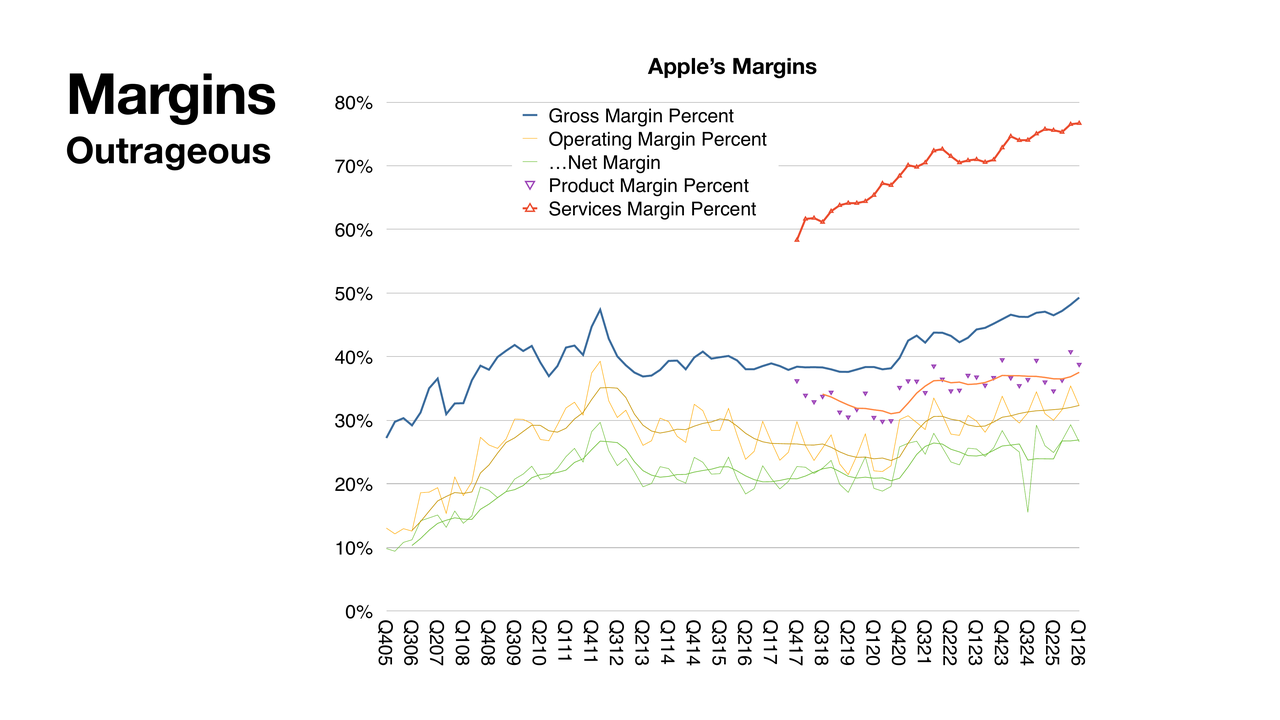
So let's now talk a little bit about margins. Unbelievable, unbelievable margins. We just hit almost 50% on gross margins. Gross margin here is the blue line. And that's composed of two subcategories. We have services in red at the top, and we have products with the purple triangles.
And although products margins are exceptional— they're right around 40%— those services, again, are pulling the whole average up, and you can see that bend in the curve in the blue line, where we were very steady around 40%, but as services took more and more; it just pulled the whole curve up.
And we also see here operating and net margins, which also are going up, naturally. There is a little bit more operating expense. We'll get into that, which maybe decreases the slope of the bottom line. But this gross margin is absolutely incredible. We just haven't seen anything like this since 2010-11. We saw that surge back then, and then it sort of leveled out, and everybody was happy with 40%, and now we're flirting with 50. I just cannot believe it.
Just one more thing. I remember being an analyst decades ago, when I was looking at different companies in hardware and software, in phones and computers and so on, and everybody was really impressed by Microsoft, because Microsoft, had an 80% gross margin, because there was very little cost of sales. That's exceptional. An 80% margin business is a money printing machine. And everybody was impressed and jealous of Microsoft that they could pull that off. Of course, Microsoft, a software company, is going to have extraordinary margins, right?
And so for a phonemaker like Nokia, there was something to be jealous of. And here we are with Apple services, a significant component on the business, approaching also almost 80% right now. And it's still rising. I just can't get over how impressive this is.
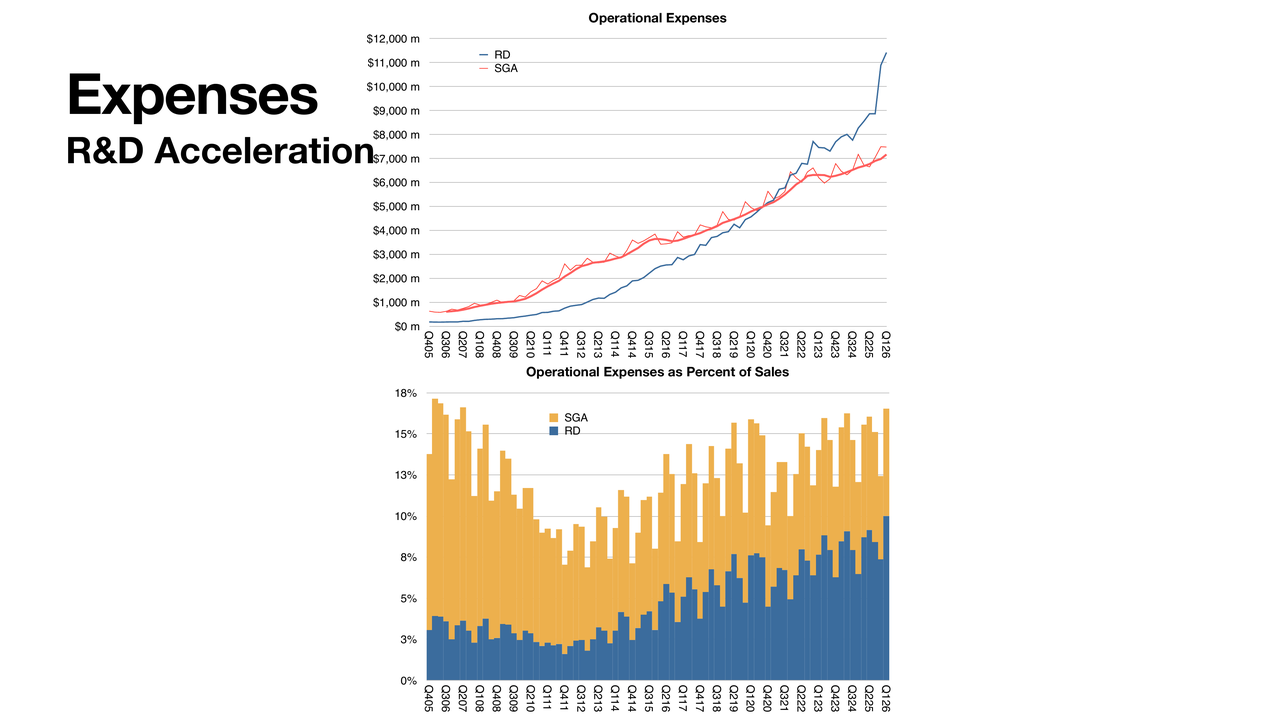
R&D Acceleration
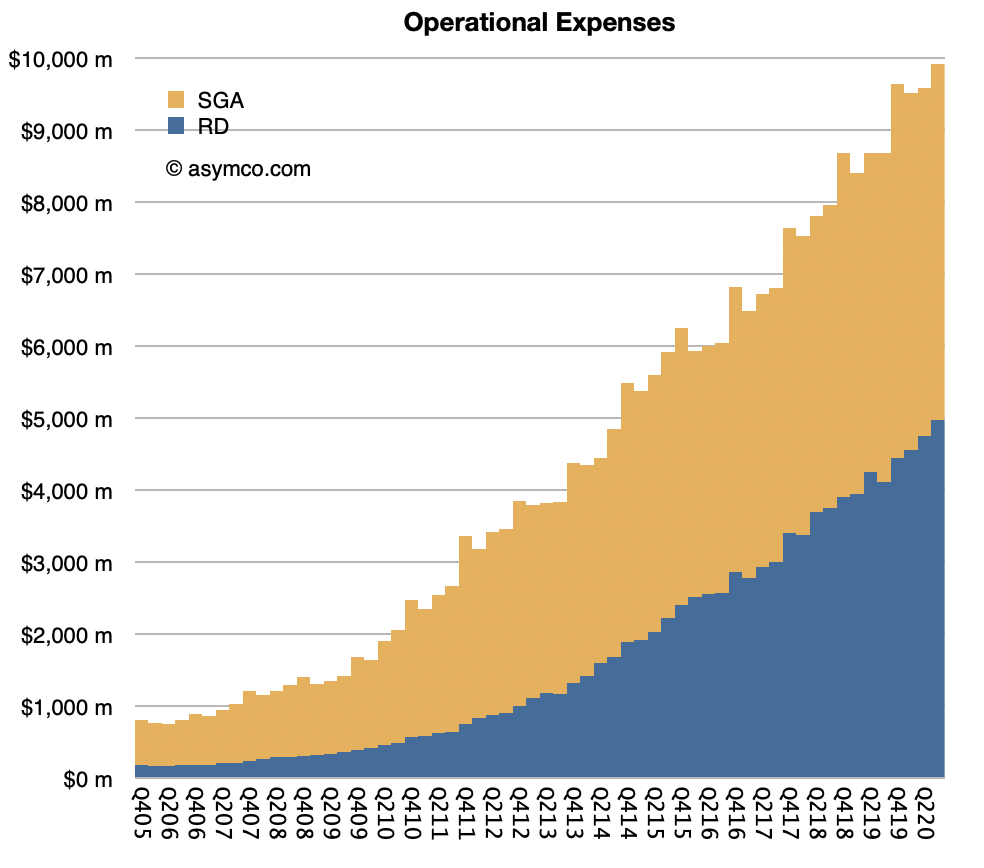
A little bit about the difference between gross and net— you have to take out the operational expenses, and this is what we have here. It's interesting what's happened. Obviously, you see R&D overtaking on the absolute basis. So R&D overtook SG&A already in 2021. And now it's just [going] almost vertical.
By reading a little bit the guidance, I think it's going to taper a bit into the next quarter. But what we see is a significant R&D increase, also as a percent of sales, which you're seeing below in the graph below, but in a stacked fashion. In that sense, the two of them together are now approaching— haven't yet reached— a percentage of sales that was in evidence around 2007 and 8, when the iPhone was just emerging. But you'll see back then, R&D was tiny, SG&A was huge as a percent of sales. So much so that R&D—this is during Steve Jobs era, R&D was like 2% of sales. And now it's approaching 8%, which is extraordinary. Because that's an engineering company that's doing breakthrough work.
And that's something that Apple's not recognized for doing. There's a negative side of spending a lot on R&D. The positive, though, is that Apple is doing a lot of fundamental research now. This isn't fixing products, this isn't updating OS. This is engineering that is really driving what might be considered breakthrough. And that's something— and I've said this to the media when interviewed about Ternus and the succession— I said, the new CEO will need to be— this is before he was announced— I said [the CEO] would need to be someone who is acceptable to engineering, because Apple is an engineering company today. Fundamentally, culturally, operationally, it's an engineering company, and it is being now led by an engineer.
Steve Jobs was not an engineer. And none of the other CEOs were engineers. Tim Cook was an operations manager. He was excellent in a fundamental part of the business. And that is acceptable to engineers, culturally speaking. But the thing is that John is an engineer's engineer. He understands the culture of engineering and will understand how to motivate and retain talent, as well as to allocate capital effectively, not wasting it on pipe dreams. Engineers have a tendency to try to chase dreams, by the way, so you got to be harsh sometimes to shut things down. So, keep an eye on the R&D— it's a great story.
However overdoing it can be a problem. There are downsides to an engineering-led company where, again, it turns into kind of an engineering welfare state. Engineers tend to get projects and do a lot of navel-gazing, which needs to be managed carefully.
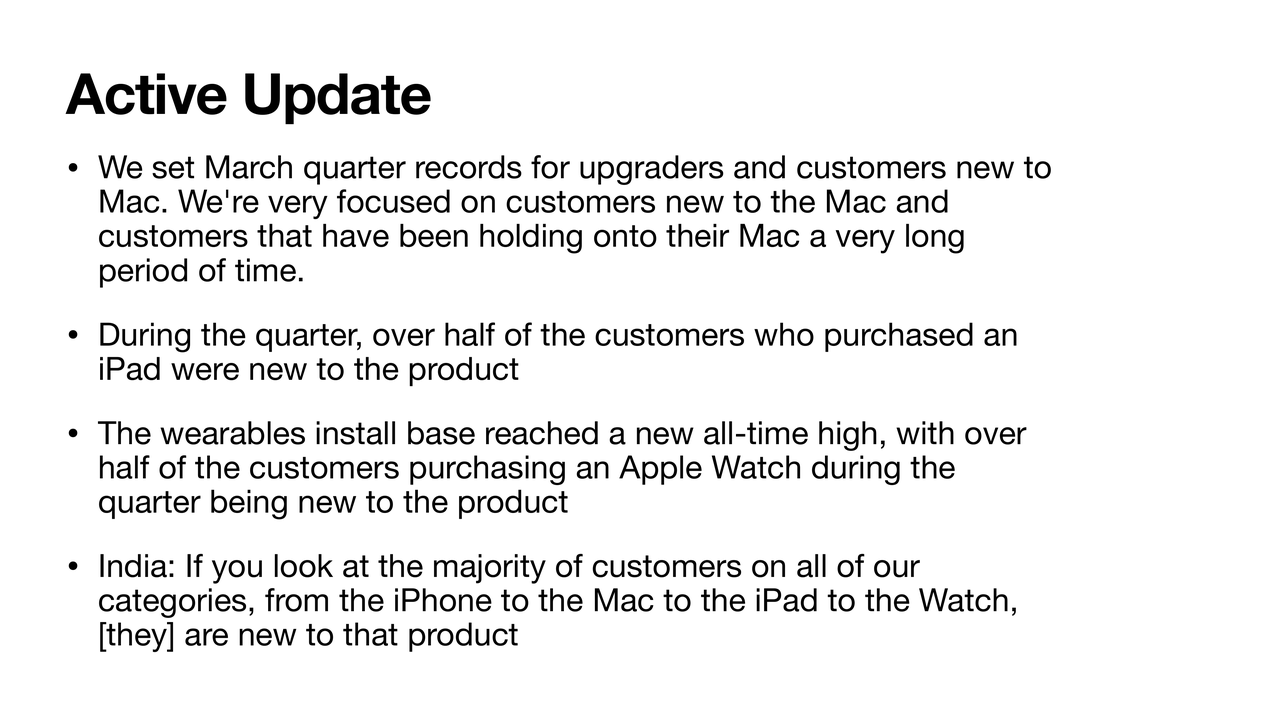
Now, let's just touch on ACTIVE. Active is the number of users, the fundamental measure of the value of the company. It's not counting iPhones. It's counting users, and these are the comments from management, just so we capture them. They come every quarter. Sometimes some products are mentioned, sometimes they're not.
So here's what we have exactly on the topic. Record upgraders and customers new to the Mac. They mentioned that Mac lifespans have been long, which is good and bad. They talk about the iPad, half the customers being— over half— new to the product. Same with the Apple Watch, this has been going on for a while.
So this is going to be important when we measure installed base, because if we see every quarter an estimate for the number of watches, or Macs, or iPads, you just take half of that and allocate it to the installed base, and the other half is growth of the installed base. So there's an interesting way to measure that, and I've been applying it. We're going to keep an eye on this.
And finally, there was a mention with respect to India during an answer to the question. The citation is that the iPhone, Mac, iPad, watch, all of these have a majority of customers that are new to the product in India. As you would expect, part of the developing market story. But this drum is still getting beaten. And that's a positive. Always want to look forward to that every quarter.
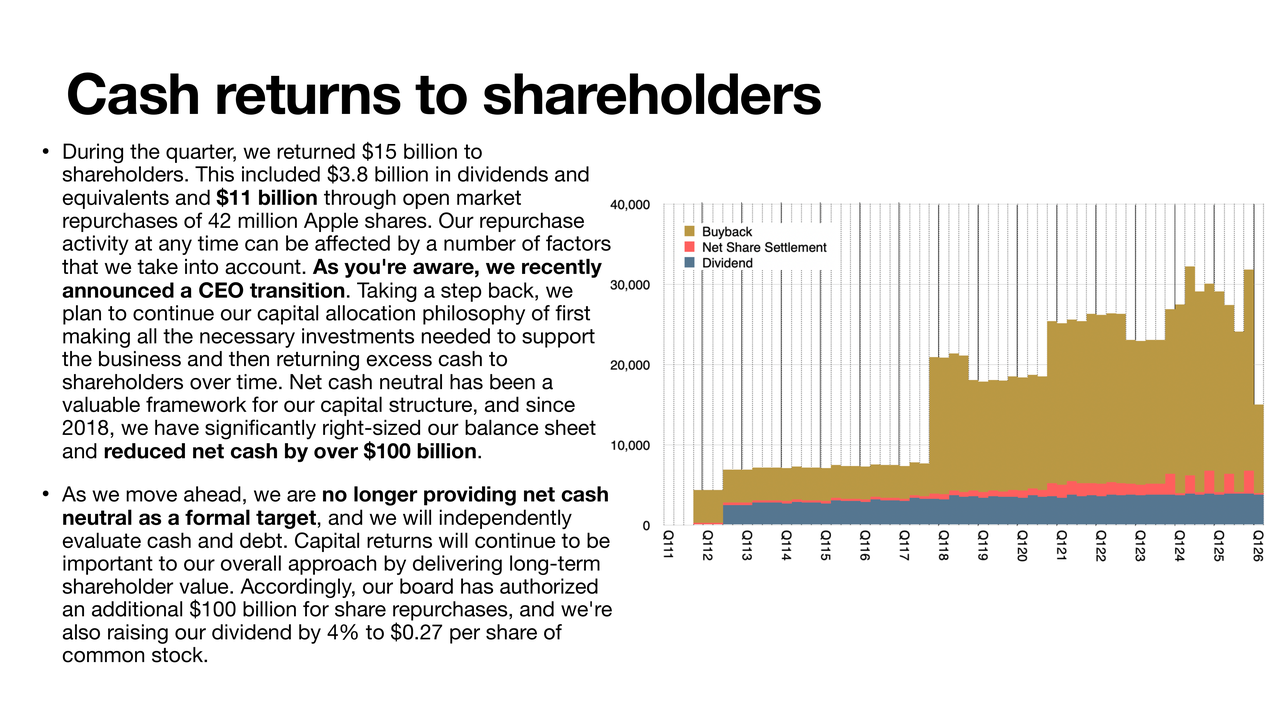
So let's jump in now to what I thought was the most unexpected comment during the call. I've pasted in here exact, verbatim the comments from the CFO. I need to point out a few things here, and I've highlighted these things in bold.
One is the dividend. The dividend number is 3.8. Last quarter was 3.9, so that's not a surprise. However, open market purchases were only $11 billion. Now, that is represented in the graph by the buyback, and that is this mustard color. And you'll notice it is extremely low. The previous quarter, we were over 25 on buyback, so we're less than half that. This is an anomaly. You'll see that it does not match the rest of the graph at all.
The blue area is dividends. The reddish area is net share repurchases, or settlements. And there's a pattern to both. Dividends has been growing in a predictable fashion, very steady. Buybacks have been somewhat steady, but up and down a little bit. During the last few periods, we've seen something unprecedented.
Now, you'll see that the 11 from last quarter was offset by a much higher number the previous quarter, but on balance, we're still down. And there's also these comments that say that they are abandoning the net cash neutral position. And I'm wondering if it's already started, because this $11 billion caught me by surprise.
I've highlighted that "our repurchase activity at any time can be affected by a number of factors that we take into account." So this was essentially explaining why sometimes there's a difference in the amount of purchases, right? And then in the middle of that commentary, he says, "as you're aware, we recently announced a CEO transition." Why does that comment fit in the middle of a paragraph, talking about the general theme?
I read this as it suggests that already the CEO choice is deciding how much to allocate to capital returns. And it appears— and again, I could be wrong— but it appears that John is probably against the idea of huge returns to shareholders in capital form. So keep an eye on this. This was, I found, very, very strange and out of character in a way. Very out of character of a Tim Cook presentation. I'm not judging it, I'm just pointing out that it isn't normal.
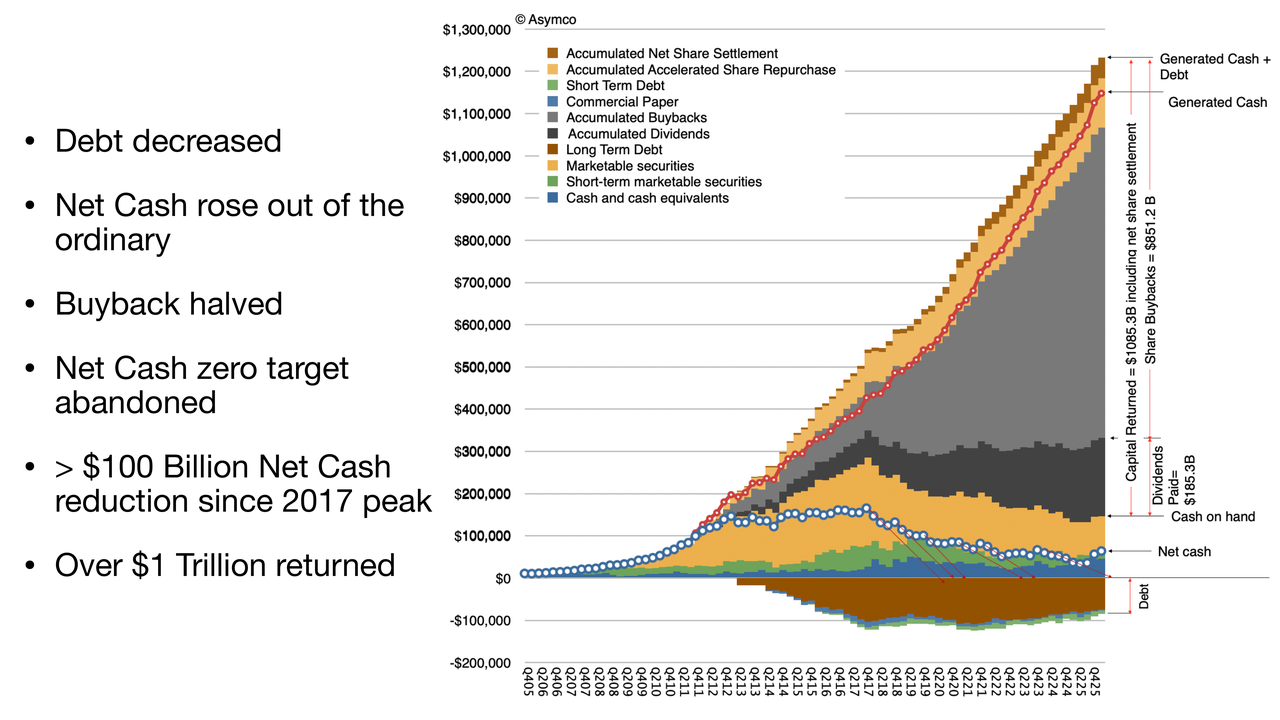
So here's the bottom line. This is the graph representing what's happening with the entire cash position and return of capital. The debt has decreased slightly, and it has been decreasing. And that's a good thing. As interest rates go up, you don't want to hold debt. A lot of that is fixed rate, but they're not taking on more. It seems like they're paying it down.
Net cash, which is the blue dotted line, has now been increasing two quarters in a row. Now, it's increased in the past, but never for long. It's had only one tick, during the holiday period. Here, where we're seeing two ticks— holiday and the quarter after.
Now, if you'll notice here, I'm going to try to zoom in. Those red lines represent what I would say were the trajectories to get to net cash zero. So that blue line, since they announced it, they kept missing the target. You would see that, another year goes by, and there's a notch up. Overall, the trend is down, but they haven't kept that path down all the way to zero. And that is now completely abandoned.
Again, we'll have to figure out why. The buyback, as I mentioned, halved— at least more than halved— to 11. Net cash zero abandoned, $100 billion net cash reduction. You'll see that this blue dot line has gone down by about half. It was down even further than that until it came back a bit. So that is going from about $160 billion net cash to the current $62 billion, which is why we get to 100 reduction. And $1 trillion overall return, which is, again, something they mentioned. In fact, they're at $1.085 trillion. And still $100 billion will be allocated further. Whether they actually spend it is another matter, but that's been approved.
So now— is this good news or bad news? I don't think it matters. I think at the end of the day, the value of the company doesn't change because of this. The value might be captured in the share price, or it might be captured as a percentage of the company that has been increasing.
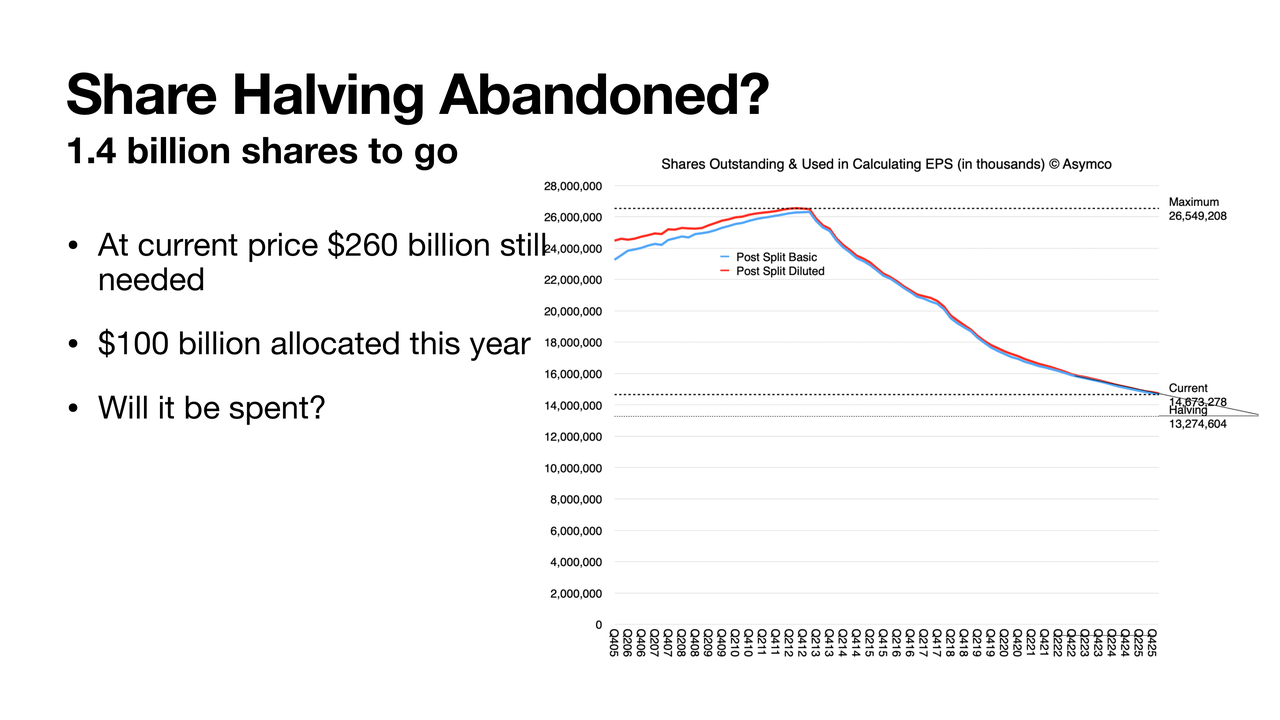
In fact, let me just pop into the next slide. What does this mean? Are we never going to reach what I call the halving? Well, we were at the maximum 26.5 billion shares. And now we've reduced that to about 14.6. Half would be 13.2. So we're still going down. But there's 1.4 billion shares to go before it's half of what the max was. Now, this is an arbitrary figure. I just thought it was an interesting target to have. And as you can see, it's getting asymptotic as the price goes up. It should be harder and harder to get there. But we have $100 billion allocated. $260 billion at the current share price would need to be spent to get to half. But probably we're not going to get there. I really don't— if I were a betting man, I would say we're probably going to see this taper.
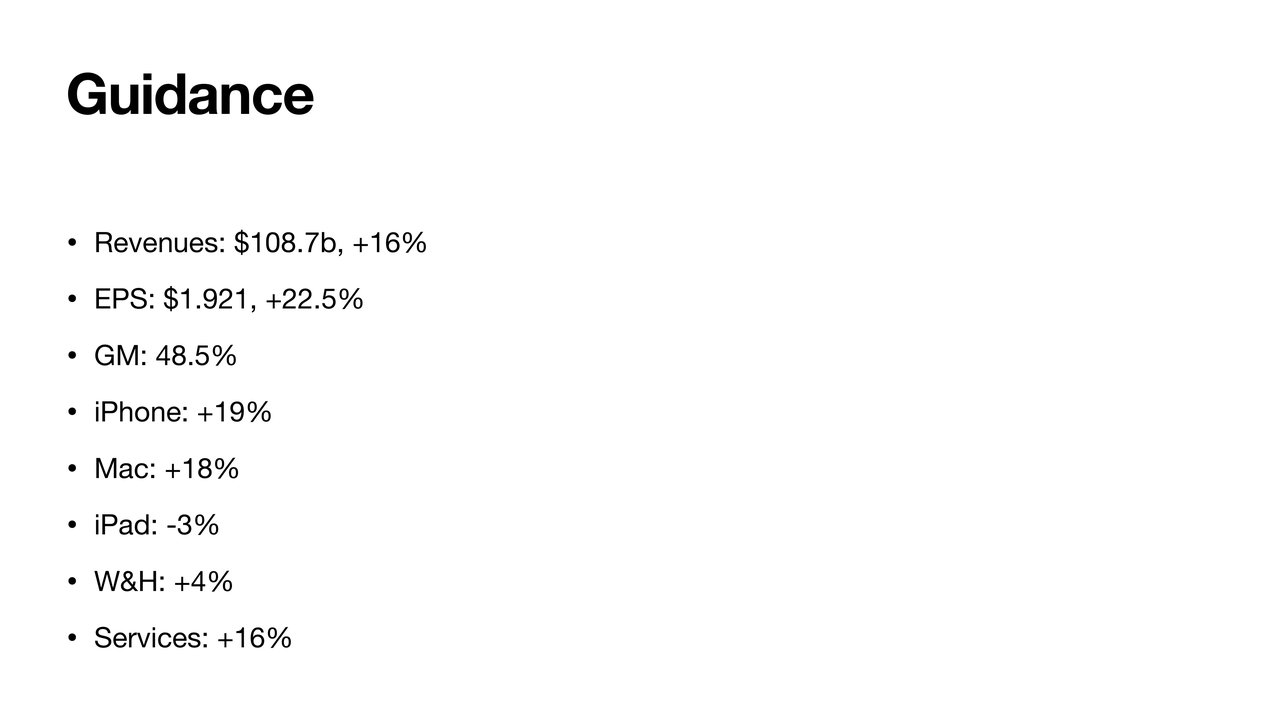
Let's look a little bit at guidance. This is based on what management already communicated. So if you put in the numbers they gave us, you will get revenue growth of 16%, coming at about— well, they guided 14 to 17, so I'm estimating 16 conservatively right now. That gets you to $108.7 billion. If you put in the other numbers— the margin, the OI&E and the tax— and do something about this share reduction. (We're still going to probably see a share reduction.) We're going to look at EPS 1.92. Which is another 22% growth. This is what we had last quarter as well.
I'm putting gross margin at the top of the guidance. [Last quarter] they went over. They guided high, and even so they went over, so I'm going to assume they're going to still hit towards the upper end of the range. I'm exactly at the upper end of that range.
If those things are true, the iPhone almost necessarily has to grow about 19%. Now, here, I'm dialing the Mac way up to 18% growth, because I do think they're going to get a lot more Mac Neos into customers' hands. Now, that's a lower price point, but it will drive sales. So yeah, I could be a little bit high on this. If I am, then iPhone needs to go a little bit higher because I still think they're going to get the revenue there.
They did warn that iPad is facing a tough comp, so I'm putting iPad down 3%. Wearables and home, 4%. It was 5% last time, so maybe consistency there. And Services, just the same as before, 16%, could come in a little bit less. But if it does, again, it's going to be put into something else like the iPhone.
So overall revenue growth, I think 16% is very much being telegraphed. And as I always say, they already have April on their books. They're communicating exactly at the end of April. They're not going to lie to us and withhold data from April. They know about a third [of the quarter] already, so that's why this guidance is so useful.
And, as you saw with my error analysis, nowadays, people's estimates are very close. There's a lot of consistency. We're not off more than a couple percentage from each other. That's just because they're so accurate on their guidance.
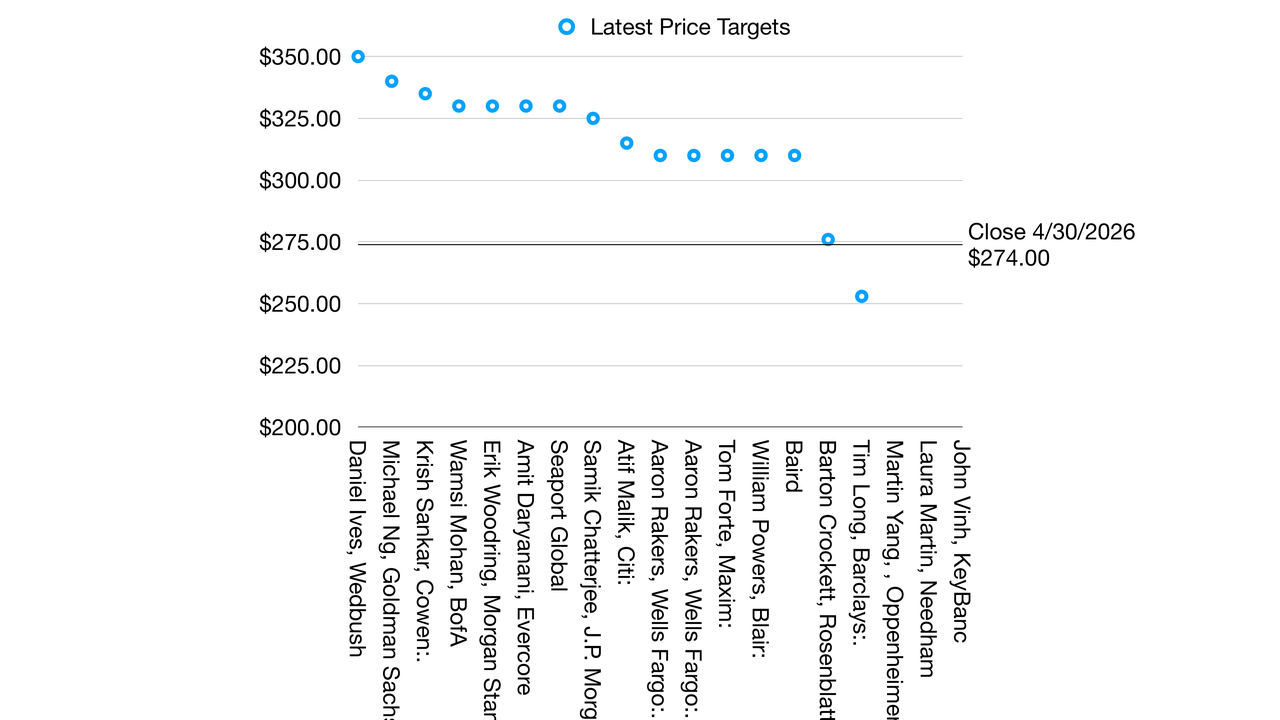
And speaking of analysts, one more graph. This is just some of the latest price targets. I'm just trying to bring everything together that came out today. This is all very brand new. A lot of targets moved up. Not that it's all that important, but people are getting more and more excited. Almost all the targets from anybody who has a positive— effectively a buy rating— is now above $310 as a target. There's two who are negative, that are at 270 and below. This is Barclays and Rosenblatt. And then there's a few which have no ratings. So they're typically neutral.
But overall, all these numbers are higher than they used to be. Now, again, I don't use that very much, but it's worth keeping an eye on things just to get a sense of how the sentiment is out there. And it looks like the stock is responding positively today. Not by much— 3% or so, last I checked. But that's the story today.
So given that, this is my first take on the quarter. Love to take questions.
-- End of Presentation --
Editor's Note: This presentation is made available to non-subscribers for a limited time. Subscribe to Asymco Oneforfull access to this and other content.
Today marks the 16th anniversary of when Apple released the first-generation iPad. After Steve Jobs announced the iPad on January 27, 2010, it launched a few months later on April 3, 2010.
The iPad was the first device that Apple released with a custom-designed chip, the Apple A4.
The concept of a tablet device like the iPad actually predated the iPhone, and Apple had a prototype project in the works in 2004. Then-Apple CEO Steve Jobs wanted to prioritize the iPhone, so the iPad was put on hold until after the iPhone was established.
Apple priced the iPad at $499, and Jobs called it a "magical and revolutionary device at an unbelievable price." Like the iPhone, the iPad dominated the tablet space, and it still continues to do so today. Apple sold a million iPads in the first month, and while competitors like Microsoft and Samsung quickly came out with competing tablets of their own, the iPad has no match.
Apple has led the global tablet market for over a decade and no competitor comes close to matching its tablet market share. As of the fourth quarter of 2025, Apple's market share was 44.9 percent, with Samsung the next closest at 14.7 percent.
Apple has expanded its iPad lineup over the years, and we now have multiple sizes at multiple price points.
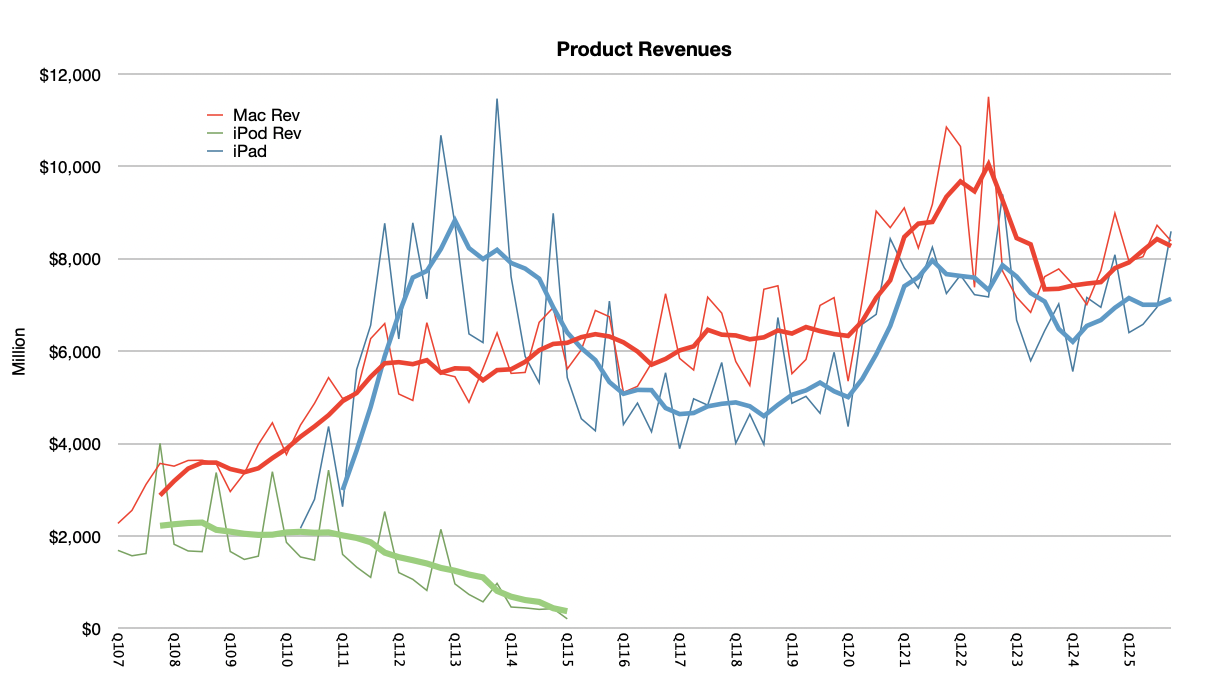
The graph above shows the iPad revenues compared to the Mac and the iPod. I included the iPod since the iPad was originally dismissed as a "big screen iPod touch". On the other hand, it was also seen as a PC or Mac substitute. To many, including Alan Kay, the tablet form factor makes much more sense than the PC form factor. It's more approachable, more intuitive and certainly smaller and more portable. As the graph shows, quickly after launch, the iPad overtook sales of the Mac.
What iPad has done is carved a niche that is resilient. After 16 years, I reckon about 910 million have been sold with about 70 million more sold each year. The product has a particularly long lifespan in use and may continue to be used for as long as 10 years. Total lifetime revenuel has been over $403 billion with about $29 billion last year. The total user base is between 400 and 450 million users. In the U.S., the iPad is highly prevalent, with over 40% of Americans owning an iPad in 2024.
Neither killer nor killed, the iPad is just a great "in between" product with plenty of value. I have no doubt that it will still be popular 16 years from now.
"I sold it too soon. But, I bought it even sooner, so," Buffett told CNBC's Becky Quick in an interview Tuesday on "Squawk Box" .
Apple remains Berkshire Hathaway's largest holding even after the conglomerate trimmed its stake to $61.96 billion at the end of last year, according to InsiderScore.
However, Buffett said Tuesday that he would continue to add to the position if it gets cheaper. He said the iPhone maker is not yet attractive even after falling more than 14% off its recent high, and dropping more than 6% this month. That's amid turmoil in the broader market, with both the Dow Jones Industrial Average and the Nasdaq Composite in a correction.
"I'm very happy to have it be our largest holding," Buffett said. "I was not happy to have it be as large as almost everything else combined."
"It's not impossible that Apple would get to a price, we would buy a lot of it," he added. "But not in this market."
Buffett said the firm has made more than $100 billion in the stock pretax, and was favorable in his comments regarding Tim Cook's leadership of the firm over Steve Jobs.
"Tim Cook has done better with the hand. Steve Jobs — he couldn't have done what Steve Jobs did — but Steve Jobs handed him a hand that Steve would not have done as well," Buffett said.
"Tim was a fantastic manager, and he's a good guy, and somehow he gets along with everybody in the world," he added. "That's a technique I wouldn't have, for example, certainly my partner, Charlie Munger, wouldn't have had it."
NB: Warren Buffett said he sold Apple stock too soon but clarified he has no actual regrets. Buffett said it is better than any business Berkshire owns outright including its railroad, which is worth more in dollar terms but earns nowhere near the return on capital that Apple does. He also said his railroad might last longer than Apple.
He said if Apple ever got cheap enough, he would buy a lot more of it. He owned a lot more of it priced a lot lower than what he would have to buy it back at. Complete nonsense.
Also Warren Buffett:
Quote: "Our favorite holding period is forever". Action: Trade Apple to realize gain.
Quote: "Price is what you pay, value is what you get". Action: Trade Apple to make $100 billion pretax, mention that price determines decision.
Quote: "At a healthy business, cash is sometimes thought of as something to be minimized as an unproductive asset that acts as a drag on such markers as return on equity" Action: Sell Apple and other equities and move $300 billion into unproductive cash.
Quote: "Investors, of course, can, by their own behavior, make stock ownership highly risky. And many do. Active trading, attempts to ‘time’ market movements..." Action: time decision to trade Apple for cash on the basis of price, tax and market conditions.
Quote: Apple is "probably the best business I know in the world," "we like to own businesses not stocks". Action: Convert Apple ownership into cash.
Quote: "I'd love to own 100 percent" of Apple. Action: Sell 60% of Apple holdings.
Quote: "I don't think of Apple as a stock. I think of it as our third business" Action: Sell Apple, move into unproductive asset cash.
Quote: "I sold Apple too soon". Action: Also say that you don't regret it.
Actions speak louder than words. The results will be felt by his shareholders.
Are Apple and Google competitors or are they partners?
Prior to the launch of the Android operating system, Apple and Google collaborated on many projects. Google Search was predominant on Apple products including the (at the time) new iPhone. The iPhone also launched with support for Gmail and had native Google Maps and even YouTube. Google was a cornerstone supplier for the new smartphone.
After the launch of Android only a year later, the relationship changed. The two companies came to be viewed as mortal enemies. The perception that Android was disruptive to Apple—insofar as it undercut the pricing power of the new touch-based user experience—was universal. The "zero price" of Android and its licensing by all other phone makers suggested a competitive collapse was imminent for the fledgling iPhone. Android phones were far cheaper and "good enough." If not immediately, then with the resources of all phone makers and Google itself, Android would surely soon overtake the iPhone in performance along all dimensions. It took a great deal of courage to argue otherwise.
But, over time, the notion that the iPhone would continue to exist became more widely held. Holding on to a "premium" positioning, iPhone seemed to be have pulled a rabbit out of a hat, perhaps because of Steve Jobs' reality distortion field or because of magical marketing. Nonetheless, doubts over long-term growth persisted.
Having survived Android, Apple was still seen as vulnerable to a multitude of Google initiatives including Chrome and Chromebooks, a range of Google Pixel phones (enabled by the acquisition of Motorola and HTC.) The entry of Google wearables (enabled by the acquisition of Fitbit), Glasses, the Play Store, YouTube content, Google productivity apps, Google cloud, Google TV, Nest, Google Assistant and numerous other services were all cited as nails in the iPhone coffin. This is all before the age of Crypto a new generation of AIs came into fashion.
Throughout this period the iPhone continued to increase its audience, growing its base of users not only from smartphone non-users but also from so-called "switchers", that is, those who moved from Android to iOS. Apple has benefitted from this net positive switching for at least five years now as most of its addressable market has already adopted the smartphone. There are about 1.2 billion iPhone users and it's far more likely that a new iPhone user today arrives from the 3.5 billion Android users than from the 3.2 billion people who don't yet have any smartphone. That is because those who don't yet have a smartphone today are also likely to not yet have access to electricity, cellular networks or money.
Indeed, it is Android that seems to be in a precarious position. The ecosystem is bleeding not just high-end users but also from fragmentation. Chinese OEMs in particular deliver their own experiences and code bases, eschewing Google services altogether. Large OEMs such as Samsung are seeking to differentiate with their own experiences and ecosystems and accessories and chafe against Google's hardware offerings. Upgrade rates to new Android versions are poor. Support of hardware beyond a few years is lacking. But, most fundamentally, Google has not developed a business model that directly fuels development of Android.
Put simply, Android is not a profitable product. It's not designed to create revenues. It's designed to reduce costs.
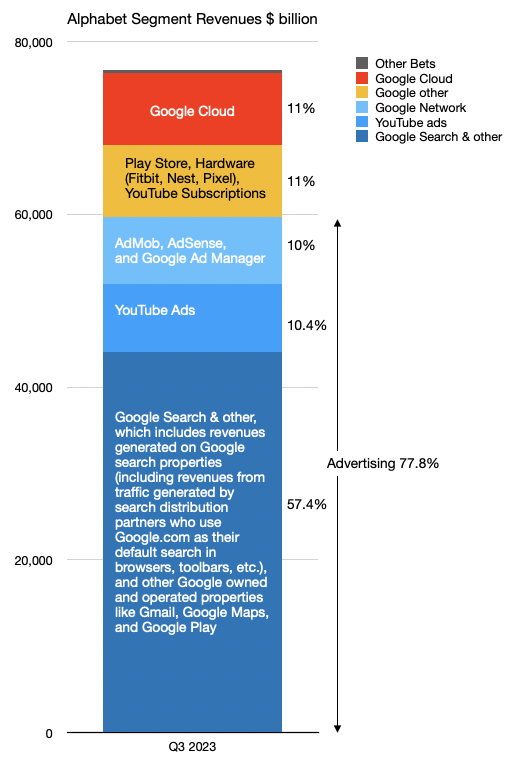
To understand this, we have to understand Google's business. It's not very complicated. Google's revenues in the last quarter are segmented as follows:
The colors above indicate the major categories. Blues are Advertising, yellow is "Other" and red is Google Cloud. Other Bets, consisting of research projects, is a 0.4% rounding error. Apart from Search which is about 60%, each major category is about 10%. Advertising as a business model is about 78%.
To Alphabet's credit, Advertising as a business model has been reduced from 94% a few years ago. Much of that credit goes to Cloud which is a B2B business and has completely different resources, processes and priorities than Search. The "one trick pony" label is less applicable to Google today.
Search however, and the ancillary properties, are still, by far, the largest sources of revenues and profit. Note that Android itself is missing from this mix apart from Play Store which is a direct Android extension. Play does contribute somewhat as part of "Other" but the OS itself is an enabler across all these categories.
While not directly producing revenues, what Android does is perhaps even more important. It helps reduce the amount Google has to pay to access its customers. Think of Search as a system which takes queries in and puts results out. These results are what advertisers pay for and the queries are what Google pays for. The output depends on the input. That input is harvested from many users. Access to those users is not free. The cost can be paid by building access directly (Android) or by paying for access to someone else's property (Apple, Windows, or Firefox). In old-school business terminology this is called distribution.
Distribution is often ignored or considered a superfluous "middleman" to be bypassed. But distribution is foundational to any business. It is, effectively, other people, outside your company, helping you sell your product because they have access to the customers. They get paid for that access, often with a percent of sales. Stores are distribution. Wholesalers are distribution. Resellers are distribution. Without distribution scale cannot happen. Distributors help both producers and consumers by creating access.
Access is also provided by what we call infrastructure. Just like you can't travel by car from your house to your destination without roads, all access to products and services is effectively infrastructure. If you own the infrastructure then you have to pay to build it and maintain it. If you don't own it you have to pay to use it. All infrastructure has value and all infrastructure has costs.
This all makes more sense when recalling the historic birth of Android. At the time (2006 to 2008) the worry for Google was that Microsoft's mobile operating system (Windows Mobile née Windows CE) would be licensed as was Windows. That is to say that all phone OEMs would take a license for a nominal fee and build Windows Mobile phones. Microsoft would thus dominate the mobile computing market the way it dominated the PC market (with market share above 95%). Microsoft would then ensure that Bing search was the default on all devices running Windows and Windows Mobile, thus blocking access to what was expected to be the next 3 billion users while capturing all search ad dollars ad infinitum.
If Windows Mobile were to dominate, Google would be denied distribution, at any price. It would thus be relegated to, at best, 10% market share of mobile search. This would be an existential crisis.
In this setting, Apple was an ally for Google. Apple was not a search engine provider and was very welcoming of Google search on a nascent Safari browser. Whereas Explorer would block Google search, Safari would offer default placement. Not for free, but for a reasonable cost. Google was a "go-to-market" partner for Apple and it was a symbiotic relationship.
However, the expectation of Google at the time was that Apple would be no more successful with iPhone than it was with the Mac: A fringe of "creative" or "fanboy" quirky oddballs. This was not just Google's expectation. It was everyone's expectation.
Android was built to counter a Microsoft mobile OS monopoly with a "zero cost" option vs. Microsoft's end-user-license model. Microsoft made money selling software. Both system software (Windows) and application software (Office.) Google would give away system software (Android) and services (Gmail and Docs) but make money on advertising.
A genius move. Phone OEMs would much rather pay zero of the OS on their phones than for the non-zero Windows Mobile license. [On a $200 retail cost phone (and thus $90 bill of materials) a $8 OS license is a huge cost.] Google's Android did indeed block Windows Mobile from getting a foothold in the post-PC era.
But it did so by taking some short cuts. Android itself was an acquisition in 2005 (for $50 million, with a keyboard interface) and, in response to the iPhone, a new touch user interface was developed. It so happened that this interface copied as closely iOS as Windows had copied the original Mac. This perceived theft was such an affront to Steve Jobs that he declared war on Google.
It was important to ask (as few did) why did Google need to develop an OS, only to give it away. Was its business that robust if it needed to expend enormous energy and capital to build an enabler? The answer is, of course, distribution.
Google was initially not paying for distribution as most people just typed "google.com" into their browsers. As the URL field became a search field, Google could still expect PC users to make Google.com their search bookmark, one click away.
But on mobile devices, the friction of the constrained interface meant that defaults mattered. Mobile was going to require new distribution economics. Devices were going to be in the hands of many more people, who, since they did not have full-size keyboards, would type less and who would interact in new (and very succinct) ways. One click away was one click too far.
With Android (and Chrome) Google set defaults for its services across the platform. If Android was the OS then Chrome would be the default. If Chrome was the default, then Google Search would be the default. For these Android-sourced queries, Google would not pay for distribution. Or, more precisely, would only pay to build and keep Android. Thus the more Android there was, the cheaper it was to obtain search queries for Google. Google had built its own highways: it owned the infrastructure that connected users to its services. These roads were for Android users. And what about iOS users?
Over a 15 year period the smartphone went from essentially zero to 5 billion users. It became so important to those 5 billion people that they keep it with them every waking moment, use it 100 times for a total of 5 hours each day. That adds up to 182,500,000,000,000 interactions a year and, as a result, it has changed behavior, politics and humanity itself.
Throughout this period, the relationship between Google and Apple changed. From being allies, to mortal enemies to, as we shall see, partners. We have to understand this new relationship that has emerged and its consequences.
The next post will explore the relationship in detail using the lens of the deal structure that exists. A deal which is not public and largely unexamined.
The Apple product line-up for 2023 is almost completely decided. This is not conjecture but simply an observation of the lead times for developing the types of products that Apple offers. The integration of hardware, software and services, often cited as the key to Apple's sustainable competitive advantage, has a great cost: the time required to develop in an integrated fashion is far longer than the time required to develop in a modular fashion.
2.5 years is not a long time. The development process on truly new products could take 4 to 5 years. Apple Silicon, new Operating Systems and new services could all take longer than 2.5 years. The products we just saw launch this year were planned and engineered at least 2 years ago. The more integrated, the more time is needed. Wearables, AI/ML and process engineering are additional examples of long arcs of development needed to reach products.
This does not mean we can predict what these products will be. We don't have visibility to the process but Apple management does and they will make decisions now on adjacent dependencies in the business. For example, visible efforts in planning the use of cash, the carbon offsetting, capital expenditures and R&D are all synchronized to the roadmap and hints may be read into this data.
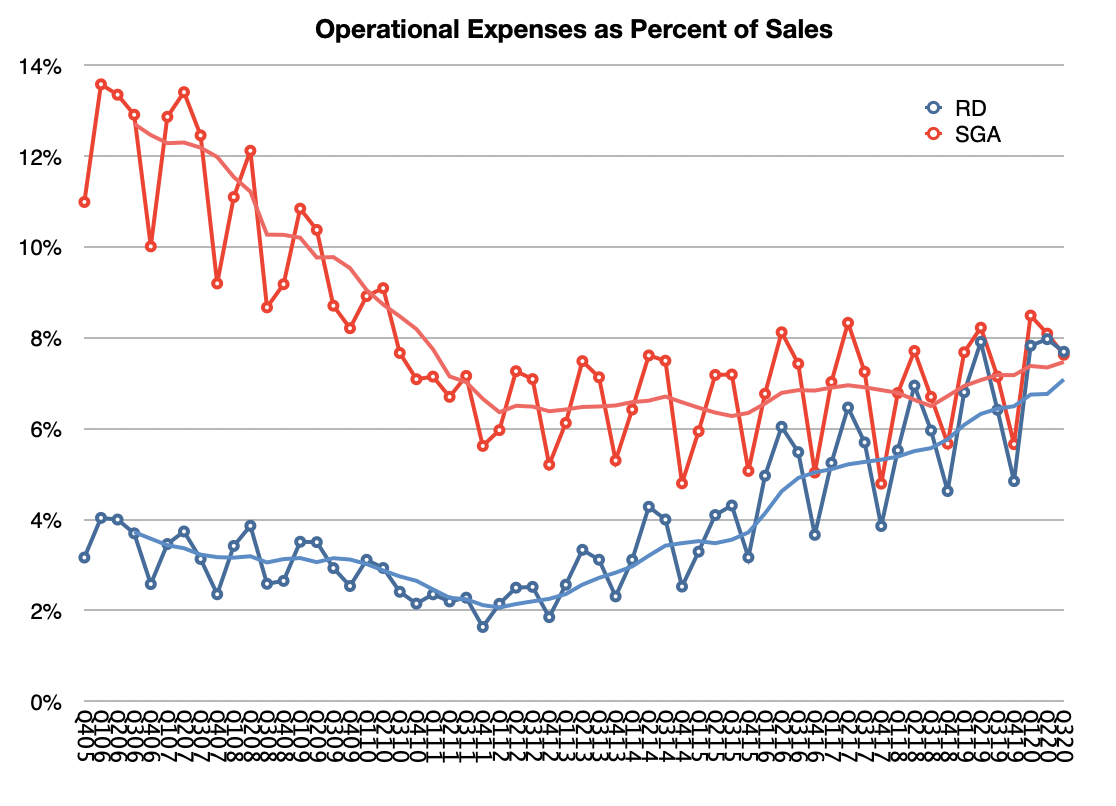
The biggest hints are the R&D spending and the company's capital return program. Combined they show a confidence in the roadmap that is hard to overestimate. First, R&D is reaching new highs of about 7% of sales (on a trailing 12 months' basis, see graph below). This is almost the same as the spending on SG&A which has declined as a percent of sales from above 12% pre-iPhone.
Of course sales have increased significantly over the time shown in the graph below and the absolute spending is shown the following graph. R&D spending is over $5 billion/quarter or about $20 billion/yr. Some of the results of this will be seen in 2023 or beyond.
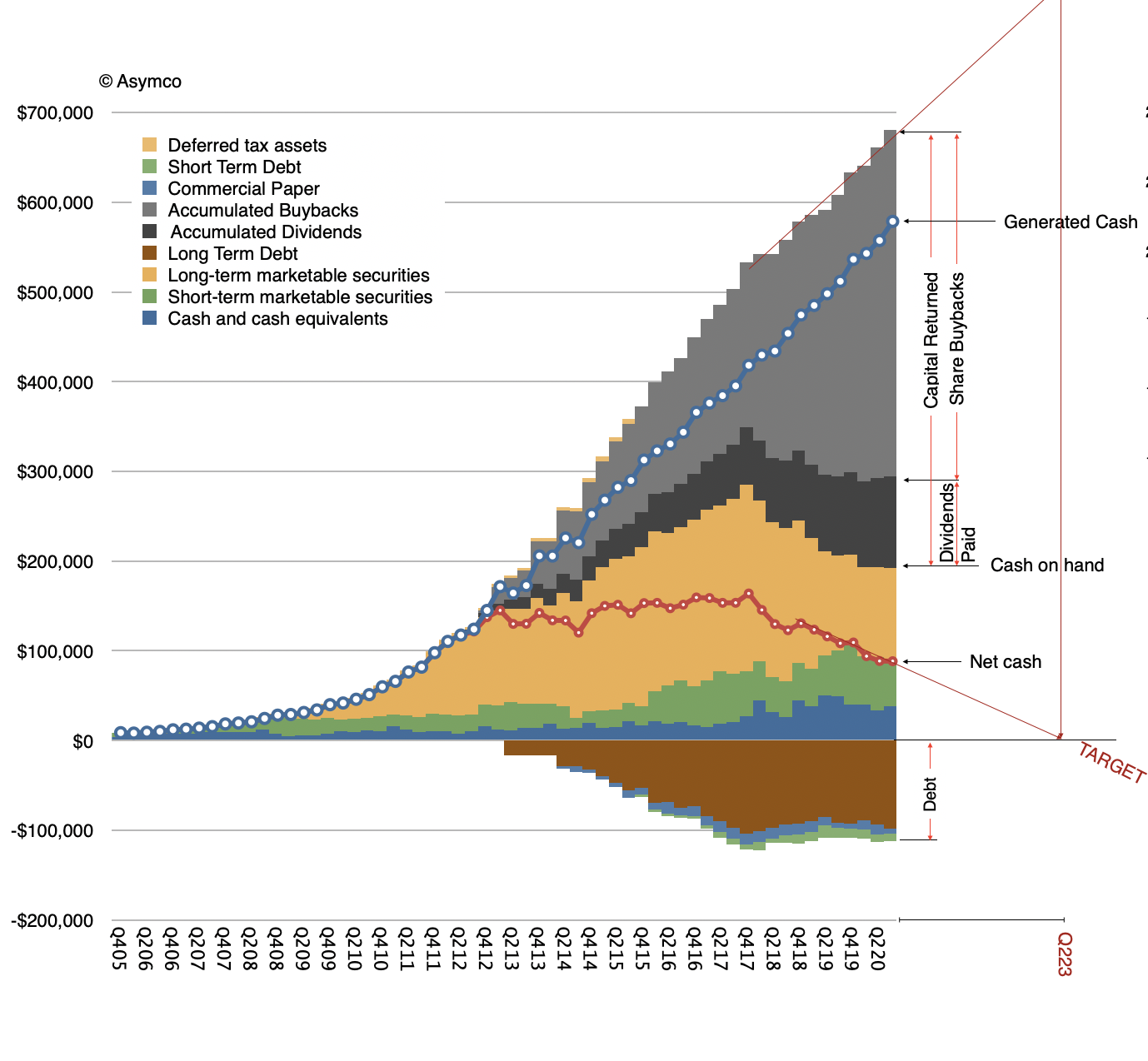
Next, capital returns. The company is returning almost all the cash it generates and is reducing its cash balance. It has returned about half a trillion dollars to date. Dividends paid has reached $100 billion and share buybacks about $400 billion. This is the largest capital return in US history.
The company has declared its intention to reduce net cash to zero. This means it will still have substantial cash due to loans in the form of bonds but no "excess" cash will be held by the company. This is in contrast to the strategy under Steve Jobs where he sought to keep as much cash on hand as possible due to the need to weather potential storms, Tim Cook's Apple is being very "casual" about cash.
Steve Jobs had his reasons for hoarding cash. The company had been through periods of existential crisis. The absence of cash jeopardized its independence and it was something he vowed never to happen again.
However if that strategy would be maintained to this day, as the graph shows, the company would have cash of nearly $700 billion today. It would make Apple the world's largest hedge fund, by far. Second only to a very few sovereign funds. Given a conservative cash preservation mandate it also means that that capital would largely go unrewarded because the return on it would have been minimal, negligible. Not to mention also the target it would paint on the company's balance sheet.
So given the trajectory in net cash being so consistent, it's probable that the goal of net zero will be reached mid 2023.
That leaves the question of what will happen at that time?
The answer is nothing. Nothing will happen. The capital return programs will probably be ended and additional cash generation will be paid as dividends going forward. That's it.
Rather than suggesting a change, the capital return program (and the R&D program) suggest a lack of change, consistency. The company management is anticipating a steady capital generation rate, a steady product roadmap (with predictable growth) and a steady customer base (with predictable loyalty).
This future for Apple in 2023 may seem boring. But that's exactly the plan. This is a plan that the company management has been making for a long time and has been executing for a long time. The plan is to be boring on the business side but exciting on the customer product side.
Consistency has been the characteristic trait of the Tim Cook era. It is a smoothing of seasonality with services. It is the clockwork delivery of product updates, regardless of macro and externalities. It is a growth in user base consistent for a decade.
It is perhaps because more people believe that consistency is the future that we have Apple's P/E ratio now in-line with its peers. Paradoxically, being boring is what makes Apple shares so exciting today.
When the iPhone launched, Steve Jobs introduced it as being three products in one:
A wide-screen iPod
A phone
A breakthrough internet communicator
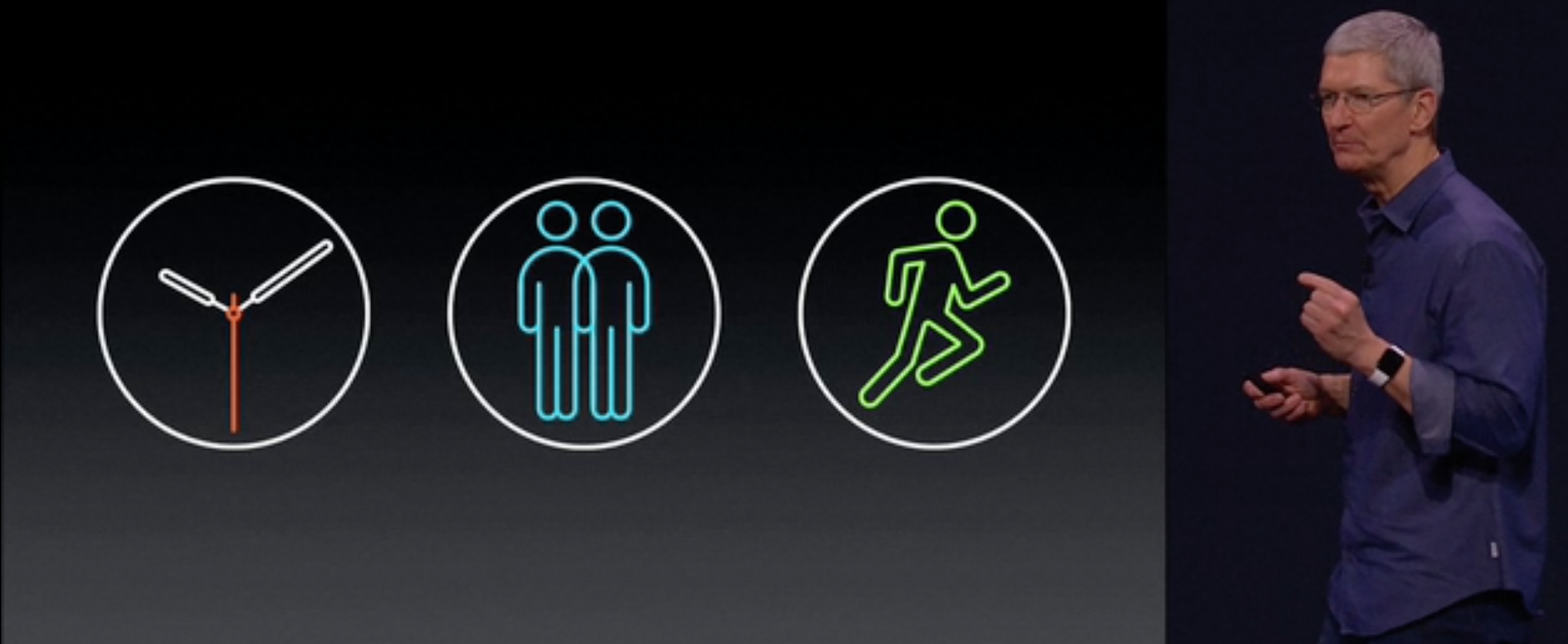
When the Apple Watch launched, Tim Cook introduced it as being three things:
A precise timepiece
A new, intimate way to communicate
A comprehensive health and fitness device.
As in the Revolutionary User Interface story, the symmetry in approach to the launch is telling, but what I want to note is that the three things which the iPhone was defined as being are no longer things that it is most used for.
Yes, the iPhone is still a wide-screen iPod which gets plenty of use but I don't think anyone thinks that is a defining feature. It's also a phone, but the Phone is just an app which, for me at least, is not frequently used. I communicate with my iPhone but the go-to app is iMessage or FaceTime or Skype or maybe Email or Twitter. Phone is something I use so rarely that the interface sometimes baffles me. And yes, it's an Internet appliance. Browsing is something I do quite a bit but many of the browsing jobs-to-be-done are done better by apps. News, shopping Facebook and maps are "things which were once done in a browser."
So I wonder whether the tentpole product-defining anchors used to introduce the Apple Watch will be faintly amusing a few years from now.
Of course, the reason iPhone outgrew its tentpoles is because of the app economy. 1.3 million apps does that to a product. When it becomes a platform a product invites collaboration on the problem of innovation. Collaborative innovation explodes the opportunity to discover new needs and uses. How, when and why people use the product changes beyond anyone's imagination.
But this does not mean that the tentpoles used at launch are in any way in error. They are necessary to explain the value of a new category. The audience can't be told "wait and see all the cool stuff you'll be able to do with it". They need to be told why it's useful today. They speak in the language the audience can understand today. Steve Jobs could not talk in the language of apps and services in 2007. The unforeseen became the inevitable.
Tentpoles therefore don't define the product but do provide the starting blocks from which the initial buyers make a cognition leap. And once they're off, the others will know where to go.
Catalin Stelian Andrei, Editor of The Day, INTERNET PROTV asked me twenty questions:
1. What phone do you have in your pocket right now? Why that model?
I carry the iPhone 5. The last iPhone I bought was an iPhone 5C which I gave to a family member.
2. Apple is going to launch, form all we know, an iPhone with a bigger screen, long after their market rivals. Is Apple one step behind, being forced to take this road in the fight with Android and Windows Phone devices? Because many smartphone users were hoping that an big screen iPhone, a redesigned model, will be lauched long time ago, and that didn’t happen.
Making bigger phones is easier than making smaller phones. First because miniaturization has always been the most difficult engineering challenge, and second, because a smaller phone has a smaller battery making efficiency much more important. The larger the phone, the simpler it is. The third reason smaller is more valuable is that it’s easier to carry and use. The largest phones cannot be put in pockets and cannot be used with one hand. In the history of consumer, electronics size reduction has been the most consistent measure of performance, and the most rewarding. Usually the most exceptional reductions in dimensions create the highest price and profit bands. There have been niches for larger portable devices but they are consistently a small part of the overall market. If Apple were to introduce a larger device I hope they will be able to solve usability problems and make the category attractive to a larger audience.
3. What do you expect from the new iPhone 6?
I expect it to run the latest version of iOS and, with the new apps developers will ship, that should make the most impact in people’s lives. I imagine health maintenance and home automation will become valuable new franchises. Of course iOS 8 will also run on older iPhones, but I suspect the newest iPhone will somehow run the new software better and have smoother integration with services.
4. What’s the “not to do” lesson that Apple needs to learn for the now iPhone from it’s own past experience or their competitors?
The biggest challenge is to move rapidly with scale. The company has managed to grow from zero phones a year to hundreds of millions. That’s great but it’s still frustrating to wait one year for major improvements. The “cycle time” of innovation for Apple remains one year. I wish it could be faster but perhaps this is also too fast for some. In some services like maps and iCloud and iWork, which are independent of hardware (mostly,) speed is of the essence.
5. The iPhone is the most expensive smartphone on the market right now. In Romania, it certainly is. But where does Apple gains it’s most money from, selling products to users or selling services, like iTunes, App Store? And having that in mind, what will be their next step: better – breakthrough products or bigger, more complete services?
The answer to where a company “gets its profits” is best answered by asking where a buyer “gets his value” from the product. For instance you might answer the question of where a car company gets its value by saying that it’s from making people be in more than one place in a day. So the “differentiation” of a car is in answering the question slightly differently. If it’s hard to see a difference to this answer between cars then it’s hard for any one company to make a profit. For a company like Apple, we need to ask what its users value about the experience and why they are willing to pay for that. My hypothesis is that the brand's value is in making life a little bit easier. That’s what Apple competes on. Of course, some people are not willing to pay to have an easier life and some even want to make their lives more complicated so Apple’s proposal to make life easier, for a price, is not accepted by everybody—which is ok by them. But for many, paying for comfort, productivity and ease of mind is worth quite a bit. The reason Apple is able to gain a premium over the competition is that this value proposal (of paying for simplification) is either weak or non-existent for competitors. Indeed, many competitors compete on the basis of making life more complicated.
6. What does innovation means for Apple right now? What are their options for assuring a next decade of success? A new Steve Jobs person or a Steve Jobs tipe of group thinking. How hard is that to achieve?
Innovation is meaningful invention—bringing useful creations to a large number of people who then make use of that creation. The interesting aspect of making money from innovation is that it’s a rare phenomenon, requiring many disciplines to work together. It’s like a big movie that somehow works and becomes widely popular but costs little to make. Many movies are made, few are successful and very few of those which are successful are built at low cost. What we know about technology innovation is that it’s a combination that comes together under strong leadership but that leadership alone is not sufficient. The myth of Steve Jobs is that he was both necessary and sufficient to success. The truth is that he was necessary but not sufficient. To make successful innovations requires strong leadership and teamwork and a process of incentives and passion that is hard to create a formula for. How this works at Apple is its biggest secret.
7. Who are the key Apple employees right now? Do they need another Jobs or do they already have him?
All Apple employees are key. I would say that’s the magic formula. There is no chief magical officer (and there never was.)
8. What will be the next best thing for Apple? […]
I don’t know. It’s probably not knowable.
… Are they capable of another breakthrough in the market?
Yes. This is almost certainly knowable.
9. Is the smart-home project something that will really happen in the next, let’s say, two decades?
If the project requires replacement of existing infrastructure, it will not happen. If the project allows adding new items to existing infrastructure, it will almost certainly happen.
10. Growth comes from the middle and low-end smartphones, according to IDC. Would or would not be a good idea for Apple to release a handset cheaper than the 5c?
If Apple were concerned with growth then they should. But we have to ask why they avoided doing this six years ago. Not only was it obvious to do so but a portfolio strategy was the modus operandi for every competitor and had been for decades. The question isn’t why Apple does not broaden its line-up but why do the others diffuse their efforts and have such poor focus.
11. What feature or software you think would be the main battleground in the future, in the smartphone market? Apps? Battery? Camera?
Integration of all the above. When new experiences and services emerge those who are able to make them usable succeed. Usability requires integration.
12. Who puts more pressure on Apple: Apple itself, Samsung, LG, HTC, Microsoft and Nokia? And how.
I suspect competition is part of motivation but it’s not the entire story. Let’s not forget that Apple is considered to suffer from competitor pressure from software companies, services companies, media companies, hardware companies and everything in between. For instance, Apple is in competition with Microsoft, Amazon, Google and Samsung but the competition is not transitive. In other words Amazon is not perceived as being in competition with Samsung and neither is Google competing with Nokia. So somehow Apple should be sensitive to every perceived alternative to every aspect of its products. This quickly becomes an absurd idea. Apple is a system of things and systems can’t be compared with components.
13. What is Apple’s sensitive spot today. What do you believe Apple fears the most?
Losing people. The problem of retaining talented people is the most difficult challenge, especially when they become very wealthy due to the success of the firm.
14. In 2012, you described the fall of Nokia in competition with Samsung at the Guardian Mobile Business Summit due to the disruption theory: the launch of the smartphone. Is Apple in danger of becoming a victim of the same story in the near future? What technology could replace the smartphone and when?
Yes, every company is vulnerable to disruption. The defense is not to protect against it but to self-disrupt or enable self-destruction. Self-preservation is an instinct in humans so this is psychologically very difficult. The crisis comes not from a technology change but a business model change and that implies a cultural change. Companies embrace any and all technologies which sustain their business models and reject, resist and ignore any and all technologies which disrupt their business models. Changing business models is like a brain transplant; it happens so rarely that we can count it on one hand. By the way, because it’s so rare is why companies who attempt it are discounted by the market.
15. You've been a Nokia executive. From this perspective, how do you see the deal with Microsoft and the future of Windows Phone and the Lumia brand?
This is a long story. I can’t really do it justice now but I will say that it seems that Microsoft understands that they need to become an integrated systems company and not a component supplier. The same became evident to Nokia so they needed to merge.
16. You've also worked with people from RIM. Do the have the capacity to innovate?
Perhaps but scale also matters. RIM and HTC may not have the time to grow.
17. Let’s imagine that no big company owns my personal information. If I wanted to sell that to someone, what would be the right price to ask? How valuable are individuals in the war for gaining personal information?
The price of your personal information will be set by auction. It’s up to you to decide if you want to create a reserve price or to let the highest bidder win. As of today most people would trade all their personal information for almost zero price. This will not last and consumers will find out their value over time. I can’t predict how it will change but it will be a combination of offers being made and personal data catastrophes which will act as warnings.
18. Do you believe in phoneblocks project from Motorola?
Only people who want more complicated lives will want to build their own products. There are some such people (for example children) but they are not willing to spend a lot for that complication so the overall market for increasing complexity is small.
19. The last question. What could trigger an Apple fall and when?
The most common trigger for failure is success. To continue succeeding is very hard because motivation disappears. What can cause a crisis of motivation would be that there is a loss of belief that there are problems left to solve.
Horace: Apple is an interesting company to study because its success comes from being a serial disruptor. This is a very rare type of success formula. I am trying to "reverse engineer" its operating model and I hope that such a model is one which others might learn from if they were to emulate it. The trouble is that very few others seem to want to emulate Apple. Why that is is also an interesting question.
Niaz: […] Do you think apple has lost its image that it has created over the years as a center of innovation and building excellent products?
Horace: I cannot comment on how Apple's image is measured by people in the industry. I have been listening to commentary on Apple for about a decade and I have never seen any change in pattern. The company has always been perceived as a failure by a majority of observers. With respect to its products, I also do not see a change in the pattern established over the last decade.
Niaz: Are you optimist about the future success of Apple? Like after 10 years and then 20 years?
Horace: Let me put it this way: if there were no Apple then somebody will have to invent an Apple to do the same thing Apple does. In that sense I'm optimistic that there will be an Apple in some way in perpetuity.
Niaz: What will be the next big innovation from Apple?
Horace: I have no idea but it's likely to involve refining new user interaction methods. Similar to the breakthroughs that came from the use of a mouse, a scroll wheel and a touch screen. It means making computers better at gleaning our intentions without our getting involved in explaining them.
Niaz: Will Apple, Google and Samsung be the major player for the future of computing? Or we can hope to see some new faces?
Horace: I am fairly sure Samsung will not be because they have not yet grafted software and services to their operating structure. I would give Amazon a higher probability in being a successful platform alternative.
Niaz: In 2011 you’ve written a blog post ‘Steve Jobs’ Ultimate Lesson for Companies’ on Harvard Business Review Blog and you have cited ‘A leader should aspire to do more. A leader should claim to have left a legacy not just on their company but on all companies.’ As you know Google, Amazon, Samsung, Facebook … all have learnt lifetime lessons from Steve Jobs. What do you think about the impact that Steve Jobs have created?
Horace: He led by example and like all great leaders sacrificed much as a way to inspire others to follow him. He also spent time in the wilderness and chose asceticism. This gave him authority. Many historical figures had the same quality. The problem is that few business leaders have it but I don't see why they shouldn't.
Much more on evaluating Tim Cook's performance, the iPhone portfolio, the rise of Android, Microsoft/Nokia, wearable technology and disrupting Google. Check it out on eTalks.
The following interview took place by email on April 15th, 2013.
1. What are the truth and false about the 'Apple shock' currently? In what perspective should we see this?
First, I'd point out that during Steve Jobs' time the company suffered many such shocks. The stock fell many times far further than it just did for trivial and irrational reasons. Recently Warren Buffett himself pointed out that his own company had 50% drops in value four times in the past. Share prices are not always good indicators of potential and markets are not always efficient. I catalogued the dramatic share price declines in Apple during the last decade here.
Second, I'd point out that the number of people watching and commenting on Apple has grown almost as fast as its sales and earnings. When Apple was small the people who studied Apple were few. (You could see this today for other, modest tech companies. There aren't 50 analysts writing reports every day and 2000 bloggers tweeting about Lenovo even though it's a successful and growing PC company.) Because of this growth, I would guess 80% of the observers have not observed Apple's prior painful episodes first hand. For them this is the first time a "dominant" Apple has slowed. The amplification of so many voices raising alarm makes it seem truer, but it isn't.
Third, the failures being cited are not significant. In terms of increased competition, before Samsung there was Nokia and Motorola and the mobile Operators and Microsoft and Dell and many others long forgotten. They were all about to "defeat" Apple. As a quick example when Apple was "the iPod company," iTunes was considered vulnerable and fragile due to DRM concerns or the Beatles not being on it. Microsoft was launching "Plays for Sure" and Zune and Creative was suing Apple over patents. These battles are long forgotten. Before those there were concerns about the viability of the Mac that go back decades. At the time those were actually very valid concerns. At the time Apple did not have half a billion users. It depended on one product. But what saved them was a process of development of new products not the products themselves. iPod faded, Mac faded. What mattered is that they created new things to replace them.
Finally, what is not commonly understood is that the mechanism for creating things at Apple is unchanged. Its functional organization is inherently unstable and chaotic, sometimes looking like it will derail. But that's the way it was designed to be. You just have to have faith that it's a system that works. Those who did in the past were well rewarded.
2. What possibilities out of 1~10, do you think, Apple will suffer the same downfall as Steve jobs has left the company in the past in current?
The threat is negligible. During the first departure of Jobs, the intention of management was to make the company into "a proper company." The plan was, essentially, to remove the chaotic model that Jobs had put in place and replace it with something more "rational" and "grown up." After he returned he set about not just returning the company to the way it was but to also codifying and identifying exactly what that was so that it did not happen again. You have to appreciate that the greatest thing Jobs ever created was not a product but Apple itself.
Note that Apple managers stay in their roles the whole time they are there, sometimes for decades. There is no "general purpose" manager and the whole company has been organized along these functional lines. The way to think about it is that during his first departure the new management tried to undo what Jobs had built which is why it became dysfunctional: the DNA did not match the body it was operating. His return re-aligned the culture and operations to what was originally developed. As long as new management does not try to undo that, they'll be all right.
3. Apple is now defined by some people, as 'the company who modifies well', not 'the company who innovates' well. What they made was ipad, ipod, iphone, apple tv and all the modifiers of the original products. Do you agree? If you do why?
Innovation is not invention. Innovation is the application of invention in ways that solve new needs. I'm always amazed at how misunderstood this term is even though the definition is easy to understand:
("Innovation differs from invention in that innovation refers to the use of a better and, as a result, novel idea or method, whereas invention refers more directly to the creation of the idea or method itself.")
Apple is an innovation machine. It does invent but that's not valuable in itself. Not all inventions are applied and not all innovations depend on internal inventions. Innovation is applied invention just like engineering is applied science. A better way to think about Apple is to think about Pixar. It's a blockbuster manufacturer. It makes blockbusters and nothing else. That means it does not make many of them and not always regularly and that the ideas may not be original, but the results are always very popular. Pixar is not like any other studio that makes some hits and some flops. Pixar is also a functional organization. It's not an accident that they were both built by the same person and that they are both successful after he left.
4. Google is forecasted to release lots of products this year, but Apple isn't really looking forward to so many innovations. Inside Apple, is the innovation team really making a new innovative product? what are their longterm plans to fight with Google, or Samsung and the rest of the competitors?
People outside of engineering organizations, especially large ones, don't appreciate the time scales involved. Products you see today were designed, planned and developed many years ago. We see plenty of evidence of this but we tend to ignore it. Consider that some prototypes end up on ebay showing they were built years before launch. It is the same with evidence presented in trials proving work on the product 4 to 5 years before it was launched. This is not the case just for Apple but all other technology companies.
For this reason, what is happening in the market and what is happening inside the company are two completely different universes. The tendency is to assume a direct relationship between market momentum and current management decisions. These are connected but with many years in-between.
For example, globally accurate Maps require a minimum of five years of development. Decisions on what ended up being Apple Maps had to have been made by Jobs himself. Namely, he must have decided whether to buy or build Maps. Contrast with Nokia's decision in 2007 to buy maps for a cost of $8 billion; instead Apple licensed and then decided to build later. In 2007 Jobs decided that it was more important to work on the product itself, meaning the iPhone (while Nokia didn't prioritize product innovation.) The results are visible today: Apple is behind and needs to accelerate with Maps and Nokia with its great maps must find a way of staying in business.
Apple is not only working on the next product but probably 15 new products, of which 14 will be discarded. Again, I cite Pixar. Each movie is produced with multiple stories, multiple character decisions and different plots in parallel. Much ends up being thrown away. We don't see any of that.
Apple is extremely "myopic" in that it is very concerned with execution and there is no visible "strategy plan". That's by design. The product comes first and then comes the market and then comes strategy. To create great products you need to tune out almost everything else. However, they do have a "strategy" and that has to do with which problems they should attack and which they shouldn't. Usually they are successful because what they can attack nobody else can. That is due to their integrated, functional approach.
5. Isn't Apple, relying too much on semiconductor manufacturers? Meaning, isn't Apple only try to be 'stable company' to supply their products on time? sometimes when companies have disruptive technologies, they have hard time supplying products.
You're touching on the question of the problems of integration. Yes, there are vulnerabilities but that's the way it has to be. To mitigate this Apple is increasing its integration of the value chains. For example developing its own chip design and owning a lot of capital equipment.
6. If you were Tim Cook, what would you do?
I'd buy Intel and turn them into Apple's microprocessor design and manufacturing group. They won't have much to do in a few years and they'll be cheap.
7. what are the reasons that Apple try to make a 'apple watch', 'apple bicycle'? How do you define these products, since, watchs and bicycles are a total different paradigm which is a totally different industries? Is Apple realizing that smartphone industry is hard for them to innovate?
Computers are becoming more personal, intimate. It's a natural evolution from large to mini to micro to portable to handheld. I don't see this slowing and Apple should re-define the user experience during every such shift. Here again integration is essential.
8. what are some of the stuff that we don't know about Tim Cook?
I can't help you there. Only thing I can say is that people who know him have told me he's not soft and gentle as a manager. He's tough.
9. How will Samsung and Apples patent fight come to conclusion?
Again, I can't add much to this. Litigation is often a decision made outside of market conditions so it can be arbitrary.
10. how does employees or executives inside apple think about their company?
It's hard to describe this without sounding soft, but the employees at Apple tend to love the brand. You can't measure that but I can think of one proxy: the number of applicants to retail jobs are in the hundreds for each opening.
[Update: Bono made an important observation regarding Jony Ive which was published after this interview: What the competitors don’t seem to understand is you cannot get people this smart to work this hard just for money. Jony is Obi-Wan. His team are Jedi whose nobility depends on the pursuit of greatness over profit, believing the latter will always follow the former, stubbornly passing up near-term good opportunities to pursue great ones in the distance]
A short interview for iCon where I'll be presenting tomorrow. The interview originally took place on January 9th, 2013.
Jasna Sykorova: You have focused on mobile devices for some time now. What made you to start to give a special attention to Apple related data?
I began to look at Apple in 2005; long before they were in the phone market. I had an iPod and liked the Mac but I did not have particular reason to think about the company. You might find it strange that it was the launch of two very peculiar products that caused me to change my perception of the company. They were the iPod Shuffle and the Mac mini.
These are not seen as important today nor were they back then. But they signaled to me that something dramatic was happening: the company was shedding its "premium" image. This and the earlier move of iTunes to Windows signaled [to me] that Apple was serious about the mass market and the minimum price that a person would need to pay to become an Apple owner.
This was pivotal to me also from the point of view of disruption theory. If a company takes the fight to the low end it means it protects itself from a low end disruptor and may even enter new markets. So if the thinking is that Apple would disrupt then it would have to get into new categories. I then asked myself what it would target. I told myself (again, in 2005) that Apple will do three things:
build a phone
disrupt the PC market
enter the living room.
1 and 2 are well understood to have happened and 3 is nearly here with Apple TV.
Each of these were tremendous opportunities and it's been fun watching it happen over the last 7 years.
By the way, my expectations were right not because of any insight into the company. I had not studied Apple much at the time. All my expectations came from understanding the psychology of a disruptor. Nor does it mean that what Apple did was deliberately planned. It's possible to predict what people will do even if they don't know what they will do themselves.
Can data tell stories? Can you judge just by data?
Data tells amazing stories but not without an interpreter. Having data without a storyteller is like the tree falling in the forest and nobody being there to hear it. If the data's story is not interpreted then does the story actually exist? Did the data "make a noise"? It's a question for philosophers.
Practically, it's important not to base decision making on data alone. Data only exists about the past. Clay Christensen blames God for making us suffer in this cruel way. The past sometimes reveals patterns that help us predict the future, but it's hard to see some patterns. You may need to look at long time frames and there's never enough data. What is more helpful is to have a theory.
Science works this way. Data helps build a model and the model helps build a theory and that theory is tested over time and adjusted. Unfortunately, we don't have very good theories about how businesses should be run. I used to say that if Business Management was a science it would be like medicine in the Middle Ages: mostly superstition and faith in the powers of individuals. [We need to move forward from this.] That's what I'm doing with my work: trying to build and test management theories. The data is just the first step on that road.
What is the difference between Apple in the time of Steve Jobs and Apple now?
Steve Jobs was a very important influence in the DNA of Apple. I think his influence was so deep that it existed even when he was not there in the 90s and I think it exists to this day. The influence is in the priorities, values and culture of the company. These influences exist in all companies and are very hard to change. They are almost never put in writing or even discussed. They are dogma, constitutions or doctrine by other names.
Processes and assets may change however. I think decision processes will change at Apple. I suspect there will be more discipline in that regard and more rational ways of doing things. That could be good or that could be bad. But the passion to be great will not change. That's what the brand speaks to each employee. They are there because they want to be part of that greatness.
You will speak about Apple's strategy for enterprises at the iCon. Do you consider it a “new wave” of activities of Apple? What chance does it have against the strong corporate players like Dell? And what benefit can iPad have for a company, if any?
If you look at my list from 2005 you don't see Enterprise on there. I think it might have joined the list since then. But it's not obvious yet. The thing is that Apple's approach to Enterprise will not be typical. It will be disruptive. It will be subtle and "easily ignored". This is what I want to discuss. The incumbents are not noticing Apple even as they are losing significant value to Apple in their core markets.
Analysts (and consultants) find all kinds of reasons to downplay Apple's efforts and comfort the organizations who hire them [which is why the approach is generally unfelt]. Also IT is changing in the jobs it's hired to do. These are all good signs that something is happening. Something that will become very quickly a fait accompli.