Asymco

Asymmetric Intelligence

Symbian

  1. Gartner Predicts Mobile OS Market Share

    Research · 15 comments

    Lots of people apparently think it’s a big deal that Gartner is predicting Android will surpass iOS for second place. But why is that necessarily a good thing, given that they’re predicting Symbian will remain in first place? Who thinks Symbian is actually doing well? Nokia’s board sure doesn’t.

    via Daring Fireball Linked List: Gartner Predicts Mobile OS Market Share.

    I also noted with amusement that by 2014 "other" is slated to sell 85 million units or nearly 10% share, up from 6.1% in 2009. These "others" will be selling more than twice what Apple is expected to sell this year. Is "other" WebOS, Bada, MeeGo, LiMO? If so they're in for a healthy future.

    But dwelling on details like these is missing the point. To see how improbable this prediction is, let's go back to 2006 and ask what Gartner was forecasting would happen now.

    First thing to note is that in 2006 Gartner was busy tracking PDA sales. You might wonder why this is relevant. The reason is because a significant proportion of RIM's Blackberries counted as wireless PDAs and were therefore considered to compete with Palm's Treos, HP's iPaq and Dell's famous Axim. Nokia was in the running with its Communicators. Here is how Gartner characterized the equivalent market in early 2006:
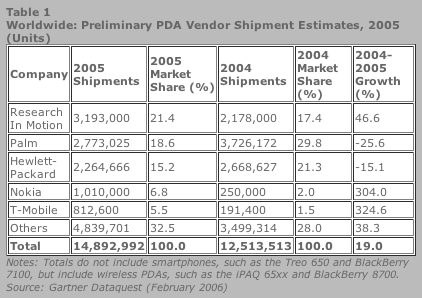
    So I'll just come out and say it: In 2006 Gartner did not have a clue what a smartphone was. By their admission:

    Gartner defines a PDA as a data-centric handheld computer weighing less than one pound that is primarily designed for use with both hands. These devices use an open market operating system supported by third-party applications that can be added into the device by end users. They offer instant on/off capability and synchronization of files with a PC. A PDA may offer WAN support for voice, but these are data-first, voice-second devices.

    In other words, in 2006 Gartner was splitting phones with operating systems into two separate markets: data-oriented wireless PDAs and voice-oriented smartphones. The split was mostly based on the judgement of the analyst on whether a device was "voice" or "data" oriented. I suppose they used the primary input method as a proxy: numeric keypads meant the device was one-handed and therefore voice-oriented. If the device had a full keyboard and/or a stylus-actuated touch screen then it was a two-handed data-oriented device. But even this proxy was not quite enough, sometimes devices were classified whimsically.

    To make it more complicated, they bundled non-cellular but Wi-Fi enabled PDAs with wireless PDAs. This made some sense from a corporate IT point of view (their primary customer base) as these data-oriented devices would be used either on a LAN or a WAN (Wide Area Networks: what Gartner anachronistically called cellular networks.)

    The presence or absence of a cellular radio did not enter into their view of these devices. So if you asked Gartner in 2006 to forecast smartphones (as we know them now) in 2010, I suppose you'd get what they forecast for "data-centric" devices.

    So assuming that today's smartphones are mostly "data-centric" we would have to look back on their view of that market and not the voice market which was seen as an entirely different thing. Their answer should have had something to do with the market leaders and participants in 2006. As the table above shows Gartner showed that RIM, Palm and HP led in 2005 with Nokia and T-Mobile[1] pulling up the rear.

    However, from a platform point of view, at the beginning of 2006

    Microsoft Windows CE was the No. 1 PDA operating system (OS) in 2005 as 7.05 million PDAs were loaded with the OS, up 33 percent from 2004 shipments of 5.28 million units. Palm OS PDA shipments declined 34 percent to 2.96 million units in 2005.

    In late 2006, Gartner made further predictions for the year:

    In 2006, Gartner expects the PDA market to increase by 6.3 percent to 16 million units. The market will continue to be driven by broader availability of cellular-enabled PDAs from wireless carriers. Gartner estimates that 53 percent of all PDAs shipped in the first half of 2006 featured integrated cellular capability, up from 46 percent during the same period in 2005. “The share of PDAs purchased by enterprises will continue to increase; it accounted for 49 percent of all PDA shipments in the second quarter of 2006 and Gartner expects that the enterprise market will account for 52 percent of all PDA shipments in 2006,” said Todd Kort.

    At this time I have not yet dug up a Gartner "Wireless PDA OS" four year forecast from the year 2006 but I suspect it would not show devices running Google's Android operating system or any running something called iOS.

    I also seem to remember that they were suggesting that Windows would be the leading mobile platform. Although it was trailing in 2006, Gartner was quite bullish on the disruptive challenger from Redmond.

    [1] T-mobile is in the list because it was common practice in 2006 for operators to market Pocket PC Phone Edition devices made by HTC under their own name. Orange, Vodafone and Verizon also had own-brand HTC Windows touch-based devices. Now what does that strategy remind me of?
  2. Nokia says: "My activations are bigger than your activations"

    Research · 6 comments

    While Jobs and Schmidt were having a contest over their mobile platform activation numbers...

    Pshaw to all that, says Symbian. The company points out that according to Canalys' research, there's 300,000 Symbian devices activated on a daily basis, which equals 109.5 million phones activated annually.

    via Sad Nokia Wants You To Know It's Activating 300,000 Smartphones Daily.

    I long for the good old days when we used to just measure units sold per quarter.

  3. Gartner's Nick Jones on Symbian: Abandon ship

    Research · 2 comments

    Market share is an existential threat to Symbian, it imperils the very existence of the platform. And the main reason Symbian is losing share is the user experience which isn’t competitive with Apple or Android. Based on the early previews I’ve seen Symbian 3 looks to have polished a few of the rough edges, but doesn’t fix the problem. So if the weak UI is threatening Symbian’s very survival the Foundation ought to be seriously worried, right? Wrong. I just looked on the Foundation web site and blogs at the roadmap and features for future releases. What I see is too much effort on stuff that really doesn’t matter. For example: Audio policy packages for Symbian, WIFi direct, support for an “open cloud manifesto”, an accredited Symbian developer program for China, better multitasking, multiple personalised home screens, HDMI connection to external TVs, better web runtime support, better internal architecture and so on.

    Forget elegant architecture, forget better multitasking, forget Chinese developers, forget release schedules that don’t deliver S4 devices with a new user experience until 2011. None of these matter. People will never use the features if they don’t buy the phone. The situation is now serious enough that any developer who isn’t working on something directly related to a new UI is wasting their time. The S4 UI is a “bet the platform” project. For any organisation to be in a situation where its survival depends on one project is very dangerous, especially when their track record in the area isn’t outstanding. I think the Foundation needs a contingency plan in case the planned S4 interface isn’t radical enough or good enough. Maybe redirect some developers and start a couple of skunkworks projects to create new competing UIs for S4, or perhaps announce a competition with a $1M prize for a new Symbian UI to encourage some radical ideas.

    I think the Symbian foundation is just re-arranging the deck chairs on the Titanic and ignoring the Android iceberg ahead.

  4. Nokia says the fightback starts now. Oh Really?

    Research · 1 comment

    2010.Realization that iPhone is a threat from new dimensions (user experience). Planning begins on reshaping the software base as a market-driven (not technology-driven) asset (5 year cycle). Apple begins to be evaluated as a competitor in devices and services, although still not compliant with current market definitions.

    via asymco | Assessing Nokia’s Competitive Response.

    I wrote these words a year ago based on observations made three years ago.  My expectation was and still is that Nokia does not quite understand what they are competing for and what the competition actually consists of.

    On Friday Anssi Vanjoki wrote that "The fightback starts now." He seems to contradict my timeline which has the "fightback" starting in 2014.

    How do we settle this?  Let's turn to the claims:

    In the article he says they sell 2 in 5 smartphones on the planet, yet, he turns around and says that Nokia is now the challenger in that space.  He says Symbian is the way forward on smartphones, yet he says MeeGo is the way forward on 'connected devices'. He writes that he is obsessed with getting Nokia to being number one in high-end devices (presumably by volume or sales or profit) but a recent survey by third-party tool developer Appcelerator shows 90 percent of developers surveyed said they were interested in the iPhone while 81 percent expressed interest in Android; for Symbian and MeeGo, the related figures were only 15 percent and 11 percent, respectively.

    I'm not ready to revise my timeline. The fightback begins in 2014.

  5. Open always wins, unless it's Symbian or LiMo or Openmoko or Qt

    Research · 59 comments

    In June 2008, Nokia made its first big move to turn around the platform, and announced that it was acquiring Symbian, with the intent of turning the OS into an open source project.

    Two years later, the move to open source has proved to be a miscalculation that is slowing down Symbian's development. It would be better for Nokia to take full control of the OS, according to Wood. A lack of support from other vendors means Nokia has to do most of the work itself, while the open nature of the platform allows competitors to keep a close eye on its progress.

    via Nokia on long comeback trail after smartphone misses - Digital Lifestyle - Macworld UK.

    Then there's LiMo foundation open source mobile Linux. Maemo is/was open source, Openmoko and Qt Extended and PalmSource/Access moving to open source and there was the Motorola Linux OS that launched years ago. If Open always wins, whatever it wins, it's not market share.

  6. Does iPhone really have 72% of Japanese smartphone market?

    Research

    MM Research does not count Symbian as a smartphone platform. This makes them inconsistent with any other analyst for counting smartphones.  So shouldn't Symbian be included?

    In a comment to iPhone has 72% of Japanese smartphone market | Asymco it's been pointed out that 12 million Symbian sold in the same time frame as Apple sold 1.7 million phones in Japan.

    It would seem then that the correct market share for iPhone would be 12%, with Symbian having 83% and "others" having less than 5%.

    However...

    Symbian in Japan is not the same thing as Symbian elsewhere.  Symbian in Japan is used as a low level OS by Fujitsu, Sony Ericsson Japan, Mitsubishi, Sharp and others to provide devices running the MOAP(Symbian) software platform.  MOAP (Mobile Oriented Applications Platform) is the software platform for NTT DoCoMo's FOMA (Freedom of Mobile Multimedia Access) service.

    Unlike Series 60 and UIQ MOAP(Symbian) is not a open development platform.

    MOAP is also supported by Linux with Panasonic and NEC using it in something called MOAP(Linux).

    MOAP(Linux) is also not an open development platform.

    So the "72% share for iPhone" in Japan must be stated with this important caveat: that Symbian and Linux are not included because, due to not having exposed APIs, they are classified as feature phone platforms.

  7. Global smart phone OS shares (part II)

    Research

    On May 5th, I tried to fill in the blanks on Global smart phone OS shares | Asymco. I estimated that the shares for the mobile OS's were as follows (based on Canalys partial data):

    • Symbian (Nokia): 42%
    • Blackberry OS (RIM): 19%
    • iPhone OS (Apple): 16%
    • WinMo (Microsoft): 10%
    • Android (Google): 10%
    • WebOS (Palm): 2%

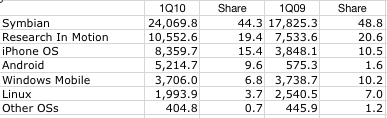
    Now Gartner has published their sell-through estimates:

    • Symbian (Nokia):: 44%
    • Blackberry OS (RIM): 19%
    • iPhone OS (Apple): 15%
    • Android (Google): 10%
    • WinMo (Microsoft): 7%
    • Linux: 4%
    • Other OSs: 1%

    My estimates were within 1 or 2 percent of actuals except for Windows Mobile where I over-estimated by 300 basis points.

    The analysis of Android vs. iPhone market shares (globally and within the US) which depended on this estimation does not change materially.

    The complete data from Gartner follows:

  8. Visualizing iPhone vs Android Shares

    Research · 1 comment

    Following up on my last post on how misleading US-only share comparisons can be, I decided to draw charts to visualize the comparison.

    As Android and iPhone compete in various ways, it's hard to see which is the preferred choice given a direct comparison.  In other words, iPhone and Android devices rarely are placed next to each other with similar terms.

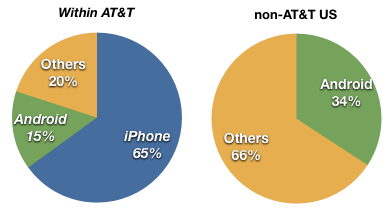
    Take the US market for example.  The overall data from NPD suggests that last quarter Android reached 28% share vs. 21% for iPhone.  Many of those Android devices were new to market or at least newer than the iPhone which in Q1 was coming to the end of its product cycle.  Second, pricing for Android devices seems to have been quite aggressive with buy one get one free sales.  But I won't dwell on tactics now; what I do want to note are the differences in share between AT&T users and non-AT&T.

    Note that within AT&T, iPhone outsells Android over 4 to 1.  iPhone also outsells "others" (mainly RIM) more than 3 to 1.  However, outside AT&T, where the iPhone is not available, Android does not outsell "others".

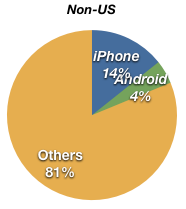
    If we exclude the US altogether, we also see that Android does not have a great distribution.

    Outside the US, the iPhone also outsells Android nearly 4 to 1, but it has a way to go before challenging Symbian which makes up the bulk of "Others".

    So in markets where Android is head-to-head with the iPhone (AT&T and non-US markets), iPhone's lead is quite high (still).  The possibility still exists that Android will overtake iPhone given the broad licensing and distribution, but it's not necessarily a given.  And in any case, iPhone is not the market share leader today and that leadership does not seem to be their objective (note the pricing).

    The bigger question is what will happen to RIM and Symbian as Android grows.

  9. Global smart phone OS shares

    Research

    In the free press release linked below Canalys reveals their estimates of vendor shares but not the OS shares for smartphones. However it's not hard to see the OS split due to the high degree of exclusivity of OS's to vendors.

    For example, virtually all Nokia devices are Symbian powered, all RIM devices are Blackberries and all Apple devices are iPhone OS.  Motorola is only shipping Android and HTC is the only top 5 vendor that now licenses more than one OS.  Even HTC's portfolio is now heavily Android weighted.

    We can carve out Palm (960k units shipped) from the "others" and we're left with mostly Windows Mobile.  My estimate would be about 5 to 6 millionWinMo made it out.

    That leads me to the following estimated OS shares:

    • Symbian (Nokia): 42%
    • Blackberry OS (RIM): 19%
    • iPhone OS (Apple): 16%
    • WinMo (Microsoft): 10%
    • Android (Google): 10%
    • WebOS (Palm): 2%

    If anyone knows the actual Canalys OS shares, let me know.

    Global smart phone market growth rises to 67% (Canalys press release: r2010043).

  10. Microsoft's standardised handsets will win the day, says Gartner

    Research

    Symbian will lose smartphone battle By Rob Jones at Gartner Symposium ITxpo, Cannes [07-11-2003] Microsoft's standardised handsets will win the day, says Gartner

    Analyst Gartner has warned that, without a concerted effort by Symbian and its backers, Microsoft will sweep them aside in the smartphone business.

    Redmond's ability to offer standardised handsets which are easier for businesses to support and use will help the software giant win corporate approval, the market watcher predicted.

    The analyst predicted that Microsoft will ship a phone boasting strong integration of a range of packages, such as Exchange and Outlook.

    Symbian, he added, needed to resolve a number of issues to be a credible, corporate alternative. Its platform and menus differ slightly on various handsets, which means that they often do not have the same user interface.

    So spoke Nick Jones, vice president and research fellow at Gartner in 2003.