Asymco

Asymmetric Intelligence

Symbian

  1. Platform Bonanza! Three new Platforms in one Day

    Research

    Delivering precisely what the world needs today:

    • Samsung launched Bada
    • Microsoft launched Windows Phone “7 Series”
    • Nokia and Intel jointly announced MeeGo.

    Three new ambitious platforms starting with zero installed bases and no applications are going up against the following:

    • Symbian with more than 200 million users and 20k apps
    • WebOS with less than 3 million users and about 1k apps
    • Windows Mobile with 30 million users and about 2k apps
    • iPhone OS, about 75 million users and 150k apps
    • Android with 3 to 5 million users and approx. 20k apps
    • Blackberry OS with more than 50 million users and a few thousand apps.

    It should be noted that Microsoft’s new Windows Phone “7 Series” will compete with Microsoft’s Windows Mobile 6.5 which will continue as a product line.

    MeeGo will also compete with Nokia’s existing Symbian OS for developers, replacing Maemo.

    Most of these new platforms will not have products shipping for at least 6 months during which time another 50 million (at least) new users will join existing ecosystems.

    There are now nine smartphone platforms, but who’s counting? I’ve been hearing predictions of consolidation for years and although platforms have come and gone (PalmOS, SavaJe), the total number continues to increase.

    If nothing else, this seems to indicate that the industry is not in any state of maturity or point of “over-service” where commoditization takes place.
  2. One Million Americans Switching to Smartphones Every Month

    Research · 2 comments

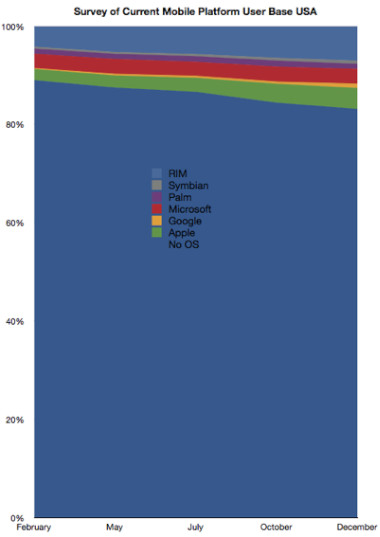
    Comscore revealed their latest survey resultsfor the US mobile subscriber market. From the latest data and the data previously released in October we can put together a few insights.

    The number of smartphone users increased by 3.2 million, growing at over 1 million new users per month.

    Apple and Android added about 1 million users each. RIM added 1.4 million with Symbian adding about 200k users. Palm lost 441k users and Microsoft lost about 44k users.

    Non-smartphones lost 2.1 million users and 1 million subscribers were added to the top line.

    The non-smartphones lost 1% share in the quarter and 6% since February. Smartphones make up 17% of all users.

    Google has overtaken Symbian to rise from last place in the platform installed base and is closing on Palm.

    At 5% share erosion per year, the non-smartphone market will completely disappear in about 14 years, though I feel 10 years is a more likely target with 5 years until the market is 50% penetrated.

  3. Version Arithmetic

    Research

    Remember when I laid out the timeline for Nokia's response to the iPhone? Still checking off the milestones: http://www.thestreet.com/_yahoo/story/10636833/1/nokia-outlook-another-year-in-limbo.html?cm_ven=YAHOO&cm_cat=FREE&cm_ite=NA

    Let's also do some version arithmetic:

    Nokia is already on the 5th version of Maemo, a platform which by any measure is non-functional but already 5 years in the making. After this investment, only one product is shipping and it's something of a science experiment--a pre-beta product. Nokia is also on the 9th version of Symbian, a functional but outdated platform stuck in the 90s. Promising big things in the 10th version to be re-branded Symbian ^2--I guess double digit version numbers are not confidence inspiring.

    Microsoft meanwhile is working hard on the 7th major version of Windows Mobile. World waiting with bated breath.

  4. Android Business Fashion Model

    Research

    Nice summary: Essentially, Android isn't Google's phone platform, it's an open alternative for failing hardware makers to use in place of Symbian, Windows Mobile, and Linux to create the same type of convoluted, fractionalized, and poorly integrated products they're already making. This is also why Symbian, Windows Mobile, Motorola, and Sony Ericsson are all failing commercially.

    Google's primary and most significant contribution won't be any major innovation in the core Android platform but rather in its own bundled apps, where Google plans to earn its revenues from via, to put it bluntly, adware and spyware.

    http://www.appleinsider.com/articles/09/11/11/inside_googles_android_and_apples_iphone_os_as_advancing_technology.html

  5. Serving the Needs of IT

    Research

    An interesting note in the latest Canalys Smartphone quarterly summary (http://www.canalys.com/pr/2009/r2009112.htm):

    "...in our October study of 600 European decision makers in medium and large enterprises, more than 20% said they expect the iPhone to be the dominant smart phone platform for running business applications in their organisation within the next 3 to 5 years. In France, the iPhone was ahead of Windows Mobile and RIM in this regard – a remarkable result.”

    This short quote brought back to mind the recently formed partnership between Nokia and Microsoft to deal with RIM. One fruit of this relationship is a recent job posting atcareers.microsoft.com which seeks Symbian developers to work for Microsoft:

    Job Category: Software Engineering: Development Location: India, Hyderabad Job ID: 702365 Division: Microsoft Business Division

    The Office team is looking for a self-motivated and highly passionate Developers to contribute in building a new team and drive discipline excellence in the delivery of Office Mobile and Communication experiences for Nokia’s Symbian smartphones.

    Microsoft and Nokia have formed a global alliance to design, develop and market mobile productivity, communications and collaboration solutions.

    Under the terms of the agreement, the two companies will begin collaborating immediately on the design, development and marketing of productivity solutions for the mobile professional, bringing Microsoft Office Mobile and Microsoft business communications, collaboration and device management software to Nokia’s Symbian devices. These solutions will be available for a broad range of Nokia smartphones starting with the company’s business optimized range, Nokia Eseries. The two companies will also market these solutions to businesses, carriers and individuals.

    This project builds on the existing relationship with Nokia who is optimizing access to email and other personal information with Exchange Activesync. Next year, Nokia intends to start shipping Microsoft Office Communicator Mobile on their smartphones, followed by other Office applications and related software and services in the future.

    (related job description)

    While the iPhone wins hearts and minds in IT through sheer brilliance Nokia tries to become a supplier to IT departments through a strategy deeply rooted in the 1980s: the manipulation and exertion of control over file formats. As IT has diminished in importance (to the point of ceasing to matter to some) it's hard to understand this misplaced alliance with Microsoft over something so inconsequential.