Asymco

Asymmetric Intelligence

Horace Dediu

  1. Microsoft and Nokia agree: Apple is hindering Innovation in Mobile market

    Research

    From the GSMA Mobile World Congress 2009 (one year ago):

    Kallasvuo used Apple and its "closed" ecosystem as an example of what could limit innovation in the mobile market in the future. He said Apple's vertically integrated model, where its hardware and software are tightly controlled by the company, further fragmented the market. And he added that what is truly needed is more openness in developing applications.

    Yes, prior to the iPhone innovation was zipping along rapidly, but now it's stuck because the iPhone is closed. The iPhone is hindering innovation because it's highly integrated.

    Ballmer argued that device openness was important to give customers more choices. And he pointed to the number of choices that Windows Mobile customers have when choosing a device.

    We'd all have more choices if we'd all choose Windows Mobile.

    Fast-forward one year and Microsoft decides to offer more choice by adding a new operating system (in parallel to its existing OS) and Nokia decides to solve fragmentation by launching a new platform called MeeGo (in parallel to Symbian).
  2. Microsoft's standardised handsets will win the day, says Gartner

    Research

    Symbian will lose smartphone battle By Rob Jones at Gartner Symposium ITxpo, Cannes [07-11-2003] Microsoft's standardised handsets will win the day, says Gartner

    Analyst Gartner has warned that, without a concerted effort by Symbian and its backers, Microsoft will sweep them aside in the smartphone business.

    Redmond's ability to offer standardised handsets which are easier for businesses to support and use will help the software giant win corporate approval, the market watcher predicted.

    The analyst predicted that Microsoft will ship a phone boasting strong integration of a range of packages, such as Exchange and Outlook.

    Symbian, he added, needed to resolve a number of issues to be a credible, corporate alternative. Its platform and menus differ slightly on various handsets, which means that they often do not have the same user interface.

    So spoke Nick Jones, vice president and research fellow at Gartner in 2003.

  3. Is the Expert Smart or Stupid?

    Research

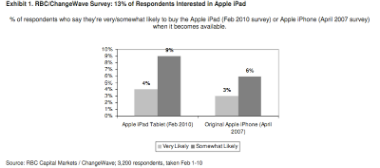
    A new survey has found that 13 percent of respondents are likely to buy Apple's forthcoming iPad, a number greater than the 9 percent who planned to purchase an iPhone before its launch in 2007.

    link: AppleInsider | Apple iPad demand exceeding pre-launch iPhone buzz?

    A summary of the typical expert reaction to the iPad in three steps:

    Step 1: Expert: "Apple is stupid to launch such a dumb product!"

    Step 2: Product sells very well

    Step 3: Expert: "Well, what do you expect... People are stupid!"

  4. Smartphones forecast to grow 46% in 2010

    Research

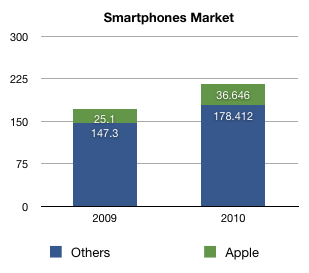
    Gartner sees smartphone market volume growing a whopping 46 percent from 172.4 million sold last year, boosted by cheaper models. The most affordable now cost just over $100 excluding operator subsidies.

    link: Handset market rebounding in 2010: report - Yahoo! News

    Anyone modeling iPhone growth this year below 50% is implying Apple will lose share.

    If Apple maintains market share (about 15%) it would sell about 37 million iPhones in 2010. Apple grew iPhone unit sales about 84% from 2008 to 2009.

  5. So Long, Flash

    Research

    A devastating exposé on the incompatibility of Flash content with touchscreens.

    Many (if not most) current Flash games, menus, and even video players require a visible mouse pointer. They are coded to rely on the difference between hovering over something (mouseover) vs. actually clicking. This distinction is not rare. It’s pervasive, fundamental to interactive design, and vital to the basic use of Flash content. New Flash content designed just for touchscreens can be done, but people want existing Flash sites to work. All of them—not just some here and there—and in a usable manner. That’s impossible no matter what.

    The author, a Flash developers, goes on to describe how none of the work-arounds will solve the problem.

    The implication is that Flash has evolved around an obsolete input method and it can no longer adapt to what is rapidly becoming the de-facto interaction method of hundreds of millions of mobile computing users.

  6. The Apple of Traders Eyes

    Research

    Of all the world’s companies, Apple ranks as the 11th most valuable. As a technology company its market capitalization is second only to Microsoft.

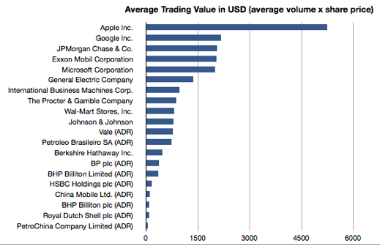
    Of the top 20 largest companies, all of which are above $150 billion in market cap (listed in graph above), Apple has the highest volume of trading as measured by dollar value (average volume multiplied by last share price is $5.2 billion per day--see graph). In fact, it’s more than twice as popular as a traded equity than the next highest, Google and 2.6 times as popular among traders as Microsoft.

    This trading volume might also be reflected in its beta (the correlation of price with the market with 1 meaning perfect correlation). Apple’s Beta is 1.59, nearly the highest of the super-large caps and the highest by far of the tech large caps.

    Surely, this confirms that Apple is not only huge but hugely popular and highly visible among investors. Suggestions that its current discounted value is due to obscurity among IT buyers translating to obscurity among investors does not wash.

    Source: Google Finance

  7. Apple’s Enterprise Value Peaked in 2007

    Research

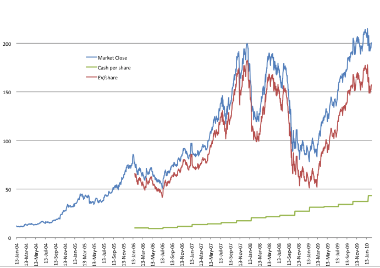
    On Christmas Eve 2007 to be precise. That’s when the Enterprise Value/share was $181.5. These days it’s around $150. The Enterprise Value (EV) measures the value of future cash flows excluding current assets and is a better indicator of the potential of a company than its current overall value.

    As you can see in the graph above, the cash per share (in green) has grown to $43 while back in late 2007 it was less than half that. As a result, although the market value for Apple peaked at $215 on 19th January this year (the blue line), the EV/share was only about $178 (the red line), below the all-time-high in 2007.

    As Apple’s cash continues to grow, the gap between EV and MV will also grow. If the MV remains low (as the P/E is indicating) then the Enterprise Value, i.e. the net present value value of future cash flows, drops.

    Did Apple’s prospects peak in 2007--six months after the iPhone was first launched--or is the current valuation still a function of sentiment of the overall economy, independent of the company’s fundamentals?