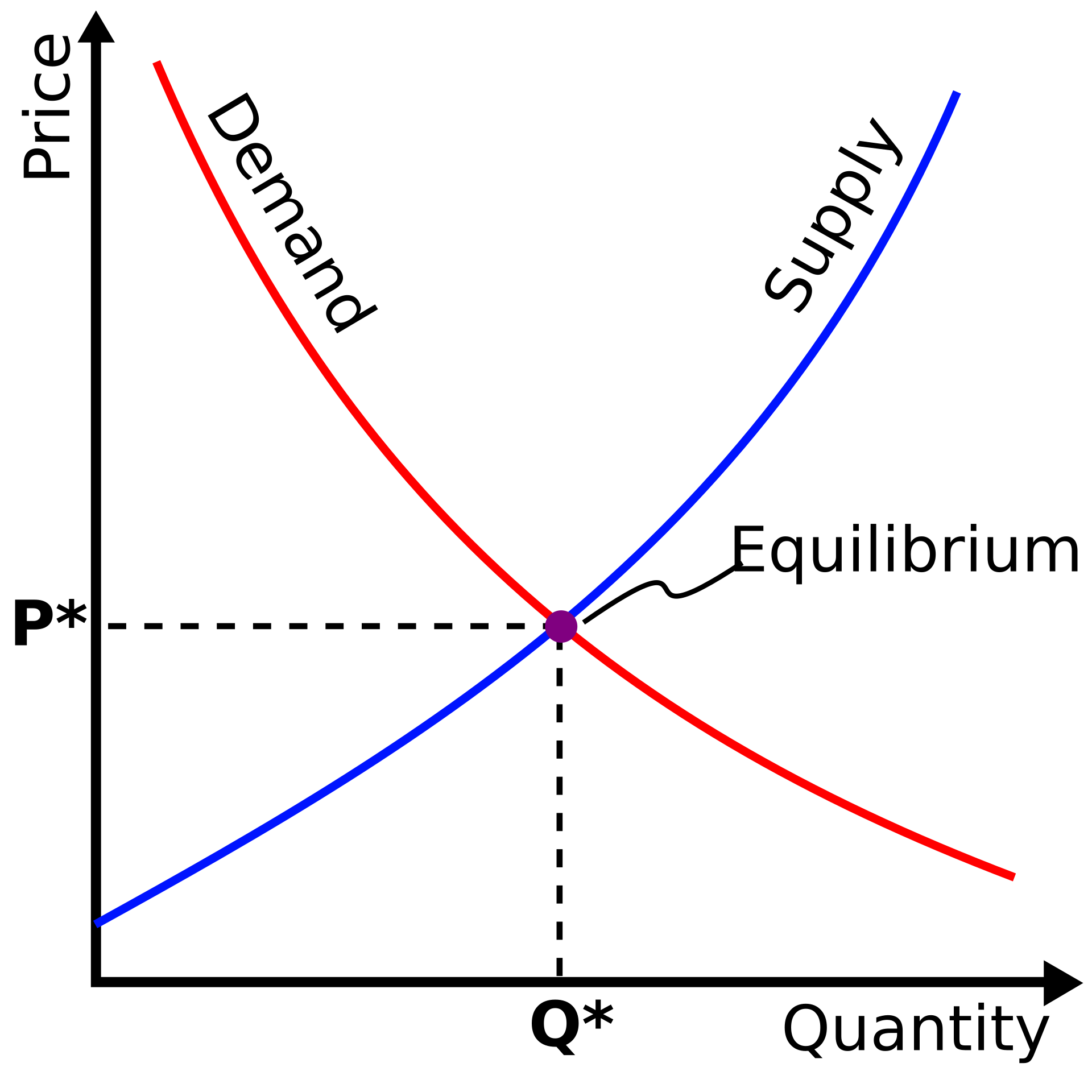
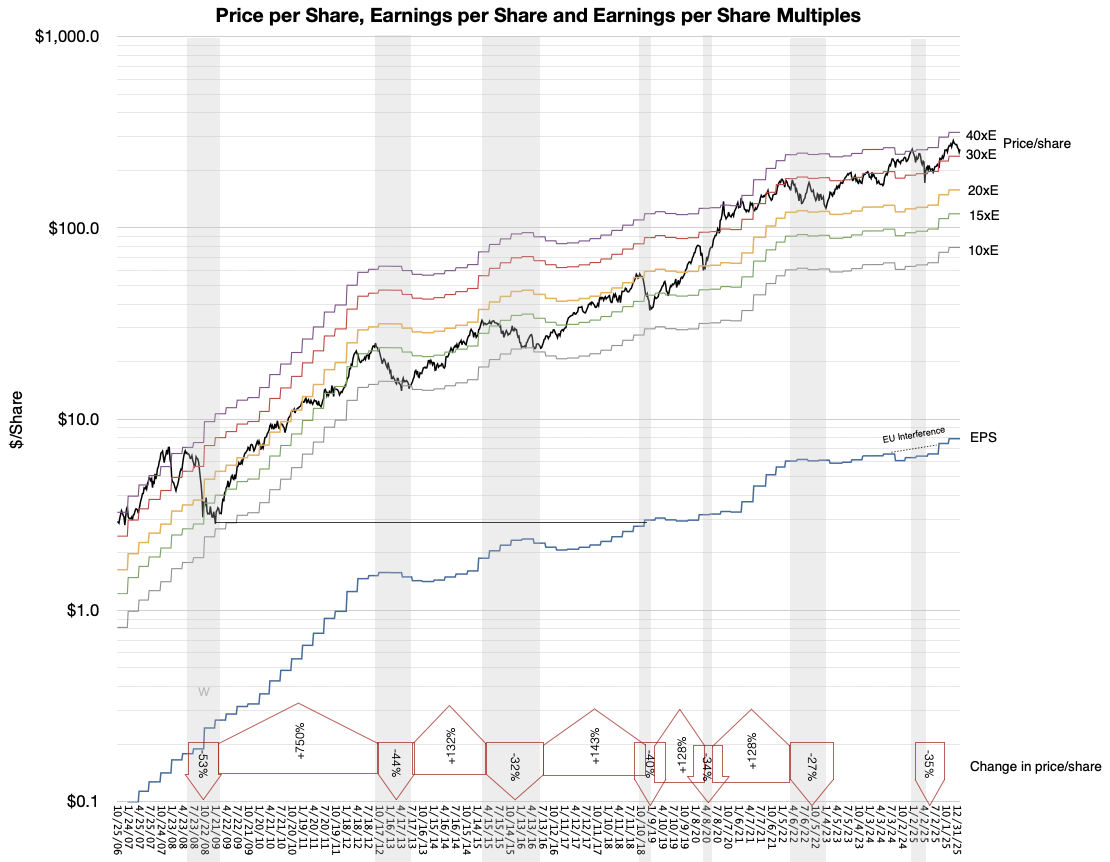
A commodity is a product whose price does not rise when performance improves, so businesses trading in commodities compete on production and distribution rather than design. That is why Apple does not build memory: it would lock itself into its own cost structure and give up the flexibility to negotiate across vendors. Memory makers can only make money by lowering cost per bit, which they do by shrinking process nodes. Beijing spent hundreds of billions over more than a decade building strategic memory suppliers; twelve years in, that industry may only be reaching profitability because of the current imbalance. →
Nota Bene
Apple's Q1 iPhone sales in Africa grew 44% → Counterpoint Research reports Africa's smartphone shipments fell 12% in Q1 2026, hit by fuel prices, memory-driven price rises, and extreme price sensitivity. iPhone bucked the trend and grew 44%. Apple does not adapt to markets; markets evolve to become Apple markets. →
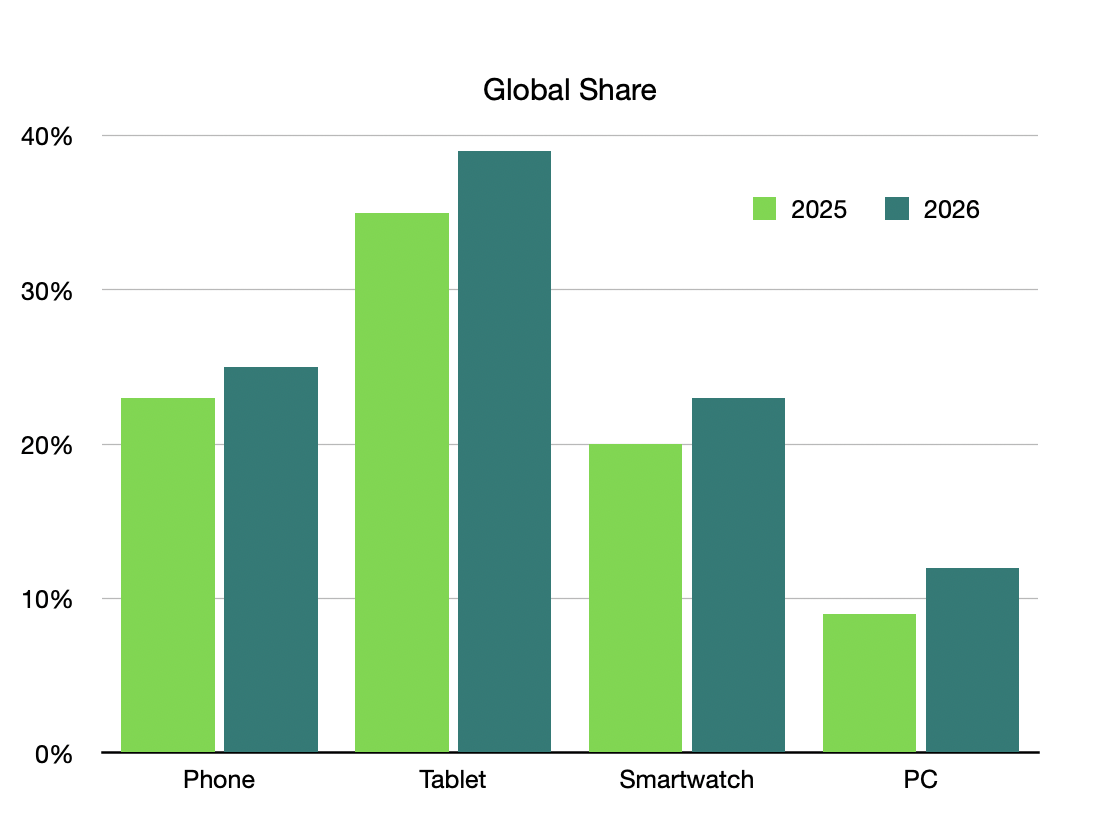
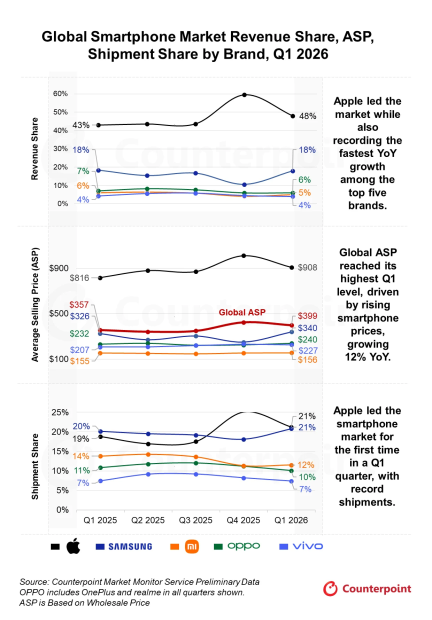
Counterpoint: Apple to Hit Record Market Shares in Smartphones, Laptops, Tablets; Watch Share Also Set to Grow → Counterpoint expects Apple to reach its highest-ever share in smartphones near 25%, plus record share in laptops and tablets in 2026, while most OEMs face double-digit declines. Stable pricing, high margins, and supply chain control let Apple weather the memory crisis best. The article predates the June 25 price increase, but the conclusion still holds. →
Office Hours Q&A
Earnings are an opinion, cash flow is a fact → Dave E. asked whether the hyperscalers face an AI bust and how Apple would adjust. There is revenue but little profit or free cash flow because everything is being reinvested. The bubble bursts only if debt gets mispriced, and so far AI has not become a debt story. →
Why is betting against Apple the extraordinary claim? → An Office Hours question about Apple's forward prospects given 26.6% CAGR over twenty years. Analysts make one-year calls swamped by short-term noise, while the CAGR reflects a decades-long trend. The extraordinary claim is that a flywheel with this much momentum suddenly stops. →
Will agents kill the app economy? → Question was: whether agentic AI would consolidate revenue to Apple and agent providers. Apple keeps trusted permissions inside apps: apps become callable APIs, Apple still hands off credentials, and the app economy lives on alongside intent, touch, and vision. →
20 more years at 24%? If we use the rule of thumb that long-term investments in Apple have yielded about 24% then the rule of 72 means you double your money in three years, every three years.
The question has always been about sustainability.
This is the question at the heart of Warren Buffett’s investment thesis. He called it a moat. It’s at the heart of management theory and it’s called sustainable competitive advantage. And it’s at the heart of Apple investment. Especially as the company was known as a hit-driven business. Hits are nice but they are not likely to be consistent. It’s why it’s had a low P/E ratio even though it was booming. →
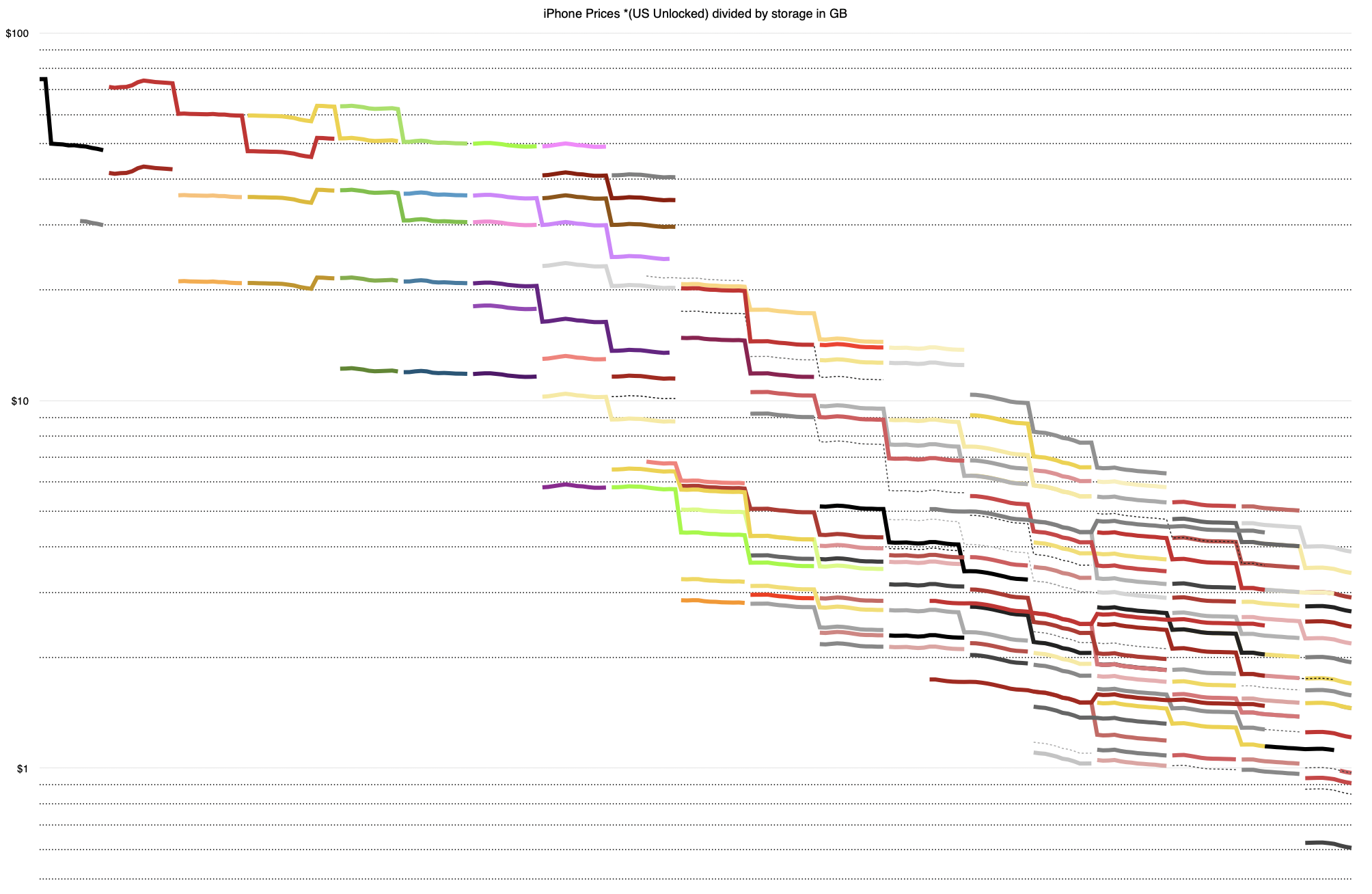
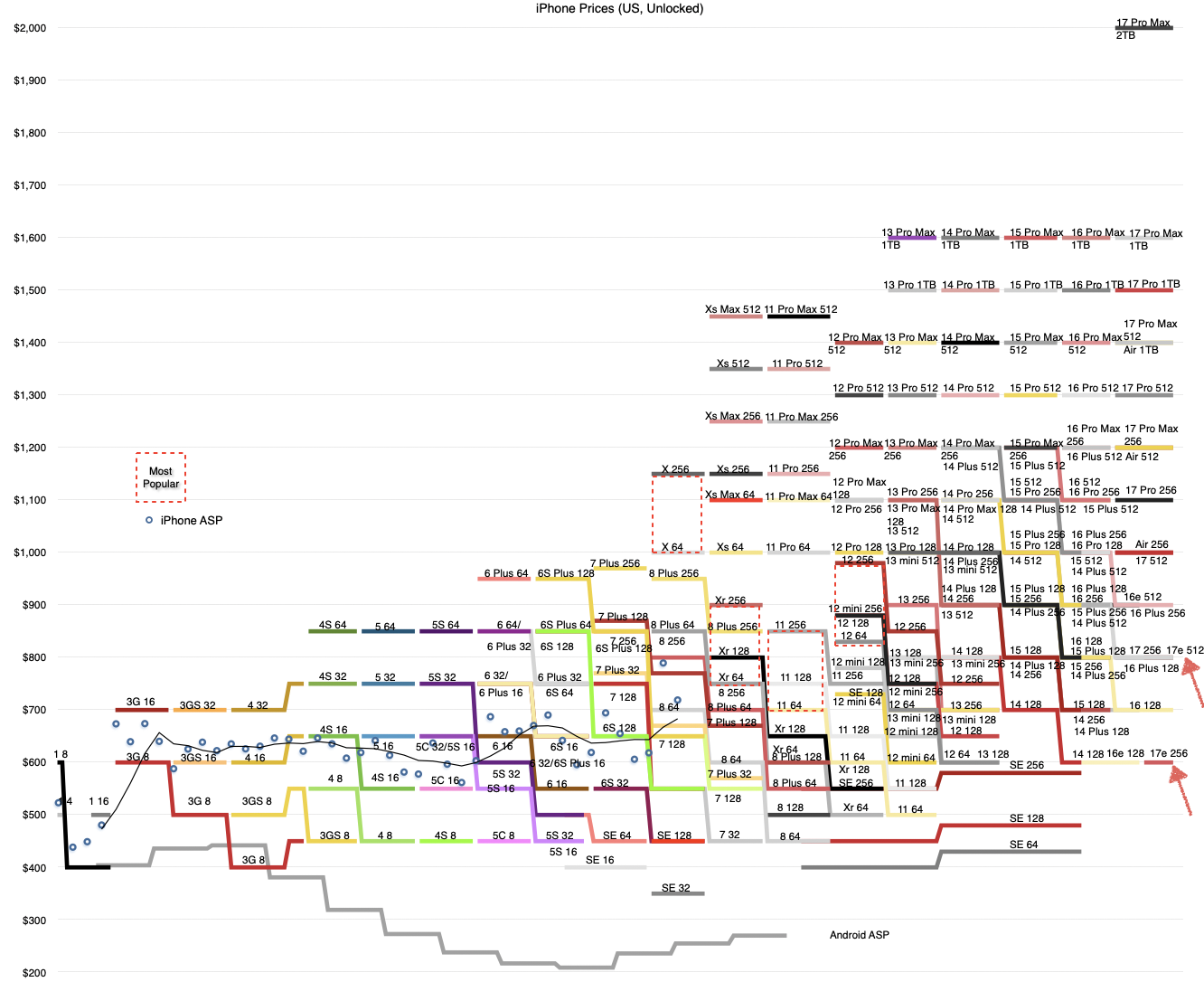
Exponential increase in performance at a flat price. Is the formula about to change? The iPhone price structure is very carefully constructed. One could even say it’s engineered. It has operated under many constraints: segmentation, margin, scale and market windows. The balance between these and other constraints has been managed for 19 years. Until 2021 inflation was not a major factor but following the Covid perturbation the iPhone pricing fell dramatically. To see the →
Nota Bene
Only one in eight smartphone users uses a smartwatch. What’s the problem? → Counterpoint has Apple Watch shipments up 21 percent, the fastest among the top ten, yet pegs the whole category at 3 percent growth through 2030. That treats the market as mature when only one in eight smartphone users wears a watch. With roughly 650 million users against nearly 6 billion phones, the constraint is non-consumption, not demand. The catalyst that finally unlocks that headroom will be a health and wellness killer app, cheaper than GLP-1 drugs and far better at changing habits. →
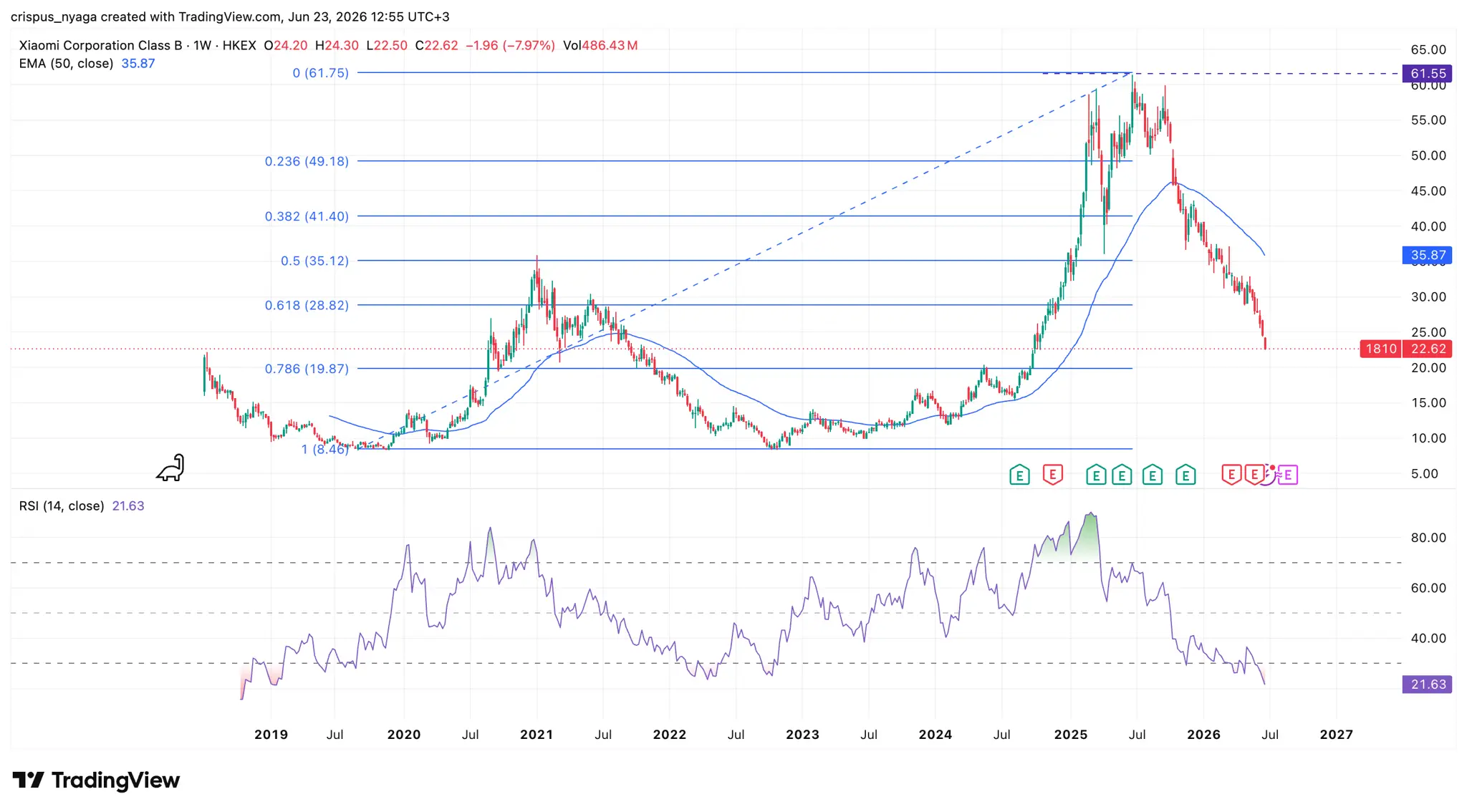
‘China’s Apple’ is in free-fall → Xiaomi, the company everyone insists on calling China’s Apple, is down 63 percent in a year, with revenue off 11 percent and profit cut by more than half. The market blames memory prices and the EV selloff, but the real cause is a lack of discipline. Xiaomi fast-followed Apple into cars and then refused to follow Apple back out when the project was cancelled. Phones and cars overlap in nothing, and a century of carmakers trying to diversify shows every version of this mix fails. →
The Memory Shock: Six Readings from a Supply-Chain Conversation → Singling out memory as strategic makes little sense when the supply chain is a global train, and qualifying an alternative supplier takes a year or two, not months. Apple’s old leverage of prepaying for hundreds of millions of devices is being undermined by data-center buyers who commit the same cash for a fraction of the units, so suppliers took the money and ran. Tim Cook calling this a hundred-year flood he has not seen in forty years told me he was shaken and out of his element. The phone market may fall 12 to 20 percent this year, the worst on record, but if Apple sneezes everyone else gets the flu and Apple quietly gains share. →
Office Hours
Why is the most expensive thing you own the dumbest? → Home has waited years for its missing ingredient, which is inference, because setting up a smart home today turns you into a programmer and it still fails. Apple TV is the hub only by convenience, and as an appliance you replace like a refrigerator it withers, so whatever comes next has to be a software object that keeps evolving. The real embarrassment is that the most expensive thing you own, a house worth millions, is the dumbest thing you own, with less intelligence than a $300 watch. The answer is not a humanoid robot that unsettles people but a little speaker with a screen that turns to greet you. →
Asymco Bulletin is a digest of all the work we have published for the week ending June 21, 2026.
Asymetric
Asymetric Podcast: Episode 138 — Watershed → Horace on WWDC 2026, John Ternus's timing, what we can learn from the candy bar, and Judd's indifference to origami. Also, World Cup predictions.
Now in beta for Asymco One subscribers; listen to Asymetricin your favorite podcast app. →
Tim Cook told the Wall Street Journal that price increases are unavoidable as Apple's range of options on memory costs has run out. WSJ estimates a $270 increase in the next iPhone Pro to maintain margins; another estimate puts it at $140 per average iPhone, which Apple could pass through with lower margins but unchanged cash flow. Either way, smaller vendors face an existential problem at $300 ASPs. This memory crunch is a hundred-year flood driven by AI demand, and the eventual drought will not arrive until at least 2028. →
Nota Bene
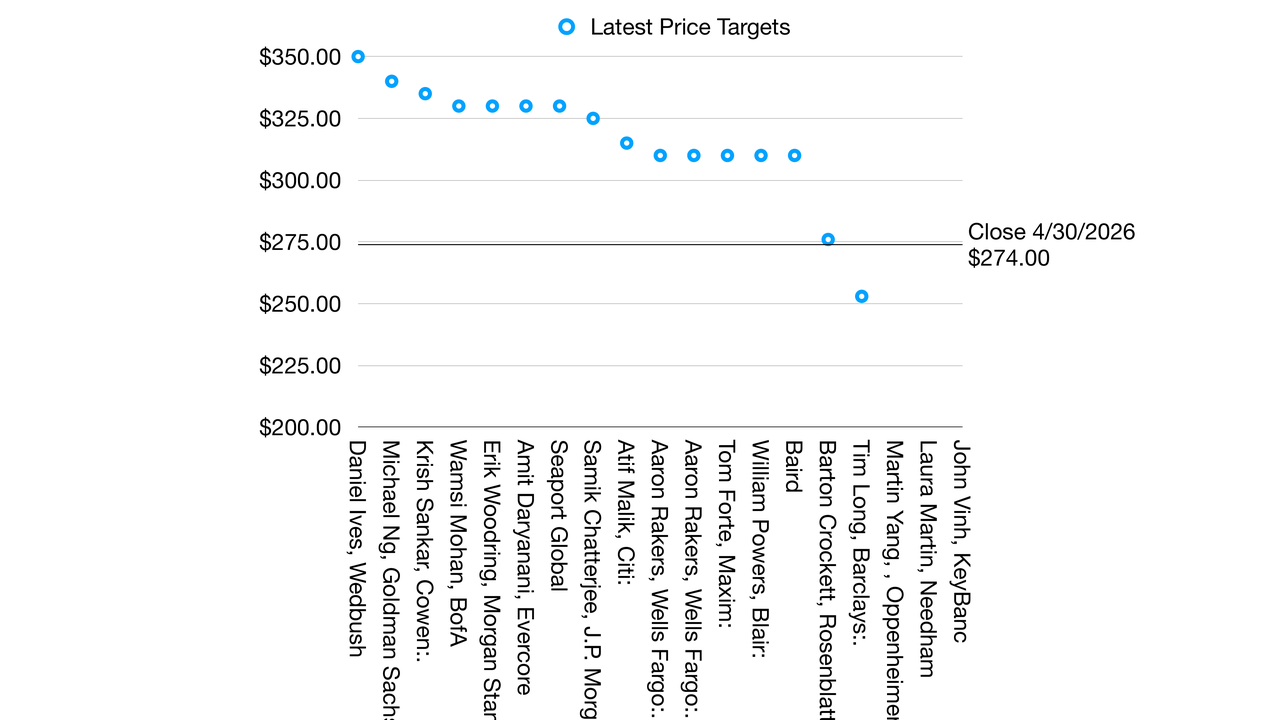
TD Cowen and Morgan Stanley increase Price Targets → TD Cowen raised Apple's target to $350 and Morgan Stanley took base to $360 with a $440 bull case, calling WWDC a chance to reframe Apple as an AI winner. The new average target is $305 with 34 published targets and 41 analysts following. In 2018 half of analysts also rated Apple hold or sell at the trillion-dollar milestone, and nothing changed. →
Office Hours
What's a billion between friends? → Bob V asked about the Apple-Google deal for the frontier model. People assumed far more than is actually happening: this is a narrow technology license, Google gets no data, and the contribution is swappable. What's a billion between friends? →
Where is the monetization? Follow the compute → Roger asked where AI monetization comes from beyond hardware. Follow the compute: if it is on-device, Apple bundles it; if it is in the cloud through an app or Siri, the user pays a subscription and Apple takes its usual distribution commission. The Services business does not need new economics, and the App Store may show another kink the way it did when subscriptions became dominant. →
Why is Apple selling hygiene? → Greg asked why Apple spent so much time on child safety at WWDC. Safety is hygiene, like plumbing, only noticed when it fails, and almost never marketable. Apple spending fifteen laborious minutes on it was not aimed at consumers, it was a message to policymakers that the custodian is doing its job. →
Apple is measured by satisfied customers, and WWDC is measured by satisfied developers. The right framing for AI is not making men into supermen, it is lifting the half of humanity below the median in communication, health, and mobility. The opportunity is in everything currently done poorly by humans: eating, sleeping, exercising, scheduling, finances, administrative work. Scaffolding is unglamorous, but no building has ever been built without it. →
AI sales are booming but free cash flow is not, so the question for Apple Intelligence is how it unlocks new cash flows. The answer seems to be that the cost of inference flows through to apps and subscriptions, leaving the Services business roughly unchanged with a possible uplift. The real monetization is hardware. AI's compute, storage, and memory requirements are already leaving two-to-three-year-old devices behind, and the upgrade wave will run across iPhone, Mac, iPad, Vision Pro, Watch, AirPods, and a refreshed Home. Nvidia won the lottery with five customers; Apple has 1.5 billion. →
The grand debate framed intent computing and spatial computing as alternatives, with passive ambient interactions or full immersion Spatial replacing touch. The dichotomy is wrong. Touch never replaced keyboard, and intent will not replace Spatial. Intent computing is Glance computing measured in seconds, Spatial is high-commitment sit-down work measured in hours, and both will coexist alongside touch, keyboard, and sensor computing. Spatial will become the highest utility for those who edit, create. →
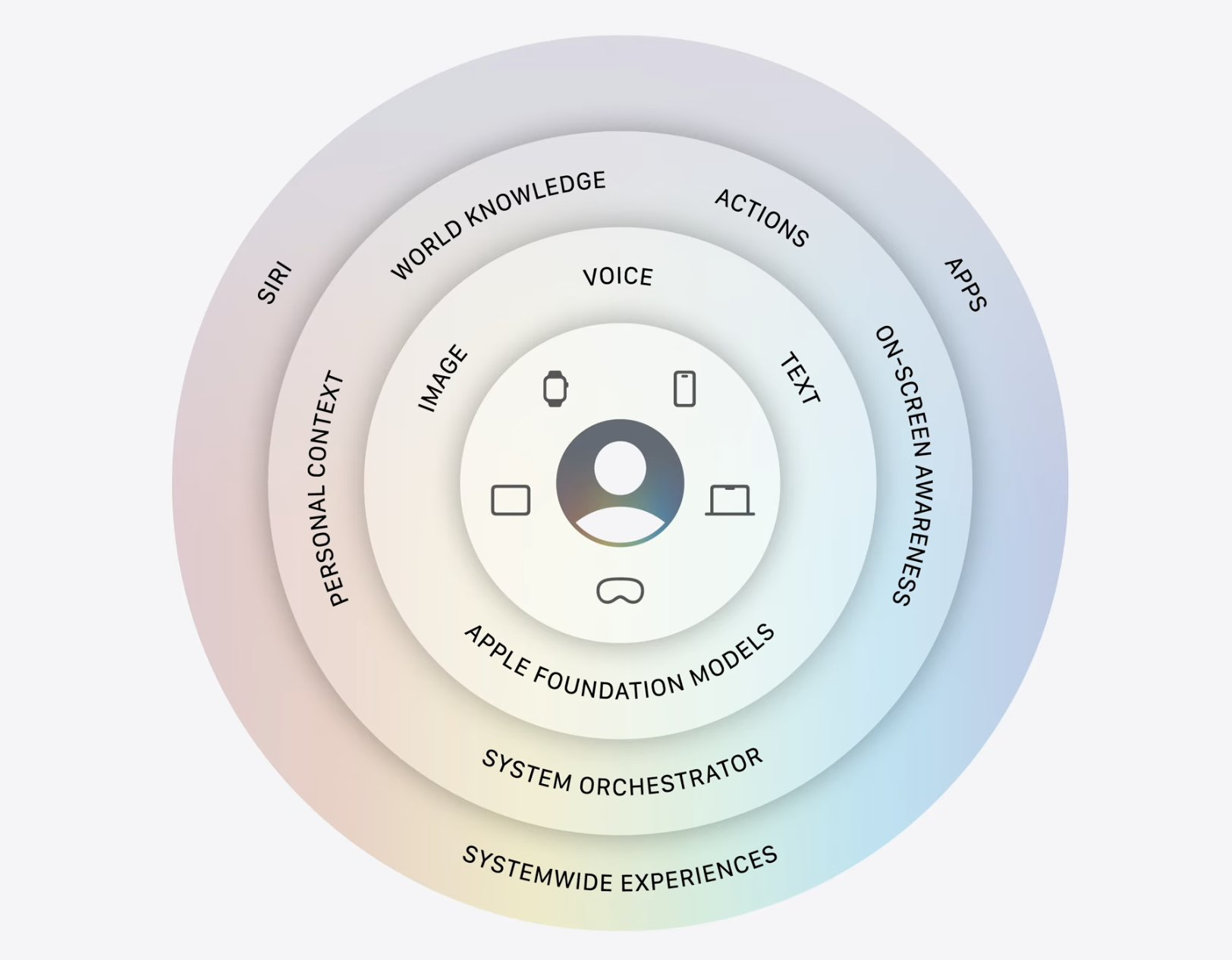
Apple Intelligence rewires the computing stack. The operating system becomes an orchestrator that connects user intent to knowledge bases and decides whether Siri or an app fulfills it. Apps are not deprecated but transformed from intent destinations to callable functions, and the App Store becomes an API directory. The new points of value should be the orchestrator and the foundation models, but models may be commodities, and the trust apps earned to hold private data is not easily transferred. Apple preserves its value as the agent of trust and discovery. →
Nota Bene
Counterpoint Research: Apple has shipped over 450 million Apple Intelligence-capable iPhones → Counterpoint says Apple has shipped 450 million Apple Intelligence-capable iPhones and "needs" to deliver a revamped Siri. The strong language contrasts with minimal evidence of demand, since iPhone 17 is already hitting first-quarter revenue records. 450 million is a real number; the ratio of how many are actually used for AI remains to be measured. →
Apple confirms not using Google models, apps or search in Apple Intelligence → Federighi confirmed Apple is not using Gemini, Google Search, or Google Assistant in Apple Intelligence. Apple introduced five custom Foundation Models, four running on-device or in Private Cloud Compute, and only one runs on Nvidia GPUs in Google's cloud. The orchestrator routing all of this is an OS for AI, and slipping in a new OS layer is demonstrably sustaining to Apple's core value proposition. →
Trendforce: Global Smartphone Production Fell 1.7% YoY in 1Q26; Sharper Decline expected in 2Q26 → Trendforce reports global smartphone production fell 1.7% in 1Q26, with a sharper decline ahead, while Apple grew production 21% to 60.2 million units. Trendforce believes Apple is prioritizing market share expansion in the downturn to drive future services revenue. None of the other vendors offer notable services. →
Asymetric
Asymetric: Deleted Scenes → Not everything in the Asymetric podcast survives the editing process. I am posting some of the deleted segments to YouTube as Asymetric Deleted Scenes, starting with the first. →
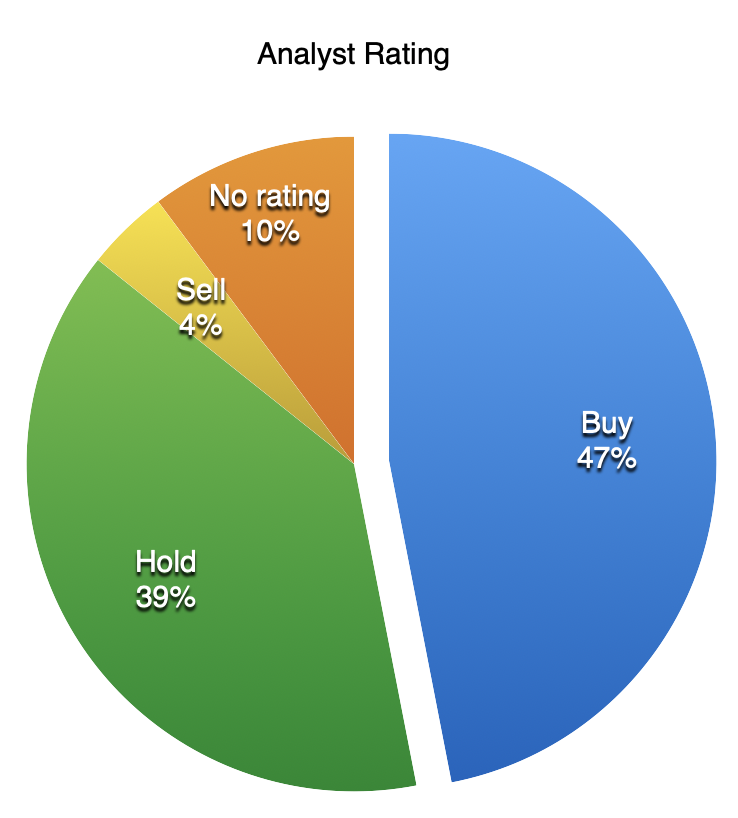
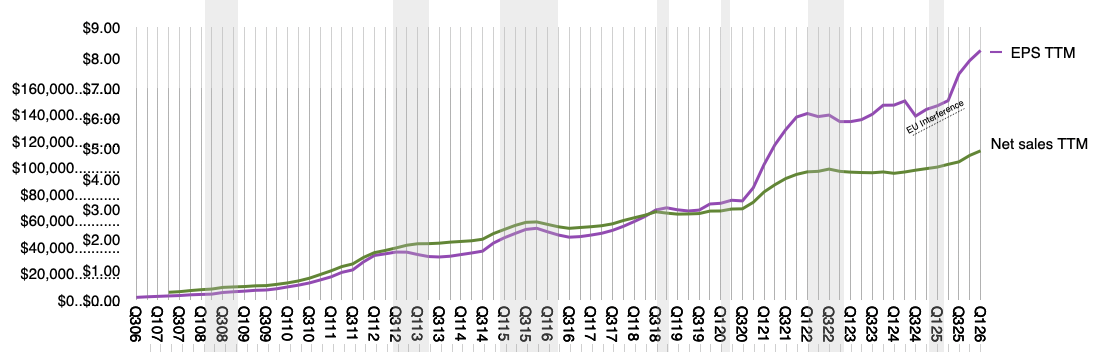
Apple has compounded net income at 26.6%, revenue at 21.5%, and share price at 27.7% for two decades, thus doubling every three years. Yet despite this, 21 of 49 analysts rate it Hold or Sell, with another 5 having no opinion. Extraordinary claims require extraordinary evidence yet assuming the Apple flywheel is about to grind to a halt is still a majority opinion. →
The App Store ecosystem facilitated $1.4 trillion in 2025. Add Apple's direct sales and the Apple Ecosystem comes to $1.8 trillion; add browsing, social, and messaging activity and the Apple Economy reaches roughly $3 trillion. Seen another way, at a $4.57 trillion market cap, Apple is valued at only 2.5 times its ecosystem and 1.5 times its economic footprint. These third-party dependencies are a measure of platform resilience and a carefully worded caution to regulators about the downside of interfering with it. →
Part 4 of the Asahi Shimbun interview turns to the spec trap. Apple maintains improvement but is selective: it ignores refresh rates beyond what the eye can see, and invests instead in features nobody asked for, like Face ID and AirPods. The phone became a machinery of vanity because the supply of cameras created demand for image editing, not the other way around. Christensen thought Apple would be disrupted by the low end. The honest answer for why it isn't is: culture, held together by extreme diligence. →
Nota Bene
Morgan Stanley reiterates $330 price target with bull-case $440 → Morgan Stanley reiterated $330 with a $440 bull case if WWDC unlocks an AI re-rating. Apple does not respond to market fads, and a multiple above 40 is almost never experienced. Disappointment after WWDC is nearly guaranteed because it has always been a software and tools show. →
Citi reiterated a Buy rating and a $315 price target → Citi reiterated its Buy and $315 target ahead of WWDC, expecting a revamped Siri to make Apple an edge AI winner. Edge AI is inevitable, but it was also inevitable two years ago. The target is already priced in, making the AI story a non-starter. →
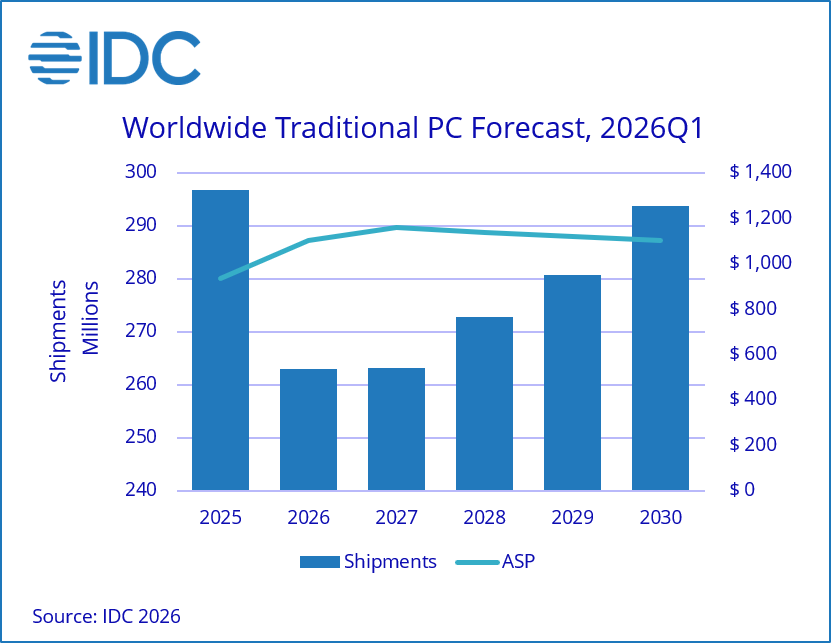
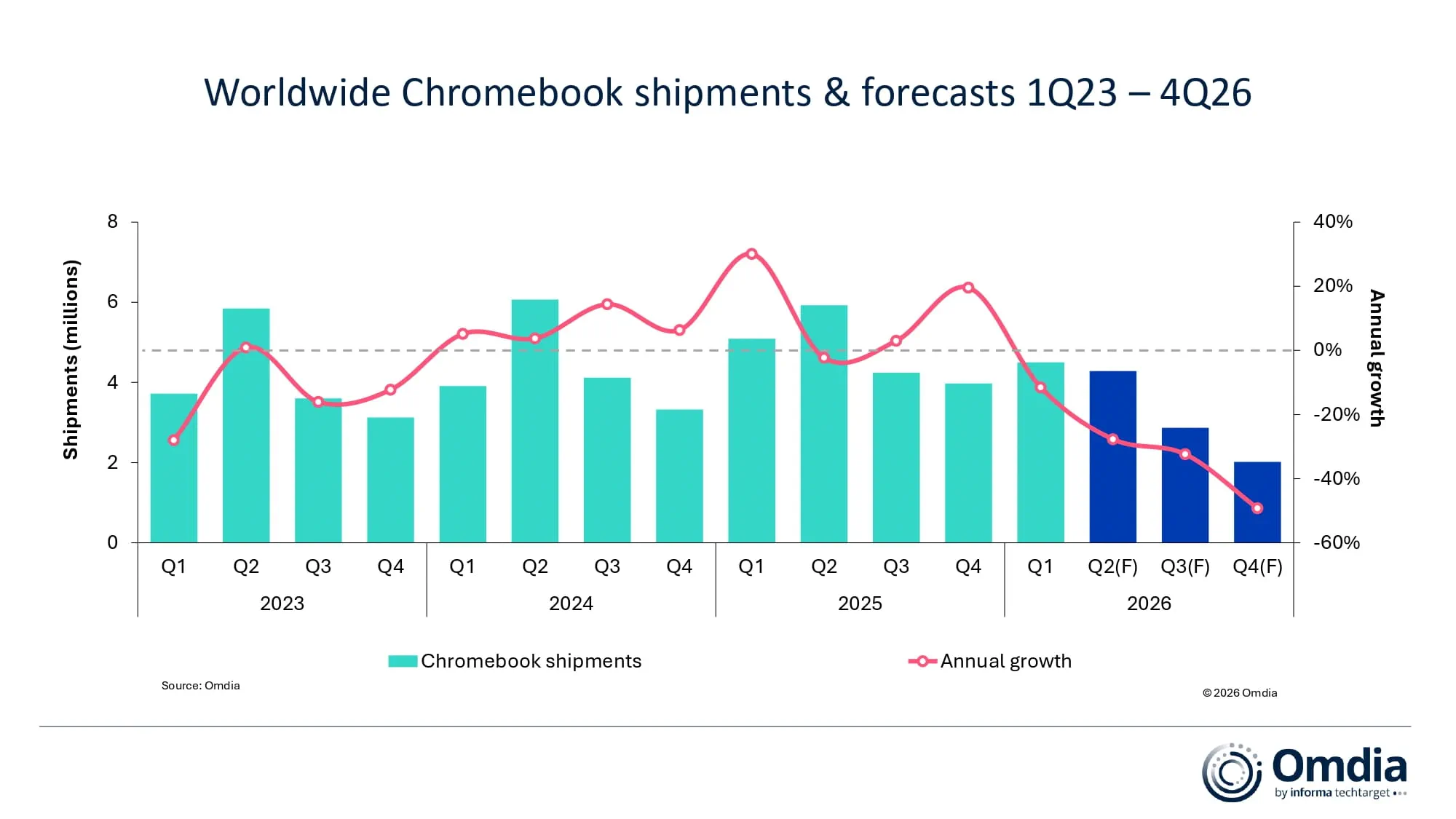
Q4 PC shipments are expected to fall 20% year-over-year, 11.3% for the full year → IDC now sees PC shipments falling 11.3% for 2026 and 20% in Q4, with no recovery in volumes until after 2030. The MacBook Neo is the only thing keeping the broader notebook forecast from being worse. This is a multi-year opportunity for Apple that may reset PC market share dynamics permanently. →
Japanese industry led the world from the 70s through the 90s because constraints forced lean, efficient manufacturing. Apple was in awe of this. What Japan missed starting in the late 90s was software, a cultural problem more than a technical one, because managing software engineers is more like herding cats. The deeper miss was customer discovery: Japan assumed quality alone would convert buyers. Many of the best product ideas start as taboos, and you never get them from surveys; you get them by observing what people actually do. →
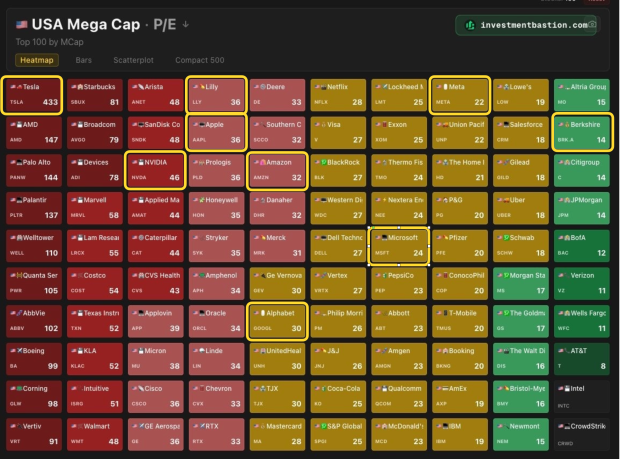
Why the most common measure for valuation is inadequate in an age of AI Software and services. Companies like Google, Microsoft, Amazon, Meta are spending on Capital Expenditures at the rate of heavy industry manufacturing. This defies their description as "asset light" business models which depend on services, distribution or platform economics. The problem isn't just semantic. It is that for their entire existence, these companies were valued for their profitability and measured in terms of a P/E ratio and earnings growth. The situation has changed dramatically. Their revenues are up, the earnings are up and growth is up and shares are up but not their P/E. Why is that? First of a series on Valuations in the age of AI→
Market contraction expected for second half of year. Omdia reports that Europe smartphone market grew 2% to 33 million units in 1Q26. Samsung was Europe's largest vendor as it grew 3% to 12.6 million units. Effective discounting of the Galaxy A16 4G helped Samsung boost volume, offsetting declines related to the delayed launch of the Galaxy S26, A57 and A37. In contrast, Apple grew 9% to 8.8 million iPhones, driven by robust iPhone 17 series demand in addition to benefiting from a wider mid-range coverage from the iPhone 15 and iPhone 16e. Apple currently captures 26% of unit volume, 43% of revenues and about 75% of the gross margin. →
Console makers overshot by listening to their heaviest spenders, who only ever asked for more performance, while mobile gaming won on user count because it served the billions who were never asked. The AI risk to Apple is the emergence of screen-less devices, where Apple typically does not compete. Given the increase in information density and the fact that our optic nerve carries far more bandwidth than other senses, the screen will likely stay dominant, and so will whoever owns it. →
Nota Bene
Bank of America increases AAPL price target considering agentic and on-device AI → Bank of America raised its Apple target to $380 on the agentic AI thesis, and at $310 the share price is approaching the median of current targets, so more upgrades are likely. The basis is a recognition that distribution still matters in an age of AI and that any agentic functionality has to integrate into the OS for cross-platform leverage, privacy, and safety. I am most impressed by how sustaining AI has been to Google, a company that looked vulnerable because of its dependence on link-based search. If Google can prosper with AI, certainly Apple can as well. →
Melius' Ben Reitzes raises price target on Apple to $385 → Melius raised Apple to $385, joining Bank of America's $380, on the thesis that an agentic Siri could replace ChatGPT-style usage for 2.5 billion devices and ignite a new App Store-scale developer cycle. I struggle to understand why none of this was evident three years ago to anyone actually following Apple and the business of technology. The allure of a new technology somehow changing everything, including human nature, economics, and centuries of business theory, is a recurring pattern. See also Tesla and SpaceX for more magical thinking. →
IDC Forecast: The smartphone market is on track for its worst year ever → IDC now sees the global smartphone market shrinking 13.9% in 2026, the steepest drop ever, with Android down 20% and the iPhone holding to a 5% decline against a $550 record ASP. The analyst story is that Apple secured memory early and positioned itself for the cycle, but the truth is simpler: scale alone ensured the supply, and Apple did not act any differently than it does every other year. Apple is forecasting 20% iPhone growth for the half while every regional analyst is reporting single digits, which means either the methodologies are failing on Apple or the company is selling into channels nobody is tracking. As with Covid, a crisis favors the strong, and in times of uncertainty a flight to value makes a lot of sense. →
The Latin American smartphone market grew 3% year over year in 1Q 2026 to 34.8 million units, supported by proactive inventory accumulation and the delayed pass‑through of rising memory costs. Samsung and Xiaomi strengthened their leading positions, while HONOR and Apple saw sharp growth supported by entry-level and premium demand, respectively. Samsung led the region, shipping 12.9 million units (+9% YoY) and lifting share to 37%, its highest quarterly level since 1Q 2023, supported by strong performance of A‑series models across low‑end and mid‑high segments. Xiaomi →
Indonesia Smartphone Shipments Fall 9% YoY in Q1 2026; Premium Segment Surges → Indonesia’s smartphone market fell 9% in the first quarter. Yet the premium tier above $600 hit a record 8.3% share and grew 30%, while the entry level below $150 collapsed 19%. Apple drove most of that surge, and the same split is appearing in Latin America and China. →
The App Store Annual Fraud Prevention Analysis → Apple blocked over $2.2 billion in fraudulent App Store transactions in 2025, part of $11.2 billion across six years. The timing, right before WWDC, is a message to the eurocrats. The alternative stores publish nothing like this, and the EU stops at market access rather than user protection. →
iPhones sales in China grew 3% year-over-year over the May Day holiday → China’s smartphone market fell 16% over the five-day May Day holiday as higher memory prices dampened upgrades. The iPhone still grew 3%, and against a wave of fresh competitor launches. Apple guided to the same growth in June that it delivered in March. →
Asymetric
Asymetric Episode 137 — E is Our Friend → On the podcast I ask whether a crash is coming. Remember that E is our friend: earnings are an opinion, cash flow is a fact, and a share price is a dream. The Mag 7 pour half a trillion into data centers yet still trade like software companies. →
Now in BETA
Asymetric Podcast is now available directly to Asymco One subscribers. See asymco.com/podcasts.
To download Asymetric, login then visit asymco.com/podcasts.
22% EPS growth is implied based on guidance. To review, "We expect our June quarter total company revenue to grow by 14%-17% year-over-year, which comprehends our best view of constrained supply. On iPad, keep in mind, we face a difficult compare driven by the launch of the A16-powered iPad in the prior year. We expect services revenue to grow at a year-over-year rate similar to what we reported in the March quarter after removing the favorable year-over-year impact from foreign exchange tailwinds. Keep in mind, during the March quarter, FX was a 2.5 percentage point tailwind to the total company growth rate, and for services, →
A Series on Valuation in the age of AI Apple recently hit an all-time high. Today the stock is trading at a P/E of 35. The P/E ratio is the current share price P divided by the last four quarters’ net earnings per share E. But we also have a pretty good idea of the earnings for the next quarter, ending June (now almost half-way completed). The guidance very clearly suggests that on a one Quarter forward basis the P/E ratio is 34. I’ve maintained for at least 15 years that a reasonable multiple for Apple is 35.
Stay tuned for upcoming Asymco One original research:
Why the most common metrics for valuation are insufficient — the problem with the P/E ratio
What are the alternatives that into consideration exceptional cash and capital expenditures — The EV/FCF ratio
How does the P/E ratio differ from EV/FCF and what does it mean if they diverge one way or another
How do the Mag 7 et. al. appear on these Metrics
How to complement snapshots like valuation ratios with the time series of fundamentals
Why payback measures are the ultimate measure of valuation
What are the current payback measures for the Mag 7 et.al.
Compare Apple to its peer group
Finally assess whether a collapse in confidence is imminent
The Smartphone Market is Cracking → Apple takes 45% of revenue and nearly all the operating profit. Samsung makes more on memory than on phones, and Google is preoccupied with cloud and AI. The situation is hopeless for anybody but Apple, and market may break altogether next year. →
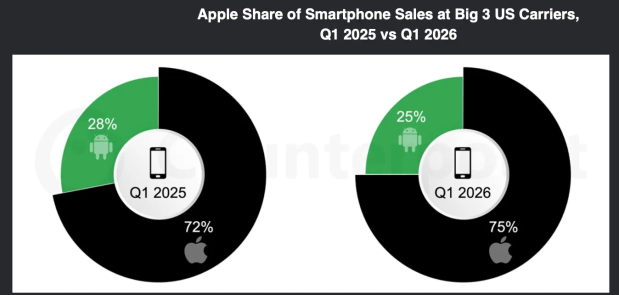
iPhone Share of US Big 3 Carriers reaches 75%, 77% with Verizon → At the low end, rising memory costs are consolidating prepaid around Motorola and Samsung. Smaller players are exiting. At the top, Apple held iPhone 17e pricing flat and doubled entry storage to 256GB; for manufacturers with thin hardware margins, this will be tough, perhaps impossible. A bifurcated market is emerging. →
Office Hour Q&As
The great memory panic of 2026 → Apple negotiates the base load on two-year lead times. The spike is at the margin, on variable spot supply. That is where the smaller suppliers live. Every semiconductor boom is followed by a bust. →
Will Apple Silicon Tackle Memory? → These commitments take years. Memory may come next, the way Qualcomm did. TSMC is the question after that. Capability is not willingness. →
What Are the Mobility Design Surfaces? → Public transport is shared. Micromobility is a heads-up experience. Cars are a lousy business, and the other modes offer almost no design surface. The opportunity is spatial computing outside interior spaces, where the entire world becomes the surface. →
This is the first part of a series of excerpts from an interview with Asahi Shimbun newspaper on Apple & Innovation:The Asahi Shimbun Interview Part 1: Horace Dediu / Takeshi Narabe & Dylan Weir / Asahi Shimbun Interview, April 2026 Takeshi Narabe.
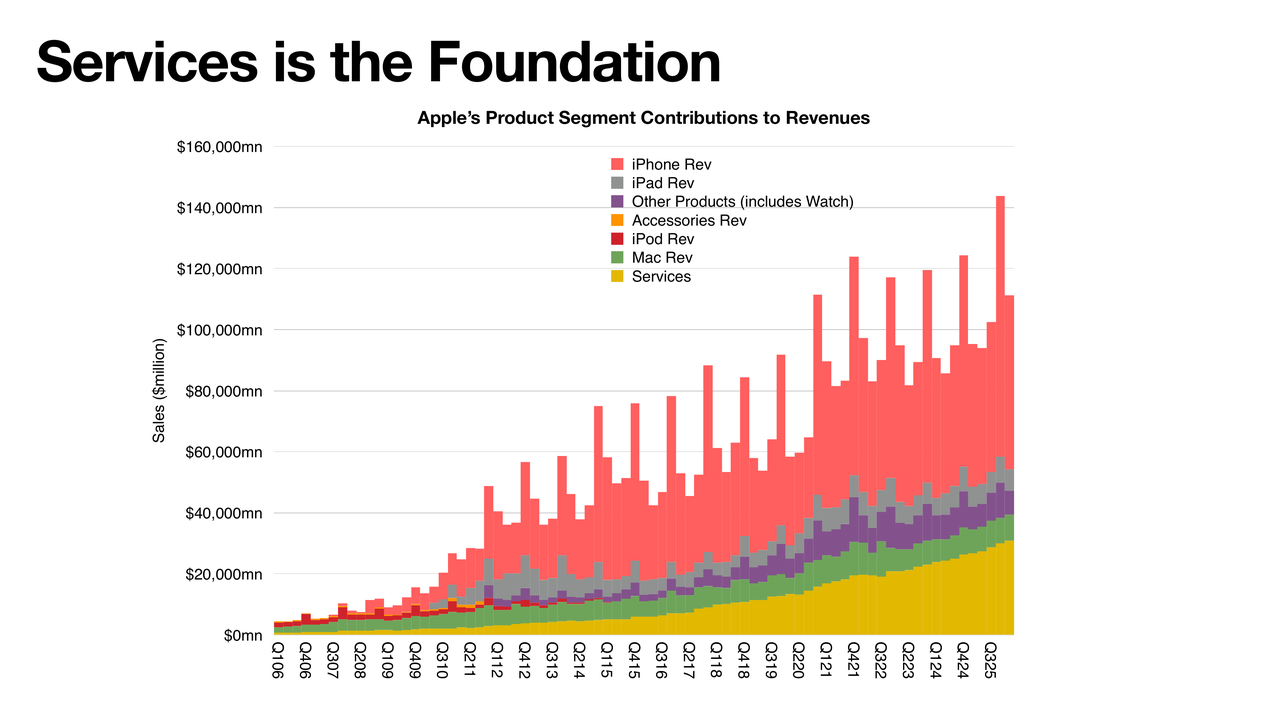
We have to recognize Services has only been a story for the last 10 years. And arguably integration of software hasn’t been really all that important before 1998 when Apple brought Steve [Jobs] back and with him came NextStep, which was [an] operating system based on Unix. And that was much more robust and much more focused around software engineering than the original MacOS. Or, what I would say [constituted] version 1 of Apple, which began in 1970s until the 1990s.
Culture in the sense of what are the priorities? What do we concentrate on and to what degree do we need to focus? They [management] repeat these things all the time. Focus, focus. What means this? It means saying no to many things, but it also means saying yes to the things where you can bring great things to bear. It’s where Apple has a unique advantage. And that means saying no to a lot of things.
Tata Electronics' rapid workforce expansion to 75,000, driven by strategic investments and acquisitions, positions India as a rising powerhouse in electronics manufacturing, rivaling China's model.
If we add Tata and Foxconn, we are probably in the 200,000 range this year. The comparable China model is …
Apple maintains iPhone prices amid rising Android costs to boost market share, leveraging a two-track model to balance accessibility and profitability.
There is always a huge surprise when Apple does the same thing it always does.
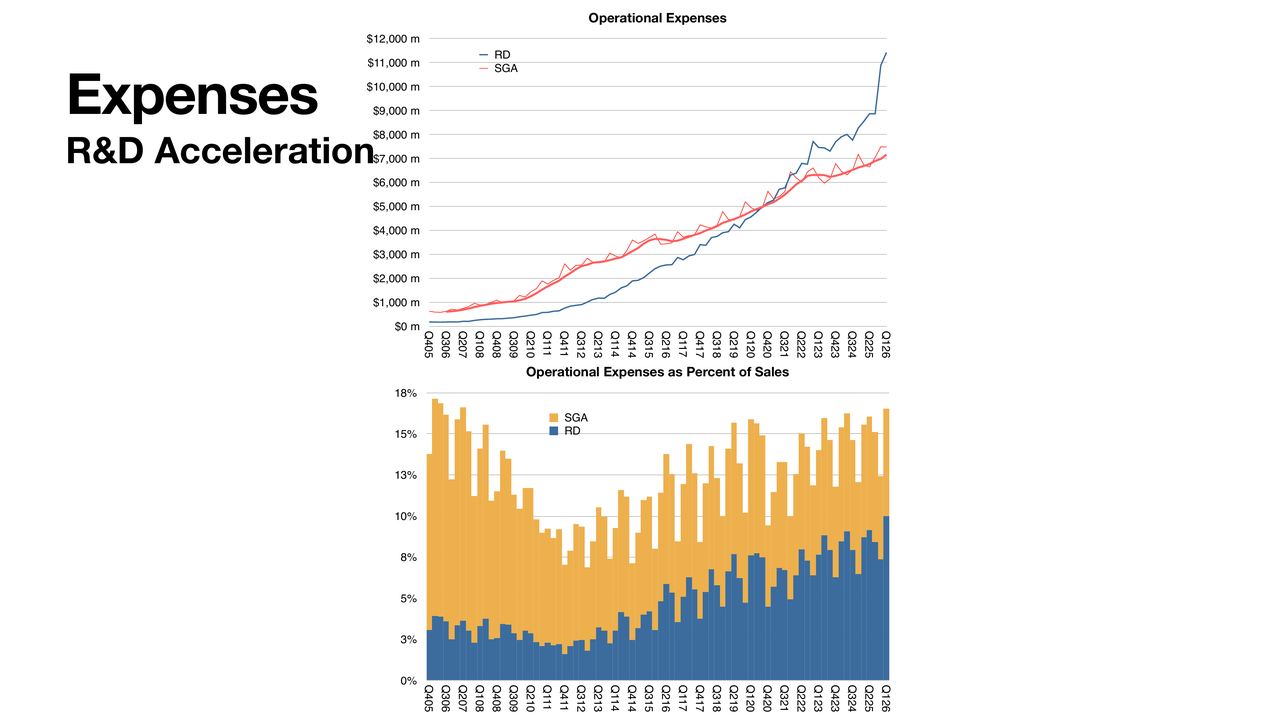
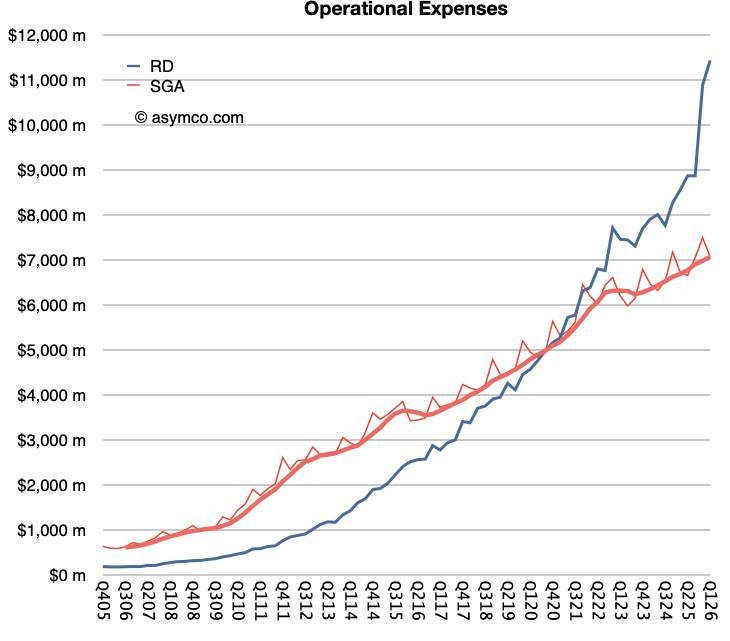
Apple's R&D spending surged to 10.3% of revenue, driven by AI advancements, while maintaining a distinct, less infrastructure-heavy capital expenditure strategy compared to peers.
Apple has been increasing its R&D spending from around 2% to 9% of sales on a 4-trailing quarter basis. It has overtaken SG&A which has remained around 7% since 2011.
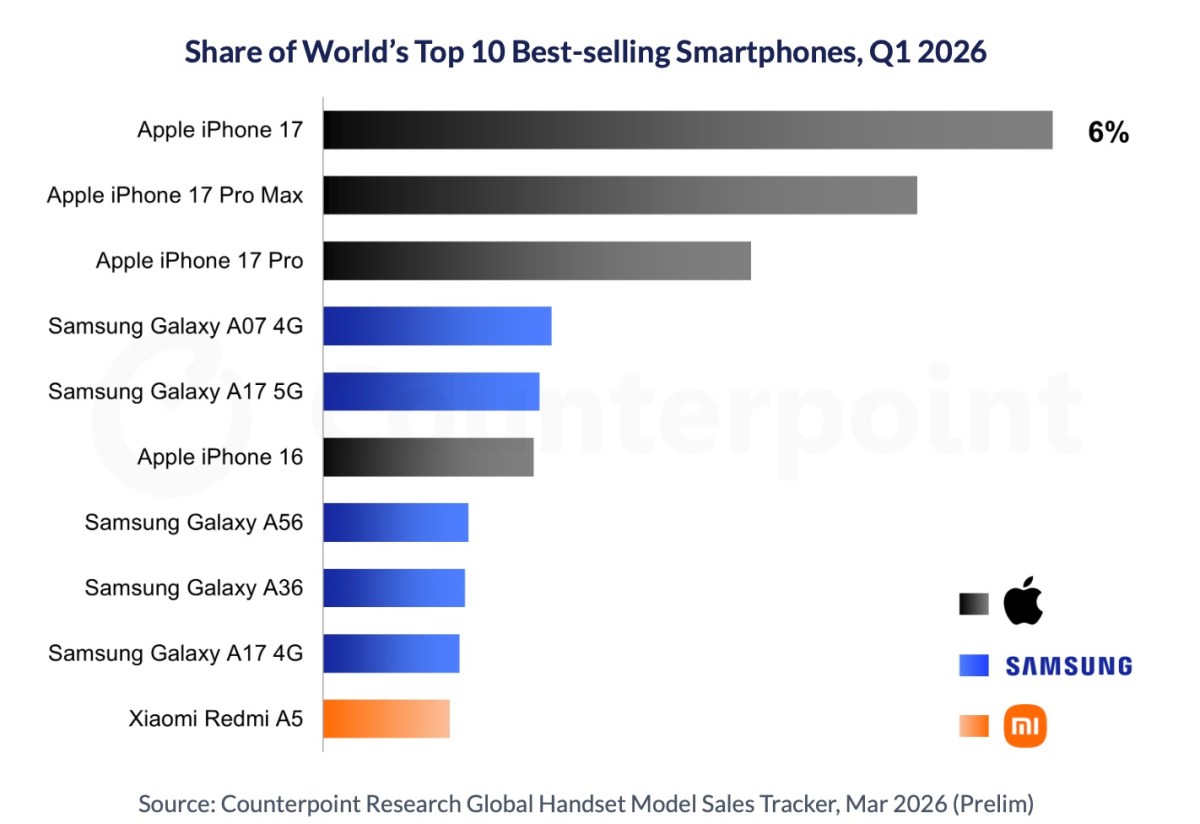
In Q1 2026, iPhone 17 dominated with 6% global sales, securing the top three spots, while Samsung's five models highlighted a record 25% market concentration amid component cost pressures.
There are over 450 brands and over 6000 phone models in the market yet 10 models from 3 brands make up 25% of sales. The near future is harsh…
Tech giants like Alphabet, Amazon, Meta, and Microsoft are heavily investing in AI infrastructure, risking near-zero free cash flow in 2026, betting on future dominance despite current financial strain.
Even before these future investments are considered, for the trailing twelve months Alphabet’s EV/FCF has his 73 vs. a P/E ratio of 29. If FCF goes to zero…
Will John Ternus's tenure as Apple CEO will likely intensify criticism, echoing past scrutiny faced by Steve Jobs and Tim Cook, due to inherent public and media skepticism towards new leadership. →
Speculation on Apple's potential to revolutionize high-end computing by integrating powerful AI capabilities directly into personal devices, shifting focus from centralized cloud services to edge computing. →
Jay Goldberg speculates that Apple may invest in developing its own server chips to reduce dependency on Nvidia, similar to moves by Google and Amazon. . →
The potential legal risk for Apple in combining products and services centers on antitrust concerns, particularly the "gatekeeper" theory in Europe, which argues against bundling services by a dominant hardware platform to exclude competitors. . →
Asymco Bulletin is a digest of all the work we have published for the week ending May 3, 2026.
Editor's Note: Starting next week, we will be sending Asymco Bulletin to Asymco One subscribers only. You will still receive Updates when new posts are published per your notification settings.
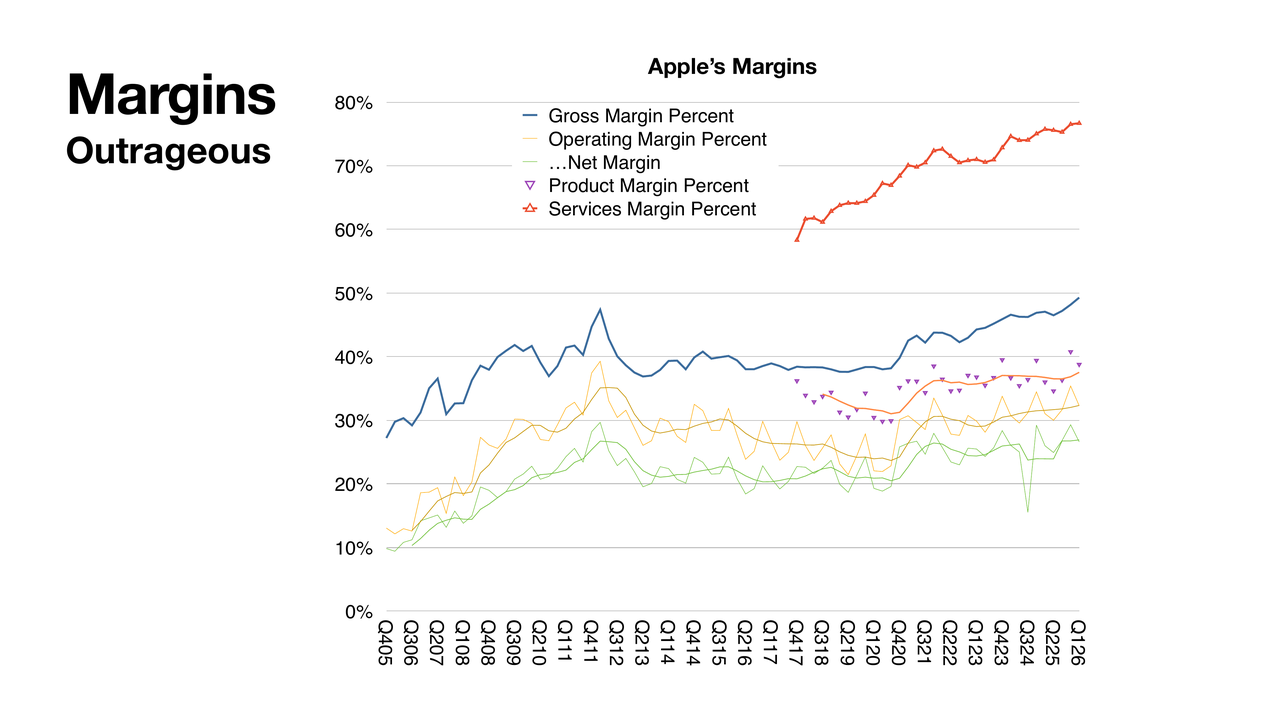
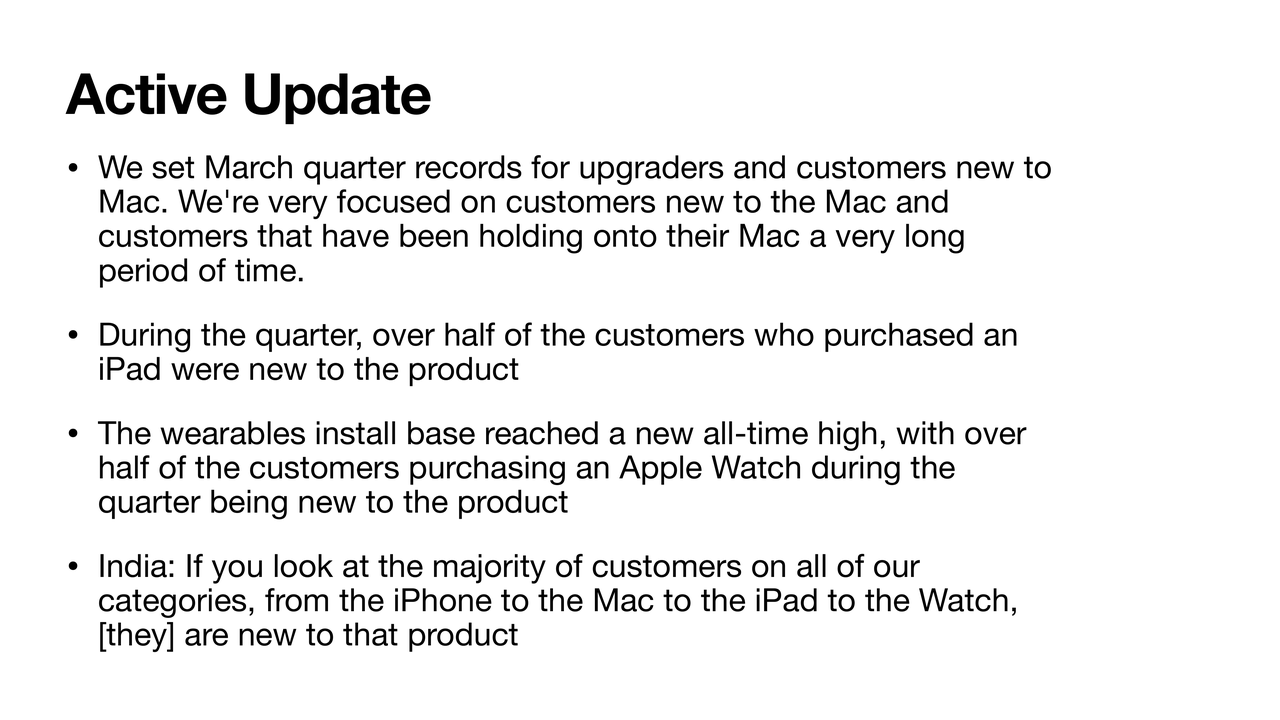
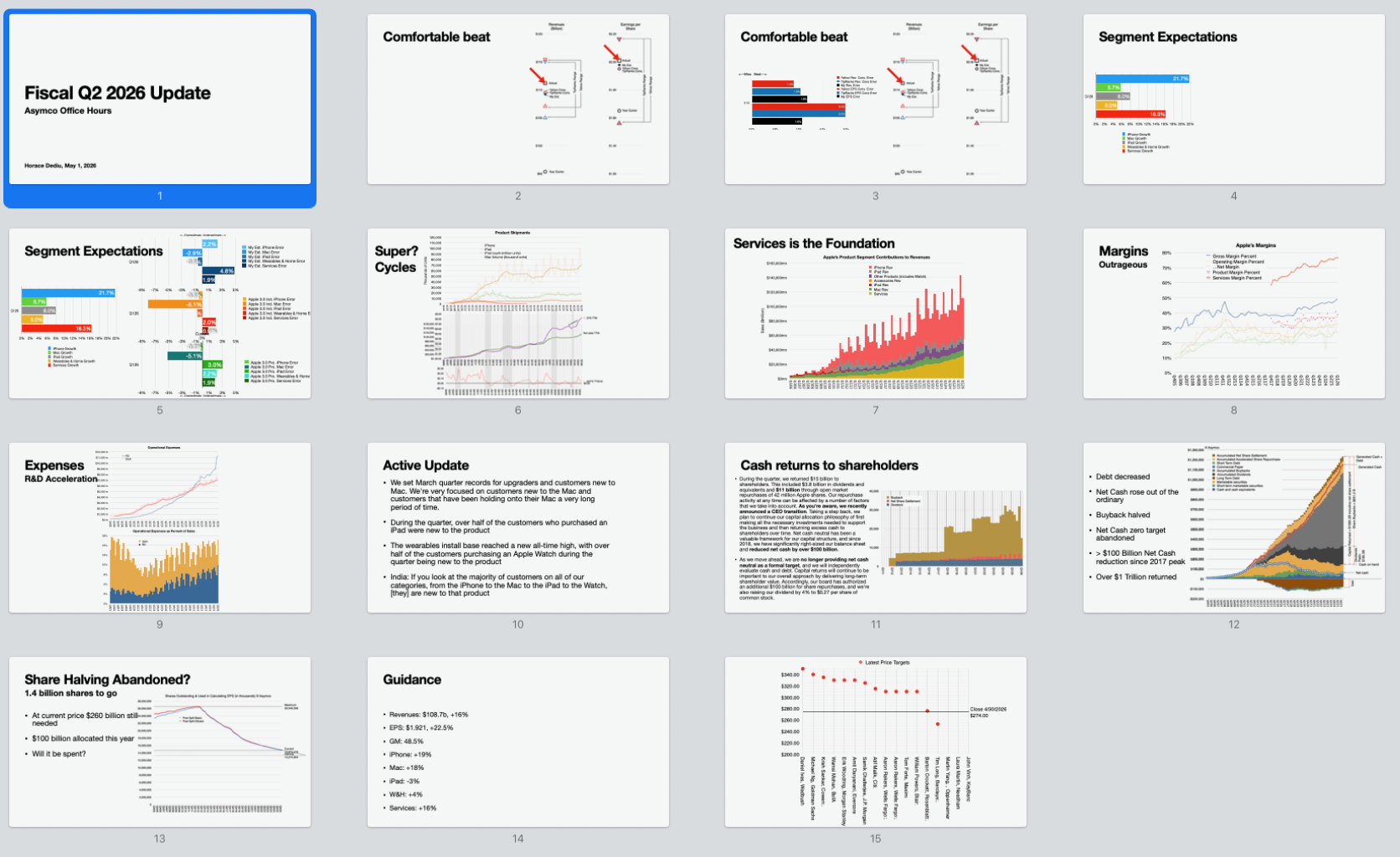
In Asymco One's May 1, 2026 Office Hours session, review of Apple's Q2 2026 earnings, segment growth: iPhone at 22%, Services at 16%, iPad at 8%, Mac at 5.7%, and wearables at 5%. Steady, foundational growth of Services, Gross margins reached nearly 50%, R&D spending surged, a shift in Apple's capital return strategy showing perhaps the hand of John Ternus. Guidance suggests 16% revenue growth, 22% EPS growth. Analyst sentiment turned positive post-earnings, with most price targets rising above $310. Apple's evolving identity as an engineering-centric company was the focus of many questions. →
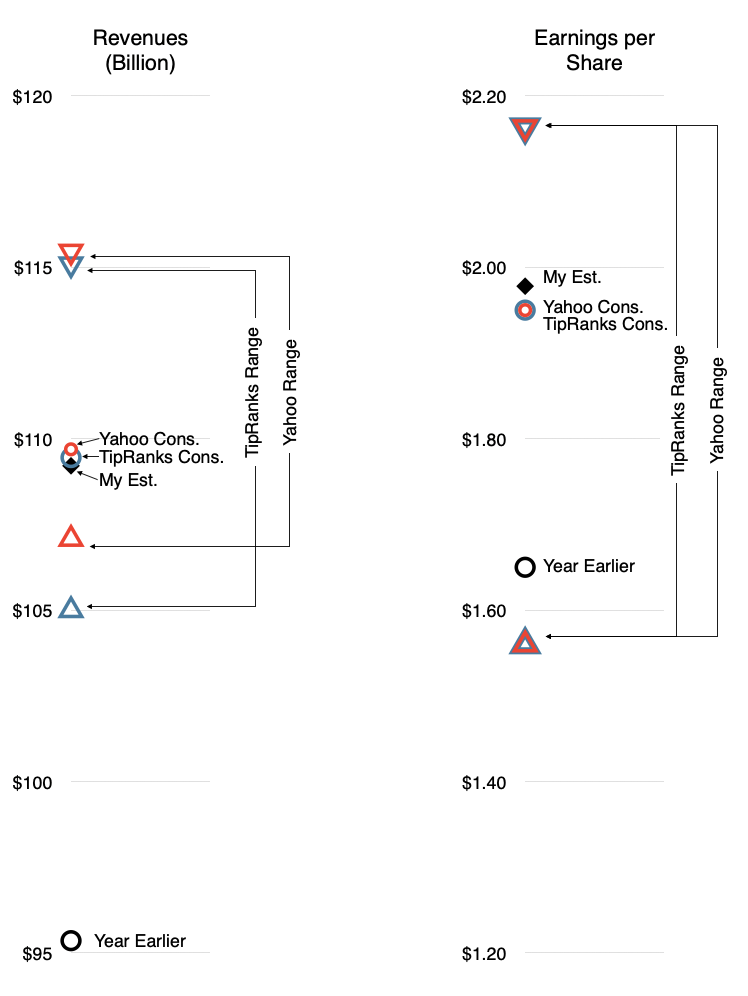
Revenue and EPS consensus, year-ago results and my expectations Yahoo Finance Yahoo Finance’s revenue estimate for Apple in Q2 stems from 31 analysts. As of April 25, the average estimate is $109.69 billion, with a low of $107.08 billion and a high of $115.37 billion. For the earnings per share estimate, 32 analysts put it at an average of $1.95. The low is $1.56 and the high is $2.16. TipRanks TipRanks also does its own analyst polling on Apple’s quarter. In its forecast as of April 19, its consensus is for a revenue of $109.45 billion, with a high of →
TD Cowen: 15% revenue growth, 10% growth guidance → Apple is projected to gain market share in both smartphones and PCs, driven by strong iPhone 17 demand and the new MacBook Neo, with anticipated revenue growth of over 15% in Q3 and positive sentiment ahead of earnings.
Morgan Stanley forecasts fiscal second-quarter EPS of $1.74→ Despite memory pricing pressures, Apple's strong iPhone sales, potential AI and foldable iPhone announcements, solid free cash flow, and favorable market conditions position it for better-than-expected earnings and a possible stock rise to $300 by September.
Is Apple borrowing Samsung’s Market Expansion Strategy?→ Bernstein SocGen maintains optimism on Apple's strategic pricing and ecosystem strength, forecasting EPS growth and potential market share gains, while Samsung faces smartphone profit challenges but thrives in memory.
Separately, it’s been reported that Samsung might see its first operation loss from its phone division, resulting in Apple capturing 100% (or more) of global smartphone profits. Simultaneously, Samsung is seeing huge profit gains from memory, even overtaking Nvidia’s profitability. This is remarkable…
Apple share of the smartphone SoC market grew from 15% to 19% in Q1 → In Q1 2026, global smartphone SoC shipments fell 8%, but Apple thrived in the premium market by leveraging its efficient supply chain and passing costs to consumers, boosting its market share from 15% to 19%.
Google to sell TPU chips as Gemini shows returns → Why pour cash into Nvidia when you can craft your own cutting-edge chips like Google, and then turn that innovation into a lucrative side hustle by selling them to tech giants like Meta and Anthropic?
The Vision Products Group Expanding → Gurman's 2025 dissolution claim clashes with 2026's active Vision Products Group hiring spree. The Vision Products Group posted 14 new senior roles last week.
A part of Horace's interview with Asahi Shimbun on the 50th Anniversary of Apple's founding. The portion here discusses management succession and occurred on April 1. Apple announced the succession of Tim Cook as CEO to John Ternus last week. This analysis of Apple leadership decisions focuses on culture and attributes of the firm rather than attributes of the persons leading it. It may prove a more reliable predictor in future leadership changes.
…, the speculation is John Ternus is the next in line. I think that's a very plausible hypothesis. And one reason, by the way, is I always maintain if you study the company from a cultural point of view, you'll realize that there are people who cannot be CEO. You may not know who it's going to be, but I can tell you who won't be. Many people over the years suggested candidates, and I would say no, never. And here are examples. Johnny Ive would never be CEO. An external hire would never be CEO. Even a head of marketing would never be CEO. Many people think that Apple is a brilliant marketing company. No, it's an engineering company. It's a huge secret out there. →
Writing the story of John Ternus' tenure as Apple CEO from April 21, 2040. What changed and what didn't.
It’s been 15 years but John Ternus has finally stepped down as Apple CEO. Analysts described the transition as expected rather than disruptive, noting that investors had long anticipated Ternus’ eventual departure. Nevertheless, he leaves with many questions still unanswered about Apple’s long term strategy. Apple incoming CEO faces a defining challenge: Fixing the company’s Services dependence. It’s been a tumultuous tenure for Ternus but he is leaving with significant accomplishments: John grew Apple devices to 4.5 billion from 2.5 billion when he took over in 2026. Many have pointed out that he has been building on… →
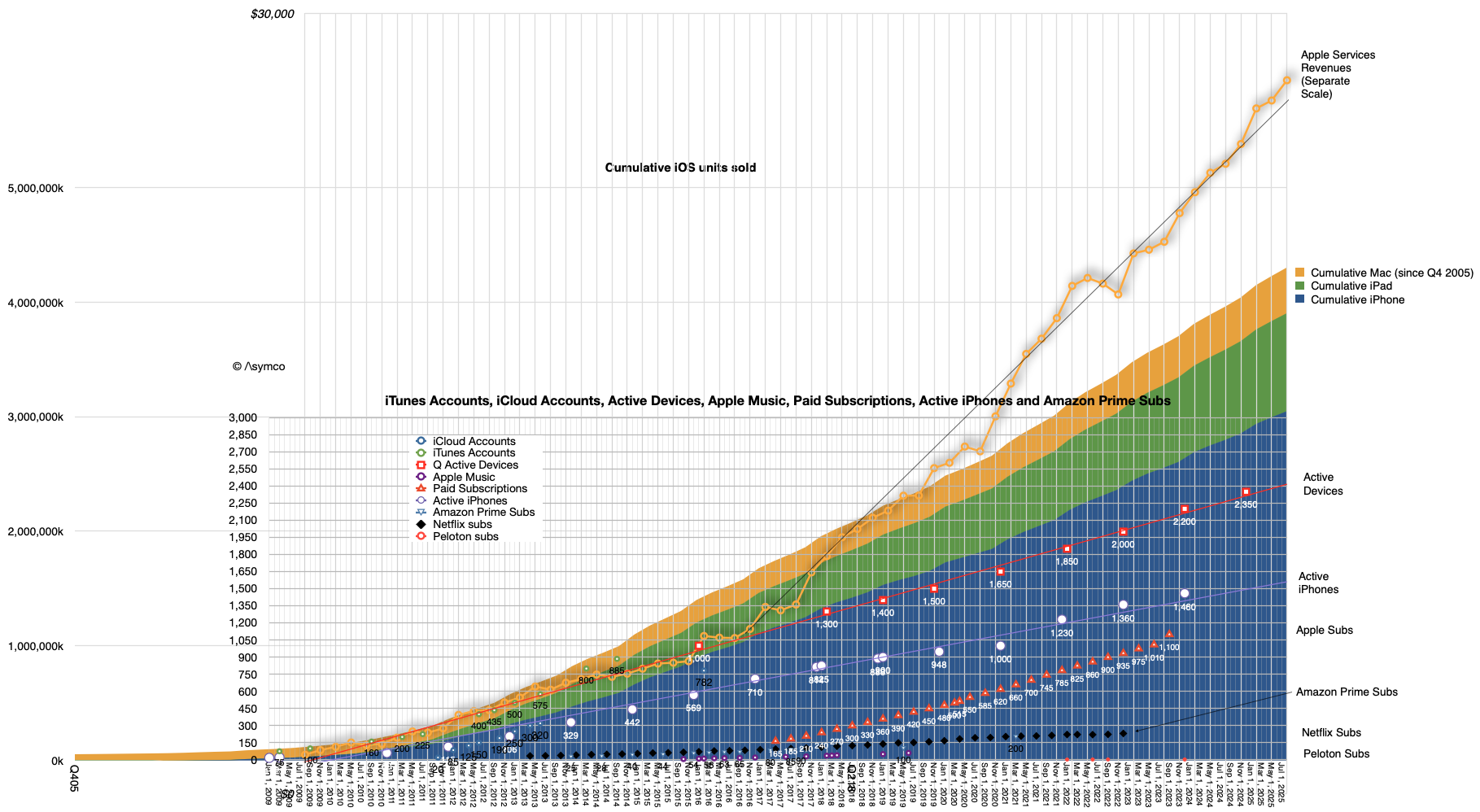
In January this year Apple reported that there were 2.5 billion active Apple devices in use. This figure has been getting updated for years and I’ve been reporting its trajectory and other measures that are correlated to it. For instance the number of Apple subscriptions, Apple Services revenues and other historical indicators such as iCloud accounts and Apple Music.
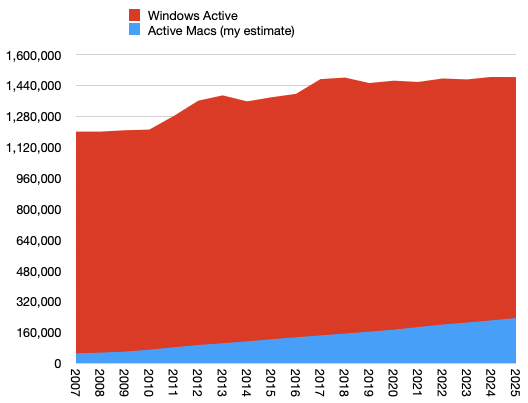
Simplifying, I published the “ACTIVE” model which makes some basic projections of this total device count and it’s shown below” One element of the analysis that has eluded me was the more precise composition of this total “devices”. →
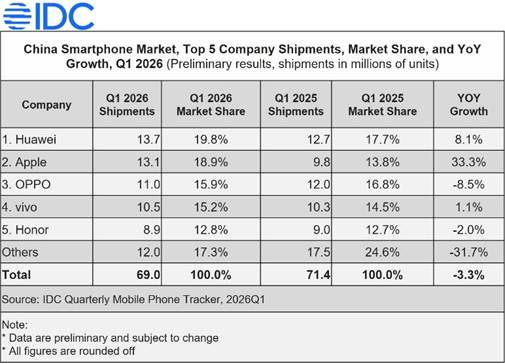
Both researchers say Apple share in China is about 19%, nearly tied with Huawei at 20%…
Some analysts are increasing their targets finally realizing that the memory supply crisis might be beneficial to Apple. This should have been noted already three months ago when Apple provided extraordinary guidance for the March quarter. →
MacBook Neo Sold Out Through April → Despite high demand and stockouts, Apple's strong brand and competitive pricing could turn challenges into opportunities for market expansion.
Microsoft’s cheapest laptop is three times more ex…
As I will argue in a further post perhaps this is one of those pivotal moments. →
Goldman forecasts fiscal second-quarter EPS of $2.00 → Goldman Sachs remains bullish on Apple, forecasting $2.00 EPS driven by strong iPhone and Services growth, dismissing overly pessimistic sentiment as the company consistently gains 100 million new customers annually.
My target of $1.98 seems amiss.…
What is always happening, the reaction that is always ongoing, is the creation of 100 million new customers every year. Accelerating this process is not a matter of just new products or change in sentiment with AI. Much of this rate is due to overall global economic and demographic change. →
What’s the consensus on $AAPL? → Apple's strong analyst backing with a 15:1 Buy:Sell ratio and $315 target contrasts its 39% year-to-date rise, overlooking potential future growth.
The consensus is positive though share price target does not consider significant share gains and service growth acceleration into 2027.
NB: The consensus is positive though share price target does not consider significant share gains and service growth acceleration into 2027. →
Apple 3.0: JP Morgan expects that Apple will beat its own guidance next week → Analyst Samik Chatterjee projects Apple's EPS to rise to $2.05 from $1.96, driven by strong iPhone and Mac demand, with a revenue boost to $112.7 billion, while I estimate a slightly lower 20.2% EPS growth, anticipating guidance will be met.
Read the original for a more detailed commentary from Chatterjee. He implies Apple will grow EPS 24%…
…My own estimate is about 20.2%. I look forward to a lively quarterly update. The primary source of growth must be the iPhone and I have that growing at 19% revenue growth. Last quarter the growth was 23%. Perhaps Chatterjee is assuming a similar growth rate into March quarter. That is not impossible but I am assuming guidance will be met rather than exceeded. →