Sonera has developed a new sensing modality that non-invasively measures magnetic fields generated by the body, in contrast with the electrical sensing techniques commonly used today. This proprietary technology holds the key to making brain activity as easy to measure as heart rate, temperature, and other physiological signals, and enabling data-backed insights related to movement, health, thoughts, and emotions.
The press release, first discovered by MacRumors, mentions an S1 chip which could “enable an entirely new class of consumer wearables and experiences based on muscle activity.” Sonera’s proprietary approach “measures magnetic fields produced by the electrical currents from neural activity” and thus bypasses the need for direct skin contact.
It’s unclear how much progress Sonera has been able to make since that 2023 press release. But clearly, Apple found something of value in their technology.
NB: My thesis is that Apple has always placed itself at the interface layer between human and machine. The original "personal" computer, the various input methods (mouse, trackpad, scroll wheel, multi-touch, glance&sensor, spatial computing and audio). The pattern of acquisitions of technologies which deduce or detect human intention including hand/facial gestures, motion sensing, biometrics, and health are part of a pattern.
In this case it's a form of sensing that I was not even aware of: magnetic fields. Sonera developed a magnetometer designed to measure weak magnetic fields generated by brain activity in a portable and cost-effective device. The company's magnetometer works on acoustically driven ferromagnetic resonance and can operate at room temperature and in portable form factors with sensitivity, enabling technological industries to expand access to the powerful neurodiagnostic tool, as well as open the door to the first practical, non-invasive brain-computer interface.
The company appears to have been spun out of Berkely in 2018 so presumably the research predates this by a few years.
The next stage of human/computer interaction…
…might be enabled by these subtle methods of intention detection. The old adage that 80% of human communications are non-verbal gives some credence to the notion that computers need to read us better.
So whereas spending on inference is approaching infinity, Apple is quietly investing in interfaces. The question underlying this is whether humans are still the interesting points of investment. Humanism in computing might be less attractive to capital today but I'm willing to wager that humans will still be the pivot point for profitability.
Stryker recently announced the successful completion of the first hip arthroscopy procedure using its SportSuite Vision application on Apple Vision Pro at Duke Health. The milestone follows the FDA's De Novo authorization for the application in July, making it the first surgical application approved for intraoperative use with Apple's mixed reality headset.
Following the FDA's De Novo authorization on July 17, SportSuite Vision became the first application cleared for intraoperative use with Apple Vision Pro, establishing a new regulatory benchmark for spatial computing in the operating room. The first live use of the technology took place during a hip arthroscopy at Duke Health, where orthopedic surgeon Chad Mather III performed the procedure, demonstrating the platform's transition from regulatory clearance to real-world clinical adoption at a nationally recognized academic medical center.
NB: Separately, Nabla is providing AI-based clinical dictation on-device for Apple computers.
As with the work of Dr. Tommy Korn, the benefits for surgeons is to make hip arthroscopy more intuitive by keeping critical clinical information within the surgeon's line of sight throughout the procedure. Instead of looking at multiple monitors around the operating room, surgeons can arrange key indicators based on their preferred workflow and access it within the sterile field. This creates a more comfortable environment, reducing unnecessary head movement and keeps essential information easily visible during surgery.
Initially the Apple Vision Pro is providing efficiency innovations for surgery. Ultimately, as we shall see, it will compete with non-consumption and create new demand for procedures and allow non-experts to do more of the work currently requiring expert-only attention.
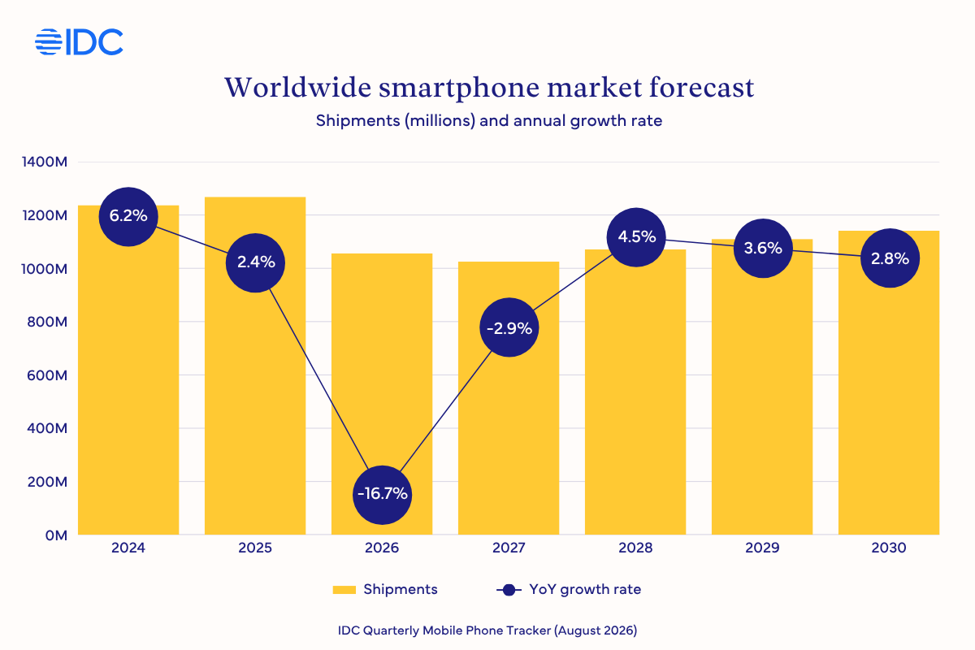
Highly anticipated foldable launches from Apple and Huawei Technologies next week are expected to offer a much-needed lifeline to a subdued global smartphone market, which is bracing for an estimated 17 per cent decline in 2026.
Analysts are counting on Apple’s foldable debut to lift a sluggish smartphone sector reeling from soaring component costs.
“Apple’s entry into the foldable market has done more than reignite growth in a category that was losing momentum,” Nabila Popal, senior research director at research firm IDC, said on Wednesday. “It has fundamentally altered the market’s trajectory.”
Popal projected that Apple would ship more than 17 million foldable iPhones by 2027, capturing about 40 per cent of the global foldable market.
“Apple is positioned to challenge Huawei and Samsung for leadership in markets where they have long dominated – an extraordinary outcome for a product expected to be less than two years into its life cycle,” Popal said.
Global smartphone shipments are expected to fall 16.7 per cent this year, which would mark their steepest annual contraction on record, according to IDC’s latest report. The forecast is down from the research firm’s previous estimate of a 13.9 per cent decline, issued last quarter.
“The memory tsunami that we warned about is now hitting the market in full, and consumers are starting to pay the AI bill,” said Francisco Jeronimo, vice-president for worldwide client devices at IDC. “The era of the cheap smartphone has ended."
“From here, the winners will be the vendors with the scale and supply leverage to hold demand at prices consumers have never had to pay before.”
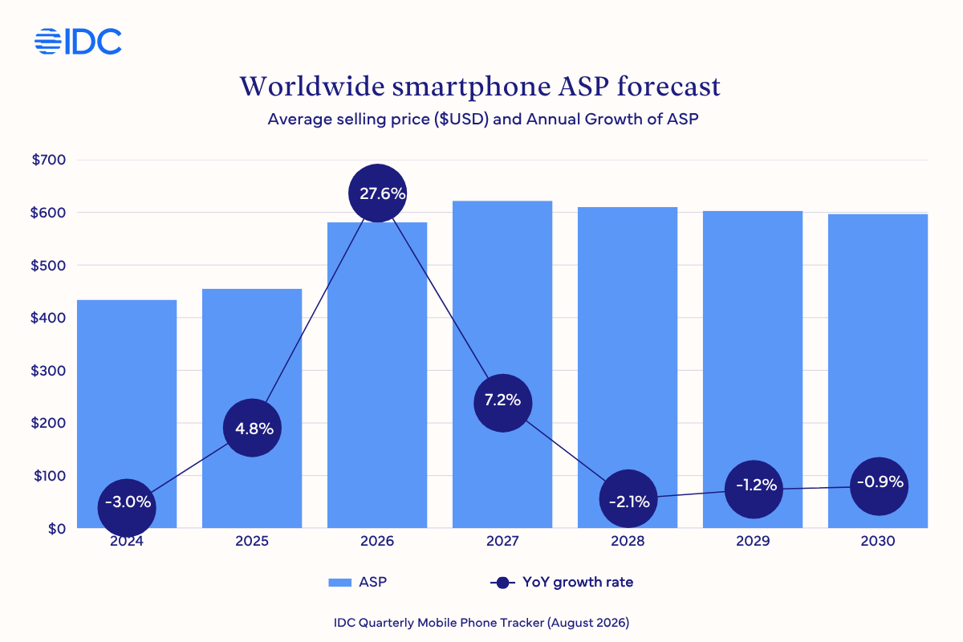
NB: Second half of 2026 shipments are expected to fall by more than 27%. ASP is forecast to rise 27% to $581 this year (revised from $550). The IDC view that Apple will shake up the foldable market is a mistaken understanding of how markets are created.
There is no "foldable market" since the market is not defined by form factor or particular mechanism of operation. There is no "thin phone" market or "touch ID" market. The market is delineated by iOS vs. Android with significant fragmentation within Android between OS variants but also between vendors and their distribution partnerships. It is then sub-divided by price and jobs to be done.
The possibility that Apple will launch a foldable means that Apple will create the market for iOS folding phones. That market currently has a size of zero. Its potential size remains to be determined but it probably has been estimated by Apple on the basis of their knowledge of their customer base.
The second aspect of this article is on the change in IDC's estimate for the year. This is not a change in thesis but on the scale of the decline in volumes and increase in pricing.
"Smaller Android brands anchored in the entry tiers face the hardest stretch in the industry’s history, and some will not clear it. The market that emerges on the other side of the crisis, when the memory supply finally stabilizes in 2028, will be smaller in units, larger in value, and far more concentrated at the top. The cheap smartphone era is not pausing. It is over."
The idea that a mature market enters a "post low-end phase" or the end of the cheap smartphone is a development that needs far deeper consideration.
I will address this in a research note separately.
When it thinks about customer convenience, Walmart waits 12 years.
When we think about convenience, we think about a lot of things, but making shopping feel simpler and more seamless from start to finish is a big part. And one of the moments where that matters most is at checkout.
Beginning Aug. 24, we will be adding Tap to Pay to our payment options at select Walmart stores and Sam’s Club locations, with plans to roll it out to all U.S. stores and clubs by the end of 2026 and to fuel stations by mid-2027.
My expectation six years ago was that Apple Pay would be a “$1 billion business” by 2020. This was based on a take rate of 15 basis points ($15/$10,000 in transactional value). Juniper Research, which regularly examines payment transaction markets, now expects that Apple will see global Apple Pay transactions of $686 billion by 2024.
At that 15 basis point rate it amounts to $1.03 billion. Thus this particular research suggests that I was off by 4 years, making the $1 billion pay day a 10 year target rather than six.
What's the state of Apple Pay today?
According to various sources, Apple Pay handled $7.6 trillion in transactions in 2025. From that, Apple Pay generated an estimated $5.6 billion in revenue in 2025. ($7.4/$10,000 or 7.4 bp, half of the take rate in 2014) This is a significant increase from $6 trillion in transactions estimated in 2022. My estimate of $1 billion in 2020 seems to have been conservative.
Apple Pay’s user base has surpassed 818 million in 2025. This represents a significant increase from 2022's 507 million users. 65.6 million were users in the US.
Projections are that the user count will climb to 87.5 million users in the US by the end of 2026. Surveys suggest that over 22% of the US population aged 14 and older uses Apple Pay daily.
The service now handles about 10% of all global card transactions, doubling its share from a few years ago. In the US, Apple Pay accounts for roughly 5.6% of all retail sales, including both in-store and digital channels. In the US alone, Apple Pay is expected to facilitate $2.9 trillion in payments, accounting for 32% of all contactless point-of-sale activity. Apple Pay has a 49% mobile payment market share in the US as of 2025. This is double the share of second placed Google Pay.
Notably, 62% of Apple Pay users live in households with an annual income above $100,000.
94% of US retail establishments accept Apple Pay in 2026. This number has reached near-ubiquity in the US, up from 85% in previous years. With WalMart's 12 year delayed acceptance the total will reach even higher. Globally, the service is now available in 95 countries.
Apple now processes more than 14.2% of all online consumer payments. This share is growing rapidly.
As of 2026, more than 11,000 banks worldwide supported Apple Pay. The number doubled from 5,480 in 2020.
Apple Pay accounts for 54% of all US in-store mobile wallet transactions. Apple is dominating this market, with Google Pay and PayPal at around 13% each. 71% of Gen Z mobile wallet users in the US choose Apple Pay first and consider digital wallet as primary payment option. Gen Z currently has an 8.8% usage rate among the total US population, compared to 4% for Millennials and 1.1% for Gen X.
Over $1 billion in fraud was eliminated globally through Apple Pay in 2025.
Why Walmart could not …
accept this reality for 12 years speaks to a peculiar myopia probably rooted in an outdated strategic vision of cost minimization.
Regardless of this, the irony of citing customer convenience as a factor in the decision does not address why it took 12 years of customer punishment to come to the conclusion that what they can't measure (satisfaction) trumps what they can measure (6.4 basis points of take rate.)
I'm sure it wasn't the calculus of customer satisfaction that changed their mind but rather the litany of statistics cited above that suggest they missed out on a behavioral trend and thus incurred loss in brand value.
In 2004, a frenzy spread across Harvard Yard in days. Four billion users later, we are only just catching up.
Harvard itself had planned to publish a college-wide digital version of a student registry along the lines of The Freshman Register, the physical book handed out to all first-year students, who traditionally used it to scour each other’s high school photos for the purposes of icebreaking and dating potential. (“The Face Book” was the informal name for that book on campus.)
[…]
on the first day, 650 users logged on; two weeks later, it was 4,300, including a few alumni and even fewer faculty members. A month later, Thefacebook had spread to other, carefully chosen, colleges—Columbia, Stanford, and Yale—and had signed up 10,000 people. Harvard’s users alone had viewed individual profiles 1.5 million times in less than a month, at a time when profile viewing was still the main activity.
Social Media has grown to be one of the primary activities consuming the most time on all devices, Apple's included. A majority of news, entertainment and communications has moved to these products and therefore their impact on how advertising and content are created has been permanently altered. Social Media takes up the largest share of total screen time. Instagram, TikTok, Facebook: 3+ hours. WhatsApp, Messages, Telegram: 2+ hours. YouTube, Netflix, Amazon Prime: 2 hours. Thus, if we include short video and messaging, social media could take more than 4 hours per day for the average user.
However, after a mere 22 years it seems that the thesis of Social Media has all but disappeared. It's no longer "Social" but rather "Algorithmic" Media. As conceived, the content seen by social media users was generated by other users--it was peer-to-peer. Driven by curiosity about social cohorts, initially classmates, later friends and family and, later still, semi-professional creators.
Today what one sees on social media rarely includes content from friends, family, classmates, or even the people you chose to follow. This transition been hard to notice mainly because the changed come gradually and subtly, but considering how people use the products, it began to change already more than seven years ago, with TikTok.
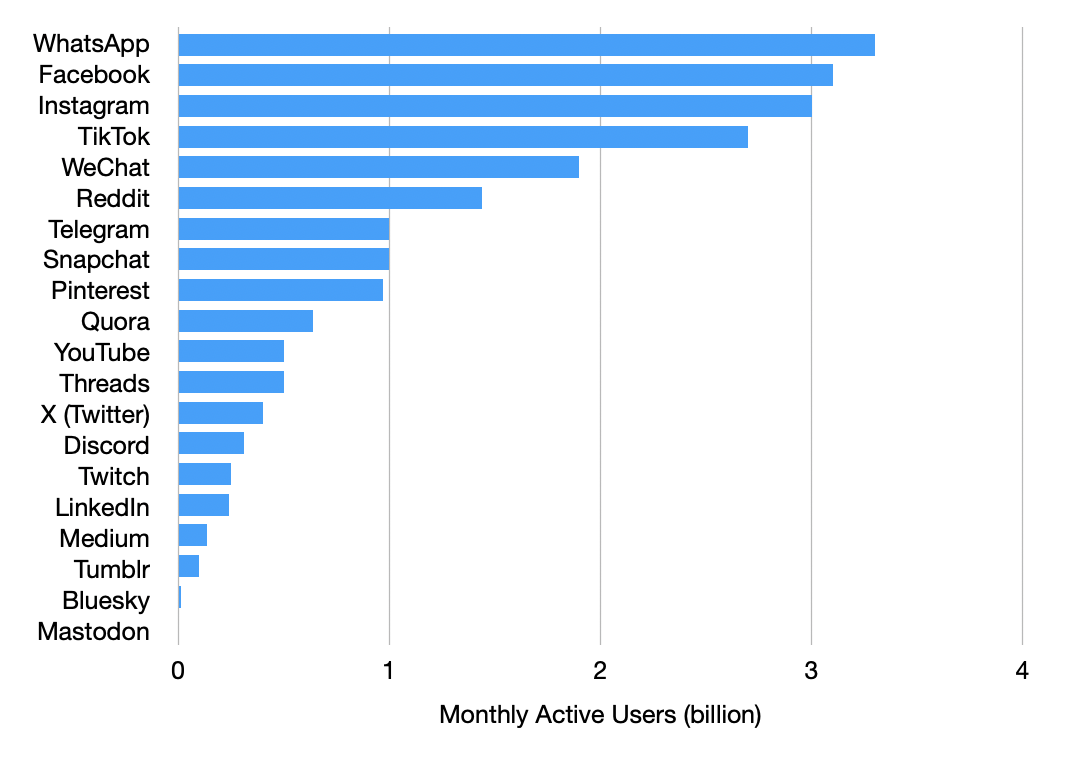
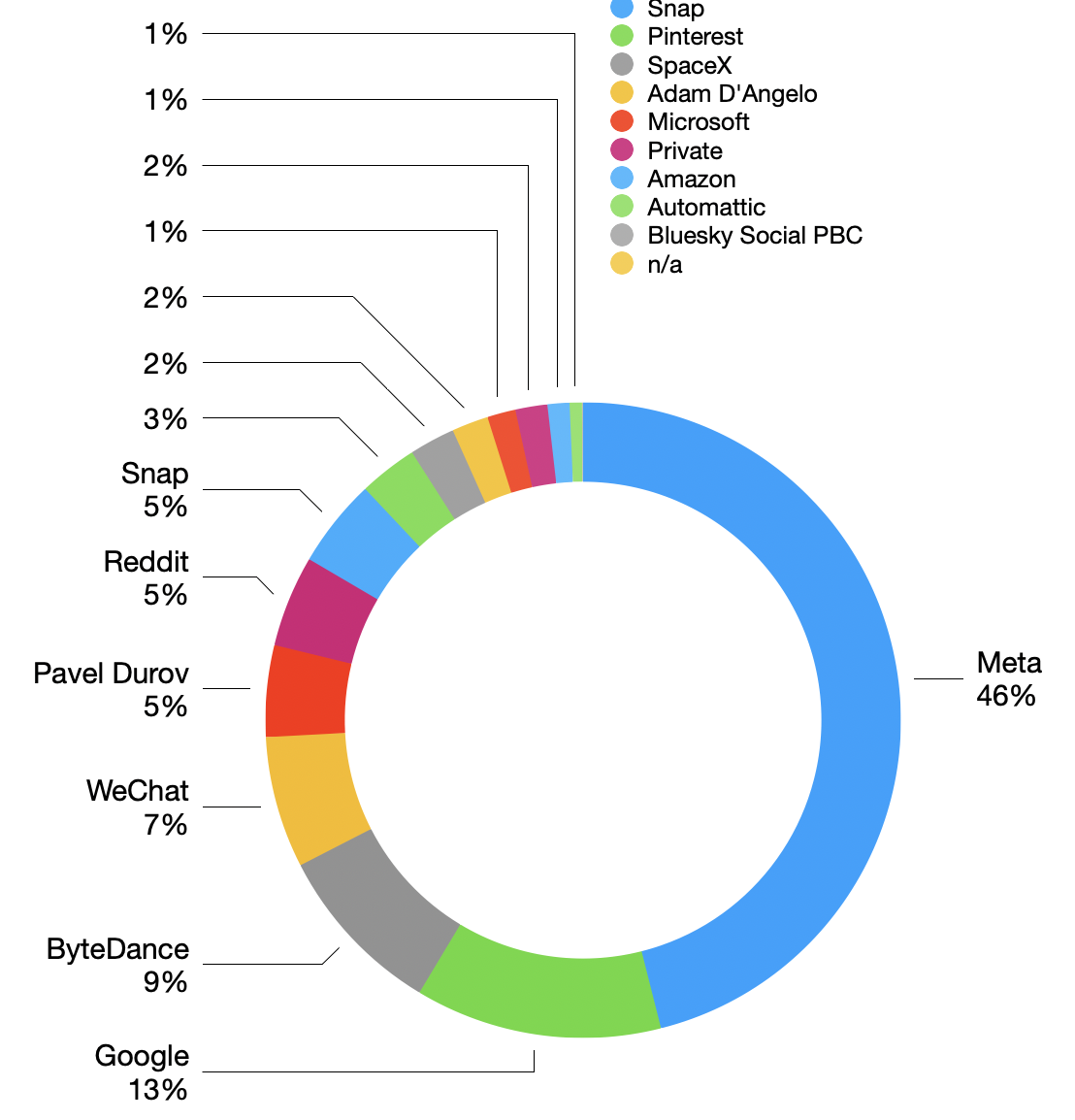
At first glance, social media seems stronger than ever. There are 22 billion active accounts across the top 20 "platforms"1. The ranking is shown below.
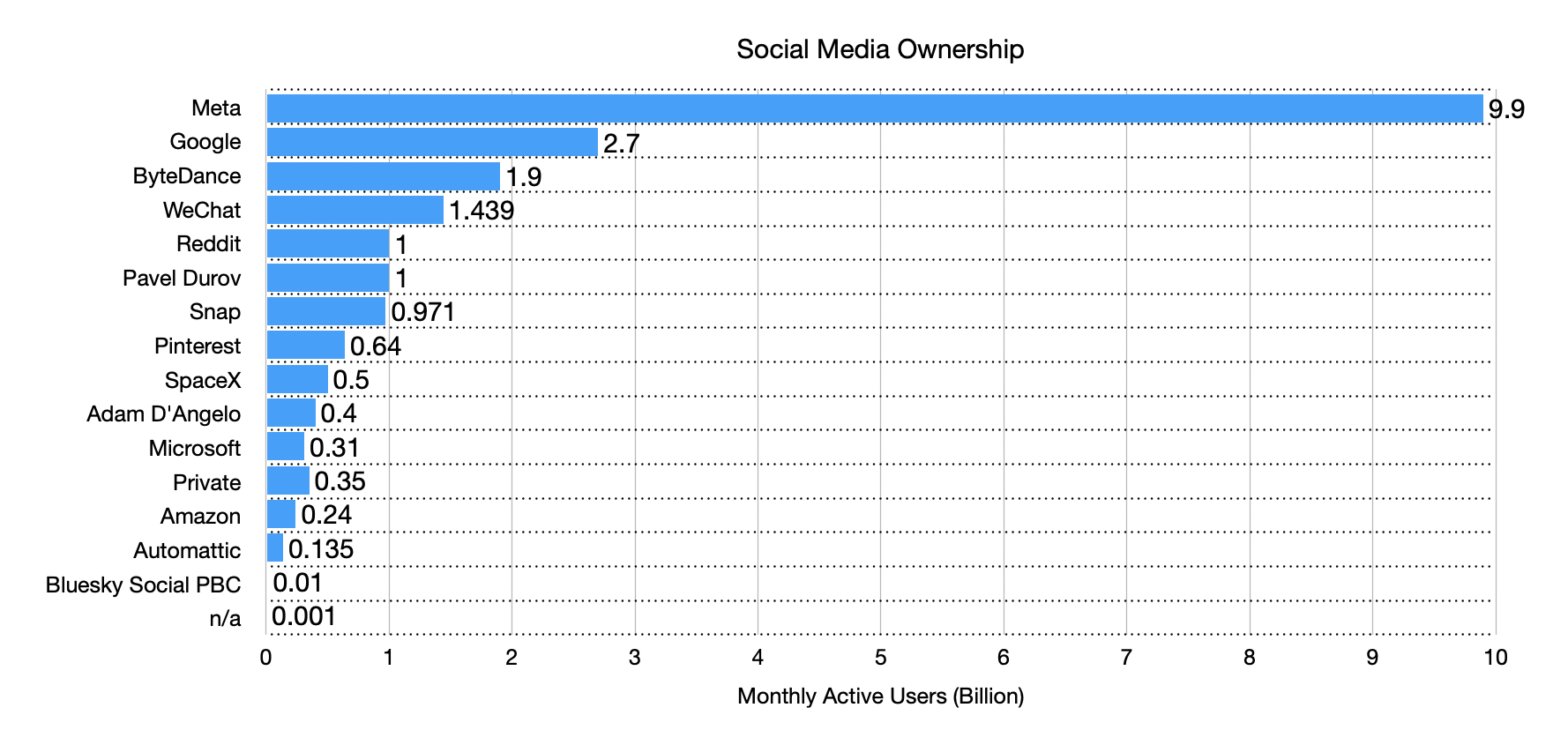
Ownership of these platforms is not self-evident so I also combined them into this chart.
Meta holds about half of the monthly active user account (MAUs). The other interests are, roughly, Google, China (ByteDance and WeChat), modest-sized public companies, private companies and even individuals. Some non-profit or decentralized organizations also bring up the rear.
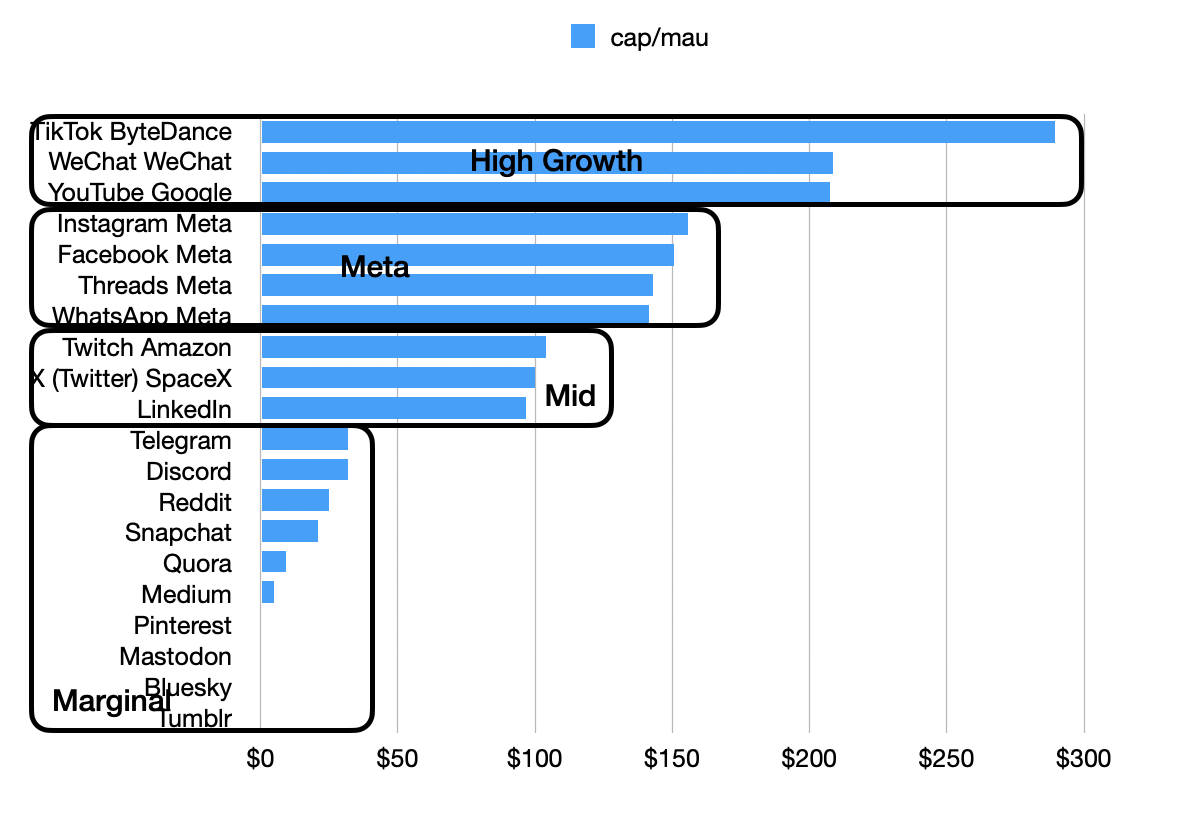
If taking a market value point of view (market capitalization per MAU) the clusters show up as follows:
A MAU is worth between $100 and $250 in net present value. Notable outliers are TikTok at $300/MAU on the upper end and the marginal players shown at below $50/MAU. The main difference in value seems to be the rate of growth.
Meta however is a good proxy for the entire space. Not just because it was the "OG" or first mainstream success with Facebook but also because it has morphed itself through acquisitions and replication to get onto the trends that resonate. Messaging (buying WhatsApp), photos (copying Snap with Instagram), short video (replicating TikTok), and Threads (replicating short text Twitter) are all invented elsewhere.
Thus observing Meta, one can't help but see how the "media" usage has shifted. It's anecdotal but one hears that Facebook demographics aged in North America and Europe, but still young in much of South Asia and Africa. FB is seen as "best for B2C with mature audiences, local businesses, and ad spend (Facebook Ads remain one of the most sophisticated targeting platforms anywhere). Organic reach for pages is low, but the platform's reach for paid distribution is unmatched."
Meanwhile, Instagram demographics center on millennials and Gen Z with Reels now the primary growth engine. E-commerce integration via Shopping makes it best for "B2C, lifestyle brands, and personal brands with a visual aesthetic."
Threads has grown faster than expected (equaling the usage of Twitter/X after only three years, by leveraging Instagram's social graph.) Its algorithm is still being tuned — chronological-leaning feeds with discovery boosts.
And this is the clue: "the algorithm" determines what people see. It's what creators live and die on. It's what determines virality. This algorithmic distribution has spread to YouTube and back to X, both of which offered, by default, followed content first and "suggestions" only as an option.
Today followers don't matter because users are no longer given what they follow by default. The odds of a follower seeing what a creator posts are insignificant.
This is all in pursuit of "engagement" or screen time. It works. Usage is up, addiction is up and dopamine is up.
However it's also corrosive. For all the new type of scrolling induced, the sense of satisfaction with the medium is dropping. It results in a sense of loss at the end and regret. It exhausts and irritates and preys on what we used to call vices.
More than a decade ago I posited that each social media is positioned on one of the seven deadly sins. In the standard list, the seven deadly sins according to the Catholic Church are pride, envy, wrath, gluttony, lust, sloth, and greed. Which media went with which sin is left as a fun exercise.
It was a tongue-in-cheek post but over time it became reality. The media seemed to be designed to "trigger" rather than inform or relax the user. Even if not intentional, an algorithm "learns" that negative emotions are more valuable than positive. This is a biological necessity: threats are more important than comforts and we evolved to pay more attention to them.
I believe that as the rush to maximally trigger users, the corrosion will ultimately undermine the businesses.
For this reason Meta is finding itself is a difficult business proposition. The ads are working but the audience is exhausted and the regulators and lawsuits keep pouncing. Meta today trades at a P/E of 20 and a 50% return over five years (compare with e.g. Google at 144% or Apple at 110%).
What comes next?
The algorithm is likely to move beyond heuristics. If we look at the methods uses so far, starting with TikTok, it seems that the rules were very basic: dwell time, categorization, engagement triggers such as like, comment and subscribe indicate what the user likes. Provide more and more of the signals that resonate. These were the result of trials and errors with a simple optimization in mind.
This is a slippery slope to a glut of stimulus.
The way this overshoots is with AI. More and more study of what people respond to leads to a perfect picture of the person's psyche. But there lies the problem. This is the formulation of narcotics and how they create undesirable dependencies.
It may be all right to addict billions of people but it does not last. Addiction with no lasting benefit will ultimately be regulated. This happened with alcohol and tobacco and other narcotics. Society realizes that these are to be managed if not banned. People recognize that they are being manipulated and turn to some form of authority to help them from themselves.
The future of the misnamed social media may be that it becomes treated as a controlled substance. The tobacco of the current century. It has so far evolved too rapidly to be controlled but attempts to do so will continue.
Turbocharging it with AI will not convince us that it is becoming more beneficial but rather the opposite.
The evidence of this aversion to the model is shown in the valuation of the companies involved. They are starting to reek of malfeasance and are not particularly desirable by capital.
I use the term loosely since, as Bill Gates once pointed out, a platform isn't valid unless the participants "on top" of it make more profits than the platform itself. A social media platform should benefit its content creators more than it benefits itself, perhaps in a 5:1 ratio. That certainly does not seem to be the case for the typical creator platforms. This is in contrast to software platforms such as Windows and iOS where there is more economic activity that is created and not even touched by the platform.
As the market shrinks, Apple now has 34% of Europe’s smartphone market
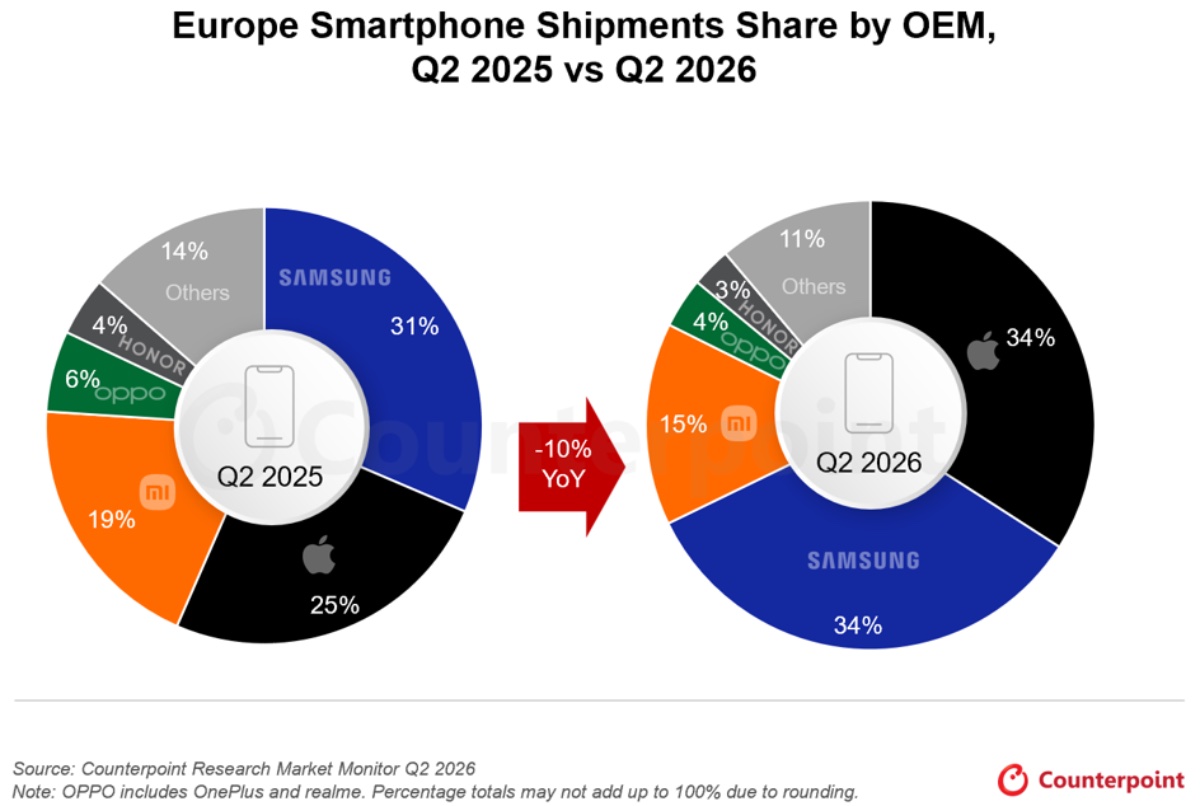
Europe’s smartphone market took a further tumble in quarter two (Q2) of 2026 with shipments falling 10% year-over-year (YoY) to 35 million units, the region’s weakest second-quarter tally in three years, according to Counterpoint Research’s Q2 2026 Smartphone Market Monitor.
However, it was good news for the iPhone. Apple increased its smartphone market share in Europe to 34% as of the second quarter of 2026. That compares to 31% in the second quarter of 2025.
Apple is tied with Samsung, which also has 34% of Europe’s smartphone market.
“It continues to be a very challenging time for the Europen smartphone market,” Counterpoint Associate Director Jan Stryjak. “An uncertain financial outlook across much of the region means consumers remain hesitant to make discretionary purchases, which is not being helped by the widespread lack of promotions as manufacturers looked to protect margins. In Q2 2026, things were relatively better in Western Europe where a very impressive quarter by Apple and marginal growth by Samsung softened the drop, although Eastern Europe suffered a significant decline as budget segments were squeezed and most Chinese manufacturers struggled.”
NB: This phenomenon is more than one quarter in duration. Counterpoint expect further declines over the next few quarters, especially for lower-end players. Indeed, they expect Apple to outperform the market "for the foreseeable future".
It's still hard to say if the market is permanently affected by this component shortage. Unlike previous perturbations, the effect today might be that it will make the phone industry unattractive to many current incumbents to the point of causing an exit. This would not be the first time.
It seems that Apple and Samsung are the only ones thriving in the market. Samsung benefiting more from the components business than from the complete phone product. As I mentioned in previous dispatches, the market is cracking. Whether is breaks altogether remains uncertain.
One possibility is that 2/3 of the incumbents call it quits and exit but at the same time a new set of entrants wade in. The entrants may see an opportunity with new form factors such as AI-based wearables, though they would be not-quite-a-phone.
Historically we might look back on 2026 as the year that the phone market cracked and the transition to wearable computing took off.
Of course, Apple is energized by this transition because it was never a phone company to begin with.
Schulze-Melander expects Apple to launch the iPhone Ultra in September, giving it a new product category to tap while potentially lifting the average selling price of its broader iPhone lineup.
The analyst estimates the device could cost $2,199, or about an 83% premium to the iPhone 17 Pro Max, meaning even relatively modest volumes could have a meaningful impact on Apple's revenue mix.
The firm expects the foldable iPhone to increase Apple's average selling price for the iPhone lineup by 11% by June 2027.
Apple could [also] have [a] revamped artificial intelligence strategy.
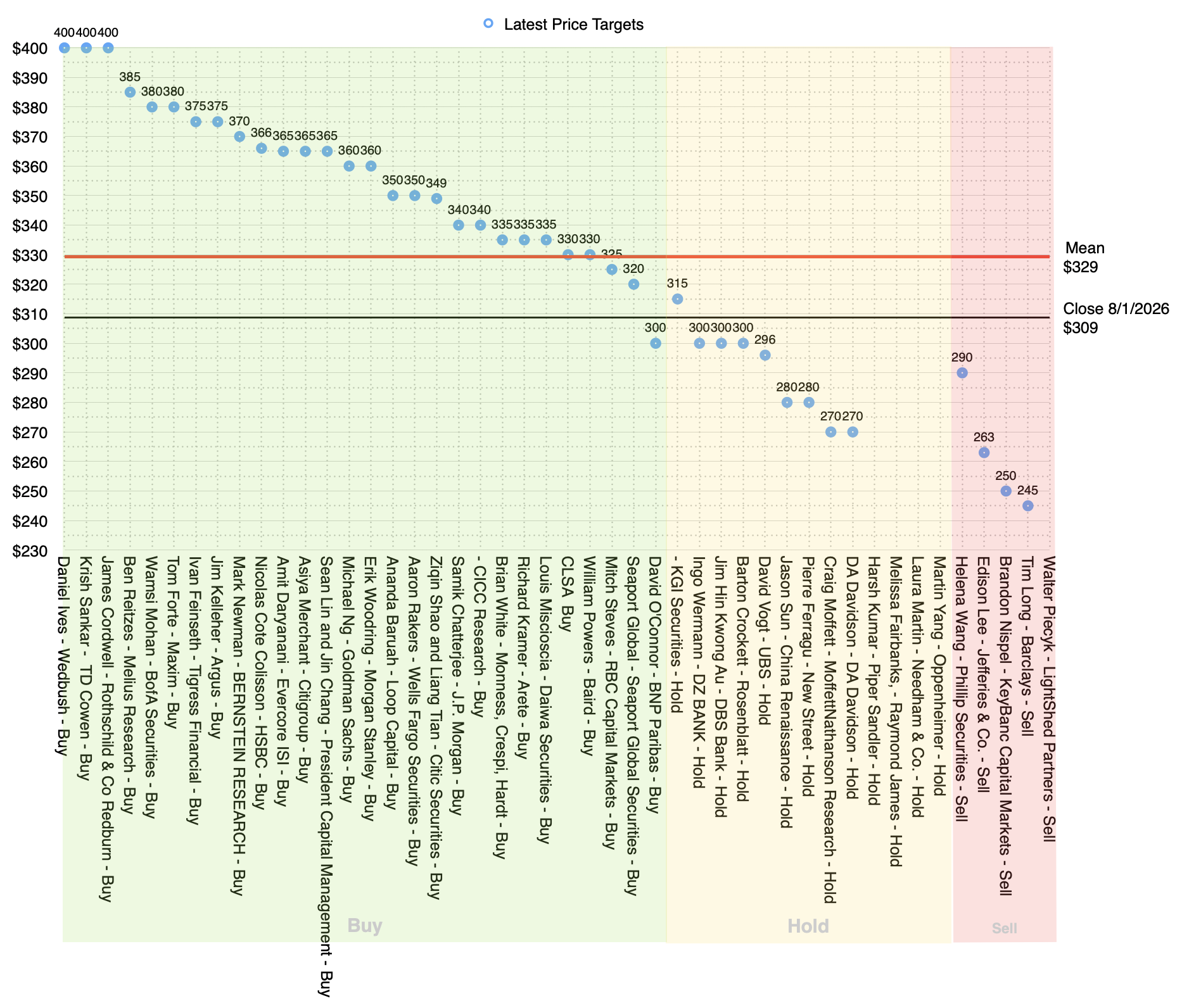
NB: This upgrade was from $260 to $400 which seems significant. This might be because the last target that I could find was in September 2025, so almost a year ago. Not sure if anything of note occurred since. But this is not the only change in analyst targets. There have been 8 other changes in ratings and targets in the two weeks since earnings. Four price target cuts, four downgrades, four price target raises and one upgrade…
Aug. 11 Loop Capital Cuts Target to $340 From $350, Keeps Buy Rating
Aug. 11 Daiwa Securities Raises Price Target to $335 From $325, Keeps Outperform
Aug. 10 Jefferies Downgrades to Underperform From Hold, Cuts PT to $263.66 From $285.56
Aug. 6 Citic Securities Raises Raises PT to $349 From $300, Keeps Add Rating
Aug. 4 China Renaissance Downgrades Apple to Hold From Buy, Cuts Price Target to $280 From $329
Aug. 4 CICC Raises Price Target on Apple to $340 From $310, Keeps Outperform Rating
Aug. 3 DZ Bank Downgrades From a Buy to Neutral rating
Aug. 3 Phillip Securities Downgrades Apple to Reduce From Neutral, Cuts PT to $290
The average price target is $329. There are 28 Buy, 13 Hold and 5 Sell ratings. 15 Analysts have not updated ratings in over a year.
Much was made of the Jefferies downgrade which seems to have hinged on a rumor of the cancellation of the iPhone 20(!) The rumor was debunked by three sources within hours but it did not deter coverage of the downgrade and its reason for days after.
The trend apparent is that analysts who previously insisted on counting iPhones have turned to predicting iPhone pricing, thus swinging between "too high" or "too low" reasons for Apple's imminent market failure.
The AI (win/fail, take your pick) drumbeat still attracts attention but overall it seems less loud.
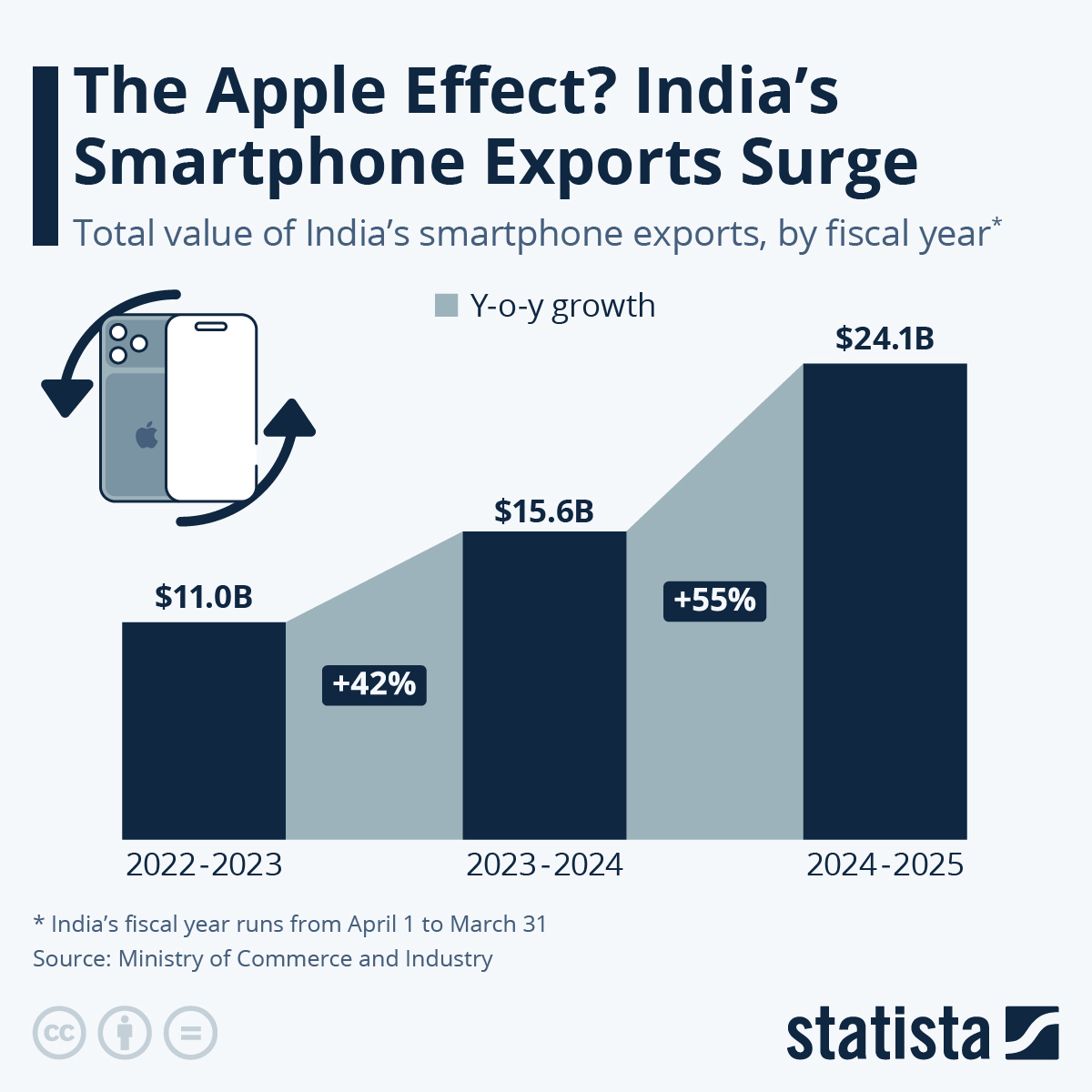
Apple passed $10B in annual sales in India for the first time in FY 2026, up from $9B in 2024-25 and $6B in 2022-23, as it expands its retail footprint — Apple Inc. exceeded $10 billion in annual sales in India for the first time last fiscal year.
NB: $10 billion was for the 12-month period running to March. It represents a 11% year-on-year increase over the previous fiscal year.
The bulk of the sales are for the iPhone, the source claimed. However, the demand for other products, such as iPad and Mac sales, also rose in the year.
Compared to other markets, India is still relatively small. Greater China recorded $18.8 billion in revenue in Apple's most recent quarter and Japan $6.6 billion.
It's also facing exchange rate headwinds with the rupee declining 10% against the dollar.
Moreover, the entry-level iPhone 17 is $870 in local currency versus $800 in the United States (though US buyers have to pay additional state sales tax).
The growth rate of 11% is not as strong as the 50% during the previous year though it exceeds GDP growth. I have a hypothesis that the Apple Upgrade program may provide some options to increase access to refurbished inventory for Apple to sell directly.
Exports have been rising at 50%+ rates. During Apple’s fiscal Q3 FY26 earnings call, CEO Tim Cook said the company achieved June quarter revenue records across every geographic segment, including India.
There is much more upside in India but I would expect 20%+ growth.
I would say they will simply collect all the available profits
MacRumors interviewed AI critic Ed Zitron, author of the Where's Your Ed At newsletter and host of the Better Offline podcast, about what could happen to Apple if the costly AI infrastructure boom collapses. Zitron argued that Apple is relatively well insulated because it has spent far less on data centers than rivals such as Microsoft, Google, and Amazon. He said the company could use the downturn to make selective acquisitions, though it might simply continue operating largely as before. "I think they will sit on the sidelines and watch everything burn," Zitron said. Here's an excerpt from the report:
If the bubble deflates the way you expect (write-downs, too much compute supply, possibly OpenAI cratering), can you walk us through what that would actually look like for Apple? Does anything break for iPhone users, or does Apple mostly watch it happen from the sidelines? Could it even benefit Apple?
I think things would look much the same for Apple. I think they will sit on the sidelines and watch everything burn. I could see them doing some choice acquisitions as things begin to collapse, but I could also see them do nothing.
I think Apple is in a very weird place at the moment. The Vision Pro was a dud, but it was also the most interesting and future-forward thing I've seen anyone put out in a while. If they were smart, they'd tread water and sink as much money into making that as small as humanely possible -- no matter how long it takes -- because the entire AI bubble is a result of everybody running out of hypergrowth ideas, mostly because we're flat out of new interfaces.
NB: Those who do not study history are doomed to repeat it. The history of computing is one of the easiest to study since it's so recent and well documented. We don't have to conduct archeology or infer from scraps of written works. The people who lived and worked through that period are mostly still alive and we can ask them questions. Still, Zirton misses a few points…
…What I appreciate about Zirton's analysis is that he places the Vision Pro at the heart of the discussion. It is indeed the most important innovation of the age. However he does not understand Apple's culture well enough to know why it is the way it is. His comments about how the Vision Pro works belie a failure to study it and understand it deeply.
There is a lot in the interview on MacRumors so it's worth reading.
final earnings call for Tim Cook as chief executive officer
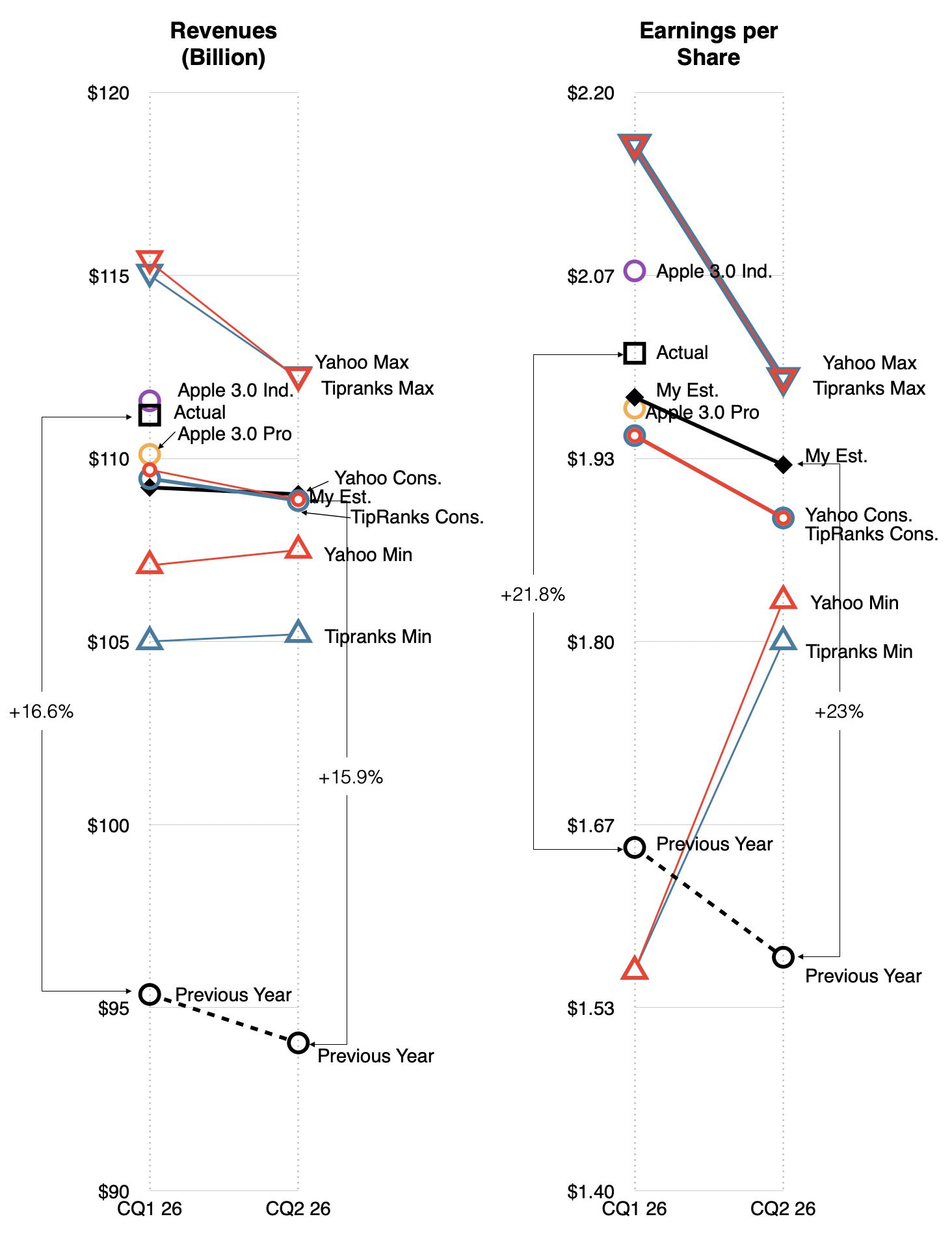
Financial experts expect the brand to post very strong numbers for the quarter. Data from Yahoo Finance shows an average revenue estimate of 108.9 billion dollars across 27 different analysts. The earnings per share estimate sits at 1.89 dollars. TipRanks shows a very similar outlook, with a consensus revenue of 108.85 billion dollars. The company previously guided for a revenue growth of 14 to 17 percent compared to the same time last year. It also expects its gross margin to land between 47.5 and 48.5 percent.
This quarter represents the first full period to benefit from devices launched earlier in the spring. Aside from the new AirPods Max 2, there were no major hardware launches during these specific months. UBS noted that the market share for the iPhone actually increased during the quarter.
Mac computer revenue also went up thanks to the arrival of new models, even though the average selling price dropped slightly. The services division should see 13 percent growth, despite some struggles with App Store revenue.
The upcoming conference call will give the market a clear picture of how well the hardware maker handled a quiet summer. Investors will listen closely for any hints about future pricing strategies and how the company plans to handle rising production costs under its new leadership team.
Apple reached $1 trillion market capitalization on August 2nd, 2018, almost exactly eight years ago. Let's recall what the consensus looked like.
The jockeying between Apple and Nvidia reflects a debate about the future of AI that has preoccupied investors this summer. Apple on Tuesday briefly hit a market capitalization of $5 trillion for the first time, a day after passing Nvidia to become the most valuable publicly traded company.
Apple trailed its trillion-dollar peers on the market last year as investors worried that the company was missing out on the AI boom by keeping investments in check and delaying the long-awaited rollout of an upgraded Siri, which will be released this fall alongside new iPhone hardware. But the narrative has flipped of late due to concerns that the aggressive tech spenders are raising mounds of debt and going cash flow negative without a clear path to hefty returns.
NB: Apple reached $1 trillion market capitalization on August 2nd, 2018, almost exactly eight years ago. Let's look back on what analysts recorded as their opinions following the company's June quarter, 2018 results. These quotes were published on August 1st, 2018, one day before the $1 Trillion print.
“The combination of a strong macro environment and an increasingly engaged customer base led to double digit growth in all regions on a sell-in basis during the June quarter,” Morgan Stanley said in a note. “A clean beat on the path to $1 trillion.”
RBC was even more blunt, “Hit snooze for 90 Days. Path to trillion intact.”
Others, like Deutsche Bank, were more measured in their commentary.
“With 80 percent of the company’s sales exposed to secularly challenged businesses, we believe the long-term growth outlook remains limited,” the brokerage said. “With positives and negatives largely balanced at current levels, we view valuation as fair and maintain our Hold.”
Here’s a wrap of all the major analyst opinions.
Morgan Stanley (Overweight):
“Third-quarter revenue beat expectations largely on iPhone average selling prices and Services with wearables maintaining momentum from previous quarters. September-quarter guidance also topped expectations and reflects a similar mid teens revenue growth rate for the overall company despite the more difficult compare from a year ago. The combination of a strong macro environment and an increasingly engaged customer base led to double digit growth in all regions on a sell-in basis during the June quarter.”
“A clean beat on the path to $1 trillion.”
RBC (Outperform):
“Apple reported a modest June-quarter beat and guided Sept-quarter ahead of expectations. Given heightened concerns around large-cap tech and ongoing U.S./China tariff issues, this was a positive print vs. expectations. While we expect investors to wait for pricing clarity on next gen iPhones before deciding on Apple stock, near-term upward bias on the name remains given multiple tailwinds stacking up.”
“While investors looking for a ‘super cycle’ will remain disappointed, Apple’s narrative is shifting towards their ability to sustain mid-single digit sales growth despite flat iPhone units and low-to-mid teens EPS growth via buybacks. Maintain OP and adjusting our target to $225.”
“Hit Snooze for 90 Days. Path to Trillion Intact”
Deutsche Bank (Hold):
“Apple reported better-than-expected third-fiscal-quarter 2018 results with sales upside driven by iPhone, Services, and Wearables. While sales beat, iPhone unit growth of just 1 percent year over year remained lackluster, as iPhone sales upside continues to come from the reset higher in average selling price. Earnings per share beat expectations by $0.18, but we estimate that just $0.04 of the beat came from revenue upside, while the remaining $0.14 was helped by below-the-line items like higher other income, a lower tax rate, and buybacks. Given its revenue base and size, Apple’s recent growth has been impressive. However, with 80 percent of the company’s sales exposed to secularly challenged businesses, we believe the long-term growth outlook remains limited. We continue to see support for the shares from the company’s substantial share buyback, however, with positives and negatives largely balanced at current levels, we view valuation as fair and maintain our Hold.”
Citigroup (Buy):
“We believe the negativity on Apple stock is overdone and the majority of our thesis remains unchanged regarding ‘Applewood & 5 Reasons the Stock Should Trade Higher’ as detailed in this report. Specifically we highlight our view of Applewood which is Apple’s growth in service 31 percent year over year or 28 percent excluding one-time items which now represent 18 percent of Apple’s total revenues coupled with early innings growth of iPhone units in emerging markets and less than 2 percent share in India, thereby driving a growing sticky user base, which we have dubbed Applewood.”
Goldman Sachs (Neutral):
“Apple demonstrated better demand resiliency than we had expected in the summer as evidenced by an iPhone average selling price of $724 which was 5 percent ahead of our forecast. Guidance was just a touch ahead of our numbers but is consistent with our above Street average selling price estimates that are based on a detailed stock keeping unit level model. We believe Street forecasts are likely to move up but that average selling price expectations probably will remain too low for the December quarter as Apple continues to see support from ongoing mix toward higher average prices. Services growth adjusted for one offs dipped slightly but not that materially to 28 percent year over year from 31 percent last quarter.”
Bank of America Merrill Lynch (Buy):
“Five reasons why we believe Apple stock should outperform include: underlying iPhone demand remains strong and average selling prices are moving higher, gross margin has upside in fiscal 2019 given tailwinds from component cost reductions and potential tailwinds from foreign exchange, continued strong capital returns with $90 billion of buyback authorization remaining, continued strong growth in Services revenue across geographies (broad-based strength with contribution from licensing, App Store and Apple Care in the quarter), and strong demand for wearables (Apple watch grew mid 40 percent year over year and AirPods remain in high demand) drove 60 percent year over year growth.”
UBS (Buy):
“Yes, inventory is the highest in memory for a second calendar quarter (primarily component related, should burn completely off in CQ3) but implied iPhone units of 47 million to 48 million for CQ3 was spot in-line + services seem to be hitting an inflection. Apple is also effectively managing through some challenges on the cost side that should abate, though continued devaluation of key currencies like Chinese Yuan are an overall negative that bears watching. Given ecosystem switching which has become nearly non-existent, we think of iPhone as a recurring model in much the same way as services – albeit without much growth until there is a major form-factor change. Fortunately, this is on the horizon with foldable. In the meantime, Apple should at least hold serve with iPhone bias more to the upside based on procurement, average selling price still strong in the $720 to $725 range for the third calendar quarter, and services set to do about $3 per share in calendar 2020.”
Raymond James (Market Perform):
“We reiterate our Market Perform rating on Apple. June quarter results were slightly ahead of expectations; the variance vs. expectations was small enough that we expect neither bears nor bulls to change their view following this report. Apple’s rubber meets the road once the new phones come on sale, and we don’t expect the fall lineup to be different enough to improve the trajectory of iPhone sales. The Services business now represents the bull case for the stock, but our view is that it will be difficult for Apple to sustain the current rate of services growth due to a large portion tied to device sales coupled with a law of large numbers issue from App Store contribution.”
Piper Jaffray (Overweight):
“Apple reported June quarter revenue and EPS above the Street, with September-quarter revenue guidance also ahead of consensus. For the June quarter, iPhone was strong, as Apple shipped a total of 41.3 million units vs. consensus at 41.79 million and iPhone ASP was $724, compared to the Street at $694. Services revenue was $9.55 billion and gross margin was 38.3 percent. Revenue guidance for the September quarter is 3 percent above consensus, with the gross margin outlook in-line at 38.3 percent. With the potential launch of a wider array of ‘X-gen’ iPhones on the horizon, we recommend owning Apple on the potential for a ‘super-long’ cycle involving an ongoing multi-year move to the ‘X-gen’ form factor. Maintain overweight, price target to $218.”
If you did not know these quotes were from 2018, apart perhaps from the price points it would be difficult to guess they were not from the present. Cynics would say nothing has changed and they'd be mostly right. The company has quintupled in value by doing nothing different. It has always been doing the right thing.
In a memo to Apple's more than 120,000 employees on the day $1 Trillion was reached Tim Cook said the $1 trillion valuation was "a significant milestone" that gave Apple employees "much to be proud of." But he said it was "not the most important measure" of the company's success.
"Financial returns are simply the result of Apple’s innovation, putting our products and customers first, and always staying true to our values," Cook said in the memo.