Asymco

Asymmetric Intelligence

Nota Bene

News Commentary from Asymco's Horace Dediu.

  1. The Smartphone Market is Cracking

    Nota Bene · 6 comments

    Fundamentals are breaking; Profits evaporate; Competitors flee; Android logic questioned
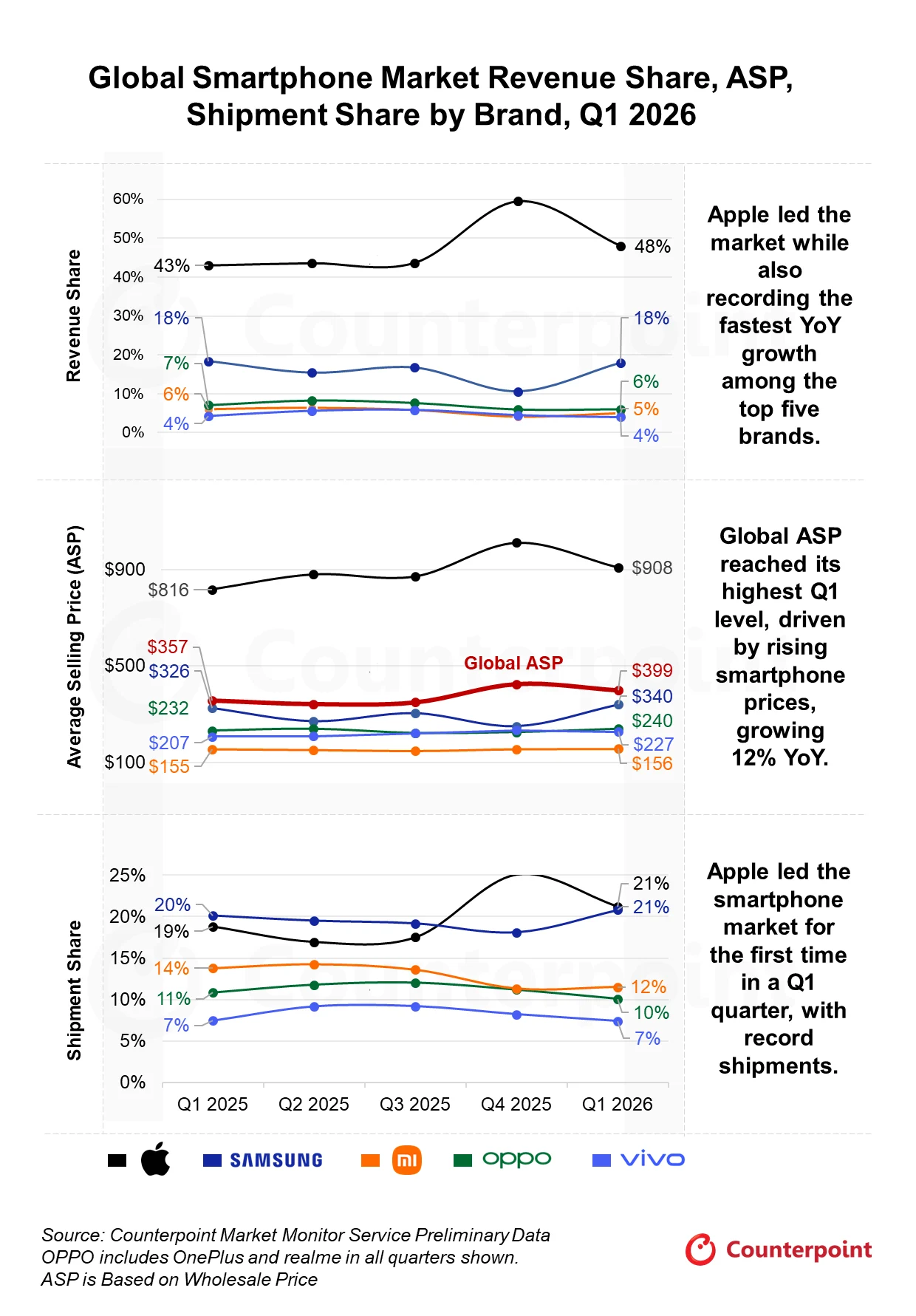
    Apple’s revenue climbed 22% YoY in Q1 2026, registering the fastest growth among the top five smartphone brands while also hitting a first-quarter record high. Furthermore, the brand led the global smartphone market in terms of shipments for the first time in a first quarter, capturing a 21% share.

    Commenting on Apple’s performance, Research Director Jeff Fieldhack said, “Apple’s growth was driven by sustained demand for the base iPhone 17 and iPhone 17 Pro Max, with a stronger mix of these models lifting Apple’s overall ASP by 11% YoY.

    Unlike its peers, Apple mostly maintained stable pricing despite rising BOM costs, reflecting its ability to absorb cost pressures and remain insulated from the memory crisis, which helped strengthen its competitive position during the quarter. Regionally, Apple saw broad-based strength, especially across the Asia-Pacific region, driven by subsidies, promotions, and trade-in offers.”

    The global smartphone market’s revenue grew 8% YoY in Q1 2026, driven by strong premium demand and pricing adjustments across major OEM portfolios amid rising Bill of Materials.

    The average selling price (ASP) climbed 12% YoY to reach $399, supported by contraction in entry-level segments and price hikes across regions.

    Apple led the global smartphone market in terms of value, recording its highest-ever first quarter revenue. Apple was the fastest growing brand with revenue up 22% YoY supported by relatively stable pricing compared to peers, despite broad-based price increases across the industry.

    Samsung held an 18% revenue share in Q1 2026, with shipments reaching 21% of the total market, supported by portfolio optimization and strong response for the Galaxy S26 series.

    The global smartphone market is expected to remain under pressure through 2026, and a substantial recovery is expected only in late 2027.

    Source: Counterpoint Research

    NB: The average sales price is up to $399 but Apple, with the largest share and fastest growth, reached $908? There's a lot more that does not make sense.

    Apple is also projected to have 45% of revenue share and I reckon nearly 100% of profit share (on an operating margin basis). Samsung, the only substantial brand remaining, is now preoccupied with memory sales, which have allowed it to reach $1 Trillion in market capitalization. Management at Samsung must be asking themselves why compete with Apple on devices when they can make 100x the profit as a supplier of components. Especially as Apple is looking for an alternative to TSMC for fabrication (and flirting with Intel too.)

    This all looks like a cornered market to me. That's not to say that capital will not still chase the smartphone dream, especially in China, but the situation is all but hopeless for anybody but Apple. Apple may take a few steps to lock this up next year with new portfolio strategy (e.g. iPhone Neo and Ultra bookends), new launch schedule and new pricing.

    Google, meanwhile, is preoccupied with cloud and AI leaving a big question mark above Android. This is a slippery slope of evaporating hardware profits, dwindling platform investments and obsessions with the new shiny thing.

    The smartphone market is cracking. It may break altogether next year. Stay tuned.


  2. Google’s free cash flow will hit zero next year

    Nota Bene · 8 comments

    The commodities strike back

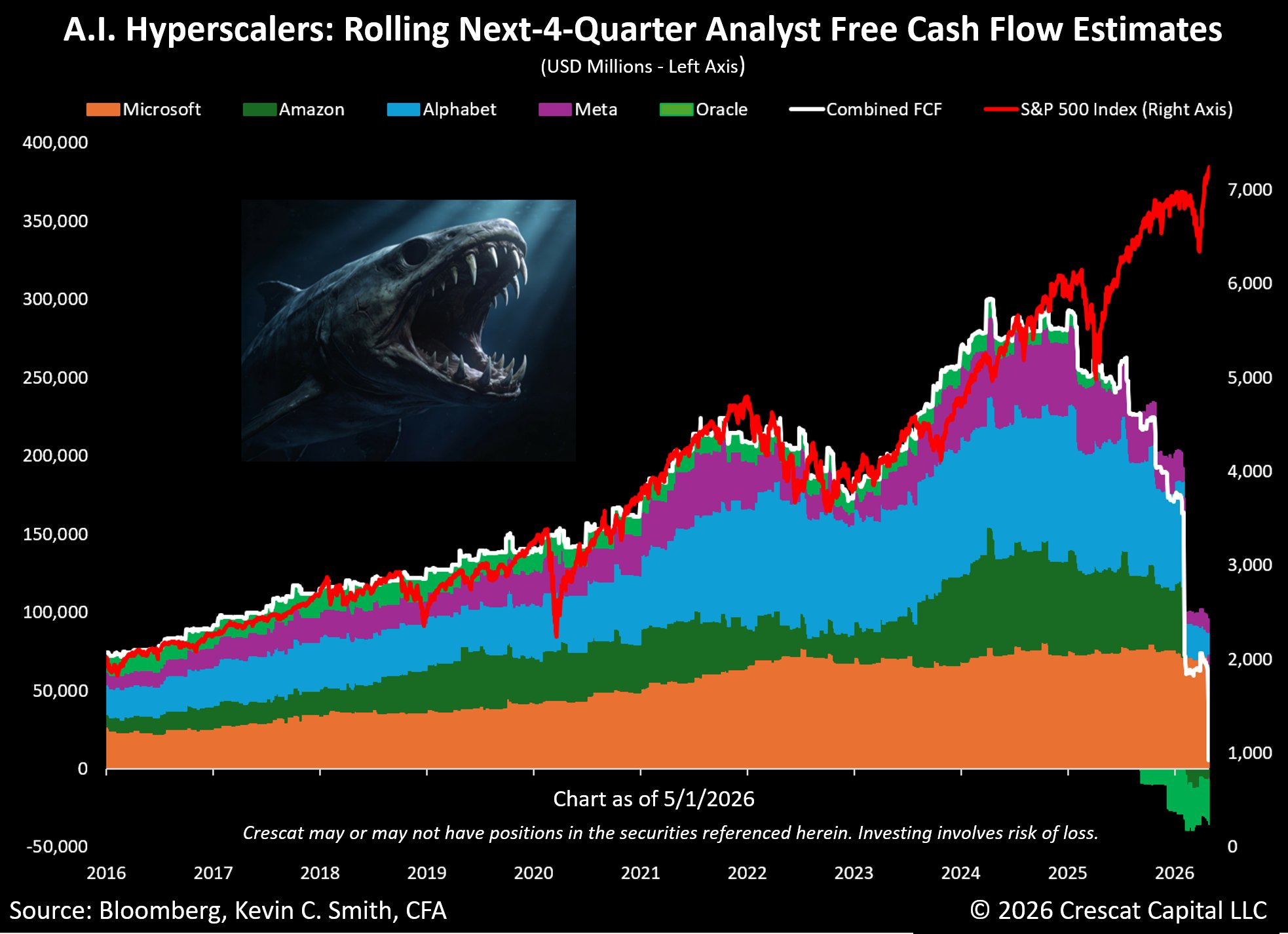
    Alphabet generated $73.266 billion in free cash flow in FY2025, which sounds enormous until you look at what's coming. CEO Sundar Pichai has guided for 2026 capital expenditures in the range of $175 to $185 billion. For context, Alphabet's FY2025 operating cash flow was $164.713 billion. If capex hits the midpoint of that guidance range, it consumes essentially all operating cash the business generates.

    The trajectory has been accelerating hard. In 2023, Alphabet spent $32.3 billion on capex. In 2024, that rose to $52.5 billion. In 2025, it hit $91.4 billion, a 74% year-over-year increase. The proposed jump to $175-185 billion in 2026 would be another near-doubling. Q4 2025 alone saw capex grow 95% year-over-year to $27.9 billion.

    This dynamic is playing out across the peer group. Amazon already lived this story in 2025: FY2025 free cash flow collapsed 65.95% year-over-year to $11.194 billion as capex hit $131.8 billion. CEO Andy Jassy has guided for approximately $200 billion in capital expenditures across Amazon in 2026.

    Meta and Microsoft are spending aggressively too. Meta's FY2025 free cash flow declined 19.39% year-over-year to $43.6 billion against 2026 capex guidance of $115 to $135 billion. Microsoft's Q2 FY2026 capex alone was $29.9 billion, up 89% year-over-year.

    Patel's broader point is that tech insiders understand the technology better than financial markets, and that returns on AI infrastructure will ultimately justify the spend. The businesses backing these bets are not struggling — Alphabet posted Google Cloud revenue of $17.7 billion in Q4 2025, up 48% year-over-year, with a 31.6% operating margin at the Alphabet level. Full detail is in Alphabet's SEC filing.

    Whether it's applied enough is exactly what Patel is questioning. If you believe AI infrastructure is a winner-take-most game and Alphabet and Amazon are positioned to win it, the FCF compression looks like the price of admission. If you think the returns won't materialize at the scale management expects, zero free cash flow at a $1.7 trillion market cap is a very different conversation.

    Source: Yahoo Finance

    NB: Even before these future investments are considered, for the trailing twelve months Alphabet's EV/FCF has his 73 vs. a P/E ratio of 29. If FCF goes to zero…

    …EV/FCF goes to infinity. I've seen estimates that on a forward basis EV/FCF is already over 155. This order of magnitude will impact all the hyperscalers into the next year.

    At this valuation, the payback needs to pretty swift but it seems to me that not all will see the benefit. Indeed, the narrative seen above is that it's a winner take most market. If Patel thinks Alphabet and Amazon are positioned to win it then what happens to Microsoft, Meta, OpenAI, Anthropic and XAI/SpaceX?

    It could well be pyrrhic victory for the winners anyway as the battle is one of muscle (capital) rather than sustainable competitive advantage. Capital after all is a commodity, especially in today's global economy.

    It's remarkable that the greatest business stories al about raw resources (compute or components fueled by capital.) Along with energy, the zeitgeist seems to be "the commodities strike back."

  3. iPhones where first, second, third and sixth most popular phones during the first quarter

    Nota Bene · 4 comments

    Concentration into top 10 now highest ever.

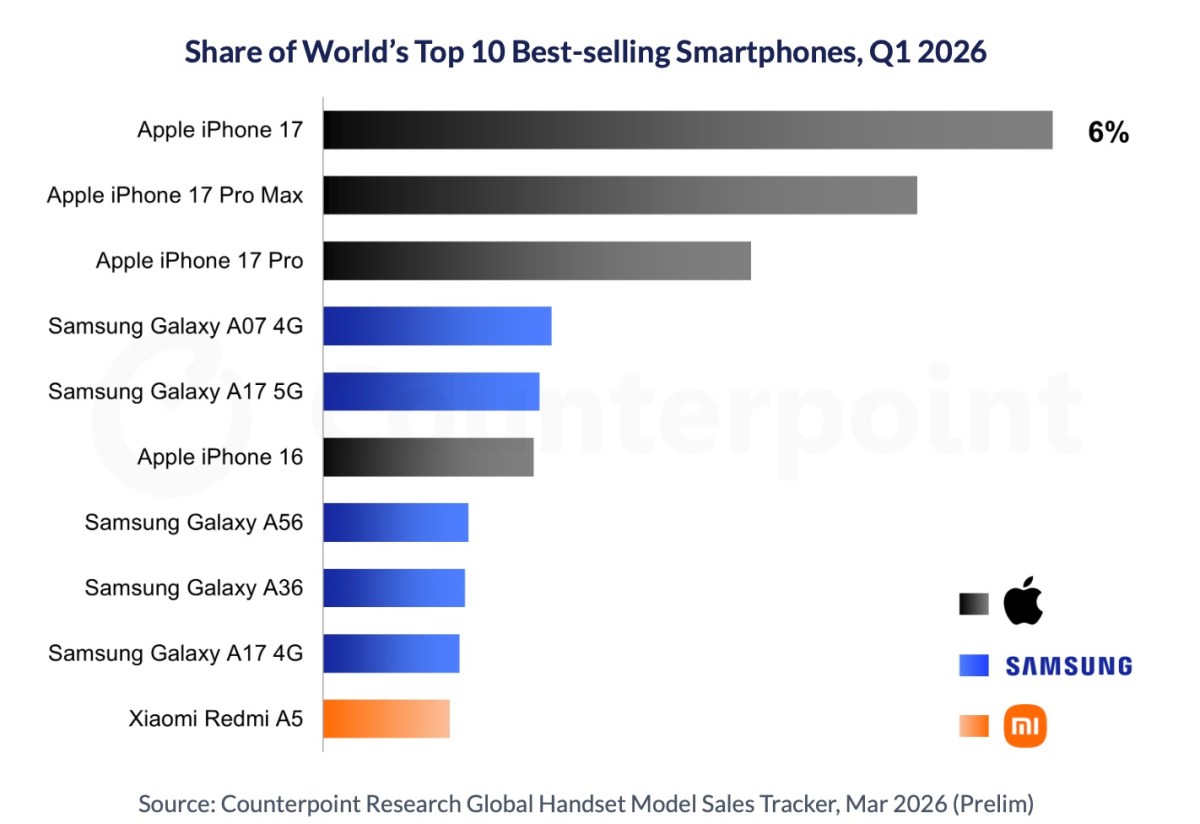
    Apple’s iPhone 17 was the world’s best-selling smartphone in quarter one of 2026, capturing 6% of global unit sales, according to Counterpoint Research’s latest Global Handset Model Sales Tracker.

    The iPhone 17 Series captured the top three spots, while Samsung Galaxy A Series was most represented with five models in the top 10. The top 10 smartphones contributed 25% of global unit sales, the highest quarter one concentration ever, according to Counterpoint. This was driven by sustained demand for the iPhone 17 series, alongside pressure on Android manufacturers in mass-market segments as the ongoing memory shortage pushes up component costs, adds the research group.

    Source: Apple World Today

    NB: There are over 450 brands and over 6000 phone models in the market yet 10 models from 3 brands make up 25% of sales. The near future is harsh…

    RAMmageddon will collapse the low end market concentrating the top 10 even further. Three vendors will make up 40% of the market and five will be 50% at least. Over 100 brands may not survive taking out perhaps 1000 models.

    The situation in profits will be even more stark with Apple probably capturing 100% of the available profits in the industry.


    Daring Fireball visitors: $250 off Annual Asymco One subscription when you use code DF260515 in the next 3 day. Subscribe →

  4. Apple's R&D investments top 10% of sales as AI race creates 'sense of urgency'

    Nota Bene · 3 comments

    Don't confuse R&D with CapEx

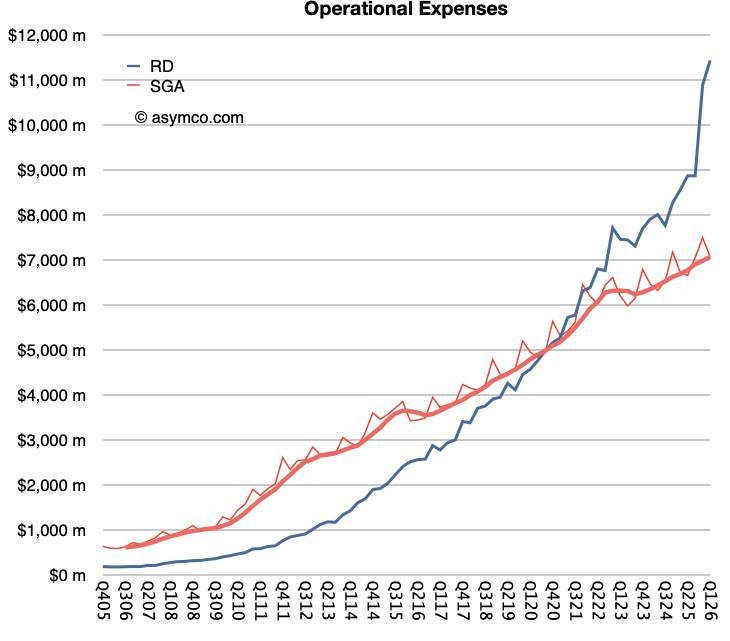
    Apple’s R&D spending hit 10.3% of revenue in the March quarter, as the the tech giant ramps up investments in artificial intelligence.

    The increase puts Apple closer to the rest of megacap tech on R&D, though the iPhone maker is still taking a very different approach when it comes to capital expenditures, according to CNBC. R&D spending was up from 7.6% in the prior period and 9% in the same quarter a year earlier. While sales jumped 17%, the fastest rate of growth for any quarter since 2021, R&D climbed twice as quickly, increasing almost 34% from a year prior, according to CNBC.

    “That’s a sign that Apple is seeing a sense of urgency around new AI products,” said Gene Munster, managing partner at Deepwater Asset Management.”

    Horace Dediu, founder of Asymco, agreed that a major question is where all that spending is going. Much of the increase, he said, is likely tied to talent, teams and experiments in training and modeling, rather than the kind of large-scale data center deployment underway at the hyperscalers. But he also said Apple is pushing across hardware, investing in silicon, optics, batteries, materials, sensors and smaller form factors.”

    "AI is an obvious candidate, but R&D is not capex," Dediu said.

    Excerpt From Apple's R&D investments top 10% of sales as AI race creates 'sense of urgency' by MacKenzie Sigalos, Jennifer Elias, CNBC

    Source: CNBC

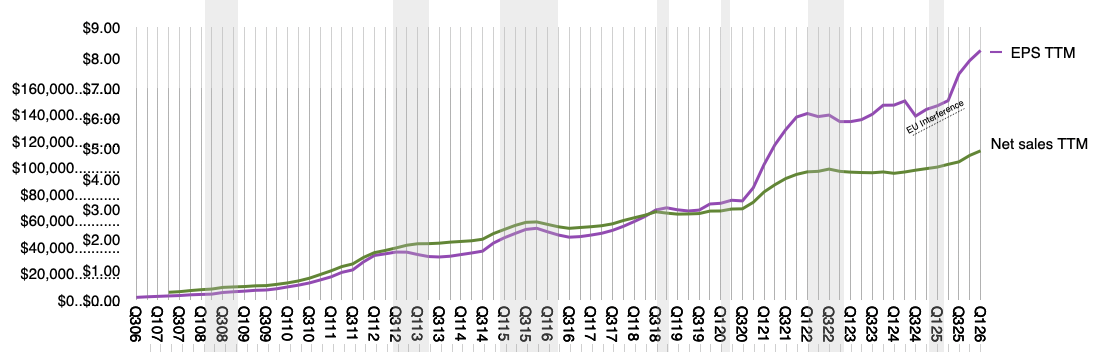
    NB: Apple has been increasing its R&D spending from around 2% to 9% of sales on a 4-trailing quarter basis. It has overtaken SG&A which has remained around 7% since 2011.

    This is a big departure from where the company was during the Steve Jobs era and the acceleration seems to be continuing. An increase to 10% seems very likely this year with a run rate of $40 billion/yr.

    This level of R&D used to be associated with companies like Microsoft and Google which had dedicated laboratories. The question is where does this spending go to?

    AI is an obvious candidate but R&D is not CapEx. Although some capital equipment is part of the spend, much of this is talent related as it’s recurring. My assumption is that there are many projects that are both hardware and software (e.g. Apple Silicon and AI). Fundamentally the power of this budget is affecting the organizational behavior with, as we have seen, the ascent of engineering leadership.

    AI is expensive but so is silicon and so are the components going into smaller form factors. They are pushing on many fronts: optics, batteries, materials, sensors and silicon.

    AI spending is teams and experiments in training and modeling. It would cost a lot more to deploy these at scale and as much as this is a lot of spending, it’s not nearly what super scaling requires.

    The late 90s to early 2000s period was defined by revenue contraction and financial distress. It wasn’t so much an increase in R&D as a decrease in revenues. In those days Apple built products on a shoe string. Literally a handful of people were tasked with scoping out new products. The iPod was Tony Fadell and a few others. Safari effort started literally with one hire. I don’t think that era is comparable to what we are seeing today. There must be thousands of engineers allocated to R&D right now.


  5. Will Apple preserve iPhone 18 Pro pricing at 17 Pro levels?

    Nota Bene · 4 comments

    History says yes.

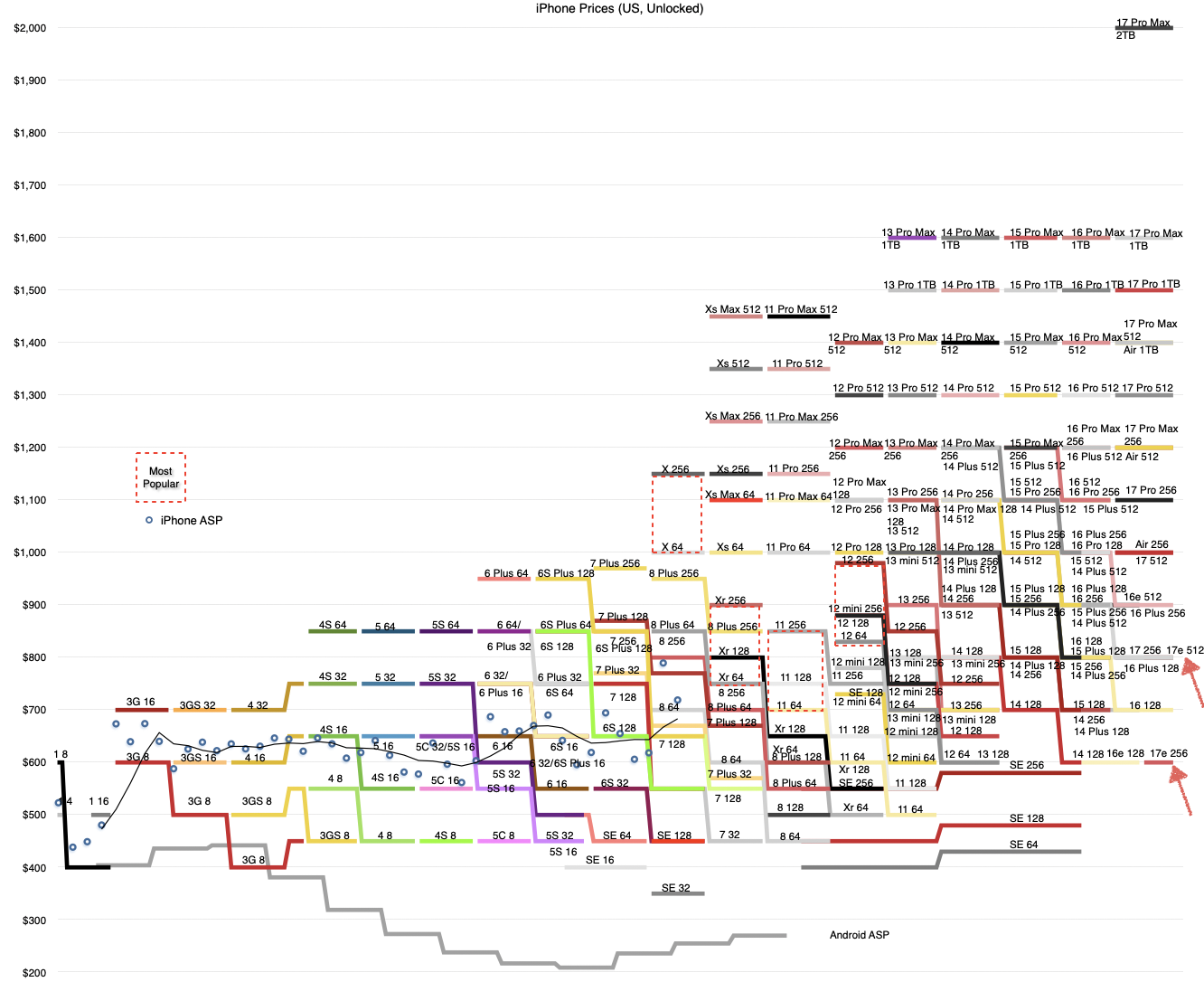
    The global smartphone market is facing structural pressure from rising memory prices. In particular, the spread of AI technology is sharply increasing demand for high-performance memory, tightening supply and pushing prices up quickly. As a result, some Android manufacturers have raised prices on new products, and low-margin budget models could shrink in the market. The industry also sees the trend as potentially leading to a contraction in the overall Android market size.

    Against this backdrop, Apple has chosen a strategy of keeping prices for its main models unchanged. Pu’s analysis said the iPhone 18 Pro is likely to start at $1,099 and the Pro Max at $1,199, maintaining the existing price range. That would be the same as the previous model. It is interpreted as a strategy to secure price competitiveness even if Apple accepts some margin decline to defend market share.

    Apple is also expected to pursue a two-track strategy that considers both price accessibility and profitability. It would keep base-model prices to lower the barrier to entry, while raising prices for higher-end models with larger storage capacity to offset profits. It has also been suggested that an ultra-premium iPhone 18 Ultra could be added, and the overall average selling price (ASP) is expected to rise.

    Ultimately, Apple’s strategy aims to exploit weaknesses in the Android camp, which is under pressure to raise prices. While rivals face demand contraction from higher prices, Apple could keep prices relatively stable and expand user inflows. A recent rise in demand from Android users switching to iPhones has also been detected, raising the likelihood that Apple will strengthen its influence in the premium market through this strategy.

    Source: 디지털투데이 via Analyst: Jeff Pu

    NB: There is always a huge surprise when Apple does the same thing it always does.

    Rule 1: Pricing choices Apple makes are based on a strategy.

    Rule 2: Apple does not respond to competition with changes in pricing

    Rule 3: Apple does not respond to supplier pricing with changes in pricing.

    Rule 4: The secondary market absorbs low end demand.


  6. Tata Electronics' workforce expands to 75,000 from 15,000

    Nota Bene · 1 comment

    Measuring how far India will go in production.

    According to The Economic Times, citing unnamed sources, "Tata Electronics has expanded its workforce to 75,000, surpassing Taiwanese rival Foxconn's headcount in the country, making it Apple's largest contract manufacturer by headcount currently." The report added that the expansion has been driven primarily by its large-scale Hosur facility in Tamil Nadu.

    Supply-chain sources said the company's workforce growth marks a sharp increase from about 15,000 in 2023, reflecting an aggressive scaling strategy supported by major capital investment, factory acquisitions, and rapid capacity buildout. The expansion includes its 500-acre Hosur campus, which has become the core hub of iPhone assembly in India.

    Tata Electronics has combined acquisitions of Taiwanese contract manufacturers' Indian assets with greenfield investment to accelerate entry into Apple's supply chain. It acquired former Wistron(3231.TW) and Pegatron(4938.TW) facilities, while simultaneously expanding its Hosur plant, which began iPhone assembly operations in 2025.

    In addition to assembly, the company is also moving upstream into semiconductor assembly and test (OSAT) and component localization, supported by large-scale funding injections in recent fiscal years. These investments aim to build a vertically integrated electronics manufacturing base spanning assembly, packaging, and supply chain services.

    The reported figure of 75,000 employees reflects both direct and acquired operations across Tata Electronics' manufacturing footprint in southern India. One source noted that the rapid scale-up has enabled the company to meet Apple's production requirements while overtaking Foxconn(2317.TW) in local headcount, although industry participants expect rankings to fluctuate as other facilities ramp up.

    Source: Source

    NB: If we add Tata and Foxconn, we are probably in the 200,000 range this year. The comparable China model is …

    …in the 2 million scale. I can imagine that India could scale to 1 million easily thus reaching about 50% of what China is producing. This may not mean a reduction in capacity in China but a net gain. This implies roughly three more doublings of expansion (200k -> 400k -> 800k -> 1000k+).

    From 2023 to the present the number of doublings is also about three (15k -> 30k -> 60k -> 75k) suggesting perhaps four to five years of aggressive growth still to come in India.

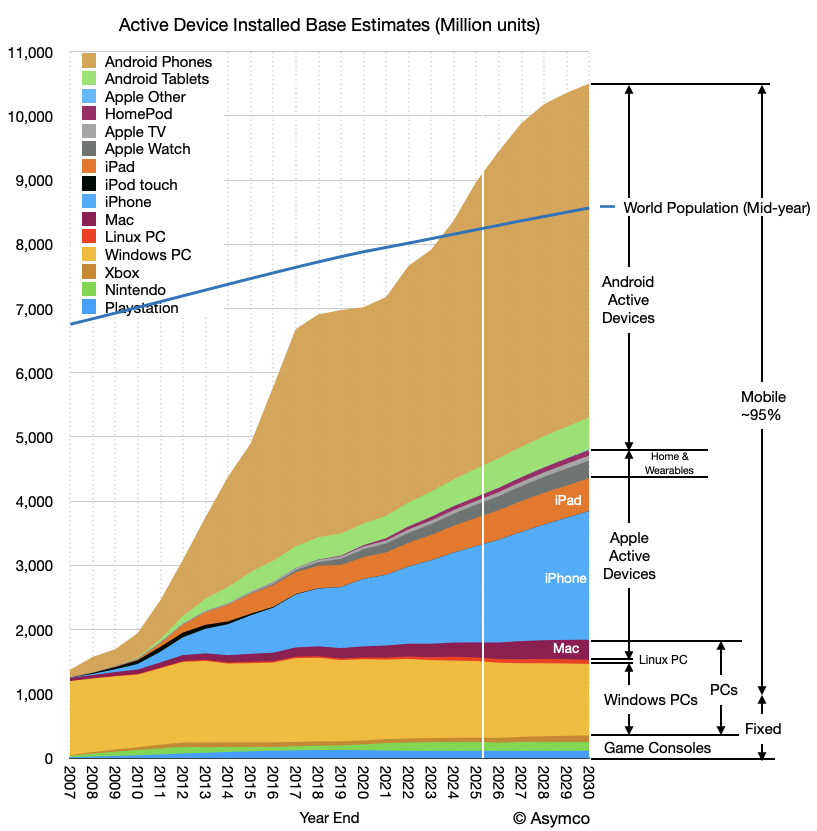
    This needs to be matched to the overall expansion of user base that is already in the Active device forecast.


  7. The Vision Products Group Expanding

    Nota Bene · 3 comments

    Mark Gurman claims Apple dissolved the Vision Products Group in 2025, but that contradicts the fact that this group is still active and hiring new employees as of April 27 2026. Mark Gurman is pretty much the main source of all reports regarding the vision pro apart from supply source analysi...

    Source: Reddit r/apple via Reddit r/VisionPro

    NB: The Vision Products Group posted 14 new senior roles last week.

    The Vision Products Group is hiring for multiple senior-level software engineering positions across cutting-edge areas — Al, augmented and virtual reality, and more! These roles offer the chance to work on innovative products that will impact billions of users.

    Maybe it's time to introduce the Anti-Gurman index: Buy each dip induced by a Gurman leak dump.


  8. Google to sell TPU chips as Gemini shows returns

    Nota Bene · 2 comments

    Why give all your cash to Nvidia? Why not make your own chips? Then why not sell them?

    Google said that it plans to sell its custom Tensor Processing Units (TPUs) to select customers who will install the chips in their own data centers.

    The move is a change from Google’s prior strategy, which saw it rent out TPU capacity to customers from its own data centers — and is yet another strike at AI chip king Nvidia.

    The announcement, during the company’s Q1 earnings call, comes a week after Alphabet announced two new TPUs: its TPU 8t for AI training and TPU 8i for inferencing.

    Alphabet didn’t disclose potential customers, but it signed a multiple-gigawatt agreement for next-generation TPUs with Anthropic earlier this month, with chips expected to begin coming online in 2027.

    And according to The Information, Alphabet has also entered into a multibillion-dollar chip deal with Meta (META).

    Source: Yahoo Finance

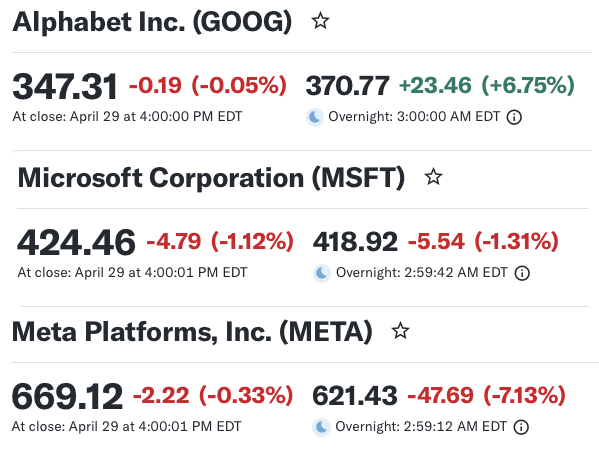
    NB: Alphabet Q1 sales grew 22% to $110 billion, with Cloud up 63% to $20 billion. Operating margins grew by 220 basis points, with services and cloud operating margins both increasing y/y.

    The search business continues to benefit from AI. AI overviews and AI mode are sustaining as search sales grew 19%.

    A year ago, Google was trading as if it had lost the artificial intelligence race. Shares are up 6.8% after-hours to all-time high even after growing 114% from a year ago.

    Though Google is considered an Apple competitor, the reality is that the two companies are very much in a partnership with Google's payments to Apple being treated as "advertising" revenues (part of Services). The relationship is being expanded with the Gemini deal.

    In many ways Apple has effective equity in Google and Google is demonstrating how sustaining AI is to its core business. That sustenance is transitive to Apple.

    Moreover, as Google's TPU strategy puts them in direct competition with Nvidia, it exposes the age-old adage that "there is no shortage that is not followed by a glut".

    Amazon is also offering up its own chips to customers and Apple is developing its own AI chips.

    In his annual shareholder letter, Amazon CEO Andy Jassy said that the company’s chip business, which includes its Graviton, Trainium, and Nitro processors, has an annual revenue run rate of greater than $20 billion.

    When Apple ships the inevitable edge AI silicon in a billion devices, the democratization of AI compute will dawn. Remarkably, some can see the dawn already at sunset.


  9. Apple share of the smartphone SoC market grew from 15% to 19% in Q1

    Nota Bene

    Supply disruptions strengthen the strongest

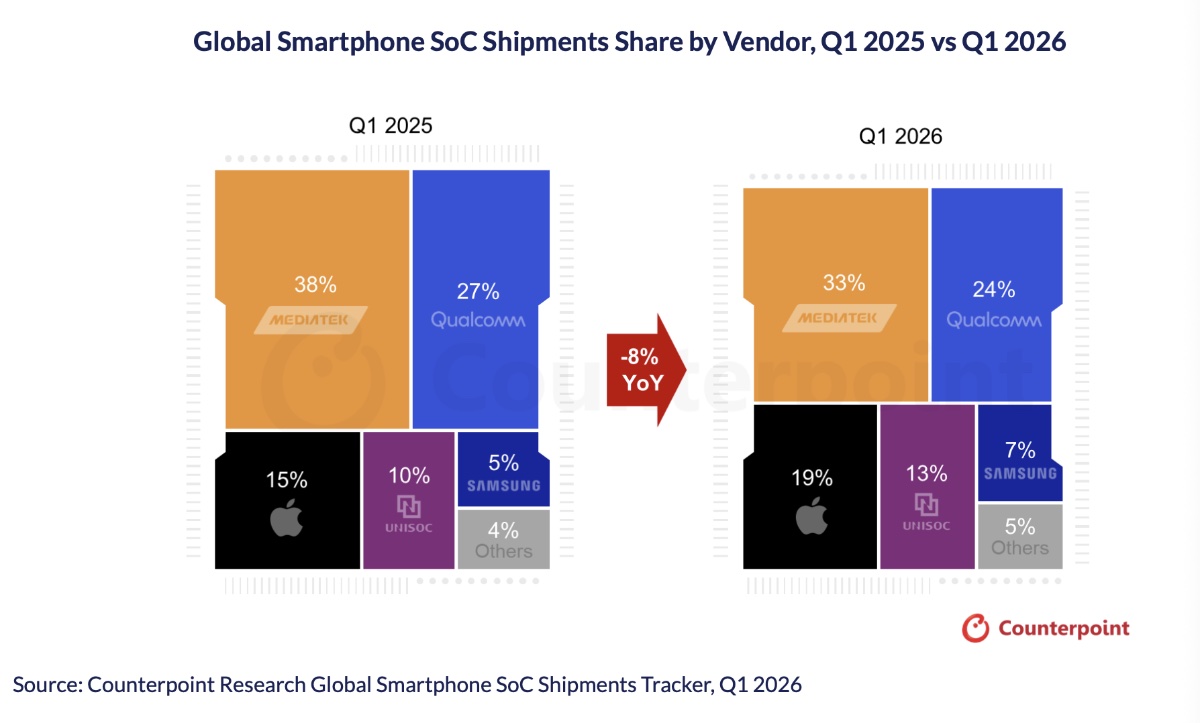
    Global smartphone system-on-a-chip (SoC) shipments declined 8% year-over-year (YoY) in quarter one (Q1) of 2026, according to Counterpoint Research’s latest Global Smartphone SoC Shipments Preliminary View report. However, it’s good news for Apple.

    Counterpoint says the premium segment has remained relatively resilient, with higher costs largely passed on to end consumers. Meanwhile, the entry-level manufacturers are increasingly adopting lower-cost chipsets to keep smartphone prices competitive.

    Qualcomm and MediaTek recorded double-digit declines in shipments. In contrast, Apple, Samsung, Google and UNISOC posted positive growth.

    Apple saw its share of the global smartphone SoC market grow from 15% in the first quarter of 2025 to 19% in the first quarter of 2026. Some explanation: A smartphone SoC (System-on-a-Chip) is a single, integrated chip that combines all essential computing components—CPU, GPU, memory, and connectivity modems (5G/Wi-Fi)—into one unit.

    Apple silicon is a series of proprietary, ARM-based systems-on-a-chip (SoCs) designed by Apple for its ecosystem, providing high-performance computing through a unified memory architecture and specialized components. They power iPhones (A-series), Macs (M-series), iPads, and wearables (S-series), focusing on superior power efficiency and security.

    Source: Apple World Today

    NB: Counterpoint Senior Analyst Shivani Parashar says that their integrated supply chains helped …

    …Apple, Samsung and Google to better mitigate the impact of the ongoing memory crunch. Supply crunches affect the smaller more than the stronger. It always surprises me when the reactions to such events (such as Covid disruptions) suggest negative impact on Apple, the strongest of the market leaders.

  10. Is Apple borrowing Samsung's Market Expansion Strategy?

    Nota Bene · 1 comment

    On March 18, 2026, Bernstein SocGen Group reaffirmed its “Outperform” rating and $340 price target for Apple Inc.

    Comparing it to Samsung’s 2009–2013 strategy, which saw Samsung increase its global smartphone share from 4% to 32% in Q3 2013, Bernstein emphasized Apple Inc.’s recent product launches as a strategy to widen portfolio price bands, driving share gains at the low end while raising prices at the high end to maintain margins. Although Samsung eventually lost market share to Chinese manufacturers, the firm said the stickiness of Apple’s iOS ecosystem will help it sustain long-term market share.

    Bernstein projected a 12% increase in fiscal 2027 EPS from share gains, split equally between hardware and services, assuming Apple Inc. captures 10% of Chinese manufacturers’ smartphone market share amid their supply issues. Some noteworthy product developments include the introduction of the $549 AirPods Max 2, the App Store cost reduction in China from 30% to 25%, and plans for a foldable iPhone.

    Source: Yahoo Finance

    NB: Separately, it's been reported that Samsung might see its first operation loss from its phone division, resulting in Apple capturing 100% (or more) of global smartphone profits. Simultaneously, Samsung is seeing huge profit gains from memory, even overtaking Nvidia's profitability. This is remarkable…

    Samsung seeing windfall profits from a memory shortage but a contraction from its phones suggests a migration of value in the value chain. AI has effectively pushed profit "down" the stack from device/OS to components, and perhaps up also to services.

    Apple has over the years invested down the stack to Silicon and up the stack to Services. What a surprise! The commentariat has not quite grasped this but has already jumped to conclusions that Apple is getting squeezed from supply chain and AI.

    The future however is not so sweet for either components or AI-as-a-service. There has never been a shortage that was not followed by a glut. The semiconductor business is known for this boom/bust cycle and this time it's not different. Unless AI conquers distribution, privacy, experiences and understanding & mastery of jobs-to-be-done while preventing commoditization through replication and scale economies of compute, there will not be a break-out new business model. There is no clear reason why Apple won't figure out any of the unknowns while preserving an ecosystem advantage.

    Samsung has the same challenge they've always had: how to create its own ecosystem and control over its future via its own platforms.


  11. Morgan Stanley forecasts fiscal second-quarter EPS of $1.74

    Nota Bene · 1 comment

    Expectations are low due to memory pricing, apparently.

    Apple has multiple catalysts for strong revenue growth, so investors shouldn’t be spooked by any margin pressure from rising memory…

    “Memory inflation will pressure margins, but this is well-known, and iPhone revenue upside sets up for a better than feared June quarter guide,” Woodring wrote.

    He added that any announcements regarding an AI powered Siri at the company’s Worldwide Developers Conference in June, and the expected release of a foldable iPhone, would be positive tailwinds that can help push the stock higher after earnings.

    Woodring, who rates the stock as Overweight with a $315 price target, also thinks Apple stands out against large tech peers as the company continues to report strong free cash flow while competitors continue to spend massive amounts of capex on building out AI infrastructure.

    We expect gross margin downside to be more than offset by revenue upside in the June quarter guide, making for a better than feared earnings and a clearing event into WWDC this June, and the iPhone launch in September.

    While our gross margin forecast remains below Consensus given rising memory cost pressure, continued strength in iPhone, Mac, and Services revenue should more than offset this pressure and result in a June quarter implied EPS guide in-line with Street estimates (~$1.74) – a better-than-feared outcome against relatively low expectations.

    At 28x next year GAAP EPS – roughly the midpoint of Apple's historical 24-34x valuation range – valuation is neither cheap nor taxing, but with our ~$10 of FY27 EPS 5% above Consensus, we see a path to $300 for Apple shares by this September, driven by modest multiple expansion and more robust positive EPS revisions.

    Source: MacDailyNews

    NB: Multiple catalysts, revenue upside, positive tailwinds, sentiment tailwind, favorable seasonal window, modest multiple expansion, thematically favorable backdrop, robust positive EPS revisions.