Asymco

Asymmetric Intelligence

Research

  1. iPad: IT gets it

    Research · 27 comments

    In the last article on the share of PCs highlighting the unwillingness of market analysts to categorize the disruptive iPad as a PC I imply that Gartner does not "get it".

    This is partly willful and partly instinctive. The willful ignorance is due to a belief that their customers (IT managers mostly) do not want to hear about the iPad as a viable technology. Certainly there is a lot of anecdotal evidence that the iPad is unworthy of consideration as a business tool.

    However, there is also increasing evidence that IT does in fact get it. I have met several senior IT managers who are whispering that the iPad will change everything. For us to decide which way the wind blows, we need to think harder about the process by which technology gets adopted in large IT organizations. Understanding how the technology is hired by IT managers to improve their career prospects unveils who wins and who loses in IT.

    The main hypothesis I put forward is that IT is an example of "rule of man" not "rule of law". The idea that law or "standards" (as doctrine is known by the jargon,) defines the products in use is a conventional myth. Standards change and they change quite dramatically based on who's in charge. The "standard" during the 70's was the Mainframe, the "standard" in the 80's was the DOS PC and the "standard" in the 90's was client-server and in the 2000's it was the web. Each new standard was a violation of the previous standard. So how did this change happen?

    Each evolution of technology standards affects the career of the IT manager. The adoption of technology is the primary driver for advancement in the profession. In most cases the technology being adopted is sustaining. In rare cases it's disruptive and can cause unforeseen re-distribution of IT power (and wealth).

    As IT is a cost center, naturally, organizational behavior (or, in the vernacular "politics") dominates the decision process. Senior managers look at each technology and ask: how can this help me achieve my career goals? Let's try this exercise with various innovations that have come along in the last few years.

    1. The Web in 1998. As IP based networking was catching on, the new technology offered a new way to tie existing assets together. It was also a completely new communication channel with customers. This was a great opportunity to increase IT consumption. It would lead to more work, more budget, more visibility and even a strong link between the profit centers of the company and the IT world. The web was an opportunity. It led to a firestorm of adoption.
    2. OSX in 2004. As Windows PCs were widespread and, given the support infrastructure behind them, worked well enough, an IT manager would look at a Mac and see no opportunity to increase their value add. They could not offer new software tools with it, and the old tools would probably not work without debugging. They could not move a Mac to new use cases and could not increase headcount to support it. The Mac was not a career opportunity.
    3. The iPad in 2010. As an IT manager looks at the iPad (and smartphones in general), he sees a similar opportunity to the Web ten years ago. The company users love their devices. Top executive love their devices. They see consumerization happening and there is no denying the explosive growth. There are challenges with integration but these devices are not a direct threat. The iPad is an opportunity to migrate to a completely new form factor and increase IT consumption.

    What this means politically is that the manager who figures out a way to roll out mobility in the organization will get the same uplift in his career as his predecessors did when they brought in disruptive waves. Those periods have become the stuff of lore and legend. Every IT manager with ambition is looking to create and ride a new wave. If the person is a mid-level manager, they will scramble to be the champion of the new technology and become a rising star. If the person is a high-level manager, they will see it as a way to protect their empire by co-option. Jostling for a vehicle to bring in the technology will begin. These vehicles are typically vendor relationships. Small vendors (example) have a better chance as the traditional vendors (for example SAP) and integrators are not quick enough with product development and don't have the products to sell.

    This IT manager's job-to-be-done analysis is crucial to understanding the adoption of IT technology.  Sustaining IT products do not sell themselves even if they are superior. Conversely, new products cannot be kept out of an organization even if they violate standards. What matters is whether they help the decision maker to achieve personal goals.

    My own intuition, having worked in such an organization (albeit briefly), and after a few conversations, is that the iPad and the mobile devices it represents is going to influence a generation of IT spending.

    Even though Gartner doesn't, IT goes get it.
  2. Gartner: as a Media Tablet, iPad deserves to be ignored in PC rankings

    Research · 40 comments

    "Media tablet hype around devices such as the iPad has also affected consumer notebook growth by delaying some PC purchases, especially in the U.S. consumer market. Media tablets don't replace primary PCs, but they affect PC purchases in many ways," Ms. Kitagawa said. "At this stage, hype around media tablets has led consumers and the channels to take a 'wait and see' approach to buying a new device."

    Gartner Says Worldwide PC Shipments Grew 7.6 Percent in Third Quarter of 2010.

    Fascinating. I'd love to hear more about the non-iPad "media tablets" that delayed PC purchases last quarter. Maybe I don't get out enough.

    But more to the point, let's combine the data from Gartner and the forecast for iPad.

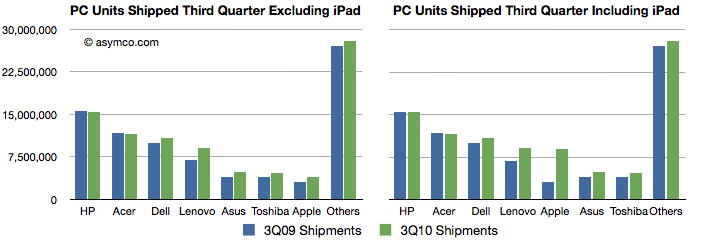
    I show below the impact of the iPad on PC vendor sales. I'm using my own estimates of world-wide PC sales (you can see other estimates here (Apple 2.0))

    The world-wide PC units shipped without and with iPad:

    When including the iPad Apple goes from 7th to 5th ranked, and with 50% growth clearly within shot of top rank next year.

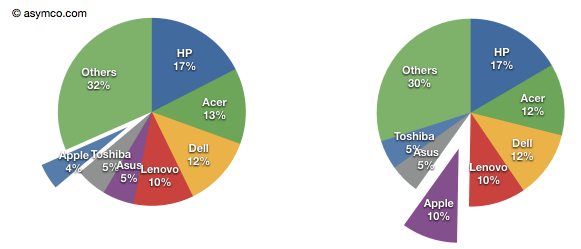
    Now I look at PC unit shares:

    With the iPad Apple goes from 4% share to 10% share. Again, within striking distance of number one or two in a year.

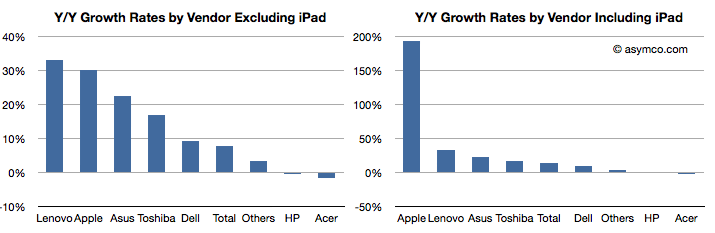
    Finally, growth rates:

    Apple's share growth goes from second to first but also several times higher than any of the others.

    When Gartner spins the iPad as a "Media Tablet" it's clear that the device is disruptive. Reminds me of what Gartner thought about Smartphones four years ago.

    I cannot think of a better endorsement for an investment than a snub from Gartner.

  3. Apps attract more viewer attention than most TV shows

    Research · 15 comments

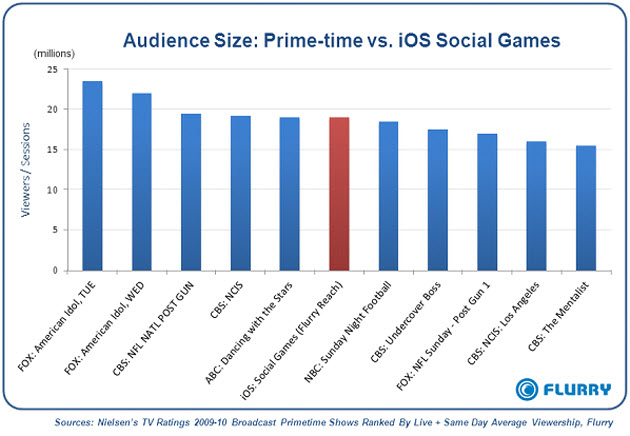
    Social games on iPhone, iPad and iPod touch devices are competing for television viewers.  In fact, these apps, tracked on the Flurry network alone, comprise of a daily audience of more than 19 million who spend over 22 minutes per day using these apps.  Treated as a consumer audience, its size and reach rank somewhere between NBC’s Sunday Night Football and ABC’s Dancing with the Stars, and only 4 million viewers shy from beating the number one prime-time show on television, FOX’s American Idol.

    via Flurry.

    I cannot tell from the original article if the iOS audience is US only and therefore not clear whether the TV shows compete for the same eyeballs, but the data shows just how far apps have come to capturing attention.

  4. Escape from license-land: Measuring phone vendor commitment to licensed mobile platforms

    Research · 29 comments

    Windows Phone had its day in the sun yesterday. After discarding its previous seven-year effort with Windows Mobile, Microsoft started with a clean sheet of paper. However, whereas the software has been re-built, the business model has not. WP is still a licensed operating system whose primary customers are mobile phone vendors. With Symbian mostly out of the picture, WP becomes only the second viable commercially licensed mobile OS, after Android.

    So with two licensed platforms in the running, how do we measure success in the licensing business? Units sold to end users is one metric. But that data will have to include the performance of vendors and operators and other distributors. And it will take a year to do valid comparisons. The only indicative metric we have available today is how many devices have been committed by vendors.

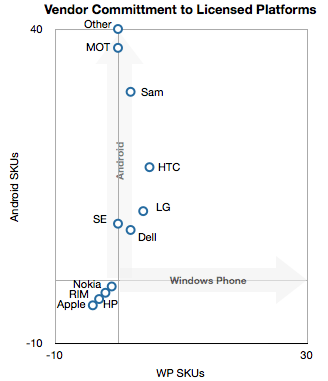
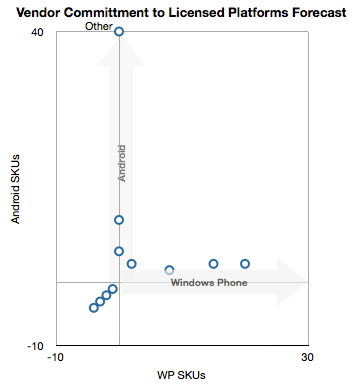
    As WP is out of the gate with device announcements, we can actually measure this. We can plot each vendor's commitment to various platforms as an early indicator of strategic success. To that end, here's the methodology: I took all smartphone vendors and tallied how many SKUs they have announced or leaked for either the WP or Android platforms (source: pdadb.net). I then plotted each vendor on two "commitment axes" (see notes below).

    The more to the right a vendor lies, the more committed they are to Microsoft's platform. The more to the top a vendor lies in the chart, the more committed they are to Google's platform. The vendors which don't have any licensed products lie below the origin.

    What we can observe is that Microsoft has pulled several, though not all vendors partially to its side. The level of commitment is not yet very high and it has not likely reduced their commitment to Android. In other words, points are moving to the right but not (yet) down.

    Framing the platforms this way helps us discuss how the market might evolve with these questions:

    1. Is Microsoft's re-entry going to peel vendors away from Android. In other words, will points move down as well as to the right.
    2. Is there motivation for some vendors to move to their own platforms like the non-committed? We've shown that profits accrue disproportionately to the vendors below the origin. As a result, is the pool of available top tier vendors going to shrink?
    3. Will vendors commit to single platforms or maintain this split OS loyalty strategy? Will we see LG migrate to WP exclusive and will Others remain exclusive in Android?

    I'll throw out my predictions to start:

    Microsoft's strategy is aimed at top tier vendors more than to the "others". This is due to a lesson they learned with Windows Mobile: having a ton of SKUs does not guarantee a healthy ecosystem (a lesson that Android has not acknowledged as true). There are positive and negative consequences. The positive is that Microsoft control the experience better, create a better brand and can participate in an effective dialogue with operators. The negative is that they are going to deal with a diminished licensee pool.

    On the second question my prediction is that vendors are going to move "down and to the left" away from the licensing model. If they can't go direct to that quadrant, vendors will consolidate portfolios around one licensed platform. The distribution of commitment I forecast will look like this:

    Maintaining multiple platform development teams is expensive. Branding is also confused. The upside is that you get to play the operator's divide-and-conquer game of platform dilution (aimed at the non-licensing players in the lower left corner).

    In particular, Samsung, with Bada, is likely to find ways out of license-land. Sony Ericsson may stick with Android and LG may move to Windows exclusively. That really leaves only HTC and Dell as licensees with multiple licenses.

    This axial alignment is not a healthy thing if you are a platform vendor. Having one or two dedicated customers means the power of the buyer is much higher and their wishes become your command.

    Which leaves only one true prize in the game: the "others". Android is clearly the darling of "Others" who are being shunned by Microsoft. Can "Others" become the lever for Google to pry open the market? History and the tangled web that is operator distribution does not point in that direction.

    ------

    Notes:

    1. I considered products announced only since Jan 1, 2010
    2. I did not consider any Windows Mobile legacy commitments
    3. "Other" vendors are off the scale with over 100 SKUs but represented as having 40 SKUs so as to be kept on chart
  5. What did Andy Rubin mean by saying WP7 was created for political reasons?

    Research · 24 comments

    In an interview with PCMag, Rubin said,

    "Look, the world doesn't need another platform. Android is free and open; I think the only reason you create another platform is for political reasons. Why doesn't the whole world run with [Android]? They don't like the people who developed, or "not invented here [NIH]"

    I note some irony in the suggestion that Windows Phone is superfluous when the acquisition of Android was an attempt to limit the growth of Windows Mobile. But that historical footnote is not entirely relevant here. The point Rubin raises is that WP is politically motivated. And by political he suggests two things: that there is mistrust of Google or NIH among potential licensees.

    The NIH argument falls flat because anyone considering WP7 would also have NIH issues with Microsoft. So that really leaves only the question of trust.

    Why would anyone mistrust Google when they offer operating systems software? How about these reasons:

    It's clear that Microsoft is buying its way back into Mobile (it went so far as to pay incentives and guarantees to established developers to convince them to port existing apps or write new ones for WP7), but that is not a political ploy. It's just good old fashioned brute force.

    The mistrust that Google earned for itself with operators, device vendors and potential content partners is rooted in its business model with Android. Hiding the costs of "openness" behind a veneer of freedom. In addition, putting forward competing products like Nexus One threaten the entire value chain.

    I'd say the politics of Microsoft licensing are a lot more transparent. Redmond is the devil they know.

  6. Acer chairman predicts iPad market share

    Research · 30 comments

    Acer chairman J.T. Wang recently predicted that Apple’s share of the tablet market would decline precipitously as new rivals emerge, falling from nearly 100 percent to 20 to 30 percent.

    via Apple Will Retain At Least Half the Growing Tablet Market, Says Analyst | John Paczkowski | Digital Daily | AllThingsD.

    So let me get this straight: A PC vendor...

    • that did not consider building tablets because they failed to see an opportunity
    • that, once introduced, dismissed the iPad as a failure
    • that has no software assets to couple to an alternative offering
    • that cannot license software assets that compete because none exist
    • that does not understand what jobs the device is hired to do vs. what his current products do
    • that has no ecosystem to couple to an offering
    • that cannot market products any cheaper than the incumbent

    ...should be taken seriously when predicting share for products that do not exist?

  7. Daring Fireball Linked List: Andy Rubin Talks Android

    Research · 29 comments

    What value have the carriers brought? Seriously. What software on Android phones have the carriers added that’s any good at all?

    Things you don’t hear iPhone users say: “Man, this iPhone would be even better if my carrier could ‘add value’ to it.”

    via Daring Fireball Linked List: Andy Rubin Talks Android.

    Good questions.  I would seriously like to hear any answers to these questions as I have never used any of these operator software phones.

  8. Adding CDMA increases iPhone addressable market by 16 percent

    Research · 18 comments

    Now that NYT and WSJ were both tipped off about the coming of a CDMA iPhone, I think it's a safe bet. Is this significant? What is the CDMA addressable market?

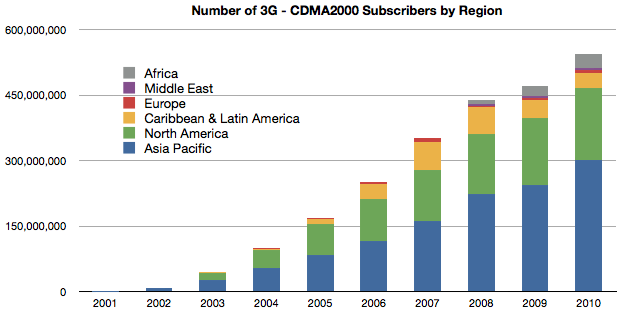
    Here is a chart showing  for the "CDMA 3G" subscribers (source: CDMA Development Group.)

    (includes CDMA2000 1X, 1xEV-DO Rel. 0 & 1xEV-DO Rev. A )

    Here are the data for various subsets.

    • CDMA2000 543 Million includes CDMA2000 1X & 1xEV-DO
    • CDMA2000 1xEV-DO 145 Million includes CDMA2000 1xEV-DO only
    • CDMA 547 Million includes cdmaOne, CDMA2000 1X & 1xEV-DO (includes non-3G)

    For comparison, the GSM data for Q2 2009 is:

    • GSM 3,450, Million
    • WCDMA 256 Million
    • WCDMA HSPA 133 Million

    It would be safe to assume that the iPhone will be able to address 543 Million additional users.  They represent about 13% of all mobile subscribers but the increase in addressable base is about 16%.

  9. The imminent demise of killers

    Research · 36 comments

    Before proclaiming the death of a company or product it's important to understand what makes it live. I'll illustrate with a personal experience.

    I was once asked to comment on a product designed to be a "Blackberry killer". Much like the latest Droid Pro, the product looked like a Blackberry. It had a monoblock keyboard and a nearly square screen. It was, in other words, a product designed for thumb typing emails.

    The backstory is that, like many phones, the requirements came from operators. At the time, RIM was growing extremely quickly and was causing some consternation at operators over an upstart's increasing reach into the relationship with end-users (sounds familiar?)

    The rigidly predictable response was to call all phone vendors and task them with developing Blackberry alternatives (aka killers). Of course, each vendor was called independently so they all got excited about having this opportunity to be assassins.

    So when I looked at the product my employer was building as a "killer" I asked: "Well, what makes Blackberry live?" This was not just rhetorical. I felt it was critical to the success of the product. Unfortunately it was not a question on anybody else's list. My cursory review of RIM's business would show that the product Blackberry was popular because it enabled a service, not because of the design of the device.

    RIM was like a barkeeper who enabled socializing on his premises by selling beer. The product he sold was not really beer but meeting services. A brewer looking enviously at the high margin beer being sold there might try to compete by launching "Pub-style beer" but the product won't help people socialize any more if they drank it at home. Bar patrons were paying the high price of bar beer because it had an implicit rent attached for using the meeting site.

    So no matter how much a brewer tried, unless they got into the business of managing taverns, they won't ever put the barkeeper out of business.

    But the rush to copy the design was in full force. Not only Nokia (E 61), but HTC (T-Mobile Dash), Motorola (Q), Samsung (Blackjack) and even Sony Ericsson (M600) rushed similar products out. And they all reached the market at about the same time. (Evidence that not only were they all asked to make products by operators at the same time, but that their product development cycles were roughly the same.)

    The deluge of keyboard monoblock Blackberry killers led to lots of comments predicting the imminent demise of RIM by way of powerful entrenched incumbent responses.

    RIM's market share actually grew after these launches.

    This is because none of the products addressed the real question of what makes Blackberry live and thrive. They were just pub-style beer, not thinly disguised meeting places.

    So next time you hear about the imminent demise of an upstart due to the reaction of suddenly awakened incumbents, ask whether the reaction is to the product or to the way the product makes money.

  10. Adobe and Microsoft sitting in a tree

    Research · 16 comments

    Adobe is one of the last surviving desktop software companies. So is Microsoft. Consolidation happens when an industry matures and excess capacity and excess overhead can be squeezed out of the value chain, giving a temporary burst of earnings growth.

    So, in this way of thinking, recognizing that the sun is setting on desktop software, a merger of old schools of thought may make sense. Rather like Sun and Oracle or HP and Compaq.

    But then a lot of other things make more sense. Like both companies trying to expand into new growth areas. Like Microsoft talking to RIM or Adobe developing tools for HTML5. Adobe's cash cow products are not going anywhere without a deep reset. Same is true for Microsoft. They will both face these challenges whether standing alone or together.

    There would be nothing strange about a Microsoft Adobe merger, but there would be nothing great about it either.