Asymco

Asymmetric Intelligence

Research

  1. Will Apple avoid giving their cash flow to Nvidia?

    Research · 3 comments

    Asked by Jay Goldberg

    Q: Do you think Apple will start investing heavily in AI data centers?

    There's rumors and actually statements from Apple saying that they're working on a server chip. Google has a server chip. Amazon's got a server chip. These are effectively aimed at Nvidia. And if you can make something, you tend to do it. Now, of course, there's some protection — Nvidia's got other special sauce, but their margin is everybody's opportunity. They have a huge margin. And everybody's writing huge checks. As I say, hyperscalers are just handing over their entire cash flows to Nvidia. And that means their shareholders' entire wealth is being handed off to Nvidia shareholders. So there's a transfer of wealth happening right now. Presumably, because we're going to get some benefit later, but if that's happening and people are irritated by it, they're going to find a way to do what Nvidia does.

    And Apple, of course, can and will do that. Now, whether that'll get deployed at the edge or in Apple's own cloud — because they probably also don't want to write checks to Nvidia, and they'll say, well, we can do it, and we won't necessarily sell them, like Google wants to. They'll probably just use them themselves. And that's something certainly they're capable of.

    The question I was always asking is how many are we talking about? Because if it's in the tens of millions, or even single-digit millions — for Apple, single digits. Is it worth it to develop your own designs? There's a limit to how many you can deploy. And probably you're going to have to replace them every so often, so there's a question about how much it costs to keep on the treadmill.

    But it is an interesting question, and I think everybody's capable of doing what Nvidia's doing. But it's about execution, timing, delays. Look at what happened with the Qualcomm chip — how long it took Apple to finally deploy the communications chip relative to the amount of grief it had to deal with. First, of course, it moved out of Intel. It moved out of Qualcomm now, and now the question is, is it going to move out of the server supplier chain? And that's a complex decision. But again, Apple's not doing it because they want to be in that business. It's more that they want to avoid dependency.

    This was one of the questions asked by the participants in Asymco's May 2026 Office Hours live Q&A sessions, open to Asymco One subscribers.

    See also: May 2026 Office Hours

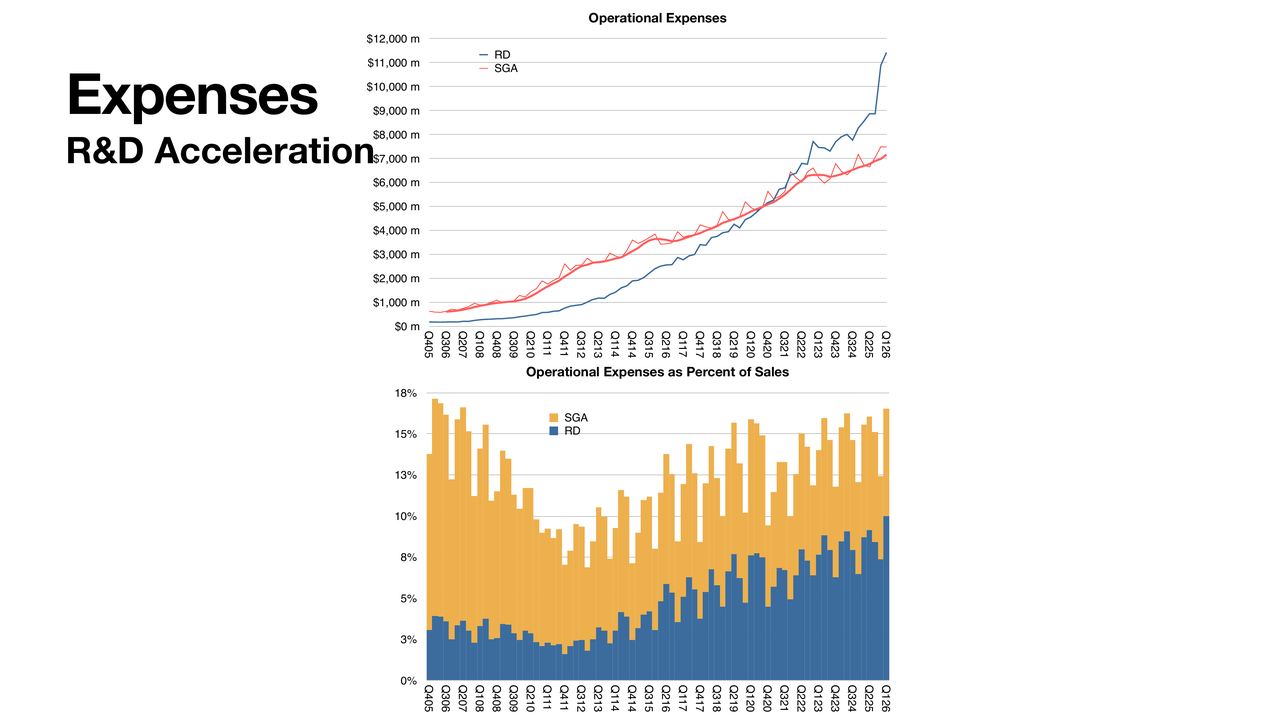
  2. Why is Apple's R&D run rate suddenly $40 billion/yr.?

    Research · 1 comment

    Office Hours question asked by Frederich H. on May 1, 2026.

    Q: Any thoughts on the breakdown of R&D, with that big jump?

    It's hard to tell. I do think they're buying — that does include some hardware. A lot of hardware. I think they're building quite a bit of capacity in order to implement their versions of AI. They're not for deployment, but they're for testing and experimenting. They're hiring people as well, obviously that's included. But I do think it used to be they bought equipment for testing — I don't know, radio frequencies, and testing the iPhones, and semiconductors, and testing a lot of things like that. But I do think probably there's a lot more spending now on the stuff that feeds AI. It's not on the level that a hyperscaler's doing, because they're building it for scale, and Apple's maybe building it for testing.

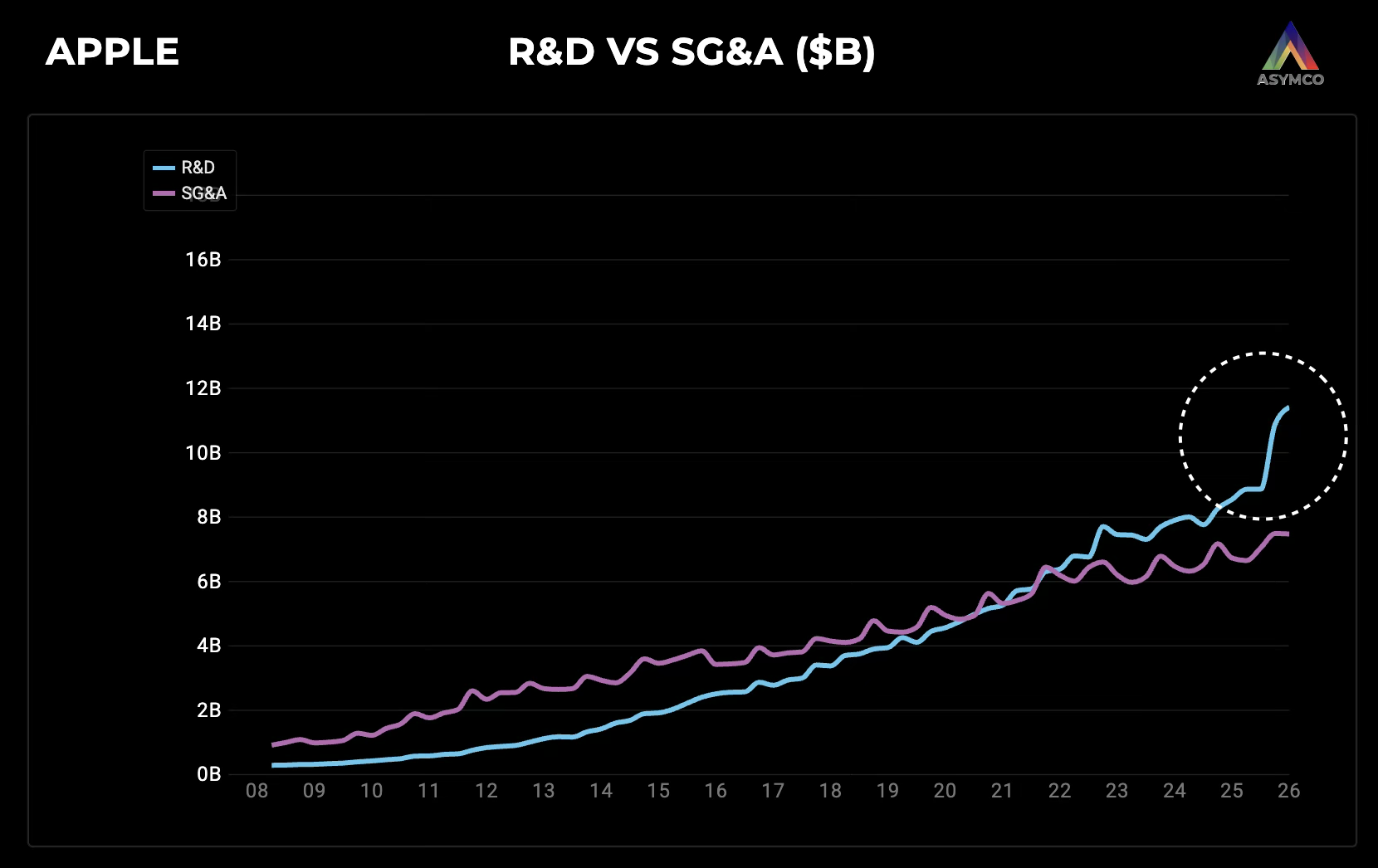
    We're talking about here, look, $11 billion in R&D, that's in one quarter. So that goes out to about $40 billion a year.

    Mostly, I think this is people, but there is some equipment involved. It's just maybe different ways of capitalizing it, because capital equipment is a complex story.

    It seems like a big jump, but it's only $2 billion more compared to the prior period. It's recurring though. And the reason that this stays steady and keeps growing is because people are on the payroll. And so if there's more and more people, that's paid every period — the reason, by the way, you see SG&A being seasonal is because there's temporary people in the stores. That involves people who are hired for the holidays in the Apple stores. So that's where you see some less than steady. But engineering people are more steady. But if there's a spike, there might be something going on where there was some equipment involved.

    See also R&D Acceleration section of Apple 2026 FQ2 Presentation.

    —
    Editor's Note: This is a lightly-edited revision of a question asked by participants in Asymco's May 2026 Office Hours live Q&A sessions, open to Asymco One subscribers.

  3. Why won't Apple become a cloud company?

    Research · 2 comments

    An Office Hours question asked by Fred S., May 1, 2026

    Q: Ever since Johny Srouji started talking about Apple Silicon and the power consumption for the performance and the unified memory, and now we've seen the Mac mini surge, I just wonder about high-end computing. The whole area of where that Mac architecture may go beyond its success as an individual consumer computing product. From all the high-end workloads that might be coming their way.

    The story of Apple is one of personal computing. It's not a story of servers, it's not a story of clouds, it's not a story of centralized computing. They've tried once or twice to make a server product, and they abandoned it. They've even abandoned the high-end Pro product, and created the almost-as-fast Studio product.

    Now, that does not mean they're shying away from high-power computing. They're just saying, we're going to put that high-power computing in a desktop, or in the laptop, or even in the phone. Everyone who's grown up throughout the personal computer era can remember Moore's Law, and how exponential growth has driven computation to levels that seemed impossible just a few years earlier. We've hit some slowdowns, but fundamentally, the potential exists.

    And by the way, it's not even a classic computational CPU problem. We're dealing with AI. We're mostly dealing with high bandwidth, large data, and we're dealing with simple calculations on it in parallel, which means the architecture is much more around large matrix computations. This is why Nvidia came from graphics. Graphics was the same problem — a graphics accelerator is a matrix problem. And so is machine learning. So different variations of these have come in as a sort of a parallel to the CPU, the general computation problem.

    The idea Apple has is that they're going to catch up with whatever is done on the server, they're going to do it on the device. You can call it Edge, you can call it personal — the old term was personal computing.

    I may be naive, but I think we'll get very powerful desktop computers that can do what is essentially AI, but for the individual. The other aspect here is that Apple is a consumer company, not a B2B company — it's a B2C. They want to bring that power to as many people as possible. And they're certainly delivering hundreds of millions of computers a year. Nvidia's making tens of millions of computers a year. Apple is capable of doing orders of magnitude more.

    So I think they're going to affect the disruption in AI. It's not going to be that there's no profit in AI, it'll be that it'll be done with Edge more, especially as it doesn't have to be a world model — it can be a personal model. If you want to look up something globally, you can use the cloud, but if you want to deal with tasks in your world, you're going to work with Apple computers.

    It may take years to get there. But in the meantime, I don't think a centralized service — these OpenAI, or Anthropic, or Microsoft, who are trying to make us a singular superintelligence — is necessary for everyone. It'll be a good reference, but it's not how you want to handle your personal information. So I think that's what the future is, and I think Apple's very much planning for it.

    It sounds cliche, but when Apple started, it was IBM that dominated computing. And IBM was about centralized computing, and their thesis was everything we now call "the cloud" — but it was all in one big computer that served the entire organization, whether that organization is a government or a big company. And then we went to mini computers, then we went to desktop computers, then we went to portable computers.

    Then, fast forward 25 years and we had Google. Well, now central computing is the internet. In the internet, everything needs to be indexed to be able to be found. So they created an index in the cloud. And then a lot of companies moved that computing they used to have locally into the cloud, as a shared resource from Amazon, AWS, and others, and that became cloud compute. Even now, those are the drivers for growth for Microsoft and Amazon and Google.

    The AI part of that is tiny — there's revenue from AI, but there's a lot of revenue from cloud. That still is valuable. But that's not a job for consumers. You do some things in the cloud — you store things, you search, you communicate in messages and so on. But most of the data that matters to you will get also indexed locally, so you can pull up your photos, pull up these things, and it'll be a blend of the two.

    So that's where Apple lives, and I don't see anything fundamentally changing about this, because computation tends to commoditize. Software tends to be replicated. Algorithms tend to be replicated. In fact, even the AIs we have today were all because people publish papers, and one company invents it, another implements it, as was the case with the transformer. As far as I understand, it was Google who actually wrote the paper on it.


    Editor's Note: This was one of the questions asked by the participants in Asymco's May 2026 Office Hours live Q&A sessions, open to Asymco One subscribers.

  4. Big shoes to fill: will the haters spare John Ternus?

    Research · 1 comment

    An Office Hours question by J.P. answered on May 3, 2026.

    Q: With the ascension of John Ternus becoming the new CEO -- will it lower the criticism from the perennial Apple haters and critics?

    No, no, of course not. Of course not, come on. You should know better than this. If anything, it'll amplify.

    I wrote a piece about this. Titled, "John Ternus will have left big shoes to fill." This is his epitaph. This would be when, in 2040, he'll retire, and this is the article that will get written then. And the criticisms he will have faced will be the same.

    We mustn't forget that when Steve was around and was the CEO, the amount of abuse he got was worse, in my opinion, than what Tim got. The criticisms of his incompetence, of his lack of ethics, morals, and overall bad decision-making were legend. I think he was accused of criminal behavior, even.

    So we tend to forgive and give peace to the deceased. But while they're alive they will be skewered. I think John will be as criticized as any [Apple] CEO. And you can use your imagination for the reasons and all the failures and all the bad, all the things he'll miss, all the things he'll do wrong, all the incompetence. That he doesn't know how to run anything. It's time for a change. Inevitable.

    —
    Editor's Note: This is a lightly-edited question by an Asymco One participant answered during our May 2026 Office Hours live Q&A sessions.

  5. Expectations for the Quarter

    Research

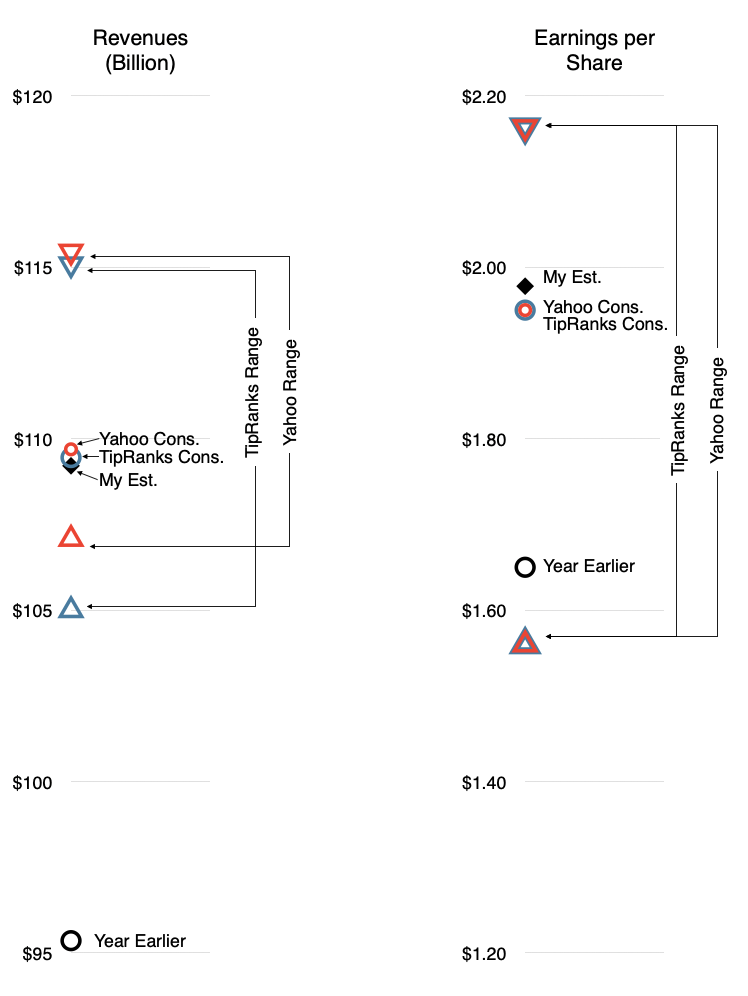
    Revenue and EPS consensus, year-ago results and my expectations

    Yahoo Finance

    Yahoo Finance's revenue estimate for Apple in Q2 stems from 31 analysts. As of April 25, the average estimate is $109.69 billion, with a low of $107.08 billion and a high of $115.37 billion. 

    For the earnings per share estimate, 32 analysts put it at an average of $1.95. The low is $1.56 and the high is $2.16. 

    TipRanks

    TipRanks also does its own analyst polling on Apple's quarter. In its forecast as of April 19, its consensus is for a revenue of $109.45 billion, with a high of $115 billion and a low of $105 billion. 

    On the earnings per share, the consensus is $1.95, with a high of $2.16 and a low of $1.56.

    A summary of the expectations include year earlier results and my own estimates is shown the following graph:

    UBS Raises Price Target from $280 to $287 but Maintains Neutral Rating
  6. The Composition of Active Devices

    Research · 8 comments

    Measuring the future

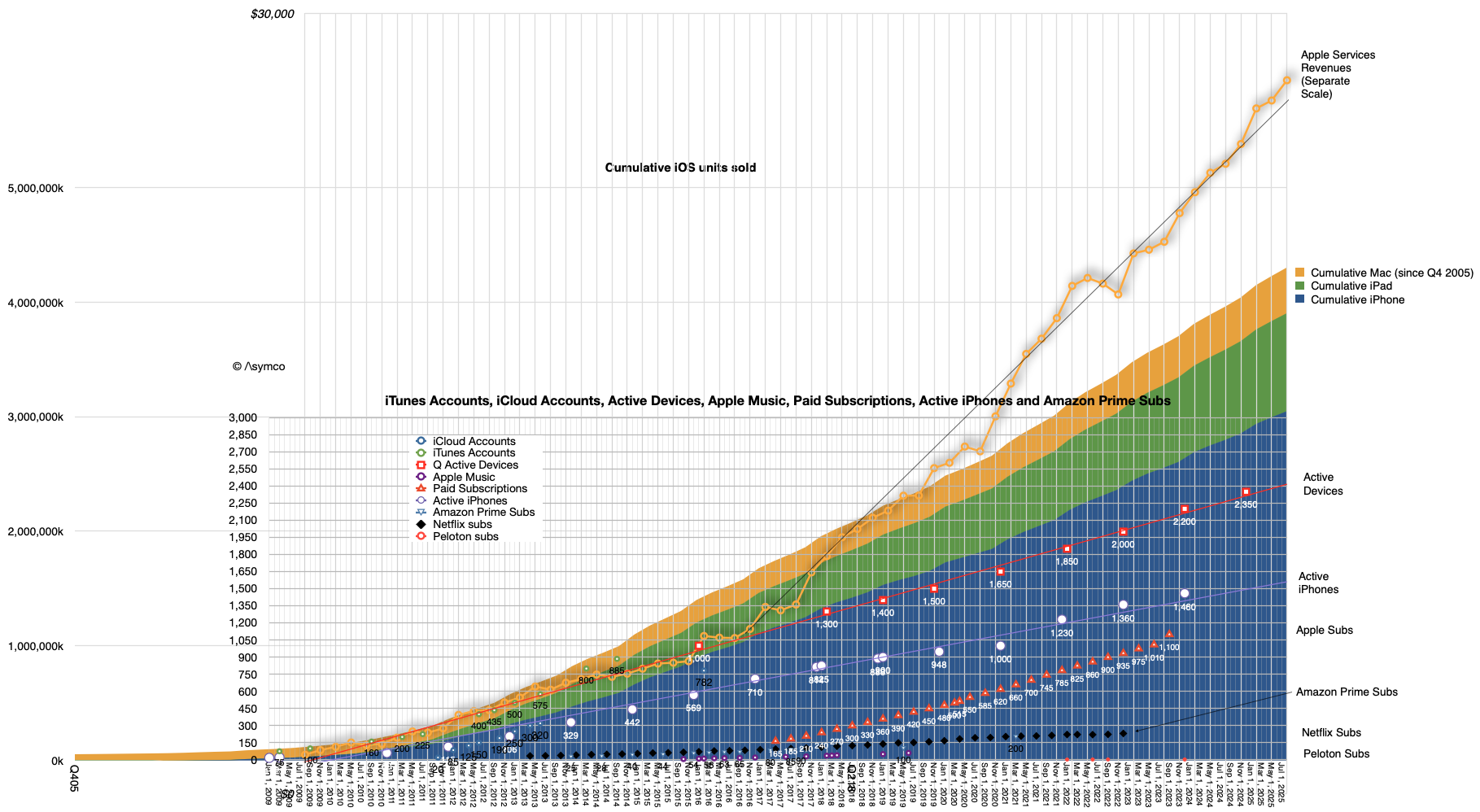
    In January this year Apple reported that there were 2.5 billion active Apple devices in use. This figure has been getting updated for years and I've been reporting its trajectory and other measures that are correlated to it. For instance the number of Apple subscriptions, Apple Services revenues and other historical indicators such as iCloud accounts and Apple Music.

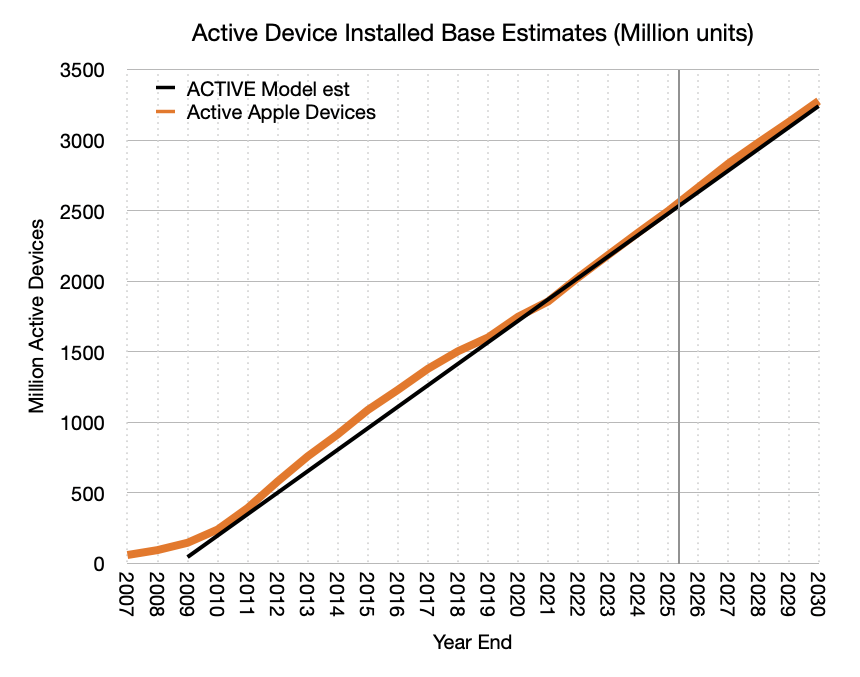
    Simplifying, I published the "ACTIVE" model which makes some basic projections of this total device count and it's shown below"

    One element of the analysis that has eluded me was the more precise composition of this total "devices". In other words, which devices and what is their mix. We have seen numbers for iPhones but not for other types of devices. I should note that this is not easily derived because we have neither the units sold (only revenues) and we don't know how long they stay in use. The measure of active population implies that the products are bought, used and eventually retired.

    The only clue we have, beside quarterly revenues--and even there wearables and home are not separated by product--is that management occasionally mentions that "more than half" of buyers of a specific product are "new to the product". It's not much to go on.

    But there are other data sets we can tap. StatCounter provides a share of platforms in use by aggregating browser identifying data for a moderately large set of web sites. That may help with share of base but not with how much the total base is. Various other analysts do try to summarize some of the installed base for particular dates.

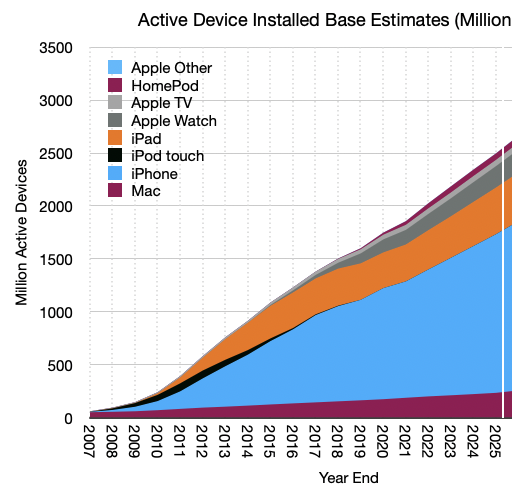
    Combining all the available data and some interpolation, I set out to do is to provide a yearly count of the population of Apple devices for each year since 2007. Then to try to forecast this population to 2030. The result is shown below:

    The following is a summary for the components for the end of 2025 in millions:

    Year-endMaciPhoneiPadWatchApple TVHomePodOther
    2025233150044220358.561.750.5

    This history looks like this:

    What about the future? Let's dig in.


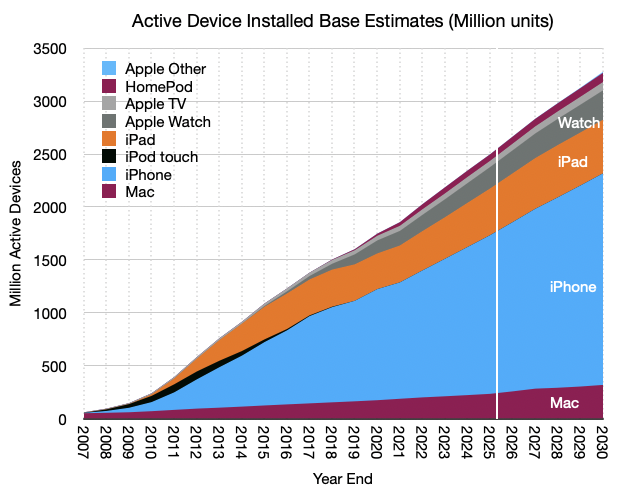
    The forecast is shown in the graph and table below. The model predicts about 3.2 billion active devices by 2030.

    YearMaciPhoneiPod touchiPadApple WatchApple TVHome PodApple Other
    20075045
    20085417157
    20095942359
    20106986591510
    201182166765513
    2012932767512115
    20131023826119517
    20141124824325918
    201512359926308822.49
    2016133700133362027.135
    201714382573393331.36
    201815390053505635.674.2
    20191629503459538.8510.1
    2020173105033812343.86519.9
    2021186110034913847.8434.7
    2022200120037215452.30548.3
    2023210130039317054.9157.8
    2024221140041818757.7560.60.2
    2025233150044220358.561.750.5
    2026257160046221862.566.750.7
    2027282170048023366.571.751
    2028291180049524870.576.752
    2029302190050226374.581.754
    2030317200050727878.586.7510

    By 2030 the iPhone will be about 60%, Mac 10%, iPad 15%, Wearables 10% and Home products about 5%. The difference from 2025 will not be great. The iPhone today is about 60%, Mac is 9%, iPad 18%, Wearables 9% and Home 4%.

    The revenue impact in the growth of this ecosystem can be computed. Although we have a figure in terms average revenue per device, looking at individual products allows a more precise view. For instance, revenue per Mac per year vs. revenue per Watch per year can be now separated.

    That will all be forthcoming.


    This is a future five years away. Is this growth rate and consistency in mix a reasonable assumption?

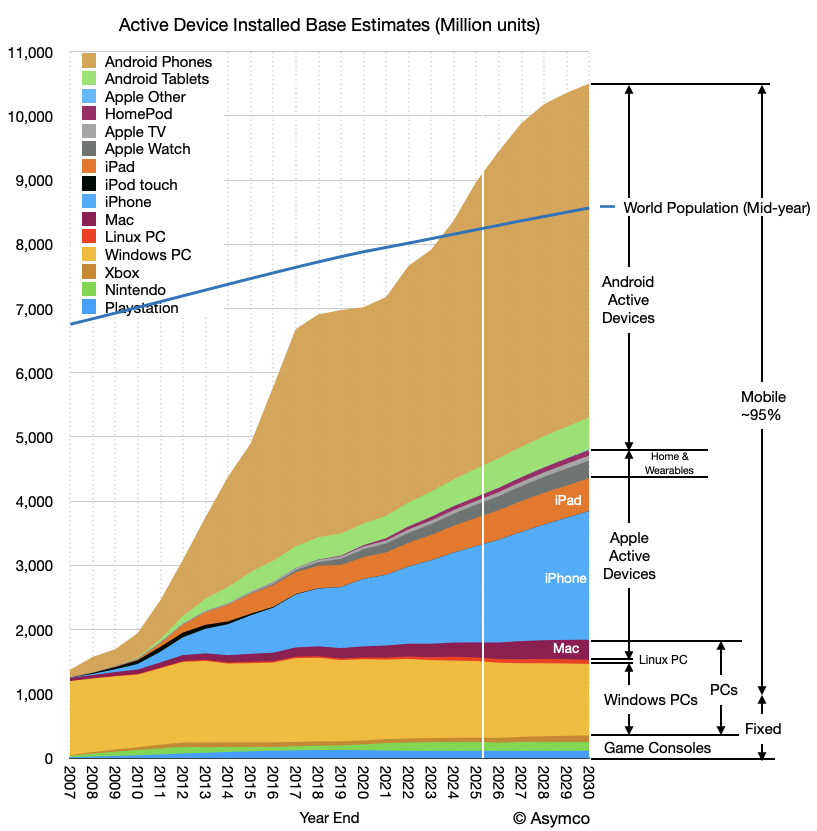
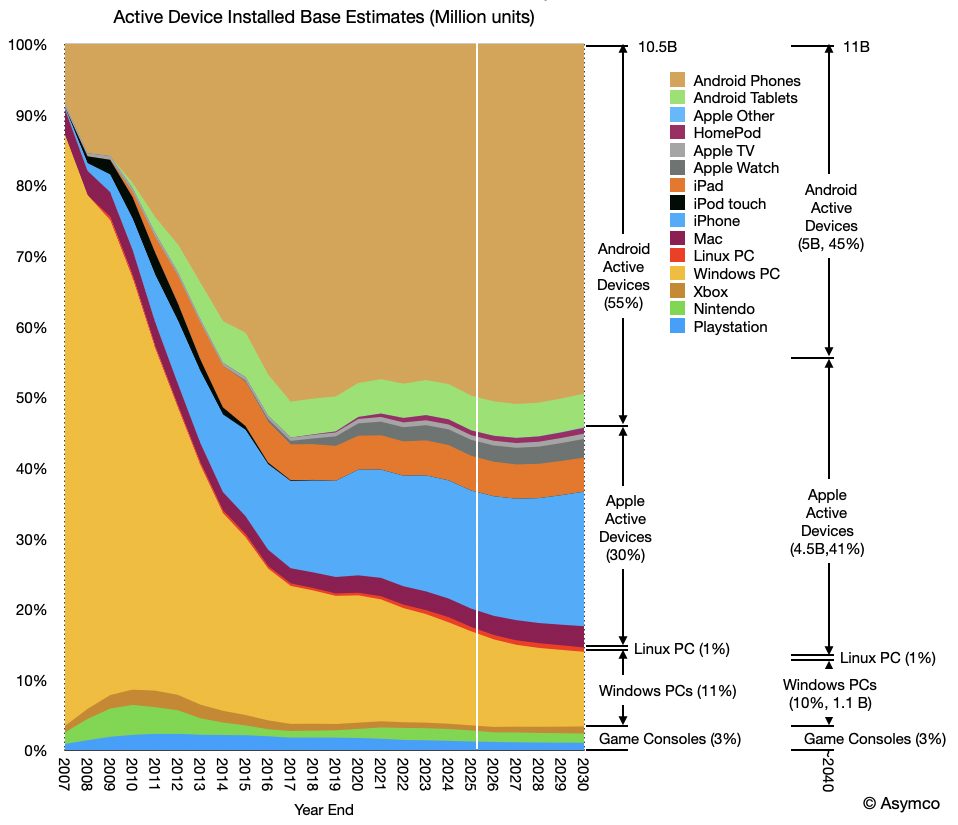
    To answer, we should zoom out and look at not just Apple's device base. The following graph shows also Android phones and tablets, Windows, Linux (PC) and Game Consoles.1 It contrasts mobile and "non-mobile" computing and shows the total global population (blue line).

    I have several observations:

    • The total device population now exceeds the total human population. The total number of phone lines was already higher for some time2 but what are shown here are "computers" insofar as they have CPUs and operating systems that can run third-party apps.
    • Given the device count exceeds human count, how much higher can this total go? The forecast shows a slowing of growth within the next five years but this is not a certainty. The attach rate of devices/person could well exceed 1.2 to 1.3 and go to levels seen in wealthy countries (above 2.) If that is the case then the device total may exceed 16 billion at saturation. This has implications for how far current strategies and business models can run.
    • The composition of device types is fairly constant and form factor substitution is rare. New categories beyond phones and current wearables are hard to anticipate but even if they emerge, the evidence suggests they are additive. Evidently the phone did not so much displace the PC but build on top of it. The potential for wearables and home devices to explode is there but it's hard to image these stealing "share of pocket" any more than phones stole "share of desk or share of backpack". If they do explode, they will add to the total via higher attach rates. 3x human population (24 billion) is possible with new wearables and home3.
    • AI holds many promises but how AI is accessed is not necessarily requiring of or benefiting from new device types. The smartphone is still the best AI device imaginable4. Ambient or passive computing can be provided by existing wearables but, as the graph shows, these are augmentative to phones. If AI introduces a completely new form factor, the impact will take decades to diffuse. As the graph shows, the mobile era is now approaching 20 years with the next five years foreseeable with some confidence. The next 15 years will be discussed in a future post.
    • Android typically captures non-consumers who eventually churn into Apple devices. This means that as long as non-consumption exists, Android grows and as long as Android exists Apple grows. If and when Android growth stops then the dynamics will change and Apple might change strategy to accelerate churn.5
    • Google and Apple will be the primary distributors for all software and services into the foreseeable future. Try as they might, challengers face over 9 billion in installed base. Note well how entrenched Windows has been on the desktop even as (free) Linux and (better) macOS alternatives have harvested usage. This rigidity has held over the 1.5 billion addressable market for 30 years now. For additional evidence consider the dynamics, or lack thereof, of the game console business.
    1. It excludes servers and early phone platforms such as Symbian, Blackberry and Linux phones.
    2. According to ITU Facts and Figures 2024, there were 112 mobile-cellular subscriptions per 100 inhabitants globally in 2024
    3. Households are 1/3 human population and vehicles are only about 1/7 so Home and Automotive don't move the needle much.
    4. AI is, if anything, putting the "smart" back in "smartphone".
    5. This might be what is happening with the Mac Neo, decades after the PC market saturated. Perhaps pieces have finally fallen into place but apart from Chromebooks, it's been very difficult to challenge the Windows PC head-on. (Though the iPad was possibly designed to displace some of the PC usage, it hit mainly with non-consuming very young or very old and PC use was unaffected.)

    —

    Join me for a live discussion of this research and more at Asymco Office Hours Live Q&A on Friday, May 1, 2026.

  7. John Ternus has left big shoes to fill

    Research · 4 comments

    April 21, 2040

    It's been 15 years but John Ternus has finally stepped down as Apple CEO. Analysts described the transition as expected rather than disruptive, noting that investors had long anticipated Ternus' eventual departure. Nevertheless, he leaves with many questions still unanswered about Apple's long term strategy. Apple incoming CEO faces a defining challenge: Fixing the company’s Services dependence.

    It's been a tumultuous tenure for Ternus but he is leaving with significant accomplishments:

    • John grew Apple devices to 4.5 billion from 2.5 billion when he took over in 2026. Many have pointed out that he has been building on Tim Cook's success and that John has only added 2 billion devices in 15 years, averaging 110 million per year. The reality is that most of those have been switchers from Android rather than first-time users. Because of this, Android's 5 billion active devices means Android users still outnumber Apple users. Apple's users do have attach rates of over 2.5 devices per user including passive AI wearables but the competition is not standing still. The new CEO will face the challenge of trying to wrest majority market share in a saturated 12 billion active device market.
    • With over 2 billion customers, Apple is capturing over 40% of all AI revenues. Critics point out that the company has not grown beyond its core: high net worth and high income households. Much of that foundation was laid by his predecessor and arguably all that John has done is maintain a base that grew organically as global income has risen. Over a billion middle/high income individuals have joined the world economy as Apple users but that is hardly attributable to Ternus. His engineering acumen did not give him the insight into marketing to low income countries where most of the users are shunning Apple products.
    • John has had to navigate a challenging geopolitical situation with the rise of India as the world power and the decline of China. Critics pointed out that Apple's dependence on India is an Achilles' heel and that his transition of production and market growth from China to India has been rough and challenges remain with regulation and labor unrest. The Indian middle class has been the growth engine for a decade but, as all eyes are on Africa and South America, Apple has been on its back foot.
    • Apple grew the AI business but now depends too much on in. Growth since 2038 has slowed from mid teens to low teens and analysts are pointing out that Apple is too dependent on Services as its biggest source of revenue. Apple's P/E ratio is now below the average of the Fab Five reflecting investor skepticism that it can capitalize on submersible data centers in international waters. Its insistence on local sovereignty for data storage goes against the bathospheric consensus.
    • Competition has been kept at bay, so far. Apple has seen off challenges by Anthropic, Netflix and SpaceX but there are hundreds of startups looking to build the next Services killer. Billions of satisfied customers are not the moat they used to be.

    Apple has made it this far, recently celebrating its 65 anniversary but there is no guarantee that it can continue its run as the world's most valuable company. The next CEO has to steer the ship Ternus just managed to helm through stormy seas.

  8. Succession, study of the firm vs. study of the person

    Research · 2 comments

    The Asahi Shimbun Interview Part 5

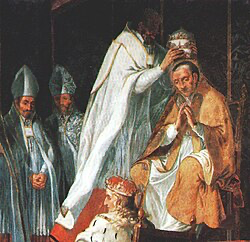
    Coronation of Celestine V; ~1215 – 1296. The only Pope to be crowned twice.1

    Horace Dediu / Takeshi Narabe & Dylan Weir / Asahi Shimbun Interview, April 1, 2026

    Dylan Weir • 31:51
    There's been some reports that Tim Cook is on the way out and some speculation about who might replace him. Is that your sense, that he will be leaving soon?

    Horace Dediu • 32:06
    One thing that hints in that [direction] is that the board members are actually limited to age 65 and he is on the board although they can extend that by vote. So one should imagine that there is an age limit. The hypothesis however is that he's too valuable. Not so much as the manager but as the negotiator and as the diplomat. Because we live in such difficult times from a geopolitical point of view he somehow has managed, i don't know how, nobody knows how, even Warren Buffett recently pointed out that he thinks that's one of his greatest skills: that everybody likes Tim Cook.

    That includes China that includes Trump that includes Europe. Somehow he gets along with everyone. So his ability to be the diplomat, will it be perhaps valued further? One possibility would be that he actually becomes executive chairman as opposed to CEO. That he continues in that role without having to do day-to-day operations.

    There are people who are very good at that. And who've been on the bench for a long time and who've been cultivated for a long time to step in his place. So in that sense, on these fundamental questions of biological life...

    You know, I think one hypothesis that makes sense is that he might stay as long as there's a Trump administration, because again, he's able to navigate that world. But yes, I think ultimately, though, he will be gone. And there's no question. And when he joined, he knew he'd be gone some day. There's no naiveté about his need to hand things to the next generation. And I think that was part of the thinking under Steve as well: How do we hand this off? And they've been thinking about it ever since.

    But anyway, the speculation is John Ternus is the next in line. I think that's a very plausible hypothesis. And one reason, by the way, is I always maintain if you study the company from a cultural point of view, you'll realize that there are people who cannot be CEO. You may not know who it's going to be, but I can tell you who won't be. Many people over the years suggested candidates, and I would say no, never. And here are examples. Johnny Ive would never be CEO. An external hire would never be CEO. Even a head of marketing would never be CEO. Many people think that Apple is a brilliant marketing company. No, it's an engineering company. It's a huge secret out there.

    If you look at the headcount, if you divide the employees by their job functions, you'll see that engineering is by far, three to four times, bigger than the next category, which would be perhaps marketing or operations. So what does that mean from a cultural point of view? It means that the people who are engineers want to have a boss who can listen and understand them. And they don't think, if you know engineering culture, […] that someone who's from marketing is going to be able to understand them because they don't have the cultural and the educational background or the mentality around engineering.

    And so the people who need to run Apple have to be competent with engineering. In the case of operations, it's one of those acceptables because they are at least covering engineering as one of their constituencies. So they have to bridge between manufacturing, distribution, and all these things. So engineers respect operations. Engineers respect manufacturing. So in that sense, when you look at the candidates, I do think John is one of those who fits the bill. Of course, there could be many others as well.

    Dylan Weir • 36:36
    That's fascinating. Thank you.

    Horace Dediu • 36:41
    I think if I may just summarize, I think it's very rare that any analysis--and I come from an engineering background and I did my work always in a lot of data, using a lot of data. But the more I study Apple, the more I think it needs to be analyzed culturally. And it's a very difficult thing to do because we have no data. We have only some anecdotes. But you have to, as an analyst, you have to be humble and see that the data, perhaps that [which is] most important, is not available.

    When it's dark outside and you're searching around the lamp, well, that's the only area that you have light. but the truth could be in the darkness. And that area under the light, that's your data set. And the solution is somewhere else perhaps. And that's why you have to have this idea: what tools can we use other than looking at the light? Use all your senses. Use other perceptions.

    And so that's why I think Apple is a peculiar thing. And by the way, the analysts out there who do try to stay out of the data [delve] more into psychology, they tend to really study the man or woman. They'll study the personality as an alternative [to the data]. So they'll say, well, the company's success depends on Zuckerberg. We have to know who he is. Or Tim Cook or Steve Jobs or Larry Ellison, whomever it is.

    There are people who specialize in understanding that person but i don't think Apple is that. I think [personality is] important but you have to study the whole. The whole way they do things internally. They give us plenty of hints; they say all the time that it's a team effort. They'll always say "no it's not me, it's it's a group effort".

    And and they always say "we" [not I].

    You know, we have a lot of debates [but I believe] we have to take them at their word that it isn't just the individual.

    Takeshi Narabe •

    Thank you so much it's very you know insightful analysis thank you very much.

    Horace Dediu • 38:57
    i love your questions. You have great questions and that's always my my biggest thrill. And not that i'm not being asked what color is the next iPhone.

    Previous in series: Part 4: How not to over serve; The machinery of vanity

    Interview as published: 聞 Asahi Shimbun on Apple & Innovation

    1. Sic transit gloria mundi means "thus passes the glory of the world". The phrase was used in papal coronation ceremonies between 1409 and 1963. As the newly chosen Pope proceeded from the sacristy of St. Peter's Basilica, the procession stopped three times. On each occasion, a papal master of ceremonies would fall to his knees before the Pope, holding a silver or brass reed, bearing a tow of smoldering flax. For three times in succession, as the cloth burned away, he would say in a loud and mournful voice, "Pater Sancte, sic transit gloria mundi!". These cautionary words served as a reminder of the transitory nature of life and earthly honors.
  9. The Inevitability of Combining the Digital and Physical Worlds

    Research · 1 comment

    Seeing is believing

    AI is attracting all the attention but one should be careful because if there is one thing about technology is that timing is everything and when attention is concentrated it signals that time is distorted.

    In a recent interview Apple management was asked about AI, which is perceived as an area where Apple has been struggling. Greg Joswiak replied:

    We've been doing things with intelligence for many years, right? And gen AI allows us an opportunity to do that even more. So I'm excited about that, but boy, this is not a sprint. This is a marathon, right? We're going to be doing stuff with intelligence for decades, not months or years.

    He also declined to comment on smart glasses, but said we're in the "early innings of spatial computing," while Ternus said that combining the digital and physical world is an "inevitability." The two were tight-lipped about any upcoming Apple products, but Joswiak said Apple is "working on some pretty cool stuff."

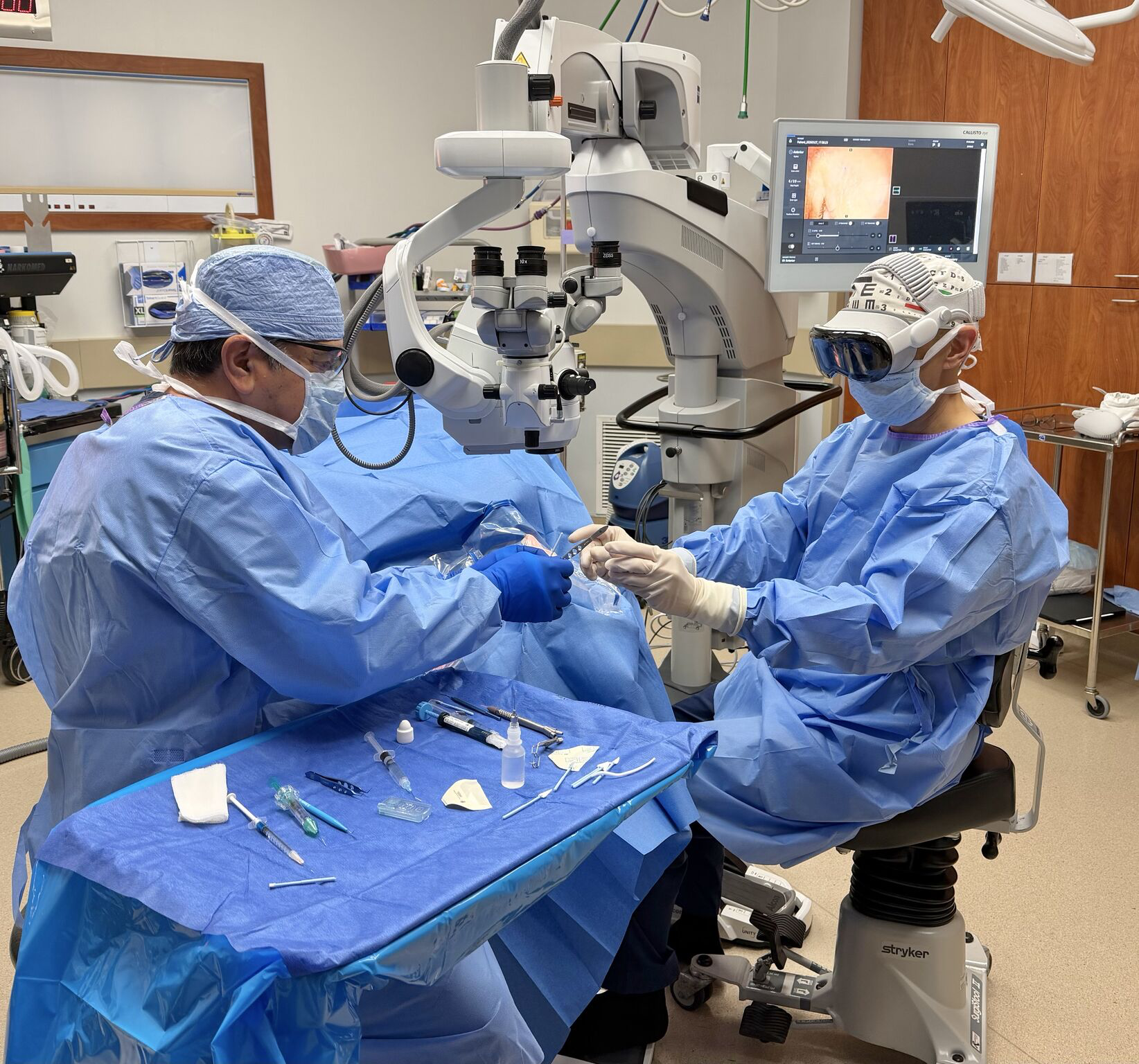
    In San Diego, Dr. Tommy Korn has been performing surgery with the Apple Vision Pro.

    We’re studying how spatial visualization may redefine microsurgery.
    • IRB-approved1
    • One of the first of its kind in microscopic eye surgery
    • Safety & feasibility study

    Technology used:
    • Apple Vision Pro - 2nd generation M5
    • ZEISS Medical Technology Artevo 850 3D Digital Microscope
    • ClearSphere spatial app from ClearSurgery

    Source: LinkedIn

    The idea of adding a layer of information or enhancing vision through a wearable computer being used to repair the vision of damaged eyes, I'd say that's pretty cool stuff.

    To oversimplify, the Apple Vision Pro is being used to substitute looking directly through microscope eyepieces, freeing the surgeon from neck and eye strain and allowing additional information to be shown without averting their gaze from the procedure. This improves outcomes and reduces fatigue allowing more procedures to be performed by the same surgeon or allowing more surgeries to be performed by more individuals with fewer obstacles to training.

    Spatial computing (SC) is also not a sprint. Joz said it's a product that has been brought from the future into the present and, as I use it, I feel that is indeed the case. And like AI, there are benefits being measured today. But what strikes me is the contrast in attention.

    Far more attention and capital is being applied to AI vs. SC but both are inevitable. The contrast might have something to do with psychology or attention markets but it shows that opportunities are not secrets. They are just unnoticed.

    1. An Institutional Review Board (IRB) in surgery is an independent ethics committee that reviews, approves, and monitors research involving human surgical patients to ensure their safety, rights, and welfare. It acts as a mandatory watchdog, evaluating surgical trials, new devices, and techniques to maintain high ethical standards.
  10. Estimates for Apple's March Quarter 2026

    Research · 2 comments

    Revenues and growth rates for iPhone, Mac, iPad, Services, Wearables, plus Net Sales, Gross Margin, Operating Expense, Other Income and Expense, Tax Rate, Net Income, Share Count and EPS with a comparison to CFO guidance.

    Kevan Parekh, Apple CFO: As we move ahead into March, I would like to review our outlook, […]. We expect our March total company revenue to grow by 13% to 16% year over year, which comprehends our best estimates of constrained iPhone supply during the quarter.

    We expect services revenue to grow at a year-over-year rate similar to what we reported in December. We expect gross margin to be between 48-49%. We expect operating expenses to be between $18.4 billion and $18.7 billion, which is at a similar level to what we reported in December and driven by higher R&D on a year-over-year basis. We expect OI&E to be around $100 million, excluding any potential impact from the mark-to-market of minority investments, and our tax rate to be around 17.5%.

    I've seen several market reports which estimate that iPhone shipments grew around 3% to 6% in the quarter. When I plug in, say, IDC's iPhones number into my model, and assume quite aggressive growth on the other categories (including Services) I get a y/y revenue growth of 11%. This is far below Kevan's January's guidance quoted above (13% to 16%).

    Are IDC, Gartner, et. al. signaling a huge miss?

    I need to point out that in the preceding December quarter the iPhone grew revenues at 23%! In order for Apple to hit its targets

    I'd also point out that when Kevan Parekh made his forecast, in late January, a full month was already on the books for Apple. Visibility into the next month would have been relatively good as orders from the channel are partly foreseeable. For a change from implying nearly 20% growth in sales/14% in units one third of the way in, to IDC's 3% in units for the whole quarter would imply a collapse in demand into February and March. We're talking double digit decline in order volumes.

    Moreover, IDC commentary on Apple is

    Apple secured second place, driven by the strong performance of the iPhone 17 series, which saw significant growth in China of over 30%. This led to a 3.3% year-over-year increase in global sales for Q1. Although demand remains robust, supply disruptions and a reduction in channel support in some key markets have hindered growth..

    30% growth in China! For this to be tied to 3.3% growth globally would imply significant declines elsewhere. I struggle to see how this adds up.

    Here is my complete forecast for the quarter including growth rate for revenues for iPhone, Mac, iPad, Services, Wearables, Net Sales, Gross Margin, Operating Exp., OIE, Tax Rate, Net Income, Share Count and EPS with a comparison to CFO guidance.

    Asymco Est. (in $ million)Asymco est. growthKevan Parekh, Apple CFO Guidance
    iPhone Revenue$55,71718.9%
    Mac Revenue$8,6408.7%
    iPad Revenue$6,9558.6%
    Services Revenue$30,37514.0%
    Wearables Revenue$7,5220.0%
    Net Sales$109,20914.5%13% to 15%
    Gross Margin49.2%48% to 49%
    Operating Exp.$18,49621.1%$18.4 to $18.7B
    OIE$100$100
    Tax Rate17.5%17.5%
    Net Income$29,11524.2%
    Share Count (million)14,720-0.6%
    EPS$1.9820.2%
  11. Asymco One: Mobile Computing

    Research · 2 comments

    As you know, as we crossed into 2001, the great crash occurred.

    Ben Thompson • 25:05
    Yep. And suddenly a job offer from a big phone company sounds pretty great.

    Horace Dediu • 25:09
    Yeah, but the crash occurred and it impacted my startup because I couldn't raise money anymore. And that's why I'm throwing in the towel. I'll take this idea to Nokia and build it inside of this company. So for the first year, I worked out of the U.S. and then they invited me to come to Finland. And I fell in love with it, not to mention finding someone to fall in love with. Yeah, I'm still here.

    So we created an internal venture called media distribution. And it struggled for a couple of years. We partnered with a publishing company here in Finland that is the biggest newspaper and magazine company. And we worked with them. 9-11 happened. We worked with them throughout that period to test this idea of distributing content on phones. That's how I met my wife. She was working for the publishing firm. Remember when Apple News launched? I forget how many years ago it was already. It was five, six years ago. [My wife] texted me during the keynote. She goes, "you realize that's what we were working on together in 2001?"

    It was called Project Melissa. Project Melissa was this idea of Apple News today. And that was [our project] 20 years earlier. That just goes to show you the story of my life. I was doing search 10 years before Google existed. I was doing e-books 10 years before Amazon launched the Kindle. I was doing smartphones and media distribution on smartphones 20 years before Apple showed how it's done.

    So my problem has been that I see things happening or see where things are going, but way too early. And that's why one of the theses I have over time is the idea that the difference between a futurist and a billionaire is knowing when one thing happens. So it's not about knowing what's going to happen. A lot of people are very good at that.

    Ben Thompson • 27:31
    Including Nokia, to your point.

    Horace Dediu • 27:33
    Nokia, science fiction writers, Elon Musk, a lot of people predict this. But getting the timing right is where the money is made. And so that was one of those lessons I learned.

    Ben Thompson • 27:45
    Well, when you talk about the publishing and Nokia and the reading and all those sorts of things, what it makes me think of is when the iPhone comes along in 2007, And I'm very curious to get your perspective on what that was like inside Nokia when the iPhone launches.

    Horace Dediu • 27:59
    I'll tell you exactly.

    Ben Thompson • 28:00
    But before I get there, but to this publishing point specifically, the key bit was the Internet was permissionless in terms of producing content. Like, it's great that you met your wife, but the fact that you needed to be in a situation where you could meet your wife was actually the reason why it wasn't going to happen. Because if you have to make a deal to do everything, it's just never going to get there. Whereas if you can just surf the Internet, the real Internet, and no one needs to do anything to adapt to it, suddenly you get it all for free. And then you get the virtual cycle going where they're making stuff for you. And that was sort of the, that's the timing bit is like the, the external structure around what you're doing.

    Horace Dediu • 28:41
    Yeah, it's, it's, it's complex and it's multi-causal and you're right. It's multiple, the reasons why things happen the way they are. And it's just not foreseeable. The internet was, and by the way, the thing that really caused the project to fail and be abandoned--this media distribution side note-- it was the fixation on DRM.

    DRM actually killed a lot of great businesses with content ideas back in the day, whether it was music or video or textual. It was people just obsessed about protecting it before they obsessed about distributing it and making it great. And this is why when iTunes came along, even though there were some circumstances there with being on a Mac and not on the PC, that the publishers finally said, why don't we go ahead with this?

    So long story there. But as far as what Nokia was doing, after four years of doing this startup inside of Nokia that did not work out, I got into the job of strategy analysis and competitive analysis. So they asked me to do Microsoft.

    Microsoft was the biggest worry for everyone because they had intentions of being in the phone business. They made no secret about it. They had prototypes. They were working with competitors to Nokia. [Intending to] give them the operating system so that [for instance] Samsung running Microsoft [Mobile]. That was the effort.

    They were pushing on all fronts. Nokia was holding out and saying "we've got our own operating system" and so on. So they gave me this job because every other competitor was hardware. All the analysts were covering hardware. I was the only guy who was covering a software company.

    And in doing that, I was also sort of nibbling at Apple a little bit because the iPod had come out. The iPod was doing amazing, but it wasn't a phone product. And I was kind of looking at it a little bit.

    Now Christensen comes back in the picture, because his book had taken off. He had already written the second book, which is The Innovator Solution. And I was like, hang on a second, a lot of stuff that I read in the book, and I remember back from my days at school, applies to Apple here because they're doing a lot of interesting things with being disruptive as the case may be.

    Nokia itself had been disruptive in its early years. But I'm focused on Microsoft. And my point was that we can fight this battle and win, but we got to be very careful. And there's a lot of twists and turns there, but I took it upon myself also to understand what's going to happen with this media product from Apple.

    And then I began to write a few internal notes because nobody was covering Apple. This is interesting and important. Imagine you have a team of a dozen analysts, you could put them on multiple jobs, assign people to multiple problems. No one thought that Apple was a problem to be looked at, even part time. No, there was nothing interesting about it.

    And part of that had to do with the fact that [Nokia perceived that Apple had been] one foot in the grave already in the 90s. And now they were this little toy media company. They didn't really have scale. Phones were on the orders of billions of users already. And this iPod was in the tens of millions, maybe a hundred million. So it was orders of magnitude. There was no real worry there.

    But I was really annoyed at this thing. And I started building a model. I remember distinctly opening a spreadsheet, looking at research reports and thinking to myself, let's look at the history of the iPod, how it's growing. And I started to match that to the Razr, which was the most viral product at the time, the Motorola Razr.

    Even Nokia was jealous about this thing. At that time, [Motorola] had cumulative sales of 50 million, which was considered way too scary. (And BlackBerry was another one, by the way.) So I'm doing this and I'm like, hang on a second, what if they do a phone and it's a combination of the Razr and the iPod, could that resonate? And I just put it out there. I said, it's possible. And there was a rumor of the iPhone coming out.

    Ben Thompson • 33:31
    So Apple did do a Motorola Razr with iTunes functionality. Did that actually end up, because that was a flop. And did that actually make people not as like more relaxed?

    Horace Dediu • 33:46
    Because we knew that it didn't run an operating system. It didn't have a developer API, there was nothing, no hooks in it. It was just an appliance. And as such, it was like a feature phone. And that was not interesting. We had been talking and pounding the table on smartphones already since 2001. Remember, when I joined, we had a communicator. We had Symbian, Series 60. We had the interfaces. We had all picture phones, music, etc.

    Ben Thompson • 34:20
    I was a user as well.

    Horace Dediu • 34:22
    And I had done the numbers, and by 2005, people were burned out on smartphones. Because the projection was like this, but it was more like this. It wasn't growing as much as you thought it would. And so a lot of people said, especially the top management was like, "you guys are very enthusiastic about the software stuff, but it's just not working out. We're going to double down on hardware."

    So there was a lot of burnout. So, but I kept looking at the phone at Apple and I suggested, hey, what if this thing scaled anyway? Like I said "what if they could sell as many as 50 million?" That was my provocation. And people were like, dude... I was essentially taken aside and told, tone it down. First of all, you're not doing yourself any favors by being so provocative. You're just going to lose credibility. My boss, who's a great guy he just took me aside and said, just don't do that. You know, it's bad for you.

    Ben Thompson • 35:22
    And this is like 2005, 2006, around then?

    Horace Dediu • 35:25
    Well, already 2006, because the iPhone was rumored. It wasn't out, but it was like, if you're going to have iPod success and you're going to do this crap phone with Motorola, you're probably thinking, maybe they're going to do something interesting beyond that, because we knew they could, in theory, do something.

    We didn't see the touch interface, but we saw maybe like a scroll wheel or something. You know, Tony Fadell was running the thing. So, bottom line is, when it finally came out, it was January 2007. It came out and was not for sale, but it was on stage. And I was so excited. And I said, this is unbelievable.

    I remember running into the office the next day. Usually you socialize at lunch hour, sitting in the cafeteria, talking to your friends and asking them what do they think about this? And most people just said, oh, it doesn't look that interesting. aspects of it were copied. There were copies from here and there. There are other people that do touch. You know, a stylus has been around for a long time with BlackBerry also doing amazing things with keyboard and so on and so on.

    So there was a lot of cynicism and sort of not really interesting. I said, man, it's running OS X, it was running a full operating system. And I said, this is going to get developers working on it. But again, the other thing, the other head fake from Apple was that Steve Jobs said they're not going to put any apps on this thing unless Apple write them. I was anticipating far more than even was being talked about. And for that reason, it was just super frustrating. Anyway, I left in 2009. But by then, Nokia were still not following Apple.

    Ben Thompson • 37:13
    How is that possible? Like even two years on, this device is out there.

    Horace Dediu • 37:19
    Because it still didn't have distribution. And this is the thing that consumed everyone following the iPhone in the beginning. It's like they had one launch partner. It was initially Cingular, became AT&T. Don't forget that the old AT&T had nothing to do with this AT&T. It was just a rebrand of Cingular, which was a crappy, small, not very small, it was maybe second tier [operator.]

    Ben Thompson • 37:47
    Verizon didn't want to do it. Apple did this again and again. Verizon was number one.

    Horace Dediu • 37:50
    Verizon was number one. Absolutely. But Verizon was in CDMA. But the thing is that it was a crappy network and they didn't have a lot of points to sale. They didn't have distribution. and everybody said this, you need 500 network operators to saturate the global market, right?

    And how fast are you going to be able to obtain distribution was the question. And so they're so cantankerous. You know, Apple is known as being "my way or the highway."

    Verizon said no for years. Nokia was like, this is not going to fly. These guys are, if anything, they're naive. Don't forget, by the way, there's a separate story on how BlackBerry dealt with the iPhone. There's a movie about it, by the way. Everybody should watch it. But basically, everyone had the similar responses: that this is not kosher.

    This is not the way things are done in this business. It's all about relationships with operators. It's about getting shelf space. It's about getting salesmen in the store who are bribed effectively with a commission to tell you what to buy, effectively yank the phone out of your hands and give you another one. So this was a very dirty business at the street level.

    Ben Thompson • 39:19
    So do you know what was the first what was the first article of mine that I think you ever linked to? It was about precisely. No, no, you don't need to know. I know because it was very formative to me. That's what I'm going to tell you. It was basically about talking about this was how distribution worked.

    And what Apple changed about the whole thing was that customers actually switched networks for the iPhone. And it was doing just sort of a traditional sort of business school analysis of and pointing out the power shifted to instead of distribution to the buyers. Basically, what I ended up writing about for 13 years now is demand mattering more than sort of the supply bit. But it was the exact same thing. That's why you linked to it. You are you are already on board with it.

    Horace Dediu • 40:04
    But it was also the thing that resonated for me personally. Not that I knew something about the phone. Mostly I knew how big it could get. I knew that there were billions of people, many more billions than used PCs, which was by far the most dominant influence in technology.

    Most people oriented themselves, like even Gruber and others who were Mac first and then all these accessories. But I knew the phone would be a couple of zeros more. That was number one.

    Number two, there was this problem of the incumbency, which were all the phone makers, who were so far from understanding what the software dynamics of platforms were. By the way, platform theory was developed by Microsoft. They pretty much invented the whole idea.