AI as Infrastructure
Build it and they will come?
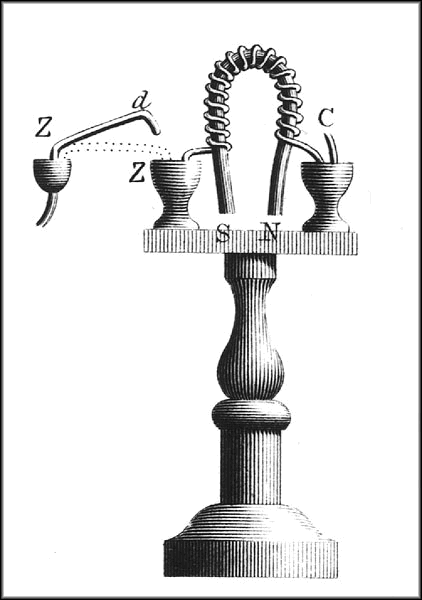
ON September 3, 1821, 37 years after James Watt invented the concept of horsepower and started charging £5/horsepower/year for the use of his steam engine, the first demonstration of the production of a mechanical force by the interaction of an electric current and a magnetic field was given by Michael Faraday in the basement of the Royal Institution in London.
1820 is, in many chronicles1, noted as beginning of the industrial revolution. It marked the end of 50 years of war2, whose conclusion unleashed pent-up demand. That demand was served by relatively free trade, guaranteed by British naval power, coupled with property rights and financial instruments which allowed inventions of the previous century to finally be harnessed for commercial gain. The steam engine is the canonical invention of the era and its implementation as a source of power for factories, shipping, rail and machinery is legend.
Not usually noted as coincidental to this period is the electric motor. Yet not long after Faraday's 1821 demonstration in London, the first DC electric motor capable of turning machinery was invented by William Sturgeon. In 1832 he built on Faraday's electromagnet by incorporating a commutator which oscillated the direction of current to ensure continuous rotation.
However, for 30 years after its invention, no practical uses could be found for the electric motor. It wasn't because there was no demand. The steam engine was in use and, as Watt's £5/horsepower/year business model demonstrated, very lucratively so. The electric motor was not in use because there was no electricity distribution system. There were no power plants, there was no grid. The motor could not stand alone.
In contrast, the equivalent distribution system for steam was the coal industry. Coal as fuel pre-existed the steam engine. Used not just for heating, it was the fuel of foundries that made iron and other metals. More energy dense than wood, coal had been mined for thousands of years. From mining concessions to barges for transport on newly dug canals to bunkering for storage, sourcing coal was a well-developed, stable and profitable industry.
Finding coal to power a steam engine in the 19th century was not a problem. Finding electricity to power your electric motor was. You could not store it, you could not ship it, you could not meter or price it. It required a completely new value network and infrastructure.
For this reason, even though the electric motor was available through most of the 19th century, the period was still known as the age of steam. The electric grid—an infrastructure—was only possible by the late 1800s as generators, capacitors and AC power were perfected. It wasn't until the early 20th century that the age of electric power began.
This illustrates perhaps better than any other example that the device precedes the infrastructure. That is, that the instrument of utility precedes the network that enables it. the boat precedes the port, the locomotive precedes the railroad, the automobile precedes the motorway, the telegraph precedes the telegraph network, the radio precedes the radio network, the phone precedes the phone network, the cell phone precedes the wireless network and the smartphone precedes the social media. The device induces the supply of its own power.
The implications are profound. It puts to the test the idea that we need to build infrastructures before we know how they will be used. The inventors of electric motors or lights relied on batteries. Investors had to imagine a grid to power more than one. The inventors of the radio had to demonstrate a single transmitter/receiver pair. Investors had to imagine broadcasting. The inventors of the car had to find fuel in pharmacies. Investors had to imagine a gas station. Steve Jobs demonstrated the iPhone without an App store. Investors had to imagine a Services business.
As AI has emerged as a technology, we are in a strange position where the interface, born as a chatbot, suggested an infrastructure that is massive in scale. The magic sauce of GenAI isn't so much the algorithm, which is quite a simple idea. It's the scale of the data and computation that permits the illusion of intelligence.
In developing the commercial idea, investors are imagining the device while investing in the infrastructure. In other words, the investors are poised to put trillions of dollars to work on what amounts to "the grid" without knowing exactly what the motor will be.
The cash flows associated with infrastructures are very different from those of devices. Devices are iterated rapidly and evolve to changing tastes and discoveries of behavior. Infrastructures are built once, maintained and perhaps re-built but only after decades. Therefore financing for infrastructures is more likely through bonds (debt) rather than shares (equity). Returns are also much more subdued as the risk for infrastructures is lower. Regulation and relations with labor are also dramatically different.
Moreover, few businesses implement both the device and the infrastructure. Indeed, the capital structures, financing, longevity and valuations of the two types of businesses are dramatically different. In cases where they are merged, regulators typically intervene to separate them.
Watching from afar, it would seem that if AI is indeed infrastructure then it will not provide a brilliant business model. Like all network business models, you either iterate constantly at great expense to deliver the next generation or you harvest the built environment to pay back the investment, hoping that a parallel network does not steal users. But the cruelty of the model is that if you have a monopoly of any kind, your margins are beaten to zero by regulation and cost of parasitic maintenance.3
We can see this with all current "grids". From electric to hydrocarbon distribution, to communications and even food distribution. The struggles to avoid commoditization, corruption and corrosion of trust and a lack of innovation are endemic.
The device however, is another story.
- I recommend "The Birth of Plenty: How the Prosperity of the Modern World Was Created" by William J. Bernstein. Bernstein argues that in order to prosper, a country must possess four main attributes: property rights, the scientific rationalism, capital markets and an effective means of transportation and communications.
- Reverse chronology: French Revolution, 1803-1815, (including the War of 1812 in US & Canada), which followed a decade of the French Revolution 1789-1799 which followed the American Revolution 1765-1783. This global war, involving most world powers, lasted 50 years.
- In a research note published April 7, Goldman Sachs strategists led by Chief Global Equity Strategist Peter Oppenheimer acknowledged the historical basis for those concerns. "The history of technology breakthroughs, from the steam engine to railways, PCs and the internet, is littered with examples of new technologies that attracted large sums of capital to build out underlying infrastructure which have led, ultimately, to low returns," he said. "The gains are then enjoyed by other companies, many of which piggyback off the original investment," he added.