Apple's first keynote under John Ternus is behind us. We are marking it with an Asymco Office Hours Duo: one on the West Coast, one on the East Coast. Join each live Q&A in person or remotely. In-person sessions are followed by an Asymco Happy Hour.
Venue details are on the ticket. Asymco One subscribers are guaranteed seats, can sign up for free, and will have access to the recordings and transcripts shortly after each event.
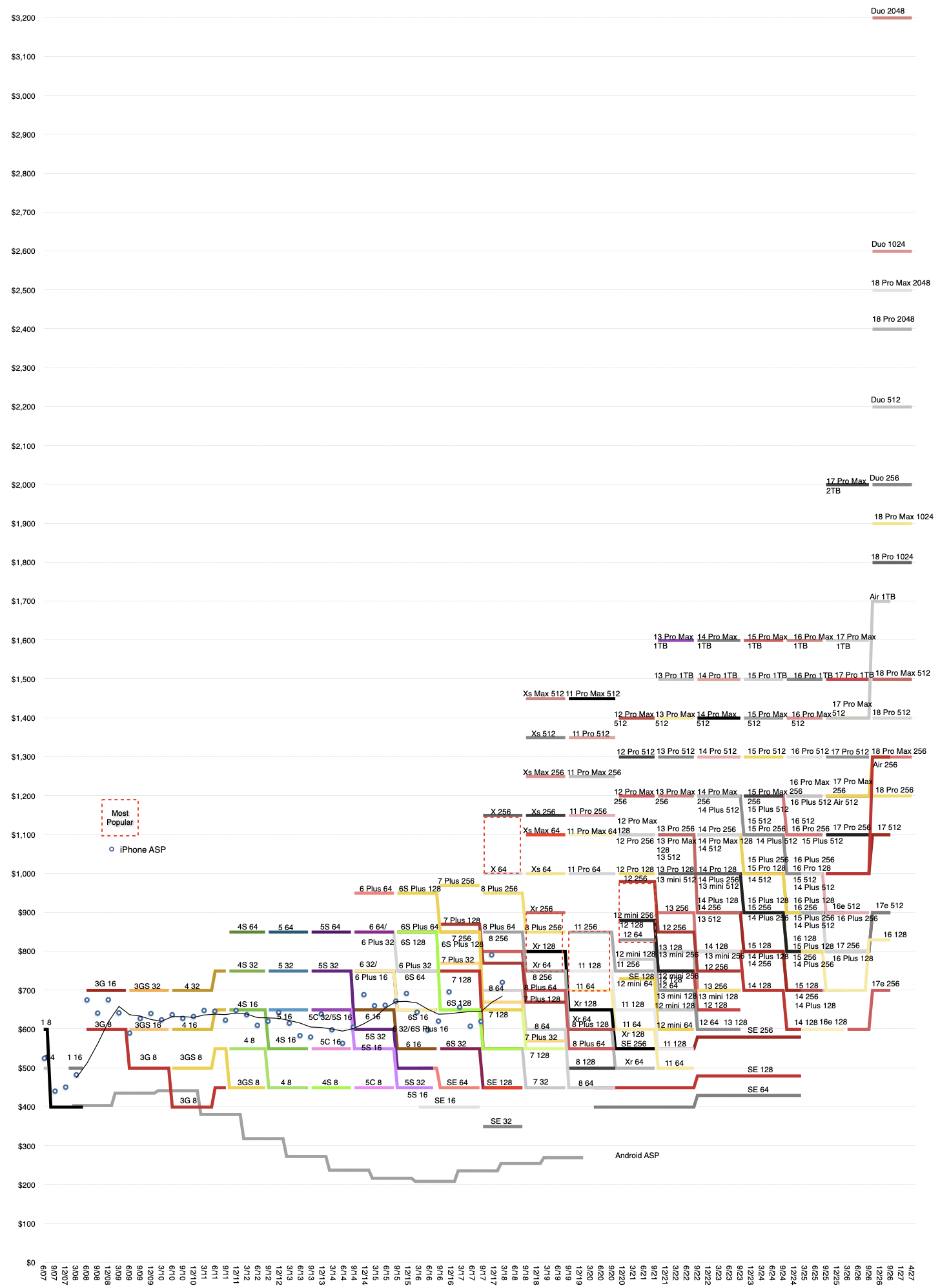
The launch of the iPhone Duo and the surge in memory pricing has caused a disturbance in the force. The new Stairway graph is shown below (click on graph to see higher resolution.)
A few notes:
The process of lowering prices for n-1 devices has reversed. Previous generation iPhone prices have gone up for the first time ever. This is mitigated by the fact that "n-1" is not quite apparent for the 17 as it's still the current model in the mid-range. The 17e and the 16 are still in the roster since there will not be replacement for at least six moths.
The higher the memory, the higher the increase. Base models (256G) see increases of $100 but 1TB configuration Air saw a $300 increase.
The Duo starting price is a reasonable $1999 which is probably where they wanted it to be years before launch. The more hard to swallow prices are in the higher memory configurations. The top of the stack is now $3200 vs. $2000 previously. That jump appears scary but the top of the range it's likely to be far from the average (or median) configuration.
Fortunately we have the Leasing (Apple Upgrade) purchase option to determine the price/day at launch. Previously we would have to estimate the resale values years in advance but leasing means Apple does all the work for us.
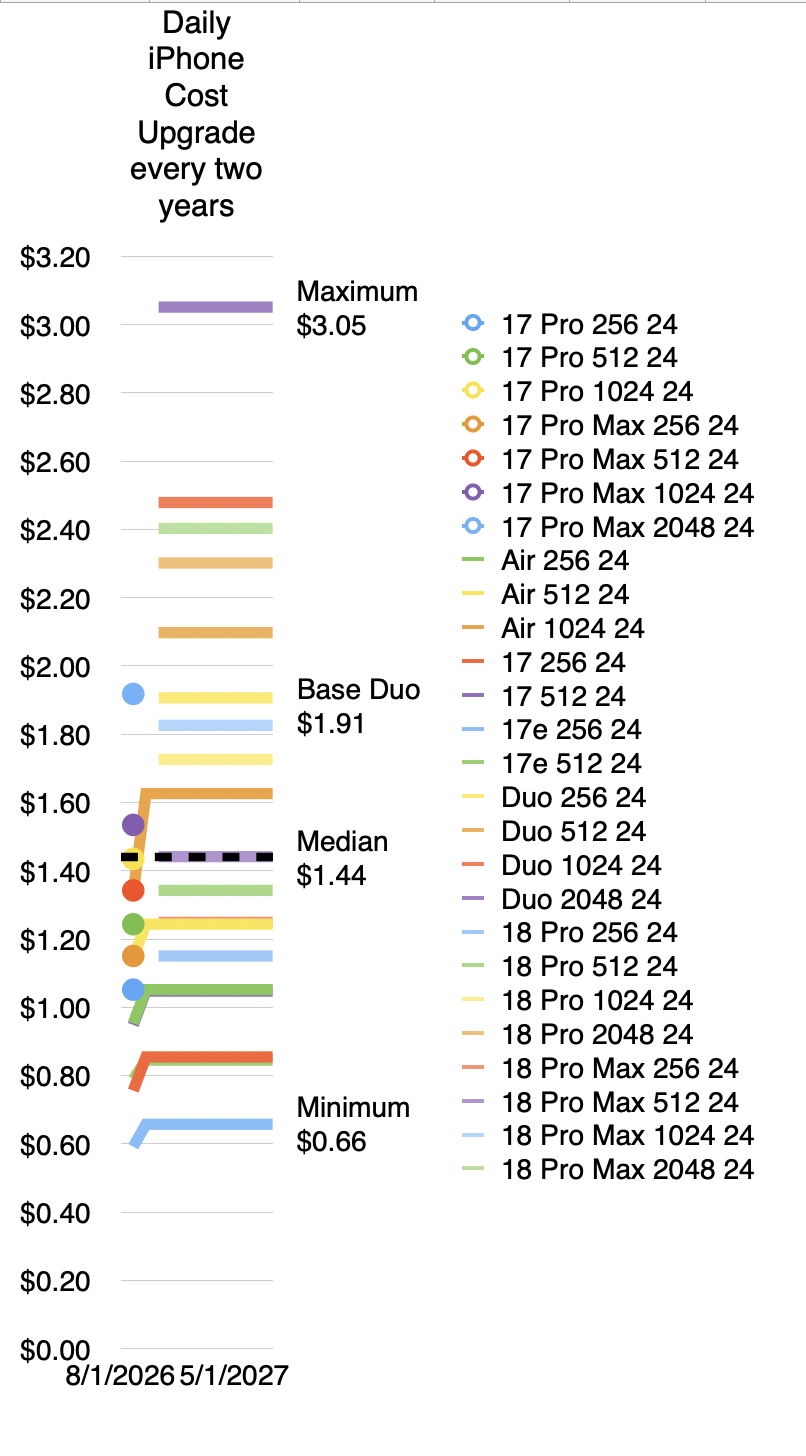
The distribution of the daily costs for all the current models (and historic) is shown below:
This is the 24 moth option which is the only option for the Duo. Note that products that are carried forward had an increase in leasing price. The new median iPhone price (half the units are above, half are below) is $1.44/day. The minimum is $0.66/day and the maximum is $3.05/day. The base Duo price is $1.91.
One could therefore say that Duo stands for two thousand up-front or two dollars/day.
What are the consequences?
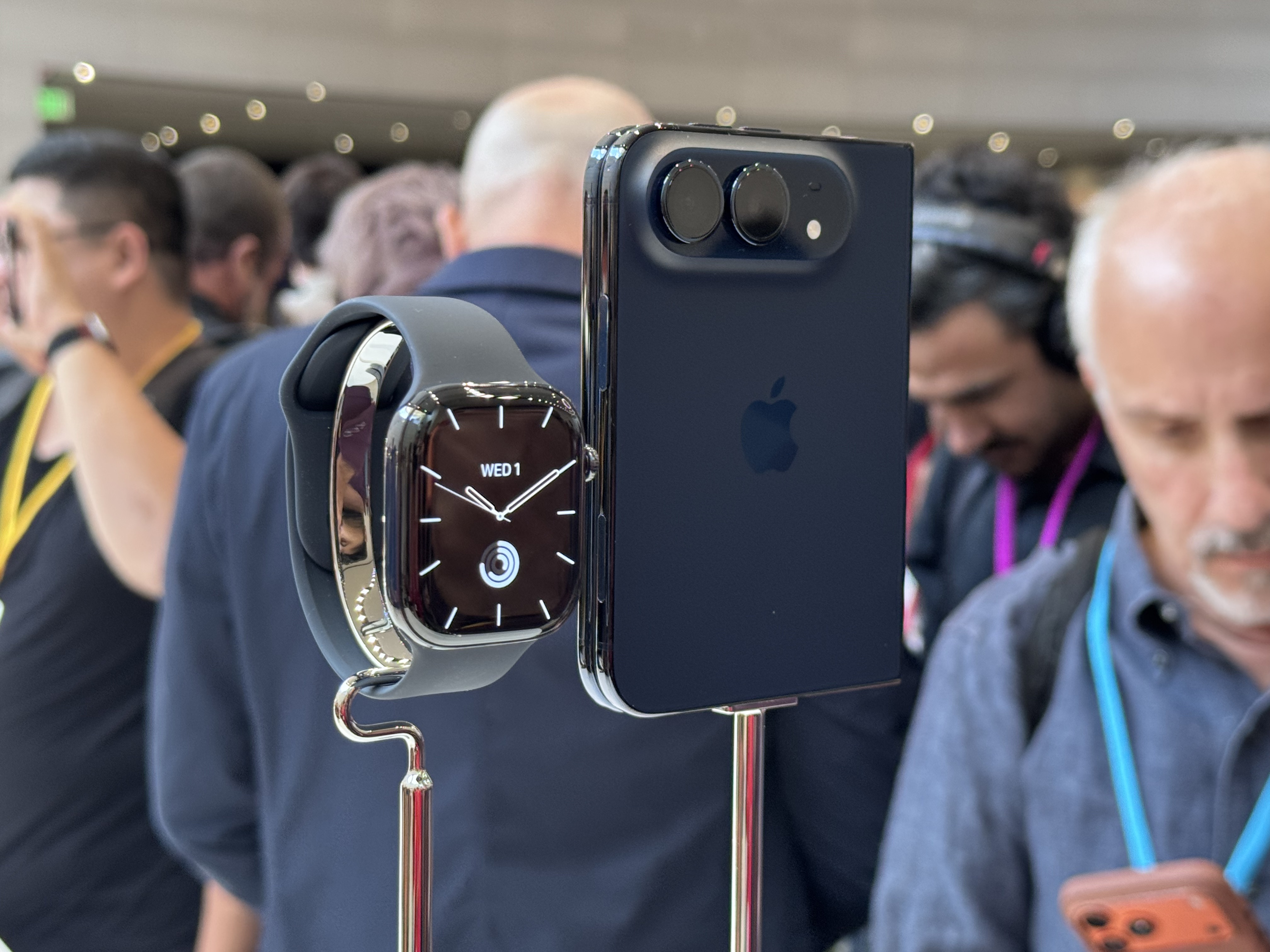
Having been at the launch event, my impression is that the new iPhones are very attractive and have that wow factor when held and seen up close. The Duo will do very well in my opinion because it has a sense of theater about it and it moves the iPhone experience into three physical dimensions.
The pricing is being mitigated with leasing and should become normalized. I do wonder if the leasing price will be slowly put forward as the primary metric. Many consumer items such as homes, cars and durable goods are often quoted in terms of monthly prices. The iPhone provides a very high level of utility to many and the idea of subscribing to it will catch on.
The iPhone will have perhaps an ASP of $1.35, growing from the historical $1/day. It's a matter of time for this pricing to anchor and become normative.
Regardless, the Duo will be very popular and be supply constrained for, I believe, at least six months.
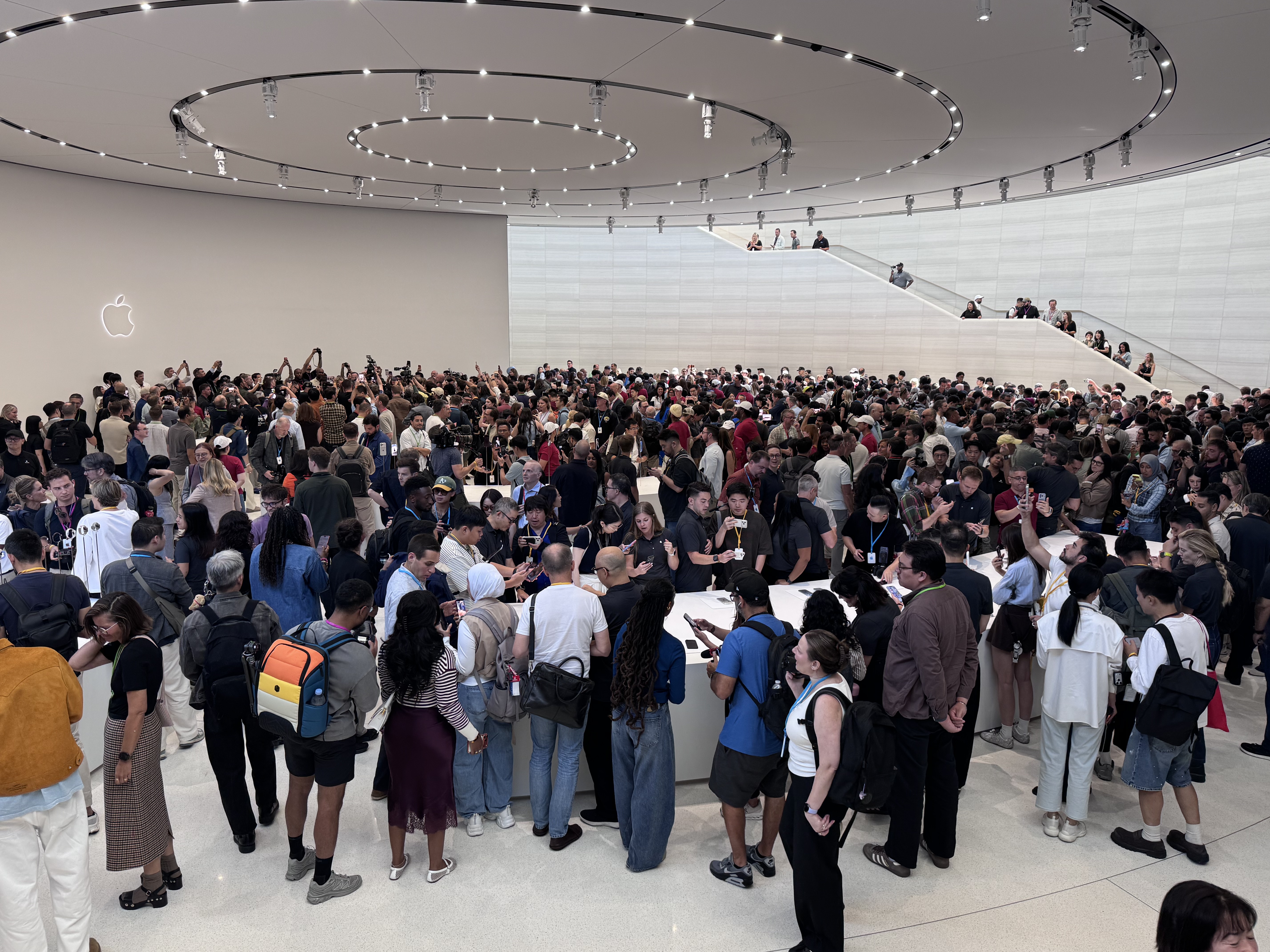
I'm writing while still in the SJ Theater in Cupertino after the end of the event and the media frenzy around the demo devices.
The atmosphere was noticeably more enthusiastic and the venue was packed. First impression was that John Ternus was already received as a "star" with a standing ovation to on-stage appearance and cheering at his video introduction from Tim Cook. Clearly the audience is already excited by his presence if not charismatic performance.
The products were on par with outstanding polish and refinement. The details especially health and assistive features are truly transformative and profound even if, as usual, they are discounted by the markets. The idea that Apple devices are life coaches and now longevity assistants is simply indistinguishable from magic.
The two surprises are:
The prices across the board are holding in an ironclad way. I was really surprised that the AirPods were marginally cheaper, the watch held and the iPhone was up by $100 (base model.) I'll do a deeper dive later with an updated stairway to heaven.
The iPhone Duo is stunning to behold. I was mildly skeptical that it would be a necessity. A nice-to-have, sure, but a must-have, I doubted it. I'm now converted. I feel the Duo is going to become extremely desirable. Mostly because to see one is to want one. The more they sell, the more they will be seen and demanded. It's the ultimate gift and object of desire.
The Apple engine is running on all cylinders and the only question is if there is enough fuel in the form of supplier components to satisfy the demand. The iPhone Duo will instantly sell out and the 18 and 17 will run strong for another year. The 17 already is the best selling iPhone in history and will stay strong into the spring. A new cadence that will probably tweak sales across the year and create a bi-seasonal burst.
This is all without mentioning AI. All reviews of Apple Intelligence are positive and the thesis that 80% of users will discover AI through an Apple device holds. The results will be seen in the language: in response to a question, people will say "My iPhone says this". Not Google, not ChatGPT, not Claude. My iPhone is the authority. And my assistant.
“The iPhone 17 series stands out as Apple’s strongest lineup in years, with the base model inheriting features once reserved for Pro variants and the 17 Pro series delivering powerful Apple silicon, a standout camera system, impressive design and greater choice in color, material and finish,” said Counterpoint Research Director Tarun Pathak. “The iPhone 17 series has resonated with a remarkably broad user base, from first-time upgraders drawn to Pro-level features at the base tier to loyal Pro users pushing for the latest Apple silicon and camera performance. The iPhone 17 base model’s revenue grew 1.3x over its predecessor during the first year. It was also the No. 1 best-selling smartphone model globally in H1 2026 in terms of units, followed by the iPhone 17 Pro and iPhone 17 Pro Max. The iPhone 17e, the most affordable model of the line-up, also saw a powerful performance.”
In terms of regional markets, China was the biggest driver of revenue growth for the iPhone 17 series, with wholesale revenue up 35% compared with the iPhone 16 series and accounting for nearly 24% of global iPhone 17 series revenue, largely due to base-variant upgrades. Japan, the Middle East and Africa (MEA) and the Asia-Pacific markets posted healthy gains. Strong demand in these markets helped offset moderate growth in mature markets like North America and Europe and contributed to the overall revenue increase.
NB: This is an 11% increase over the iPhone 16 series’…
…wholesale revenue in its first year. Strong demand across the lineup, especially for the base and Pro Max variants, supported by a stronger replacement cycle, contributed to this record revenue.
Counterpoint says that adding foldable could raise Apple’s overall iPhone ASP, while the later launch of lower-priced models could broaden the portfolio and sustain sales momentum into the following cycle.
The extension of the 17's presence as the prime model into Spring will be seen as a genius move.
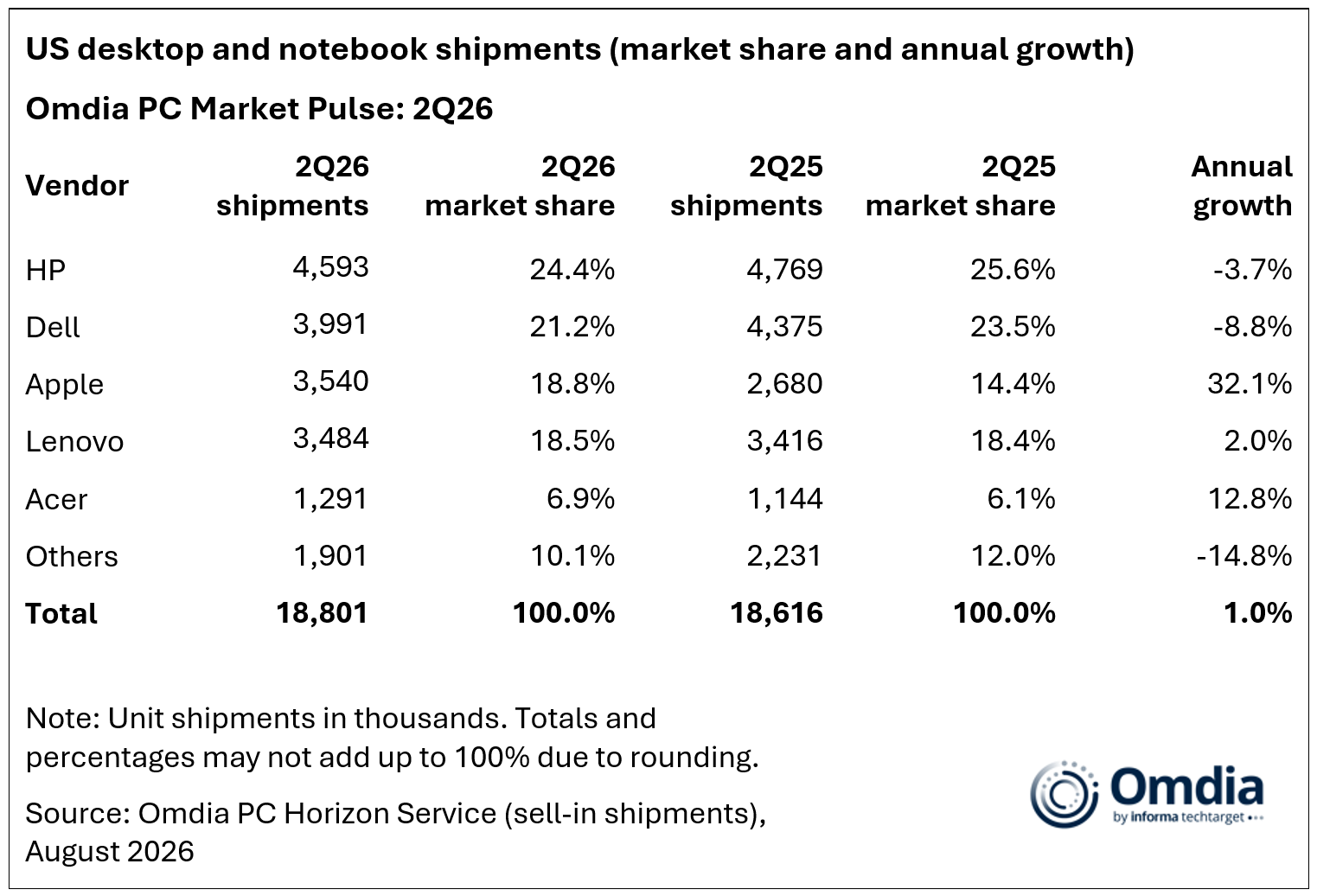
Apple moved into third place ahead of Lenovo, with US PC shipments growing 32.1% YoY, supported by a full quarter of MacBook Neo availability. This lifted Apple’s share of the US consumer PC segment to 29.4%. Apple also continued to expand in the business segment, where shipment grew 50.6%.
Dell recorded the largest decline among the major PC vendors, with shipments falling 8.8% as component allocation shifted away from entry-level systems; its US Chromebook shipments fell 47.0%, against a 10.0% decline for the overall US Chromebooks market. HP shipments fell 3.7%, although both HP and Dell recorded revenue growth as higher ASPs offset lower shipment volumes. Lenovo shipments increased 2.0%, slightly outperforming the overall market, supported by consumer demand.
NB: Consumer PC shipments expected to decline 13.6% in…
…2026. Commercial PCs forecast to decline 9.3% for the full year. It seems to me that Apple has a shot at beating Dell. That will be a noteworthy footnote. The parallel to how the phone market is reshaping is uncanny.
Sonera has developed a new sensing modality that non-invasively measures magnetic fields generated by the body, in contrast with the electrical sensing techniques commonly used today. This proprietary technology holds the key to making brain activity as easy to measure as heart rate, temperature, and other physiological signals, and enabling data-backed insights related to movement, health, thoughts, and emotions.
The press release, first discovered by MacRumors, mentions an S1 chip which could “enable an entirely new class of consumer wearables and experiences based on muscle activity.” Sonera’s proprietary approach “measures magnetic fields produced by the electrical currents from neural activity” and thus bypasses the need for direct skin contact.
It’s unclear how much progress Sonera has been able to make since that 2023 press release. But clearly, Apple found something of value in their technology.
NB: My thesis is that Apple has always placed itself at the interface layer between human and machine. The original "personal" computer, the various input methods (mouse, trackpad, scroll wheel, multi-touch, glance&sensor, spatial computing and audio). The pattern of acquisitions of technologies which deduce or detect human intention including hand/facial gestures, motion sensing, biometrics, and health are part of a pattern.
In this case it's a form of sensing that I was not even aware of: magnetic fields. Sonera developed a magnetometer designed to measure weak magnetic fields generated by brain activity in a portable and cost-effective device. The company's magnetometer works on acoustically driven ferromagnetic resonance and can operate at room temperature and in portable form factors with sensitivity, enabling technological industries to expand access to the powerful neurodiagnostic tool, as well as open the door to the first practical, non-invasive brain-computer interface.
The company appears to have been spun out of Berkely in 2018 so presumably the research predates this by a few years.
The next stage of human/computer interaction…
…might be enabled by these subtle methods of intention detection. The old adage that 80% of human communications are non-verbal gives some credence to the notion that computers need to read us better.
So whereas spending on inference is approaching infinity, Apple is quietly investing in interfaces. The question underlying this is whether humans are still the interesting points of investment. Humanism in computing might be less attractive to capital today but I'm willing to wager that humans will still be the pivot point for profitability.
Friday 11 September, Time TBD. We are holding an in-real-life Office Hours, either in Boston or the Bay Area, open to Asymco One subscribers. We will be broadcasting the event live. If you would be interested in attending, write to events@asymco.com.
Apple’s AI angle in the enterprise There was a time when Apple’s point to the Enterprise buyer was that Apple products were ultimately more cost effective and productive. The total cost of ownership was lower as the products were cheaper to maintain and lasted longer and users were more productive as the user experience frictions were lower than Windows. The problem was that Apple devices were at odds with IT policies and standards. Everything from device management, software licensing, identity and authentication management, migration, training, security were built excluding the Apple platforms. The Microsoft world was interlocking and impenetrable even →
Nota Bene
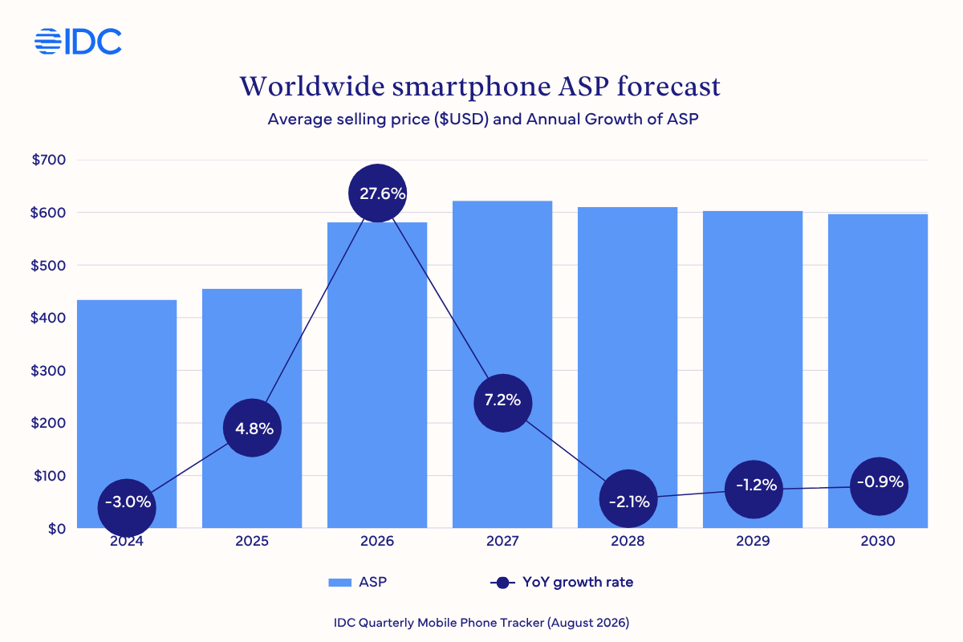
IDC lowers smartphone market volume estimates again → IDC now expects global smartphone shipments to fall 16.7% in 2026, revised down from 13.9%, which would be the steepest annual contraction on record. Second half shipments are set to drop more than 27% while ASP rises 27% to $581, because the memory tsunami has arrived and consumers are paying the AI bill. The era of the cheap smartphone has ended. IDC also credits Apple’s foldable with altering the market’s trajectory, which mistakes how markets are actually created. →
The first surgical Apple Vision Pro application approved by the FDA → Stryker’s SportSuite Vision received De Novo authorization on July 17, making it the first application cleared for intraoperative use with Apple Vision Pro, and the first live procedure was a hip arthroscopy at Duke Health. Separately, Nabla is running AI clinical dictation on device on Apple computers. Regulatory clearance is the hard part, and it has now been cleared. Spatial computing has moved from demonstration to the operating room. →
There was a time when Apple's point to the Enterprise buyer was that Apple products were ultimately more cost effective and productive. The total cost of ownership was lower as the products were cheaper to maintain and lasted longer and users were more productive as the user experience frictions were lower than Windows.
The problem was that Apple devices were at odds with IT policies and standards. Everything from device management, software licensing, identity and authentication management, migration, training, security were built excluding the Apple platforms. The Microsoft world was interlocking and impenetrable even if it was sub-optimal on metrics of performance.
It began to change with the subversive iPhone and iPad. As not only some early adopter employees but management itself began to bring their personal devices to work and ask IT to make the "systems" work through them. Thus the infiltration was not as much through the "grass roots" but through the top of the food chain. The canonical example was the CEO demanding to use an iPad to speed run meetings all day.
And from that crack Apple penetrated enterprises to such an extent that today the MacBook Air is the world's best selling enterprise laptop. The iPhone and iPad are also the best selling enterprise phones and tablets. More Apple devices are purchased in enterprise than any other brand.
Though MacOS and iOS are still not the majority platforms, in some verticals such as surgery, Apple Vision Pro has been established as the only viable option.
But now that AI is becoming a new wave of software/service for Enterprises, Apple is surprisingly in the driver's seat for being the best platform for deployment.
By "best" I mean objectively best in performance, security and, most shockingly, cost.
Best Performance
Though there are lower cost alternatives, the top of the line Mac Studio in a cluster configuration can provide 2TB of unified memory, 1.2 TB/s of bandwidth and handle up to to 1.6 trillion active parameters.
It's hard to visualize these numbers but what it boils down to is that enterprises can deploy vast models to run locally. Why locally? Because many examples from healthcare to aviation to transportation to financial services require privacy, off-line or compliance which disallow cloud-based services.
By one estimate, 50% of Enterprise AI inference will be processed locally by 2030. Half of the market for enterprise AI will be on device. This is profound.
Best Security
Apple offers built-in security at every layer: Service layer, Network, App, Data, System, and Silicon hardware. This is religion for Apple and not an after-thought. As such, the frameworks were ready before even the new AI as a service has been invented.
Best Price
This is the most surprising and most consequential development.
Apple devices already have the higher residual value, highest employee affinity, lowest operating cost (due to security mainly), lower energy cost and lower support cost.
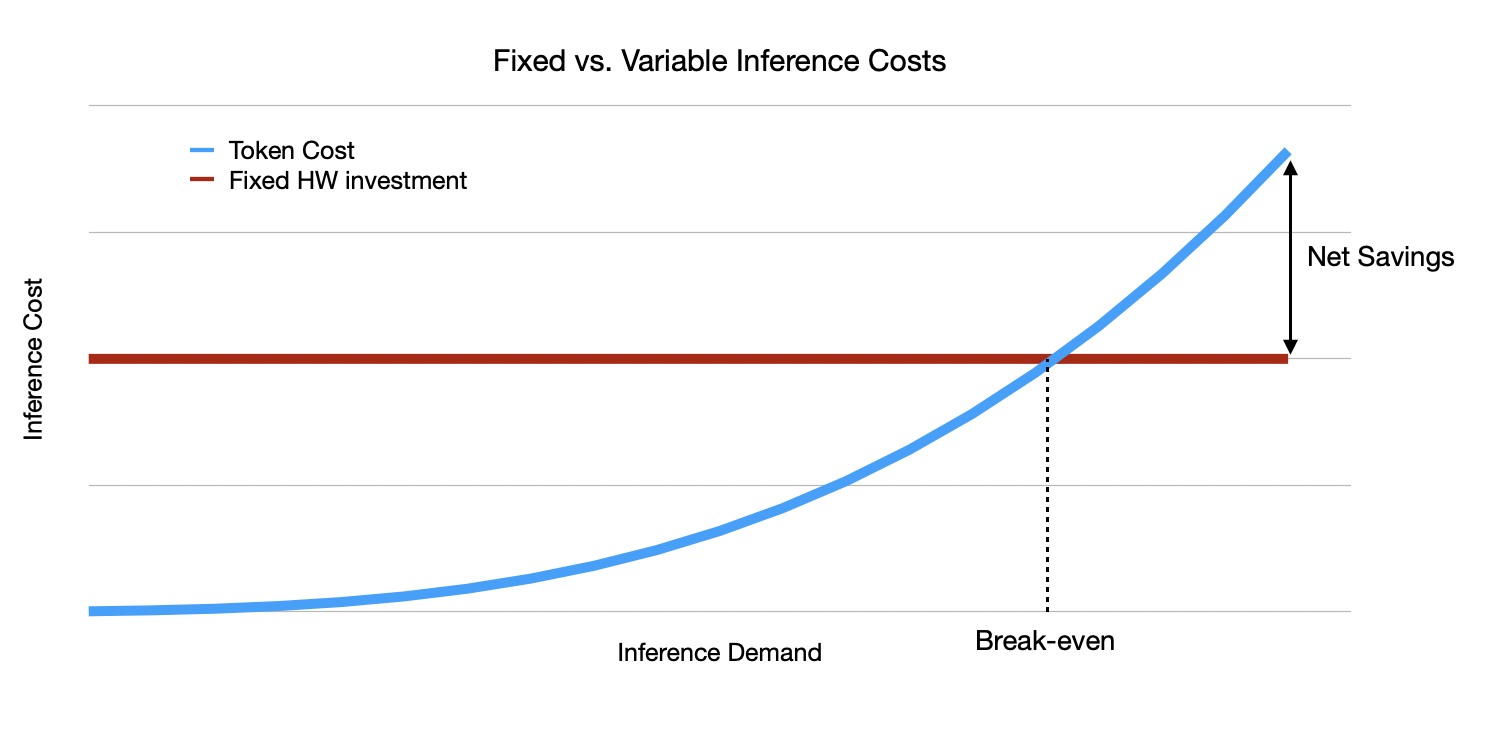
But now, when running AI, localized inference delivers a capped cost structure vs. an unlimited risk for token costs. The math is shocking.
Two examples:
A 26B parameter business analysis model running for 4 hours a day consuming 150 million tokens a month results in a cost of between $450 and $850 per user per month. The alternative is to buy a MacBook Pro and run that same model at zero cost. The acquisition cost of a 16" M5 Max with 40-core GPU and 128GB of unified memory is $6500. The payback period is 7 to 14 months. Thereafter the savings are $5400 to $10,200 per year.
Agentic coding using an 80B parameter model running 12 hours a day and consuming 300 million tokens a month will cost between $900 and $1500 per user per month. The alternative is to buy a Mac Studio M5 Ultra 80-core GPU and 256GB 4TB storage for $11,219. The payback period is 7 to 12 months, saving $11,000 to $18,000 every year thereafter.
The graph at the top of this post illustrates that this net savings is available above a certain threshold. These are serious numbers when the number of possible users is in the hundreds. The fixed hardware investment is a significant game changer in AI implementations.
The questions changes from why should we use Apple devices to why shouldn't we?
History has shown that computation tends to distribute itself to "the edge" of the network. It's been so since microprocessors were first developed in the 1970s. The logic at first is one of control and flexibility but it soon becomes one of cost. Early PC users in the enterprise loved the ability to have local spreadsheets and word processing at their fingertips and under their own ability to operate. Later it was desktop publishing and image editing and a multitude of applications.
That has been Apple's story in the enterprise: first it was a set of really unique experiences and degrees of creative freedom. Now we are at the stage where it just makes enormous financial sense. That is a watershed moment.
The corollary here is that AI is not much more than computing demand. If that demand is local or remote is a question of requirements. It so happens that local is desirable for a lot of people, and not just consumers.
The counter-argument is that the model must always evolve and thus the local becomes outdated or stale. But there are many forms of intelligences which do not require global or world models. The information an enterprise relies on for operations is not going to constantly change based on factors outside of its control.
When we look back on this period we will probably be amazed at how Apple was able to "pivot" to becoming the platform for Enterprise AI. The real magic is that it was always on the same path.
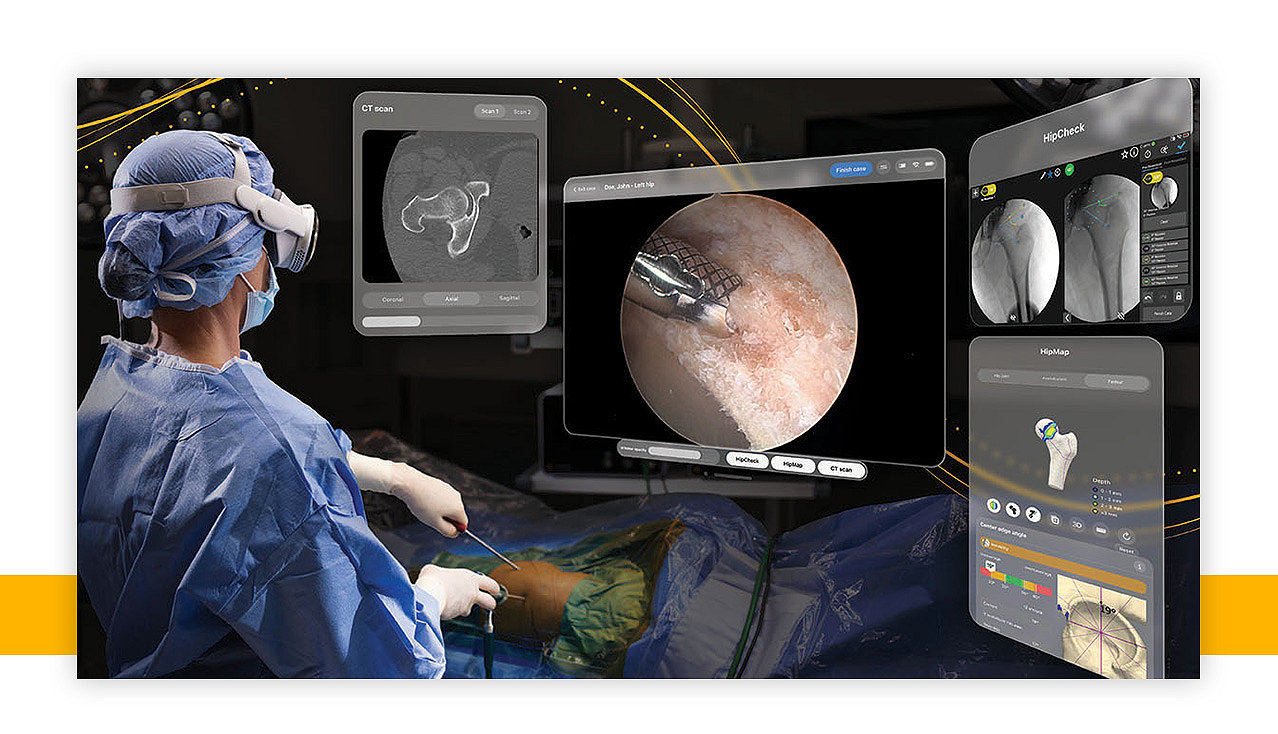
Stryker recently announced the successful completion of the first hip arthroscopy procedure using its SportSuite Vision application on Apple Vision Pro at Duke Health. The milestone follows the FDA's De Novo authorization for the application in July, making it the first surgical application approved for intraoperative use with Apple's mixed reality headset.
Following the FDA's De Novo authorization on July 17, SportSuite Vision became the first application cleared for intraoperative use with Apple Vision Pro, establishing a new regulatory benchmark for spatial computing in the operating room. The first live use of the technology took place during a hip arthroscopy at Duke Health, where orthopedic surgeon Chad Mather III performed the procedure, demonstrating the platform's transition from regulatory clearance to real-world clinical adoption at a nationally recognized academic medical center.
NB: Separately, Nabla is providing AI-based clinical dictation on-device for Apple computers.
As with the work of Dr. Tommy Korn, the benefits for surgeons is to make hip arthroscopy more intuitive by keeping critical clinical information within the surgeon's line of sight throughout the procedure. Instead of looking at multiple monitors around the operating room, surgeons can arrange key indicators based on their preferred workflow and access it within the sterile field. This creates a more comfortable environment, reducing unnecessary head movement and keeps essential information easily visible during surgery.
Initially the Apple Vision Pro is providing efficiency innovations for surgery. Ultimately, as we shall see, it will compete with non-consumption and create new demand for procedures and allow non-experts to do more of the work currently requiring expert-only attention.
Highly anticipated foldable launches from Apple and Huawei Technologies next week are expected to offer a much-needed lifeline to a subdued global smartphone market, which is bracing for an estimated 17 per cent decline in 2026.
Analysts are counting on Apple’s foldable debut to lift a sluggish smartphone sector reeling from soaring component costs.
“Apple’s entry into the foldable market has done more than reignite growth in a category that was losing momentum,” Nabila Popal, senior research director at research firm IDC, said on Wednesday. “It has fundamentally altered the market’s trajectory.”
Popal projected that Apple would ship more than 17 million foldable iPhones by 2027, capturing about 40 per cent of the global foldable market.
“Apple is positioned to challenge Huawei and Samsung for leadership in markets where they have long dominated – an extraordinary outcome for a product expected to be less than two years into its life cycle,” Popal said.
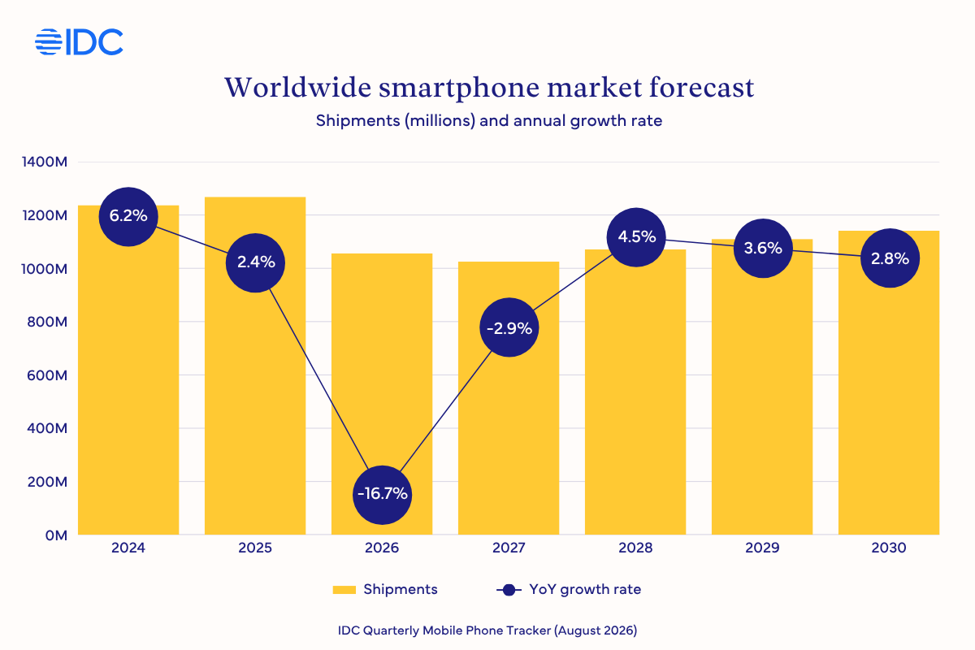
Global smartphone shipments are expected to fall 16.7 per cent this year, which would mark their steepest annual contraction on record, according to IDC’s latest report. The forecast is down from the research firm’s previous estimate of a 13.9 per cent decline, issued last quarter.
“The memory tsunami that we warned about is now hitting the market in full, and consumers are starting to pay the AI bill,” said Francisco Jeronimo, vice-president for worldwide client devices at IDC. “The era of the cheap smartphone has ended."
“From here, the winners will be the vendors with the scale and supply leverage to hold demand at prices consumers have never had to pay before.”
NB: Second half of 2026 shipments are expected to fall by more than 27%. ASP is forecast to rise 27% to $581 this year (revised from $550). The IDC view that Apple will shake up the foldable market is a mistaken understanding of how markets are created.
There is no "foldable market" since the market is not defined by form factor or particular mechanism of operation. There is no "thin phone" market or "touch ID" market. The market is delineated by iOS vs. Android with significant fragmentation within Android between OS variants but also between vendors and their distribution partnerships. It is then sub-divided by price and jobs to be done.
The possibility that Apple will launch a foldable means that Apple will create the market for iOS folding phones. That market currently has a size of zero. Its potential size remains to be determined but it probably has been estimated by Apple on the basis of their knowledge of their customer base.
The second aspect of this article is on the change in IDC's estimate for the year. This is not a change in thesis but on the scale of the decline in volumes and increase in pricing.
"Smaller Android brands anchored in the entry tiers face the hardest stretch in the industry’s history, and some will not clear it. The market that emerges on the other side of the crisis, when the memory supply finally stabilizes in 2028, will be smaller in units, larger in value, and far more concentrated at the top. The cheap smartphone era is not pausing. It is over."
The idea that a mature market enters a "post low-end phase" or the end of the cheap smartphone is a development that needs far deeper consideration.
I will address this in a research note separately.
We are considering an in-real-life Office Hours this fall, either in Boston or the Bay Area, open to Asymco One subscribers. If you would be interested in attending, write to events@asymco.com.
Nota Bene
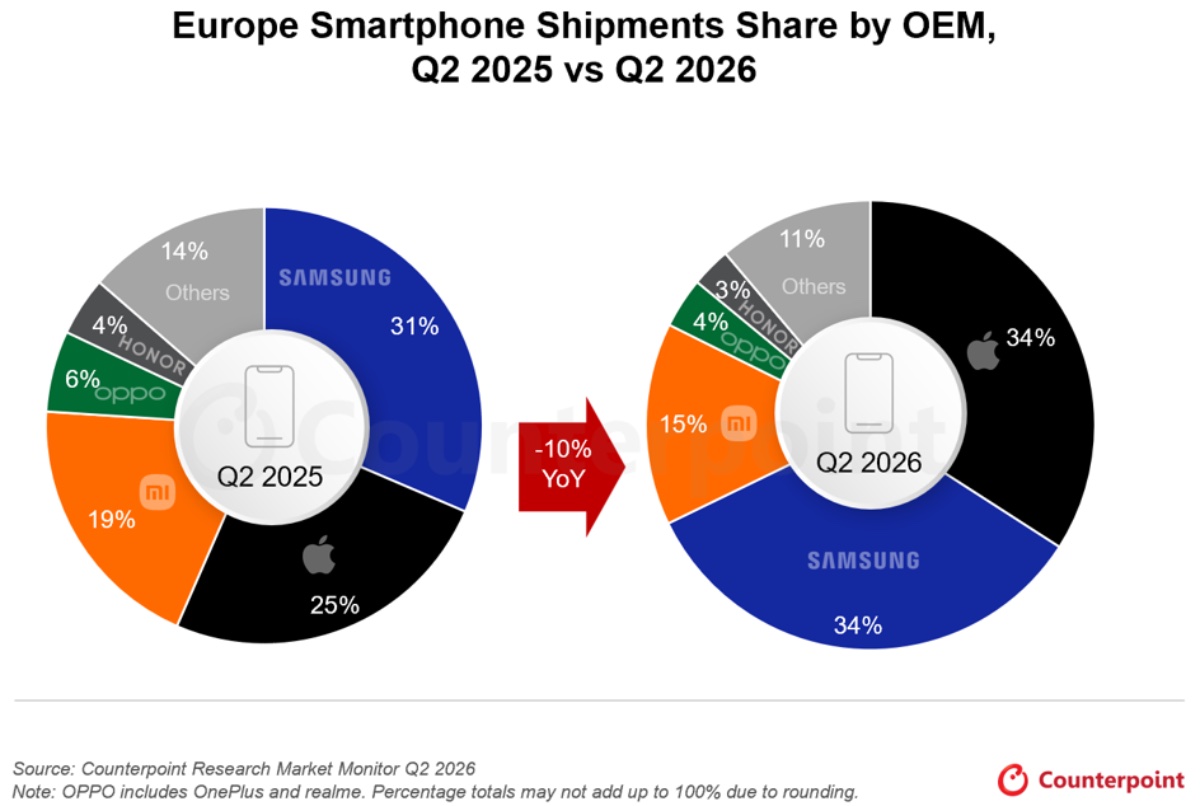
One in three phones sold in Europe is now an iPhone → Europe's smartphone market fell 10% year over year in Q2 to 35 million units, the weakest second quarter in three years, and Apple took 34% share, up from 31%, now tied with Samsung. Counterpoint expects further declines ahead, worst at the low end, and expects Apple to outperform the market for the foreseeable future. This runs longer than a single quarter. Apple is energized by the transition because it was never a phone company to begin with. →
The Freshman Register → Social media accounts for the largest share of screen time on every device, Apple's included, and if short video and messaging count it runs past four hours a day. But the thesis has collapsed after 22 years: what users see is almost never from friends, family, or the accounts they chose to follow, a shift that began with TikTok seven years ago. Followers no longer matter because the algorithm decides distribution, and an algorithm learns that negative emotions are worth more than positive ones. Usage is up, satisfaction is down, and Meta now trades at a P/E of 20 with a five year return of 50% against Google's 144% and Apple's 110%. It is no longer social media. It is algorithmic media, and the corrosion will eventually undermine the business. →
Apple Pay’s Pay Day: Tap to Pay Is Coming to Walmart and Sam’s Club → In 2014 I expected Apple Pay to be a billion dollar business by 2020 at a 15 basis point take rate, and in 2021 I concluded I had been four years too optimistic. Apple Pay handled $7.6 trillion in 2025 and generated roughly $5.6 billion in revenue at half that take rate, so the estimate was conservative after all. The user base passed 818 million, 94% of US retail accepts it, and it now carries 10% of global card transactions and 54% of US in-store wallet transactions. Walmart is joining on August 24, which means the last major holdout took twelve years to decide that checkout convenience matters. →