To own Apple today, you need to believe its ecosystem can keep deepening even as growth expectations are already high and the stock trades on a premium multiple. The latest quarter’s US$143.76 billion in revenue and US$42.10 billion in net income, powered by iPhone 17 demand and a rebound in China, reinforce that story, while expanding AI features and services aim to make each device more valuable over time. The upcoming low cost MacBook fits neatly into this, extending macOS and Apple Intelligence to more price sensitive users without changing the core near term catalysts, which still sit around iPhone 17 uptake, AI rollouts and services momentum. Key risks feel more about execution and sentiment: memory cost pressures, high expectations baked into the price and any cooling of AI enthusiasm..
NB: Another money quote: "An interesting angle is how design-led appeal in China, such as the viral “Cosmic Orange” iPhone 17, combined with new AI features across devices is reinforcing Apple’s ecosystem pull for both consumers and developers."
I tried but failed to connect how Cosmic orange is reinforcing Apple's ecosystem pull for consumers and especially developers.
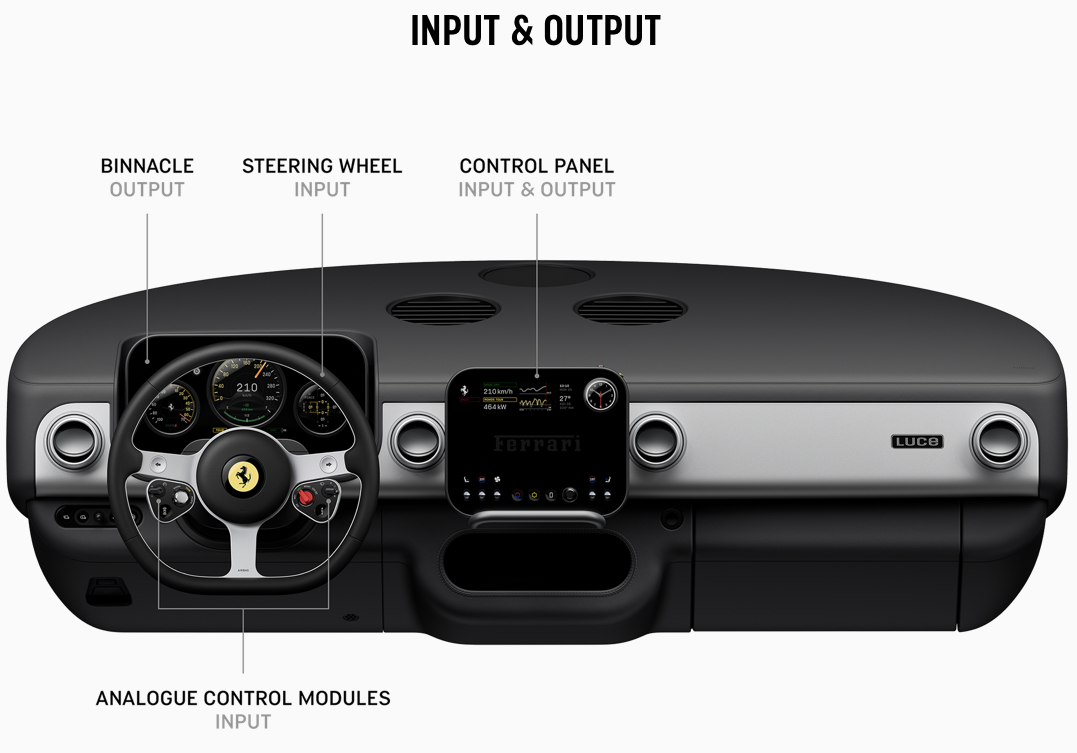
The design language suggests a computing interface.
The Ferrari Luce's interface is designed with clear organisational principles. Controls and displays are grouped functionally, with the most essential commands and feedback directly in front of the driver.
NB: Unlike most consultants, Jony seems to have had some influence. It's also refreshing that a car is now being designed with a minimum of touchscreens. My 1983 Saab 99 starts to look good.
Investment bank Goldman Sachs discussed Apple Inc. in January. It reiterated a Buy rating and a $330 share price target on the firm. The bank discussed the firm’s App Store performance in its coverage. It outlined that the App Store spending trends were improving as spending grew by 7% in January to accelerate by one percentage point over December’s 6% growth. Goldman added that the App Store growth should contribute meaningfully to Apple Inc. Services business.
Along with Goldman Sachs, Bernstein also praised the firm. It reiterated an Outperform rating and a $325 share price target. Bernstein cited Apple Inc.’s record iPhone revenue and optimistic growth guidance to point out that the firm was correctly navigating the turmoil in the memory industry.
Imagine trying to explain this to yourself if you lived during this era.
"Retrocade turns your room into a playable retro arcade. You can place a lifelike arcade cabinet in your space or jump into a full virtual arcade and play classic games like you’re actually there.
In this video, I show Retrocade running on Apple Vision Pro, from placing the arcade cabinet in mixed reality to stepping inside the virtual arcade and playing. You’ll see how it looks and what the experience is like once you’re in it.
Retrocade includes classic arcade legends like Pac Man, Galaga, Frogger, Space Invaders, Asteroids, Bubble Bobble, Centipede, Breakout, Track and Field, and Haunted Castle. Retrocade is included with Apple Arcade and requires a compatible game controller to play.
If you love retro games or just want a fun, instantly impressive Vision Pro experience, this one is worth checking out. Retrocade launches on February 5, 2026 and is one of the coolest Vision Pro experiences I've tried yet. You’ll find it here on the visionOS App Store: https://apps.apple.com/us/app/retroca...
NB: Helicopter flying is one of the most difficult piloting skills to master. The implications for training and education can hardly be overstated. The Vision Pro remains, two years later, the most impressive computer I've ever used.
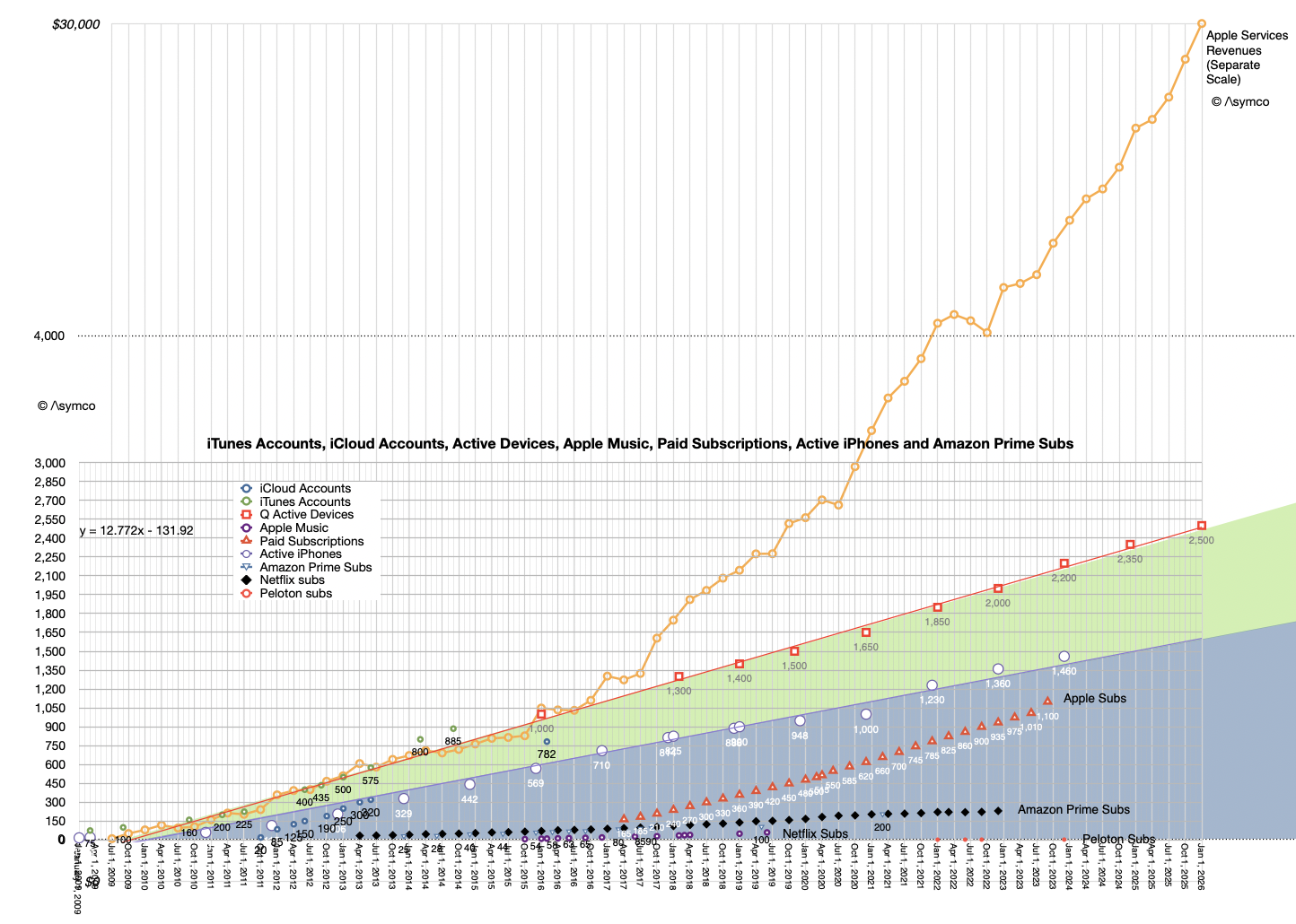
We are proud to report that we have a new record for our installed base with more than 2.5 billion active devices. -Tim Cook
2.5 billion active devices follows the announcement of 2.35 billion active devices a year ago, a growth of 150 million devices in one year. Let's examine some of the implications.
By my estimate, Apple sold about 250 million iPhones, 23 million Macs, 40 million Watches, 70 million iPads. Other devices including Apple TVs, Apple Vision Pro, Apple HomePods may add another 10 million units. Therefore the total number of "connected" devices sold is around 400 million/yr.
Adding 150 million to the active base in one year implies that 250 million devices are replacements, many surely are reused but also at least a third (37.5%) of units sold are expanding the base. This is reflected by management's occasional mention that "nearly (or, alternatively, over) half of customers who purchased a <product> being new to the product".
In the last quarter and for quite some time, <product> has been the Mac, the iPad and Apple Watch. If we use my estimates of units sold during the full year that means 17 million Macs, 20 million Watches and 35 million iPads were sold to new users. These add up to 72 non-iPhone new devices in use. That suggests about 78 million new iPhone users.
How does this compare to the following pattern:
The line to focus on is the red with square points. "Q Active Devices" is the history of what Apple calls "Quarterly Active" devices or those which ping an Apple server at least once a quarter. The data appears to be linear, or the growth is about 150 million per year at least since 2016. Historic data on the iPhone is also shown with a blue line. That is also consistent with about 100 million new iPhones in use every year. This is a bit higher than the 78 million bottom-up analysis of new users. I'd argue that Watch numbers may be a bit too high and perhaps iPad as well.
The mix is a matter of debate but overall this consistency allows for some confident forecasting.
The iPhone will reach 1.7 billion active users by this time next year.
There will be three billion active devices by early 2029.
Services, which is shown in the second graph is clearly correlated to active device growth.
The consistency in active device growth is far more important than device sales in a particular period and determines the value of the company.
Knowing this, here are some additional observations:
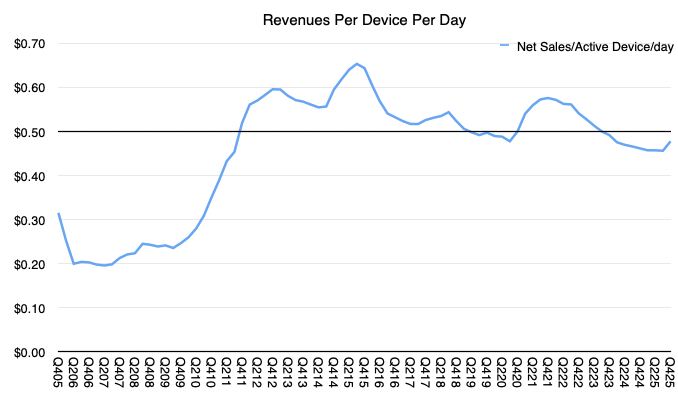
Yearly revenues per active device are $129, services revenues per active device are $45 for a total revenue per active device at $174/device/yr. That is equivalent to 48c/device/day. Data shows that daily revenues have been an average of 53c/device/day for 59 quarters. My rule of thumb is 50c/day per active device is a good estimate for Apple's revenues, and estimate that I have been holding for over 14 years.
There are additional implications. With a base of 1.65 billion iPhones, and knowledge of replacement vs. new-to-product/switcher growth what is their average lifespan and thus replacement rate and therefore what is the average selling price?
On January 30, JPMorgan analyst Samik Chatterjee raised the price target on the stock to $325 while reiterating an “Overweight” rating. The firm is confident on the stock as it sees Apple results as reassuring for investors.
According to the firm, Apple’s latest financial results should help “calm investor nerves” about memory-related impacts on gross margins and concerns regarding a Services slowdown. This is despite the magnitude of iPhone revenue upsides, which is “noteworthy” itself.
JP Morgan also highlighted Apple delivering “record Product gross margins” in the December quarter, with the March quarter also anticipated to show record product gross margins.
This, the firm believes, should help investors be reassured regarding the materiality of the impact that investors have been concerned about related to rising memory costs.
“Record Product gross margins in the December quarter and an implied March quarter record Product gross margin should help reassure investors around the materiality of the impact that investors have been concerned about in relation to rising memory costs, even though management acknowledged slightly higher impact in March quarter than the December quarter.”
On Sunday, India's government gave a key win to Apple by allowing foreign companies to provide machines to their contract manufacturers in certain areas for five years without tax risk.
Apple had been lobbying the Indian government to revise its income tax laws to ensure the company is not taxed for ownership of the high-end iPhone machinery it provides to its contract manufacturers, Reuters reported.
The move could prompt Apple and other companies to invest swiftly in the electronics manufacturing space by taking over initial expenses for pricey machines, cutting the initial cost burden on contract manufacturers they collaborate with, according to the report.
"We are saying that if you bring your machine, and that machine is used by a local manufacturer to produce something, we will … exempt you for five years. We are giving them certainty," said Revenue Secretary Arvind Shrivastava at a post-budget press conference, the report added.
NB: This is huge. Apple depends on It will open the floodgates for Indian production. Apple uses investment in supplier equipment/tooling to accelerate supplier responsiveness and to create leverage in the supply chain. See also my post "Margin Call. "
While the commentariat assumes the worst, Apple delivers the best.
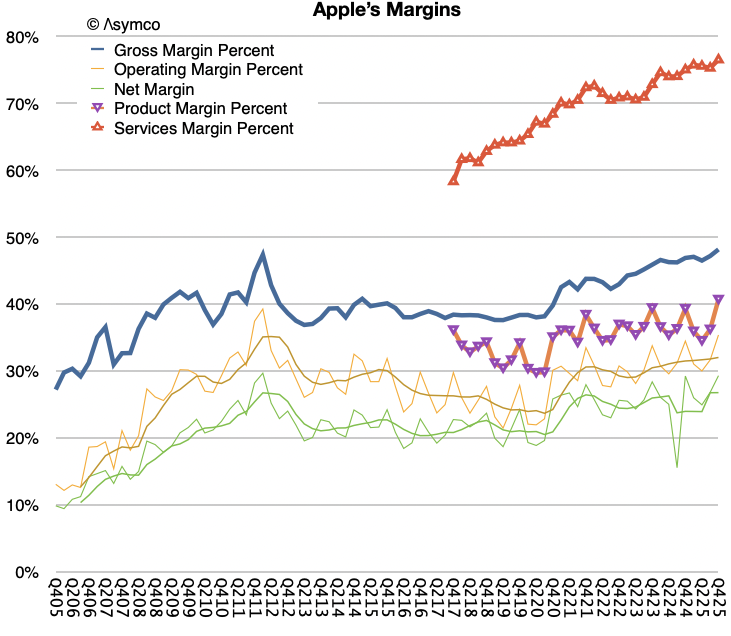
Last quarter Apple delivered a gross margin of 48.2%. This was above the high end of their guidance range and up 100 basis points sequentially. Management commented that this was "driven by favorable mix and leverage."
Further, products gross margin was 40.7%, up 450 basis points sequentially, driven by favorable mix and leverage. Services gross margin was 76.5%, up 120 basis points sequentially, driven by mix.
This performance is even more astonishing considering the history shown below. Apple is quite simply, delivering at the highest gross and net margins in its history.
Note that the graph actually projects forward one quarter because we have the following guidance: "We expect gross margin to be between 48-49%." The graph reflects the high end of this guidance range.
So what's going on? Especially as a drumbeat of constant doom is being broadcast by pundits. The conference call itself seemed to be dedicated to margins. It became what I call the Margin Call.
Amit Daryanani, the first questioning analyst, specifically kicked off with the following:
"there is a lot of focus on the impact of memory to host the companies, and I would love to kind of get your perspective when you are first guiding gross margins up into March. Talk about, a, your comfort in securing the bit that you need for shipment and b, how do we think about memory inflation flowing through Apple's model over time?"
Tim Cook answered:
We are currently constrained, and at this point, it is difficult to predict when supply and demand will balance. The constraints that we have are driven by the availability of the advanced nodes that our SoCs are produced on. And at this time, we are seeing less flexibility in the supply chain than normal, partly because of our increased demand that I just spoke about. From a memory point of view, to answer your question, memory had a minimal impact on Q1. So the December gross margin. We do expect it to be a bit more of an impact on the Q2 gross margin, and that was comprehended in the outlook of 48 to 49% that Kevin gave earlier.
what Apple is saying is that they are constrained by production of silicon but not of memory. They do see some impact in the future but that is included in a guidance of margin expansion.
Analysts still could not believe this, the following exchange soon followed:
Ben Reitzes: So the next question is on gross margin. I am pretty shocked I gotta hand it to you, Tim. I am, you know, that you are able to do 48 to 49. What is really going on there? How are you doing that with this memory, the NAND prices? Is it due to mix that there is a good less hardware and more services? Services and services margins are going up. How are you doing it to keep it at 48 to 49?
Kevan Parekh: Yeah, Ben. This is Kevin. [] Let me start maybe by just reflecting on the Q1 gross margin. I think we talked about the fact that we landed at 48.2%, so just above the high end of the range we provided, [], on the last call. [] if you look at that performance, [], we were up 100 basis points sequentially. We talked about the fact that we had favorable mix. [], as you know, when we have a good product cycle, strong price cycle we are seeing for iPhone, that does lend itself to a bit more favorable opportunity on the [] leverage side.
So we are having a strong iPhone cycle as Tim outlined. And so that also translates itself. So we talked about products sequentially went up by 450 basis points. So I think, in general, I think we are just seeing, [], favorable mix dynamics as well. [], service continues to contribute as well. That business is growing, [], double digits, so that also is a contributor. And I think that, [], if you looked at our guidance, [], we are providing a similar range to where we reported in December. There are going to be a few puts and takes. [], we do expect to see favorable mix in the services.
As you know, when we move from Q1 to Q2, that tends to be the case, and that is partly offset by a seasonal loss leverage. So there will be puts and takes, but again, we feel pretty good about the guide of 48 to 49%, which is similar to the range we reported in December.
Still not enough. Two more questions followed on margin. I will quote one here.
Aaron Rakers: Yep. And then as a quick follow-up, you know, kind of tied to memory, maybe not so much, but part of this current generation iPhone cycle is you clearly deepened some of your own internal silicon capabilities on the device. I am curious if that if we should think about that as a lever and maybe a supportive factor to gross margin that might be underappreciated and any thoughts on where we go from here as far as continual opportunities of internalizing your own silicon? Thank you.
Timothy D. Cook: Yeah. I will let Kevin talk about the gross margin. But in terms of the product, which is at the heart of what we think about in the user, Apple silicon has just been an incredible game changer for us. Starting with iPhone and then on iPad and, of course, the Mac as of a few years ago. And so we believe it is a game changer and a major advantage.
Kevan Parekh: Yeah. And as far as impact on gross margin, yeah, we have been, as you know, investing in core technologies like our own silicon and our own modem. And certainly, while those do provide opportunities for cost savings and can be plugged in margins, they also importantly provide, [], the differentiation that is really important for our products as well and us more control of our roadmap. So I think there is a lot of strategic value to it, but also we are seeing, [], investments in our core technologies impacting, [], gross margin in a positive way.
After all this, the financial commentariat continues to assume that Apple will be hit with margin pressure from memory and that has presumably been affecting the share price since the call.
Well, we've seen all this before. Before the great memory crisis Apple was going to be constrained by tariffs, by China, by developer dissatisfaction, by AI, by regulators, etc.
The feeling one gets is that Apple is always navigating through a minefield of pitfalls and gotchas. The opposite is true. It's highly likely that Apple has sufficient leverage which increases its access to supply and that everyone is keen to work with the company. Leverage comes from scale, from lead time, from vertical integration and from engineering. Management is saying as much. Indeed, the evidence of leverage across the supply chain and over the entire ecosystem and economy is evident in its margin expansion story told in the graph above.
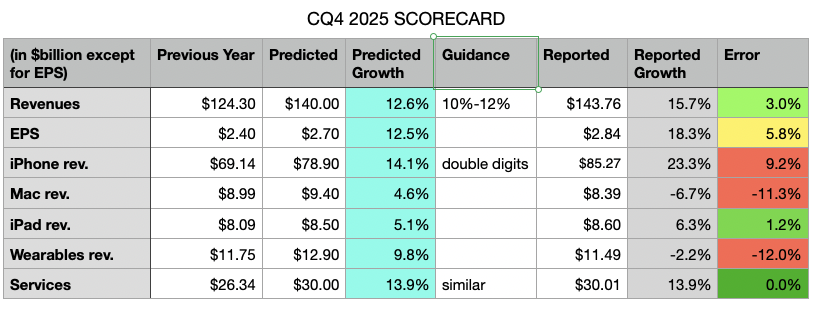
My predicted growth is in the light blue column, the reported growth is in the grey column and my errors are in the last column. Also included is the guidance from the previous quarter's conference call.
The table shows my errors were primarily in underestimating iPhone, while over-estimating Mac and Wearables. The errors mostly cancelled each other out on the top line (off by 3 percentage points) but, due to an underestimation of the gross margin led to a bottom line error of 5.8 percentage points.
The Mac overestimation was based on not paying enough attention to the comparable from the year earlier. I was warned: "On Mac, keep in mind, we expect to face a very difficult compare against the M4 MacBook Pro, Mac Mini and iMac launches in the year ago quarter". Wearables are similarly underperforming due to lack of new product launches.
But the iPhone underestimation is simply because the new products are a massive hit. Nobody predicted this level of performance. Indeed Apple was caught by surprise and has been unable to meet demand. They are still going to be below supply/demand balance going well into the first quarter of 2026.
Finally, an error on the margin came from Apple's continuing over-performance on supply chain management.
Apple is providing the following guidance [my emphasis]:
We expect our March total company revenue to grow by 13% to 16% year over year, which comprehends our best estimates of constrained iPhone supply during the quarter.
We expect services revenue to grow at a year-over-year rate similar to what we reported in December. We expect gross margin to be between 48-49%. We expect operating expenses to be between $18.4 billion and $18.7 billion, which is at a similar level to what we reported in December and driven by higher R&D on a year-over-year basis. We expect OI&E to be around $100 million, excluding any potential impact from the mark-to-market of minority investments, and our tax rate to be around 17.5%.
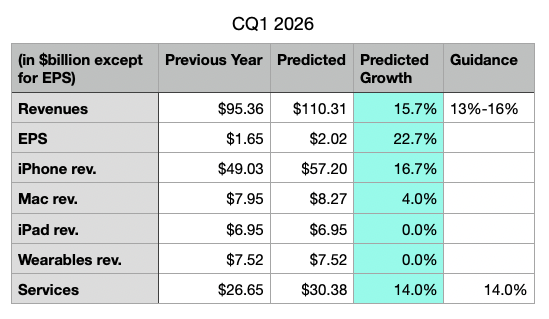
Based on provided guidance, I'm making the following predictions for the next quarter:
It's vey important to note that Apple is guiding gross margin to be between 48-49%, a record high and something that we will discuss in the next post. This results in a 22% to 23% EPS growth rate!
Note also that Apple guided revenue growth between 10% and 12% and delivered 12.6%. They guided grass margins between 47% and 48% and delivered 48.2%. It's highly probable that their top-of-the-range guidance will also be exceeded slightly and that my current estimates are therefore modest. [NB: the guidance is being put forward at the end of the first month of the quarter therefore the company already has booked one third of the quarter and has very clear visibility into the next third.]