The next Asymco Office Hours Live Q&A will be on Friday, July 31st at 12pm ET / 9am PT, the day after Apple’s fiscal Q3 2026 Earnings Call on Thursday. Horace will review the results and their implications, and we will take Q&A from our live audience.
Tim Long of Barclays Bank has an underweight (Sell) rating on Apple shares. Apple shares have just hit an all-time high. Perhaps he's right. Perhaps one should sell high.
The problem is that Tim Long has had a sell or hold rating on Apple for many years. As far as my data shows, Barclays downgraded Apple shares to a "hold" equivalent on February 20, 2014. In that instance, Barclays analyst Ben Reitzes shifted his rating from "overweight" to "equal weight" due to expectations that upcoming hardware products would not be enough to further move the needle. More recently, on January 2, 2024, Barclays analysts further downgraded Apple shares to "underweight" (a sell equivalent).
Ben Reitzes with Barclays Capital today stripped away his Overweight rating on shares of Apple (AAPL), a rating he's had for a decade, while maintaining a $570 price target, writing that the various products that one can imagine from the company — a smart watch, or a television set — won't be enough to move the needle, so to speak, for the company.
The price target in February 20, 2014 was set to $570 which, accounting for a 7 to 1 spent in June 9, 2014 and 4 to 1 in August 31, 2020, would be $20.39 today (On February 20, 2014, the date of the new $20 target and downgrade, Apple shares closed at $16.54. A year later the shares were $28.77.)
Thus the recommendation from Barclays has been to sell low for 12 years.
Let's dig in.
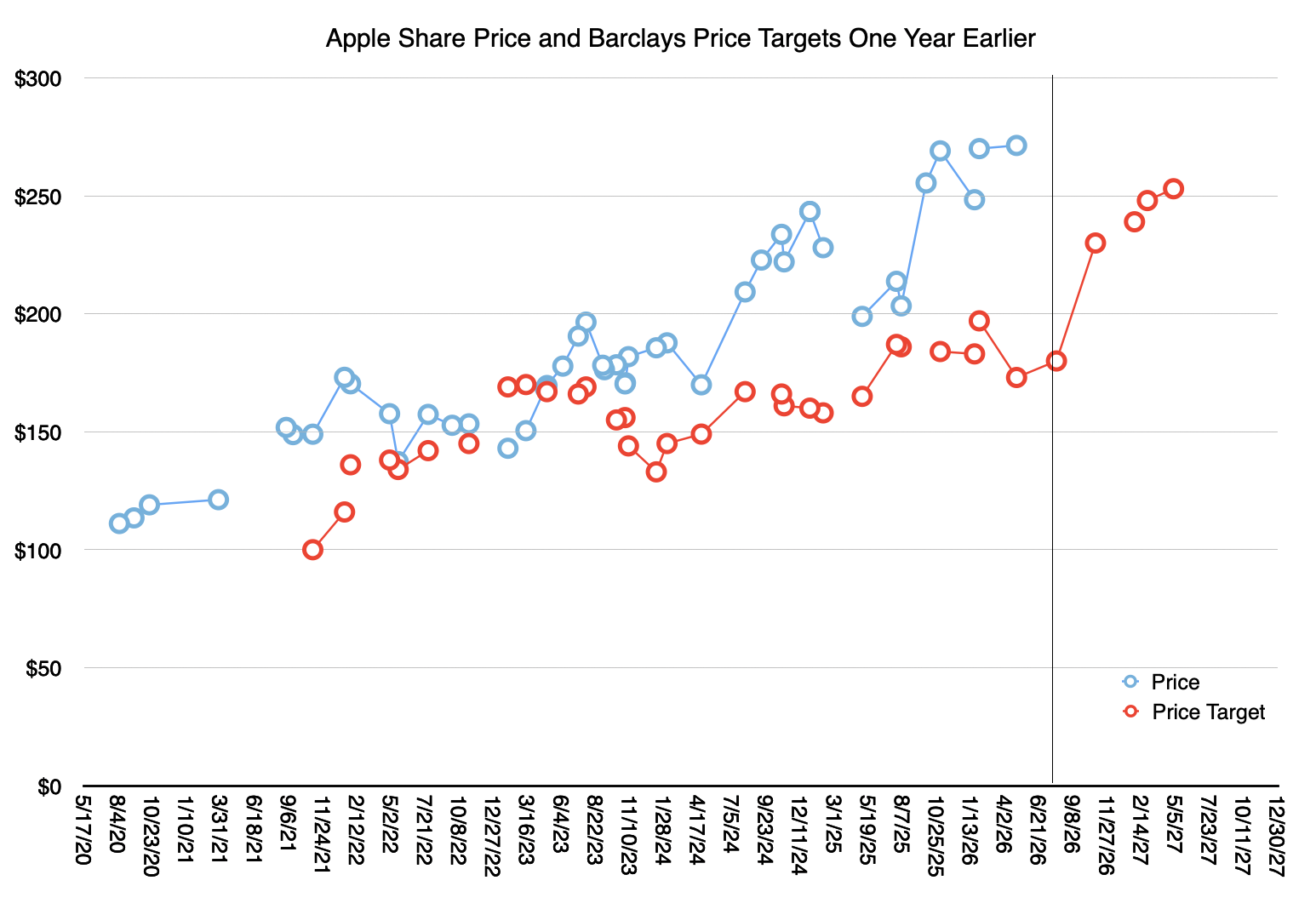
Nearly a year ago, on August 1st, 2025 Barclays adjusted their price target on Apple to $180 From $173. Today the share price is around $317. We still have a few weeks before August 1st so there is time for the price to fall to $180, however, here are additional 30 price targets set by Barclays and the corresponding price of shares a year later allowing us to evaluate performance:
Date of Target Set
Target
Price one year later
Error
4/30/25
$173
$271
-56.8%
1/31/25
$197
$270
-37.1%
1/22/25
$183
$248
-35.7%
11/1/24
$184
$269
-46.2%
8/2/24
$186
$203
-9.3%
7/24/24
$187
$214
-14.3%
5/3/24
$165
$199
-20.5%
2/2/24
$158
$228
-44.3%
1/2/24
$160
$243
-52.1%
11/3/23
$161
$222
-37.9%
10/30/23
$166
$234
-40.8%
8/4/23
$167
$209
-25.3%
4/26/23
$149
$170
-14.0%
2/3/23
$145
$188
-29.4%
1/11/23
$133
$186
-39.5%
11/7/22
$144
$182
-26.3%
10/28/22
$156
$170
-9.2%
10/10/22
$155
$178
-15.1%
7/29/22
$169
$196
-16.2%
7/13/22
$166
$191
-14.8%
4/29/22
$167
$170
-1.6%
3/11/22
$170
$150
11.5%
1/28/22
$169
$143
15.4%
10/29/21
$145
$153
-5.8%
7/28/21
$142
$157
-10.8%
5/19/21
$134
$137
-2.5%
4/29/21
$138
$158
-14.2%
1/28/21
$136
$170
-25.2%
1/14/21
$116
$173
-49.2%
10/30/20
$100
$149
-49.0%
The graph version of this data is shown below:
Today is shown with a vertical line.
The graph speaks for itself. The average error is 30%. The worst is 57%. Putting aside the gross failure in setting targets, the most curious aspect of this coverage is that the price targets are trending upwards quite consistently while the ratings are coming down.
Since the Sell->Hold downgrade in 2014, and the subsequent downgrade (Hold->Sell) a decade later, the targets offered by the same analysts have increased from $20 to $253 today (+1,165%).
The targets have increased while the rating has decreased. You were told to not buy at $16 then continue not to buy until you are told to sell because the shares are going to $160 and then sell again because they are going to $250. This is simply contradictory.
The only way to accept the raising targets while maintaining a hold/sell rating is by arguing that all previous ratings and targets are moot and should be ignored. But if you suggest ignoring your own commentaries over 12 years published in over 100 reports reiterating your position then your own recommendation is to ignore what you say.
How long does an analyst insist on being ignored?
The key thesis was resting on a comparison with Microsoft. It might be worth re-reading: "Microsoft hit an all-time high market cap of about $620 billion in late 1999 as it was obvious its business model that bet on industry standards was the clear winner in the PC/Internet revolution. In August 2012, Apple beat Microsoft's record of the most valuable company when shares rose past the $660 level and shares continued to rise to an all time high past $700 just after the launch of the iPhone 5 with a market cap of about $650 billion as investors assumed Apple was the clear winner in the mobility revolution.
The point is that the most dominant tech leaders of their era don't necessarily just regroup from these types of peaks and re-assume a new all-time high market cap after a year or two. They may get usurped in the ensuing decade or two. These observations are easier to see in hindsight – but it shows how hard it is to get to this type of size and stay there, much less regroup – and rise above it again […] Both companies seem to have been re-rated as investors ascribe little probability to a next "big thing" after a series of attempts to reclaim past glory.
Apple now trades at 12.7x consensus 2014 estimates – down from its P/E of 15.9x in October 2012. Microsoft traded around 20x in 2004 after a strong rebound in 2003, but its multiple has settled in the mid-teens since that time. We don't see evidence that suggests Apple has another product as material as the iPhone or iPad in the pipeline. We are not arguing the nominal multiples here – but the rate and sustainability of the new contracted multiple from peak is worth noting. Once the market decides that your main product will remain slow for a long time, there does seem to be a visible pattern for multiples to sustain lower levels for a long time even if revenues grow –as was the case with Microsoft."
Asymco Bulletin is a digest of all the work we have published for the week ending Jul 19, 2026. Posted on July 20th.
July Office Hours
Asymco Office Hours Live Q&A — Friday, July 31 → The next Asymco Office Hours Live Q&A will be on Friday, July 31st at 12pm ET / 9am PT, the day after Apple’s fiscal Q3 2026 earnings call on Thursday. Horace will review the results and their implications, and we will take Q&A from our live audience. Asymco One subscribers are guaranteed seats, can bring a guest, and will have access to the live recording.
When Essilor merged with Luxottica in 2018 the eyewear market was $100 billion. In 2021 it was $150 billion. Last year it was $220 billion, this year it’s estimated at $245 billion and in six years, $463 billion. Much of this growth is due to increases in the Asia Pacific region with 11.5% CAGR. The growth is due to improving competitiveness with non-consumption through expanding distribution, mainly through retail and e-commerce. Technologies such as virtual try-on are enhancing accessibility, personalization, and purchasing experiences. Aging populations are also boosting demand for prescription eyewear. Focusing on the buying experience and addressing new users are evolutionary steps but changes in the product itself are an emerging revolution. Injection of software into what has been a purely passive optical object will change how we see the world. →
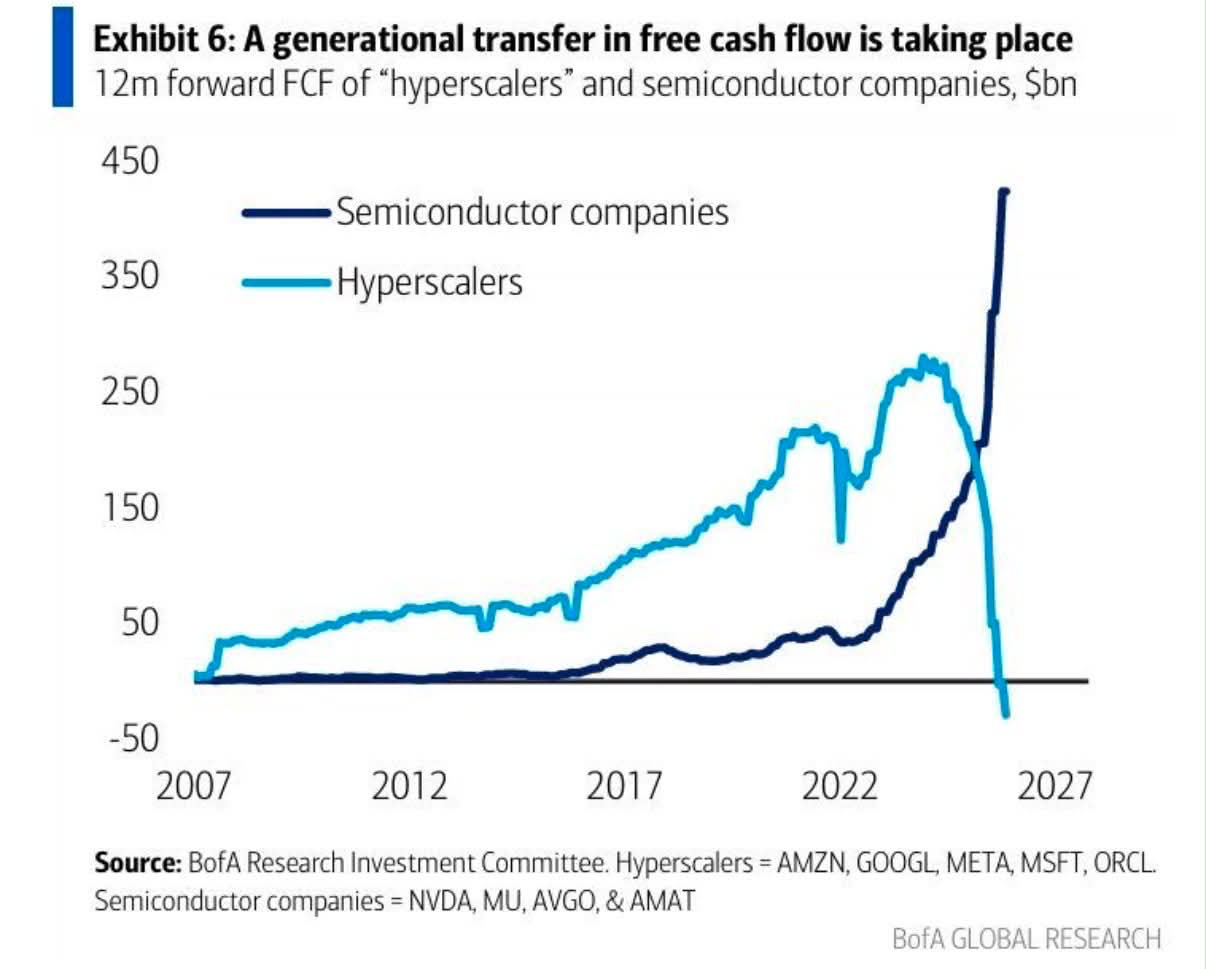
The graph above shows that Amazon, Alphabet, Meta, Microsoft and Oracle decided to transfer their shareholders’ wealth to the shareholders of Nvidia, Micron, Broadcom and Applied materials. The transfer is real since the capital expenditures undertaken with this cash flow by these “hyperscalers” have gone directly to create unprecedented windfall profits for semiconductor companies. The scale is astonishing! These companies alone are taking hundreds of billions out of their owners' pockets. I ask why this is happening and, even more curiously, why is there a rush by all companies to do this. All but one that is. →
Nota Bene
No one admits they like or want to buy more AAPL → Apple hit an all-time high as investors went looking for a hedge against everyone else’s AI spending. The setup is almost funny: Meta, Oracle and Amazon are burning cash to build data centers, while Apple is expected to throw off $143 billion in free cash flow with capex falling. Its edge-AI approach, running models on the device, turns the absence of a frontier model into the whole thesis. The analysts calling it a boring defensive name are the ones who missed it. →
Worldwide PC market update Q2 2026: Omdia and IDC → The PC market shrank about 4 percent while Apple grew, up 16 percent by Omdia’s count and 10 percent by IDC’s. Apple was lifted by the MacBook Neo, placing Dell now within reach. Units are falling while revenue climbs, because everyone is pushing through 20 to 40 percent price increases on the memory crunch. →
Why doesn’t anybody copy Apple? → Everyone copies Apple’s products; almost no one tries to copy its operating model, which is the thing that actually matters. OpenAI poaching Apple people is the first real attempt I have seen to reconstruct that model, and I don’t think they have their priorities straight. Jobs said anyone you removed from Apple would be useless on their own, and they are about to prove him right. →
JP Morgan raises Apple stock price target by $20 to $345 → JP Morgan lifted its Apple target to $345, arguing the memory-driven cost increases are a short-term worry and that iPhone, Mac and iPad volumes have shown little relationship to price over the years. Mac looks the most insulated, helped by AI-led demand.. →
Citi hikes Apple price target by $50 to $365 → Citi cited Apple’s share gains in falling smartphone and PC markets and its power to raise prices mid-quarter. It expects further increases at the September launch, weighted to the high end, plus a foldable iPhone late in the year. Even with the raise the average target is below the market where the shares set a fresh all-time high above $323, running out ahead of the very analysts chasing them. →
Game Over. Remember Consoles? → A PlayStation reader poll had nearly half of respondents considering a jump to PC, put off by the end of physical games and the prospect of a $1,000 PS6. Reader polls are unreliable, with selection bias and complaints crowding out the satisfied. The real signal is elsewhere: consoles have been under disruption pressure for years, and Microsoft is now cutting thousands from Xbox. I called this more than a decade ago, and the game is still ending. →
The graph above shows that Amazon, Alphabet, Meta, Microsoft and Oracle decided to transfer their shareholders' wealth to the shareholders of Nvidia, Micron, Broadcom and Applied materials1. This is not an exaggeration. Free cash flow is wealth and it belongs to shareholders. The transfer is real since the capital expenditures undertaken with this cash flow by these "hyperscalers" have gone directly to create unprecedented windfall profits for semiconductor companies. So much so that the companies receiving these windfalls are scrambling to give it to their shareholders (and employees.) And the scale is astonishing! These companies alone are moving hundreds of billion, more than the profits gained in the semiconductor businesses in decades.
Prof. Clayton Christensen had a theory he called "the dumb manager theory" to describe what most people use to explain why companies fail. According to this theory when a company is successful it's because its managers are smart. Conversely, when a company is failing it's because its managers are dumb. The problem with the theory is that it's usually the same managers who are there when a company succeeds as when it fails. Believing in the theory implies that you also believe that smart people can turn dumb. But you can't tell when and why this happens so determining success depends on your skill at psychoanalyzing managers.
The second problem with the theory is that when one company fails, many other companies in the same industry fail as well. Yes, Kodak failed to grasp digital photography and its management has been skewered for it. But so did Fujifilm in Japan and Agfa in Germany. Did all these managers get together at a dumb management conference and agree to do the same dumb things at the same time? Clay Christensen asked if it's possible that they colluded to fail. He noted that he's often heard of collusion in order to succeed but never of collusion to fail.
So the dumb manager theory of success and failure of businesses is problematic. When successful companies fail, it's not likely due to managers losing their competencies. Indeed, it may be because they are too competent.
Disruption theory holds that companies fail precisely because managers pay too close attention to targets that are no longer relevant. And the "collusion" aspect is that all managers become fixated on the same target at the same time because they are all trained in the same way. There is group-think but also group-obsession on metrics and best practices and theories of the market that no longer apply.
In the current wealth-transfer spectacle, managers at companies which are at the "top of the stack" offering complex, multi-faceted, multi-sided marketplaces of services to billions of consumers and businesses and advertiser customers through multiple channels of global distribution chose to give all they have2 to the "bottom of the stack" commodity semiconductor designers and manufacturers. The very businesses that they chose not to participate in and which a multitude of advisors, analysts and academics told them for decades are worthless metal benders.
This new logic is that by directing all their capital to the bottom of the stack they will ensure continuing success of their complex top-of-the-stack business.
The irony should not be lost on the reader.
It's not just a question of "what if they're wrong?" The paradox is why is the plunge so headlong, so reckless. I.e. why is it not calibrated to an abundance of evidence of returns on the risk taken and, moreover, why is the belief so universally held.
In other words, why all-in and why all are in.
Of course, there is one anomaly: Not "all" are in. Apple is not all-in and it's the only one of the Magnificent 7 that is conspicuously hedging on this wealth transfer.
Apple may be the anomaly that answers the paradox. The reason Apple stayed out will not be found in the "wise manager theory" of avoiding failure.
Apple preserved its shareholders' wealth because they focused on their customers. (Yes, quite an anticlimax.)
They did not have data centers to serve ads and sell capacity to businesses. They did not assume that customers' data is a commodity to be traded. They worried about privacy and quality of experience. They had to convince each buyer to decide to buy individually. In other words, they had a very simple business model: sell things to people who decide to buy because it works for them.
But it required a complex execution. They had an integrated business: from retail to distribution to manufacturing and all the way to silicon. They did not sit only at the top of the stack. They sat at the bottom of the stack too. And in the middle. They were aware of the power of silicon and of hardware and of operating systems, APIs, design and everything in between.
Having this perspective on their own business and customers, making all-in bets on a single technology that may be vulnerable to rapid commoditization3 seemed unwise. When everyone was throwing everything at "infrastructure" they looked at their own infrastructure and asked what the big deal was. When all the "compute" spending went to Nvidia, Apple asked why can't we just build our own, 1000x more processors? When projections of infinite revenues were made Apple asked where it would come from and how will it be segmented and justified and how exactly will consumers benefit and pay for it.
The head scratching was seen as foolishness or foot dragging or fatal delays but it was genuine prudence. The more alone Apple was the more it was accused of stupidity. Au contraire! The suspicion should have been on the "group" making wild bets not on the skeptic sitting on his hands. Always be suspicious of beliefs in miracles and especially of any consensus in them. But that is how markets work. Overreaction is axiomatic; disillusionment guaranteed.
Not included are the capital flows from investors in OpenAI, Anthropic and SpaceX and recipients such as Samsung and LG and a multitude of data center suppliers.
All the current cash flow is gone, next comes the process of going into debt and thus giving up what they might get in the form of future cash flows.
Open source/Chinese models will clearly be good enough.
Many PlayStation users are considering a switch to PC after Sony announced the end of physical games on its platforms.
A reader poll by Push Square, which specializes in PlayStation coverage, has shed light on how fans are feeling about Sony’s next generation console and it should raise alarm bells for the company. Nearly half of the 6,545 respondents shared that they’re seriously considering switching from PlayStation to PC. Meanwhile, only a mere 23% were intent on staying in the PlayStation ecosystem.
Far and away the biggest reason this group of players was looking at the PC was Sony’s recent decision to not support physical games beyond 2028, with 41% of respondents pointing to this as the reason for a potential move away from PlayStation. This was followed by being more confident in long-term game ownership on PC, which likely stems from the company having recently removed purchased shows and movies from users’ libraries.
It’s not just concerns about the future of game ownership on Sony’s platform that’s giving these users pause, though. Higher prices are a sticking point, too. When asked what they would do if the PS6 cost $1,000, only 14% of respondents affirmed that they would pick it up at launch. Most respondents say they will opt to either get a PC instead or just skip out on the next generation entirely.
NB: There are big problems with reader polls. There is selection bias and the chance of dissatisfaction generating a response is higher than satisfaction. However, the bigger problem is that consoles are under persistent disruption pressure. Microsoft is laying off thousands in its XBox division. This problem was evident more than a decade ago.
The phone was a "good enough" gaming system and created its own demand and hence its own market. New genres and new generations of users grew up with phone gaming. The PC on the other hand was getting powerful enough to challenge the type of immersive games for high-end gaming (online massive multiplayer especially).
The upshot of it is that the App Store has overwhelmed the console business. The old platforms carry on but are increasingly appearing to be exhausted. User dissatisfaction and defection are inevitable.
When Essilor merged with Luxottica in 2018 the eyewear market was $100 billion. In 2021 it was $150 billion. Last year it was $220 billion, this year it's estimated at $245 billion and in six years $463 billion.
Much of this growth is due to increases in Asia Pacific with 11.5% CAGR. The growth factors are improving competitiveness with non-consumption through expanding distribution mainly through retail and e-commerce. Technologies such as virtual try-on are enhancing accessibility, personalization, and purchasing experiences. Aging populations are also boosting demand for prescription eyewear.
EssilorLuxottica (EL) is an interesting case study as it represents a significant share of this total market. It’s also a useful proxy because it has a large overlap with segments Apple might target. EL operates in 150 countries, offers 150 brands, introduces 3500 eyewear models new every year, and has over 600 production facilities & optical labs. It sells 113 million prescription frames, 97 million non-prescription frames and 755 million solid and 79 million contact lenses per year. It distributes through 300k optical partners, 20k stores, 89 eye clinics and serves 500 million customers.
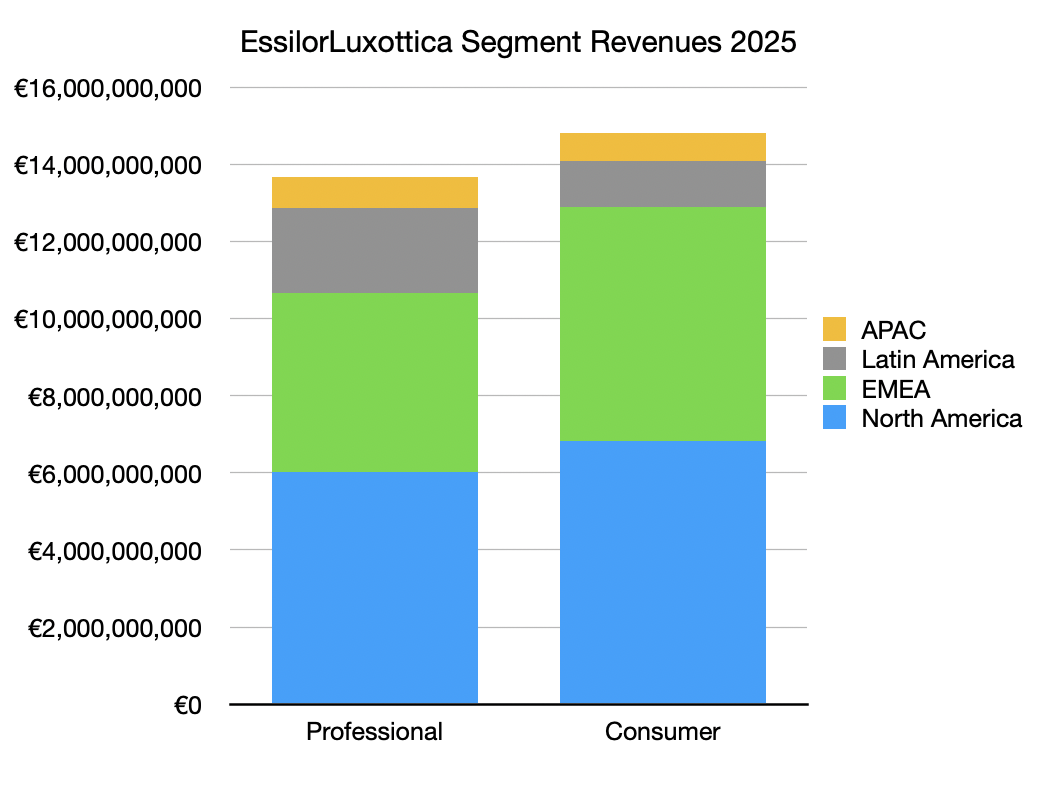
Through this, in 2025 it generated 28.5B€ revenues, at 16% gross margin, 11% net margin. Geographic segment revenues are shown below.
Additional consumer categories: 70% Prescription, 21% sunglasses, 6% AI glasses, 3% Apparel. In terms of consumer 77% is sold through Brick and Mortar retail.
There is a demographic overlap with Apple though they are far weaker in Asia (6% consumer sales). Distribution is also very fragmented as are its brands. Consumer sales are about $17B which I estimate is about the same as Apple Watch revenues.
On a unit basis i estimate that the wholesale average revenue per frame is $100, average revenue per lens pair is $50 and retail margins at 50% put average selling price per glasses of $300. Price ranges vary widely from $50 to $5000. The $300-$500 segment is expected to record the fastest growth from 2025 to 2030. This price structure allows the entry of a software-enabled frame+lens that is priced at what consumers are willing to pay but adding significant functionality—as long as style, aesthetic and social standards are met.
This suggests a similar opportunity for Apple to the watch market: approach the mid market and push incumbents into either low end or very high end while iterating rapidly on function and design.
Unlike the watch market, however the eyewear market is far bigger and growing much faster.
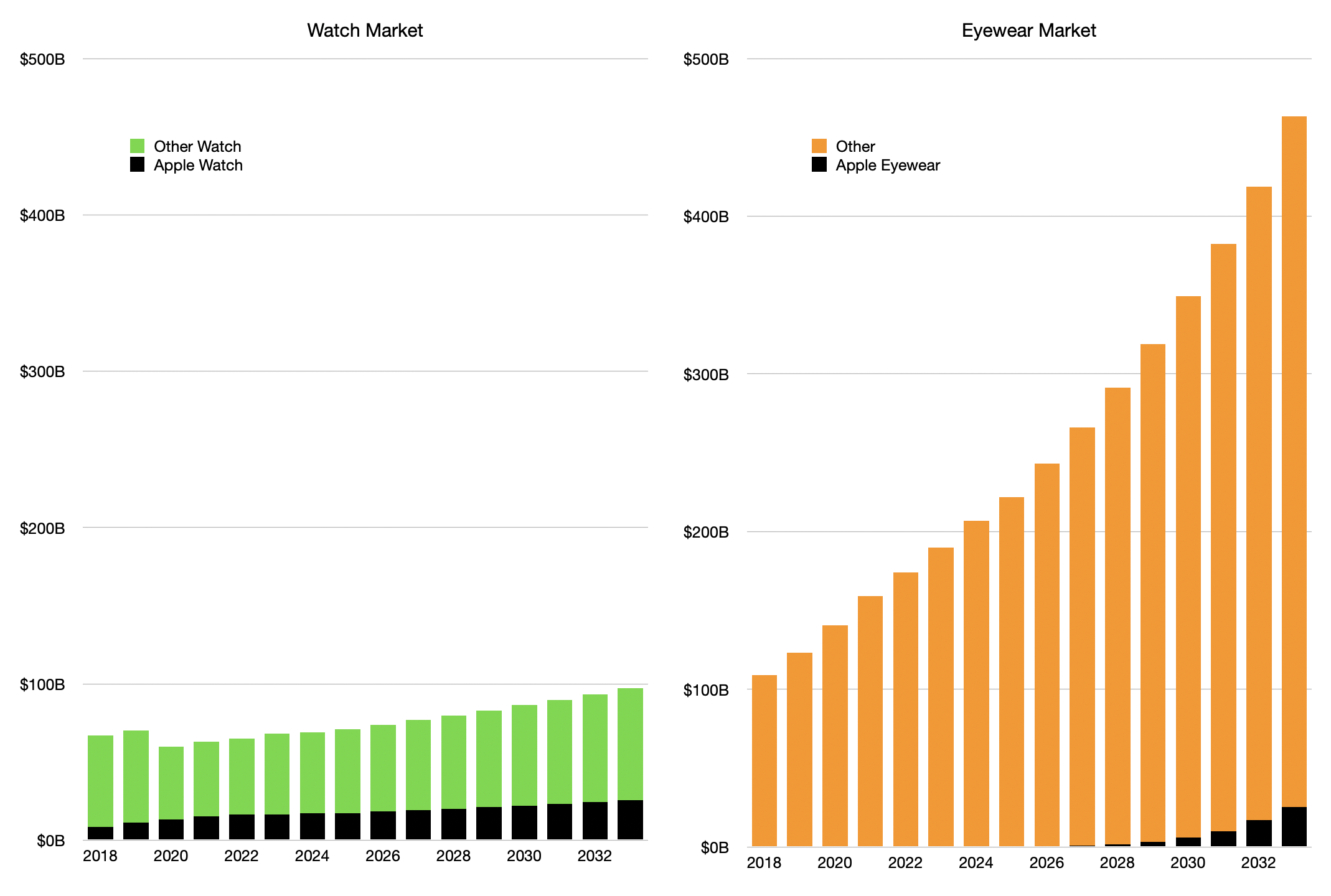
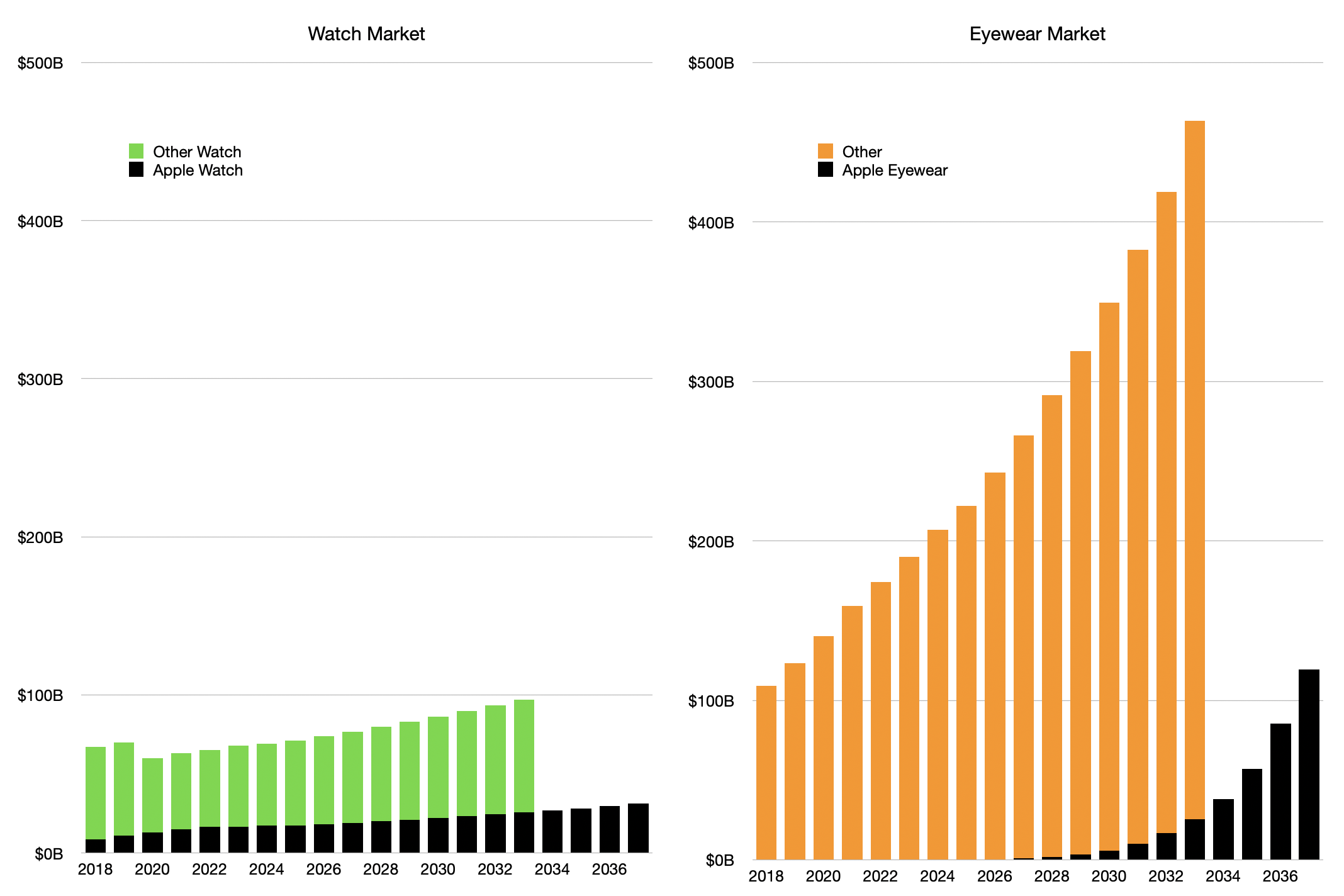
My estimates for both the watch market and the eyewear market (2018 to 2033) including Apple's share is shown below.
This scale suggests Apple eyewear could reach to be the same size as the Apple Watch by 2033 and each would be worth about $25 billion/yr.
By then Apple's share in the watch market would be about 25% but only 5% of the eyewear market. A substantial headroom exists where Apple eyewear could reach as much as $100 billion/yr.
This is one of the reasons Spatial Computing is so strategic. By the time this opportunity arrives, vision computing technologies will allow the injection of software into eyeglasses that would solve incremental problems for many users on a continuous basis. We call this jobs-to-be-done and as display, input, and capture/sensing data will flood into the eyewear product, consumers will find new jobs to hire the products to do.
Overall Wearables should growth from $18billion/yr. today to $115 billion by 2035 sustaining a 20% compounding growth rate.
One important aspect here is not just competition with new features but with new customer experiences: virtual try-on, personalization, and purchasing options. The fact that 80% of the market is still brick-and-mortar and requires typically multiple visits is archaic. In addition there are many non-consumers. There is non-consumption for people who do not have an eye refractive condition (myopia, hyperopia, presbyopia), i.e. children and there are the underserved who may be unwilling to obtain glasses.
The conversion of 2.2 billion un-served is also worth considering1. When Apple watch arrived, many people had stopped wearing watches since timekeeping was always on their phones. The watch became an accessory to the phone and adoption increased. The same might happen with Apple eyewear. "Eyespace" is perhaps the most interesting and important wearable space after all.
In 2018, an estimated 2.5 billion people, mostly in India, Africa, and China, lack access to eye tests and spectacles. This “visual divide,” as NGOs call it, is a significant global issue. Myopia and presbyopia, common in developing countries, are linked to high road deaths, low educational achievement, and poor factory productivity. Eye-health campaigners refer to it as the world’s largest untreated disability.
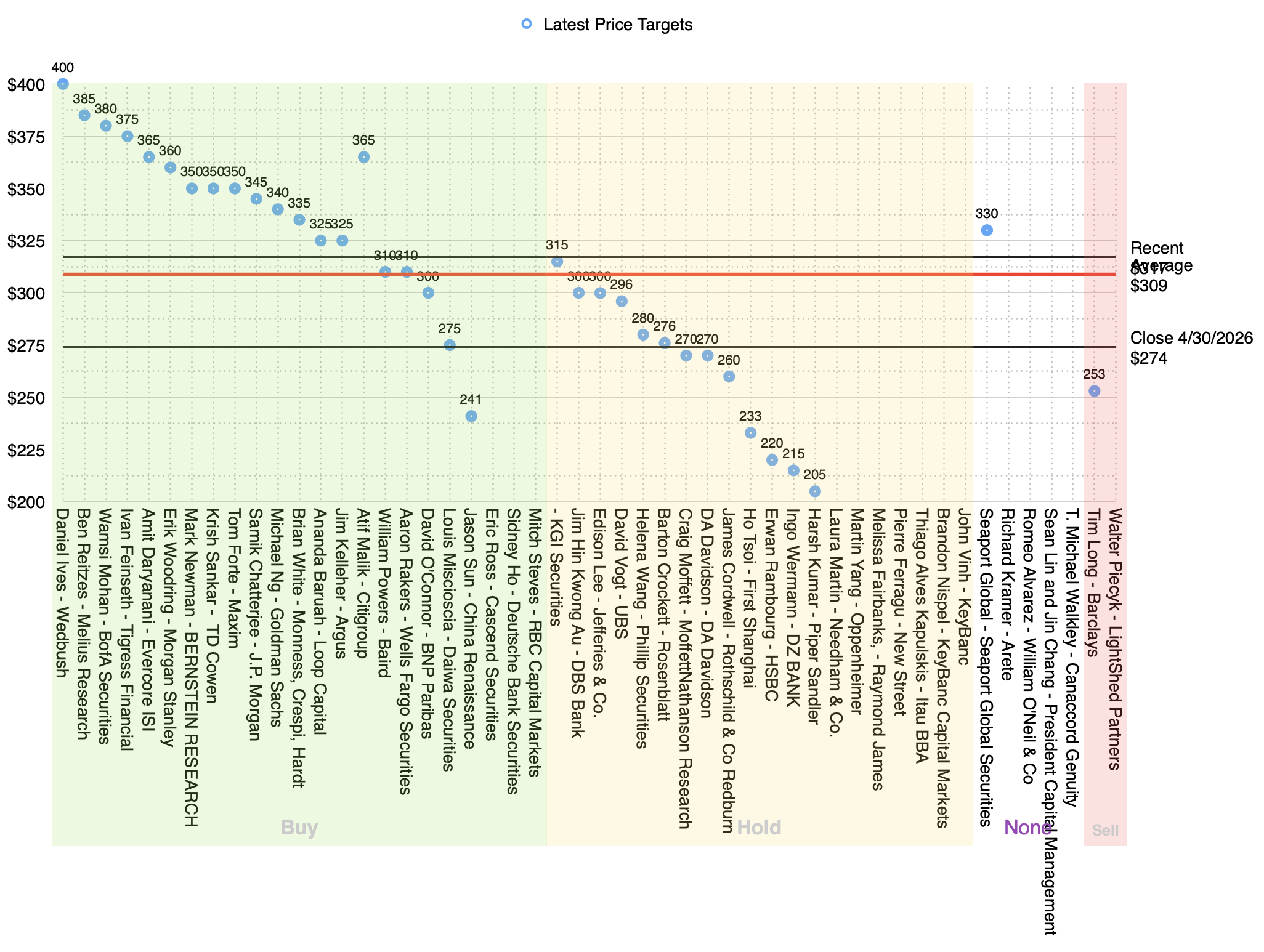
On Monday, Citi raised its price target on Apple to $365 from $315 while maintaining its Buy rating. The move reflects stronger margin expectations and rolled-forward financial estimates amid what the bank sees as Apple’s continued resilience in a tough environment for devices.
Citi remains constructive on the stock, highlighting Apple’s ability to gain market share even as broader smartphone and PC markets face headwinds.
Outperforming a Declining Market
Citi notes that smartphone and PC markets are likely to decline by mid-to-high teens percent. Despite this, Apple is positioned to outperform. According to the note:“continues to outperform the broader smartphone market through share gains, design-driven demand, and strong positioning in the mid-range price segment via promotions and subsidies.”
The firm also stated that Apple “should continue gaining market share despite a slowing devices market.”
Pricing Power and Margin Protection
A key driver behind the higher price target is Apple’s demonstrated ability to implement selective price increases. Citi observed that Apple raised prices on several products mid-quarter amid rising component costs and is evaluating additional memory suppliers to diversify its supply chain.
While iPhone prices remain unchanged for now, Citi expects price increases in the upcoming September launch cycle: “with more focus likely on the higher end models where demand is more resilient.”
The bank also flagged an expected foldable iPhone launch in the fourth calendar quarter. These factors support higher margin expectations following recent price increases.
NB: The new price target is shown in the updated analyst target graph. The average target has now risen to $309 while the shares are trading around $317 and set a new all-time intra-day high above $323.
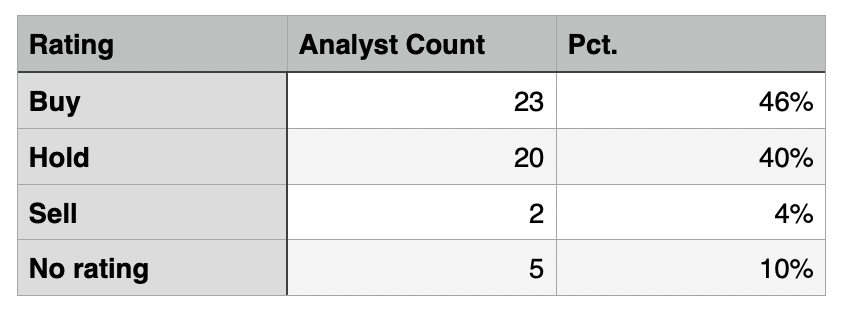
Targets are increasing among the "Buy" rating analysts but the majority of analysts maintain a hold or sell or no rating on the company. There is a possibility that Apple may resume the position of highest market capitalization.
The news of price increases caused a dramatic fall in the share price but a few weeks later the analysts are noting that the company might prosper regardless. This should not come as a surprise to readers of this web site.
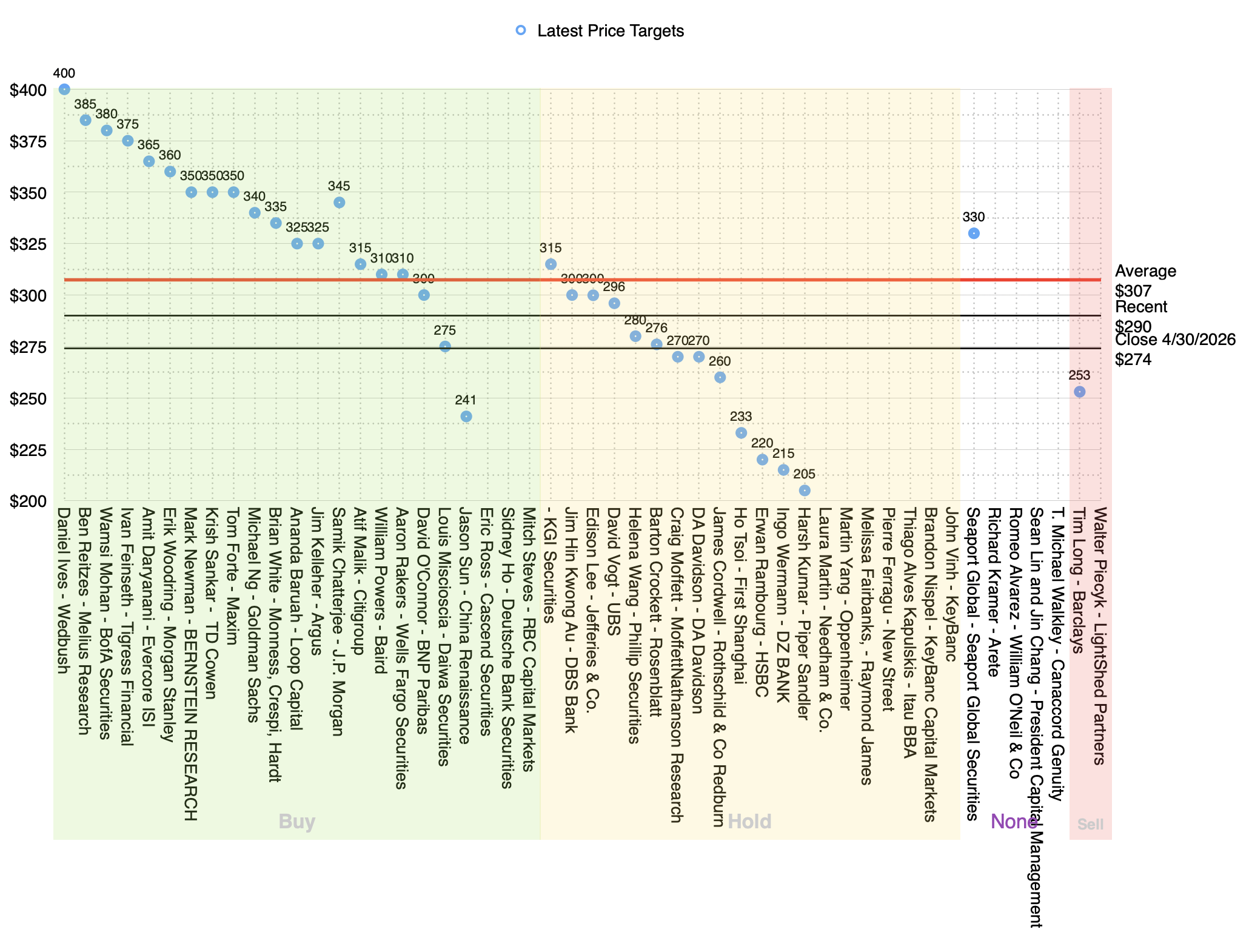
In a note to investors seen by AppleInsider on Tuesday, JP Morgan has increased its price target for Apple to $345. This is an increase of $20 from January, when it last raised the stock target price to $325.
The firm acknowledges the hefty price increases are going to be a short-term issue, with investors trying to judge how badly consumers will take the news. But even so, the news isn't enough to dampen JP Morgan's spirits.
In its reasoning, JP Morgan first says that the historical data for sales volumes covering iPhone, Mac, and iPad show a "limited relationship" to pricing across multiple years. Essentially, consumers are going to buy Apple products anyway, and pricing doesn't seem to matter too much.
Mac sales are probably the most insulated in JP Morgan's view, with more price point options and AI-led demand working in its favor.
The iPhone also benefits from limited elasticity on the premium end. Those with larger budgets are less affected by price changes, it seems.
NB: Average target is $307.4, below current price of $312. A majority of analysts maintain a negative or neutral outlook on the company.
Among "Buy" ratings, the average price target is $336.8. Among "Hold" ratings, the average target is $264.6. Over the last year, the share price has risen 49%.
Apple accuses OpenAI, and former design star Jony Ive’s io Products firm, of stealing hardware trade secrets in blockbuster lawsuit
Apple sued OpenAI on Friday for allegedly stealing its trade secrets, an extraordinary move that pits the $4.6 trillion iPhone maker against the fast-growing AI startup as it prepares to release a new class of hardware products that have been shaped in large part by Apple’s former design boss.
In the lawsuit, filed in the Northern District of California court, Apple accused two former employees now working at OpenAI of systematically stealing confidential data, including information about unreleased hardware products, technical specifications, and details about vendors and contractors in Apple’s supply chain. The complaint also listed OpenAI as a defendant, as well as io Products, a hardware design firm acquired by OpenAI last year that was co-founded by Apple’s former design boss, Jony Ive.
NB: Jobs said that if you took anybody out of Apple they would be useless. He was right. In my 2013 post "Why Doesn't Anybody Copy Apple" I agued that even though everyone tries to copy Apple's products nobody tries to re-create Apple's operating model. OpenAI seems to be the first to try, though I'd argue they don't have a clue what they are doing.
What Ive and Altman tried to do was brute force replicate Apple by taking as many people and processes from Apple to replicate the operating model. What they could not replicate was the priorities. Resources are easy to steal or replicate. Processes are much more difficult but with a lot of persistence it may be possible. But Priorities cannot be replicated because they include every aspect of the business logic. OpenAI has a miserable business. They cannot graft a device business any better than Google did and arguably have a much shorter runway to even try. It does appear to be a grab the money and run type venture.
Ive's greed has destroyed his legacy. He will try to distance himself but he is forever tainted.
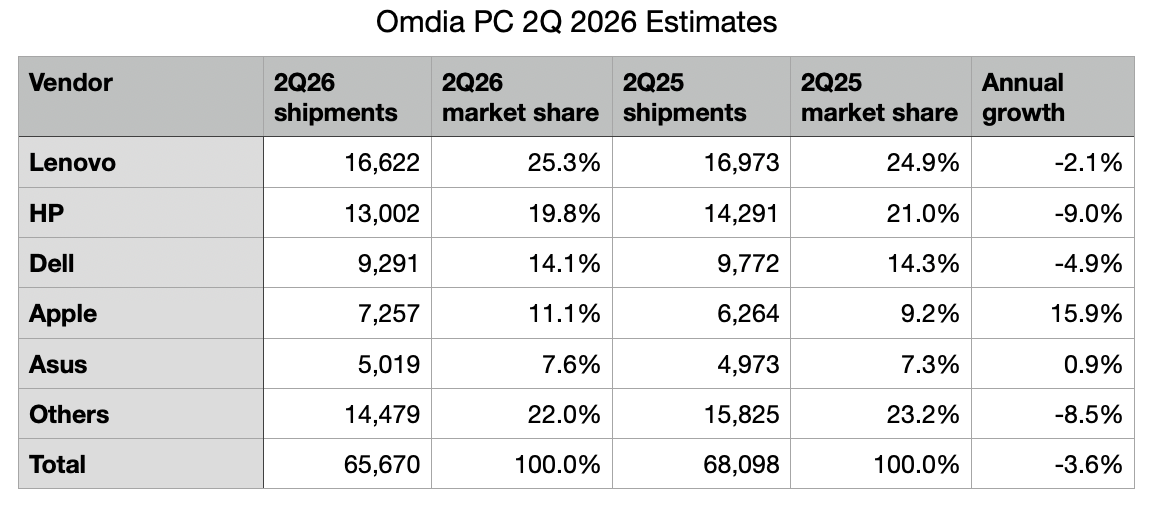
Global shipments of desktops, notebooks, and workstations in 2Q26 declined 3.6% year-over-year to 65.7 million units according to the latest research from Omdia. Shipments of desktops (including desktop workstations) hit 13.9 million, falling 1.3% annually, while notebook (including mobile workstations) shipments landed at 51.7 million units, representing a 4.2% decline.
"The sharp increase in memory and storage prices during the first quarter of the year had a significant impact on product pricing in the second quarter," said Ben Yeh, Principal Analyst at Omdia. "It also prompted consumers and IT decision makers to bring forward their PC purchases to mitigate the risk of further price increases. Although sales volumes were maintained at a stable level, the risk of a subsequent downturn remains."
Apple's recent decision to raise prices across MacBooks has become one of the key focal points in the market. However, other PC vendors began increasing prices as early as the end of 4Q25 and have continued to adjust them quarter over quarter. Across comparable product lines, prices have risen by about 20% to 40% compared with the same period last year.
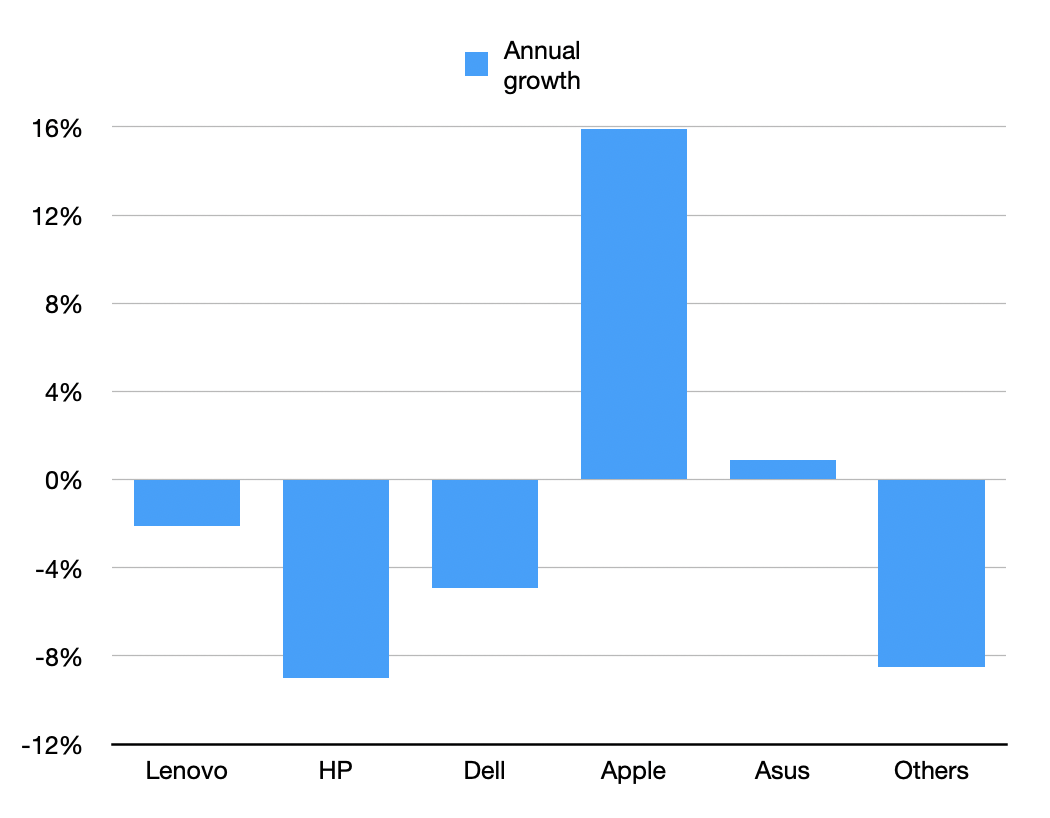
Lenovo retained the top position, shipping 16.6 million units and maintaining a 25% market share despite a modest 2% decline in shipments. HP ranked second with 13.0 million units shipped, as volumes declined 9% year over year. Dell held third place, demonstrating resilience in a supply-constrained environment by shipping 9.3 million units and capturing a 14% market share. Apple recorded the strongest growth among the top vendors, shipping 7.3 million units, driven by the launch of the MacBook Neo and healthy underlying demand. The company gained 2 percentage points of market share compared with 2Q25. Asus rounded out the top five with 5.0 million units shipped, delivering a broadly flat performance year over year.
IDC
New data from IDC shows that Apple was the only major PC vendor to post significant shipment growth in Q2 2026, with the broader market declining for the first time in more than two years.
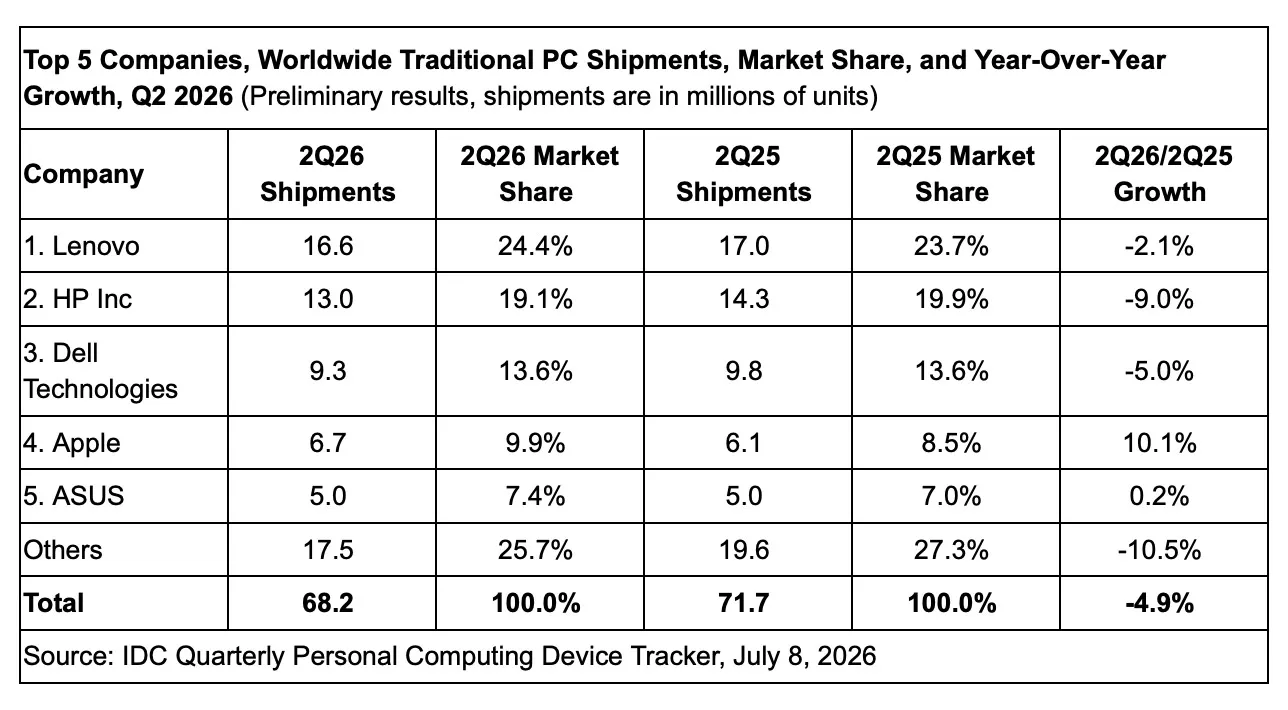
Mac shipments rise as PC demand cools In a report published today, IDC says global PC shipments fell 4.9% year over year in Q2 2026, dropping to 68.2 million units from 71.7 million units in Q2 2025. The data showed that the top-five vendor ranking was unchanged from Q2 2025, even as most major PC makers posted year-over-year declines.
In practice, Lenovo held on to the top spot with 24.4% market share, despite a 2.1% year-over-year decline in shipments. HP followed with a 19.1% share and a 9% drop, while Dell remained in third place with a 13.6% share and a 5% decline. Apple, meanwhile, saw Mac shipments jump 10.1% year over year, giving the company 9.9% share, and ASUS rounded out the top five with 7.4% share and a slight 0.2% increase. From the report:
“Apple’s share gain coincided with its latest product launch, the MacBook Neo, and while the company did raise prices in line with the broader market, it still remains well positioned against rivals facing the same cost pressures.”
Here’s Jitesh Ubrani, research director for consumer devices at IDC: “The real story here is the disconnect between units and dollars: shipments are falling, but revenue is climbing because vendors are pushing through price increases faster than demand is dropping. […] Given worsening macro conditions and a memory shortage that isn’t expected to ease until early 2028, we don’t expect another round of inventory pull-forward, which points to a sharp slowdown in growth rates in the second half of 2026. Vendors are bracing for further price hikes into 2027, and channels are already flagging concern about elevated inventory at these higher price points.”
IDC also warned that sustained price pressure could start weighing on PC upgrade cycles, “even as interest in on-device AI processing continues to grow.” The firm also pointed to another risk: the biggest PC makers gaining even more share as smaller rivals struggle with the memory crunch.
NB: The two estimates are almost exactly the same for the top vendors, differing only on Apple's shipment and "Others". Overall…
…Apple is growing the Mac line between 10% and 15% in units. My own estimate is of a 15% increase in revenues (to $9.25 billion) with a volume increase of 20% due to the MacBook Neo. The Neo launch was extremely successful and it hit the market at the launch price of $599, holding the level through the end of the June quarter.
As a result, Apple's growth is very much an outlier.
According to the Omdia data, Apple is still a few percentage points (2 million units) below Dell and a third place in the volume ranking. Overtaking Dell in units would be quite an achievement given the admonishment Michael Dell had when asked what he would do if he were CEO of Apple. “What would I do? I’d shut it down and give the money back to the shareholders.”
How Apple Became the Most Defensive Stock in the Market
The stock hit an all-time high Thursday as investors look for hedges against massive artificial-intelligence investments elsewhere in the market.
Shoring up a portfolio with defensive stocks typically means buying stable names from seemingly boring categories: Consumer staples, utilities, medical devices. These days, you can just buy Apple stock instead.
Whether by design or by luck, Apple’s relative inaction on artificial intelligence has made it the ultimate hedge in a market driven by AI investments. And as investors grow wary of ballooning capital outlays elsewhere in Big Tech, the iPhone maker’s stock has proven its worth.
Apple hit an all-time high of $316.22 on Thursday after a quiet and steady long-term climb. Shares are up 15% this year and 48% in the last 12 months—first and second in the Magnificent Seven, respectively—outpacing both the Nasdaq Composite and the S&P 500. “No one admits they like or want to buy more AAPL,” Mizuho Securities analyst Jordan Klein wrote Friday. “But I get why more folks [are] looking at AAPL as a hedge or long idea.”
The story of the tech market over the last two years goes something like this: AI labs like Anthropic and OpenAI need data centers; hyperscalers like Oracle and Amazon.com are investing historic sums to provide them; and that money is going to chip and server makers, memory and storage suppliers, and a host of other companies.
Apple doesn’t fit neatly into any of those categories. It doesn’t have a frontier AI model, a sprawling cloud business, or much in-demand hardware. Instead, it is carving out a lower-cost niche as a leader in “edge AI,” which involves embedding AI applications directly on its devices, with the help of Broadcom chips.
Analysts estimate Meta Platforms, Oracle, and Amazon will have negative free cash flow in 2026 because of their AI investments. Meanwhile, Apple is expected to produce $143 billion in free cash flow, up from $109 billion last year, per FactSet. Its capital expenditures will likely decline in 2026.
“[Apple] has definitely been out of favor, but carries a lot less direct near-term execution risk,” Klein wrote.