Asymco

Asymmetric Intelligence

Industry

  1. Blackberries are not Smartphones

    Research

    It's time to re-evaluate the categorization of smartphones. The term has always been problematic. It loosely means a phone that runs an advanced operating system and has third party SDKs. There is no industry standard definition and some call it a converged device or a multimedia device. One analyst famously said that the iPhone did not count as a smartphone on launch because it was not open to developers.

    I'd propose a different definition, not based on the attributes of the device, but the jobs that the device is hired to do. This is in a way, the same distinction between Facebook and MySpace. They are clearly hired to do different things by their users and as a result don't directly compete. When you do this job-based segmentation, you realize that iPhones, Android devices and Windows Mobile and Palm are fairly similarly used. Blackberry, however, does not match the profile. (Neither do most recent Symbian devices, though for different reasons.)

    The most common jobs I can see in use with the first cohort of devices is (Comscore data exists to back this up)

    • browsing
    • social networking
    • applications/games
    • email
    • media consumption
    • navigation

    The Blackberry has relatively poor utilization of any function except for email and perhaps social networking (though the latter is not likely in company-sourced devices). The focus on a large number of jobs to be done is what distinguishes smartphones from the more limited "feature phones". By this logic Blackberry is hired as a "feature phone".

    It's also instructive to follow commentary among enthusiasts. It's fairly clear that this segmentation exists implicitly: Android, iPhone, Palm and WinMo are comparable while Blackberries are for a different demographic, different user, different usage.

    Finally, there is the gut check. It's become clear to me that what users do with Blackberries is similar to what they do with voice phones: voice and messaging. Although additional functionality is available, it hardly gets used because it's hard to use.

    But you may ask: so what? The reason this is significant is that smartphones are embryonic mobile computers with a clear trajectory for improvement. Feature phones are overshot voice phones which are likely to be disrupted by data-centric entrants.

    On a different level, it also means that growth stats for the two product types are not comparable. Saying that the Blackberry is outgrowing the iPhone (or vice versa) is meaningless.

    It also means that Blackberries, being an evolution of voice products, still have a huge growth potential with those customers which are looking for messaging as an improvement for their good enough voice products and for whom smartphones are over-serving.

  2. That River in Egypt

    Research

    Mini-MSFT:

    Windows Mobile 7: we so dropped the ball in our early phone OS presence that now it seems like it's a losing battle to have a dog in this fight. But WinMo7 is out there. To me, I can imagine this becoming like the Zune HD: well praised and all, but not making a dent in the market because everyone has already moved on to the iPhone platform. David Worthington interviews Brandon Watson, “director of product management in the developer platform at Microsoft”: Watson claimed that many developers of applications for the iPhone OS–which the iPad uses–are not making money. Developing applications for the iPhone and iPad is expensive, he said, because iPhone OS uses the Objective-C language rather than Microsoft’s more pervasive .NET platform. And Apple’s control over the platform has alienated some people that make software for its products, he said.

    Now if we can get the Grand Poobah of Ovi to chime in, we'll be all set.

  3. Two Million Droids

    Research

    During the reported quarter, Motorola shipped 12 million mobile phones, commanding a global market share of just 3.7%. However, the newly launched two Android 3G smartphones CLIQ and DROID witnessed impressive results. Launched in the fourth quarter of 2009, these two devices generated sales of 2 million units together in the quarter.

    Not sure what's impressive about getting 2 million units sold after $100 million in promotion by Verizon.

  4. Nokia back on top

    Research

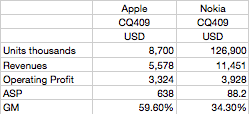
    Nokia regained top spot in operating profit. I'll leave net profit assumptions aside this time, but Apple is sure to have beat by having far lower R&D as percent of sales.

    Nokia Smartphones had a good quarter due to new launches. I show also share and ASP comparisons for smartphones in both companies.

  5. Sony Ericsson ships 14.6 million phones

    Research

    Sony Ericsson shipped 14.6 million phones at an average selling price of EUR120 in the fourth quarter, down from 24.2 million units at an average selling price of EUR121 a year before. Net sales fell to EUR1.75 billion from EUR2.91 billion, in line with market expectations.

    We will see next week, but by my reckoning, Apple sold more iPhones and iPod Touch units last quarter than Sony Ericsson sold of all its phones.

    The ASP is also likely to higher at maybe 400 EUR blended average, for a total sales of 6 Billion EUR vs. 1.75B for SE. That's more than 3x the sales level.

    Next year we might see >50% growth from Apple which would imply Apple overtaking Sony Ericsson in the phones market share race.

  6. Keeping it Real

    Research

    From the VP of marketing for the Limo Foundation:

    Growth within the siloed Apple ecosystem will actually stifle the grass-roots innovation

    It's interesting that this comment came on the day after Rob Glaser left Real Networks. Let's take a stroll down memory lane of Glaser quotes:

    (in 2003) “It’s absolutely clear now why five years from now, Apple will have 3 (percent) to 5 percent of the player market. … The history of the world is that hybridization yields better results.”

    “Apple’s (market) share will go down if they continue to do this. The only way to presently put songs on an iPod is to (buy) them from iTunes.”

    The (unforeseen) standard that emerged from the iPod is iTunes marketplace. It allowed Apple to establish itself as the premier and dominant merchant of all media including disruptive new media like apps. The iPod was "closed", "siloed" and "locked-in" users. But it worked and grew and grew to the point where it set the standard.

    The same arguments raised against the iPhone were raised against the iPod and Windows before it. Last I checked iPod had 70% share 9 years after the launch and Windows has 90% share 20 years after launch. iTunes sells more songs than any other retailer on the planet and more apps that anyone imagined possible.

    Perhaps this data bears repeating:

    • 140,000 apps - made by over 28,000 developers
    • Users downloaded an average of 3.7 apps each in December.
    • One Quarter of apps downloaded are paid. Average cost of $2.59/app.
    • Each iPhone user spends an average of $10/mo.
    • There are over 75 (est.) million active users
    • 200 million apps are being downloaded every month
    • $500 million in revenues each month. 70% to developers or $385 million

    All these numbers are increasing and accelerating. iPhone Platform Fastest Ecosystem Ramp in History.

  7. Google the Shopkeeper

    Research

    The Nexus One is an HTC branded and developed phone. The only thing that Google is doing (beside the software) is acting as retailer.

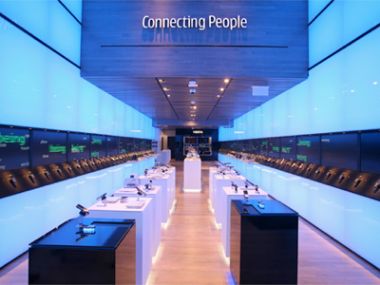
    Still don't see what the point is as a Web page does not make a very good retail experience for a phone. It reminds me of when the iPhone was launched, Apple's head of retail said that their stores were basically "built for this type of product".

    http://www.engadget.com/2010/01/05/googles-nexus-one-is-official/

    Om Malik Interviews Google’s Mobile Chief Andy Rubin

    Regarding Android partners like Verizon and Motorola being upset about the Nexus One:

    “People shouldn’t focus too much on the device (Nexus One),” said Rubin. “What’s more important is the strategy behind the devices.”

    John Gruber:

    Yes, what better way to get the press not to focus on a device than to hold a big press conference to announce a device, talk about how great it is, and give one away to everyone who attends?

  8. Is Android Disruptive?

    Research · 1 comment

    The common thread among the Android fans is that Google is the agent of disruption of a hated operator business model. Since disruption is well understood (though not by many) it is fairly easy to evaluate this hypothesis.

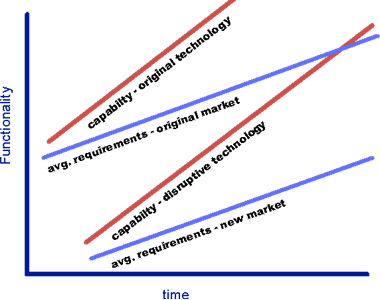
    The problem with disrupting network operators is that disruption can only happen when the underlying service/product they provide becomes "good enough" i.e. more than what customers can absorb. A new basis of competition emerges and we all know what happens.

    Here's the problem: since mobile broadband is by all accounts not good enough, it cannot be disrupted. Operators are very critical in building out this new mobile computing future and they are investing and will reap rewards. Bitpipe models will only emerge after 4G when there will be ubiquitous high speed networks and competition will shift away from coverage and more to price and convenience of plans.

    What is happening instead of operator disruption is that mobile voice which is more than good enough is being disrupted. Businesses built around mobile voice (e.g. handset vendors who have not developed a viable business model around data) will simply evaporate and their profits will condense around entrants who have mobile computing platforms.

    Google is moving on this opportunity but they are not executing in a way that ensures they control the future platform due to the their being on the wrong side of the modular/integrated dichotomy.

    Android will disrupt but I expect it will take 10 to 15 years. The life cycle of a new global network generation rollout is about 10 years. We're in the middle stage of the 3G cycle that traces its beginnings to early this decade. 4G will take another 10 years.

  9. Windows Marketplace for Mobile

    Research · 1 comment

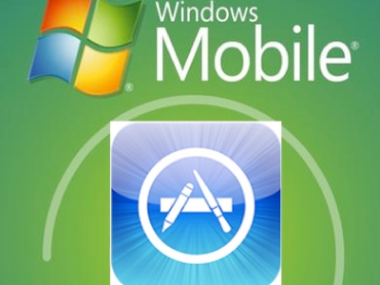
    One observer has posted that WMM (Microsoft's answer to iTunes App Store) has 520 apps in it now. The store launched in Nov 1 with 281 apps. That means there will be about 300 apps added in the first two months. The growth rate is therefore about 150/mo.

    This has to be the slowest growing app store among all the contenders, though Palm may also be similar.

    By way of comparison, iTunes App Store is growing at about 10k apps/mo. with Android about 3 to 5k/mo.

    How does this make sense coming from the company that is known for "developers, developers, developers" and is the largest software company in the world?

    http://msmobiles.com/news.php/8847.html

  10. Nokia shutters U.S. flagship stores

    Research · 1 comment

    In other news:

    • Nokia shutters flagship Regent Street store in face of Apple retail’s domination - December 08, 2009
    • Nokia sees flat market share as Apple gains - December 02, 2009
    • Nokia Chief Strategist: Apple will remain a niche player in smartphones, just like in computers - November 30, 2009
    • Nokia to cut another 330 R&D jobs - November 20, 2009
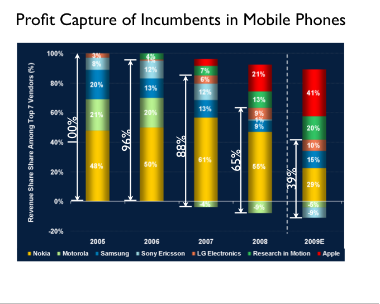
    • To understand market share vs. profits, look no further than Nokia vs. Apple - November 11, 2009
    • How Apple passed Nokia to become the world’s most profitable handset vendor - November 11, 2009
    • Strategy Analytics: Apple passes Nokia to become world’s most profitable handset vendor - November 10, 2009
    • Nokia sues Apple claiming iPhone infringement of Nokia GSM, UMTS and WLAN patents - October 22, 2009
    • Nokia posts loss of 559 million euros on weaker smartphone sales - October 15, 2009
    • Nokia’s earnings plummet 66 percent - July 17, 2009
    • Jim Cramer: The problem with Dell and Nokia is that no one wants their products; Buy Apple - July 17, 2009
    • Nokia’s failures vs. Apple’s vibrant iPhone platform puts market share at risk - June 24, 2009
    • Nokia Ovi Store launch a complete disaster - May 26, 2009
    • Nokia ships 19% fewer phones in Q1, bleeds more share - April 16, 2009
    • Nokia axes 1700 jobs worldwide - March 17, 2009
    • Nokia halts sale of iPhone killer; 5800 handset plagued with major problems - March 02, 2009
    • Nokia hops on bandwagon, unveils knockoffs of Apple’s iTunes Store, App Store - February 16, 2009
    • Nokia profit collapses 69% in fourth quarter 2008 - January 22, 2009
    • Nokia’s profits plummet 30 percent - October 16, 2008
    • Nokia’s fatally flawed ‘Comes With Music’ service no Apple ‘iTunes Store killer’ - October 03, 2008
    • Nokia fumbles iPhone lookalike-not-workalike launch in U.S. and Europe - October 02, 2008
    • Nokia sputters that iPhone ‘not worthy of discussion’ - August 13, 2008
    • Apple takes top spot from Nokia on AMR Research’s 2008 Supply Chain Top 25 list - May 30, 2008
    • Nokia shares slammed in wake of miss; Nokia CEO calls Apple iPhone ‘niche product’ - April 17, 2008
    • The knockoff parade continues: Nokia exec shows Apple iPhone lookalike ‘Tube’; dismisses Apple - April 08, 2008
    • Nokia previews blatant Apple iPhone knock-off (with video) - August 29, 2007
    • Nokia CEO challenges Apple over iPhone - February 13, 2007

    http://www.macdailynews.com/index.php/weblog/comments/nokia_shutters_us_flagship_stores_as_floundering_cellphone_maker_fails/