Symbian will lose smartphone battle By Rob Jones at Gartner Symposium ITxpo, Cannes [07-11-2003] Microsoft's standardised handsets will win the day, says Gartner
Analyst Gartner has warned that, without a concerted effort by Symbian and its backers, Microsoft will sweep them aside in the smartphone business.
Redmond's ability to offer standardised handsets which are easier for businesses to support and use will help the software giant win corporate approval, the market watcher predicted.
The analyst predicted that Microsoft will ship a phone boasting strong integration of a range of packages, such as Exchange and Outlook.
Symbian, he added, needed to resolve a number of issues to be a credible, corporate alternative. Its platform and menus differ slightly on various handsets, which means that they often do not have the same user interface.
So spoke Nick Jones, vice president and research fellow at Gartner in 2003.
The mobile operating system formerly known as “Pocket PC 2000/2002, Pocket PC 2000/2002 Phone Edition, Smartphone 2002, Windows Mobile (2003/5.0) for Pocket PC, Windows Mobile (2003/SE/5.0) for Pocket PC Phone Edition, Windows Mobile (2003/SE/5.0) for Smartphone, Windows Mobile 6[.1/.5] Professional/Classic/Standard” will now be known as Windows Phone Classic.
The last “Classic” nomenclature lasted from Windows Mobile 6 Classic to Windows Mobile 6.1 Classic and denoted the OS for Microsoft’s PDAs. It disappeared after version 6.5.
Windows Phone Classic will co-exist with Windows Phone 7 Series.
What are we to make of the new Windows Phone 7 Series?
First, we have to distinguish it as a new platform. Let’s use Microsoft’s new naming conventions and call it “WP7S” as distinct from the current Windows Mobile 6.5 aka “WinMo”.
Steve Ballmer said they will continue to “invest” in WinMo presumably in parallel to the WP7S platform. This is an interesting development since although there might be some interoperability of applications, the new platform will likely have a new set of APIs.
What strikes a follower of the WinMo platform is that the new WP7S is orthogonal in its positioning. Whereas WinMo was for either hard core, ROM burning, .cab-editing geeks, or for corporate suits, the new WP7S is going for the Xbox, Facebook ADHD hipster user. Perhaps Microsoft is also going for the “average” user though that did not come through the presentations.
So these two constituencies (geek vs. socialite) are quite distinct and a product that pleases one won’t please the other. Evidence of this is the fact that many existing users are feeling dejected over the absence of true multi-tasking, the locked memory cards, the lack of compatibility with the old UI and apps, and the overall “dumbing down” of what they thought was a haven of nerdiness in a sea of iPhone hype.
If Microsoft pours more resources into the new WP7S at the expense of the WinMo platform then we can assume they are “firing” their loyal geek users. Frankly, they are a difficult set of customers whose advice tends to steer a product into ever-more complexity and over-service.
This sets up a potential schism repelling the geek set toward Android and the corporate set perhaps sliding toward iPhone.
That would leave Microsoft in a quixotic pursuit of iPhone users without the benefit of an ecosystem.
Three new ambitious platforms starting with zero installed bases and no applications are going up against the following:
Symbian with more than 200 million users and 20k apps
WebOS with less than 3 million users and about 1k apps
Windows Mobile with 30 million users and about 2k apps
iPhone OS, about 75 million users and 150k apps
Android with 3 to 5 million users and approx. 20k apps
Blackberry OS with more than 50 million users and a few thousand apps.
It should be noted that Microsoft’s new Windows Phone “7 Series” will compete with Microsoft’s Windows Mobile 6.5 which will continue as a product line.
MeeGo will also compete with Nokia’s existing Symbian OS for developers, replacing Maemo.
Most of these new platforms will not have products shipping for at least 6 months during which time another 50 million (at least) new users will join existing ecosystems.
There are now nine smartphone platforms, but who’s counting? I’ve been hearing predictions of consolidation for years and although platforms have come and gone (PalmOS, SavaJe), the total number continues to increase.
If nothing else, this seems to indicate that the industry is not in any state of maturity or point of “over-service” where commoditization takes place.
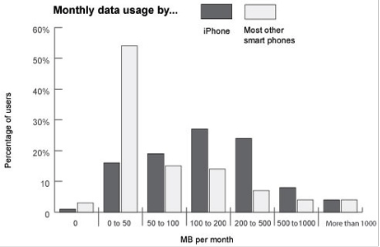
Consumer Reports announced this week the results of a study it commissioned assessing the monthly data usage for customers of Apple's iPhone and other smartphones. The data reveals:
On average, iPhone users consume 273 MBs of data per month. That compares with 54 MBs for consumer users of Blackberrys and 150 MBs for consumers who use other brands of smart phones, the Validas study found.
The disparity in data usage is particularly evident at low levels, where 80% of BlackBerry and 54% of "other" smartphone users consume less than 50 MB of data per month while only less than 20% of iPhone users maintain such low usage.
As I argued in the past, Blackberries should be considered feature phones. Doing so helps to understand both their limitations and their potential.
This categorization helps put into perspective the phenomenal growth RIM is able to maintain while not being at all competitive with other platforms by any measure of performance that defines the basis of competition in smartphones.
Being a feature phone means the Blackberry just needs to be better than a dumb phone, something it’s more than able to demonstrate to a prospective buyer.
When I heard about Android being positioned against the iPhone, I thought about how that decision must have been justified internally at Google. I wondered how Andy Rubin added up the benefits of his product vs. the risks of losing whatever value Google derived from the iPhone.
On the benefits side, Android’s original business plan called for zero direct revenues with indirect revenues from search. The actual value would be somewhat dubious during the half decade it will take to get a significant installed base. Of course, with the Google-as-retailer model, Android can also be justified as earning some margin from devices, but as we’ve seen, these numbers don’t add up to much.
On the risk side there is the potential loss of the screen real estate on the iPhone (see photo above). Being the default search engine in mobile Safari might be worth hundreds of millions to Google.
Silicon Alley Insider reports a rumor that Apple's current deal with Google to provide default search functionality for the iPhone is currently worth over $100 million per year to Apple in revenue sharing.
So the iPhone may be a bigger money maker for Google than Android will, at least for a long time.
Which begs the question of whether by picking a fight with Apple, Android is biting the hand that feeds it.
If there is any logic to this Android adventure it might be that Google really feels it needs to have an option on the future mobile computing platform and that Android is worth the risk of losing placement on the iPhone.
I, for one, don’t think this is a risk worth taking.
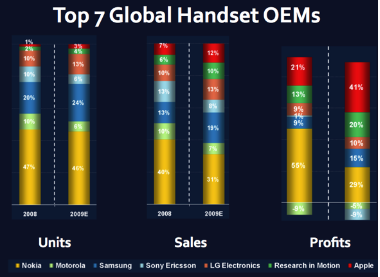
I calibrate my growth rates on the assumption that Apple will overtake the combined share of the two money-losing handset vendors.
Sony Ericsson and Motorola are the weakest competitors in terms of portfolio and competence with software. Their sales, units and profits shares for 2008/2009 are shown in the graph above (source: Morgan Stanley).
Therefore, my thesis is that Apple could beat these two weakest competitors in 3 more years.
Here is the basic top-down view:
In 2009 174 million smartphones were sold out of a total of 1.13 billion phones (IDC, Strategy Analytics). Using a 10% CAGR on this figure gives 1.65 billion phones in 2013
Apple obtained 2.1% share in 2009 and about 1.5% share in 2008. My forecast share for Apple:
2010: 3%
2011: 4.1%
2012: 5.5%
2013: 7.5%
During the last quarter, Sony Ericsson held 4.5% share and Motorola 3.7% therefore my 2013 target for Apple is a little less than the sum of what these two hold today.
This results in unit sales for Apple of 125 million units for 2013 and a compound annual growth rate of 50% a year.
Google sold about 80,000 Nexus One smart phones in their first month on the market, according research firm Flurry,Dow Jones Newswires reports.
By contrast, Apple sold about 600,000 iPhones when it launched the device in 2007, the story notes; the Motorola Droid sold 525,000 in the first month, according to Flurry.
Flurry estimates sales by measuring mobile applications usage and then extrapolating overall ownership.
Andy Rubin, head of Android said they hoped to sell 150k units, so this would be a very good start for the brand.
I would also like to estimate the revenue that Google probably earned from this phone so far. Assuming HTC receives a gross margin of 35% and the bill of materials is $174, then Google would have a gross income from the device of about $270/unit (based on $529 price).
Google could still have to pay for shipping, returns, warranties, etc. so their income might be closer to $220.
The income before operating expenses would therefore be $17.5 million in the first month.
I should point out that this would be the first income Android has ever received as the software is available free of charge.
I knew of Dick Brass at the time when he was promoting ClearType inside Microsoft. We met his team to consider licensing our table recognition algorithms for the production of ebooks for Microsoft Reader, an early ebook reading solution for the PocketPC. It was then I learned about plans for “reading solutions” from Microsoft, almost 10 years ago.
Now he writes about the tragedy of Microsoft’s complete absence from the future of mobile computing.
"...why Microsoft, America’s most famous and prosperous technology company, no longer brings us the future, whether it’s tablet computers like the iPad, e-books like Amazon’s Kindle, smartphones like the BlackBerry and iPhone, search engines like Google, digital music systems like iPod and iTunes or popular Web services like Facebook and Twitter."
Part of the answer, Brass writes, is that Microsoft put too much faith in aggressive managers (like himself) who nurtured a culture of conflict. But mostly, he says, it's because of inter-departmental bullying by Microsoft's established divisions and a "dysfunctional" corporate culture that thwarts innovation.
To support his contention, he offers a couple of telling anecdotes in which he does everything but name names:
Microsoft's ClearType display technology languished in the lab for years, he says, because engineers in the Windows group "falsely claimed" it made the display go haywire, the head of Office products said it was fuzzy and gave him headaches, and the vice president for pocket devices was said he’d support ClearType only if Brass transferred the programmers to his control.
In 2001, the vice president in charge of Microsoft Office refused to modify Word, Excel and Outlook to work properly with Brass' tablet. Result: "if you wanted to enter a number into a spreadsheet or correct a word in an e-mail message, you had to write it in a special pop-up box, which then transferred the information to Office. Annoying, clumsy and slow... To this day, you still can’t use Office directly on a Tablet PC. And despite the certainty that an Apple tablet was coming this year, the tablet group at Microsoft was eliminated."
Brass believes that the intense, sometimes cut-throat, internal competition that Bill Gates fostered among his managers has devolved into something uncontrolled and destructive: "The big established groups are allowed to prey upon emerging teams, belittle their efforts, compete unfairly against them for resources, and over time hector them out of existence."
He also gives a nod to the modular/integrated dichotomy to which we are always pointing accusing fingers:
“Part of the problem is a historic preference to develop (highly profitable) software without undertaking (highly risky) hardware. This made economic sense when the company was founded in 1975, but now makes it far more difficult to create tightly integrated, beautifully designed products like an iPhone or TiVo. “
"It’s not an accident," he writes, "that almost all the executives in charge of Microsoft’s music, e-books, phone, online, search and tablet efforts over the past decade have left."
HTC is the world’s fourth largest smartphone company. It ships 80% of all Windows Mobile and probably a similar proportion of Android devices. Like Microsoft in 2003, Google turned to HTC for its first smartphone, the G1 and its latest, the co-branded Nexus One. The company shipped a total of 11.7 million mobile phones in 2009.
It would appear that HTC is very well positioned in what amounts to be the best industry in technology.
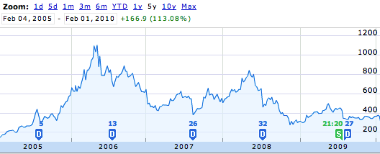
However, not all is well. A few days ago HTC issued revenue guidance below analyst estimates and its stock price is at 2005 levels, 70% off its peak (see graph--source: Google finance).
Part of this could be explained by its continuing reliance on Windows Mobile which is fading fast, but also it’s because, as management acknowledged, there is significant price pressure.
HTC prides itself with having a “premier” product with typically high-end feature sets and positioning. HTC invested in its own UI to differentiate its products and has mounted a branding campaign to move away from being a white-label ODM.
It seems all for nought. The rules of the smartphone market do not favor modular component players. As HTC does not front its own OS, it still struggles to stand out in the eyes of the consumer.
Looking at the list of top 3 vendors: Nokia, RIM and Apple, we see hardware companies that field an integrated OS/service bundle.