Asymco

Asymmetric Intelligence

Android

  1. Gartner's Nick Jones on Symbian: Abandon ship

    Research · 2 comments

    Market share is an existential threat to Symbian, it imperils the very existence of the platform. And the main reason Symbian is losing share is the user experience which isn’t competitive with Apple or Android. Based on the early previews I’ve seen Symbian 3 looks to have polished a few of the rough edges, but doesn’t fix the problem. So if the weak UI is threatening Symbian’s very survival the Foundation ought to be seriously worried, right? Wrong. I just looked on the Foundation web site and blogs at the roadmap and features for future releases. What I see is too much effort on stuff that really doesn’t matter. For example: Audio policy packages for Symbian, WIFi direct, support for an “open cloud manifesto”, an accredited Symbian developer program for China, better multitasking, multiple personalised home screens, HDMI connection to external TVs, better web runtime support, better internal architecture and so on.

    Forget elegant architecture, forget better multitasking, forget Chinese developers, forget release schedules that don’t deliver S4 devices with a new user experience until 2011. None of these matter. People will never use the features if they don’t buy the phone. The situation is now serious enough that any developer who isn’t working on something directly related to a new UI is wasting their time. The S4 UI is a “bet the platform” project. For any organisation to be in a situation where its survival depends on one project is very dangerous, especially when their track record in the area isn’t outstanding. I think the Foundation needs a contingency plan in case the planned S4 interface isn’t radical enough or good enough. Maybe redirect some developers and start a couple of skunkworks projects to create new competing UIs for S4, or perhaps announce a competition with a $1M prize for a new Symbian UI to encourage some radical ideas.

    I think the Symbian foundation is just re-arranging the deck chairs on the Titanic and ignoring the Android iceberg ahead.
  2. Android is a BlackBerry killer

    Research · 2 comments

    Much has been made of the potential for Android to reduce the growth of iPhone. The iPhone seems to be doing very well and continuing to be supply rather than demand constrained.

    RIM however seems to be under significant pressure.  A Goldman Sachs analyst first pointed this out in her last report and placed a "Sell" on RIMM.  The fact is that most of RIM's sales are in the US on the carriers other than AT&T.  In those very same carriers, Android is being pushed hard as a customer retention strategy, so iPhone is pressuring RIM only indirectly through Android.

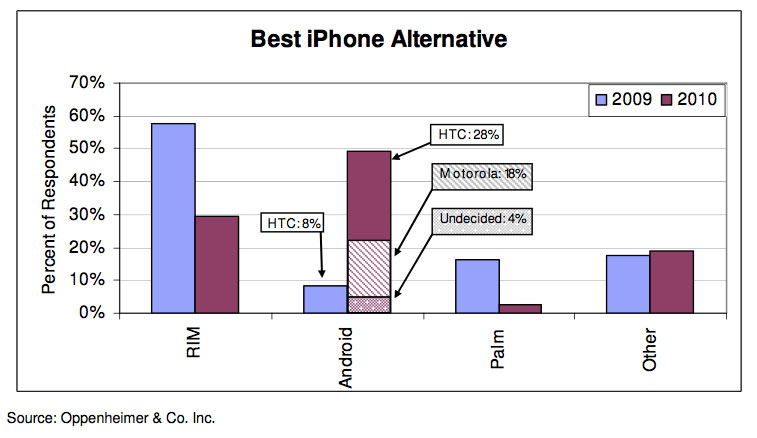
    The evidence is also in survey data.  In the graph below, we see how iPhone buyers are considering Android as the most credible alternative to the iPhone whereas they considered BlackBerry the best alternative a year ago.  In terms of vendors, what RIM lost HTC gained.

    One can only wonder what will happen when the iPhone enters unrestricted distribution in the US.  The results in other markets speak for themselves.

    AppleInsider | Apple's recurring revenue stream: 77% of iPhone 4 sales were upgrades.

  3. RIMM near 52 week low

    Research · 1 comment

    RIMM shares dropped more than 5% after hours after company reported "light" units and a 20% rise in profit with a 24% rise in revenue.

    RIMM sold 11.2 million units (of which 4.9 million were new subscribers and the rest replacement units--a deterioration in replacement rate). This represents 43% growth. The unit growth is nearly double the revenue rise implying a lower ASP ($300--half the iPhone) and margin (45.4%).

    RIM passed another milestone: 100 millionth BlackBerry was sold during the quarter. We've noted before that Apple will also pass its 100 millionth iOS device this month. RIM sold 20 million units as of October 2007, right on the heels of the iPhone launch. That means that iOS grew 100 million to BlackBerry OS growing 80 million in the same time frame.

    So why are shares at a P/E of 13? 20% EPS growth would be respectable numbers, but the smartphone market is growing faster than that. The implication is that RIMM is losing share and everyone is expecting that loss to accelerate.

    Simona Jankowski from Goldman Sachs repeats her Sell rating. “RIM has now missed top-line expectations for three of the last four quarters, in our view demonstrating the building competitive pressures on its business from the iPhone and more recently from Android,” she writes. “We estimate that net subscriber additions in North America declined on a sequential basis, which we attribute primarily to the success of Android-based phones, such as the Motorola Droid and the HTC Incredible at Verizon.”

    Research In Motion Limited (USA): NASDAQ:RIMM quotes & news - Google Finance.

  4. iPhone takes share from RIM, Android takes share from Windows Mobile

    Research

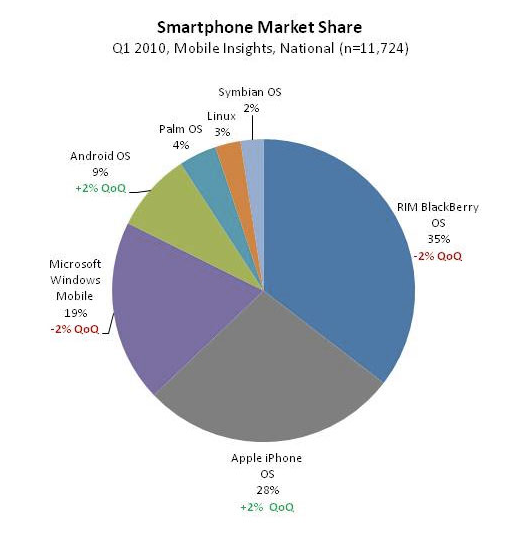
    Data tracking firm Nielsen Co.’s quarterly survey found that, in the U.S. the iPhone added two percentage points for a 28% market share in the three months ended in late March compared to the previous quarter. RIM still had the biggest market share at 35% but it lost two percentage points in that period.

    Phones that run on Google Inc.’s Android operating system also gained two percentage points for a market share of 9% over the same period, while Microsoft Corp.’s Windows Mobile phones lost two percentage points for a 19% share.

    via Appetite for IPhone Continues Undiminished - Digits - WSJ.

    Although Android is often considered in competition with the iPhone, as we've shown in the past, the two are seldom competing for the same purchase decision.  From a distribution and business model point of view, the platforms are mostly non-overlapping.

    The installed base data above shows that in their respective areas of competition: in the US, with the current operator channel, the iPhone is taking share from a similarly positioned platform (RIM) while Android is taking share from a similarly licensed alternative (Windows Mobile).

  5. Deagol: iPad web usage 20x iPod

    Research

    So my prediction from six and a half weeks ago came through, with a couple of days to spare. iPad has surpassed iPod in web traffic. It took only two months and two million units, compared to almost 3 years and about 40 million iPod touches out there. That means iPads use the web roughly 20 times as much as iPod touches.

    Also, not only has iPad more than doubled Android 2.1's share, it's now past all Android OS's combined. .

    via Deagol's AAPL Model: iPad web usage passes iPod.

    Good call.

  6. IDC: I Dream of Claim Chowder

    Research · 3 comments

    A few eyebrows were raised when Microsoft presented a slide at a French event where they made the claim that 30 Million Windows Phone devices would be sold by the end of 2011.  Given that the first Windows Phone won't ship until October 2010 at the earliest, or, according to Mr. Ballmer, "by Christmas," count me among the skeptics.

    However, the claim was later retracted by Microsoft stating that they mis-quoted IDC, the original source for the forecast.  The correction was perhaps meant to put an end to the credibility crisis.

    However, the actual forecast from IDC was even more preposterous. Apparently IDC makes the forecast that 32 million "Windows Mobile" devices will sell during all of 2011--a combination of both Windows Mobile and Windows Phone devices.

    Instead, the research company forecast 2011 sales of 32 million devices running all Windows Mobile operating systems. This includes expected sales of devices with Windows Mobile 6.5, which is already on the market. IDC has not given any sales estimate for Windows Phone 7, which Microsoft has said will be available in the fourth quarter.

    Their report showed about 16 million Windows Mobile devices shipped in 2009, with a forecast of 22 million this year and 32 million next year.

    Windows Mobile shipped a total of 3.7 million phones in 1Q10, so in order to reach 22 million this year they need to ship 18.3 million for the rest of the year or, on average, 6.1 million phones a quarter.  That's a higher number than what Android shipped in Q1 with BOGO promotions (5.2m units). That's almost as high as the launch quarter for the iPhone 3G.  And all this (mostly) with WinMo 6.5!

    Alternatively perhaps IDC foresees a huge launch for Windows Phone. Assuming an erosion of the WM6.5 to 2.7 m this quarter, 2 million in Q3 and 2 million in Q4, then Windows Phone would somehow need to ship 12 million units during the last quarter.  This number is higher than what iPhone sold in its highest ever quarter.

    This sounds sillier than 30 million Windows Phones in 2011.  By claiming that Microsoft's combination of deprecated Windows Mobile (6.5) and unreleased Windows Phone 7 will continue to sell at a growth of 38% this year, they are actually suggesting an acceleration in sales going into the second half at a rate higher than what the market is likely to grow at.

    In other words, they are suggesting that Microsoft will gain share during the rest of this year. Share gains for a platform that has declined in share in Q1 from 10.2% to 6.8% with 3.7 million units sold on the back of further share losses the quarter prior. Share gains against Android that competes with a free license. Share gains with a new platform that has no clear differentiation vs. the iPhone.

  7. At 135 devices, the Android army marches on but what happened to the Windows Mobile legions?

    Research · 2 comments

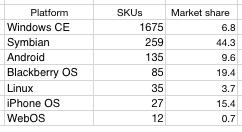
    The number of Android devices is rising steadily; it's already up to 135.  Android devotees should rightly rejoice.  However, Android is not the first mobile platform with an open licensing strategy. A quick visit to pdadb.net lets us count the number of devices that shipped for every mobile platform in history.  We can also see the current market shares as listed by Gartner for these platforms.

    The numbers of SKUs (stock keeping units) that have shipped historically vs. the market shares of the mobile phones running those platforms are (see Footnote below for some caveats):

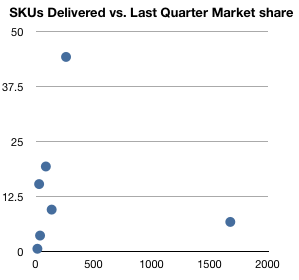
    The same data in a scatter plot:

    (SKUs on the x-axis and share on the y-axis)

    The thing that jumps out is how uncorrelated the two quantities are.  The Windows Mobile/CE number is such an outlier that it breaks any attempt to link the two variables.

    What's likely to happen is that since the licensing of Android is even less problematic than it was for WinCE (i.e. it's both free as in beer and free as in speech) the number of Android SKUs is likely to overtake WinCE.  In other words, we're very likely to see Android grow from hundreds to thousands SKUs.

    However, the real question for the Android platform isn't whether it will have licensees. WinCE proved that there is vast demand from many companies to build cloned and undifferentiated devices. The real challenge is whether Android can achieve significant volumes without fragmentation to keep the platform/network effect going.

    The WinCE platform was actually less fragmented through its life than Android is today. This is understandable since the source code was decidedly not open and thus not modifiable and new versions were released far less frequently. And even with a high price tag, it was wildly popular with licensees. Nevertheless, the volumes never came and Microsoft was forced to abandoned the whole strategy.  The next version of Windows Mobile (Windows Phone 7) will follow an "iPhone lite" model of highly restricted configurations and device and ecosystem specification.

    So will Android follow the fate of Windows Mobile with an even more fragmented, bazaar-like licensing model? Or will thousands of undifferentiated Android devices swamp their integrated competitors?

    Footnote: The total SKU number includes non-cellular devices whereas the market share number includes only cellular devices. Omitting non-cellular devices will not detract from the pattern or change the correlation meaningfully.  The argument can also be made that the "platform" value lies in both cellular and non-cellular devices (e.g. iPad) and they should both be counted.  Unfortunately there are no market share statistics that blend both device types into one market.

  8. Global smart phone OS shares (part II)

    Research

    On May 5th, I tried to fill in the blanks on Global smart phone OS shares | Asymco. I estimated that the shares for the mobile OS's were as follows (based on Canalys partial data):

    • Symbian (Nokia): 42%
    • Blackberry OS (RIM): 19%
    • iPhone OS (Apple): 16%
    • WinMo (Microsoft): 10%
    • Android (Google): 10%
    • WebOS (Palm): 2%

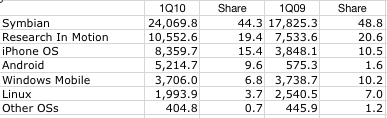
    Now Gartner has published their sell-through estimates:

    • Symbian (Nokia):: 44%
    • Blackberry OS (RIM): 19%
    • iPhone OS (Apple): 15%
    • Android (Google): 10%
    • WinMo (Microsoft): 7%
    • Linux: 4%
    • Other OSs: 1%

    My estimates were within 1 or 2 percent of actuals except for Windows Mobile where I over-estimated by 300 basis points.

    The analysis of Android vs. iPhone market shares (globally and within the US) which depended on this estimation does not change materially.

    The complete data from Gartner follows:

  9. Visualizing iPhone vs Android Shares

    Research · 1 comment

    Following up on my last post on how misleading US-only share comparisons can be, I decided to draw charts to visualize the comparison.

    As Android and iPhone compete in various ways, it's hard to see which is the preferred choice given a direct comparison.  In other words, iPhone and Android devices rarely are placed next to each other with similar terms.

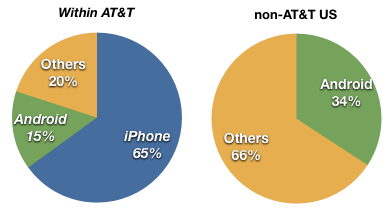
    Take the US market for example.  The overall data from NPD suggests that last quarter Android reached 28% share vs. 21% for iPhone.  Many of those Android devices were new to market or at least newer than the iPhone which in Q1 was coming to the end of its product cycle.  Second, pricing for Android devices seems to have been quite aggressive with buy one get one free sales.  But I won't dwell on tactics now; what I do want to note are the differences in share between AT&T users and non-AT&T.

    Note that within AT&T, iPhone outsells Android over 4 to 1.  iPhone also outsells "others" (mainly RIM) more than 3 to 1.  However, outside AT&T, where the iPhone is not available, Android does not outsell "others".

    If we exclude the US altogether, we also see that Android does not have a great distribution.

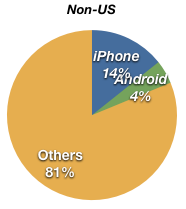
    Outside the US, the iPhone also outsells Android nearly 4 to 1, but it has a way to go before challenging Symbian which makes up the bulk of "Others".

    So in markets where Android is head-to-head with the iPhone (AT&T and non-US markets), iPhone's lead is quite high (still).  The possibility still exists that Android will overtake iPhone given the broad licensing and distribution, but it's not necessarily a given.  And in any case, iPhone is not the market share leader today and that leadership does not seem to be their objective (note the pricing).

    The bigger question is what will happen to RIM and Symbian as Android grows.

  10. NPD: iPhone is 65 percent of AT&T's smartphone volume

    Research · 4 comments

    Much ink is being spilled over Android outselling the iPhone in the US in Q1.  Here's what NPD survey data shows:

    • Q1 units for Android reached 28% vs. iPhone at 21%.
    • AT&T stated that they activated 2.7 million iPhones.  That is 31% of all iPhones sold by Apple.  Assuming NPD data is accurate, we can conclude that Android shipped 3.6 million units in the US or 65% of their total.
    • In a previous posting (Global smart phone OS shares « Asymco) I estimated, based on Canalys estimates, that global Android share reached 10% last quarter or about 5.5 million.
    • We can compute that Android captured only 4% of smartphone share outside the US while Apple obtained 14% share.
    • You can also observe that iPhone's US share increased y/y while every other platform except Android dropped (implying that Android took share from everybody but Apple.)
    • NPD claims AT&T accounted for 32% of the smartphone market, and even though AT&T carried both Android and WinMo and Blackberry devices, 21 out of every 32 phones or 65% of AT&T's volume were iPhones.
    • We can conclude that Android captured 34% of the non-AT&T US smartphone market.

    The table below combines the NPD, AT&T, and Canalys data to show units for iPhone and Android in the US, Global and non-US regions.

    One can only wonder what would happen if iPhone would be available non-exclusively.  Would iPhone achieve greater than 60% share as it did on AT&T?  Certainly that's what happened in France.