Recording and transcript of the June 9, 2026 Asymco One Office Hours, recorded the day after Apple's WWDC 2026 keynote. Horace Dediu shares his impressions of the event and takes questions from Asymco One subscribers.
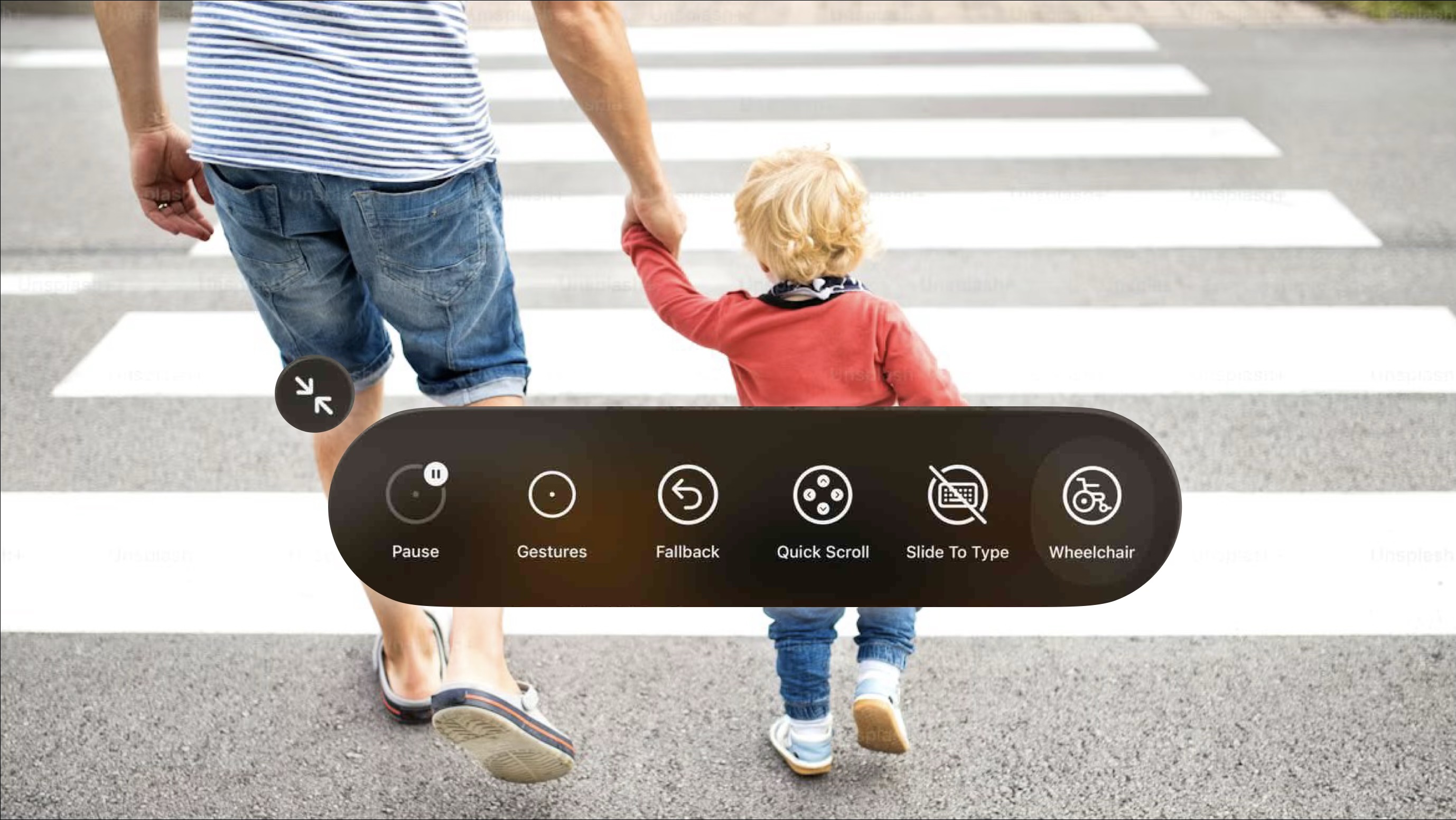
Apple announced new features for users to control power wheelchairs with Apple Vision Pro using their eyes. A new power wheelchair control feature leverages the precision eye-tracking system on Apple Vision Pro to offer a responsive input method for compatible alternative drive systems.
Also announced is on-device speech recognition whereby subtitles are generated privately and appear automatically for uncaptioned videos on iPhone, iPad, Mac, Apple TV, and Apple Vision Pro.
Moreover, Vehicle Motion Cues come to visionOS, which can help reduce motion sickness for people who use Apple Vision Pro as a passenger in a moving vehicle. Vision Pro will also support face gestures for performing taps and system actions, plus a new way to select elements with one’s eyes while using Dwell Control.
“The option to control my power wheelchair on my own is gold to me,” said Pat Dolan, founder of GeoALS and a member of Team Gleason’s patient advisory board, who has lived with ALS for 10 years. “With this new feature, Apple is developing life-enhancing technology for the people who need it most.”
NB: We have not yet arrived at WWDC yet Apple unveils huge new accessibility features powered by Apple Intelligence and reveals Vision Pro functions that will change lives. The Vision Pro remains the most remarkable machine I've ever seen or heard of. It is S tier.
An Office Hours question asked by Darcy B., May 1, 2026
Q: Will Apple do more in transportation than CarPlay Ultra? Not just cars — transportation in general.
Well, there's a lot of modes out there, and I apologize I didn't get into all of them. I had assumed falsely — I think way outside of cars myself, obviously, but it's very rare that others do. My bad that I kind of assumed that. But the answer doesn't change. I don't think Apple will do much in mobility. The reason being — first of all, cars are a lousy business. They are, were, and will be a lousy business forever. Maybe to won't even exist very long. I just find it shocking, that it continues to exist today.
But the problem is that the other modes are less of a surface for Apple to add value to. In other words, there isn't a lot of design surface on which you can put your design and your ideas. And the reason for the surface problem is that, first, there's modes that are public and shared — buses and public transport, even airplanes. You could imagine, for example, having the back of the seat in front of you be an iPad. Why is it this screen on the plane one you can never comprehend? But you try to figure that [business] out, and you realize it's a dead end. You just can't serve that market as Apple. So there's that design surface in airplanes — you've got the seat back.
Then you look at other modes, and you look at micromobility. The problem with micromobility is the surface is below your sight line when you're using it. You're looking above typically where the vehicle is. I consider it a heads-up experience, not a heads-down experience. Cars are heads down and becoming more so. They're cocooning the user in a bubble for an hour a day. That's what can be tolerated, typically. Not a great idea. Why? Because an hour is not a significant amount of time that will separate that experience outside of the phone.
Now, if you're looking at micro, the problem there is that it's a heads-up experience. And unless it's going to be through a wearable — that was my dream for the Vision Pro two, three years ago, was that it would be usable as — even integrated into a helmet. And then you have a visor coming, and then you have a beautiful design surface. In fact, the design surface is the entire world. Because as you see it, whatever you're looking at can be considered a surface upon which you can add a new reality [and new services].
And that is a dream and vision, that if it were to happen, not only would Apple be a very, very interesting player to create a virtual world on top of existing worlds — outdoor experiences. That's a great, great opportunity. Spatial computing outside of the home. Just put that down as the summary — spatial experiences outside the interior spaces. When that happens, it'll be very exciting. It'll be very much Apple's contribution to repaint the world.
But it takes time, and this is where we're stuck. We're stuck in this, like, not good enough, not small enough, not light enough, not powerful enough — all those things. And if they get solved, we'll move into that world.
And that goes back to a lot of debates about whether the Vision Pro is or just not going to continue. I definitely think it's going to continue. Even the latest comments from John and Joz, together, saying — the phrase they used was, "we pulled this from the future into the present." So they are effectively stating that it's too early. It's a future that hasn't come yet. But they're proud of what they achieved, and it is amazing what they've demonstrated is possible.
It's not the old Apple, though. Old Steve Apple was: you don't release until it's not just market ready, but mass market ready. And that was a risk. Maybe this was another thing that Tim did that was not what John would do. But to work on this problem is exactly what John would do, because solving spatial computing is, like, more important in my mind, because it is the human-computer interface. Which is essentially the physical layer of the entire world. That reconstruction of the physical world and broadcasting it into your retina is the future. It's not audio. It's not some background thing. It has to go through the eyes. And if it goes through the eyes, it's where Apple wants to be.
So I do believe there's going to be a lot of research to be done there. And maybe it'll still take a couple years once the AI thing runs its course.
This was one of the questions asked by the participants in Asymco's May 2026 Office Hours live Q&A sessions, open to Asymco One subscribers.
Takeshi Narabe On the secret of Apple's success, you have previously noted that the key to Apple's success was its ability to integrate hardware, software, and services to create products that are perfectly hired for a specific job to be done. You also highlighted how they moved beyond mere devices to lock customers into an ecosystem like iOS, iCloud and Apple stores. So this analysis is now very well known. So do you still think this is one of the biggest reasons of Apple's success?
Horace Dediu Yes, we have to recognize Services has only been a story for the last 10 years. And arguably integration of software hasn't been really all that important before 1998 when Apple brought Steve [Jobs] back and with him came NextStep, which was [an] operating system based on Unix. And that was much more robust and much more focused around software engineering than the original MacOS. Or, what I would say [constituted] version 1 of Apple, which began in 1970s until the 1990s.
Most people tend to think of Apple as one continuous story for 50 years. [But] it's at least two major stories. I would say pre-98 and post-98. And post-98, it's been so different. And it's much more, I would say, something [that can be studied] as a theory.
I think in the first decades Apple was more, let's say, a story of people. There were people who were brilliant. There were people who were celebrated [as they are] now. But the second half of Apple is much more about building a business that has longevity, [that] can last a long time. It's an unusual priority.
I think for many companies in the world, they don't think about longevity. And that is why, even Tim Cook recognizes that it's the next 50 years that are more important [than the last 50 years]. So thinking about a century is really important and I think [that] is core to the current culture of Apple. Now, of course, this means, as you said, integration, and that is one of the key things. But fundamentally, beneath all that, there's this point about culture.
Takeshi Narabe Culture?
Horace Dediu Culture in the sense of what are the priorities? What do we concentrate on and to what degree do we need to focus? They [management] repeat these things all the time. Focus, focus. What means this? It means saying no to many things, but it also means saying yes to the things where you can bring great things to bear. It's where Apple has a unique advantage. And that means saying no to a lot of things.
We know about the car business that they eventually rejected even though they worked on it for many years. I think ultimately that decision was based on a realization that they couldn't bring enough contribution. And that's not just an economic decision. Of course they could have made money. There are even phone companies in China that make cars today. But it isn't what they thought of as important.
Takeshi Narabe All right, thank you. So you also mentioned to what extent do you attribute Apple's dominance to the ability to tap into non-consumption addressing latent demands that consumers themselves hadn't yet realized.
Horace Dediu So this is also one of the keys indeed. i learned about this by listening to my professor Clayton Christensen, who observed that great companies not only compete effectively, but they also create their own markets. They create their own demand.
[It's an] Extraordinary idea. And when you look at Apple, you do see that they use a different language. They talk about customers not asking for the product. But they also fundamentally build something that compels the user to buy it. When it was something that wasn't conceivable. Steve Jobs famously said, the customer hires us to find out what they want. So this is a fundamental thing.
And there are many examples. And I think one of the struggles today, for example, is Vision Pro, a product that is very difficult to find how it's going to solve problems. But at the same time, it's an extraordinary product. I think the jury is still out on the Vision Pro, but there are many other examples where I think initially they thought things would go in one direction and they went in another direction.
But even the iPhone, I like to repeat the fact that when the iPhone was introduced, Steve Jobs said it was three things. That it was a widescreen iPod, that it was an internet communicator, and it was a phone. But I point out that these days, those three jobs of being a music player, being a telephone, and being a browser, are not among the most popular things people do with it.
So it's fascinating how they introduced it as a blank slate. [It was] software, written by third parties [that discovered the compelling uses], and it developed in its own ecosystem. That is also a very interesting lesson there.
But it is fundamentally about really being humble. I think, again, it's a cultural trait, being humble and saying, maybe we don't know fully what to do, but to concentrate on quality and concentrate on doing at least something useful for people. And then later, new things will appear.
— This is the first part of a series of excerpts from an interview with Asahi Shimbun newspaper on Apple & Innovation.
AI is attracting all the attention but one should be careful because if there is one thing about technology is that timing is everything and when attention is concentrated it signals that time is distorted.
In a recent interview Apple management was asked about AI, which is perceived as an area where Apple has been struggling. Greg Joswiak replied:
We've been doing things with intelligence for many years, right? And gen AI allows us an opportunity to do that even more. So I'm excited about that, but boy, this is not a sprint. This is a marathon, right? We're going to be doing stuff with intelligence for decades, not months or years.
He also declined to comment on smart glasses, but said we're in the "early innings of spatial computing," while Ternus said that combining the digital and physical world is an "inevitability." The two were tight-lipped about any upcoming Apple products, but Joswiak said Apple is "working on some pretty cool stuff."
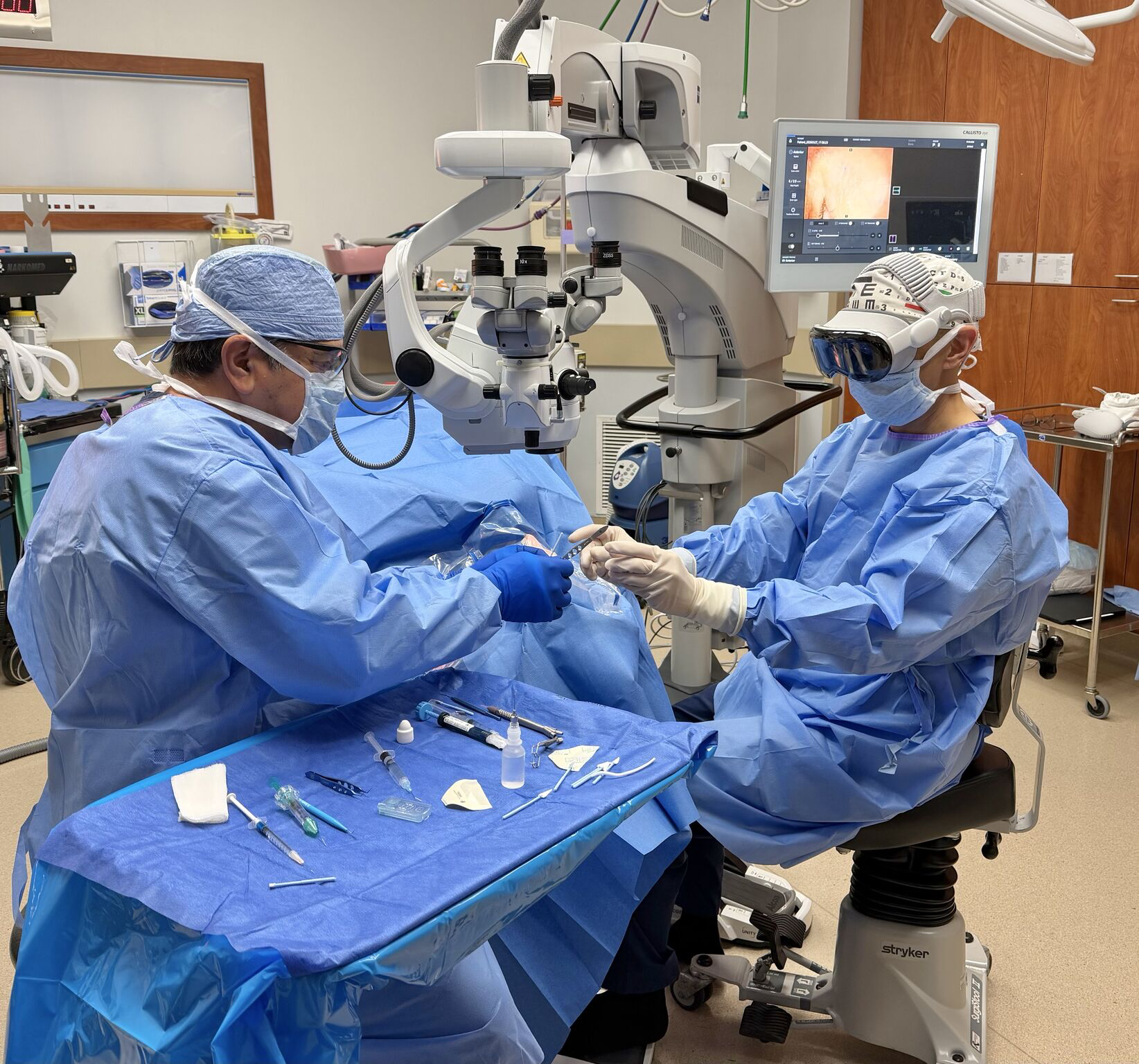
In San Diego, Dr. Tommy Korn has been performing surgery with the Apple Vision Pro.
We’re studying how spatial visualization may redefine microsurgery. • IRB-approved[1] • One of the first of its kind in microscopic eye surgery • Safety & feasibility study
Technology used: • Apple Vision Pro - 2nd generation M5 • ZEISS Medical Technology Artevo 850 3D Digital Microscope • ClearSphere spatial app from ClearSurgery
The idea of adding a layer of information or enhancing vision through a wearable computer being used to repair the vision of damaged eyes, I'd say that's pretty cool stuff.
To oversimplify, the Apple Vision Pro is being used to substitute looking directly through microscope eyepieces, freeing the surgeon from neck and eye strain and allowing additional information to be shown without averting their gaze from the procedure. This improves outcomes and reduces fatigue allowing more procedures to be performed by the same surgeon or allowing more surgeries to be performed by more individuals with fewer obstacles to training.
Spatial computing (SC) is also not a sprint. Joz said it's a product that has been brought from the future into the present and, as I use it, I feel that is indeed the case. And like AI, there are benefits being measured today. But what strikes me is the contrast in attention.
Far more attention and capital is being applied to AI vs. SC but both are inevitable. The contrast might have something to do with psychology or attention markets but it shows that opportunities are not secrets. They are just unnoticed.
An Institutional Review Board (IRB) in surgery is an independent ethics committee that reviews, approves, and monitors research involving human surgical patients to ensure their safety, rights, and welfare. It acts as a mandatory watchdog, evaluating surgical trials, new devices, and techniques to maintain high ethical standards.
Ben Thompson of the Stratechery interviews Horace on the Stratechery Plus Podcast to discuss Horace's journey to become an influential tech analyst: early career in research, business school under Clayton Christensen, and his time at Nokia during the rise of the iPhone.
The conversation further explores Disruption Theory in the context of both smartphones and AI, why Christensen misjudged Apple, and whether AI could challenge today’s tech giants. It also marks the launch of Dediu’s new paid service Asymco One and reflects his continued conviction in Apple Inc. at its 50-year milestone.
NASA’s Artemis program is about to get the cinematic treatment it deserves — and Apple Vision Pro owners are in for an unforgettable ride…
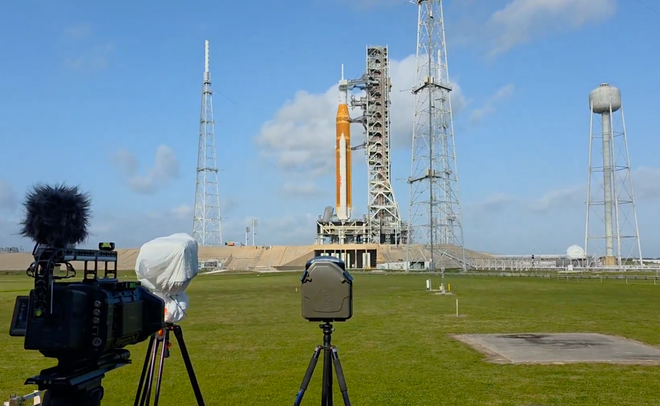
On Monday, March 30, 2026, filmmaker and space documentarian Cosmic Perspective (@considercosmos) shared thrilling behind-the-scenes footage showing the first wave of high-end cameras being installed inside the launch pad perimeter at NASA Kennedy Space Center. The star of the show? A sleek Blackmagic Design URSA Cine Immersive camera, complete with its signature dual-lens stereoscopic rig, ready to capture the thunderous liftoff in true 3D spatial video.
The short video pans across the massive Space Launch System (SLS) rocket standing tall on the pad, with the immersive Blackmagic camera prominently featured in the foreground. Other pro rigs — complete with furry windshields and sturdy tripods — dot the grassy viewing areas, signaling that this won’t be just another standard rocket launch broadcast. This is next-level, immersive filmmaking designed to put viewers right in the middle of the action.
NB: Immersive video is angling for a cut of the live event business…
I can imagine these cameras being not only on the launch site but on the landing site on the moon as well. What would be the value of providing an immersive experience of landing on the moon?
50 already? It seems only a blink of an eye since I wrote Apple at 40. Let's try copy & paste.
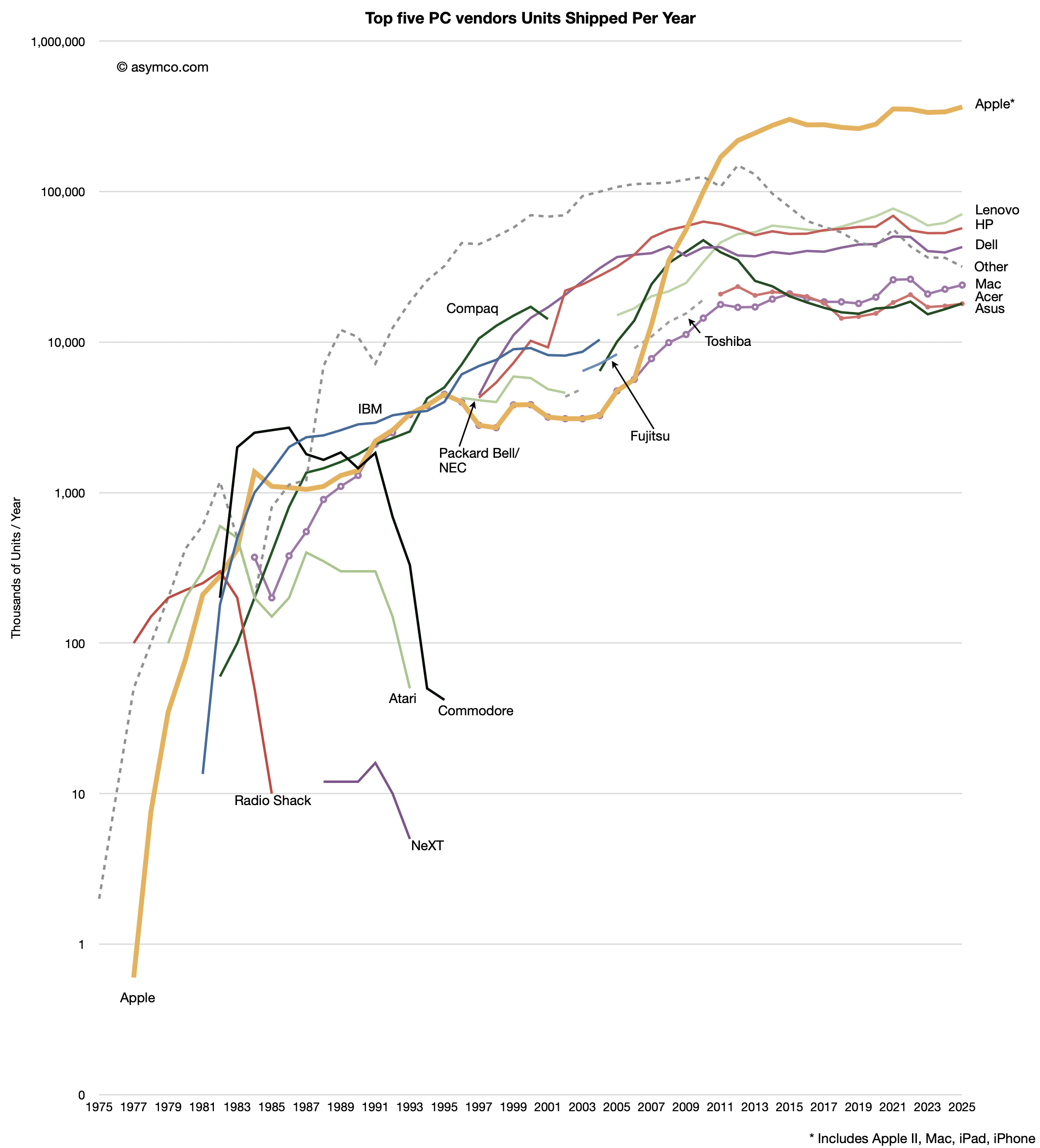
In Apple’s first 40 50 years it shipped 1,591,092,250 5,126,211,000 computers[1].
This shipment total is higher than any other computer company in its first 40 50 years. Actually there are no other PC makers that are 40 50 years old. One computer maker (IBM) is older but they only sold PCs for 24 years and what they still sell they don’t sell in high numbers.
That does not make Apple the top seller in a given year. Looking at only the Mac, Apple’s traditional form factor personal computer, Apple is fifth fourth in market share. If including the iPad, it was the top computer vendor in 2011 and, including the iPhone, it was first in 2009.
The following graph shows the top computer makers by units sold since 1975, a year before Apple was founded. (Click on the graph to see a higher resolution.)
Note that the graph is log scale and in multiples of 1000. Following the yellow Apple line we can see how it started with fewer than 1000 units shipped in its first year to today when it is shipping more than 1 million computers every day[2]. It's also quite remarkable to count how many other companies have come and gone in this top five list and imagine how many came and went in the "other" category.
Who remembers Atari, Commodore, Packard Bell, Compaq? Few said that they were doomed while they were in the running. Going back to Apple at 40,
After having a 40 50 year run and after selling more computers than all American and Japanese computer companies put together, how should we think about the next 40 50 years?
First, clearly Apple shifted from being a “computer company”. It has already changed its name to exclude the word “Computer.” That [came to mean that] it sells devices (which happen to also include computers.) We don't use computers to compute anyway. We use them to make decisions, keep track of things, speed things up and to communicate and to entertain.
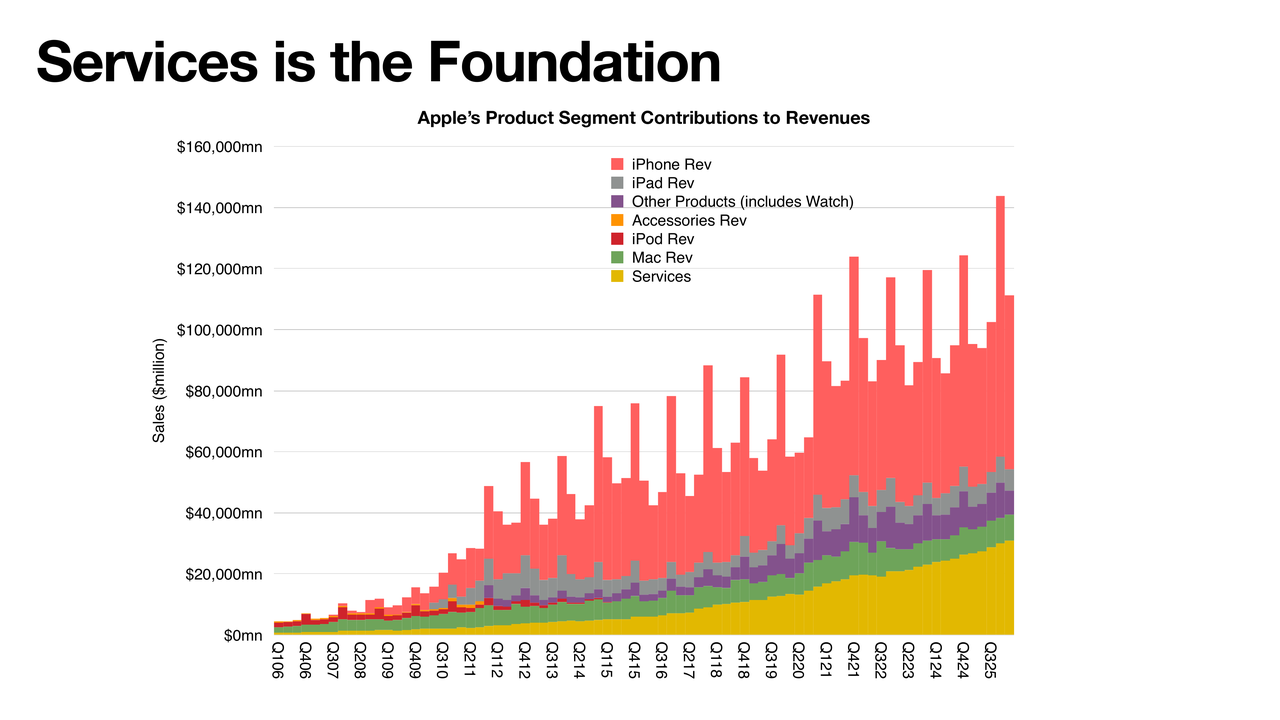
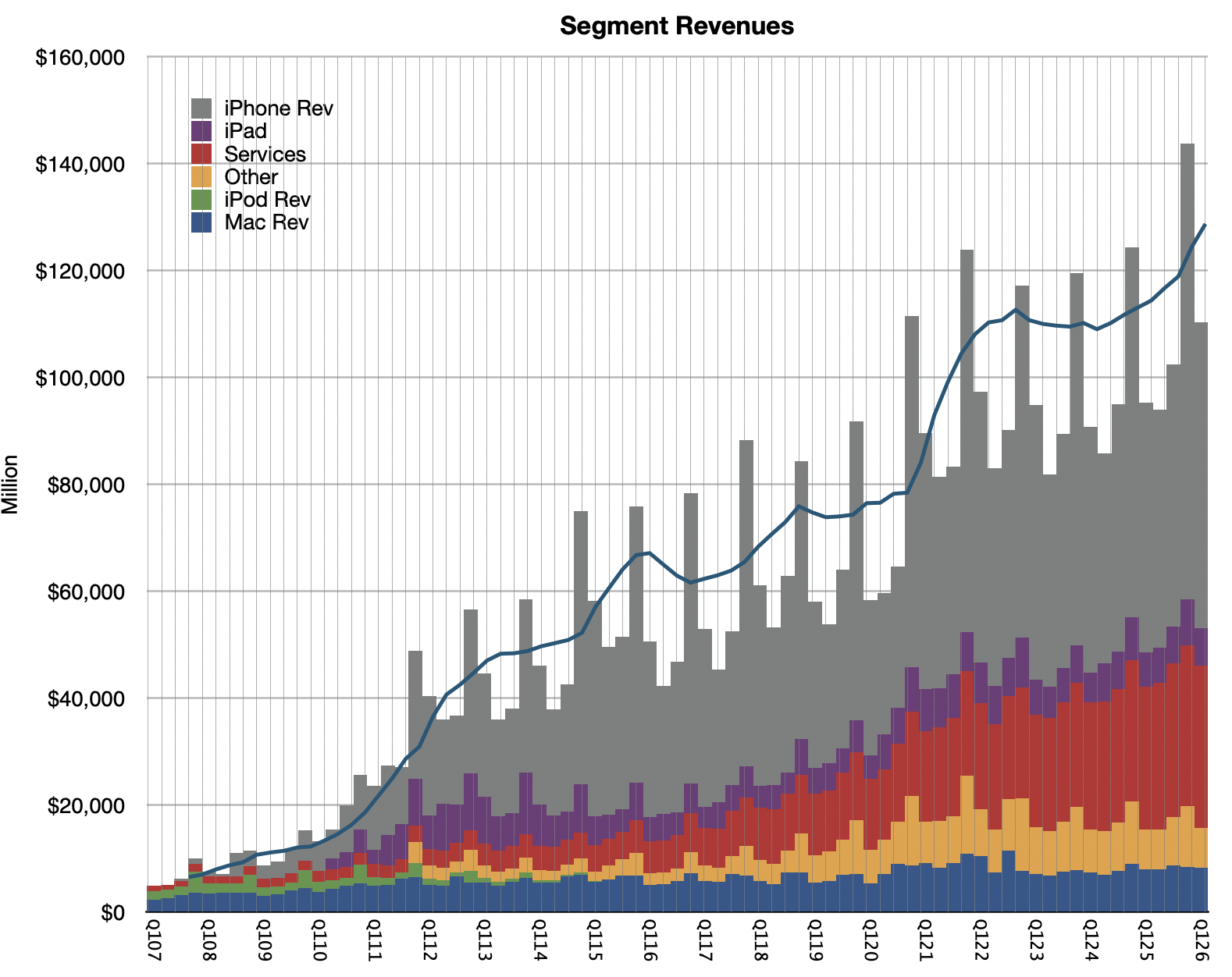
After convincing the world that it's a not just a computer company, the next challenge has been to convince the world that it's also not just a product company. It did so by launching Services as a group (formerly known as iTunes Software and Services) and then separating the financial reporting so that Services can be measured with its own gross margin. Year after year management emphasized Services growth in its commentary. Services has grown into the second largest segment, 26% of total revenues ($112.8 billion out of 435.6 billion in calendar 2025.)
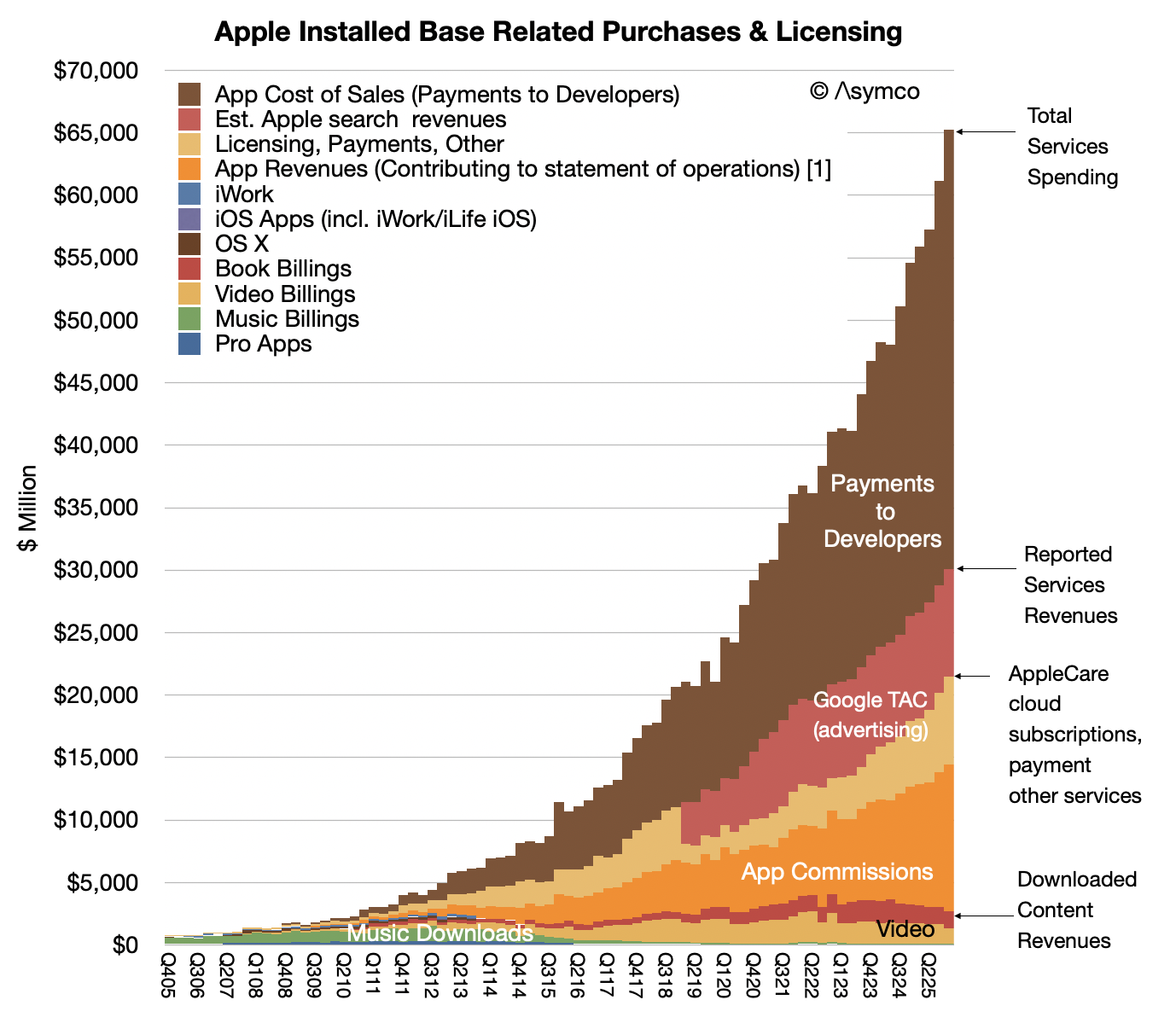
Services, if it stood alone, would be number 40 in the Fortune 500 list of largest companies by sales. It has been impossible to ignore it. Considering how much customers actually spend on Apps, Content and Services, the total is even bigger at $240 billion last year[3]. As a result, some, perhaps most, recognize Apple as a Products & Services company.
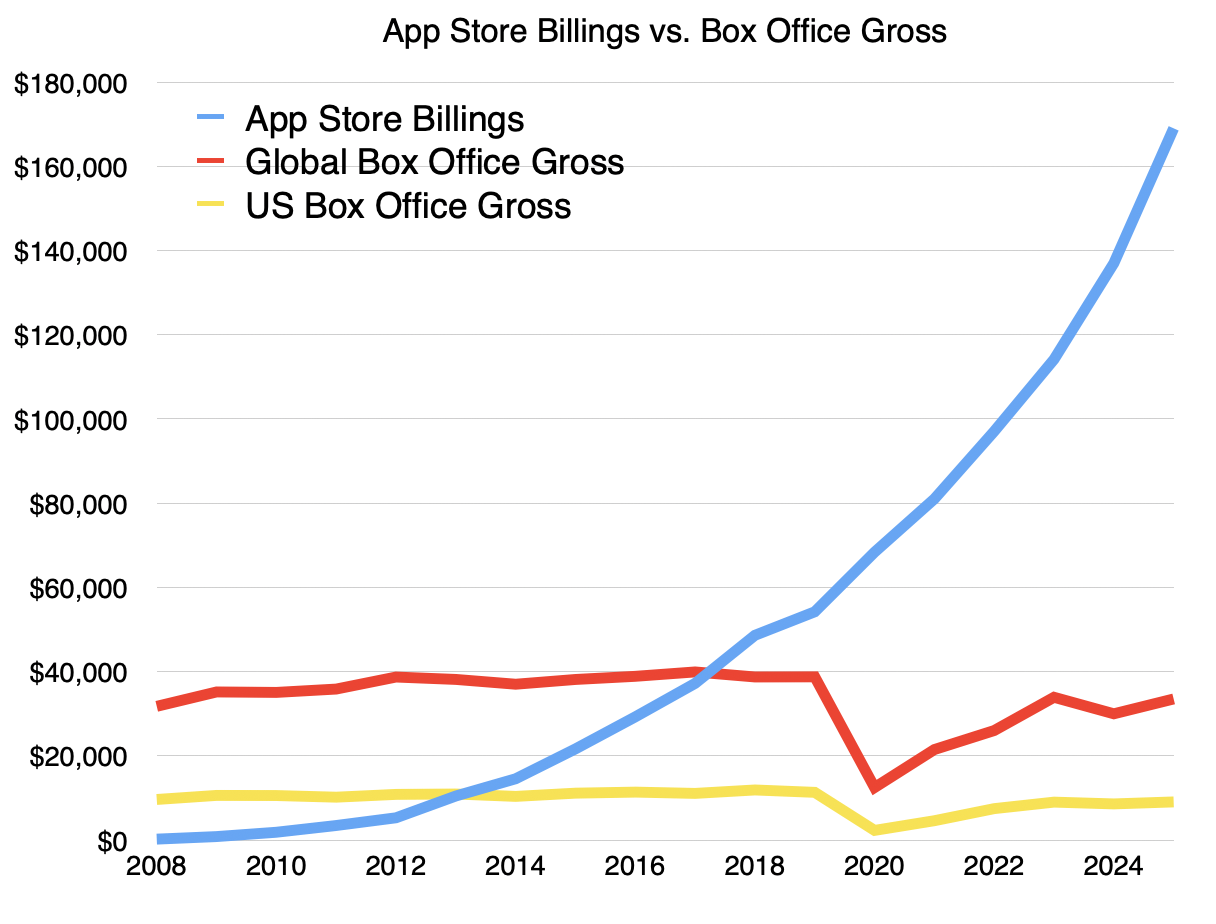
The App store alone attracts $169 billion in spending per year (2025) and that is now 5x what theatrical movie sales bring in world-wide.[4]
So if Apple is today at least a bundle of Products and Services then what will Apple be 50 years from now?
Again from Apple 40:
My simple proposal is to think of Apple as a customer creator. It creates and maintains customers. The more it creates, the more it prospers. The more customers it preserves the more it’s likely to persevere. This measure of performance for a company is not easy to obtain. It’s not a line item in any financial report.
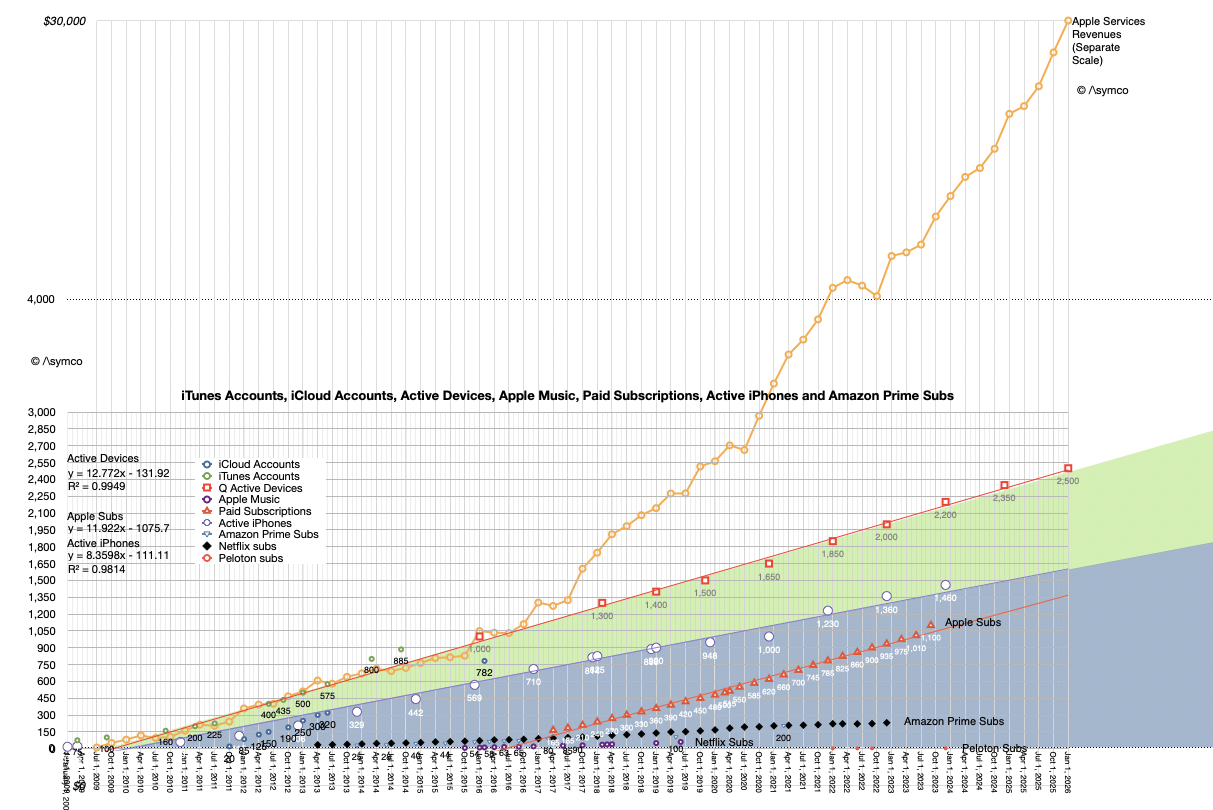
The closest figure we have is that today Apple has one 2.5 billion active devices in use. It has around 1.1 billion users [5]. Using the devices as a proxy, we can say that this audience has more than doubled in the last decade.
So we know that at least Apple has created a large number of customers. Knowing total devices sold and number in use means that we can be sure that 63% of all the computers Apple sold are still in use. This means that most customers are recent customers. Are they going to come back?
If we then factor in the size and persistence of Apple’s audience (customer base) we might conclude that there are factors which will allow it to grow rather than shrink. My analysis based on public data shows that the customer base has been increasing steadily.
And here is a graph showing the size of device base and implications for subscriptions. services and comparisons with other consumer aggregators. Note the forward looking nature of a linear extrapolation of the historical data.
10 years ago, I continued:
Combining the history of customer creation and customer preservation with the value obtained from each customer implies that the next 40 years will be about creating another large tranche of customers whose willingness to spend on whatever Apple creates will be relatively unchanged.
We don’t know the limit. One billion was hard to imagine even one year ago. We might see two billion devices in short order. Perhaps not. Perhaps as we have a multitude of devices about us all day the number will become less meaningful. But if the number of middle class customers grows and as Apple keeps its products within their reach, there is no reason to think that there will be a reversal of the last 40 years in terms of customer acquisition.
This analysis contradicts the current perception of the company as reflected by its stock price. That price assumes the audience will wither ((With a P/E ratio of 11, without a change in revenue per user, the only justification would be the audience shrinking by more than 90% over the next 20 years.)) That is not insanity. It is what we could expect if Apple were unexceptional.
We did see 2 billion. We actually saw 2.5 billion. The assumption of a company in distress as reflected by the P/E ratio of 11 is gone. It's safe to say that Apple is exceptional.
But note that we are only 10 years into that 40 year forecast from a decade ago. Do we still feel confident that the company can last 30 more years given what we've seen so far? If one company could get through the next 30 I would say it is Apple. And if it is so then I think it will get through the next 50.
One more Thing
So, the plan is to make more of the same. It's more than enough.
Including Apple II, Mac, iPhone, iPad and iPod touch; excluding Apple Vision Pro, Apple TV and other iPods. Includes Q1 shipments estimated
2025 shipments were above 364.9 million excluding Apple Vision Pro, Apple TV, Apple Watch.
A Fortune 15 ranking. This would be the case if payments to developers were counted as sales but that is not the case for accounting reasons. As a result Services margins are an extraordinary 76%, on the order of a software only business like Microsoft Office.
As an aside, when I first started tracking this data it was early 2015. The App store had just overtaken US Box Office revenues and the outrage at my comparison and the skepticism that this sustainable was impressive. Much of the outrage was due to my choice of the headline "Bigger Than Hollywood". You can still read the 72 comments. App store billings are now nineteen times bigger than US Box office billings. I still stand by the idea that the App Store is Bigger than Hollywood. It is in fact bigger than many other forms of entertainment combined--more about this later
Stay tuned for a detailed exposition of this audience
In a bold departure from its Big Tech peers, Apple sidestepped the $650 billion AI infrastructure spending frenzy. While Amazon, Google, Microsoft, and Meta funneled cash into data centers, bleeding cash flow and adding debt, Apple maintained a consistent $14 billion capital budget. This strategic choice reflects Apple’s belief that AI models are rapidly commoditizing, as evidenced by DeepSeek’s $6 million model rivaling $100 million counterparts. Instead of building proprietary models, Apple licensed Google’s Gemini, reserving the option to switch vendors as superior models emerge.
Apple’s genius lies in leveraging its ecosystem—2 billion devices transforming into a distributed AI powerhouse. Apple silicon on device enables local AI processing, bypassing the need for colossal server farms. This approach not only conserves capital but also amplifies customer loyalty, as Apple uniquely protects privacy. Ultimately, Apple bets on owning the customer experience, positioning itself to thrive regardless of infrastructure ownership. →
Apple's recent product launches, including the 17e and MacBook Neo, have sparked speculation about a strategic shift towards low-end markets. However, this view overlooks Apple's fundamental approach to market segmentation, which eschews simplistic price categorizations. Instead, Apple focuses on the "job-to-be-done," understanding that consumer purchases are driven by desired outcomes rather than affordability alone. This perspective reveals that performance and quality are crucial, transcending income levels. For instance, affluent individuals may opt for simpler devices, while budget-conscious consumers might invest in high-performance tools to meet specific needs, like content creation.
Historically, Apple has aimed to deliver superior experiences to a broad audience, refusing to compromise on quality with budget-friendly products like Chromebooks. While cost can limit access, as seen with the Vision Pro, Apple prioritizes profitability as a validation of its value proposition. The MacBook Neo exemplifies this ethos, leveraging efficient mobile chipsets to redefine laptop capabilities at a competitive price point. This innovation blurs the lines between mobile and traditional computing, underscoring Apple's commitment to crafting products tailored to diverse tasks. Ultimately, Apple's strategic depth, powered by Silicon advancements, positions it to serve an expansive global market by addressing a wide array of functional needs. →
Nota Bene
Rosenblatt Lifts Price Target on Apple by $1, Maintains Netural Rating → On March 5, Rosenblatt's Barton Crockett slightly raised Apple's price target to $268 while maintaining a Neutral stance, optimistic about Apple's budget product launches and steady high-end performance, despite trading at a modest premium compared to peers, as analysts foresee robust revenue growth for FY2026. →
How many employees does Apple have? What do they do? → Apple, despite its marketing reputation, is fundamentally an engineering powerhouse with nearly half its workforce dedicated to engineering roles, driving its substantial revenue growth and global employment expansion. →
First footage of X-Plane 12 on Vision Pro → X-Plane 12 on Apple Vision Pro leverages ARKit to seamlessly integrate physical controls into a mixed reality flight simulation streamed from a Mac, showcasing advanced professional-grade AR capabilities. →
iPhone production in India increases by 53% in 2025 → Apple's strategic shift to ramp up iPhone production in India by 53% last year, aiming not just to sidestep tariffs but to cultivate a vast new customer base, underscores a long-term vision mirroring its successful penetration of the Chinese market. →