Asymco

Asymmetric Intelligence

ecosystem

  1. Meet the System Orchestrator: Toward Intent-centric Computing

    Research · 1 comment

    The end of apps? Not so fast.

    The traditional computing "stack" is usually portrayed as a layered cake where the base is silicon, on top of which are system-level interfaces, followed by the operating system, then core services, and finally applications. The User interacts with the applications only. This is an app-based ecosystem which exposes "tools" for users to use as they try to accomplish tasks. This ecosystem for Apple is approaching $2 Trillion/yr in economic transactional value.

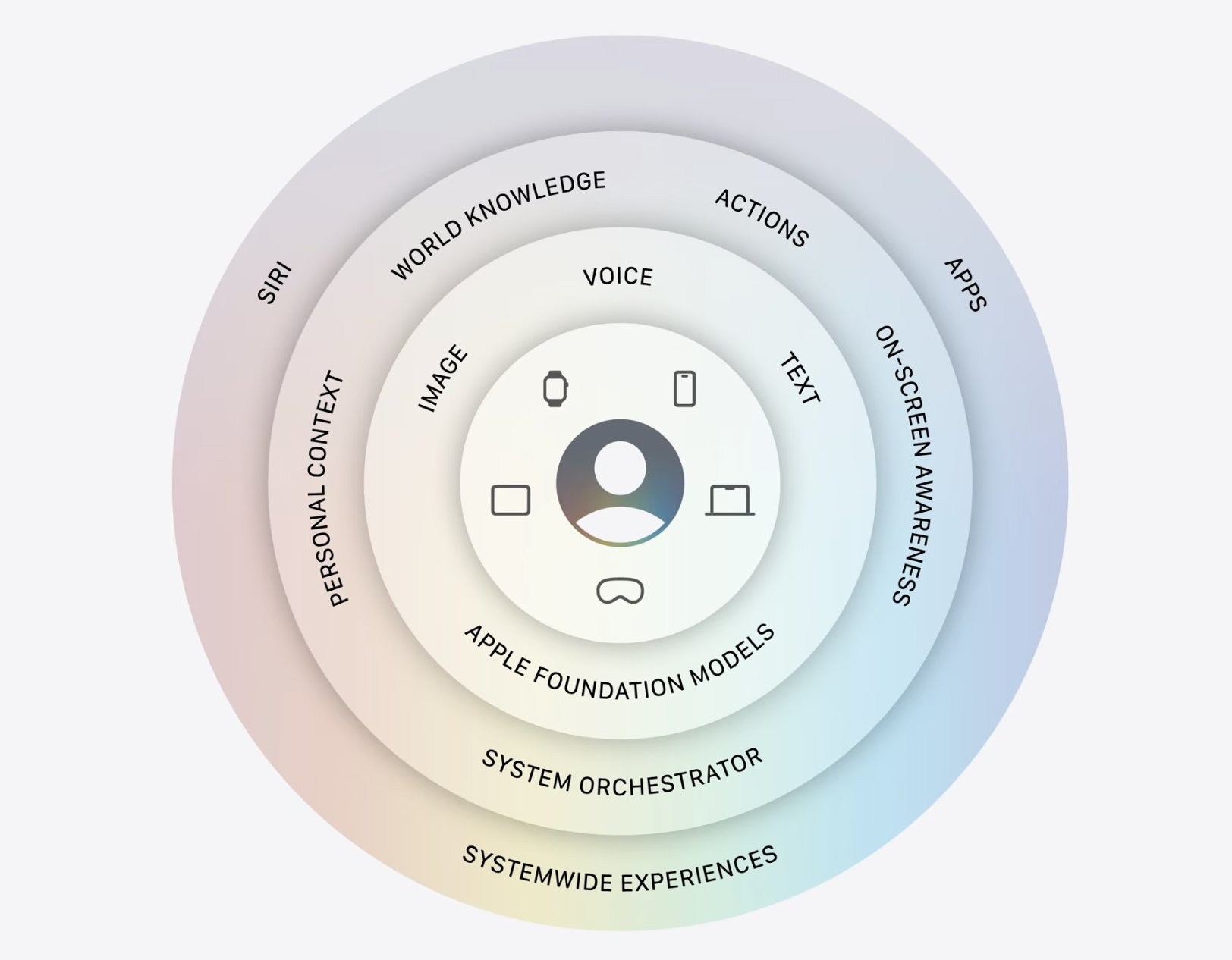
    The diagram above, introduced as the new Apple Intelligence architecture, is quite different. The user is connecting using various devices via various input methods (image, voice, text) to prompt an orchestrator to tap various knowledge bases (local and remote) to initiate either Siri or an App to act on some intent.

    The role of the operating system is now that of "orchestrator' that connects inputs to knowledge and decides how best to fulfill an intent. It sometimes connects to a chatbot (Siri) but also initiates apps to act.

    This might be seen as moving from an app based ecosystem to an intent centric world. For the original Siri, queries were usually routed to apps (calendar, weather, stopwatch, music, etc.) In this new world Siri AI will resolve the intent directly and have the ability to construct & deconstruct interfaces / experiences on demand. There are many tasks that do not need third party applications.

    However, the diagram still shows Apps as equal to Siri in terms of Systemwide Experiences. Apple announced a Foundation Models framework and expanded App Intents. Intent-centrism doesn't deprecate apps. It transforms them them from intent destinations to callable functions.

    Using the nomenclature of integration/modularization and business model evolution, it modularizes what was integrated, subtly shifting the locus of value. The App Store becomes an API directory. That's a business model shift. Classic innovation theory suggests that as the value chain evolves, some profit will evaporate from one point and condense in another point in the chain; usually wherever the new point of modularization has been injected.

    The old points of concentrations were the OS (where Apple captured profit) and the Apps (where developers did.) The new points might be in the orchestrator and in the foundation models.

    But I don't think it's that simple.

    Models might be commodities and orchestrators are not much different than OSs. Intent action requires access to private app data. bank accounts, calendars, messages. Authentication is an app responsibility and thus earned trust. Every app removed or disintermediated becomes a permission the orchestrator needs. Would banking credentials be granted directly to the device/OS? Much peril lurks there. This local data is where app control lies.

    Where the threat for apps lies is in the possible loss of user interaction. It's also a great part of the cost of development. Shifting from a point of contact with the customer to a callable function comes with costs and benefits that are not easily predictable.

    Transitioning the OS from a layer between hardware and applications to a layer between foundation models and experiences fundamentally shifts the architecture, but, in the case of Apple, it preserves its value as the agent of trust and discovery.

    For this the value created and captured remains and perhaps increases.

    It's clear to me that Apple has engineered this quite carefully and thoroughly.

  2. How to Measure WWDC

    Research · 2 comments

    How to measure helping others

    René Descartes, who published the phrase I think, therefore I am" in Discourse on the Method, in 1637

    Apple isn't measured by revenue or profit, at least not primarily. The measure is always satisfied customers. The application of services, software and computing hardware to improve lives has always been the modus vivendi and the resulting customer creation has always been the metric of success. Revenues and profits follow customer creation in a 1:1 relationship.

    WWDC seems to attract attention as a catharsis for product and strategy announcements but it was never intended to be this. It's about developers (the D in WWDC) and what matters to them: APIs, operating system updates, languages, SDK, and other tooling. It's also a chance to reveal the economic value proposition for those developers who are following their part of the $2 trillion ecosystem.

    And so the measure of WWDC should be how developers are created and satisfied. The products, which come later, are important but what matters more is developer opportunity, productivity and satisfaction.

    So here is what I'm looking forward to:

    • New developer opportunity with AI. This is via easier integrations, more choices perhaps in terms of back ends and possible hooks into different parts of the ecosystem. To wit: Swift extensions, *Kit extensions with hooks to smart home, exercise/fitness, accessibility.
    • New developer productivity tools: How is AI going to improve the toolchain for developers.
    • New developer business models: how agents can be built and integrated into privacy and safety that only Apple can guarantee.

    As Apple has shown with accessibility improvements (foreshadowing!), AI can be used to make people's lives better especially those who cannot perform due to disability. AI can lift those "below the median" in terms of many forms of ability: below median communications, below median health and below median mobility. Those with more limited ability can be "enhanced" into at least median ability. By definition, half of humans are below the median so helping them is as useful as helping those above the median.

    This is in contrast to the narrative that AI makes supermen. The opportunity is not mainly about taking over high ability tasks and forcing human effort to be displaced. it's much more about making the less able become more abled. (Characteristic of GenAI output is the "averageness" of it. For those of exceptional ability it feels worse/erroneous and irritates. For those of less ability it's empowering. AI pushes toward the median, both from below and above.)

    Below the median here does not necessarily mean below the median income or wealth. Ability is not always correlated with income. There are many Apple customers and potential Apple customers who can use help. I surely can use help in many areas of life.

    WWDC is about the scaffolding upon which these grand problems can be solved. Scaffolding is not pretty to look at and most look away in disappointment if that's all that is revealed. But no matter how well regarded, no great building has ever been built without scaffolding.

  3. Asymco Bulletin 016 - June 7, 2026

    Bulletin

    Asymco Bulletin is a digest of all the work we have published for the week ending June 7, 2026.

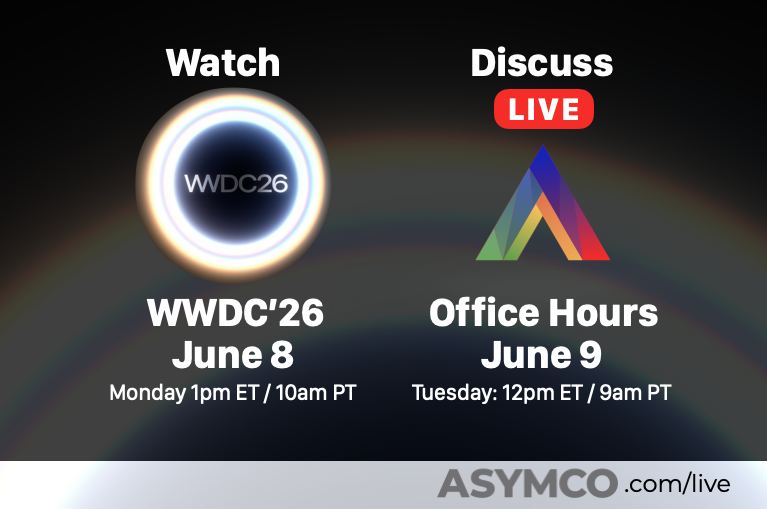
    Coming Up: Post-WWDC Office Hours

    Office Hours Live Q&A, Tuesday June 9, 2026
    Day after Apple WWDC'26 Keynote

    Join us for our June 2026 Office Hours the day after WWDC'26 for a look into Apple's announcements, implications, and insights, and our live Q&A.

    To sign up, and for the latest live event information, visit: asymco.com/live. →


    Research

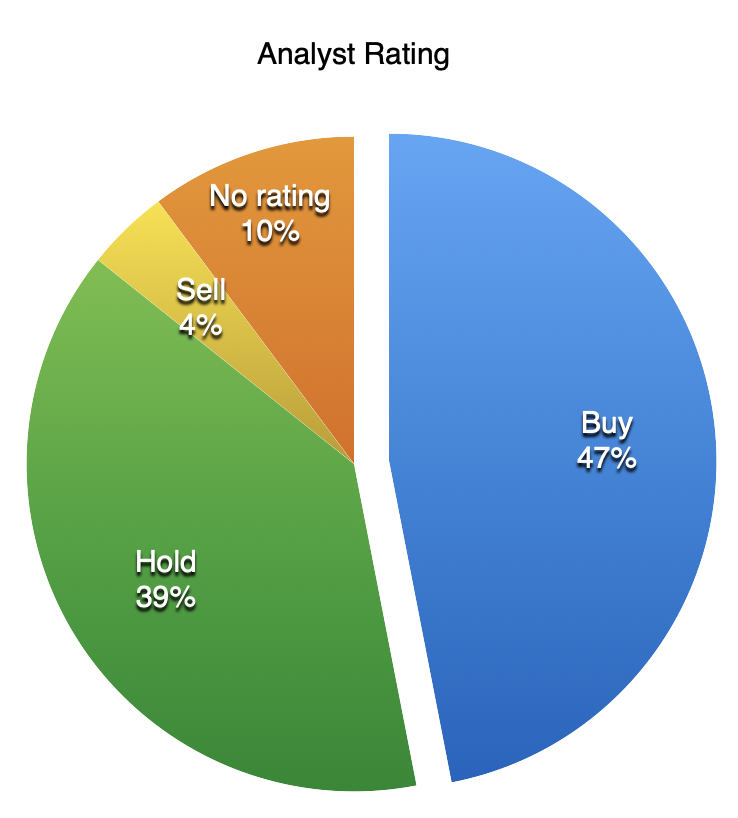
    42% of Apple Analysts rate it a Hold or Sell

    Apple has compounded net income at 26.6%, revenue at 21.5%, and share price at 27.7% for two decades, thus doubling every three years. Yet despite this, 21 of 49 analysts rate it Hold or Sell, with another 5 having no opinion. Extraordinary claims require extraordinary evidence yet assuming the Apple flywheel is about to grind to a halt is still a majority opinion. →

    The Apple Ecosystem Approaches $2 Trillion

    The App Store ecosystem facilitated $1.4 trillion in 2025. Add Apple's direct sales and the Apple Ecosystem comes to $1.8 trillion; add browsing, social, and messaging activity and the Apple Economy reaches roughly $3 trillion. Seen another way, at a $4.57 trillion market cap, Apple is valued at only 2.5 times its ecosystem and 1.5 times its economic footprint. These third-party dependencies are a measure of platform resilience and a carefully worded caution to regulators about the downside of interfering with it. →

    How not to over serve; The machinery of vanity

    Part 4 of the Asahi Shimbun interview turns to the spec trap. Apple maintains improvement but is selective: it ignores refresh rates beyond what the eye can see, and invests instead in features nobody asked for, like Face ID and AirPods. The phone became a machinery of vanity because the supply of cameras created demand for image editing, not the other way around. Christensen thought Apple would be disrupted by the low end. The honest answer for why it isn't is: culture, held together by extreme diligence. →


    Nota Bene

    Morgan Stanley reiterates $330 price target with bull-case $440 → Morgan Stanley reiterated $330 with a $440 bull case if WWDC unlocks an AI re-rating. Apple does not respond to market fads, and a multiple above 40 is almost never experienced. Disappointment after WWDC is nearly guaranteed because it has always been a software and tools show. →

    Citi reiterated a Buy rating and a $315 price target → Citi reiterated its Buy and $315 target ahead of WWDC, expecting a revamped Siri to make Apple an edge AI winner. Edge AI is inevitable, but it was also inevitable two years ago. The target is already priced in, making the AI story a non-starter. →

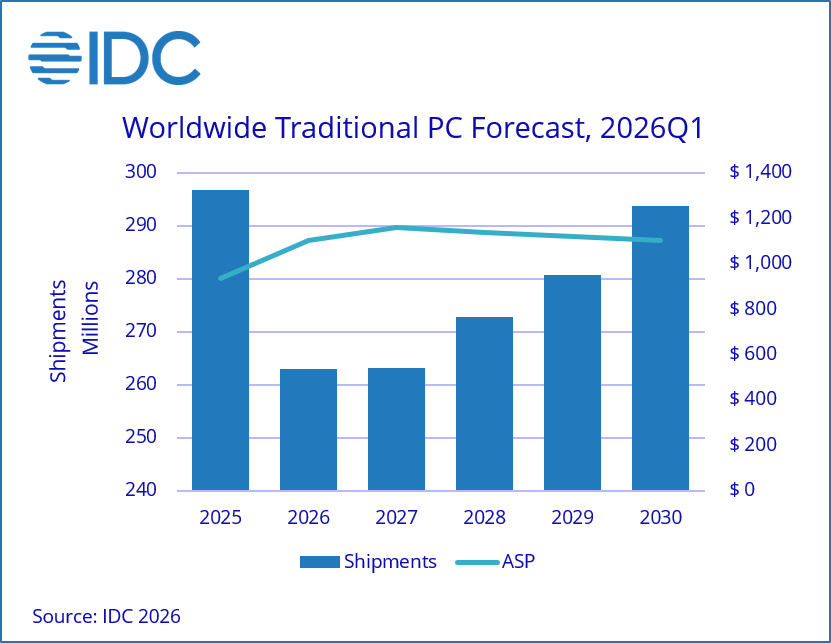
    Q4 PC shipments are expected to fall 20% year-over-year, 11.3% for the full year → IDC now sees PC shipments falling 11.3% for 2026 and 20% in Q4, with no recovery in volumes until after 2030. The MacBook Neo is the only thing keeping the broader notebook forecast from being worse. This is a multi-year opportunity for Apple that may reset PC market share dynamics permanently. →


    Asymco One gives you full access to our research, analysis, and commentary. Subscribe with code BULLETIN for a discount.

    Feedback: Have questions or comments? Reach out to us at contact@asymco.com. We'd love to hear from you.

  4. The Apple Ecosystem Approaches $2 Trillion

    Research · 10 comments

    The iPhone maker is trading at 2.5x its ecosystem value and 1.5x its economic impact

    Apple today announced the global App Store ecosystem facilitated over $1.4 trillion in developer billings and sales in 2025, according to a new study by economists at Analysis Group. For more than 90 percent of the billings and sales facilitated by the App Store ecosystem, developers did not pay any commission to Apple. Since 2019, the size of the App Store ecosystem has nearly tripled, as the App Store remains the safest and best place for users to discover and download apps. .

    Source: Apple

    Bill Gates once said you have a platform when other people make more money from it than you do.

    In other words, success is if there is more value created on top of it than captured from it.

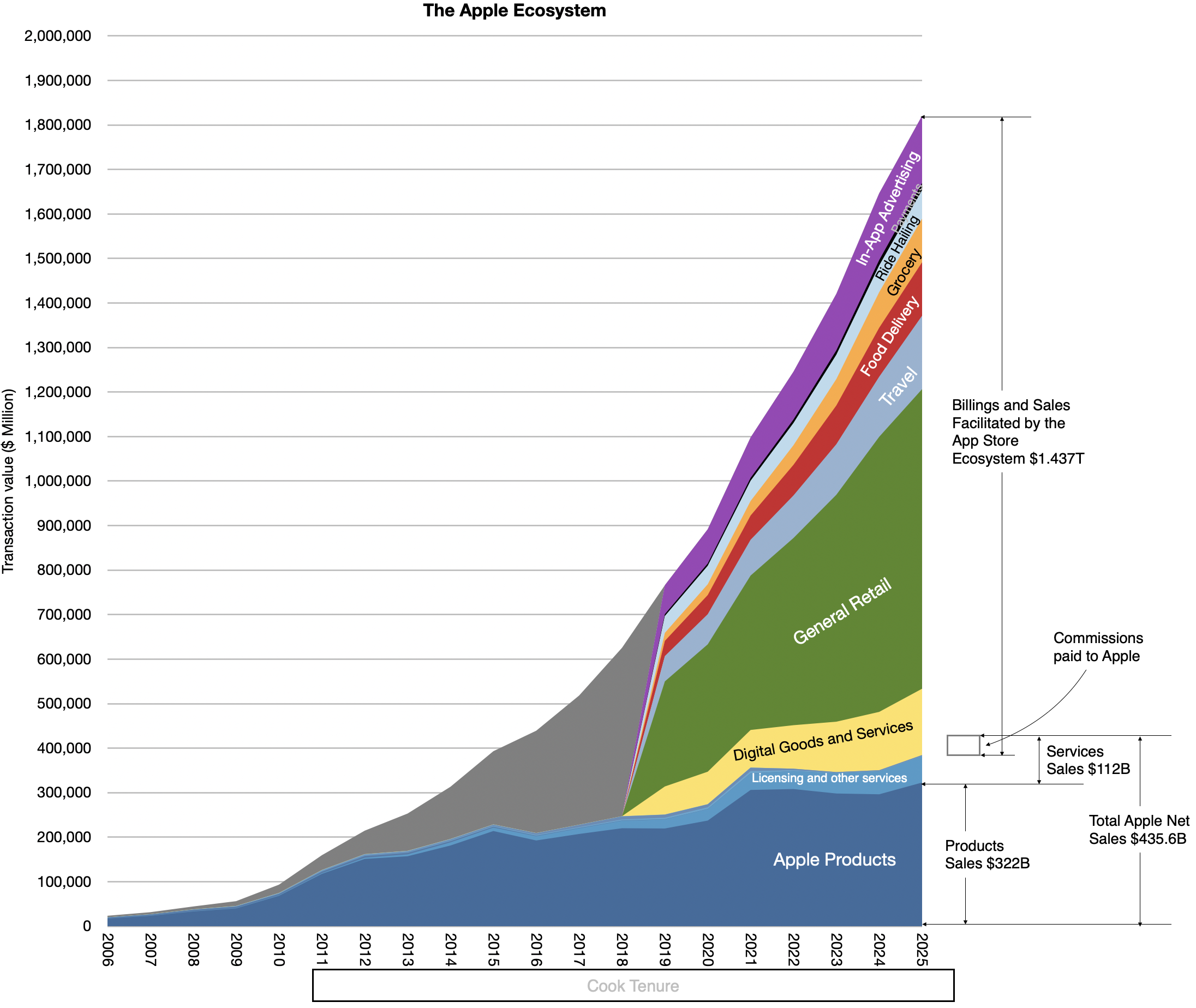
    Few platforms qualify but Apple's certainly does. Apple's ecosystem is shown in the graph below.

    Apple's direct payments to developers were about $126.7 billion but, as the Analysis Group report shows, Apple and the developers enabled transactions dwarfing app store transactions. In 2025 Apple captured a tiny fraction of the economic activity it induced on its platforms (about $57 billion out of $1.437 trillion or 4%).

    Combining the billings and sales facilitated by the App Store and Apple's direct sales of products and services leads to a total of over $1.8 trillion. I call this the Apple Ecosystem (Apple + App Store.)

    But that's not everything. There are lots of economic activities on the platform that do not involve the App Store. Activity on browsing and social media and messaging apps probably add another 50% on top of this, perhaps even 100%. I call this the Apple Economy (Apple + App Store + All other transactions.)

    Ultimately, the 1.4 billion Apple users using 2.5 billion devices are likely inducing as much as $3 trillion of economic activity.

    It seems to me that we need a way to measure a multiple of this activity as perhaps a fundamental metric of value creation.

    At $4.57 trillion current market cap, the value is only 2.5x its ecosystem and 1.5x its economic footprint.

  5. Melius’ Ben Reitzes raises price target on Apple to $385

    Nota Bene · 6 comments

    The company “may be on the brink of some real AI sizzle.”

    Reitzes said people are becoming more comfortable using voice commands, and Apple could benefit from this shift as technology becomes more voice-driven.

    Reitzes also said the upgraded Siri could become a standalone tool that many Apple users rely on, even instead of apps like OpenAI’s ChatGPT. He described it as an “agent-style interface” that could make the Apple ecosystem more unique and spark fresh excitement among developers.

    Additionally, he highlighted that no other consumer tech company has both parts of that system under one trusted setup. He added that this advantage will become even clearer—and more valuable—as AI systems get more complex and start acting more independently.

    Overall, he expects Apple to post about $613 billion in revenue by fiscal 2028.

    Source: TipRanks Financial

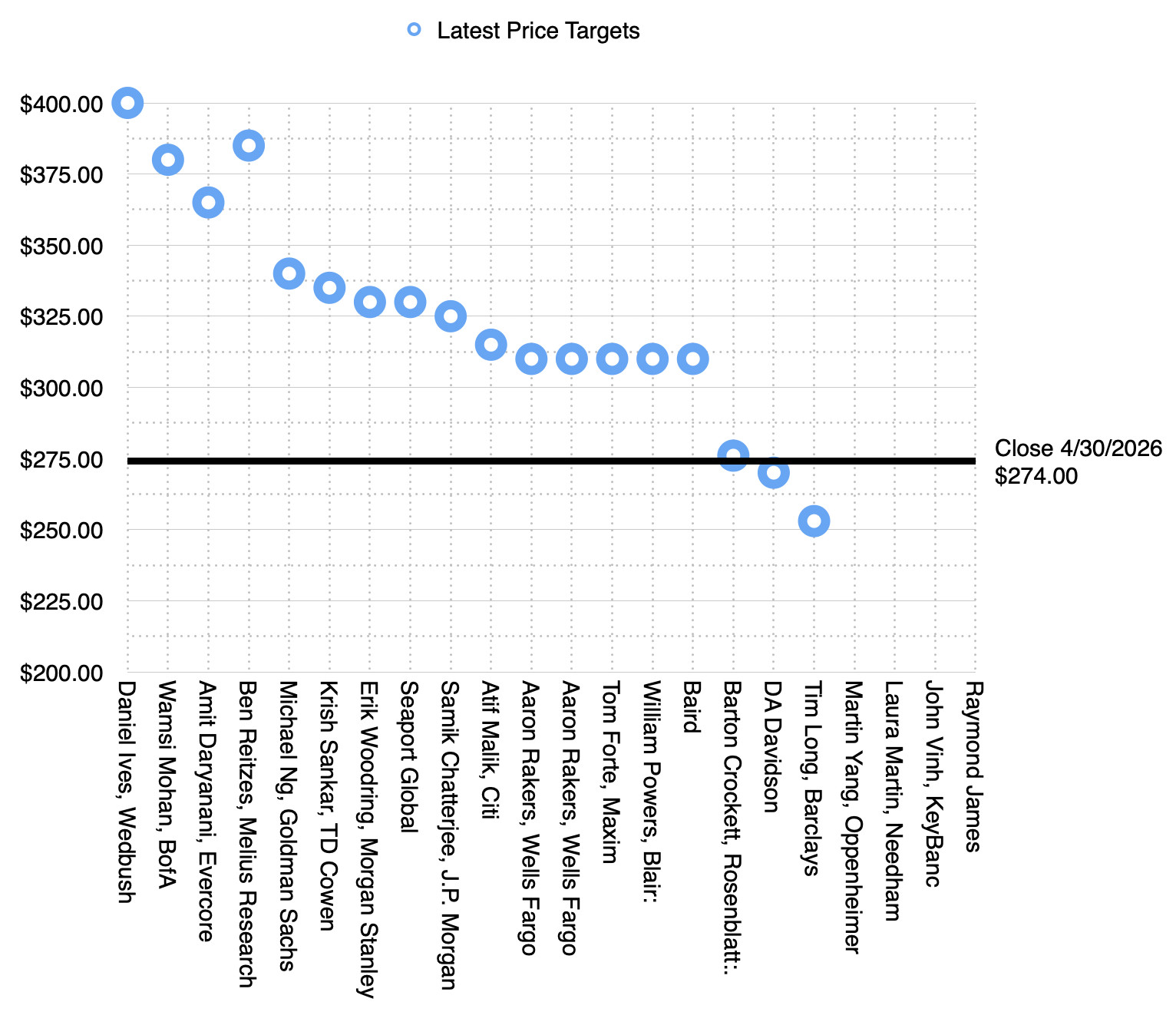
    NB: Latest analyst targets are shown with Melius' stepping up. Analysts are coming round.

    This upgrade follows Bank of America boosting its price target to $380 a share.

    “In an agentic world, value accrues to the platform that controls user intent, personal context, app access, permissions, identity, authentication, payments, and trust,” said BofA’s senior equity research analyst Wamsi Mohan. 

    “Smartphone is the scaled consumer device where these factors already converge,” he added. “If AI assistants become the new front door…we think Apple should have meaningful leverage over model providers, app developers, merchants, advertisers, and payment networks.”

    An agentic version of Siri could boost 2030 revenue by as much as $65 billion, Wamsi and his team estimated, adding up to $2 billion in incremental earnings over the next four years.

    Reitzes sees the new Apple Siri as a stand-alone app that has the potential to replace ChatGPT for Apple's 2.5 billion installed devices, while proving to be “an agentic interface that can further differentiate the Apple ecosystem and ignite a level of excitement with developers not seen since the early days of the App store.”

    But it’s also likely to establish Apple as the leader in consumer-use AI.

    “If agentic AI shifts the market from answering questions to taking actions, the critical control point becomes centered around owning the endpoint,” Wamsi said. “Apple does not need to own the best frontier model if it owns the trusted interface that routes intent across local models, Apple-controlled cloud models, external models, and app actions.”

    Reitzes at Melius sees that shift, which he describes as a “shot in the arm” for Apple’s app store, driving “a massive new product cycle that keeps iPhone growth going.”

    He’s also observing that Apple’s architecture, with on-device models handling lighter workloads and its private cloud taking on the larger ones, makes it unique.

    “No other consumer technology company has both legs of that architecture under a single trust model, and we think that gap becomes more visible, and more valuable, as agentic complexity scales,” he said. 

    “Agentic AI is a structural tailwind that will force consumers to get the latest and greatest Apple device because it will work better than other brands.”

  6. Integration, culture and market creation

    Research

    The Asahi Shimbun Interview Part 1

    (Sibyl with Tabula Rasa) by Diego Velázquez, c. 1648

    Horace Dediu / Takeshi Narabe & Dylan Weir / Asahi Shimbun Interview, April 2026

    Takeshi Narabe
    On the secret of Apple's success, you have previously noted that the key to Apple's success was its ability to integrate hardware, software, and services to create products that are perfectly hired for a specific job to be done. You also highlighted how they moved beyond mere devices to lock customers into an ecosystem like iOS, iCloud and Apple stores. So this analysis is now very well known. So do you still think this is one of the biggest reasons of Apple's success?

    Horace Dediu
    Yes, we have to recognize Services has only been a story for the last 10 years. And arguably integration of software hasn't been really all that important before 1998 when Apple brought Steve [Jobs] back and with him came NextStep, which was [an] operating system based on Unix. And that was much more robust and much more focused around software engineering than the original MacOS. Or, what I would say [constituted] version 1 of Apple, which began in 1970s until the 1990s.

    Most people tend to think of Apple as one continuous story for 50 years. [But] it's at least two major stories. I would say pre-98 and post-98. And post-98, it's been so different. And it's much more, I would say, something [that can be studied] as a theory.

    I think in the first decades Apple was more, let's say, a story of people. There were people who were brilliant. There were people who were celebrated [as they are] now. But the second half of Apple is much more about building a business that has longevity, [that] can last a long time. It's an unusual priority.

    I think for many companies in the world, they don't think about longevity. And that is why, even Tim Cook recognizes that it's the next 50 years that are more important [than the last 50 years]. So thinking about a century is really important and I think [that] is core to the current culture of Apple. Now, of course, this means, as you said, integration, and that is one of the key things. But fundamentally, beneath all that, there's this point about culture.

    Takeshi Narabe
    Culture?

    Horace Dediu
    Culture in the sense of what are the priorities? What do we concentrate on and to what degree do we need to focus? They [management] repeat these things all the time. Focus, focus. What means this? It means saying no to many things, but it also means saying yes to the things where you can bring great things to bear. It's where Apple has a unique advantage. And that means saying no to a lot of things.

    We know about the car business that they eventually rejected even though they worked on it for many years. I think ultimately that decision was based on a realization that they couldn't bring enough contribution. And that's not just an economic decision. Of course they could have made money. There are even phone companies in China that make cars today. But it isn't what they thought of as important.

    Takeshi Narabe
    All right, thank you. So you also mentioned to what extent do you attribute Apple's dominance to the ability to tap into non-consumption addressing latent demands that consumers themselves hadn't yet realized.

    Horace Dediu
    So this is also one of the keys indeed. i learned about this by listening to my professor Clayton Christensen, who observed that great companies not only compete effectively, but they also create their own markets. They create their own demand.

    [It's an] Extraordinary idea. And when you look at Apple, you do see that they use a different language. They talk about customers not asking for the product. But they also fundamentally build something that compels the user to buy it. When it was something that wasn't conceivable. Steve Jobs famously said, the customer hires us to find out what they want. So this is a fundamental thing.

    And there are many examples. And I think one of the struggles today, for example, is Vision Pro, a product that is very difficult to find how it's going to solve problems. But at the same time, it's an extraordinary product. I think the jury is still out on the Vision Pro, but there are many other examples where I think initially they thought things would go in one direction and they went in another direction.

    But even the iPhone, I like to repeat the fact that when the iPhone was introduced, Steve Jobs said it was three things. That it was a widescreen iPod, that it was an internet communicator, and it was a phone. But I point out that these days, those three jobs of being a music player, being a telephone, and being a browser, are not among the most popular things people do with it.

    So it's fascinating how they introduced it as a blank slate. [It was] software, written by third parties [that discovered the compelling uses], and it developed in its own ecosystem. That is also a very interesting lesson there.

    But it is fundamentally about really being humble. I think, again, it's a cultural trait, being humble and saying, maybe we don't know fully what to do, but to concentrate on quality and concentrate on doing at least something useful for people. And then later, new things will appear.

    —
    This is the first part of a series of excerpts from an interview with Asahi Shimbun newspaper on Apple & Innovation.

    Next in series: Part 2: The Story of Japanese Innovation

    Interview as published: 聞 Asahi Shimbun on Apple & Innovation

  7. Is Apple borrowing Samsung's Market Expansion Strategy?

    Nota Bene · 1 comment

    On March 18, 2026, Bernstein SocGen Group reaffirmed its “Outperform” rating and $340 price target for Apple Inc.

    Comparing it to Samsung’s 2009–2013 strategy, which saw Samsung increase its global smartphone share from 4% to 32% in Q3 2013, Bernstein emphasized Apple Inc.’s recent product launches as a strategy to widen portfolio price bands, driving share gains at the low end while raising prices at the high end to maintain margins. Although Samsung eventually lost market share to Chinese manufacturers, the firm said the stickiness of Apple’s iOS ecosystem will help it sustain long-term market share.

    Bernstein projected a 12% increase in fiscal 2027 EPS from share gains, split equally between hardware and services, assuming Apple Inc. captures 10% of Chinese manufacturers’ smartphone market share amid their supply issues. Some noteworthy product developments include the introduction of the $549 AirPods Max 2, the App Store cost reduction in China from 30% to 25%, and plans for a foldable iPhone.

    Source: Yahoo Finance

    NB: Separately, it's been reported that Samsung might see its first operation loss from its phone division, resulting in Apple capturing 100% (or more) of global smartphone profits. Simultaneously, Samsung is seeing huge profit gains from memory, even overtaking Nvidia's profitability. This is remarkable…

  8. The iPhone is ‘not getting disrupted’ by AI: Perplexity CEO

    Nota Bene

    AI makes the strong stronger. That is the opposite of disruption.

    The iPhone appears stronger than ever despite Apple’s AI struggles, and that’s not a coincidence, says Perplexity CEO Aravind Srinivas.

    Speaking on the latest episode of the This Week in AI podcast, Srinivas indicated that the iPhone only stands to benefit from continual AI improvement.

    "Here’s my opinion. I haven’t said this before. The phone, the iPhone is actually not getting disrupted by AI at all. In fact, the more AI works better, the iPhone essentially becomes your digital passport."

    Perplexity’s CEO touts Apple’s ecosystem and silicon advantages as some of the reasons why the iPhone is positioned for continued success. It’s also, in his view, why Apple can afford to move slow with its long-delayed Siri overhaul.

    "My sense is that even though a lot of people have opinions on how bad Siri is or good Siri is, [Apple has] the ability to take time and do things they want to do, because they have advantages as a brand that people truly trust. The ecosystem lock-in is underrated. Auxiliary hardware devices, the chip advantage, all of this is really underrated right now.
    Srinivas also mentions how the iPhone is central to people’s lives for many reasons that have nothing to do with AI."

    He says, “It has your wallet, it has all your cards, it has your passes, it has your health records, you connect with other human beings through it, you do FaceTimes, you do calls, you have photos of precious moments in your life.” All of these are extremely personal, and as a result, users won’t easily switch away from iPhone.

    Source: 9to5Mac

    NB: Knowing the theory of disruption provides a three year lead in decision making. The observation...

  9. Survey shows iPhone improved retention, purchase intent, growth in services, service pricing, product mix, foldable upside

    Nota Bene · 1 comment

    Attach rates for iCloud reached about 42%, while Apple Music stood near 30%

    The iPhone ecosystem is showing signs of increased customer loyalty and steady demand, while its high-margin services business remains a key support to profitability, according to UBS analysts.

    The bank, which maintains a 'Neutral' rating on Apple with a 12-month price target of $280, cited findings from its Evidence Lab survey of roughly 4,000 iPhone users globally. The data suggests that iPhone “stickiness” continues to improve, even as replacement cycles remain relatively stable.

    UBS said the average age of iPhones in use globally was largely unchanged year-over-year at about 33 months. Outside China, device age edged slightly higher to around 38 months, a trend the analysts said could push some upgrade demand into 2027.

    At the same time, customer retention strengthened, with the global iPhone retention rate rising about 200 basis points to roughly 74%. Gains were particularly notable in the United States and China, where retention increased by 200 and 700 basis points, respectively. UBS belives that this indicates Apple is maintaining share despite a competitive smartphone market.

    Purchase intent also improved across regions, with more surveyed users indicating their next smartphone would be an iPhone. The UK recorded the largest increase, while China also saw a meaningful rise despite what UBS described as a challenging competitive backdrop.

    The report highlighted continued growth in Apple’s services ecosystem, particularly iCloud and Apple Music. Attach rates for iCloud reached about 42%, while Apple Music stood near 30%, trends UBS said should help sustain services gross margins above 75% through fiscal 2026 and 2027.

    Higher-tier iCloud usage is also increasing, even as Apple raises base storage on newer devices. Among iPhone 17 users, 77% reported subscribing to mid- to high-tier iCloud storage plans, compared with roughly 60% across the broader installed base. UBS noted that additional services uptake carries incremental gross margins of at least 90%, helping offset potential pressure from rising memory costs.

    On the hardware side, consumers are also opting for higher storage configurations. UBS wrote that 56% of iPhone 17 users purchased models with more than the base storage, up about 800 basis points year-over-year. This shift could support product margins, with incremental storage estimated to generate gross margins of around 75% on roughly one-fifth of sales.

    Looking at the installed base, UBS estimates about 68% of iPhones in use are from the 14 through 17 series, while around 40% are Pro or Pro Max models. The analysts said this premium segment could be a target market for a potential foldable iPhone, though they expect the opportunity to be relatively limited given the anticipated price range of $2,000 to $2,500.

    UBS estimates a foldable launch could result in as many as 8 million units in fiscal 2026, contributing roughly 6 million incremental iPhone shipments, or about a 2% uplift to its forecast of 251 million units.

    Source: Yahoo Finance

    NB: Neutral rating. Let's summarize the findings.

  10. The Next 50

    Research · 2 comments

    Make no small plans

    50 already? It seems only a blink of an eye since I wrote Apple at 40. Let's try copy & paste.

    In Apple’s first 40 50 years it shipped 1,591,092,250 5,126,211,000 computers[1].

    This shipment total is higher than any other computer company in its first 40 50 years. Actually there are no other PC makers that are 40 50 years old. One computer maker (IBM) is older but they only sold PCs for 24 years and what they still sell they don’t sell in high numbers.

    That does not make Apple the top seller in a given year. Looking at only the Mac, Apple’s traditional form factor personal computer, Apple is fifth fourth in market share. If including the iPad, it was the top computer vendor in 2011 and, including the iPhone, it was first in 2009.

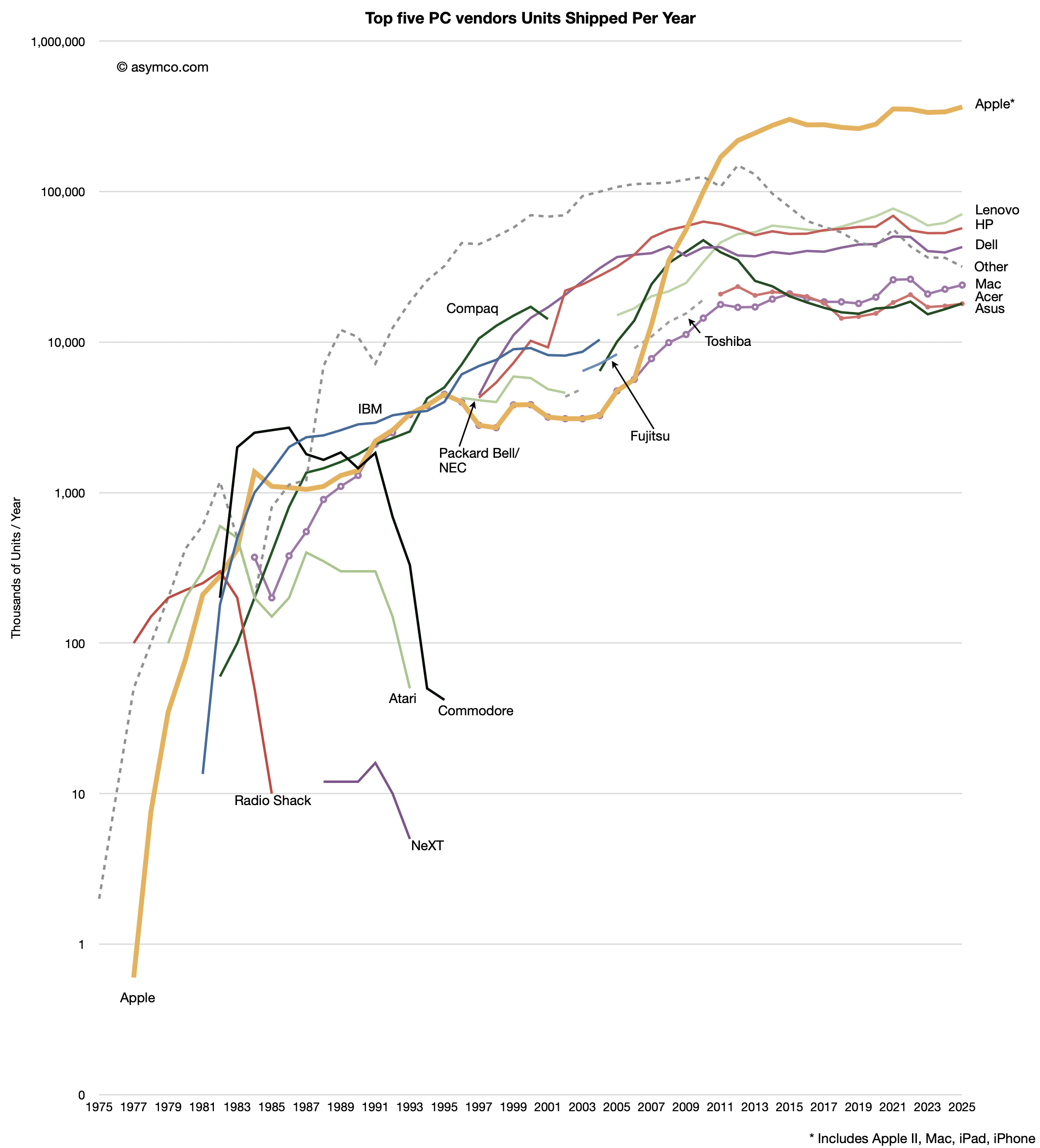
    The following graph shows the top computer makers by units sold since 1975, a year before Apple was founded. (Click on the graph to see a higher resolution.)

    Note that the graph is log scale and in multiples of 1000. Following the yellow Apple line we can see how it started with fewer than 1000 units shipped in its first year to today when it is shipping more than 1 million computers every day[2]. It's also quite remarkable to count how many other companies have come and gone in this top five list and imagine how many came and went in the "other" category.

    Who remembers Atari, Commodore, Packard Bell, Compaq? Few said that they were doomed while they were in the running. Going back to Apple at 40,

    After having a 40 50 year run and after selling more computers than all American and Japanese computer companies put together, how should we think about the next 40 50 years?

    First, clearly Apple shifted from being a “computer company”. It has already changed its name to exclude the word “Computer.” That [came to mean that] it sells devices (which happen to also include computers.) We don't use computers to compute anyway. We use them to make decisions, keep track of things, speed things up and to communicate and to entertain.

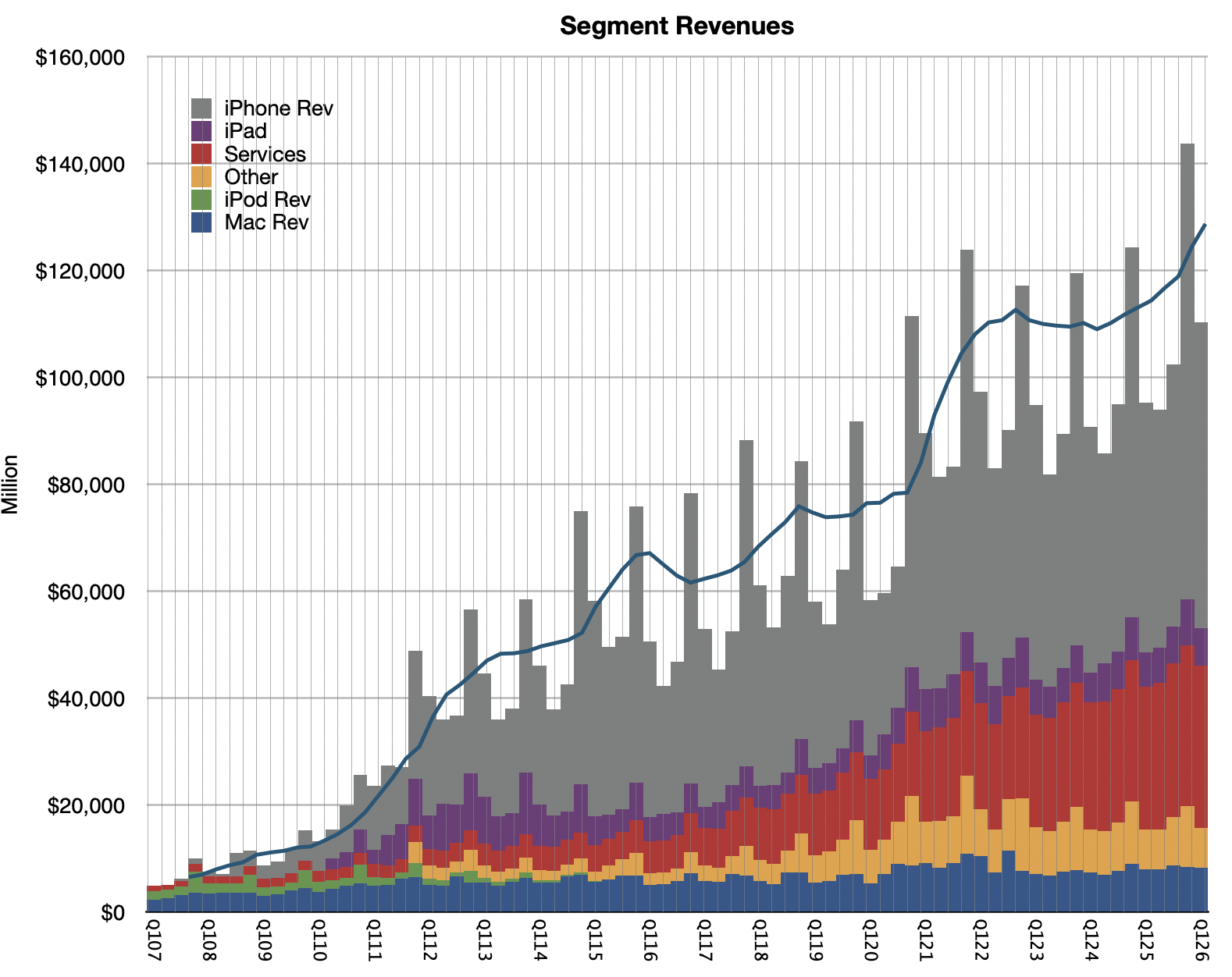
    After convincing the world that it's a not just a computer company, the next challenge has been to convince the world that it's also not just a product company. It did so by launching Services as a group (formerly known as iTunes Software and Services) and then separating the financial reporting so that Services can be measured with its own gross margin. Year after year management emphasized Services growth in its commentary. Services has grown into the second largest segment, 26% of total revenues ($112.8 billion out of 435.6 billion in calendar 2025.)

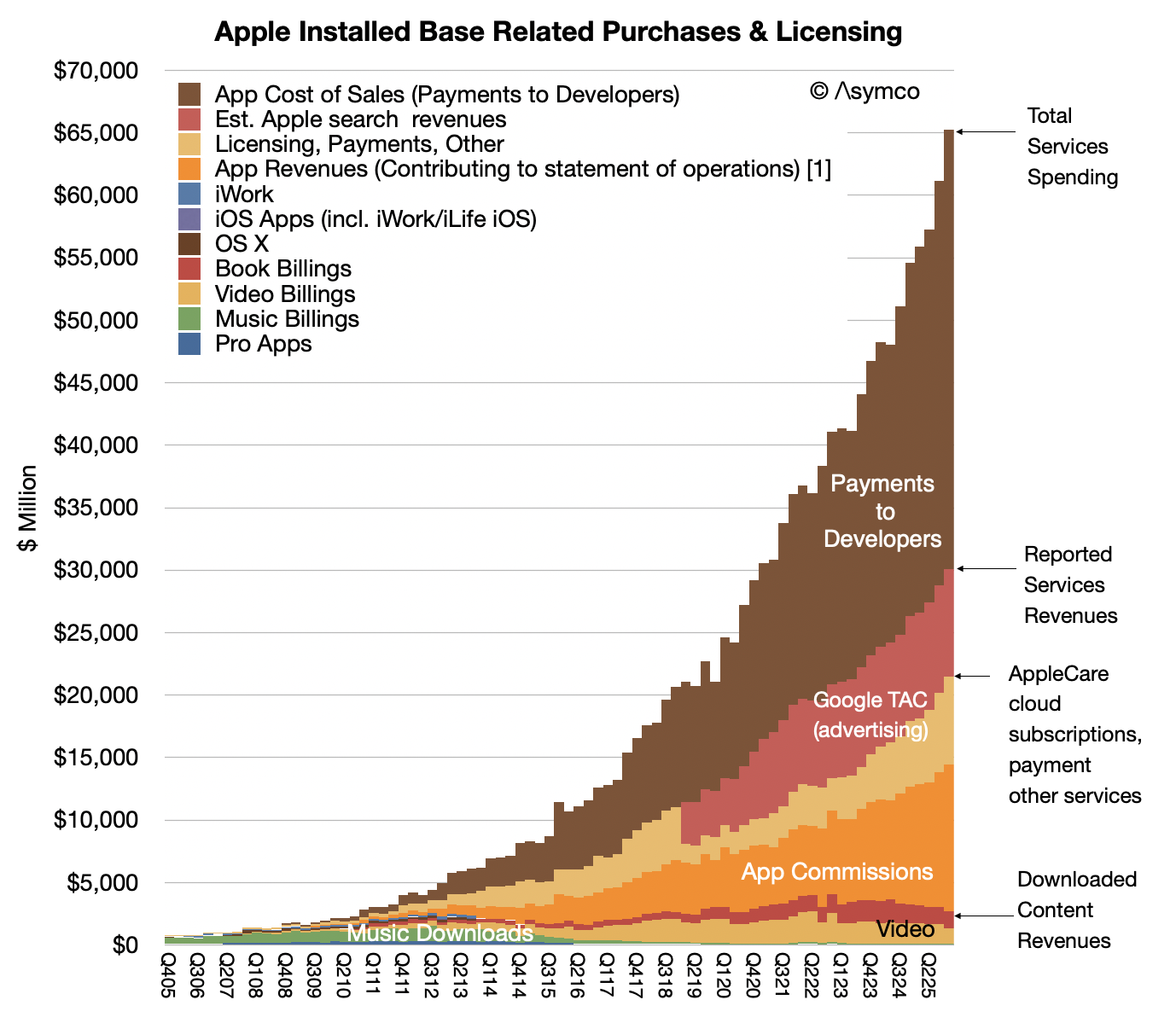
    Services, if it stood alone, would be number 40 in the Fortune 500 list of largest companies by sales. It has been impossible to ignore it. Considering how much customers actually spend on Apps, Content and Services, the total is even bigger at $240 billion last year[3]. As a result, some, perhaps most, recognize Apple as a Products & Services company.

    Apple’s services continue to see increased engagement, spending

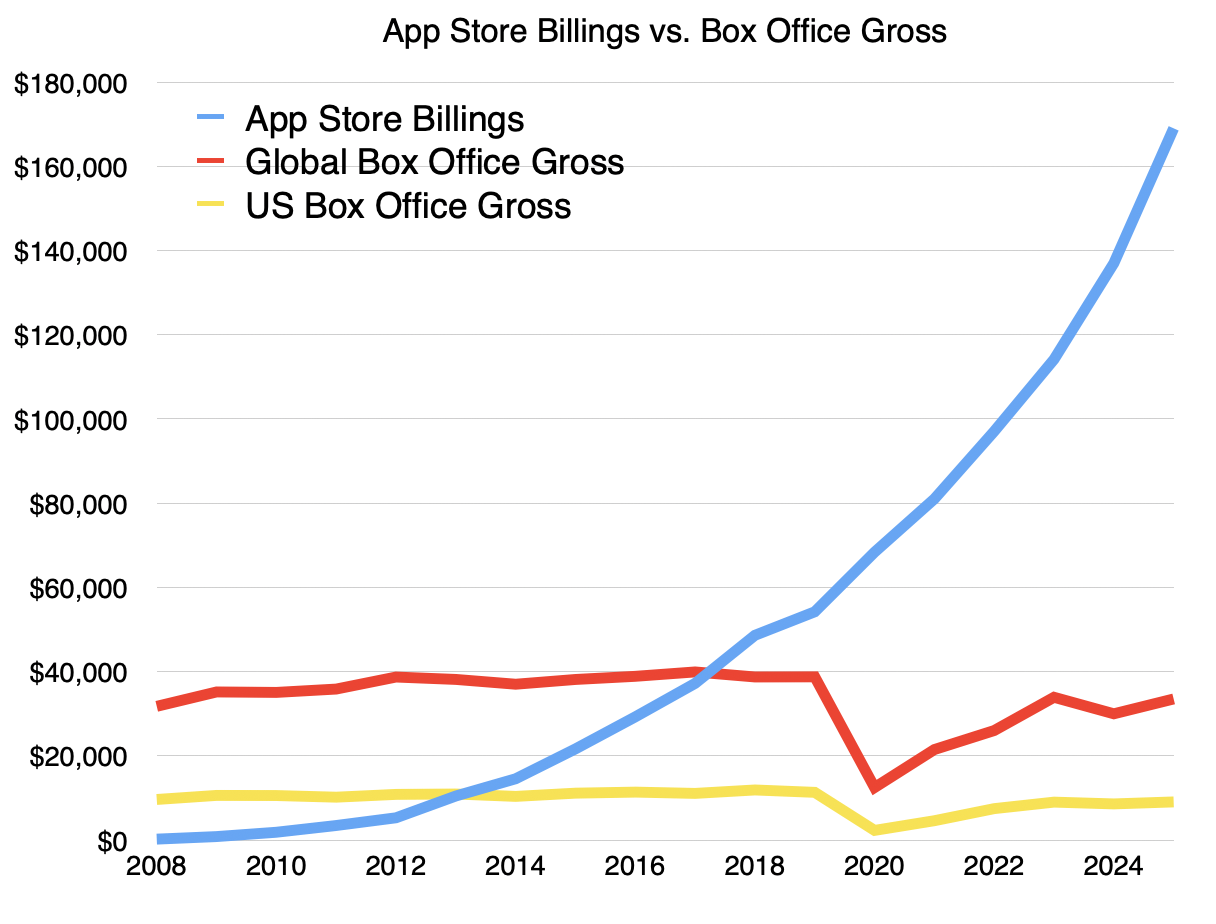
    The App store alone attracts $169 billion in spending per year (2025) and that is now 5x what theatrical movie sales bring in world-wide.[4]

    So if Apple is today at least a bundle of Products and Services then what will Apple be 50 years from now?

    Again from Apple 40:

    My simple proposal is to think of Apple as a customer creator. It creates and maintains customers. The more it creates, the more it prospers. The more customers it preserves the more it’s likely to persevere. This measure of performance for a company is not easy to obtain. It’s not a line item in any financial report.

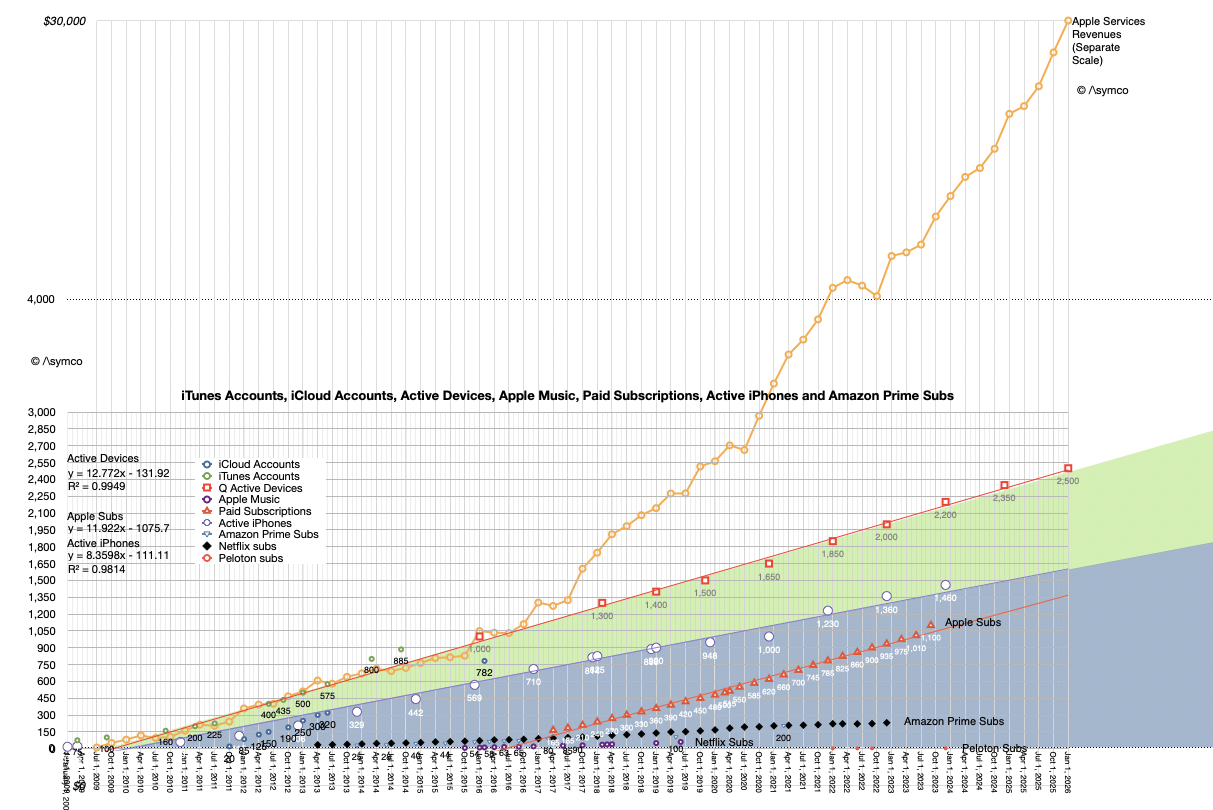
    The closest figure we have is that today Apple has one 2.5 billion active devices in use. It has around 1.1 billion users [5]. Using the devices as a proxy, we can say that this audience has more than doubled in the last decade.

    So we know that at least Apple has created a large number of customers. Knowing total devices sold and number in use means that we can be sure that 63% of all the computers Apple sold are still in use. This means that most customers are recent customers. Are they going to come back?

    If we then factor in the size and persistence of Apple’s audience (customer base) we might conclude that there are factors which will allow it to grow rather than shrink. My analysis based on public data shows that the customer base has been increasing steadily.

    And here is a graph showing the size of device base and implications for subscriptions. services and comparisons with other consumer aggregators. Note the forward looking nature of a linear extrapolation of the historical data.

    10 years ago, I continued:

    Combining the history of customer creation and customer preservation with the value obtained from each customer implies that the next 40 years will be about creating another large tranche of customers whose willingness to spend on whatever Apple creates will be relatively unchanged.

    We don’t know the limit. One billion was hard to imagine even one year ago. We might see two billion devices in short order. Perhaps not. Perhaps as we have a multitude of devices about us all day the number will become less meaningful. But if the number of middle class customers grows and as Apple keeps its products within their reach, there is no reason to think that there will be a reversal of the last 40 years in terms of customer acquisition.

    This analysis contradicts the current perception of the company as reflected by its stock price. That price assumes the audience will wither ((With a P/E ratio of 11, without a change in revenue per user, the only justification would be the audience shrinking by more than 90% over the next 20 years.)) That is not insanity. It is what we could expect if Apple were unexceptional.

    We did see 2 billion. We actually saw 2.5 billion. The assumption of a company in distress as reflected by the P/E ratio of 11 is gone. It's safe to say that Apple is exceptional.

    But note that we are only 10 years into that 40 year forecast from a decade ago. Do we still feel confident that the company can last 30 more years given what we've seen so far? If one company could get through the next 30 I would say it is Apple. And if it is so then I think it will get through the next 50.

    One more Thing

    So, the plan is to make more of the same. It's more than enough.

    1. Including Apple II, Mac, iPhone, iPad and iPod touch; excluding Apple Vision Pro, Apple TV and other iPods. Includes Q1 shipments estimated
    2. 2025 shipments were above 364.9 million excluding Apple Vision Pro, Apple TV, Apple Watch.
    3. A Fortune 15 ranking. This would be the case if payments to developers were counted as sales but that is not the case for accounting reasons. As a result Services margins are an extraordinary 76%, on the order of a software only business like Microsoft Office.
    4. As an aside, when I first started tracking this data it was early 2015. The App store had just overtaken US Box Office revenues and the outrage at my comparison and the skepticism that this sustainable was impressive. Much of the outrage was due to my choice of the headline "Bigger Than Hollywood". You can still read the 72 comments. App store billings are now nineteen times bigger than US Box office billings. I still stand by the idea that the App Store is Bigger than Hollywood. It is in fact bigger than many other forms of entertainment combined--more about this later
    5. Stay tuned for a detailed exposition of this audience
  11. Asymco Bulletin 001 / 22 Feb 2026

    Bulletin

    Asymco Bulletin is a digest of all the work we have published for the week ending Feb 22, 2026.

    Research

    Teen Survey Update: What happens when teens grow up?

    Latest data indicates 88% of teens own and intend to purchase iPhones, marking a decade-long trend of increasing adoption. This phenomenon transcends mere functionality; the iPhone has become a cultural icon, symbolizing status and identity.

    Unlike other Apple products, such as Apple TV+ or Apple Music, which struggle for traction among teens, the iPhone's appeal is deeply woven into the social fabric, partly due to generational continuity—the children of early iPhone adopters are now loyal users themselves.

    In contrast, social media platforms illustrate the fickle nature of tech usage among younger demographics. While Facebook remains prevalent among older millennials, Gen Z gravitates towards Instagram and TikTok, reflecting shifts in cultural preferences and digital behaviors.

    For Apple, success in services like Music and TV+ hinges on leveraging existing family dynamics through bundling.

    Read More →→→

    Apple in Europe: How many iPhone switchers are addressable in the near term?

    On the Q4 call, Tim Cook highlighted Greater China’s 38% year-over-year revenue growth, fueled by record iPhone sales, strong upgrade activity, and double-digit retail traffic gains.

    Europe, however, drew little attention—despite generating more revenue for Apple than China. This is peculiar.

    Europe’s smartphone market shows steady structural gains for iOS. Since 2018, share has risen from 24% to 39%, while Android has fallen from 74% to 60%—a 15-point swing equal to roughly 70 million additional users. With an installed base near 459 million users versus about 300 million in the U.S., Europe combines scale with affluence.

    In sum, the pattern for Apple in Europe is not saturation but share transfer, signaling durable competitive strength in a mature market and an inkling of how all markets will eventually behave in maturity.

    Read More →→→

    Estimating 2035 iPhone Users

    In the last quarter Apple reported 2.5 billion active devices. Of those, I estimate 1.6 billion are iPhones.

    Using this as a base, I've created an iPhone installed base estimate looking forward to 2030, integrating Statcounter’s market share data, Ericsson’s global smartphone user forecasts, and BankMyCell’s smartphone install base.

    The sources broadly align through 2025, though Statcounter’s historical iOS share (2017–2023) diverges somewhat, possibly reflecting Android’s heavier web traffic footprint due to usage patterns and bot activity rather.

    Taken together, the data points to iPhone nearing 2 billion active devices by 2030, consistent with overall smartphone adoption. Android’s projected rise toward 4.5 billion users signals continuing headroom.

    If switching dynamics and monetization trends persist, Apple’s ecosystem could expand to 2.5–3 billion users by 2035, with growth thereafter driven by switching and increased engagement depth and value extraction per user.

    Read More →→→


    Nota Bene

    Apple Announces Special Event in New York, London, and Shanghai on March 4 → Apple is hosting intimate, global "Special Apple Experience" events on March 4, 2026, likely unveiling new products like the iPhone 17e and M5-powered MacBooks, marking a fresh twist on traditional live-streamed launches.

    Apple adds video experience to Apple Podcasts → The "pod" in podcasts originated from Apple's iPod, with the company popularizing the medium by integrating podcasting into iTunes in 2005, and continuing to innovate with features like video podcast support and dynamic ad insertion.

    Why not maroon? The Macalope ponders the power of color → Apple's upcoming lineup, featuring color-excited anticipation for the iPhone 17e and modest updates to iPads, promises subtle yet intriguing tech advancements.

    Dan Ives Says Apple’s AI Alone Could Be Worth $1.5 Trillion → Apple's unparalleled distribution through its vast user base offers a significant competitive edge for rapidly monetizing AI innovations, potentially adding $1.5 trillion in value.

    While big tech burns cash on AI, Apple waits → As foundation models commoditize, Apple strategically curates top AI tech into its ecosystem, prioritizing user experience over engine development.

    Secure the chips, absorb the costs, and grab more market share → Apple faces memory cost inflation potentially raising iPhone prices, yet its strong ecosystem and execution provide resilience, whereas competitors like Samsung may struggle more due to lesser volume leverage.

    iPhone Emergency SOS via Satellite Helped Six Skiers Survive Tahoe Avalanche → Six skiers survived a deadly Lake Tahoe avalanche by using iPhone's Emergency SOS via satellite, highlighting its transition from luxury to essential. This feature enabled crucial communication with rescuers in remote areas lacking cellular service. The evolution mirrors mobile phones but faces slower adoption due to satellite bandwidth constraints.

    The US Supreme Court has ruled against US President Donald Trump’s decision to impose a raft of global tariffs → Apple and other affected companies may soon seek refunds for tariffs paid, following the Supreme Court's decision to invalidate Trump's tariffs, though the exact timeline and amount remain uncertain.

    Bankers complain that Apple has a tight grip on mobile payments → Canadian banks struggled to compete in the mobile wallet market, dominated by tech giants like Apple and Google, due to their risk-averse nature clashing with tech's innovation-driven approach.


    The all new Asymco One

    Introducing Asymco One Early Bird Pricing. → Asymco celebrates 17 years of insightful Apple analysis, launching Asymco One to guide stakeholders through Apple's evolving era with comprehensive content and community engagement. →

    Introducing: Asymco One Office Hours → Join Asymco One's monthly Office Hours with Horace to get live insights on Apple's business and financials, with special editions during key events.

    All Asymco Podcasts. All in One: Asymco One. → Exciting news: All Asymco Podcasts now under Asymco One subscription with remastered classics and new episodes.


    Asymco One gives you full access to our research, analysis, and commentary. Subscribe with code BULLETIN for a discount.

    Feedback: Have questions or comments? Reach out to us at contact@asymco.com. We’d love to hear from you.