That interpretation of the data is exaggerated and/or incorrect. An analysis of profitability was done with respect to Nokia here and industry-wide here.
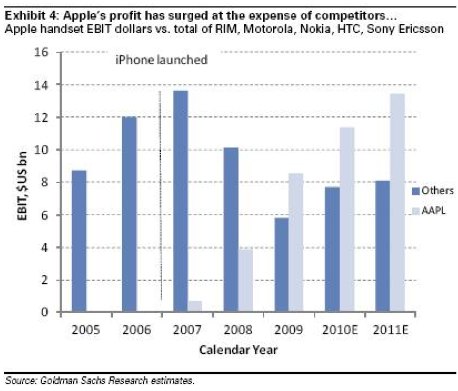
Goldman Sachs analysis (graph below) shows competitors' profits and losses combined. Sony Ericsson and Motorola generated negative profits during 2008 and 2009 and may do so through 2010. Apple's profits are likely to be larger than the industry *net* profits but not twice as much by 2011 (the graph does not even show that; 13.5 is not twice 8). Furthermore, the competitors do not include Samsung and LG!
Exaggeration or not, the fact remains that Apple entered the market in 2007 and in only three years became the most profitable phone vendor. It's indicative of the value of an integrated user experience innovation in the market, which itself is indicative of the value of software in a hardware-oriented incumbency.
While Apple's patent lawsuit against HTC remains ongoing, the Taiwanese handset maker has reached a licensing agreement with Microsoft to avoid another lawsuit over its Android-powered handsets.
On the eve of iPad sales start, and the soon-to-be classic quotes from iPad experts, it's time to play back some of the classic iPhone expert predictions from yesteryear:
"[iPhone] just doesn't matter anymore. There are now alternatives to the iPhone, which has been introduced everywhere else in the world. It's no longer a novelty." - Eamon Hoey, Hoey and Associates, April 30, 2008
"We are not at all worried. We think we've got the one mobile platform you'll use for the rest of your life. [Apple] are not going to catch up." - Scott Rockfeld, Microsoft Mobile Communications Group Product Manager, April 01, 2008
"Microsoft, with Windows Mobile/ActiveSync, Nokia with Intellisync, and Motorola with Good Technology have all fared poorly in the enterprise. We have no reason to expect otherwise from Apple." - Peter Misek, Canaccord Adams analyst, March 07, 2008
"[Apple should sell 7.9 million iPhones in 2008]... Apple's goal of selling 10 million iPhones this year is optimistic." - Toni Sacconaghi, Bernstein Research analyst, February 22, 2008
"What does the iPhone offer that other cell phones do not already offer, or will offer soon? The answer is not very much... Apple's stated goal of selling 10 million iPhones by the end of 2008 seems ambitious." - Laura Goldman, LSG Capital, May 21, 2007
Motorola's then-Chairman and then-CEO Ed Zander said his company was ready for competition from Apple's iPhone, due out the following month. "How do you deal with that?" Zander was asked at the Software 2007 conference. Zander quickly retorted, "How do they deal with us?" - Ed Zander, May 10, 2007
"The iPhone is going to be nothing more than a temporary novelty that will eventually wear off." - Gundeep Hora, CoolTechZone Editor-in-Chief, April 02, 2007
"Apple should pull the plug on the iPhone... What Apple risks here is its reputation as a hot company that can do no wrong. If it's smart it will call the iPhone a 'reference design' and pass it to some suckers to build with someone else's marketing budget. Then it can wash its hands of any marketplace failures... Otherwise I'd advise people to cover their eyes. You are not going to like what you'll see." - John C. Dvorak, March 28, 2007
Even if [the iPhone] is opened up to third parties, it is difficult to see how the installed base of iPhones can reach the level where it becomes a truly attractive service platform for operator and developer investment." - Tony Cripps, Ovum Service Manager for Mobile User Experience, March 14, 2007
"I'm more convinced than ever that, after an initial frenzy of publicity and sales to early adopters, iPhone sales will be unspectacular... iPhone may well become Apple's next Newton." - David Haskin, Computerworld, February 26, 2007
"Consumers are not used to paying another couple hundred bucks more just because Apple makes a cool product. Some fans will buy [iPhone], but for the rest of us it's a hard pill to swallow just to have the coolest thing." - Neil Strother, NPD Group analyst, January 22, 2007
"The iPhone's willful disregard of the global handset market will come back to haunt Apple." - Tero Kuittinen, RealMoney.com, January 18, 2007
"[Apple's iPhone] is the most expensive phone in the world and it doesn't appeal to business customers because it doesn't have a keyboard which makes it not a very good email machine... So, I, I kinda look at that and I say, well, I like our strategy. I like it a lot." - Steve Ballmer, Microsoft CEO, January 17, 2007
"The iPhone is nothing more than a luxury bauble that will appeal to a few gadget freaks. In terms of its impact on the industry, the iPhone is less relevant... Apple is unlikely to make much of an impact on this market... Apple will sell a few to its fans, but the iPhone won't make a long-term mark on the industry." - Matthew Lynn, Bloomberg, January 15, 2007
"iPhone which doesn't look, I mean to me, I'm looking at this thing and I think it's kind of trending against, you know, what's really going, what people are really liking on, in these phones nowadays, which are those little keypads. I mean, the Blackjack from Samsung, the Blackberry, obviously, you know kind of pushes this thing, the Palm, all these... And I guess some of these stocks went down on the Apple announcement, thinking that Apple could do no wrong, but I think Apple can do wrong and I think this is it." - John C. Dvorak, January 13, 2007
"I am pretty skeptical. I don't think [iPhone] will meet the fantastic predictions I have been reading. For starters, while Apple basically established the market for portable music players, the phone market is already established, with a number of major brands. Can Apple remake the phone market in its image? Success is far from guaranteed." - Jack Gold, founder and principal analyst at J. Gold Associates, January 11, 2007
"Apple will launch a mobile phone in January, and it will become available during 2007. It will be a lovely bit of kit, a pleasure to behold, and its limited functionality will be easy to access and use. The Apple phone will be exclusive to one of the major networks in each territory and some customers will switch networks just to get it, but not as many as had been hoped. As customers start to realise that the competition offers better functionality at a lower price, by negotiating a better subsidy, sales will stagnate. After a year a new version will be launched, but it will lack the innovation of the first and quickly vanish. The only question remaining isif, when the iPod phone fails, it will take the iPod with it." - Bill Ray, The Register, December 26, 2006
"The economics of something like [an Apple iPhone] aren't that compelling." - Rod Bare, Morningstar analyst, December 08, 2006
"Apple is slated to come out with a new phone... And it will largely fail.... Sales for the phone will skyrocket initially. However, things will calm down, and the Apple phone will take its place on the shelves with the random video cameras, cell phones, wireless routers and other would-be hits... When the iPod emerged in late 2001, it solved some major problems with MP3 players. Unfortunately for Apple, problems like that don't exist in the handset business. Cell phones aren't clunky, inadequate devices. Instead, they are pretty good. Really good." - Michael Kanellos, CNET, December 07, 2006
"We've learned and struggled for a few years here figuring out how to make a decent phone. PC guys are not going to just figure this out. They're not going to just walk in." - Ed Colligan, Palm CEO, November 16, 2006
Starting in January, Apple launched a series of C-Level discussions with tier-1 handset makers to underscore its growing displeasure at seeing its iPhone-related IP infringed. The lawsuit filed against HTC thus appears to be Apple's way of putting a public, lawyered-up exclamation point on a series of blunt conversations that have been occurring behind closed doors.
Top-tier handset makers continued to avoid implementing multi-touch, but Apple could safely assume that they were hanging back to gauge Apple's response to Motorola and HTC. If there wasn't one, the OEMs would likely read the silence as a green light, especially after Google also moved to enable multi-touch on its Nexus One phone.
Even before the lawsuit, handset makers were having second thoughts about Google, which with the Nexus One had become a direct competitor. Now their faith in Android as the easiest and cheapest way to counter the iPhone has been shaken, says Reiner.
Therefore it’s entirely likely that HTC was singled out to disrupt the business logic of modular mobile software. HTC is the pioneer and the hub as the largest licensee for both WinMo/WinP and Android and the inspiration for hundreds of OEM/ODMs to make modular products.
... Other vendors looking at this licensing model might think harder about participating, and that may be the whole point.
We previously estimated that Google might sell 3.5 mn Nexus One units in 2010. Initial data-points were disappointing, possibly due to limited marketing and customer service challenges. Flurry estimated (based on mobile traffic) that Google sold 20,000 in the first week, and 80,000 in the first month, both annualizing to 1.0 mn. We forecast that Google sells 1.0 mn Nexus One units in FY2010, benefiting from US carriers other than T-Mobile, and non-US carriers such as Vodafone, promoting the device too, but suffering from limited marketing activity. We assume that Google rolls out a second Nexus handset, markets it more aggressively, and makes it available offline, and therefore forecast that Google sells 2 mn handsets per year in 2011 and future years.
Symbian will lose smartphone battle By Rob Jones at Gartner Symposium ITxpo, Cannes [07-11-2003] Microsoft's standardised handsets will win the day, says Gartner
Analyst Gartner has warned that, without a concerted effort by Symbian and its backers, Microsoft will sweep them aside in the smartphone business.
Redmond's ability to offer standardised handsets which are easier for businesses to support and use will help the software giant win corporate approval, the market watcher predicted.
The analyst predicted that Microsoft will ship a phone boasting strong integration of a range of packages, such as Exchange and Outlook.
Symbian, he added, needed to resolve a number of issues to be a credible, corporate alternative. Its platform and menus differ slightly on various handsets, which means that they often do not have the same user interface.
So spoke Nick Jones, vice president and research fellow at Gartner in 2003.