Asymco

Asymmetric Intelligence

iOS

  1. What job is a Blackberry hired to do?

    Research · 15 comments

    When mobile platforms are discussed, the conversation frequently turns to market share battles between Android and iOS. I've pointed out before that the problem with this reasoning is that market share in a market that's growing at 90% is a false measure of performance.

    The more important measure is how much of the non-smartphone market is being taken by smartphones and how fast the whole phone market is growing. Competition with non-consumption is very different from platform warfare.

    But even when discussing the rivalry between current platforms, the Blackberry and Symbian are often overlooked as contenders. Windows Phone and iOS come in and out of discussion only on the basis of press releases. The truth is however that Symbian, Windows, Blackberry are not going to disappear anytime soon.  Why is that?

    The reason is that when you stop framing the market as rivalry between platforms, you see that many buying decisions are driven by specific device value propositions or jobs that the products are hired to do. For many years smartphones were purchased because they had the best cameras or the best keyboards and users never downloaded any apps or even used data plans.

    Later, smartphones were purchased because they allowed for browsing and gameplay. Very rarely did buyers opt for "iOS" or "Symbian". Most buyers don't even know what these words mean. Phones are rarely advertised according to their platforms. (As an aside, the mention of Windows in a PC ad is made possible by Microsoft funding, the same as "Intel Inside." So for platform recognition, someone needs to fund the promotion and that implies some revenue to justify it.)

    To illustrate, consider the Blackberry: A product that continues to grow despite a completely different basis of competition from the large screen touch competitors. It comes down to being good at some very specific jobs. RIM continues to grow in certain markets like Latin America and the Middle East on the basis of BBM (RIM’s sales outside the U.S. climbed 94 percent last quarter from a year earlier.)

    “A 15-year-old boy who likes a 15-year-old girl, sends her a BBM and he’s able to measure how important he is to her based on the speed of response after the letter turns to an R,” meaning it’s been read, he says. “No one else runs an end-to- end service plan like we do. That’s killer and is why it’s almost a social phenomenon.”

    or

    BBM is also popular in socially conservative Saudi Arabia where its speed -- messages are typically sent in less than two seconds, according to Morgan Keegan -- has made it a way for teenagers to communicate in a country where religious police bar unmarried couples from meeting in public.

    You could argue that the other platforms also allow for free messaging (through free texting apps) but the combination of a low cost device, a data plan and attention to detail (like Message Read notification) gives the Blackberry an edge.

    The general purpose smartphone that Google and Microsoft and Apple promote is still not the prevailing view of mobile usage for most buyers. One could also argue that many if not most Nokia smartphones are still being "hired" to do feature phone jobs.

    The fact that all these devices are classified as smart and therefore competing misses the point that they are hired for different things.
  2. Visualizing smartphone platform growth

    Research · 55 comments

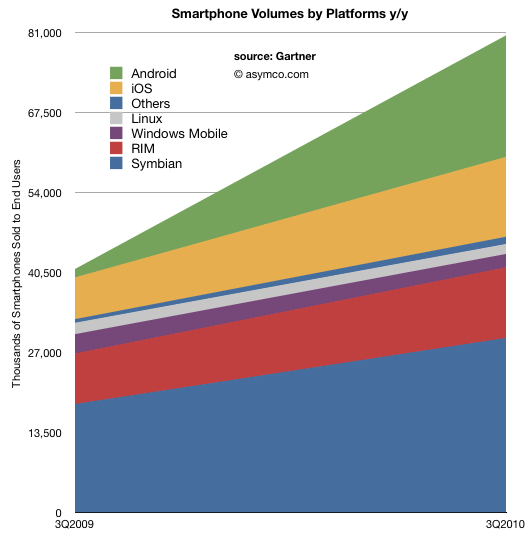
    None of this should come as major surprises, but Gartner's data allows for a bit more granular detail in the overall view of the market. Here are new points derived from Gartner's sell-through data:

    • The smartphone market is growing at nearly 100% (96%).
    • The overall market is growing at 35%.
    • The non-smartphone market is growing at 25%.
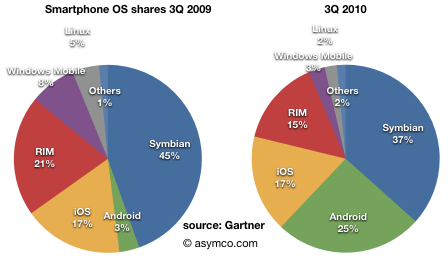
    • Android grew at 1,340% y/y. iOS grew at 92%, Symbian at 61% and RIM at 40%.
    • Platform market shares (below) shows a more even distribution of platform volumes between four main platforms:
    • Non-branded mobile phones grew to 33% of the market, with 141% unit growth. This is an alarming figure for the low-end of the market. The unbranded market excludes ZTE and Hauwei which grew below the overall market growth (9.8%, 27% respectively). The implications were most dire for Motorola (-36% units growth), Sony Ericsson (-23%) and LG (-14%). Nokia grew but, at 3.5%, well below market growth.
    • In 3Q 2009 41 million smartphones were sold. In 3Q 2010 80.5 million were sold. If we were to split the growth among platforms, nearly half the growth was Android. 27% of the additions were Symbian and 16% were iOS. Only 8.3% of the growth was RIM devices.
    • Windows Mobile and Linux were the only smartphone platforms to shrink volumes. However, even though the platform is deprecated, 2.2 million Windows Mobile devices were still sold last quarter -- more than Android sold a year earlier.
  3. The Mac App Store: can it change the software business?

    Research · 36 comments

    What is it that makes the iTunes App Store so compelling? Will the value the App store added to the iPhone be added by the Mac App Store to the Mac?

    Here are the characteristics I think make the App Stores valuable:

    1. They redefine software as content. The pricing, marketing, discovery and buying process is identical to that for content like music or video.
    2. They redefine the skill required to create a relationship with customers. They allow a new class of less-skilled and less-capitalized developers participate in selling software directly to the buyer. By "skill" I don't mean engineering skill but marketing skill. A developer can create a product that can reach millions without having to acquire with channels and distribution skills.
    3. From a consumer's point of view, they simplify purchasing and lower the price of software.

    These three characteristics of app stores make them disruptive. The disrupted companies are the traditional software publishers. The response from game publishers to the App store were predictable: they condemned it for destroying value, "cheapening" their product, and creating a race to the bottom. They also predicted that it would all end badly as nobody would make any money.

    The truth is that they were disrupted by different cost structures. The entrants did not need to spend on market development, and focused on innovating on the essential novelty of the user interface.

    So the Mac App Store could be disruptive to traditional software vendors. A large new population of software developers could emerge targeting the Cocoa environment and they may bring new apps that move the jobs that the computer is hired for to appeal to new users.

    However there is a problem. The Mac is a small target market relative to iOS. Apple announced that there are 50 million Mac users. This compares badly to the 130 million (or so) iOS users. It won't be long before 50 million iOS users will be added every three months.

    So the first thing that Apple needs to do is grow the Mac installed base. Perhaps the new Air and following updated to the MacBooks will do just that. But the growth rate needs to be an order of magnitude faster. And I suspect price is an obstacle to this growth.

    Regardless of this obstacle, the Mac App Store has the potential to change the appeal of the Mac. As the first personal computer with an App Store, new uses may emerge and create the same app-platform effect.

  4. Back to the PC

    Research · 67 comments

    Apple's "Back to the Mac" was a clever play on words. Everyone expected it to mean that the event was going to focus back on new Mac products.  As we had been so steeped in iDevice news the Mac was feeling neglected. It was time to take the discussion "back to the Mac."

    Instead Apple told us that the Mac and OSX were going to become more like Devices and iOS. iOS innovations were what's going "back to the Mac"

    So it wasn't "back to talk about the Mac" it was "OSX went to iOS and iOS is going back to OSX." The strategic upshot of it is that "the Mac is an extension of the device portfolio." Heady stuff. We'll need to chew on this for a while.

    But some implications are easy to foresee. For example, the consequences for competitors. When Apple launched the iPhone, competitors followed suit, powering their phones with a variety of "open" operating systems. When Apple launched the iPad, competitors followed suit, powering their devices with a variety of "open" operating systems. These reactions to Apple's initiatives by dozens of "open-wielding" competitors are all being touted as the inevitably winning strategies.

    So, as we've observed all of Apple's strategies being copied, I can't wait to see the competitors follow its "back to the Mac" strategy:

    • It won't be long before Dell takes UI and hardware design elements from the Streak "back to the PC." Think of the magic that will happen when Android Froyo "hooks up" with Windows 7.  Both Android and Windows being "open", if I squint hard enough I can just visualize the tweet from Andy Rubin of the command line to build a new Windows  8 with Android mojo. The Android Market selling Windows Apps. It will be beautiful.
    • Or perhaps we'll soon see "back to the Blackberry" as RIM takes QNX interface elements back to their core business. Not so sure about the command line make statement there.
    • Or maybe Nokia will announce "back to Symbian" as they take gestures from the ultra-open MeeGo to do an evolution of their majestically open Symbian.

    These initiative will surely be helped by the vast community of open developers surging to support the great open merged PC/tablet/device future.

    As a clue to the sarcasm challenged: The power of Apple's integrated approach across its product lines goes deeper than the user experience.

  5. iOS users are ten times more likely to download apps than Symbian users

    Research · 13 comments

    With the number of active Nokia service users now reaching 140 million worldwide, the company today announced that more than 200,000 people are currently signing up daily to Ovi, and that Ovi Store has reached the milestone of 2.3 million downloads per day. Available in more than 190 countries,

    via Nokia Ovi Services Continue to Grow.

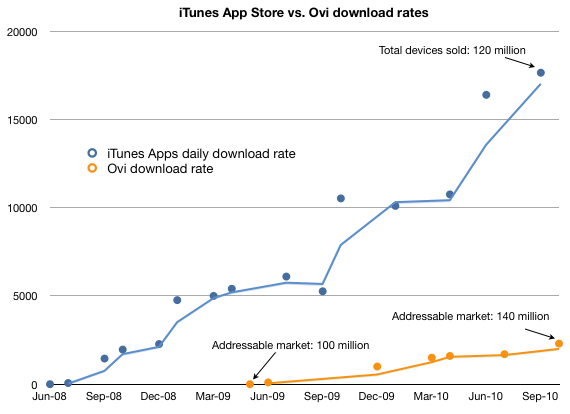
    Nokia updated its tally of download rates so we can put the numbers side-by-side with Apple's iTunes.

    The slope of the Ovi curve does not yet compel one to get excited over the platform's prospects in the near term. However to get a true picture, one needs to not only look at absolute download numbers but also the probability of any one user or device being used to download an app.

    For this we need to note how the number of devices relates to the download rate. Apple announced recently that they sold 120 million devices running iOS. Not all those devices are still in use.  If we remove 20 million from that total we get approximately 100 million iOS devices. Nokia, on the other hand, specified exactly how many devices can access the Ovi store: 140 million.

    Therefore 100 million iOS devices download at a rate of 17.7 million per day while 140 million Symbian devices download at the rate of 2.3 million per day.

    That puts the weekly download rate per device at 1.24 for iOS users vs. 0.12 apps (or whatever is the appropriate content item for Ovi) every week for Symbian users.

    As the table below details, the rate of downloads per device for iOS is more than 10x higher. This is the more interesting number if you are a developer.

    If someone can point me to Android Market download rate (historic and/or current) I can add it to the mix.

  6. Is Android share of Web lagging iOS share of Web?

    Research · 12 comments

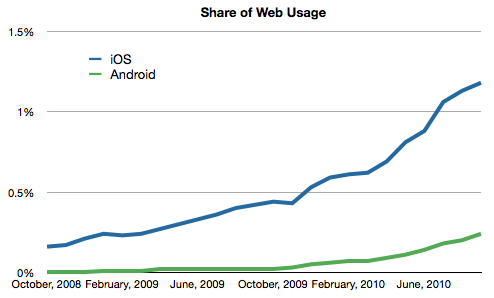
    Of all the public statistics about platform share, Share of web use must be the most important measure for Google. The more browsing people do, the more searching they do and if Google search is most likely for a platform then the more income Google derives from that platform.

    NetMarketshare.com has offered an insight into the split between Android and iOS as search platforms and it shows how iOS is still five times more likely to yield search revenue than Android. That multiple is likely to shrink as the gap narrows, but it still demonstrates the power of iOS to drive Google's bottom line. It's no wonder then why Google has renewed their default placement of Google search in mobile Safari (a guarantee they don't seem to share with all Android licensees.)

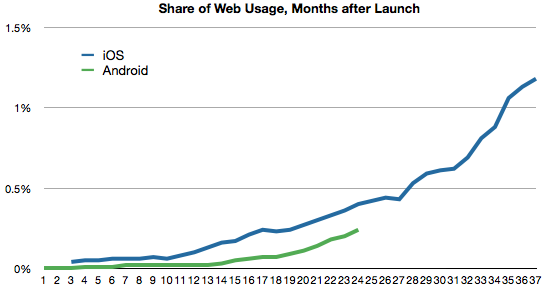
    But Android launched later than iPhone, so everyone should be asking how rapidly the share of Web has grown since the start of each platform. When iPhone launched in 2007 it was almost competing with mobile web non-consumption. The alternative mobile browsing experiences were so bad that it's hard to remember anyone putting up with them. A year later, the bar was set higher and Android filled a vast chasm of demand for mobile browsing for people who could not buy an iPhone.

    At the same point in the life of each platform, Android seems to be exploding in units sold. With this proliferation of Android licenses, it should be interesting to see if their unit share numbers are reflected in web share numbers. So far the story is not convincing. The growth in Web share is not pacing faster than iOS achieved at a similar point in time.

    So far, 24 months into the life of each platform, iOS leads by almost 50% higher share.

    iOS/mobile Safari has the advantage of iPod and iPad for distribution but that does not explain the relative lag of Android with respect to Web share as Android has a large number of SKUs.

    It may be too early to draw conclusions, but anyone trying to analyze Google's strategy with Android should be paying close attention to this.

  7. RIM Quarterly update: just the numbers

    Research · 11 comments

    Noteworthy data (with my notes in parentheses.)

    • 12.1 million phones shipped, 11 million sold through (estimated iPhones for this Q range from 11 to 13 million)
    • Net subscriber account additions were 4.5 million which was lower than anticipated (41% of units sold through were to new subscribers which implies nearly 60% were to existing users)
    • Revenue grew 31% over the same quarter last year and GAAP earnings grew 76%.
    • The BlackBerry subscriber account base grew 56% year-over-year to over 50 million
    • RIM has shipped approximately 115 million handhelds to date. (note: 120 million iOS to date)
    • BlackBerries are available through over 565 carrier and distribution partners in approximately 175 countries and international markets (vs. 150 carriers and 88 countries for the iPhone)
    • Approximately 52% of revenue in the quarter was generated outside the United States and over 45% of BlackBerry subscriber account base is outside of North America. (70% of iPhones were sold outside the US through the first half of this year)
    • Torch was launched with one carrier but will expand to 75 next quarter
    • To date over 35 million BlackBerry Smartphones have downloaded App World at an average of over 1.5 million Apps are being downloaded every day which is up 40% sequentially (iOS apps are running at 17 million downloads per day)
    • Average selling price for RIM devices was $304 (vs. $600 for the iPhone)
    • Gross margin was 44.5% (upward of 50% for the iPhone)

    Research In Motion CEO Discusses F2Q2011 Results - Earnings Call Transcript -- Seeking Alpha

  8. Gartner Predicts Mobile OS Market Share

    Research · 15 comments

    Lots of people apparently think it’s a big deal that Gartner is predicting Android will surpass iOS for second place. But why is that necessarily a good thing, given that they’re predicting Symbian will remain in first place? Who thinks Symbian is actually doing well? Nokia’s board sure doesn’t.

    via Daring Fireball Linked List: Gartner Predicts Mobile OS Market Share.

    I also noted with amusement that by 2014 "other" is slated to sell 85 million units or nearly 10% share, up from 6.1% in 2009. These "others" will be selling more than twice what Apple is expected to sell this year. Is "other" WebOS, Bada, MeeGo, LiMO? If so they're in for a healthy future.

    But dwelling on details like these is missing the point. To see how improbable this prediction is, let's go back to 2006 and ask what Gartner was forecasting would happen now.

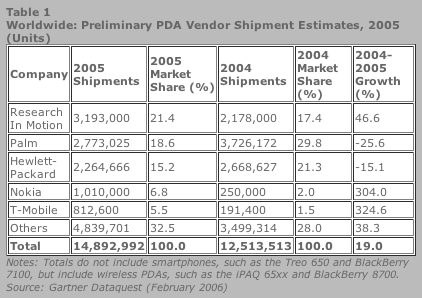
    First thing to note is that in 2006 Gartner was busy tracking PDA sales. You might wonder why this is relevant. The reason is because a significant proportion of RIM's Blackberries counted as wireless PDAs and were therefore considered to compete with Palm's Treos, HP's iPaq and Dell's famous Axim. Nokia was in the running with its Communicators. Here is how Gartner characterized the equivalent market in early 2006:

    So I'll just come out and say it: In 2006 Gartner did not have a clue what a smartphone was. By their admission:

    Gartner defines a PDA as a data-centric handheld computer weighing less than one pound that is primarily designed for use with both hands. These devices use an open market operating system supported by third-party applications that can be added into the device by end users. They offer instant on/off capability and synchronization of files with a PC. A PDA may offer WAN support for voice, but these are data-first, voice-second devices.

    In other words, in 2006 Gartner was splitting phones with operating systems into two separate markets: data-oriented wireless PDAs and voice-oriented smartphones. The split was mostly based on the judgement of the analyst on whether a device was "voice" or "data" oriented. I suppose they used the primary input method as a proxy: numeric keypads meant the device was one-handed and therefore voice-oriented. If the device had a full keyboard and/or a stylus-actuated touch screen then it was a two-handed data-oriented device. But even this proxy was not quite enough, sometimes devices were classified whimsically.

    To make it more complicated, they bundled non-cellular but Wi-Fi enabled PDAs with wireless PDAs. This made some sense from a corporate IT point of view (their primary customer base) as these data-oriented devices would be used either on a LAN or a WAN (Wide Area Networks: what Gartner anachronistically called cellular networks.)

    The presence or absence of a cellular radio did not enter into their view of these devices. So if you asked Gartner in 2006 to forecast smartphones (as we know them now) in 2010, I suppose you'd get what they forecast for "data-centric" devices.

    So assuming that today's smartphones are mostly "data-centric" we would have to look back on their view of that market and not the voice market which was seen as an entirely different thing. Their answer should have had something to do with the market leaders and participants in 2006. As the table above shows Gartner showed that RIM, Palm and HP led in 2005 with Nokia and T-Mobile[1] pulling up the rear.

    However, from a platform point of view, at the beginning of 2006

    Microsoft Windows CE was the No. 1 PDA operating system (OS) in 2005 as 7.05 million PDAs were loaded with the OS, up 33 percent from 2004 shipments of 5.28 million units. Palm OS PDA shipments declined 34 percent to 2.96 million units in 2005.

    In late 2006, Gartner made further predictions for the year:

    In 2006, Gartner expects the PDA market to increase by 6.3 percent to 16 million units. The market will continue to be driven by broader availability of cellular-enabled PDAs from wireless carriers. Gartner estimates that 53 percent of all PDAs shipped in the first half of 2006 featured integrated cellular capability, up from 46 percent during the same period in 2005. “The share of PDAs purchased by enterprises will continue to increase; it accounted for 49 percent of all PDA shipments in the second quarter of 2006 and Gartner expects that the enterprise market will account for 52 percent of all PDA shipments in 2006,” said Todd Kort.

    At this time I have not yet dug up a Gartner "Wireless PDA OS" four year forecast from the year 2006 but I suspect it would not show devices running Google's Android operating system or any running something called iOS.

    I also seem to remember that they were suggesting that Windows would be the leading mobile platform. Although it was trailing in 2006, Gartner was quite bullish on the disruptive challenger from Redmond.

    [1] T-mobile is in the list because it was common practice in 2006 for operators to market Pocket PC Phone Edition devices made by HTC under their own name. Orange, Vodafone and Verizon also had own-brand HTC Windows touch-based devices. Now what does that strategy remind me of?

  9. 54 apps have been downloaded for every iOS device sold

    Research · 19 comments

    At the September 1st music event, Apple announced that 6.5 billion apps were downloaded and that there had been 120 million iOS devices sold.

    This works out to 54 apps per iOS device.

    On June 7 Apple reported 5 billion apps over 100 million iOS devices or an average of 50 apps for iOS device.

    On April 8th, I computed that the app attach rate was 47.

    Is this rate noteworthy?

    Let's rewind to two years ago.  August 27th, 2008, soon after the App store launched.

    Nokia had just declared that its users had downloaded over 90 million applications over the past 2 years. An analyst estimated that over 100 million users globally use Nokia smartphones/converged devices, implying an attach rate of less than 1 app/smartphone.

    My, how expectations have changed.

  10. iPod touch made up 37.7 percent of all iOS devices sold so far

    Research · 13 comments

    On September 1st, Apple announced that 120 million iOS devices were sold to date.

    We know that there were 59.6 million iPhones sold through June (from SEC filings)

    We also know that 3.2 million iPads were sold.

    If we assume about 8 million iPhones and 4 million iPads were sold during August and July, the total number of iPod touch sold is 45.2 million.

    That is 37.7% of total units.

    In April I wrote that 41% of all iOS units sold were iPod touch to date.

    The expansion of iPhone distribution plus the addition of iPad as reduced the platform footprint for the iPod, but it's still a sizable chunk. More than one in three iOS units in use are non-cellular devices. As the iPad rolls that number could move toward 50%.

  11. Where are the iPod touch knockoffs?

    Research · 96 comments

    The latest iOS numbers and the new iPod touch launch demonstrate what a huge hit the iPod touch has become. It's safe to assume that about half of all iPods, or between 4 and 5 million units in the current quarter, are sold as touch versions.

    The iPod touch has been around about as long as the iPhone. It was launched three months after the first iPhone 2G, almost exactly three years ago. While the iPad has been in the market less than six months, a large number of potential competitors have been launched running Android and there seems to be a real rush to market. Six months is about as quickly as any hardware product can be reasonably engineered.

    So the question is why is the iPad being cloned while the iPod has remained in the market by itself?

    The value of the iPod is arguably as high with a healthy margin and consistent pricing. The volumes are comparable with tens of millions already sold so there is no obvious economic disadvantage to the iPod vs. iPad. Indeed, the iPod touch is a large (1.6) multiplier to the whole iOS platform. The demographics are very sweet too with a clear upsell opportunity.

    One explanation might be that the iPod is a music device and that market has been locked up with iTunes, putting up a huge barrier to entry. However during the music launch this month, there was almost no mention of the iPod touch as a music player while it was loudly touted as a game and app platform. Browsing and Facetime are also huge uses for the device.

    So in the iPod touch we have a mini iPad--ironically, the dig at the iPad was that it was nothing more than a large iPod touch.

    So if cloners are rushing to copy the iPad, why not its smaller incarnation?