Asymco

Asymmetric Intelligence

iPhone

  1. Prepare for unrestricted iPhone distribution

    Research · 3 comments

    I'm picking up all kinds of signals that Apple is about to let loose with a storm of operator distribution deals.

    It all started with Tim Cook's comment in the last conference call:

    Over the past year we have moved a number of markets from exclusive to non-exclusive. In each case as we have done that we have seen our unit growth accelerate and our market share improve

    Now we are hearing of unrestricted iPhone distribution in France and today the rumor of T-Mobile picking it up in the US (which I always thought was more logical than Verizon).  There are other hints from the Nordic countries

    Three to Carry iPhone 4 in UK | News | The Mac Observer observes that there will be five (!) UK carriers selling it.

    In addition to the super-steep ramp of 88 countries launching in 3 months.

    It looks like Tim pulled all the stops.

  2. The next 100 million iOS devices

    Research · 9 comments

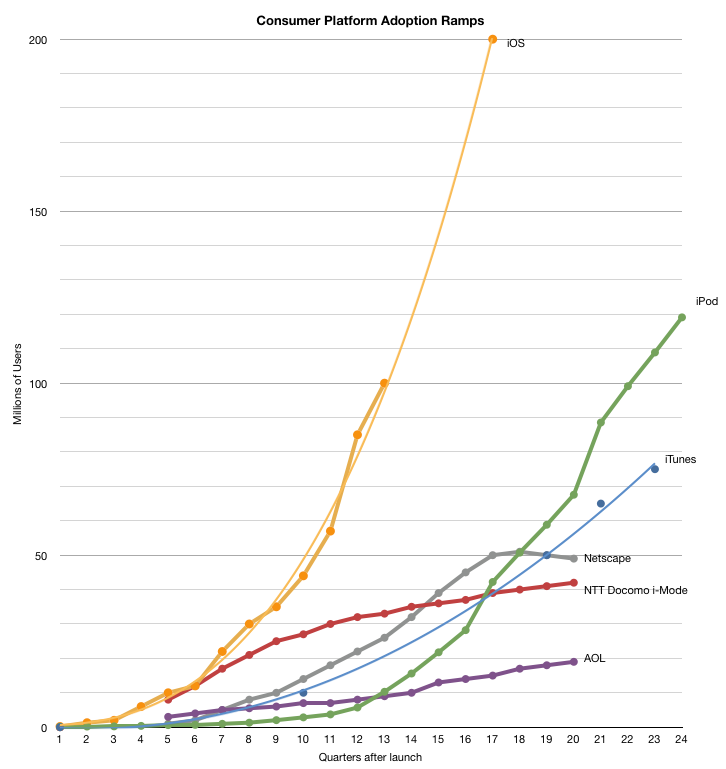
    As iOS crosses 100 million units sold 3 years after the platform launched, it's time to look forward to the next 100 million. My expectation is that well over 100 million iOS devices will sell during 2011, but even during the next 12 months (2H '10 and 1H '11) the total may well reach 100 million, making 200 million installed by June 2011 very likely.

    Here is where the numbers will come from:

    iPhone: Assuming only 50% growth (half of the average growth seen so far) gives 50 million units in the next 12 months.

    iPad: 15 million base assumption

    iPod: This is the most difficult to predict, but 46 million iPods will sell with a growth rate of -8% to -9%. If we consider the iPod touch part of the mix to be 40%, we get 19 million.

    The total with these assumptions would be 84 million. A slightly higher growth rate for the iPhone would easily push the total to 100 million.

    200 million devices in four years is quite a feat. Compare it to the growth of television which reached 50 million Americans in the first decade after commercial launch. Or consider the Netscape browser which only reached 50 million in its first four years or AOL which just crossed 20 million or in Japan where i-Mode reached 40 million users in the same time frame.

    At 200 million, the iOS platform will be 18% the size of the world-wide television audience.

  3. Steve Jobs forecasts iPhone sales to grow at least 50% y/y

    Research · 6 comments

    Well, not exactly.

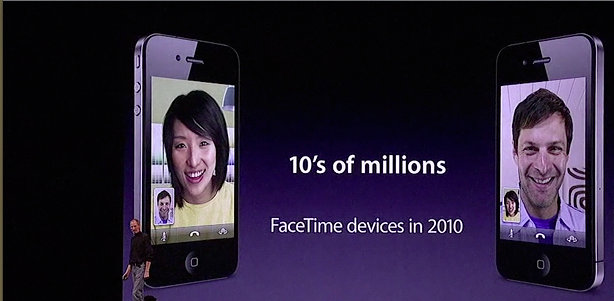
    During the WWDC keynote Steve Jobs announced that "we will ship 10's of millions of FaceTime devices in 2010".  Since only iPhone 4 currently runs FaceTime(*) then it stands to reason that there will be "10's of millions" of iPhone 4 devices sold.  And since the year is half over, it means we can divide "10's of millions" over two quarters.  That puts sales in the 10+ million range per quarter.

    My current forecast shows 11 million in Q3 and 13 million in Q4 corresponding to 50% y/y growth.

    Steve Jobs seems to be indicating this is well within reason.

    (*) one exception to this assumption is that he's including a future iPod touch running FaceTime.  This may very well be the case when the iPod line-up will be released probably in October.

  4. WWDC Context: A quarter million apps approved

    Research

    Six months ago IDC predicted 300k apps before end of 2010.

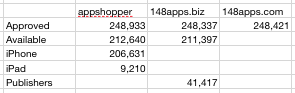
    Here is a quick mid-year check: As of today there are around 215k available, with 250k likely approved by the end of WWDC.

    These are the stats from three app store tracking spiders:

    Apple's WWDC banners proclaim 200k apps which was the last public count stated at the April iPhone OS 4.0 launch event.

    Looks like IDC's forecast will not be a stretch especially as the new iPhone will create a new wave of apps.

    Also noteworthy is the nearly 10k iPad apps available in less than 3 months.  The original iPhone reached 10k apps in about six months.

  5. iPhone takes share from RIM, Android takes share from Windows Mobile

    Research

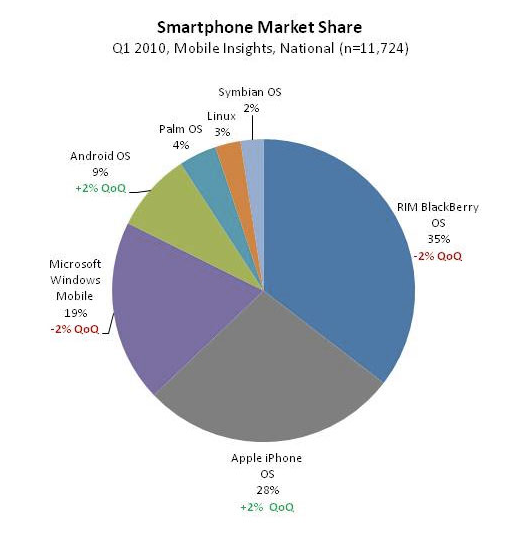
    Data tracking firm Nielsen Co.’s quarterly survey found that, in the U.S. the iPhone added two percentage points for a 28% market share in the three months ended in late March compared to the previous quarter. RIM still had the biggest market share at 35% but it lost two percentage points in that period.

    Phones that run on Google Inc.’s Android operating system also gained two percentage points for a market share of 9% over the same period, while Microsoft Corp.’s Windows Mobile phones lost two percentage points for a 19% share.

    via Appetite for IPhone Continues Undiminished - Digits - WSJ.

    Although Android is often considered in competition with the iPhone, as we've shown in the past, the two are seldom competing for the same purchase decision.  From a distribution and business model point of view, the platforms are mostly non-overlapping.

    The installed base data above shows that in their respective areas of competition: in the US, with the current operator channel, the iPhone is taking share from a similarly positioned platform (RIM) while Android is taking share from a similarly licensed alternative (Windows Mobile).

  6. IDC: I Dream of Claim Chowder

    Research · 3 comments

    A few eyebrows were raised when Microsoft presented a slide at a French event where they made the claim that 30 Million Windows Phone devices would be sold by the end of 2011.  Given that the first Windows Phone won't ship until October 2010 at the earliest, or, according to Mr. Ballmer, "by Christmas," count me among the skeptics.

    However, the claim was later retracted by Microsoft stating that they mis-quoted IDC, the original source for the forecast.  The correction was perhaps meant to put an end to the credibility crisis.

    However, the actual forecast from IDC was even more preposterous. Apparently IDC makes the forecast that 32 million "Windows Mobile" devices will sell during all of 2011--a combination of both Windows Mobile and Windows Phone devices.

    Instead, the research company forecast 2011 sales of 32 million devices running all Windows Mobile operating systems. This includes expected sales of devices with Windows Mobile 6.5, which is already on the market. IDC has not given any sales estimate for Windows Phone 7, which Microsoft has said will be available in the fourth quarter.

    Their report showed about 16 million Windows Mobile devices shipped in 2009, with a forecast of 22 million this year and 32 million next year.

    Windows Mobile shipped a total of 3.7 million phones in 1Q10, so in order to reach 22 million this year they need to ship 18.3 million for the rest of the year or, on average, 6.1 million phones a quarter.  That's a higher number than what Android shipped in Q1 with BOGO promotions (5.2m units). That's almost as high as the launch quarter for the iPhone 3G.  And all this (mostly) with WinMo 6.5!

    Alternatively perhaps IDC foresees a huge launch for Windows Phone. Assuming an erosion of the WM6.5 to 2.7 m this quarter, 2 million in Q3 and 2 million in Q4, then Windows Phone would somehow need to ship 12 million units during the last quarter.  This number is higher than what iPhone sold in its highest ever quarter.

    This sounds sillier than 30 million Windows Phones in 2011.  By claiming that Microsoft's combination of deprecated Windows Mobile (6.5) and unreleased Windows Phone 7 will continue to sell at a growth of 38% this year, they are actually suggesting an acceleration in sales going into the second half at a rate higher than what the market is likely to grow at.

    In other words, they are suggesting that Microsoft will gain share during the rest of this year. Share gains for a platform that has declined in share in Q1 from 10.2% to 6.8% with 3.7 million units sold on the back of further share losses the quarter prior. Share gains against Android that competes with a free license. Share gains with a new platform that has no clear differentiation vs. the iPhone.

  7. 40 percent of US iPhones are sold to enterprises

    Research · 1 comment

    Four out of 10 sales of the iPhone are made to enterprise users. When the iPhone came out, what most people heard in the first year from ‘07 to ‘08 was oh my God, it’s not BlackBerry secure. This is not going to work on the enterprise space.

    At the end of the day, it’s just software. That’s all it is. And by the time the 3G came out in ‘08 they had solved about 80% of the security issues.

    So enterprises today view the iPhone as a mobile computer. It happens to have a voice application on it.

    via AT&T exec: 4 out of 10 of our iPhone sales to enterprises | ZDNet.

    Compare Apple's approach to that of Nokia:

    Microsoft and Nokia have formed a global alliance to design, develop and market mobile productivity, communications and collaboration solutions.

    Under the terms of the agreement, the two companies will begin collaborating immediately on the design, development and marketing of productivity solutions for the mobile professional, bringing Microsoft Office Mobile and Microsoft business communications, collaboration and device management software to Nokia’s Symbian devices.

  8. Apple's R&D Efficiency

    Research · 2 comments

    In fact it's rumored that Apple brought the iPhone to market for a mere $150 million, doing so organically without acquisition outside of a touch gesture recognition company named FingerWorks.

    This begs the question: how in the world did Apple grow the iPhone platform organically from zero into the most profitable cell phone business in the world with so little investment?

    via Apple's Incredible Efficient Growth.

    Apple has always spent below the industry average for R&D.

    Here are Apple's trailing 9 quarters R&D as percent of sales:

    3.42% 3.86% 2.59% 2.65% 3.51% 3.50% 2.93% 2.54% 3.16%

    Nokia spends at least 10% of sales on R&D and Microsoft at least that much.

    But these numbers are not as spectacular as the comment above that iPhone development cost was $150 million.  To date, the product has generated $31.4B in sales.

    As the article points out, Apple spent $4.6B on R&D over the past four years and Microsoft spent 7x that or $31 billion. Cisco and Intel spent 4x.

  9. Does iPhone really have 72% of Japanese smartphone market?

    Research

    MM Research does not count Symbian as a smartphone platform. This makes them inconsistent with any other analyst for counting smartphones.  So shouldn't Symbian be included?

    In a comment to iPhone has 72% of Japanese smartphone market | Asymco it's been pointed out that 12 million Symbian sold in the same time frame as Apple sold 1.7 million phones in Japan.

    It would seem then that the correct market share for iPhone would be 12%, with Symbian having 83% and "others" having less than 5%.

    However...

    Symbian in Japan is not the same thing as Symbian elsewhere.  Symbian in Japan is used as a low level OS by Fujitsu, Sony Ericsson Japan, Mitsubishi, Sharp and others to provide devices running the MOAP(Symbian) software platform.  MOAP (Mobile Oriented Applications Platform) is the software platform for NTT DoCoMo's FOMA (Freedom of Mobile Multimedia Access) service.

    Unlike Series 60 and UIQ MOAP(Symbian) is not a open development platform.

    MOAP is also supported by Linux with Panasonic and NEC using it in something called MOAP(Linux).

    MOAP(Linux) is also not an open development platform.

    So the "72% share for iPhone" in Japan must be stated with this important caveat: that Symbian and Linux are not included because, due to not having exposed APIs, they are classified as feature phone platforms.

  10. iPad outsells iPhone (part II)

    Research

    “Checks indicate that US iPad sales remain strong post-launch, driven by rising consumer visibility to iPad’s user experience, sustained PR/word-of-mouth marketing, 3G iPad launch, and broadening iPad apps/content,” Abramsky wrote in a note to clients this morning. “We believe Apple is now selling >200k iPads/week, greater than US Macs (est. 110k Macs/week) and just below US iPhone 3GS first quart (246k/week).”

    Retail checks in mid-May showing widespread iPad stockouts at Apple stores and Best Buy. The 3G iPad is sold out at many Apple stores and about 25 percent of them now have only selected Wi-Fi iPads available. Waiting lists are not uncommon.

    ... Abramsky raised his global iPad outlook for 2010 from 5 million to 8 million.

    via Apple Selling More iPads Than Macs | John Paczkowski | Digital Daily | AllThingsD.

    iPad is not only outselling iPhone version 1, but, soon, iPhone version 3.