Asymco

Asymmetric Intelligence

iPhone

  1. Microsoft Taketh Away

    Research

    Summarizing the new Windows Phone 7 Series:

    1. No Multi-tasking -- However, there are going to be notifications.
    2. No App Sideloading
    3. No App store other than the Microsoft App Store
    4. No Cut/Copy/Paste
    5. No Expandable Storage
    6. No Exposed File System
    7. No Shell Customization / Skinning
    8. No native applications (managed code only)

    Funny how when iPhone came out and Ballmer laughed his head off, these were the "power" features that most pointed to in WinMo that made the iPhone a "toy".

    Maybe if people want an iPhone copy, they will get an iPhone.

    UPDATE:  (via Gruber)

    Catching up is hard. And based on what I’m hearing about iPhone OS 4.0, it seems likely that Windows Phone 7 is going to fall further behind before it even gets a chance to ship.

  2. 7000 companies were created just to make apps

    Research

    An estimated one in five iPhone developers are companies founded specifically to create applications for the iPhone, according to the latest Flurry Smartphone Industry Pulse survey. That represents the second-largest category of developers behind only preexisting online companies, including giants like Google, Facebook and eBay. Those established brands take up 22 percent of the iPhone developer share.

    link: AppleInsider | Startup developers represent one in five on Apple's App Store

    Flurry argues that with 75 million units sold, the platform is reaching a critical mass where major brands being to take a dominant position in terms of position and sales rank.

    This argument is suggesting that the platform will be a sustaining technological improvement to existing industries such as traditional media, online media, retail and traditional gaming.

  3. iPad Sales Estimates: How did they stack up?

    Research

    Deagol counts about 120k iPad units were pre-ordered on the first day. How do we judge this performance?

    The problem will be in using some comparable as a measure of reference. This is a problem because first, there is no equivalent product in history, second, there are few similar products that are pre-ordered and sold without user samples being available, and third it's being sold through a very limited channel (on-line Apple Store). Lastly, the number includes only delivered units vs. reservation for pick-up.

    Nevertheless, the figure is intriguing. One class of comparable products might be new smartphone products from companies that were launching on new platforms.

    One example is the Android G1--the first Android device. It sold 663k units in the launch quarter. Another is the Nokia 5800, Nokia's first touch capable device. It sold 536k units in the first quarter (up to 1 million in the first 3 months). Sony Ericsson's first Windows Mobile device was the X1. It sold 237k units in the first quarter of sales. The first Sense UI HTC device (the Diamond) sold about 1 million units. The RIM Storm, RIM's first touch device sold 1.6 million units. Finally the iPhone which sold 1.1 million units in the first full quarter of sales (about 1.4 million if we include the weekend sales that fell outside the first quarter).

    The iPad does seem to be doing rather well relative to these products. Again, their figures were for a full 90 days of sales and were sold through physical retail channels in a variety of geographic markets.

    I will be surprised if the number of units sold in Apple's CQ2 don't exceed 1 million. (Apple will book all these sales only on delivery which means they won't appear in CQ1 sales figures). This will probably mean better performance with a new platform than Nokia, Google, Sony Ericsson or HTC and perhaps better than the iPhone.

    (data source: Canalys).

  4. Korean Regulations Stifle Mobile Games Market

    Research

    South Korea is considering banning access to the Android Marketplace to its residents if Google continues to offer game apps that are not approved by the country's regulator

    link: Korea may block Android Market due to game laws | Electronista

    Currently, South Koreans have a choice of two Android-powered smartphones that have access to the Android Marketplace, and more are due for release this year. There are about 4,400 games on the Android Market available to South Koreans, with all of them needing to be rated.

    Apple has gone around the South Korean laws by not offering any gaming apps at its App Store for iPhones and iPod touch devices. South Korean developers put up locally approved games under the entertainment category in the App Store, however. Many South Korean iPhone owners create a second account outside of South Korea that does grant them access to games on the App Store as well.

  5. Getting Misty Eyed With Memories...

    Research · 4 comments

    On the eve of iPad sales start, and the soon-to-be classic quotes from iPad experts, it's time to play back some of the classic iPhone expert predictions from yesteryear:

    "[iPhone] just doesn't matter anymore. There are now alternatives to the iPhone, which has been introduced everywhere else in the world. It's no longer a novelty." - Eamon Hoey, Hoey and Associates, April 30, 2008

    "We are not at all worried. We think we've got the one mobile platform you'll use for the rest of your life. [Apple] are not going to catch up." - Scott Rockfeld, Microsoft Mobile Communications Group Product Manager, April 01, 2008

    "Microsoft, with Windows Mobile/ActiveSync, Nokia with Intellisync, and Motorola with Good Technology have all fared poorly in the enterprise. We have no reason to expect otherwise from Apple." - Peter Misek, Canaccord Adams analyst, March 07, 2008

    "[Apple should sell 7.9 million iPhones in 2008]... Apple's goal of selling 10 million iPhones this year is optimistic." - Toni Sacconaghi, Bernstein Research analyst, February 22, 2008

    "What does the iPhone offer that other cell phones do not already offer, or will offer soon? The answer is not very much... Apple's stated goal of selling 10 million iPhones by the end of 2008 seems ambitious." - Laura Goldman, LSG Capital, May 21, 2007

    Motorola's then-Chairman and then-CEO Ed Zander said his company was ready for competition from Apple's iPhone, due out the following month. "How do you deal with that?" Zander was asked at the Software 2007 conference. Zander quickly retorted, "How do they deal with us?" - Ed Zander, May 10, 2007

    "The iPhone is going to be nothing more than a temporary novelty that will eventually wear off." - Gundeep Hora, CoolTechZone Editor-in-Chief, April 02, 2007

    "Apple should pull the plug on the iPhone... What Apple risks here is its reputation as a hot company that can do no wrong. If it's smart it will call the iPhone a 'reference design' and pass it to some suckers to build with someone else's marketing budget. Then it can wash its hands of any marketplace failures... Otherwise I'd advise people to cover their eyes. You are not going to like what you'll see." - John C. Dvorak, March 28, 2007

    Even if [the iPhone] is opened up to third parties, it is difficult to see how the installed base of iPhones can reach the level where it becomes a truly attractive service platform for operator and developer investment." - Tony Cripps, Ovum Service Manager for Mobile User Experience, March 14, 2007

    "I'm more convinced than ever that, after an initial frenzy of publicity and sales to early adopters, iPhone sales will be unspectacular... iPhone may well become Apple's next Newton." - David Haskin, Computerworld, February 26, 2007

    "Consumers are not used to paying another couple hundred bucks more just because Apple makes a cool product. Some fans will buy [iPhone], but for the rest of us it's a hard pill to swallow just to have the coolest thing." - Neil Strother, NPD Group analyst, January 22, 2007

    "The iPhone's willful disregard of the global handset market will come back to haunt Apple." - Tero Kuittinen, RealMoney.com, January 18, 2007

    "[Apple's iPhone] is the most expensive phone in the world and it doesn't appeal to business customers because it doesn't have a keyboard which makes it not a very good email machine... So, I, I kinda look at that and I say, well, I like our strategy. I like it a lot." - Steve Ballmer, Microsoft CEO, January 17, 2007

    "The iPhone is nothing more than a luxury bauble that will appeal to a few gadget freaks. In terms of its impact on the industry, the iPhone is less relevant... Apple is unlikely to make much of an impact on this market... Apple will sell a few to its fans, but the iPhone won't make a long-term mark on the industry." - Matthew Lynn, Bloomberg, January 15, 2007

    "iPhone which doesn't look, I mean to me, I'm looking at this thing and I think it's kind of trending against, you know, what's really going, what people are really liking on, in these phones nowadays, which are those little keypads. I mean, the Blackjack from Samsung, the Blackberry, obviously, you know kind of pushes this thing, the Palm, all these... And I guess some of these stocks went down on the Apple announcement, thinking that Apple could do no wrong, but I think Apple can do wrong and I think this is it." - John C. Dvorak, January 13, 2007

    "I am pretty skeptical. I don't think [iPhone] will meet the fantastic predictions I have been reading. For starters, while Apple basically established the market for portable music players, the phone market is already established, with a number of major brands. Can Apple remake the phone market in its image? Success is far from guaranteed." - Jack Gold, founder and principal analyst at J. Gold Associates, January 11, 2007

    "Apple will launch a mobile phone in January, and it will become available during 2007. It will be a lovely bit of kit, a pleasure to behold, and its limited functionality will be easy to access and use. The Apple phone will be exclusive to one of the major networks in each territory and some customers will switch networks just to get it, but not as many as had been hoped. As customers start to realise that the competition offers better functionality at a lower price, by negotiating a better subsidy, sales will stagnate. After a year a new version will be launched, but it will lack the innovation of the first and quickly vanish. The only question remaining isif, when the iPod phone fails, it will take the iPod with it." - Bill Ray, The Register, December 26, 2006

    "The economics of something like [an Apple iPhone] aren't that compelling." - Rod Bare, Morningstar analyst, December 08, 2006

    "Apple is slated to come out with a new phone... And it will largely fail.... Sales for the phone will skyrocket initially. However, things will calm down, and the Apple phone will take its place on the shelves with the random video cameras, cell phones, wireless routers and other would-be hits... When the iPod emerged in late 2001, it solved some major problems with MP3 players. Unfortunately for Apple, problems like that don't exist in the handset business. Cell phones aren't clunky, inadequate devices. Instead, they are pretty good. Really good." - Michael Kanellos, CNET, December 07, 2006

    "We've learned and struggled for a few years here figuring out how to make a decent phone. PC guys are not going to just figure this out. They're not going to just walk in." - Ed Colligan, Palm CEO, November 16, 2006

    Nostalgia was better in the old days...

  6. Music. Sweet music

    Podcast · 37 comments

    iPad Death Watch : AAPLinvestors

    You can't go wrong betting against this bunch.

    (link above reproduced below due to bandwidth issues with their servers.)

    “Any tablet computer, including Apple’s eagerly anticipated iPad, will face serious problems in generating big sales. Tablets look cool, but the reality is they don’t do anything new.” Michael Comeau, Minyanville, 5 March 2010

    Dvorak:”I’m telling you, look at this product coming out of India called the Adam.” Curry: “A-D-A-M?” Dvorak: “Yeah.” Curry: “And it’s a what it’s a pad?” Dvorak: “It’s an iPad Killer. And I hate to use that term since the iPad is probably dead anyway.” No Agenda Podcast, Adam Curry & John C. Dvorak, 25 February 2010

    “Fewer capabilities (than a netbook) but a similar size? Not a good start.”Lee Gomes, Forbes Asia Magazine, 5 March 2010

    “We of course build plastic mock-ups that we show (to customers)…we had a slate form factor. The feedback was that for (our) customers it will not work because of the need to have (a physical) keyboard. These were 14-year-old kids, who, I thought, would be most willing to try a virtual keyboard but they said no, we want the physical keyboard.” Mika Majapuro, Worldwide Sr. Product Marketing Manager, Lenovo, 22 February 2010

    “The Apple iPad is not going to be the company’s next runaway best seller.” John Dvorak, MarketWatch, 12 February 2010

    “It’s a nice reader, but there’s nothing on the iPad I look at and say, ‘Oh, I wish Microsoft had done it.’” Bill Gates, Microsoft, 10 February 2010

    “The rally has been especially kind to seemingly racy stocks such as Apple and Google. Both have pole-vaulted to market-surpassing gains over the past 12 months, despite the fact that the former’s hamster-wheel of innovation (to borrow an apt phrase from my Fool colleague Joe Magyer) may have hit a snag with the iPad. ” Shannon Zimmerman, The Motley Fool, 10 February 2010

    “It’s not a tablet, it’s an extension of the iPod Touch. It has some new kinks, but generally speaking it’s using the iPhone OS. It’s more like a smart phone than a personal computer. It’s the Newton reborn. What’s missing most is the communications aspect.” Andreas Haas (former Apple executive), CEO, Axiotron (Modbook), 7 February 2010

    Before Jan 20th, 49 percent of people said they didn’t think they needed an Apple Tablet. That number jumped to 61 percent after the announcement. Fifty-nine percent of buyers wouldn’t pay extra for 3G coverage. Whether this device becomes a big hit is anyone’s guess but based on this study it sure looks doubtful.” Retrevo, 5 February 2010

    “Yet it’s hard to see how the iPad, in the form unveiled last month, will come close to transforming daily life as much as the iPod or iPhone. The challenge with the iPad will be less about improving an established market than building a new one.” Arik Hesseldahl, BusinessWeek, 5 February 2010

    “I added it up and … like 800 people are going to buy the iPad. . . . It’s not that the iPad is a failure. It’s just a product ahead of its time. No one should actually buy this iPad — between its inevitable first-generation bugs, fulfillment problems, and buyer’s remorse over added features and price drops, it’s heartbreak waiting to happen.” Molly Wood, CNet, 31 January 2010

    “It was a bigger iPod Touch. I question whether those features would be enough to get people to buy new machines.” Satoru Iwata, President, Nintendo, 29 January 2010

    “The company once notorious for its ability to upend convention and revolutionize markets may no longer have what it takes, worry some technology journalists. Call it the iPad or the iPlod, but the message seems clear: Apple may have lost its mojo.” Jeremy A. Kaplan, FOXNews.com, 28 January 2010

    “What’s the single most worrisome thing about the iPad? It’s Apple’s monopoly on distribution of applications. ” Harry McCracken, Tecnologizer.com, 29 January 2010

    “The tablet market has only succeeded as a niche market over the years and it was hoped Apple would dream up some new paradigm to change all that. From what I’ve seen and heard, this won’t be it.” John Dvorak, MarketWatch, 29 January 2010

    “It is a humorous world in how Microsoft is much more open than Apple,” Frank Shaw, Microsoft, Corporate VP, Corporate Communications, 29 January 2010

    “When Steve Jobs first demonstrated the Apple Mac, he used the words “insanely great” to demonstrate the full graphical display of the computer. It’s a tag that has stuck around to this day among Apple fans. But, today’s comments from Jobs that the iPad is a “magical, revolutionary” device ring hollow.”Dan Wayne, apc mag, 28 January 2010

    “All the people (including me) who felt underwhelmed by the iPad initially might have missed its true potential. Put another way: the iPad is all about software. Forget the sleek form factor – that’s just a prerequisite. Ironically, it’s the software and services that Microsoft never ‘got’, that Apple totally does get.” Dan Wayne, apc mag, 12 February 2010

    “Nothing from the iPad specs that I’ve seen really shows any great cause for celebration. Unless Apple has also developed some new type of power source, such as nuclear cells or magical hamsters on tiny spinning wheels for the iPad, don’t expect the claims about battery life to hold true. ” John Breeden II, Government Computer News, 28 January 2010

    “Ultimately, the iPad is a large iPod touch: a great device to draw your inspiration from, but perhaps not the seismic shift in technology that we were expecting.” Claudine Beaumont, The Telegraph, 28 January 2010

    “Behold: The Apple iFlop Neither “truly magical” nor “revolutionary,” the cluelessly named Apple iPad tablet device has dropped like a shiny wedge into the gadget game, dividing tech watchers in to opposing views — the critical and the adoring.” Scott Moritz, TheStreet.com, 28 January 2010

    “9 Worst Things About The Apple Tablet: 1. No Flash 2. Its screen 3. Its price 4. Closed App Store 5. Its name 6. No multitasking 7. No camera 8. No USB 9. AT&T deal Bianca Bosker, Huffington Post, 29 January 2010

    “What do the new Apple iPad and Google’s Nexus One have in common? Both were DOA: Disappointing On Arrival. Why is the iPad a disappointment? Because it doesn’t allow us to do anything we couldn’t do before. Sure, it is a neat form factor, but it comes with significant trade-offs, too. No 16:9 widescreen, for example.” David Coursey, PC World, 28 January 2010

    “E-readers will outsell iPads because of the simple economics of the consumer device market. It’s triple the weight and 30% thicker than an e-reader. You need two hands to hold it. It’s got a backlit screen, and it’s too expensive to give one to everyone in your house.” Russ Wilcox, CEO E-Ink (makers of Amazon’s Kindle), 28 January 2010

    “It seems like a high priced, unnecessary trinket to me.” Paul Thurrott, SuperSite for Windows, 27 January 2010

    “Apple iPad - failure, joke or fiasco? Pick one” Linen DeFiller, MillionFace.com, 27 January 2010

    “The press weren’t cheering and whooping. I didn’t see anybody pee their pants … Not one! The only people I saw cheering were the people who work at Apple down in the front two rows … Al Gore was going crazy. I wanted to see more. It’s a big iPod. What is there to do there? Play a video game on a bigger screen? I thought it [iPad] was ‘paving the cow path’ (enshrining a makeshift solution).” Dan Lyons aka Fake Steve Jobs, 27 January 2010

    “Let’s face it, the Internet was designed for the PC. The Internet is not designed for the iPhone. That’s why they’ve got 75,000 applications — they’re all trying to make the Internet look decent on the iPhone.” Steve Ballmer, Microsoft, 21 October 2009

  7. Why HTC (Part II)

    Research · 1 comment

    Starting in January, Apple launched a series of C-Level discussions with tier-1 handset makers to underscore its growing displeasure at seeing its iPhone-related IP infringed. The lawsuit filed against HTC thus appears to be Apple's way of putting a public, lawyered-up exclamation point on a series of blunt conversations that have been occurring behind closed doors.

    link: Apple talks tough to handset makers - Apple 2.0 - Fortune Brainstorm Tech

    Top-tier handset makers continued to avoid implementing multi-touch, but Apple could safely assume that they were hanging back to gauge Apple's response to Motorola and HTC. If there wasn't one, the OEMs would likely read the silence as a green light, especially after Google also moved to enable multi-touch on its Nexus One phone.

    Even before the lawsuit, handset makers were having second thoughts about Google, which with the Nexus One had become a direct competitor. Now their faith in Android as the easiest and cheapest way to counter the iPhone has been shaken, says Reiner.

    Seems pretty close to what I wrote here:

    Why HTC?

    Therefore it’s entirely likely that HTC was singled out to disrupt the business logic of modular mobile software. HTC is the pioneer and the hub as the largest licensee for both WinMo/WinP and Android and the inspiration for hundreds of OEM/ODMs to make modular products.

    ... Other vendors looking at this licensing model might think harder about participating, and that may be the whole point.

  8. L’iPhone, le smartphone préféré des Français (part deux)

    Research

    And the most successful market for the iPhone based on the Gartner numbers, is, um, France, where the company has gained over 10% of the market, at the expense of Nokia and Sony. “France is now the most successful market in the world on a relative basis,” says McCourt.

    link: France Now iPhone’s Most Successful Market? - Tech Trader Daily - Barrons.com

    See also:

    77 % des téléphones vendus par Orange à Noël ont été des iPhone
    L’iPhone, le smartphone préféré des Français

  9. iPad vs. Kindle: Purchase Intent Survey

    Research · 1 comment

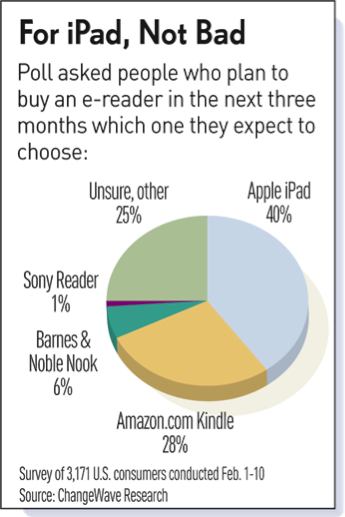
    A survey of nearly 3,200 consumers by ChangeWave Research finds that 40% of people planning to buy an e-reader in the next 90 days expect to get Apple's iPad. The current leader, Amazon.com's (AMZN) Kindle, came in second at 28%.

    link: E-Reader Buyers Coveting iPad Over The Kindle - Investors.com

    This should be put together with data showing at least 15% of iPhone users showing purchase intent for iPad.

    If we assume 45 million iPhone users by time of launch (42 million units have been sold as of end of December) and 15% would buy iPads it would therefore not be unreasonable to assume about 7 million iPads will go to iPhone users alone.

    It's unfortunate that we cannot calibrate against installed base of Kindle users since Amazon has never released any sales figures.

  10. Android vs. Google Part II

    Research · 3 comments

    AppleInsider | First AT&T phone with Google Android will feature Yahoo search

    As the Backflip will mark the first time U.S. customers under contract with AT&T will have the option to choose between Android and the iPhone, every Motorola Backflip that AT&T sells might potentially be at the expense of an iPhone.

    That Backflip sold will not generate Google any ad revenue since it will offer Yahoo/Microsoft search exclusively. Nor will the Backflip generate any license revenue for Google, because Android is licensed without a fee.

    If that buyer would instead have bought an iPhone, the search from mobile Safari would have some non-zero value.

    It is therefore pretty obvious that, at least in this instance, Android is destroying value for Google.

    See also:

    Android vs. Google (part I)