Asymco

Asymmetric Intelligence

iPhone

  1. New Survey Data on iPad Demand Suggests Significant Upside From Current Estimates

    Research · 1 comment

    Admob did an interest survey. Although limited by its methodology (see below) the data is incrementally interesting as it also relates to the ChangeWave survey.
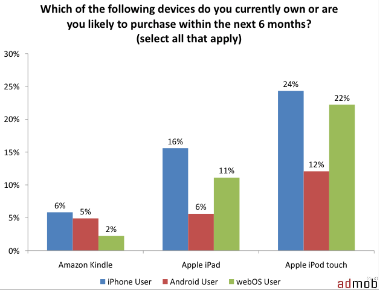
    ChangeWave suggested that 13% of early adopters claim they are likely to buy an iPad. Admob suggests that 16% of existing iPhone users would be likely to purchase an iPad in the next 6 months.

    This is interesting because we know roughly how many iPhones there are.

    If we assume 45 million iPhone users by time of launch (42 million units have been sold as of end of December) and 15% would buy iPads it would therefore not be unreasonable to assume about 7 million iPads will go to iPhone users alone.

    Being conservative, let's round that down to 5 million. This does seem quite a bit more than the 2 million most analysts are forecasting. I'm partial to 5 million but I might now be inclined to increase that to maybe 7 to account for a portion of 33 million iPod touch users.

    The aggressive scenario would see 16% of the 75 million iPhone + iPod touch installed base buying an iPad--resulting in 12 million units.

    Admob survey and report: http://metrics.admob.com/wp-content/uploads/2010/02/AdMob-Mobile-Metrics-Jan-10.pdf

    Methodology

    All data in the feature section is based on an opt-in survey taken by users on their mobile device.

    Respondents were sourced by responding to mobile ads throughout AdMob's iPhone OS, Android and webOS networks. There was no incentive offered to participate in the survey.

    There were 963 total respondents: 318 Android, 244 iPhone, 356 iPod touch and 45 webOS. The survey was run from February 5th - February 16th.

    The geographic representation of the respondents was designed to approximate the distribution of users in the AdMob network. The respondents were sourced from English-speaking countries in the AdMob network.
  2. 33 Million iPod Touch Sold

    Research · 1 comment

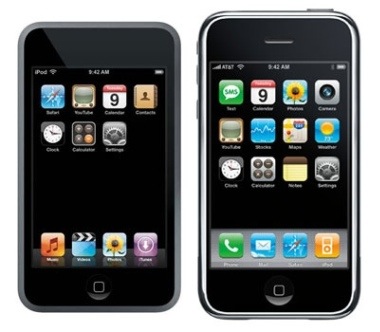
    Tim Cook made the claim yesterday that about 75 million iPhone OS devices have been sold. The total iPhones we know are about 42 million. That leaves at least 33 million iPod touch units or 44%.

    iPod touch grew 55% y/y in CQ4.

    My estimate had been 40% iPod share of the platform, so this is very encouraging. It seems that the proportion of iPod is growing and with the iPad, it's possible that we'll see less than 50% of the ecosystem being iPhones.

  3. Microsoft and Nokia agree: Apple is hindering Innovation in Mobile market

    Research

    From the GSMA Mobile World Congress 2009 (one year ago):

    Kallasvuo used Apple and its "closed" ecosystem as an example of what could limit innovation in the mobile market in the future. He said Apple's vertically integrated model, where its hardware and software are tightly controlled by the company, further fragmented the market. And he added that what is truly needed is more openness in developing applications.

    Yes, prior to the iPhone innovation was zipping along rapidly, but now it's stuck because the iPhone is closed. The iPhone is hindering innovation because it's highly integrated.

    Ballmer argued that device openness was important to give customers more choices. And he pointed to the number of choices that Windows Mobile customers have when choosing a device.

    We'd all have more choices if we'd all choose Windows Mobile.

    Fast-forward one year and Microsoft decides to offer more choice by adding a new operating system (in parallel to its existing OS) and Nokia decides to solve fragmentation by launching a new platform called MeeGo (in parallel to Symbian).

  4. Is the Expert Smart or Stupid?

    Research

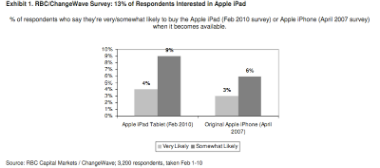
    A new survey has found that 13 percent of respondents are likely to buy Apple's forthcoming iPad, a number greater than the 9 percent who planned to purchase an iPhone before its launch in 2007.

    link: AppleInsider | Apple iPad demand exceeding pre-launch iPhone buzz?

    A summary of the typical expert reaction to the iPad in three steps:

    Step 1: Expert: "Apple is stupid to launch such a dumb product!"

    Step 2: Product sells very well

    Step 3: Expert: "Well, what do you expect... People are stupid!"

  5. Smartphones forecast to grow 46% in 2010

    Research

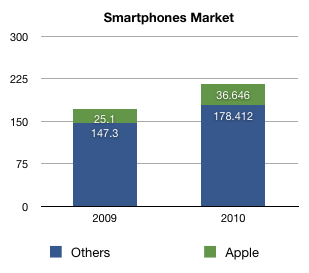
    Gartner sees smartphone market volume growing a whopping 46 percent from 172.4 million sold last year, boosted by cheaper models. The most affordable now cost just over $100 excluding operator subsidies.

    link: Handset market rebounding in 2010: report - Yahoo! News

    Anyone modeling iPhone growth this year below 50% is implying Apple will lose share.

    If Apple maintains market share (about 15%) it would sell about 37 million iPhones in 2010. Apple grew iPhone unit sales about 84% from 2008 to 2009.

  6. Into the Mind of a Windows Mobile User

    Research

    What are we to make of the new Windows Phone 7 Series?

    First, we have to distinguish it as a new platform. Let’s use Microsoft’s new naming conventions and call it “WP7S” as distinct from the current Windows Mobile 6.5 aka “WinMo”.

    Steve Ballmer said they will continue to “invest” in WinMo presumably in parallel to the WP7S platform. This is an interesting development since although there might be some interoperability of applications, the new platform will likely have a new set of APIs.

    What strikes a follower of the WinMo platform is that the new WP7S is orthogonal in its positioning. Whereas WinMo was for either hard core, ROM burning, .cab-editing geeks, or for corporate suits, the new WP7S is going for the Xbox, Facebook ADHD hipster user. Perhaps Microsoft is also going for the “average” user though that did not come through the presentations.

    So these two constituencies (geek vs. socialite) are quite distinct and a product that pleases one won’t please the other. Evidence of this is the fact that many existing users are feeling dejected over the absence of true multi-tasking, the locked memory cards, the lack of compatibility with the old UI and apps, and the overall “dumbing down” of what they thought was a haven of nerdiness in a sea of iPhone hype.

    If Microsoft pours more resources into the new WP7S at the expense of the WinMo platform then we can assume they are “firing” their loyal geek users. Frankly, they are a difficult set of customers whose advice tends to steer a product into ever-more complexity and over-service.

    This sets up a potential schism repelling the geek set toward Android and the corporate set perhaps sliding toward iPhone.

    That would leave Microsoft in a quixotic pursuit of iPhone users without the benefit of an ecosystem.

  7. Blackberry Users Consume One Fifth the Data of iPhone Users

    Research · 1 comment

    As mentioned before, Blackberries should not be thought of as smartphones.

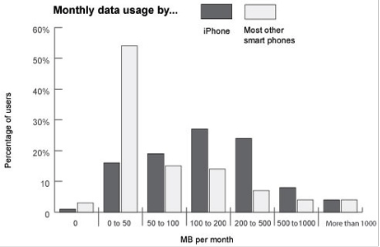
    Consumer Reports announced this week the results of a study it commissioned assessing the monthly data usage for customers of Apple's iPhone and other smartphones. The data reveals:

    On average, iPhone users consume 273 MBs of data per month. That compares with 54 MBs for consumer users of Blackberrys and 150 MBs for consumers who use other brands of smart phones, the Validas study found.

    The disparity in data usage is particularly evident at low levels, where 80% of BlackBerry and 54% of "other" smartphone users consume less than 50 MB of data per month while only less than 20% of iPhone users maintain such low usage.

    As I argued in the past, Blackberries should be considered feature phones. Doing so helps to understand both their limitations and their potential.

    This categorization helps put into perspective the phenomenal growth RIM is able to maintain while not being at all competitive with other platforms by any measure of performance that defines the basis of competition in smartphones.

    Being a feature phone means the Blackberry just needs to be better than a dumb phone, something it’s more than able to demonstrate to a prospective buyer.

  8. Android vs. Google

    Research · 2 comments

    When I heard about Android being positioned against the iPhone, I thought about how that decision must have been justified internally at Google. I wondered how Andy Rubin added up the benefits of his product vs. the risks of losing whatever value Google derived from the iPhone.

    On the benefits side, Android’s original business plan called for zero direct revenues with indirect revenues from search. The actual value would be somewhat dubious during the half decade it will take to get a significant installed base. Of course, with the Google-as-retailer model, Android can also be justified as earning some margin from devices, but as we’ve seen, these numbers don’t add up to much.

    On the risk side there is the potential loss of the screen real estate on the iPhone (see photo above). Being the default search engine in mobile Safari might be worth hundreds of millions to Google.

    Silicon Alley Insider reports a rumor that Apple's current deal with Google to provide default search functionality for the iPhone is currently worth over $100 million per year to Apple in revenue sharing.

    So the iPhone may be a bigger money maker for Google than Android will, at least for a long time.

    Which begs the question of whether by picking a fight with Apple, Android is biting the hand that feeds it.

    If there is any logic to this Android adventure it might be that Google really feels it needs to have an option on the future mobile computing platform and that Android is worth the risk of losing placement on the iPhone.

    I, for one, don’t think this is a risk worth taking.

  9. Estimating iPhone’s Nosebleed Gross Margins

    Research

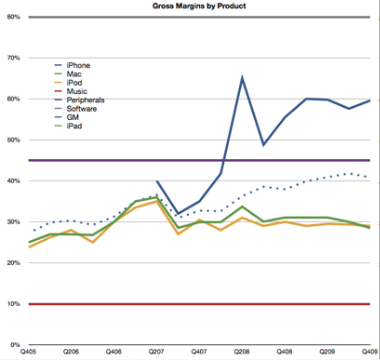
    Apple’s latest re-statement of financial statements eliminated subscription accounting for the iPhone not just for the past quarter but for the entire history of the product, back to mid-2007. This allows a more precise estimate of the gross margin of the product and the results are eye-watering.

    Apple does not reveal the margin for any product. They do provide an overall margin for the company (shown in the dotted line above).

    The only challenge is to “back into” the GM for iPhone based on what we know of the margins for the other product lines and filling in the iPhone as the last piece of the puzzle.

    To do so, we need to have some idea of what the other products’ margins are. Fortunately, this is not that hard.

    We start with the easiest and work up:

    The Software products business line ($2.4 billion last year) is easily the most profitable on a unit basis as software does not require much cost in manufacturing. A solid ballpark estimate is 80% GM (which is what Microsoft typically gets.)

    Next, Music ($4.2 billion revenues). The estimate for music is fairly straight-forward. Apple and the industry have leaked the terms many years ago. Apple pays the labels most of the revenue of the music and keeps about 10% to operate the store. On the App Store there is a 30% margin off the selling price but that is offset by higher direct costs (shipping billions of free apps and free updates). I stick with 10% margin for the Music business line.

    Third, Peripherals. The peripherals business is not particularly large for Apple, but they do a fair amount of peripherals with $1.5 billion last year. My estimate for peripherals margin is 45% based on some comparables.

    Fourth, the iPod ($8.1 billion). The iPod has had a fairly well understood cost structure. The main variable is the cost of the memory, which, as a commodity, varies greatly quarter to quarter. Nevertheless, there is a strong consensus that iPod margins have kept around 29% to 30% over a few years. Teardown analysis coupled with spot pricing for memory chips gives a consistent average.

    Fifth, the Mac ($14.7 billion). The Mac is a difficult product to estimate margins for due to the relatively wide variety of SKUs in the market, the complex components, various quality/warranty issues, transportation costs and the point in the life cycle of any given Mac. The best estimates however hover around the same as the iPod: 30%.

    Once these values are available, and knowing the proportion of sales attributable to the iPhone vs. the other products, we can get an estimate of the gross margin.

    Recent GM estimates are all shown in the graph attached. Here are a few observations:

    1. The overall GM was tied very closely to the Mac/iPod prior to the iPhone.
    2. Gross Margin has been increasing since the iPhone
    3. The iPhone GM is consistently above 60% and is chiefly the reason for the increasing of the overall GM

    The expanding margin for the whole of Apple is quite a story in itself (especially vis-a-vis the tragicomedy of the other PC vendors). However, what really stands out is how high the iPhone margin is.

    Knowing why it stays so high in the face of an assault of “iKiller” devices is a clue to how Apple creates value.

  10. Dick Brass Vents

    Research

    I knew of Dick Brass at the time when he was promoting ClearType inside Microsoft. We met his team to consider licensing our table recognition algorithms for the production of ebooks for Microsoft Reader, an early ebook reading solution for the PocketPC. It was then I learned about plans for “reading solutions” from Microsoft, almost 10 years ago.

    Now he writes about the tragedy of Microsoft’s complete absence from the future of mobile computing.

    "...why Microsoft, America’s most famous and prosperous technology company, no longer brings us the future, whether it’s tablet computers like the iPad, e-books like Amazon’s Kindle, smartphones like the BlackBerry and iPhone, search engines like Google, digital music systems like iPod and iTunes or popular Web services like Facebook and Twitter."

    Part of the answer, Brass writes, is that Microsoft put too much faith in aggressive managers (like himself) who nurtured a culture of conflict. But mostly, he says, it's because of inter-departmental bullying by Microsoft's established divisions and a "dysfunctional" corporate culture that thwarts innovation.

    To support his contention, he offers a couple of telling anecdotes in which he does everything but name names:

    Microsoft's ClearType display technology languished in the lab for years, he says, because engineers in the Windows group "falsely claimed" it made the display go haywire, the head of Office products said it was fuzzy and gave him headaches, and the vice president for pocket devices was said he’d support ClearType only if Brass transferred the programmers to his control.

    In 2001, the vice president in charge of Microsoft Office refused to modify Word, Excel and Outlook to work properly with Brass' tablet. Result: "if you wanted to enter a number into a spreadsheet or correct a word in an e-mail message, you had to write it in a special pop-up box, which then transferred the information to Office. Annoying, clumsy and slow... To this day, you still can’t use Office directly on a Tablet PC. And despite the certainty that an Apple tablet was coming this year, the tablet group at Microsoft was eliminated."

    Brass believes that the intense, sometimes cut-throat, internal competition that Bill Gates fostered among his managers has devolved into something uncontrolled and destructive: "The big established groups are allowed to prey upon emerging teams, belittle their efforts, compete unfairly against them for resources, and over time hector them out of existence."

    He also gives a nod to the modular/integrated dichotomy to which we are always pointing accusing fingers:

    “Part of the problem is a historic preference to develop (highly profitable) software without undertaking (highly risky) hardware. This made economic sense when the company was founded in 1975, but now makes it far more difficult to create tightly integrated, beautifully designed products like an iPhone or TiVo. “

    "It’s not an accident," he writes, "that almost all the executives in charge of Microsoft’s music, e-books, phone, online, search and tablet efforts over the past decade have left."

    Read More (New York Times)...