Asymco

Asymmetric Intelligence

iPod

  1. The strategic tension inherent in the iPhone franchise

    Research · 25 comments

    I don't write product reviews and I don't pass judgement on individual products but I do own and test various products. For example I have the Android powered Samsung Galaxy 5 (GT-I5500) and the experience is, in my opinion, better than for recent Symbian phones but not as smooth as for Apple's products.

    But that's not what this article is about.

    It's about the price. The price for the Samsung is one third that of the iPhone 4 (both devices unlocked and sold in Europe with a 23% VAT). It was also purchased in a department store with as much hassle as buying a pair of gloves.

    When it comes to the product, it may be a fair trade-off: one third the price for one third the product. The specs are not only worse but the whole experience is rougher and cruder. But that "one third the product" may be just good enough for a large population of users who are now satisfied even with "one tenth the product". The price point should be evaluated as a valid threat.

    But Apple can respond. It's not like this is asymmetric competition. As the iPod shows, Apple can make money with low end products. Easily. Is this entry price point (€200 unlocked) something Apple should cover? My answer would be an unqualified yes.

    For operator distribution, the subsidized price combined with a high-end offering is by far the best marketing mix (price, promotion, positioning, etc.) However, for non-operator distribution, a lower spec unlocked device sold through tens of thousands of points of purchase (like the iPod, and soon, iPad) makes a lot of sense from a platform point of view.

    These two channels are often in conflict due to subsidy and exclusivity clauses. This conflict makes the decision to ignore the non-operator channel compelling. The economics for the operator channel are always going to trump the non-operator channel. But as the platform expands across geographies and income segments not covered by the operator-subsidized channel, these populations will need to be addressed.

    So this is the inherent strategic tension for the iPhone franchise: Whether to use the iPhone brand to enable ubiquitous mobile computing outside operator channels, or use iPod/iPad as a complementary but separate brand to engage in an orthogonal attack.

    I suspect the decision has been made. We will observe the consequences next year.

  2. iPad lead seen as 'overwhelming'

    Research · 37 comments

    Chris Whitmore predicted 2.0 million iPads would be sold in 2010 soon after the product launched. (asymco | Analysts predict iPad sales)

    More recently, Chris Whitmore writes for Deutsche Bank:

    "We believe Apple's lead in the tablet market will prove difficult to close by the onslaught of competing products coming over the next several quarters," he writes in a note to clients issued early Monday. "Ultimately, we expect the slew of upcoming competition to fall flat from a user experience standpoint while struggl[ing] to materially undercut the iPad on price."

    How far ahead is Apple (AAPL)? According to Whitmore:

    12-18 months in content (see chart)

    2 or more years in terms of other media acquisition and integration via iTunes

    Untold dollars in terms of component pricing

    via iPad lead seen as 'overwhelming' - Apple 2.0 - Fortune Tech.
    Compare this fresh (re-)assessment with the following points I made in May of this year:

    The iPad comes with an even bigger value chain [than the iPod] bolted on: the App Store. Apple is flogging not just an “app player” but also a new way to develop and distribute software. If you cut “music” and paste “apps” you see the immediate parallel between iPod and iPad. The app ecosystem will quickly grow to be larger than the music ecosystem with the mobile software business already eclipsing the music business.

    ...

    So the iPad challengers face five daunting obstacles:

    Recognition of a threat from a seemingly benign product

    Execution on hardware against the best integrator on the planet

    Execution on software against a new UI metaphor fortress surrounded by a patent moat

    Integration of hardware and software to a sublime whole

    Re-building a value chain for which they have no handle vs. a broad and deep existing universe of app/content creation distribution and consumption enjoying logarithmic network effect value.

    asymco | Will Apple rule the iPad market? (part II)

    Welcome to the club, Chris.

  3. Updated estimates for Apple's fourth quarter earnings

    Research · 12 comments

    We expect revenue to be about $18 billion compared to $12.2 billion in the September quarter last year. We expect gross margins to be about 35%...

    We are targeting EPS of about $3.44.

    via Apple Inc. AAPL Q3 2010 Earnings Call Transcript.

    I've updated my estimates from the July forecast as follows:

    • iPhone units: 12.2 13 million (65% 77% growth)
    • Macs: 4 million (30% growth)
    • iPads: 3.3 5 million
    • iPods: 9.4 9.7 million (-5% growth)
    • Music growth: 26.7% 25%
    • Peripherals growth: 21% 15%
    • Software growth: 8%
    • Total sales: $19.0 $20.5 billion (56% 69%y/y growth)
    • GM: 42.3% 40.4%
    • EPS: $4.78 $5.00 (73% 81% y/y growth)

    The main news items that affected the changes in estimates were:

    1. iPhone continues to be supply constrained.
    2. iPad supply nearly matching demand though not yet rolled out in all markets
    3. new iPods look compelling though offset by back to school promos

    Follow other estimates at Deagol's site:
    Deagol's AAPL Model: Fiscal 4Q 2010 Final Estimates

  4. Where are the iPod touch knockoffs?

    Research · 96 comments

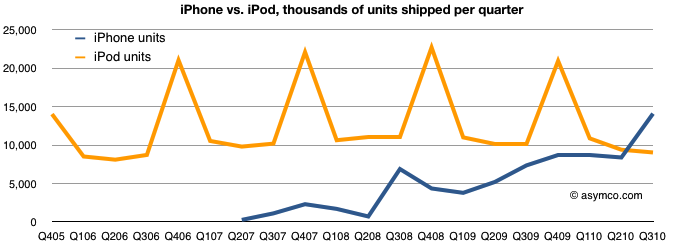
    The latest iOS numbers and the new iPod touch launch demonstrate what a huge hit the iPod touch has become. It's safe to assume that about half of all iPods, or between 4 and 5 million units in the current quarter, are sold as touch versions.

    The iPod touch has been around about as long as the iPhone. It was launched three months after the first iPhone 2G, almost exactly three years ago. While the iPad has been in the market less than six months, a large number of potential competitors have been launched running Android and there seems to be a real rush to market. Six months is about as quickly as any hardware product can be reasonably engineered.

    So the question is why is the iPad being cloned while the iPod has remained in the market by itself?

    The value of the iPod is arguably as high with a healthy margin and consistent pricing. The volumes are comparable with tens of millions already sold so there is no obvious economic disadvantage to the iPod vs. iPad. Indeed, the iPod touch is a large (1.6) multiplier to the whole iOS platform. The demographics are very sweet too with a clear upsell opportunity.

    One explanation might be that the iPod is a music device and that market has been locked up with iTunes, putting up a huge barrier to entry. However during the music launch this month, there was almost no mention of the iPod touch as a music player while it was loudly touted as a game and app platform. Browsing and Facetime are also huge uses for the device.

    So in the iPod touch we have a mini iPad--ironically, the dig at the iPad was that it was nothing more than a large iPod touch.

    So if cloners are rushing to copy the iPad, why not its smaller incarnation?

  5. The race to a billion users

    Research · 16 comments

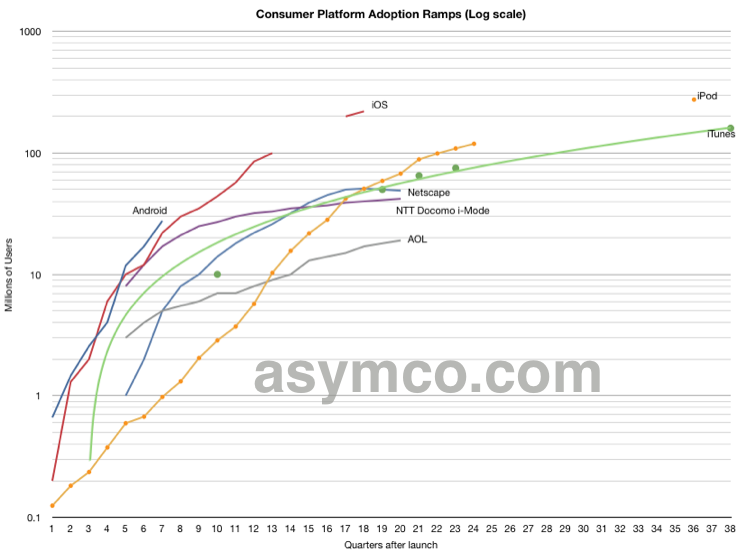
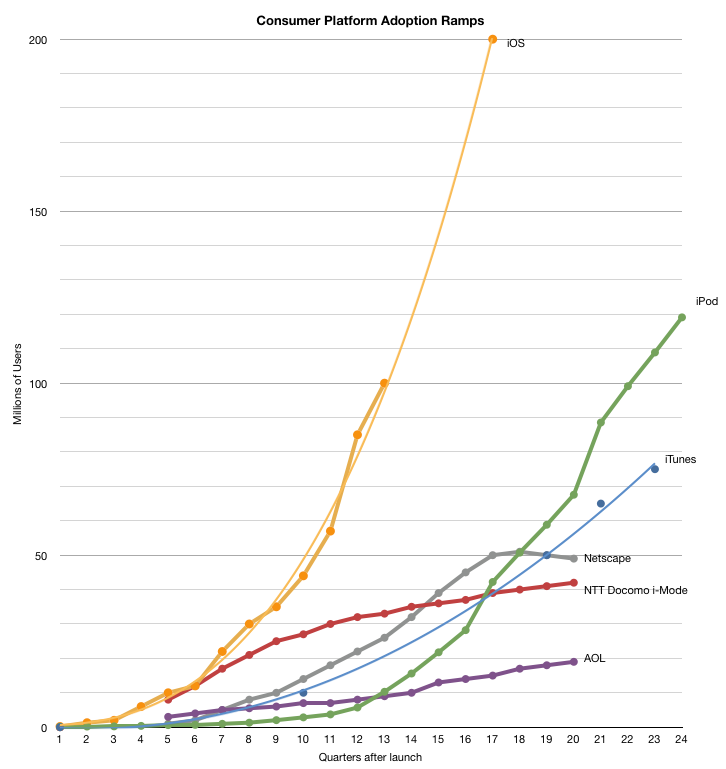
    I took the venerable Consumer Platform Adoption Ramps chart and added Android and the latest data on iTunes, iPod and iOS.

    To make it more readable (but conceptually more complicated) I put the data on a log chart.

    Discussion

    The time span covered is nine and a half years. The top of the graph marks the one billion threshold. Reaching one billion in less than 10 years is an interesting challenge for any platform and, at first glance, it seems that both iOS and Android have a shot at it. This does not seem likely for any of the other platforms.

    The challenge is that as penetration grows, it's natural for the slope for the lines to become shallower. Some platforms are simply not able to address one billion users:

    • i-Mode, AOL and other technologies with localized value networks are clearly limited to populations in their home countries.
    • iTunes is limited by the use of a PC, which has a small footprint in under-developed countries (dependency by iOS on iTunes should throw up a red flag here).
    • The iPod was embraced and extended by more ubiquitous mobile phones.

    In contrast, mobile phones in general and smartphone platforms in particular have potential to reach a billion users (per platform.)

    To wit, note that iOS and Android have similar curves to date and are both likely to overtake iPod and any other contender.

    So for the obligatory theological question: Will Android follow the curve of iOS or will it diverge and continue on a steeper trajectory? Does it matter?

    Discuss...

  6. 3Q review: The iPod revenues increase again

    Research

    The iPod touch increased sales 48% year-over-year.  The continuing mix shift toward iPod touch resulted in an overall iPod ASP increase of 12% to $164 (up from $143) generating total iPod revenue growth of 4%.

    Units declined 7.9%, inline with my expectations of -8%. I had forecast 9.40 and the actuals was 9.406 million. I note that most amateur analysts over-estimated iPods with my guess being the second lowest.  It's important to consider just how much the iPhone (and iPad) cannibalize the non-iOS iPods.

    I am estimating gross margin holding steady at 28%.

    Looking forward I am forecasting ASP of 170 and unit growth of -8%.

    I'll also mention here the Music business.  Revenues grew at an accelerating 26.7%. This growth is a significant rebound from the 15% to 22% growth of 2009 though lower than the 30%+ range of 2007 and 2008.

  7. Accuracy of Apple unit volume forecast

    Research

    From Apple's FQ3 press release:

    "Apple sold 3.47 million Macs during the quarter, representing a new quarterly record and a 33 percent unit increase over the year-ago quarter. The Company sold 8.4 million iPhones in the quarter, representing 61 percent unit growth over the year-ago quarter. Apple sold 9.41 million iPods during the quarter, representing an eight percent unit decline from the year-ago quarter. The Company began selling iPads during the quarter, with total sales of 3.27 million."

    My unit forecast.

    In millions of units.

    Product Asymco Actual Diff Error
    iPhone 8.500 8.398 0.102 1.2%
    Mac 3.462 3.472 -0.010 -0.3%
    iPad 3.300 3.270 0.030 0.9%
    iPod 9.398 9.406 -0.008 -0.1%

    Rankings of various analyst forecasts are at :
    Deagol's blog.

  8. Why I think Apple wants everybody to have an iPhone

    Research · 15 comments

    In recent entries I asked: Can the iPhone reach 10% of the world’s 3G subscribers? and  Can iPhone reach 20% of global smartphone market?

    These were rhetorical questions designed to demonstrate that a growth rate of 50% (compounded) over three years was clearly possible through reduction to absurdity of alternative scenarios.

    The question of iPhone as iPod vs. iPhone as Mac businesses is at the crux of any investment in Apple today and the key strategic question facing Apple and all its competitors.  Anyone holding or considering buying AAPL shares should answer this question for themselves.

    To the top-down market share scenarios above I add the following, more direct, signals Apple has made regarding their iPhone-for-all strategy:

    1. The fact that they entered the market at all.  When they were building iPods, Apple came to understand that to be a device company means to be a phone company.  The device business is much more sensitive to volume (i.e. economies of scale) than the PC business. Nokia proves this point every day.  You can’t be in the device business with low volumes and stay profitable for long. This is because you can't get component pricing low enough to sustain margins that can afford you R&D sufficient to differentiate your product.  Therefore you cannot stay in the phone business with low volumes (see Palm).
    2. Apple repeatedly signaled that they will not permit a pricing umbrella for their products.  Although the product seems priced highly now it’s only because that’s what the market can bear and because of the possibility of taking a cut from service revenues.  The iPhone is not as expensive as it might seem relative to other smartphones, it just has a huge gross margin (50% at least).  Apple can keep their costs low through volume but they can also tweak pricing down if they need to.
    3. The platform approach.  Apple is putting in an enormous effort to orchestrating a mobile platform.  This is the most obvious signal.  Platforms are expensive to build. If the cost to build a mobile phone is x, the cost to build a mobile platform is 10x.  Platforms are expensive to maintain but generate enormous rents if volumes are built and users are retained.  The platform’s value grows as the n*log(n) of the number of users (Metcalfe’s law).
  9. The next 100 million iOS devices

    Research · 9 comments

    As iOS crosses 100 million units sold 3 years after the platform launched, it's time to look forward to the next 100 million. My expectation is that well over 100 million iOS devices will sell during 2011, but even during the next 12 months (2H '10 and 1H '11) the total may well reach 100 million, making 200 million installed by June 2011 very likely.

    Here is where the numbers will come from:

    iPhone: Assuming only 50% growth (half of the average growth seen so far) gives 50 million units in the next 12 months.

    iPad: 15 million base assumption

    iPod: This is the most difficult to predict, but 46 million iPods will sell with a growth rate of -8% to -9%. If we consider the iPod touch part of the mix to be 40%, we get 19 million.

    The total with these assumptions would be 84 million. A slightly higher growth rate for the iPhone would easily push the total to 100 million.

    200 million devices in four years is quite a feat. Compare it to the growth of television which reached 50 million Americans in the first decade after commercial launch. Or consider the Netscape browser which only reached 50 million in its first four years or AOL which just crossed 20 million or in Japan where i-Mode reached 40 million users in the same time frame.

    At 200 million, the iOS platform will be 18% the size of the world-wide television audience.

  10. Deagol: iPad web usage 20x iPod

    Research

    So my prediction from six and a half weeks ago came through, with a couple of days to spare. iPad has surpassed iPod in web traffic. It took only two months and two million units, compared to almost 3 years and about 40 million iPod touches out there. That means iPads use the web roughly 20 times as much as iPod touches.

    Also, not only has iPad more than doubled Android 2.1's share, it's now past all Android OS's combined. .

    via Deagol's AAPL Model: iPad web usage passes iPod.

    Good call.