Asymco

Asymmetric Intelligence

iPod

  1. Why Apple is on top today: the top 10 technology decisions

    Research · 91 comments

    As Apple overtook Microsoft in market cap and as Steve Jobs reminisced about some recent history, I thought I'd reflect on some of the decisions that brought Apple to the pinnacle of technology companies.  The criteria I used to select these is how improbable and hence courageous they were when taken and how much impact they have had on the industry. Since the impact of these decisions could not be felt for a long time, the courage required to act early is all the more remarkable.

    At the time they were made, none of these decisions did anything to move the stock price or cause great rejoicing. In fact, in many cases the decisions were ridiculed by those who should know better. Yet each one became a massive pillar of the foundation of Apple as it is today.  As you read through, think of the decisions that Apple competitors made or did not make in the same time frame.

    Top 10 Apple technology decisions of the 2000 decade in reverse order:

    • 10. HTML 5 (canvas). It was initially introduced by Apple for use inside their own Mac OS X WebKit component, powering applications like Dashboard widgets and the Safari browser. Still in its infancy, the canvas element is an Apple technology that promises to finally offer a credible Flash equivalent.  Remember that Flash is now over 10 years old and was incubated at a time when the Web was barely 1.0.  HTML canvas finally brings vector graphics to the modern era.
    • 9. H.264. The decision to support a standard video codec at a time when the industry was mostly arguing over whether Blu-ray or HD-DVD would win signaled a foresight that physical media was not long for this world.  The consequences are still being weighed as YouTube and other media sources are shifting their inventory to this format.
    • 8. iTunes. iTunes started as a personal music database, grew into a music and media store-front, a payment processing engine, device synchronization and updating center, and finally an application store.  It was forked into both a PC and a mobile version.  Without iTunes the iPod would have been just another MP3 player.
    • 7. WiFi. Implemented in Airport before the spec was finished, WiFi gave the laptop wings.  Think back to when you still had to plug a wire into a computer to have it communicate. PC's did not catch up in being wireless for years.  WiFi was even a rare feature on mobile phones when the iPhone shipped in 2007 with some operators (Verizon) banning it from their phones even in 2009.
    • 6. FireWire. Along with iTunes brought iPod to life.  Launched at a time when external drives required screwdrivers and a circuit board to install, FireWire made opening your computer case to expand it as common as opening the hood of your car to fix it.
    • 5. iLife. Did to user-generated media what word processors did to words and spreadsheets did to numbers. A singularly great reason to get a Mac.
    • 4. Portability. OSX migrated across three different CPU architectures in less than 10 years. Apple revealed that they built it from day one to be portable to different CPUs.  That took amazing foresight in the late 90s.
    • 3. WebKit. Speed and flexibility.  The biggest reason why we can surf on a phone today.
    • 2. Multi-Touch UI. Seven years in development and still sublime.  Starting down this road in 2003 must have seemed science fiction.  But, unlike other companies, Apple took this science experiment and went to market.  Steve Jobs said how he wanted a screen keyboard and how scrolling opened his eyes to making a phone. That took vision.
    • 1. OSX/Cocoa. The company's backbone.  Everything above hangs off OSX. Remarkably scaleable, portable, robust and reliable.  With roots going back decades, it's the canonical OS. Somebody should build a monument to it.
  2. Will Apple rule the iPad market? (part II)

    Research · 12 comments

    Continuing from Will Apple rule the iPad market? | Asymco.

    The first claim is that

    it is unclear if [Apple] will end up dominating the market the way it has come to rule the digital music player market with the iPod.

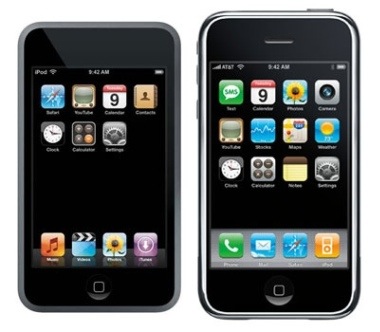
    After hearing a thousand voices cry out that the iPad is nothing more than a bigger iPod touch (which, plainly, it is) it's amusing to read that its similarity with a sibling ends when it comes to market performance.

    Let me make one claim up-front: the iPad is more of an iPod than the iPod.

    The original iPod was successful because it had a significant integrated value chain bolted on. Apple disrupted music with a value chain, not a product. It changed the way music is bought, consumed and even how it is produced. It changed the economics from retail down to songwriting.

    This is why it came to dominate its market. Every competitor that took a run at it did so with a partial solution to the value chain. Often it was nothing more than a music player, and in some cases (e.g. Zune) it was bundled with some other pieces of technology, but poorly executed and too late.

    The iPad comes with an even bigger value chain bolted on: the App Store. Apple is flogging not just an "app player" but also a new way to develop and distribute software. If you cut "music" and paste "apps" you see the immediate parallel between iPod and iPad. The app ecosystem will quickly grow to be larger than the music ecosystem with the mobile software business already eclipsing the music business.

    A competitor launching a tablet device will have to somehow overcome the momentum of billions of downloads fed by hundreds of thousands of apps built by tens of thousands of developers for hundreds of millions of users.

    The iPod juggernaut pales in comparison to the iPad supernova. The iPod had no apps or dedicated developers. Its ecosystem consisted of a handful of music companies. The only thing that made it "sticky" was the tie-in with one type of content.

    The iPad on the other hand has a thousand other jobs to do for its users. It has a rich tapestry of functionality and a multi-dimensional (literally) user experience.  It's a platform. It's even powerful enough to impose new standards on the web itself and to suggest that search is a bygone activity.

    So to suggest that Asus or Dell will somehow build "iPad killers" sounds asinine. These competitors don't even grasp what the product is and what it's for.  Sony said they don't see a market for it. Microsoft, trapped in the innovator's dilemma and overshooting the market by miles, said they don't understand what the point is because users want full PCs.  Google asked what's the value of a big iPod. I could go on, but there was not a single company in the industry who recognized what they were looking at in January. Apple keeps a tight lid on new products so that competitors don't get a head-start on copying, but in the case of the iPad, advance knowledge would not have had any impact. Competitors look at the iPad and see nothing.  They'll only react once the market explodes and they start to feel belated pain.

    If, and it's a big if, they do recognize what an iPad is, their response cycle is going to be measured in years. On hardware, they were blown away with a product that had twice the power, half the bulk, twice the battery life with half the price of what they had on the shelf. They may catch up on hardware in a year or two and launch some sort of iPad-like assembly of components, but that is like making the first iPod killer in 2002.

    Then there is software. Their software supplier (Microsoft of Google) will have to build a platform that works. That will take years. Years during which the iPad will penetrate every geography, demographic and vertical market.

    Google might move more rapidly than Microsoft, but they will produce an open source poster child of a platform. Fragmented and rough around the edges to the point of looking like a hobby project. Their flea market store will also have the smell of fresh glue about it. Microsoft is so far behind the curve that I don't even think they will try to move the tiller.  Their view of the market was betrayed by the recently knifed Courier demoware. To suggest a challenge to the PC/Windows model inside Microsoft is a career-limiting move so don't expect their brightest to be lining up to propose new platforms to management.

    What about HP? Assuming they overcome the pitfall of NIH that kills 80% of integration efforts, they will still need to perform an enormous amount of heavy lifting to get WebOS to be a competitive experience on a tablet. Most opinions were that Palm came pretty close with a smartphone, but that was nowhere near enough to stay alive, never mind challenge iPhone.

    Then there is the ecosystem. Building it is just not something I can even begin to roadmap. What about developer tools, SDKs, frameworks and evangelism? With a Palm division, HP is the best positioned of the PC vendors but it has a chance at being a player as much as Creative did vs. the iPod, or needless to say, Palm vs. the iPhone.

    So the iPad challengers face five daunting obstacles:

    1. Recognition of a threat from a seemingly benign product
    2. Execution on hardware against the best integrator on the planet
    3. Execution on software against a new UI metaphor fortress surrounded by a patent moat
    4. Integration of hardware and software to a sublime whole
    5. Re-building a value chain for which they have no handle vs. a broad and deep existing universe of app/content creation distribution and consumption enjoying logarithmic network effect value.

    That does not even touch the logistics, sourcing, margin and pricing challenges of world-wide distribution of the whole value chain. Nor does it cover the lock-in of advertisers to new tools for creatives or the billions of daily views from a platform that is blindingly dazzling.

    To put it in the language of disruption, by the time the competitors launch symmetric attacks on the iPad, Apple will be the incumbent. And we all know that symmetric attacks never work against entrenched incumbents who have all the levers of power at hand to deploy in a withering counter-attack.

  3. Will Apple rule the iPad market?

    Research · 1 comment

    This question sounds like a tautology. It's like asking "Will Apple rule the iPod market?" But redundancy has not stopped WSJ journalist Benjamin Pimentel from asking. His answer to the question is below:

    But while Apple apparently has the edge in the emerging tablet war, it is unclear if the company will end up dominating the market the way it has come to rule the digital music player market with the iPod.

    Gartner's Fiering said the iPad has "raised the bar and suppliers are now scrambling to make sure they get it right."

    IDC now projects 6 million tablet devices to ship this year, including 4 million iPads, Shim said. But while Apple has taken the lead, he added, the company faces the "burden of lifting or defining this entire new market," because there are no other competitive devices available.

    "In the iPhone market, they learned from everybody else," he added in a video interview. "In this new space, there's nobody else to kind of bounce ideas of so to speak."

    But Apple may not have to feel so alone for long.

    Fiering specifically pointed to H-P's as the best positioned challenger, given its scale, reach and its upcoming merger with Palm.

    "There are not too many suppliers that can pull all those pieces together," she said. "H-P could if they integrate the Palm acquisition properly."

    Another IDC analyst, Crawford Del Prete, agreed saying, while the "buzz" from H-P had generally been defensive in relation to the iPad, "the longer term story is far more interesting."

    "Given H-P's massive scale, I think they have the ability to drive new price points for this kind of product," he said. "With a lower price point, the category becomes far more interesting."

    via PC Makers Look To Challenge Apple's IPad - WSJ.com.

    Before diving into the statements above it's worth noting where the journalist went to get opinions to fill his column. He called Gartner and IDC. Quoting industry analysts is a standard operating procedure to fill column-inches with material that does not offend. But how good are they?

    In my years of watching those who watch markets I formed a ranking of analyst types and their likely accuracy with respect to prognosticating a market shift. In order from most accurate to least accurate:

    1. The most accurate are rank amateurs (deagol, Muller, et. al).  Independent bloggers who do some fact checking tend to make the boldest but most accurate forecasts.
    2. The next most accurate are sell-side analysts (purveyors of analyst reports from established brokerages).  They follow financials for individual companies.  You might think their record is quite poor, but in fact they are much better than..
    3. Industry analysts (like Gartner, IDC).  Their forecasts and sensitivity to disruption are often off by an order of magnitude.  This is partly because they forecast a bit further out than Wall St. but also because they are closer to their industry clients-- the source of their ideas.  They spend a lot of time talking to the least accurate forecasters...
    4. The corporate analysts.  They are typically hired to advise management in the incumbent companies. These are people who have the most information about the way the industry is performing on a daily basis.

    You might notice a pattern here: the closer you are to the market, the less likely you are to observe how that market is crumbling around you. You cannot see the forest for the trees.

    How could this be? How can having more access give you a poorer picture? The answer lies in the asymmetry of a disruptive attack. The more you know about how things are the less you know about how things could be.

    In practice, the analyst information value chain works like this:

    Corporate analysts feed information to management that management is comfortable digesting. Those managers then hire industry analysts to validate their opinions. Industry analysts are keen to maintain a relationship with those firms and so they listen carefully to the prejudices of their clients. They then hold up a mirror to those myths and consolidate those opinions for wider distribution and quotation by journalists at respectable publications.

    Stock analysts listen with one ear to the chatter but with the other to the way the wind blows with the stock market. Sometimes they actually sample the data in the value chain directly by calling acquaintances in the market and hire interns to watch what's happening in the shops. They then build an opinion that has some level of surprise but that they hope will not stray too far into controversy so that they can keep their jobs in case they are wrong. The safe bet is always to say that things will stay mostly the way they are, but to say it in clever ways.

    So that just leaves only one group of analysts with independence from a paycheck who can make an opinion on the basis of facts alone.

    This post has become longer than I planned, so I'll dive into the exact answer to the article claims in part II.

  4. Apple Business Review: Product Line Prices

    Research

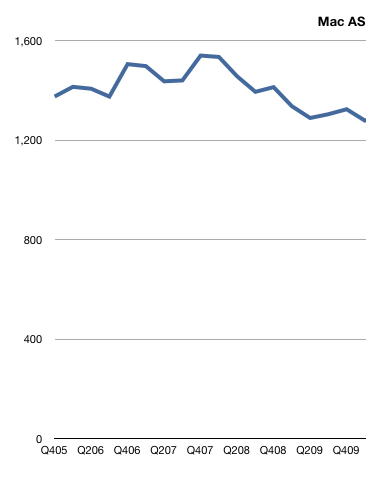
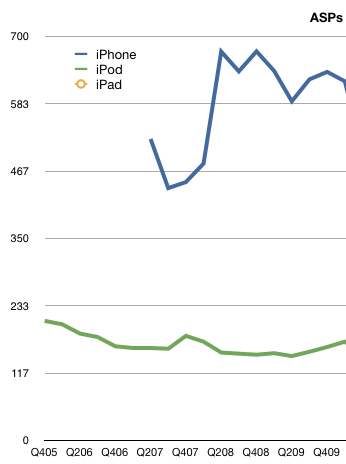
    Apple's ASPs have been holding quite steady.  Gains in the iPod are offset by losses in the Mac. Here are the current ASPs.

    • iPhone $622.15 (includes accessories)
    • Mac $1,278
    • iPod $171

    A historic perspective for ASP growth is shown in the graphs below:

  5. Apple Business Review: Product Line Growth

    Research

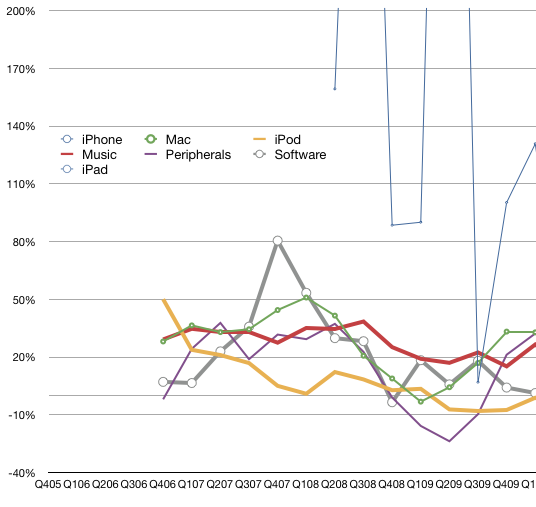
    Each of Apple's individual business lines is profitable.  Last quarter only the iPod experienced negative year-on-year unit growth but still generated a positive sales growth due to higher ASP.

    Here is the list of each product line and its y/y sales growth:

    Unit Growth, Sales Growth

    • iPhone 131%, 124%
    • Mac 33%, 27%
    • iPod -1%, 12%
    • iTunes n/a, 27%
    • Periph n/a, 32%
    • Software n/a, 1%

    Overall sales grew 49%.

    A historic perspective for unit growth (iTunes, Peripheral and Software sales growth) is shown in the graph below.

  6. One Hundred Million (part II)

    Research · 3 comments

    My prediction is that sometime next year Apple will announce the 100 millionth iPhone OS device sold, making the iPhone the fastest selling platform in history. The iPhone will have been on the market for three years.

    One Hundred Million « Asymco. (five months ago)

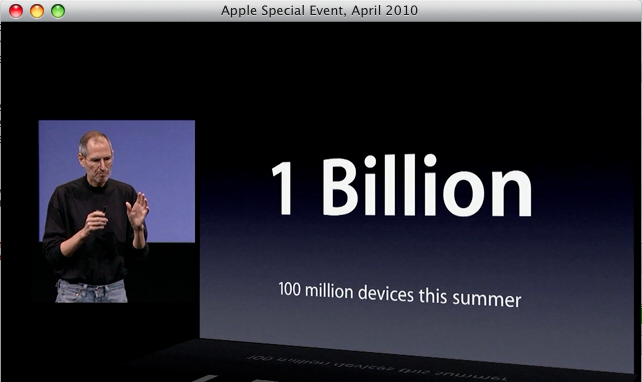
    Did anybody else see the line below the "1 Billion" header in the iPhone 4.0 Launch Event? The segment was about the 1 Billion impressions that iAd will be able to target.  Interestingly this is one of only two forward looking estimates that Apple has ever made on the iPhone.

    100 million

    The 100 million threshold in units is important in several contexts.

    First, on April 9th, 2007 Apple announced that the 100 millionth iPod had been sold, making the iPod the fastest selling music player in history. The first iPod was sold five and a half years earlier, in November 2001.  The iPhone will reach this in 3 years.

    Second, no other platform comes close.  On November 3, 2003, Microsoft announced that it intends to sell 100 million Windows Mobile devices by year 2007. Two years after that goal, in 2009, Microsoft sold 15 million units, down from 16.5 million in 2008.  It has not reached half the targeted installed base.

    Although there could be more than 100 million Symbian devices in use, they are not all running the same software, so they do not offer a targetable installed base.

  7. Getting Misty Eyed With Memories...

    Research · 4 comments

    On the eve of iPad sales start, and the soon-to-be classic quotes from iPad experts, it's time to play back some of the classic iPhone expert predictions from yesteryear:

    "[iPhone] just doesn't matter anymore. There are now alternatives to the iPhone, which has been introduced everywhere else in the world. It's no longer a novelty." - Eamon Hoey, Hoey and Associates, April 30, 2008

    "We are not at all worried. We think we've got the one mobile platform you'll use for the rest of your life. [Apple] are not going to catch up." - Scott Rockfeld, Microsoft Mobile Communications Group Product Manager, April 01, 2008

    "Microsoft, with Windows Mobile/ActiveSync, Nokia with Intellisync, and Motorola with Good Technology have all fared poorly in the enterprise. We have no reason to expect otherwise from Apple." - Peter Misek, Canaccord Adams analyst, March 07, 2008

    "[Apple should sell 7.9 million iPhones in 2008]... Apple's goal of selling 10 million iPhones this year is optimistic." - Toni Sacconaghi, Bernstein Research analyst, February 22, 2008

    "What does the iPhone offer that other cell phones do not already offer, or will offer soon? The answer is not very much... Apple's stated goal of selling 10 million iPhones by the end of 2008 seems ambitious." - Laura Goldman, LSG Capital, May 21, 2007

    Motorola's then-Chairman and then-CEO Ed Zander said his company was ready for competition from Apple's iPhone, due out the following month. "How do you deal with that?" Zander was asked at the Software 2007 conference. Zander quickly retorted, "How do they deal with us?" - Ed Zander, May 10, 2007

    "The iPhone is going to be nothing more than a temporary novelty that will eventually wear off." - Gundeep Hora, CoolTechZone Editor-in-Chief, April 02, 2007

    "Apple should pull the plug on the iPhone... What Apple risks here is its reputation as a hot company that can do no wrong. If it's smart it will call the iPhone a 'reference design' and pass it to some suckers to build with someone else's marketing budget. Then it can wash its hands of any marketplace failures... Otherwise I'd advise people to cover their eyes. You are not going to like what you'll see." - John C. Dvorak, March 28, 2007

    Even if [the iPhone] is opened up to third parties, it is difficult to see how the installed base of iPhones can reach the level where it becomes a truly attractive service platform for operator and developer investment." - Tony Cripps, Ovum Service Manager for Mobile User Experience, March 14, 2007

    "I'm more convinced than ever that, after an initial frenzy of publicity and sales to early adopters, iPhone sales will be unspectacular... iPhone may well become Apple's next Newton." - David Haskin, Computerworld, February 26, 2007

    "Consumers are not used to paying another couple hundred bucks more just because Apple makes a cool product. Some fans will buy [iPhone], but for the rest of us it's a hard pill to swallow just to have the coolest thing." - Neil Strother, NPD Group analyst, January 22, 2007

    "The iPhone's willful disregard of the global handset market will come back to haunt Apple." - Tero Kuittinen, RealMoney.com, January 18, 2007

    "[Apple's iPhone] is the most expensive phone in the world and it doesn't appeal to business customers because it doesn't have a keyboard which makes it not a very good email machine... So, I, I kinda look at that and I say, well, I like our strategy. I like it a lot." - Steve Ballmer, Microsoft CEO, January 17, 2007

    "The iPhone is nothing more than a luxury bauble that will appeal to a few gadget freaks. In terms of its impact on the industry, the iPhone is less relevant... Apple is unlikely to make much of an impact on this market... Apple will sell a few to its fans, but the iPhone won't make a long-term mark on the industry." - Matthew Lynn, Bloomberg, January 15, 2007

    "iPhone which doesn't look, I mean to me, I'm looking at this thing and I think it's kind of trending against, you know, what's really going, what people are really liking on, in these phones nowadays, which are those little keypads. I mean, the Blackjack from Samsung, the Blackberry, obviously, you know kind of pushes this thing, the Palm, all these... And I guess some of these stocks went down on the Apple announcement, thinking that Apple could do no wrong, but I think Apple can do wrong and I think this is it." - John C. Dvorak, January 13, 2007

    "I am pretty skeptical. I don't think [iPhone] will meet the fantastic predictions I have been reading. For starters, while Apple basically established the market for portable music players, the phone market is already established, with a number of major brands. Can Apple remake the phone market in its image? Success is far from guaranteed." - Jack Gold, founder and principal analyst at J. Gold Associates, January 11, 2007

    "Apple will launch a mobile phone in January, and it will become available during 2007. It will be a lovely bit of kit, a pleasure to behold, and its limited functionality will be easy to access and use. The Apple phone will be exclusive to one of the major networks in each territory and some customers will switch networks just to get it, but not as many as had been hoped. As customers start to realise that the competition offers better functionality at a lower price, by negotiating a better subsidy, sales will stagnate. After a year a new version will be launched, but it will lack the innovation of the first and quickly vanish. The only question remaining isif, when the iPod phone fails, it will take the iPod with it." - Bill Ray, The Register, December 26, 2006

    "The economics of something like [an Apple iPhone] aren't that compelling." - Rod Bare, Morningstar analyst, December 08, 2006

    "Apple is slated to come out with a new phone... And it will largely fail.... Sales for the phone will skyrocket initially. However, things will calm down, and the Apple phone will take its place on the shelves with the random video cameras, cell phones, wireless routers and other would-be hits... When the iPod emerged in late 2001, it solved some major problems with MP3 players. Unfortunately for Apple, problems like that don't exist in the handset business. Cell phones aren't clunky, inadequate devices. Instead, they are pretty good. Really good." - Michael Kanellos, CNET, December 07, 2006

    "We've learned and struggled for a few years here figuring out how to make a decent phone. PC guys are not going to just figure this out. They're not going to just walk in." - Ed Colligan, Palm CEO, November 16, 2006

    Nostalgia was better in the old days...

  8. Music. Sweet music

    Podcast · 37 comments

    iPad Death Watch : AAPLinvestors

    You can't go wrong betting against this bunch.

    (link above reproduced below due to bandwidth issues with their servers.)

    “Any tablet computer, including Apple’s eagerly anticipated iPad, will face serious problems in generating big sales. Tablets look cool, but the reality is they don’t do anything new.” Michael Comeau, Minyanville, 5 March 2010

    Dvorak:”I’m telling you, look at this product coming out of India called the Adam.” Curry: “A-D-A-M?” Dvorak: “Yeah.” Curry: “And it’s a what it’s a pad?” Dvorak: “It’s an iPad Killer. And I hate to use that term since the iPad is probably dead anyway.” No Agenda Podcast, Adam Curry & John C. Dvorak, 25 February 2010

    “Fewer capabilities (than a netbook) but a similar size? Not a good start.”Lee Gomes, Forbes Asia Magazine, 5 March 2010

    “We of course build plastic mock-ups that we show (to customers)…we had a slate form factor. The feedback was that for (our) customers it will not work because of the need to have (a physical) keyboard. These were 14-year-old kids, who, I thought, would be most willing to try a virtual keyboard but they said no, we want the physical keyboard.” Mika Majapuro, Worldwide Sr. Product Marketing Manager, Lenovo, 22 February 2010

    “The Apple iPad is not going to be the company’s next runaway best seller.” John Dvorak, MarketWatch, 12 February 2010

    “It’s a nice reader, but there’s nothing on the iPad I look at and say, ‘Oh, I wish Microsoft had done it.’” Bill Gates, Microsoft, 10 February 2010

    “The rally has been especially kind to seemingly racy stocks such as Apple and Google. Both have pole-vaulted to market-surpassing gains over the past 12 months, despite the fact that the former’s hamster-wheel of innovation (to borrow an apt phrase from my Fool colleague Joe Magyer) may have hit a snag with the iPad. ” Shannon Zimmerman, The Motley Fool, 10 February 2010

    “It’s not a tablet, it’s an extension of the iPod Touch. It has some new kinks, but generally speaking it’s using the iPhone OS. It’s more like a smart phone than a personal computer. It’s the Newton reborn. What’s missing most is the communications aspect.” Andreas Haas (former Apple executive), CEO, Axiotron (Modbook), 7 February 2010

    Before Jan 20th, 49 percent of people said they didn’t think they needed an Apple Tablet. That number jumped to 61 percent after the announcement. Fifty-nine percent of buyers wouldn’t pay extra for 3G coverage. Whether this device becomes a big hit is anyone’s guess but based on this study it sure looks doubtful.” Retrevo, 5 February 2010

    “Yet it’s hard to see how the iPad, in the form unveiled last month, will come close to transforming daily life as much as the iPod or iPhone. The challenge with the iPad will be less about improving an established market than building a new one.” Arik Hesseldahl, BusinessWeek, 5 February 2010

    “I added it up and … like 800 people are going to buy the iPad. . . . It’s not that the iPad is a failure. It’s just a product ahead of its time. No one should actually buy this iPad — between its inevitable first-generation bugs, fulfillment problems, and buyer’s remorse over added features and price drops, it’s heartbreak waiting to happen.” Molly Wood, CNet, 31 January 2010

    “It was a bigger iPod Touch. I question whether those features would be enough to get people to buy new machines.” Satoru Iwata, President, Nintendo, 29 January 2010

    “The company once notorious for its ability to upend convention and revolutionize markets may no longer have what it takes, worry some technology journalists. Call it the iPad or the iPlod, but the message seems clear: Apple may have lost its mojo.” Jeremy A. Kaplan, FOXNews.com, 28 January 2010

    “What’s the single most worrisome thing about the iPad? It’s Apple’s monopoly on distribution of applications. ” Harry McCracken, Tecnologizer.com, 29 January 2010

    “The tablet market has only succeeded as a niche market over the years and it was hoped Apple would dream up some new paradigm to change all that. From what I’ve seen and heard, this won’t be it.” John Dvorak, MarketWatch, 29 January 2010

    “It is a humorous world in how Microsoft is much more open than Apple,” Frank Shaw, Microsoft, Corporate VP, Corporate Communications, 29 January 2010

    “When Steve Jobs first demonstrated the Apple Mac, he used the words “insanely great” to demonstrate the full graphical display of the computer. It’s a tag that has stuck around to this day among Apple fans. But, today’s comments from Jobs that the iPad is a “magical, revolutionary” device ring hollow.”Dan Wayne, apc mag, 28 January 2010

    “All the people (including me) who felt underwhelmed by the iPad initially might have missed its true potential. Put another way: the iPad is all about software. Forget the sleek form factor – that’s just a prerequisite. Ironically, it’s the software and services that Microsoft never ‘got’, that Apple totally does get.” Dan Wayne, apc mag, 12 February 2010

    “Nothing from the iPad specs that I’ve seen really shows any great cause for celebration. Unless Apple has also developed some new type of power source, such as nuclear cells or magical hamsters on tiny spinning wheels for the iPad, don’t expect the claims about battery life to hold true. ” John Breeden II, Government Computer News, 28 January 2010

    “Ultimately, the iPad is a large iPod touch: a great device to draw your inspiration from, but perhaps not the seismic shift in technology that we were expecting.” Claudine Beaumont, The Telegraph, 28 January 2010

    “Behold: The Apple iFlop Neither “truly magical” nor “revolutionary,” the cluelessly named Apple iPad tablet device has dropped like a shiny wedge into the gadget game, dividing tech watchers in to opposing views — the critical and the adoring.” Scott Moritz, TheStreet.com, 28 January 2010

    “9 Worst Things About The Apple Tablet: 1. No Flash 2. Its screen 3. Its price 4. Closed App Store 5. Its name 6. No multitasking 7. No camera 8. No USB 9. AT&T deal Bianca Bosker, Huffington Post, 29 January 2010

    “What do the new Apple iPad and Google’s Nexus One have in common? Both were DOA: Disappointing On Arrival. Why is the iPad a disappointment? Because it doesn’t allow us to do anything we couldn’t do before. Sure, it is a neat form factor, but it comes with significant trade-offs, too. No 16:9 widescreen, for example.” David Coursey, PC World, 28 January 2010

    “E-readers will outsell iPads because of the simple economics of the consumer device market. It’s triple the weight and 30% thicker than an e-reader. You need two hands to hold it. It’s got a backlit screen, and it’s too expensive to give one to everyone in your house.” Russ Wilcox, CEO E-Ink (makers of Amazon’s Kindle), 28 January 2010

    “It seems like a high priced, unnecessary trinket to me.” Paul Thurrott, SuperSite for Windows, 27 January 2010

    “Apple iPad - failure, joke or fiasco? Pick one” Linen DeFiller, MillionFace.com, 27 January 2010

    “The press weren’t cheering and whooping. I didn’t see anybody pee their pants … Not one! The only people I saw cheering were the people who work at Apple down in the front two rows … Al Gore was going crazy. I wanted to see more. It’s a big iPod. What is there to do there? Play a video game on a bigger screen? I thought it [iPad] was ‘paving the cow path’ (enshrining a makeshift solution).” Dan Lyons aka Fake Steve Jobs, 27 January 2010

    “Let’s face it, the Internet was designed for the PC. The Internet is not designed for the iPhone. That’s why they’ve got 75,000 applications — they’re all trying to make the Internet look decent on the iPhone.” Steve Ballmer, Microsoft, 21 October 2009

  9. 33 Million iPod Touch Sold

    Research · 1 comment

    Tim Cook made the claim yesterday that about 75 million iPhone OS devices have been sold. The total iPhones we know are about 42 million. That leaves at least 33 million iPod touch units or 44%.

    iPod touch grew 55% y/y in CQ4.

    My estimate had been 40% iPod share of the platform, so this is very encouraging. It seems that the proportion of iPod is growing and with the iPad, it's possible that we'll see less than 50% of the ecosystem being iPhones.

  10. Estimating iPhone’s Nosebleed Gross Margins

    Research

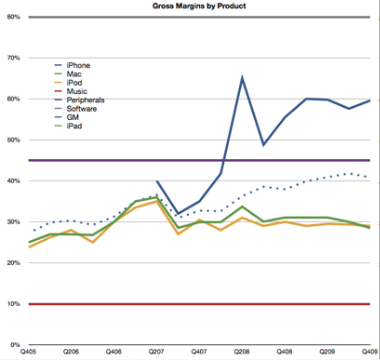
    Apple’s latest re-statement of financial statements eliminated subscription accounting for the iPhone not just for the past quarter but for the entire history of the product, back to mid-2007. This allows a more precise estimate of the gross margin of the product and the results are eye-watering.

    Apple does not reveal the margin for any product. They do provide an overall margin for the company (shown in the dotted line above).

    The only challenge is to “back into” the GM for iPhone based on what we know of the margins for the other product lines and filling in the iPhone as the last piece of the puzzle.

    To do so, we need to have some idea of what the other products’ margins are. Fortunately, this is not that hard.

    We start with the easiest and work up:

    The Software products business line ($2.4 billion last year) is easily the most profitable on a unit basis as software does not require much cost in manufacturing. A solid ballpark estimate is 80% GM (which is what Microsoft typically gets.)

    Next, Music ($4.2 billion revenues). The estimate for music is fairly straight-forward. Apple and the industry have leaked the terms many years ago. Apple pays the labels most of the revenue of the music and keeps about 10% to operate the store. On the App Store there is a 30% margin off the selling price but that is offset by higher direct costs (shipping billions of free apps and free updates). I stick with 10% margin for the Music business line.

    Third, Peripherals. The peripherals business is not particularly large for Apple, but they do a fair amount of peripherals with $1.5 billion last year. My estimate for peripherals margin is 45% based on some comparables.

    Fourth, the iPod ($8.1 billion). The iPod has had a fairly well understood cost structure. The main variable is the cost of the memory, which, as a commodity, varies greatly quarter to quarter. Nevertheless, there is a strong consensus that iPod margins have kept around 29% to 30% over a few years. Teardown analysis coupled with spot pricing for memory chips gives a consistent average.

    Fifth, the Mac ($14.7 billion). The Mac is a difficult product to estimate margins for due to the relatively wide variety of SKUs in the market, the complex components, various quality/warranty issues, transportation costs and the point in the life cycle of any given Mac. The best estimates however hover around the same as the iPod: 30%.

    Once these values are available, and knowing the proportion of sales attributable to the iPhone vs. the other products, we can get an estimate of the gross margin.

    Recent GM estimates are all shown in the graph attached. Here are a few observations:

    1. The overall GM was tied very closely to the Mac/iPod prior to the iPhone.
    2. Gross Margin has been increasing since the iPhone
    3. The iPhone GM is consistently above 60% and is chiefly the reason for the increasing of the overall GM

    The expanding margin for the whole of Apple is quite a story in itself (especially vis-a-vis the tragicomedy of the other PC vendors). However, what really stands out is how high the iPhone margin is.

    Knowing why it stays so high in the face of an assault of “iKiller” devices is a clue to how Apple creates value.

  11. Keeping it Real

    Research

    From the VP of marketing for the Limo Foundation:

    Growth within the siloed Apple ecosystem will actually stifle the grass-roots innovation

    It's interesting that this comment came on the day after Rob Glaser left Real Networks. Let's take a stroll down memory lane of Glaser quotes:

    (in 2003) “It’s absolutely clear now why five years from now, Apple will have 3 (percent) to 5 percent of the player market. … The history of the world is that hybridization yields better results.”

    “Apple’s (market) share will go down if they continue to do this. The only way to presently put songs on an iPod is to (buy) them from iTunes.”

    The (unforeseen) standard that emerged from the iPod is iTunes marketplace. It allowed Apple to establish itself as the premier and dominant merchant of all media including disruptive new media like apps. The iPod was "closed", "siloed" and "locked-in" users. But it worked and grew and grew to the point where it set the standard.

    The same arguments raised against the iPhone were raised against the iPod and Windows before it. Last I checked iPod had 70% share 9 years after the launch and Windows has 90% share 20 years after launch. iTunes sells more songs than any other retailer on the planet and more apps that anyone imagined possible.

    Perhaps this data bears repeating:

    • 140,000 apps - made by over 28,000 developers
    • Users downloaded an average of 3.7 apps each in December.
    • One Quarter of apps downloaded are paid. Average cost of $2.59/app.
    • Each iPhone user spends an average of $10/mo.
    • There are over 75 (est.) million active users
    • 200 million apps are being downloaded every month
    • $500 million in revenues each month. 70% to developers or $385 million

    All these numbers are increasing and accelerating. iPhone Platform Fastest Ecosystem Ramp in History.