Asymco

Asymmetric Intelligence

Nvidia

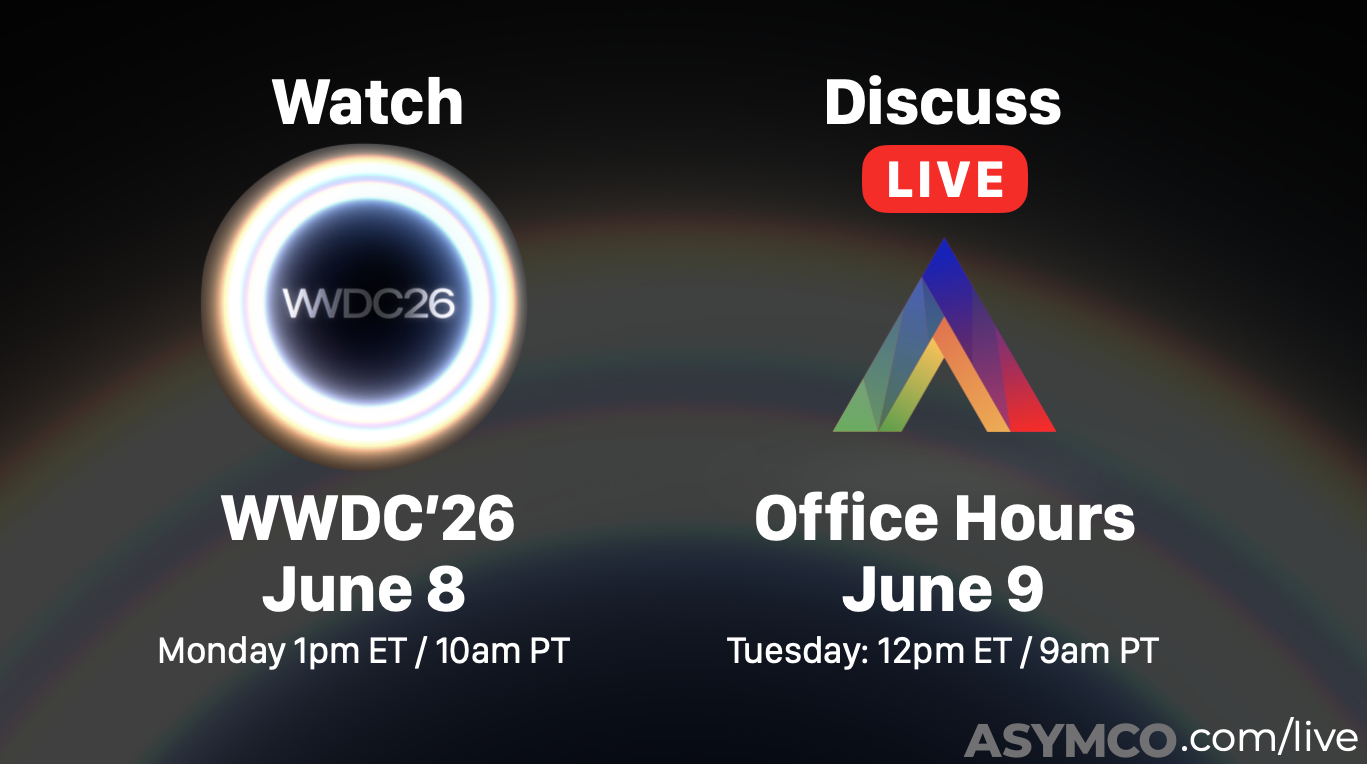
  1. WWDC Special: Asymco Office Hours - June 2026 - Live Q&A with Horace Dediu: Recording & Transcript

    Office Hours

    Recording and transcript of the June 9, 2026 Asymco One Office Hours, recorded the day after Apple's WWDC 2026 keynote. Horace Dediu shares his impressions of the event and takes questions from Asymco One subscribers.

    Recording

    Subscribe to Asymco One to listen to the recording and read the transcript.

    Transcript

    Sign up and latest updates at asymco.com/live.

  2. Apple confirms not using Google models, apps or search in Apple Intelligence

    Nota Bene · 5 comments

    One Foundation Model runs on Nvidia GPUs hosted in Google’s cloud and some Google proprietary model data used to refine Apple's Models.

    Apple has shared new details about the technology behind its latest Apple Intelligence platform, explaining how its new Apple Foundation Models (AFM) work and clarifying the company's relationship with Google. During a post-WWDC technical discussion, Apple executives said the company does not use Google’s Gemini models, Google Search, or Google Assistant infrastructure to power Siri or Apple Intelligence

    Craig Federighi, Apple’s Senior Vice President of Software Engineering:

    “Of course, we don’t have the Gemini app as our app. In fact, none of that client code is part of how we run on iOS. For these models, we use none of the models that Google deploy to their customers, nor do we use the infrastructure and means by which they deploy models to their customers. And then, when it comes to the knowledge base, we of course don’t use Google Search or anything like that as the foundation of our system. So I hope that’s clear. The amount of the Google Assistant we use is none.”

    Source: The Mac Observer

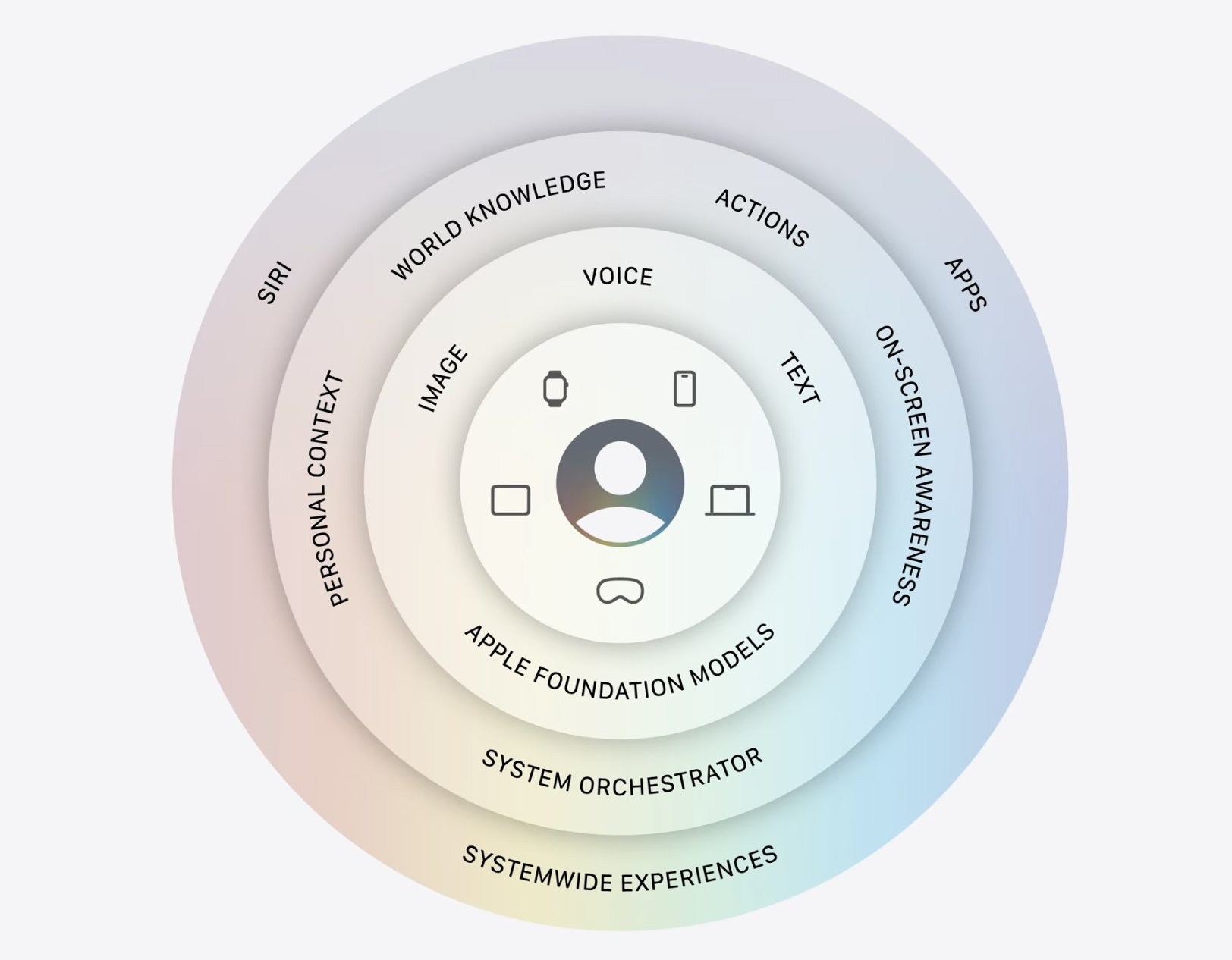
    NB: Apple introduced five foundation models.

    • AFM Core (used for expressive voices and invitation capabilities on device)
    • AFM Core Advanced (on device)
    • AFM Cloud
    • AFM Cloud Image image generation and editing tools, including spatial reframing
    • AFM Cloud Pro complex reasoning and agentic actions; Nvidia GPUs hosted in Google’s cloud

    These models are custom-built for Apple Silicon, trained using proprietary data, and refined using outputs from Gemini frontier models. The company emphasized that there is no direct use of Gemini itself.

  3. Will Apple avoid giving their cash flow to Nvidia?

    Research · 3 comments

    Asked by Jay Goldberg

    Q: Do you think Apple will start investing heavily in AI data centers?

    There's rumors and actually statements from Apple saying that they're working on a server chip. Google has a server chip. Amazon's got a server chip. These are effectively aimed at Nvidia. And if you can make something, you tend to do it. Now, of course, there's some protection — Nvidia's got other special sauce, but their margin is everybody's opportunity. They have a huge margin. And everybody's writing huge checks. As I say, hyperscalers are just handing over their entire cash flows to Nvidia. And that means their shareholders' entire wealth is being handed off to Nvidia shareholders. So there's a transfer of wealth happening right now. Presumably, because we're going to get some benefit later, but if that's happening and people are irritated by it, they're going to find a way to do what Nvidia does.

    And Apple, of course, can and will do that. Now, whether that'll get deployed at the edge or in Apple's own cloud — because they probably also don't want to write checks to Nvidia, and they'll say, well, we can do it, and we won't necessarily sell them, like Google wants to. They'll probably just use them themselves. And that's something certainly they're capable of.

    The question I was always asking is how many are we talking about? Because if it's in the tens of millions, or even single-digit millions — for Apple, single digits. Is it worth it to develop your own designs? There's a limit to how many you can deploy. And probably you're going to have to replace them every so often, so there's a question about how much it costs to keep on the treadmill.

    But it is an interesting question, and I think everybody's capable of doing what Nvidia's doing. But it's about execution, timing, delays. Look at what happened with the Qualcomm chip — how long it took Apple to finally deploy the communications chip relative to the amount of grief it had to deal with. First, of course, it moved out of Intel. It moved out of Qualcomm now, and now the question is, is it going to move out of the server supplier chain? And that's a complex decision. But again, Apple's not doing it because they want to be in that business. It's more that they want to avoid dependency.

    This was one of the questions asked by the participants in Asymco's May 2026 Office Hours live Q&A sessions, open to Asymco One subscribers.
    See also: May 2026 Office Hours

  4. Why won't Apple become a cloud company?

    Research · 2 comments

    An Office Hours question asked by Fred S., May 1, 2026

    Q: Ever since Johny Srouji started talking about Apple Silicon and the power consumption for the performance and the unified memory, and now we've seen the Mac mini surge, I just wonder about high-end computing. The whole area of where that Mac architecture may go beyond its success as an individual consumer computing product. From all the high-end workloads that might be coming their way.

    The story of Apple is one of personal computing. It's not a story of servers, it's not a story of clouds, it's not a story of centralized computing. They've tried once or twice to make a server product, and they abandoned it. They've even abandoned the high-end Pro product, and created the almost-as-fast Studio product.

    Now, that does not mean they're shying away from high-power computing. They're just saying, we're going to put that high-power computing in a desktop, or in the laptop, or even in the phone. Everyone who's grown up throughout the personal computer era can remember Moore's Law, and how exponential growth has driven computation to levels that seemed impossible just a few years earlier. We've hit some slowdowns, but fundamentally, the potential exists.

    And by the way, it's not even a classic computational CPU problem. We're dealing with AI. We're mostly dealing with high bandwidth, large data, and we're dealing with simple calculations on it in parallel, which means the architecture is much more around large matrix computations. This is why Nvidia came from graphics. Graphics was the same problem — a graphics accelerator is a matrix problem. And so is machine learning. So different variations of these have come in as a sort of a parallel to the CPU, the general computation problem.

    The idea Apple has is that they're going to catch up with whatever is done on the server, they're going to do it on the device. You can call it Edge, you can call it personal — the old term was personal computing.

    I may be naive, but I think we'll get very powerful desktop computers that can do what is essentially AI, but for the individual. The other aspect here is that Apple is a consumer company, not a B2B company — it's a B2C. They want to bring that power to as many people as possible. And they're certainly delivering hundreds of millions of computers a year. Nvidia's making tens of millions of computers a year. Apple is capable of doing orders of magnitude more.

    So I think they're going to affect the disruption in AI. It's not going to be that there's no profit in AI, it'll be that it'll be done with Edge more, especially as it doesn't have to be a world model — it can be a personal model. If you want to look up something globally, you can use the cloud, but if you want to deal with tasks in your world, you're going to work with Apple computers.

    It may take years to get there. But in the meantime, I don't think a centralized service — these OpenAI, or Anthropic, or Microsoft, who are trying to make us a singular superintelligence — is necessary for everyone. It'll be a good reference, but it's not how you want to handle your personal information. So I think that's what the future is, and I think Apple's very much planning for it.

    It sounds cliche, but when Apple started, it was IBM that dominated computing. And IBM was about centralized computing, and their thesis was everything we now call "the cloud" — but it was all in one big computer that served the entire organization, whether that organization is a government or a big company. And then we went to mini computers, then we went to desktop computers, then we went to portable computers.

    Then, fast forward 25 years and we had Google. Well, now central computing is the internet. In the internet, everything needs to be indexed to be able to be found. So they created an index in the cloud. And then a lot of companies moved that computing they used to have locally into the cloud, as a shared resource from Amazon, AWS, and others, and that became cloud compute. Even now, those are the drivers for growth for Microsoft and Amazon and Google.

    The AI part of that is tiny — there's revenue from AI, but there's a lot of revenue from cloud. That still is valuable. But that's not a job for consumers. You do some things in the cloud — you store things, you search, you communicate in messages and so on. But most of the data that matters to you will get also indexed locally, so you can pull up your photos, pull up these things, and it'll be a blend of the two.

    So that's where Apple lives, and I don't see anything fundamentally changing about this, because computation tends to commoditize. Software tends to be replicated. Algorithms tend to be replicated. In fact, even the AIs we have today were all because people publish papers, and one company invents it, another implements it, as was the case with the transformer. As far as I understand, it was Google who actually wrote the paper on it.


    Editor's Note: This was one of the questions asked by the participants in Asymco's May 2026 Office Hours live Q&A sessions, open to Asymco One subscribers.
  5. Asymco Bulletin 011 - May 3, 2026

    Bulletin

    Asymco Bulletin is a digest of all the work we have published for the week ending May 3, 2026.

    Editor's Note: Starting next week, we will be sending Asymco Bulletin to Asymco One subscribers only. You will still receive Updates when new posts are published per your notification settings.

    Office Hours

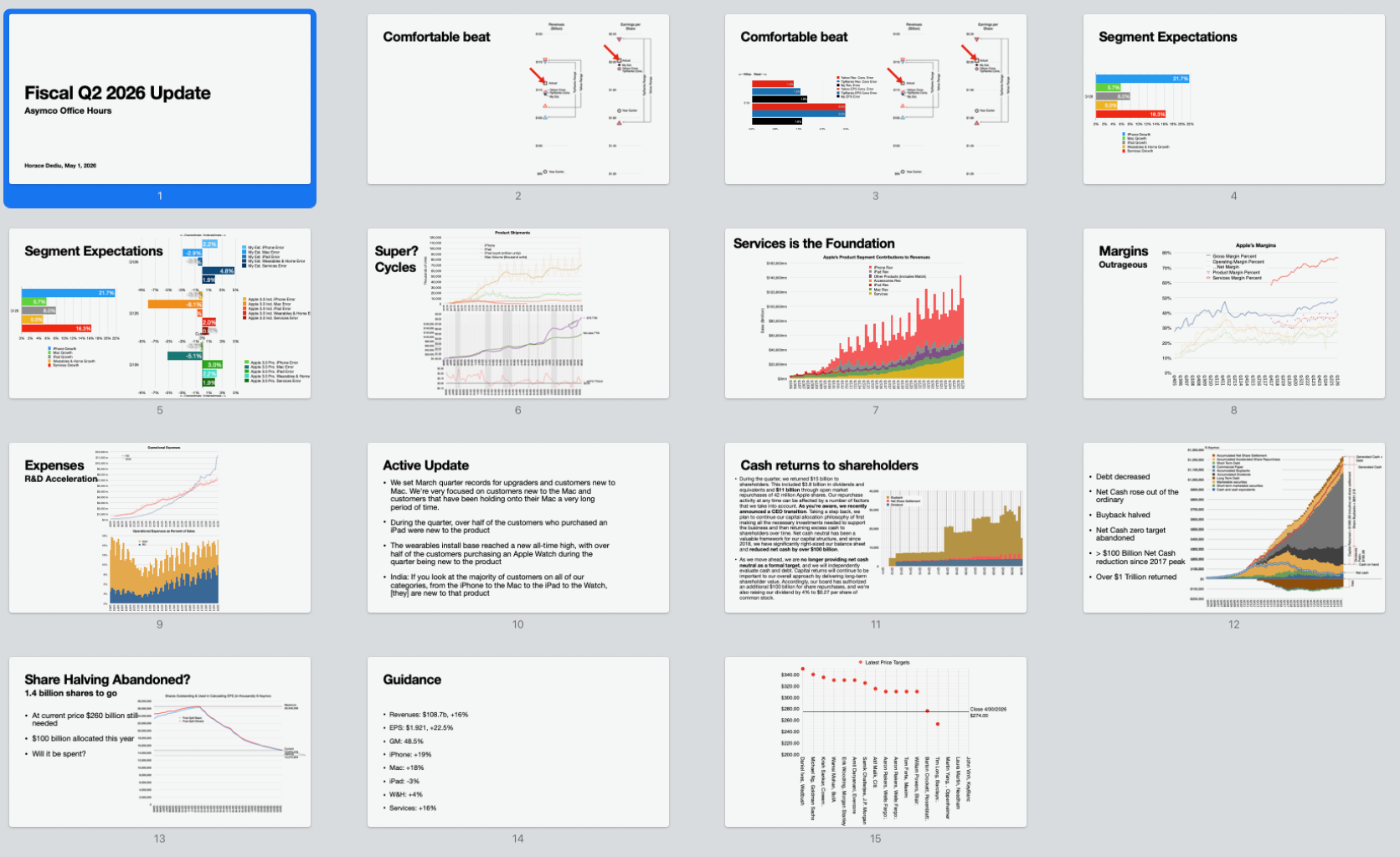
    Asymco Office Hours — Apple Fiscal Second Quarter 2026 Review: The Presentation

    Apple FQ2 2026 Earnings Review

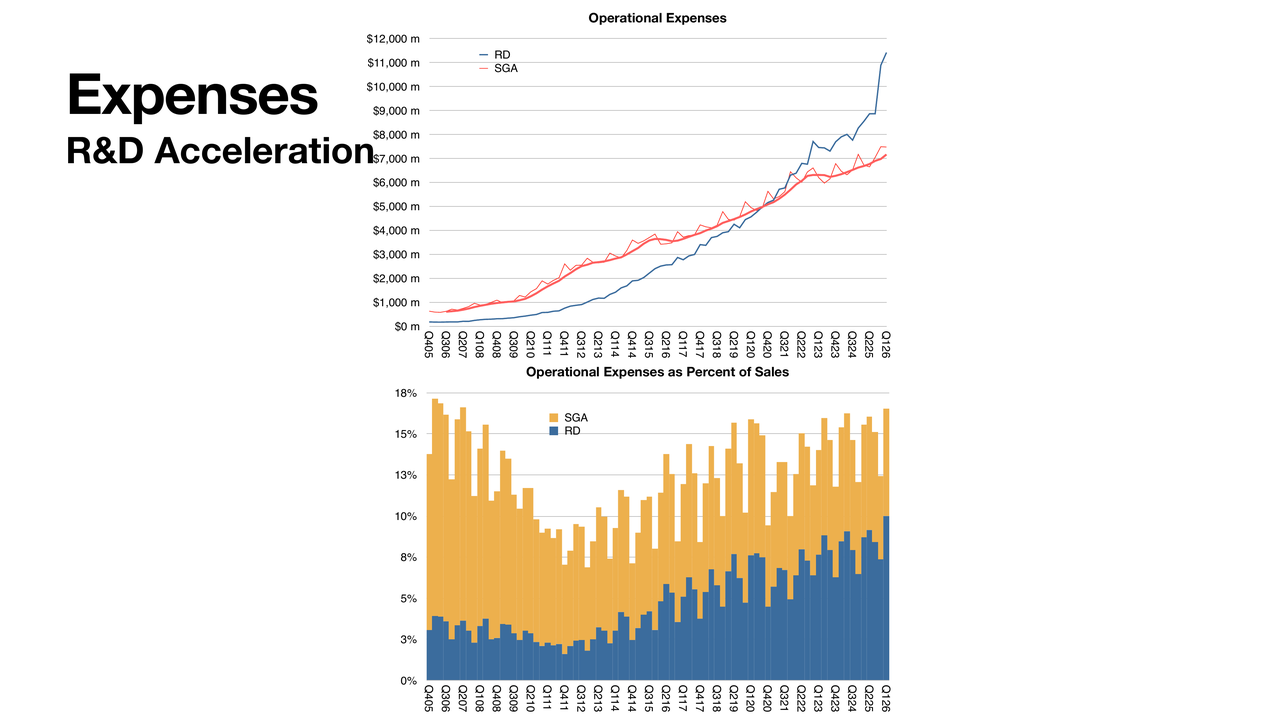
    In Asymco One's May 1, 2026 Office Hours session, review of Apple's Q2 2026 earnings, segment growth: iPhone at 22%, Services at 16%, iPad at 8%, Mac at 5.7%, and wearables at 5%. Steady, foundational growth of Services, Gross margins reached nearly 50%, R&D spending surged, a shift in Apple's capital return strategy showing perhaps the hand of John Ternus. Guidance suggests 16% revenue growth, 22% EPS growth. Analyst sentiment turned positive post-earnings, with most price targets rising above $310. Apple's evolving identity as an engineering-centric company was the focus of many questions. →

    Research

    Expectations for the Quarter

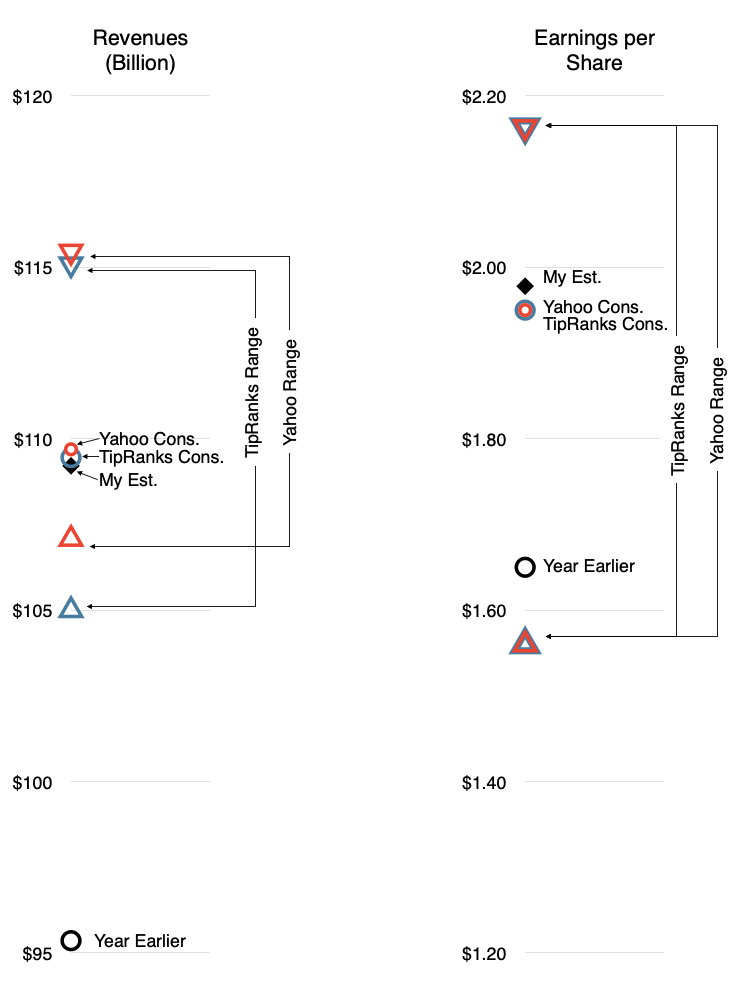
    Revenue and EPS consensus, year-ago results and my expectations Yahoo Finance Yahoo Finance’s revenue estimate for Apple in Q2 stems from 31 analysts. As of April 25, the average estimate is $109.69 billion, with a low of $107.08 billion and a high of $115.37 billion. For the earnings per share estimate, 32 analysts put it at an average of $1.95. The low is $1.56 and the high is $2.16. TipRanks TipRanks also does its own analyst polling on Apple’s quarter. In its forecast as of April 19, its consensus is for a revenue of $109.45 billion, with a high of →

    UBS Raises Price Target from $280 to $287 but Maintains Neutral Rating

    Nota Bene

    The Economist Interview: Hints at the future direction of the company → As is often the case, a 45 minute discussion turns into two sentences. The article sadly does not provide hints at the future direction of the company. But we can…

    TD Cowen: 15% revenue growth, 10% growth guidance → Apple is projected to gain market share in both smartphones and PCs, driven by strong iPhone 17 demand and the new MacBook Neo, with anticipated revenue growth of over 15% in Q3 and positive sentiment ahead of earnings.

    UBS Raises Price Target from $280 to $287 but Maintains Neutral Rating → Apple's fiscal Q2 shows promise with iPhone strength and solid Mac demand, especially for the budget-friendly Neo and AI-capable Mac mini, potentially boosting earnings beyond expectations.

    Morgan Stanley forecasts fiscal second-quarter EPS of $1.74 → Despite memory pricing pressures, Apple's strong iPhone sales, potential AI and foldable iPhone announcements, solid free cash flow, and favorable market conditions position it for better-than-expected earnings and a possible stock rise to $300 by September.

    Is Apple borrowing Samsung’s Market Expansion Strategy? → Bernstein SocGen maintains optimism on Apple's strategic pricing and ecosystem strength, forecasting EPS growth and potential market share gains, while Samsung faces smartphone profit challenges but thrives in memory.

    Separately, it’s been reported that Samsung might see its first operation loss from its phone division, resulting in Apple capturing 100% (or more) of global smartphone profits. Simultaneously, Samsung is seeing huge profit gains from memory, even overtaking Nvidia’s profitability. This is remarkable…

    Apple share of the smartphone SoC market grew from 15% to 19% in Q1 → In Q1 2026, global smartphone SoC shipments fell 8%, but Apple thrived in the premium market by leveraging its efficient supply chain and passing costs to consumers, boosting its market share from 15% to 19%.

    Google to sell TPU chips as Gemini shows returns → Why pour cash into Nvidia when you can craft your own cutting-edge chips like Google, and then turn that innovation into a lucrative side hustle by selling them to tech giants like Meta and Anthropic?

    The Vision Products Group Expanding → Gurman's 2025 dissolution claim clashes with 2026's active Vision Products Group hiring spree. The Vision Products Group posted 14 new senior roles last week.


    Asymco One gives you full access to our research, analysis, and commentary. Subscribe with code BULLETIN for a discount.

    Feedback: Have questions or comments? Reach out to us at contact@asymco.com. We’d love to hear from you.

  6. Google to sell TPU chips as Gemini shows returns

    Nota Bene · 2 comments

    Why give all your cash to Nvidia? Why not make your own chips? Then why not sell them?

    Google said that it plans to sell its custom Tensor Processing Units (TPUs) to select customers who will install the chips in their own data centers.

    The move is a change from Google’s prior strategy, which saw it rent out TPU capacity to customers from its own data centers — and is yet another strike at AI chip king Nvidia.

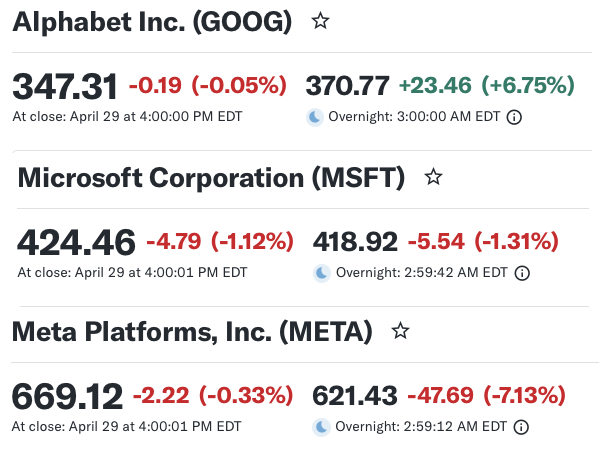
    The announcement, during the company’s Q1 earnings call, comes a week after Alphabet announced two new TPUs: its TPU 8t for AI training and TPU 8i for inferencing.

    Alphabet didn’t disclose potential customers, but it signed a multiple-gigawatt agreement for next-generation TPUs with Anthropic earlier this month, with chips expected to begin coming online in 2027.

    And according to The Information, Alphabet has also entered into a multibillion-dollar chip deal with Meta (META).

    Source: Yahoo Finance

    NB: Alphabet Q1 sales grew 22% to $110 billion, with Cloud up 63% to $20 billion. Operating margins grew by 220 basis points, with services and cloud operating margins both increasing y/y.

    The search business continues to benefit from AI. AI overviews and AI mode are sustaining as search sales grew 19%.

  7. Asymco One Office Hours Live Q&A with Horace Dediu & Gene Munster: April 8, 2026

    Office Hours

    A lively discsussion of Apple topics such as:

    • Geopolitics: China concentration; Taiwan tail risk
    • Financials: Solid near-term growth
    • AI: Critical narrative shift; to be proven
    • Growth Strategy: User expansion
    • Business Model: Evolution: hardware → services → Personal AI platform
    • Moat: Privacy + integration; trust

    Non-Subscribers:

    Join Asymco One as a Subscriber to participate OR

    Just Register to Watch live.

    Contact us at events@asysmco.com if you have any questions.

    For most up-to-date information, see

  8. The Motley Fool asks: Where Will Apple Stock Be in 5 Years?

    Nota Bene · 1 comment

    Not reading this article is probably a wise decision.

    Shares could perform in line with the S&P 500's long-term average

    Investors can follow a straightforward exercise to try and figure out where Apple's stock price will be in late March 2031. It's important to consider both the valuation and profit gains.

    We just released a brand-new report with the full story and the company’s name.

    Apple shares current trade at a price-to-earnings ratio of 31.5. I believe it's reasonable that this multiple could drop to 30 in five years, which is still a premium valuation.

    On the other hand, sell-side analysts hold a consensus view that diluted earnings per share will rise at a compound annual rate of 11.6% between fiscal 2025 and fiscal 2028. If we assume that this pace of growth continues in the years after this explicit forecast period, then Apple's stock price will be around $410 in five years. This translates to a 10.5% annualized gain.

    This is obviously a very rough guide that may or may not prove to be correct. Apple's earnings could surprise to the upside or disappoint to the downside. And market sentiment is also extremely unpredictable, which will impact the stock's valuation. [Seriously?-ed]

    That expected rate of return mimics the S&P 500's long-term average. But if the widely followed benchmark keeps up its performance from the past decade, then Apple will lag the market.

    Source: The Motley Fool

    NB: The Motley Fraud is not a reliable source of anything but bad stock picking advice…

  9. Asymco Bulletin 005 - Mar 22, 2026

    Bulletin

    Asymco Bulletin is a digest of all the work we have published for the week ending Mar 22, 2026.

    Research

    How to calibrate executive departures

    Executive exodus explicated.

    In December, the company lost AI chief John Giannandrea, its top lawyer and a key design executive in a single week. Other recent headlines: “Apple faces unprecedented executive exodus”, “Apple rocked by executive departures, with chip chief at risk of leaving next.” “Apple home devices executive leaves for Finland’s Oura” “Lisa Jackson is set to retire late January 2026, while Kate Adams will retire in late 2026”. That’s just the names we hear about. They represent senior executives. But the harsh truth is that Apple lost tens of thousands of talented developers, marketers and mangers last year.

    What's wrong with this analysis? →

    The biggest surprise of the MacBook Neo

    The biggest surprise of the MacBook Neo

    Remembering the PC market.

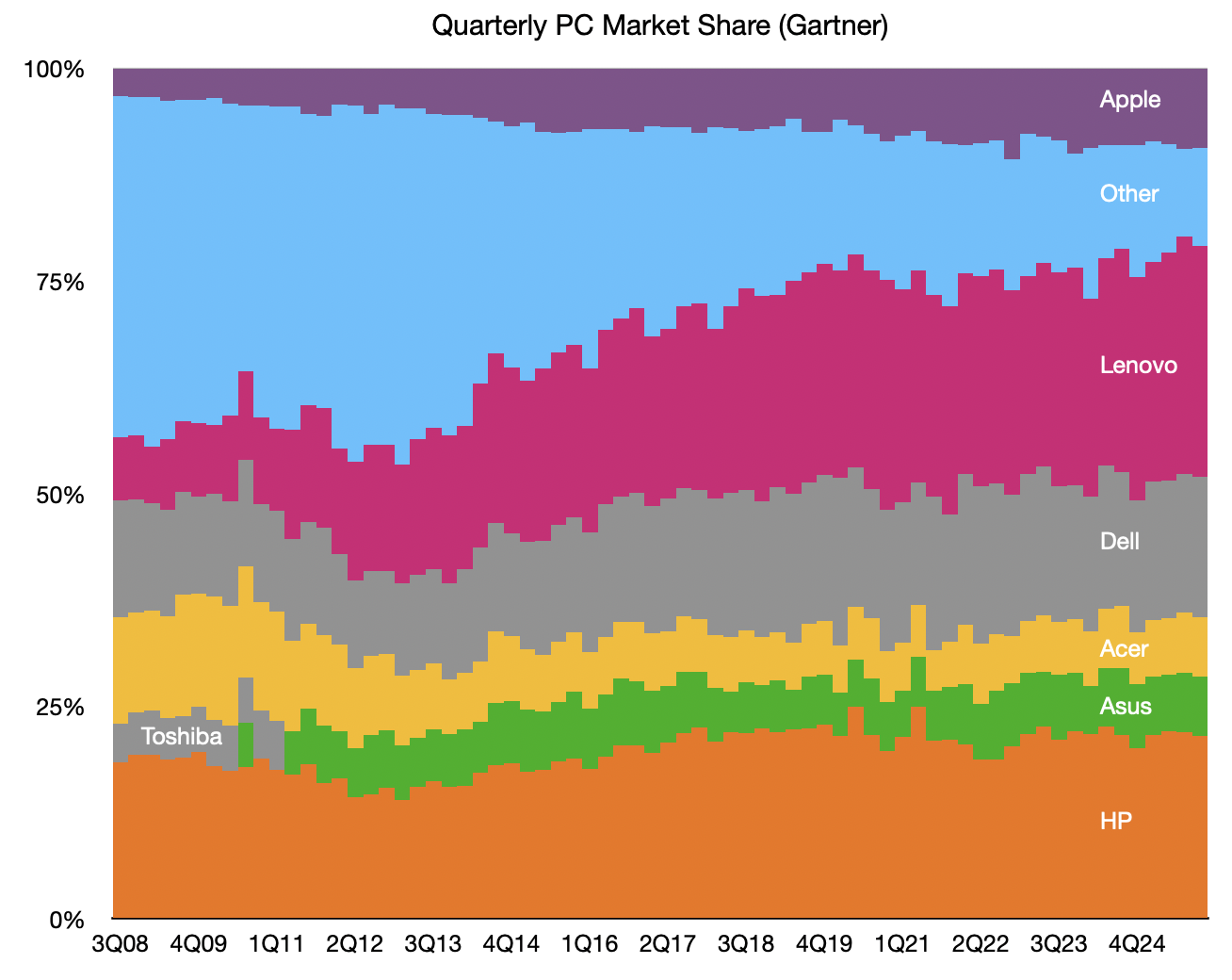
    Almost 10 years ago I said “Managing the Mac product line must be one of the most challenging problems at Apple. That may not be obvious given the product’s success.” I pointed out that although the company grew the Mac into a redeemed and prosperous platform, “The big change in computing has not been a growing Mac vs. declining PC. It has been a huge surge in mobile device use vs. a decline in PC use overall.” It’s time to revisit this observation. First, a status update: The Mac is in its 42nd year...

    How to read the history of the Mac and how to look at market share gains potential. Also: why the Mac has always been a cheaper alternative for buyers. →


    Nota Bene

    Apple’s China smartphone sales jump 23% as overall market fell 4% to start 2026 → Apple defied market trends with a striking 23% iPhone sales surge in China, outpacing competitors despite broader smartphone shipment declines. →

    Running a data-center AI model on a MacBook

    Running a data-center AI model on a MacBook → The article discusses how Apple's MacBook Pro, with its unique Apple silicon architecture, could revolutionize personal AI by enabling powerful AI models to run locally without relying on cloud data centers, potentially shifting the competitive landscape in Apple's favor despite current perceptions of lagging behind in AI advancements. →

    Tim Cook: Apple just had best launch week ever for first-time Mac customers

    Tim Cook: Apple just had best launch week ever for first-time Mac customers → Apple's MacBook Neo reportedly had its strongest launch week for attracting first-time Mac buyers, hinting at successful customer transitions from Windows. →

    Apple, Samsung Dominate 2025 List of Highest-shipping Models Across Regions → In 2025, Apple dominated premium smartphone markets across North America, Europe, and Asia-Pacific, while Samsung excelled in entry- to mid-tier segments in Latin America and the Middle East and Africa. →

    Apple Is Way Behind in AI—and Still Making a Fortune From It: WSJ → "Apple's billion-dollar AI distribution play highlights its retail prowess but pales against its trillion-dollar ambitions." →

    Lobster Boil

    Lobster Boil → "OpenClaw, a revolutionary open-source AI agent by Peter Steinberger, transforms personal computing by autonomously managing tasks across platforms, sparking a Mac Mini craze and hinting at a future where AI agents are integral to daily life." →

    ‘No Near-Term Catalyst,’ KeyBanc on Apple Stock

    ‘No Near-Term Catalyst,’ KeyBanc on Apple Stock → Near-term catalysts may not sway long-term investors, but if Apple's valuation seems steep, critique the pricing, not its promising 14% revenue growth forecast. →

    Tim Cook squashes retirement rumors, says he ‘can’t imagine life without Apple’ → Tim Cook dismisses rumors of stepping down, emphasizing his enduring passion for Apple and suggesting stability through potential political changes. →

    NVIDIA’s Language Processing Units Shipments Swell 10x+ vs Previous Yr (but how do they compare to Apple Silicon volumes?) → NVIDIA's Groq investment boosts LPU forecasts to 4-5 million, yet Apple's 500 million AI chips dwarf this, hinting at centralized intelligence reminiscent of '1984.' →

    Harmful chemicals found in popular headphones → Apple's AirPods Pro 2 and JBL's Tune 720BT topped the safety charts, while budget brands like Temu raised red flags for hazardous chemical exposure. →

    When does Apple split its stock? → Apple's stock split history shows a pattern of adjusting high share prices to maintain accessibility, with splits occurring around $100-$650 thresholds, potentially hinting at a $300 minimum for future splits. →


    Asymco One gives you full access to our research, analysis, and commentary. Subscribe with code BULLETIN for a discount.

    Feedback: Have questions or comments? Reach out to us at contact@asymco.com. We’d love to hear from you.

  10. NVIDIA's Language Processing Units Shipments Swell 10x+ vs Previous Yr (but how do they compare to Apple Silicon volumes?)

    Nota Bene · 1 comment

    Are you sure that's "millions"? It's 1984 all over again.

    Ming-Chi Kuo, an analyst at TF International Securities, posted on social platform X that the latest supply chain survey pointed to a considerable upward revision in LPU (Language Processing Unit) shipment forecasts following NVIDIA's investment in Groq.

    The total shipments for this year and next are estimated to be between 4 million and 5 million units, with this year accounting for 30-40% and next year for 60-70%. Against the previous year, this implies a spike of over 10 times.

    Source: AASTOCKS.com via Analyst: Ming-Chi Kuo

    NB: Total shipments for Apple's A and M series processors were about 490 million last year…

  11. The most brilliant move in corporate history?

    Research · 4 comments

    An allergy to centralized computing

    Based on Tweets by MilkRoadAI

    The 3rd? most valuable company on Earth watched as its rivals lit $650 billion on fire and did nothing. The biggest cash bonfire in history, by far, eagerly fed by all the usual suspects but one.

    It's either the dumbest or the most brilliant move in corporate history.

    Apple used to be the biggest capex spender, mainly because it paid for most of the property plant and equipment in the factories that made its phones and computers. The so-called tooling or equipment spending plus its leased store renovations and some data centers were costs no other tech giants had and so Apple was an outlier. It was, as I wrote at the time, equivalent to buying a few aircraft carriers every year.

    But that all changed with AI. Amazon is spending $200 billion this year on AI data centers. Google, $185 billion. Microsoft, $114 billion. Meta, $135 billion. Combined: $650 billion. [Not including OpenAI, Anthropic and SpaceX/XAI.] That is like buying the US Navy every year. And yet Apple's capital budget is still a modest $14 billion, oscillating with new hardware tooling cycles.

    Apple is refusing to transfer its cash flow to Nvidia. Curiously, it believes that its cash flow belongs to its shareholders, not to Nvidia's.

    The hyperscalers are now spending 94% of their operating cash flows on AI infrastructure. Amazon is projected to go negative free cash flow this year with as much as $28 billion in the red. Alphabet's free cash flow is expected to collapse 90% from $73 billion to $8 billion. These companies used to be the greatest cash machines ever built. Now they're borrowing money to keep the data center lights on.

    The Big Five raised $121 billion in bonds in 2025 alone. Morgan Stanley projects $1.5 trillion in tech debt over the coming years. For the first time in history, hyperscalers hold more debt than cash. Perhaps this is why their P/E ratios slumped from mid thirties to mid twenties.

    And what are they getting for that $650 billion? AI services generate roughly $35 billion in total revenue or 5% of what's being spent on infrastructure. There are dreams of more of course, but the business models of AI have yet to resonate, especially for consumers.

    Now here is where Apple's bet becomes genius. AI models are commoditizing faster than anyone predicted. Software and hardware both have tendencies to commodify. Protections exist but they have to do with integration and distribution. DeepSeek built a model for $6 million that matches systems costing $100 million. Open source models now power 80% of startups seeking VC funding. The moat these companies are spending hundreds of billions to build is evaporating.

    Apple understood this before anyone else. It didn't build its own AI model, it licensed Google's Gemini for about $1 billion a year. Why spend $100 billion building a factory when outsourcing costs a billion? And if a better model appears next year, Apple just switches vendors.

    But Apple is not sitting still. It just dropped the M5 chip with a 16 core Neural Engine and Neural Accelerators built into every GPU core. It runs 70 billion parameter AI models locally, eventually even on your phone. The M5 delivers 4x the AI performance of the M4 and Apple doesn't need $200 billion in data centers.

    Because Apple turned 2 billion devices into the data center.​ Every iPhone, Mac, iPad gets distributed AI at a scale no server farm can match. While its rivals burn cash, Apple is doing the opposite. $90.7 billion in stock buybacks last fiscal year.​ Its competitors? Combined buybacks collapsed 74% from their peak.​

    Apple didn't miss the AI revolution. It just bet that the winners won't be the ones who build the infrastructure. They'll be the ones who own the customer and no one else on Earth owns the best customers.