Asymco

Asymmetric Intelligence

Office Hours

  1. Why is Apple selling hygiene?

    Office Hours Research · 2 comments

    An Office Hours question asked by Greg, June 9, 2026.

    Q: That long child-safety section seemed to be championing the walled garden — things Apple can do that companies whose business models depend on selling data can’t. Was that a stance against Facebook or a message for the politicians?

    It’s a super important thing, but the word I’d use is hygiene. I remember this from Nokia: there are features that are pure hygiene. If you have them, most people don’t care; if you don’t, everyone complains, because it’s unusable. Safety is also like plumbing — only noticed when it fails. That’s why safety, even automotive safety, is almost never marketable. Volvo, maybe, but they’re a niche. People don’t want to hear about negative things.

    So here was Apple, in front of millions, talking and implying things sabout child "abuse"— unpleasant things everyone wants to avoid. Any marketer at Apple would have been beside themselves, because that’s a forum you’d normally use to generate euphoria, not dwell on harm.

    Which tells you it wasn’t really aimed at consumers. It was designed to induce a particular feeling in policymakers and authorities who’ve been pressuring Apple: we are custodians, doing our job extremely well, and we’re making it very public. That’s a strange thing to do unless there’s something happening behind the scenes.

    It also fits how regulators think. Engineers work with constraints; regulators work with outcomes and don’t think about how to get there. They are happy with a good intention pursued with the wrong approach. So Apple stood up and spent fifteen laborious minutes on safety as one of the three tent poles of the keynote — uncharacteristic, dull by design, and very carefully calculated.


    Editor’s Note: This was one of the questions asked by participants in Asymco’s June 2026 Office Hours live Q&A session, open to Asymco One subscribers.


    Subscribe to Asymco One for more in-depth analysis and commentary like this.

  2. Where is the monetization? Follow the compute

    Office Hours Research · 3 comments

    An Office Hours question asked by Roger S., June 9, 2026.

    Q: Beyond selling more capable hardware — phones, Macs, iPads — is there real monetization in all of this AI?

    Absolutely. They gave us an architecture: it’s about intent, about orchestration, about routing a request through multiple models and input types, and then deciding whether it goes through an app or back to Siri. Where’s the money? My answer is: follow the compute.

    If this works on-device, the user is happy buying the device, with the memory it needs, and Apple bundles all of that into the purchase price. Developers still sell their apps, but they’re not selling extra compute. But if a result requires heavy computation in the cloud, through an app, then trace it: who sends you the bill? That invoice comes from somewhere. If it’s a developer or a model supplier, it isn’t free — they’ll ask you to subscribe to get the answer, priced as a fixed fee or variable. Apple gets its usual commission, thirty percent or fifteen, somewhere in between.ssss

    If Siri depends on services that don’t go through an app, then Siri charges back through iCloud for the compute. So all they’ve really done is take the exact same business model — Services with subscriptions — and either fold compute into existing subscriptions or add new ones. Apple gets the same distribution commission it always has. Nothing changes. In fact, the absence of any commentary from Apple about new economics is, to me, a tacit acknowledgment that nothing different is needed.

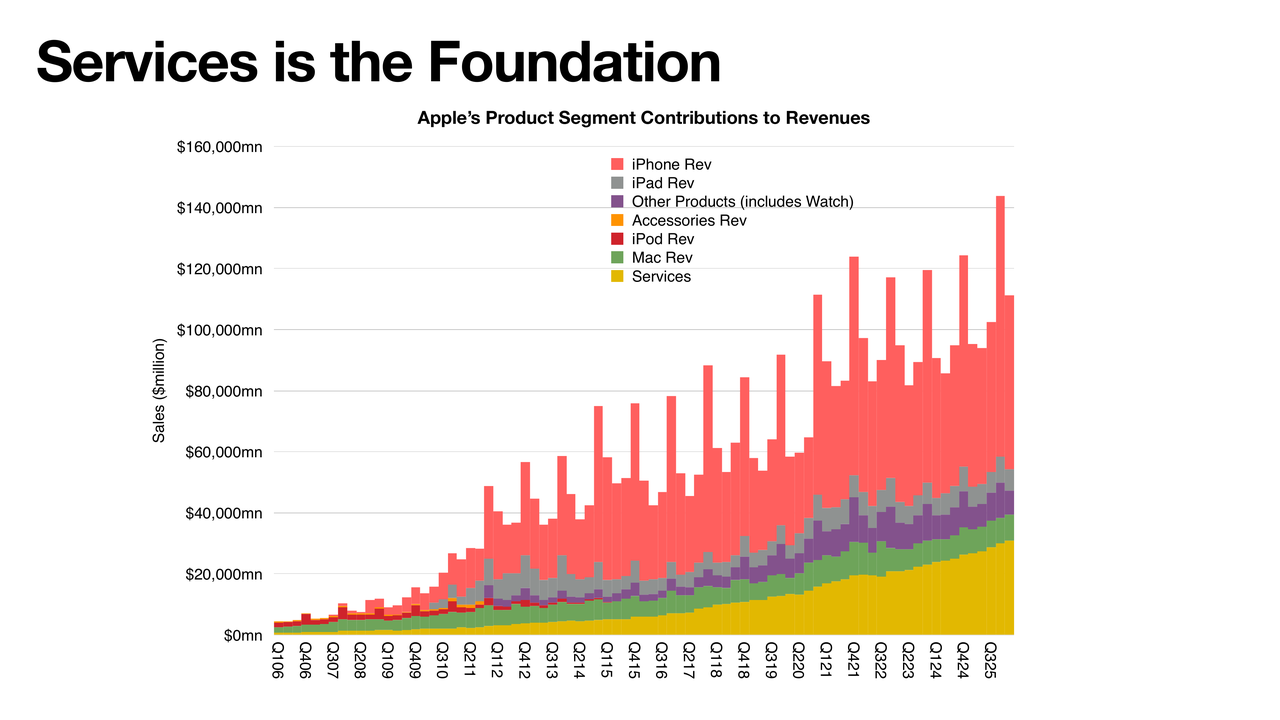
    That means the App Store, and if anything economically interesting happens, you’ll see another kink in its trajectory — the way we saw a kink when subscriptions became dominant. To users, it’s invisible. Maybe the monthly services bill rises ten percent; maybe they add a couple of subscriptions and drop one. It all reflects in Services, at a 72%+ gross margin, with a hardware uptick alongside. I reckon it’s a ten-year cycle before half of the Apple base are AI active daily, paying something for it. Developers will just see more of the same, only bigger.


    Editor’s Note: This was one of the questions asked by participants in Asymco’s June 2026 Office Hours live Q&A session, open to Asymco One subscribers.


    Subscribe to Asymco One for more in-depth analysis and commentary like this.

  3. What's a billion between friends?

    Office Hours Research · 3 comments

    An Office Hours question asked by Bob V., June 9, 2026.

    Q: The Apple–Google deal for the frontier model is multi-year with no known end date. What happens after — and what is Google really getting out of it?

    When that deal came out, people jumped to conclusions. I talked to Laura Martin {of Needham), who assumed Google would run Siri, and thus get all the data from Apple. Since that data was the real gold mine, even without much revenue from Apple, Google would begin to control the user’s data and experience. This would be check mate to Apple. I was skeptical from the start that Apple would ever release end-user data. That has now been made clear: this is a technology licensing deal including some Google training data but no services from Google and only some cloud capacity from Google using Nvidia chips but running Apple's own Private Cloud.

    The follow-up sessions after the keynote answered most of it. Federighi and his staff have been adamant that Google gets nothing — certainly no data. Only one of the many models accessed through Core AI runs on Google Cloud, outside Apple’s own private servers. It’s the most powerful one, but it’s a world model, and Google has no access to anything. The tools aren’t Google’s either. It’s not Gemini. It’s not their image model. It’s Apple’s own foundation models, several of them, and one happens to run with Google in the cloud, privately and securely.

    People assumed far more than what is actually happening here. Google's contribution is also probably swappable: at some point Apple may decide to do it themselves. And let’s not forget that Google sends Apple more than twenty billion dollars a year. So now Apple sends one back. What’s a billion between friends?

    Apple is not going to give away the single most important thing it has, which is its relationship with the customer.


    Editor’s Note: This was one of the questions asked by participants in Asymco’s June 2026 Office Hours live Q&A session, open to Asymco One subscribers.


    Subscribe to Asymco One for more in-depth analysis and commentary like this.

  4. WWDC Special: Asymco Office Hours - June 2026 - Live Q&A with Horace Dediu: Recording & Transcript

    Office Hours

    Recording and transcript of the June 9, 2026 Asymco One Office Hours, recorded the day after Apple's WWDC 2026 keynote. Horace Dediu shares his impressions of the event and takes questions from Asymco One subscribers.

    Recording

    Subscribe to Asymco One to listen to the recording and read the transcript.

    Transcript

    Sign up and latest updates at asymco.com/live.

  5. Asymco Bulletin 016 - June 7, 2026

    Bulletin

    Asymco Bulletin is a digest of all the work we have published for the week ending June 7, 2026.

    Coming Up: Post-WWDC Office Hours

    Office Hours Live Q&A, Tuesday June 9, 2026
    Day after Apple WWDC'26 Keynote

    Join us for our June 2026 Office Hours the day after WWDC'26 for a look into Apple's announcements, implications, and insights, and our live Q&A.

    To sign up, and for the latest live event information, visit: asymco.com/live. →


    Research

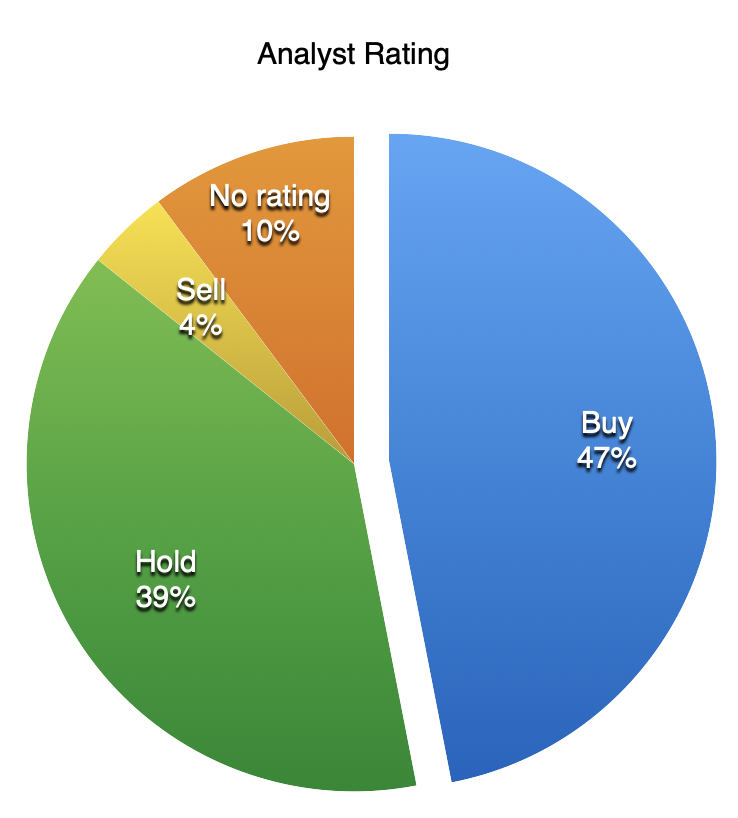
    42% of Apple Analysts rate it a Hold or Sell

    Apple has compounded net income at 26.6%, revenue at 21.5%, and share price at 27.7% for two decades, thus doubling every three years. Yet despite this, 21 of 49 analysts rate it Hold or Sell, with another 5 having no opinion. Extraordinary claims require extraordinary evidence yet assuming the Apple flywheel is about to grind to a halt is still a majority opinion. →

    The Apple Ecosystem Approaches $2 Trillion

    The App Store ecosystem facilitated $1.4 trillion in 2025. Add Apple's direct sales and the Apple Ecosystem comes to $1.8 trillion; add browsing, social, and messaging activity and the Apple Economy reaches roughly $3 trillion. Seen another way, at a $4.57 trillion market cap, Apple is valued at only 2.5 times its ecosystem and 1.5 times its economic footprint. These third-party dependencies are a measure of platform resilience and a carefully worded caution to regulators about the downside of interfering with it. →

    How not to over serve; The machinery of vanity

    Part 4 of the Asahi Shimbun interview turns to the spec trap. Apple maintains improvement but is selective: it ignores refresh rates beyond what the eye can see, and invests instead in features nobody asked for, like Face ID and AirPods. The phone became a machinery of vanity because the supply of cameras created demand for image editing, not the other way around. Christensen thought Apple would be disrupted by the low end. The honest answer for why it isn't is: culture, held together by extreme diligence. →


    Nota Bene

    Morgan Stanley reiterates $330 price target with bull-case $440 → Morgan Stanley reiterated $330 with a $440 bull case if WWDC unlocks an AI re-rating. Apple does not respond to market fads, and a multiple above 40 is almost never experienced. Disappointment after WWDC is nearly guaranteed because it has always been a software and tools show. →

    Citi reiterated a Buy rating and a $315 price target → Citi reiterated its Buy and $315 target ahead of WWDC, expecting a revamped Siri to make Apple an edge AI winner. Edge AI is inevitable, but it was also inevitable two years ago. The target is already priced in, making the AI story a non-starter. →

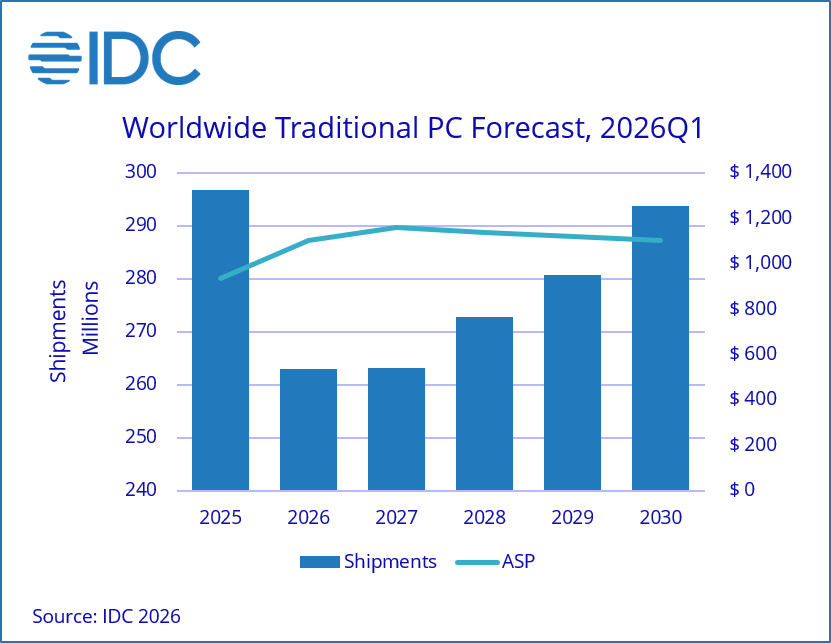
    Q4 PC shipments are expected to fall 20% year-over-year, 11.3% for the full year → IDC now sees PC shipments falling 11.3% for 2026 and 20% in Q4, with no recovery in volumes until after 2030. The MacBook Neo is the only thing keeping the broader notebook forecast from being worse. This is a multi-year opportunity for Apple that may reset PC market share dynamics permanently. →


    Asymco One gives you full access to our research, analysis, and commentary. Subscribe with code BULLETIN for a discount.

    Feedback: Have questions or comments? Reach out to us at contact@asymco.com. We'd love to hear from you.

  6. What Are the Mobility Design Surfaces?

    Research · 1 comment

    An Office Hours question asked by Darcy B., May 1, 2026

    Q: Will Apple do more in transportation than CarPlay Ultra? Not just cars — transportation in general.

    Well, there's a lot of modes out there, and I apologize I didn't get into all of them. I had assumed falsely — I think way outside of cars myself, obviously, but it's very rare that others do. My bad that I kind of assumed that. But the answer doesn't change. I don't think Apple will do much in mobility. The reason being — first of all, cars are a lousy business. They are, were, and will be a lousy business forever. Maybe to won't even exist very long. I just find it shocking, that it continues to exist today.

    But the problem is that the other modes are less of a surface for Apple to add value to. In other words, there isn't a lot of design surface on which you can put your design and your ideas. And the reason for the surface problem is that, first, there's modes that are public and shared — buses and public transport, even airplanes. You could imagine, for example, having the back of the seat in front of you be an iPad. Why is it this screen on the plane one you can never comprehend? But you try to figure that [business] out, and you realize it's a dead end. You just can't serve that market as Apple. So there's that design surface in airplanes — you've got the seat back.

    Then you look at other modes, and you look at micromobility. The problem with micromobility is the surface is below your sight line when you're using it. You're looking above typically where the vehicle is. I consider it a heads-up experience, not a heads-down experience. Cars are heads down and becoming more so. They're cocooning the user in a bubble for an hour a day. That's what can be tolerated, typically. Not a great idea. Why? Because an hour is not a significant amount of time that will separate that experience outside of the phone.

    Now, if you're looking at micro, the problem there is that it's a heads-up experience. And unless it's going to be through a wearable — that was my dream for the Vision Pro two, three years ago, was that it would be usable as — even integrated into a helmet. And then you have a visor coming, and then you have a beautiful design surface. In fact, the design surface is the entire world. Because as you see it, whatever you're looking at can be considered a surface upon which you can add a new reality [and new services].

    And that is a dream and vision, that if it were to happen, not only would Apple be a very, very interesting player to create a virtual world on top of existing worlds — outdoor experiences. That's a great, great opportunity. Spatial computing outside of the home. Just put that down as the summary — spatial experiences outside the interior spaces. When that happens, it'll be very exciting. It'll be very much Apple's contribution to repaint the world.

    But it takes time, and this is where we're stuck. We're stuck in this, like, not good enough, not small enough, not light enough, not powerful enough — all those things. And if they get solved, we'll move into that world.

    And that goes back to a lot of debates about whether the Vision Pro is or just not going to continue. I definitely think it's going to continue. Even the latest comments from John and Joz, together, saying — the phrase they used was, "we pulled this from the future into the present." So they are effectively stating that it's too early. It's a future that hasn't come yet. But they're proud of what they achieved, and it is amazing what they've demonstrated is possible.

    It's not the old Apple, though. Old Steve Apple was: you don't release until it's not just market ready, but mass market ready. And that was a risk. Maybe this was another thing that Tim did that was not what John would do. But to work on this problem is exactly what John would do, because solving spatial computing is, like, more important in my mind, because it is the human-computer interface. Which is essentially the physical layer of the entire world. That reconstruction of the physical world and broadcasting it into your retina is the future. It's not audio. It's not some background thing. It has to go through the eyes. And if it goes through the eyes, it's where Apple wants to be.

    So I do believe there's going to be a lot of research to be done there. And maybe it'll still take a couple years once the AI thing runs its course.

    This was one of the questions asked by the participants in Asymco's May 2026 Office Hours live Q&A sessions, open to Asymco One subscribers.

  7. Will Apple Silicon Tackle Memory?

    Research · 1 comment

    Asked by Ian Hobson

    Q: Will Apple evolve to make their own memory chips, or manufacture compute chips instead of just designing them? Will they go much more vertical?

    It's a possibility — capability is not willingness to do it. They're capable of doing it. They can become vertically integrated on all manners of silicon. I think the decision is a very careful one, because you have to commit years in advance. They did so, as I said, with Qualcomm. They needed to push that dependency out. I think memory may come next. And they need to figure out what they're going to do about TSMC as well, by the way, if you have a single supplier there.

    But this is an ongoing thing. They're always re-evaluating it. And I'm not concerned, because nobody does this better. You see other companies' jealousy. You see other companies wanting to do what Apple did eight years ago with the A series. The fact that you can hire a team and become a chip designer — we hear about Tesla, Google, Amazon. I don't know — probably Microsoft's got a team, and probably Meta's got a team. So I just see these out of the corner of my eye and say, well, obviously, yeah, you can now hire a semiconductor team.

    And one of the things about Srouji, by the way, that was making a lot of news, is that he got elevated to this position. Very likely he is getting a lot of inbounds, saying, hey, if you come and head this up for us, we'll give you half a trillion dollars. And the amount of money people are willing to throw at this is extraordinary. But again, he wasn't the first, he's not the last. There is an importance in good teams, but it is also important to have a deep bench.

    This was one of the questions asked by the participants in Asymco's May 2026 Office Hours live Q&A sessions, open to Asymco One subscribers.

    See also: May 2026 Office Hours

  8. The great memory panic of 2026

    Research · 2 comments

    Office Hours question asked by by Ian H. on May 1, 2026

    Q: Memory prices could move from 15% to 40% of the BOM of a device. This seems incredible. So how can Apple deal with this?

    This has been on people's minds now for what, three, four months? I think since January. I call it the Great Panic of 2026. The great memory panic.

    First of all, you have to understand the scale that Apple operates at. The number of devices in the hundreds of millions. It's not just iPhones, obviously. All of the Apple products consume some memory. And there's a lead time. When you're dealing with scale, there's a lead time. There's usually a couple years of lead time. And every supplier who works with Apple is doing it because they love volumes.

    Now, volumes are good for suppliers because they can also predict things in their own operations. They can plan, they can raise capital. Usually they need loans to do that, and they get good terms on loans if it's a long-term payback. And there's a lot of moving parts there that benefit scale.

    The difference with memory pricing that we're seeing a lot of anxiety around is at the margin. That is to say, there's a base production, and then there's a variable production. That variable production comes when somebody orders, "Hey, can I have something next month?" And the smaller suppliers tend to not have that long-term planning or the volumes that can fill the pipe. And so the marginal pricing on memory has gone through the roof. It spiked, and that's what we're seeing. But that's on the variable bit.

    So Apple negotiates on the base load. Now, of course, that marginal cost is going to eventually infect, if it continues long enough, base price. In fact, suppliers are going to say, well, even if it's two years out, we're going to have to ask for more, because there's so many other players that also we anticipate will be two years out. But then Apple can negotiate on another basis and say, well, if you don't do us a favor here and give us a better rate, then maybe we won't work with you when all this settles down. You know things are going to settle down. These things are always cyclical. There's never been a semiconductor boom that's not followed by a semiconductor bust. Never. And they know it.

    So they're happy to make mint on this volatility right now. So much so that I heard Samsung's making more money now with memory than Nvidia's making with their processors. So memory suddenly is the new gold. A year ago, two years ago, it was about compute. Now it's memory. Who knows what's next?

    But if you're in this business for the long term, and you want to play games, Apple's going to be there a lot longer. You could believe that AI is going to be going at this rate forever. We'll see if the profit model can sustain it. But I just speak from experience. There's a lot of these things that happen in the phone space with all kinds of components. There were always some shortages.

    There was storage. The iPod killed a hard drive supply chain. Apple monopolized the CNC machines that made the aluminum Macs. And these things happen. By the way, that monopoly is no longer in effect. Eventually, somebody built enough of the tooling and sold them to Apple's competitors. And if they want to make an aluminum enclosure, they can do so now. But that's how it is in this game, and nobody plays it as well as Apple does.

    If you read the book on China — Apple in China — there's a lot of anecdotes about this. So I can't get excited about any of these stories about supply crunches, other than there being a windfall for somebody and an anxiety, a panic for somebody else.

    And again, other analysts are starting to come around to notice that maybe this all settles into Apple gaining a whole lot of share, because all the other competitors won't be able to get any memory. So Apple could also just lock up everything and say, alright, we've got the biggest checkbook in the business, we'll take a hit on margins. As if we care, as if that matters. We go from 49% to 45%. Which is where we were two years ago. And then in doing so, we're going to take out everybody but Samsung. So we get in a situation where a lot of marginal players just disappear. And Apple locks up even more.

    And when you go for the jugular, you do all this, and then you launch a low-end product that's even cheaper, which is what the Neo looks like to me. I mean, Neo might be a prototype. The Neo might be John's trial balloon out there. Maybe he has a theory — I'm just speculating now — that Apple is going to go for the jugular on the iPhone in a couple of years. The iPhone's going to be $499. It'll be as good as the best iPhone today. And they're going to launch that against a landscape where everybody else is losing money at $800 a phone. And so they'll just quit.

    Now, it's uncharacteristic, but it's a low-end disruption coming from Apple. It's completely possible. It's well within their ability. And if they want to, they could. There's a lot going on here with what strategic intent is from John, and I think he comes with a fresh thinking on this. Not that Tim was unwilling, but I think he knew what works, and he was not willing to stray too far from what was reliable. And John may just think that, I know we can pull this off. And we'll go for a different way. Who knows?

    —

    This was one of the questions asked by the participants in Asymco's May 2026 Office Hours live Q&A session, open to Asymco One subscribers.

  9. Is Apple an Enterprise Gatekeeper?

    Research · 1 comment

    Asked by David Emery

    Q: What's the potential legal regulatory risk to the Apple enterprise combining both products and services? You can make a case that services growth over top of the monopoly in hardware is an illegal monopoly. That seems to be the way regulators are going. And forcing a split between services and products could definitely damage Apple as a whole.

    Sure. So let me take a European — not just point of view, but sort of a language. The language is that of being a gatekeeper, and a gatekeeper has a responsibility not to exclude competitors, because if you're big enough as a gatekeeper, you effectively are a platform for millions and millions. And so it matters how many. It's not just a gatekeeper per se, but a gatekeeper with a sufficient audience. And the logic there is that you can't bundle your own services and therefore exclude — especially by putting yours as a default, then the others have a hard time competing.

    And that is an antitrust logic. May or may not agree with it. I certainly don't, but I'd say it's a clear argument when seen through this gatekeeping phrase.

    Now, the difference — what you're asking is in business. Well, that doesn't fall under the same restriction. Usually, because antitrust is about consumer protections. There's a lot of businesses which get into complex deals that are tolerated because it doesn't affect the mass population. Now, of course, collusion and other things are still illegal. But I think you get a little bit more of a pass if you're solving the problem for businesses. There's one reason why Microsoft got away with what they were doing for so many decades. It's only when, in the late 90s, consumer personal computing became so prominent that there arose an antitrust argument about bundling everything into the operating system that got them into trouble.

    So I think Apple's bundling hardware and services for business users is probably going to be okay for a while. I would just say it's a question of quantity rather than the logic at this moment, so I wouldn't worry about it yet.

    But there are ways around it. Even if you do want to worry about it, there are ways around it which basically deal with providing provisions for alternatives, and that's what Apple's done to comply over and over again. Bending over backwards, providing alternatives, providing options. But then nobody uses those options, because they're far more complicated.

    The law is futile on this, because it doesn't take into consideration user satisfaction. It doesn't take into consideration the ease of things as opposed to the existence of things. It's nice to have options, but if it's complicated and annoying and expensive, you don't use the options. And so they have a very crude mechanism to try to enforce some utopian view of economic benefit. It just tends to create unnecessary penalties for consumers and producers, and as a result, they're just tripping over themselves. It just leads to all kinds of dysfunction.

    Quality is what Apple's always said — quality, experience, ease of use. And bureaucracies are not oriented around either quality, efficiency, or delighting anything. It's incompatible with all of the work people do at Apple. And so it ends up being a net negative, overall, in my opinion.

    This was one of the questions asked by the participants in Asymco's May 2026 Office Hours live Q&A sessions, open to Asymco One subscribers.

    See also: May 2026 Office Hours

  10. Margins or revenue: which matters more?

    Research

    Asked by Dave Emery

    Q: If you had to choose only between expanding gross margins or gross revenue, which one would you choose?

    Always top line, always. There's the only thing that matters. The ultimate measure is the customer. But the next best thing you have is the customer's purchase. You want to maximize the number of customers, and you want to maximize their satisfaction, and if you do that, then you will get good top-line revenue. Then, if you manage your house well, then you do so at a margin, at a good margin. But nothing matters more than getting as many happy customers as you can get. The creation of the customer is the purpose of the firm.

    We didn't get an update on the 2.5 billion actives, but we do get that once a year, unfortunately, no faster than that. We don't get an update on subscriptions either. Maybe, again, if I were to appeal to John, it's give us more data. I know he's an engineer. He knows the value of numbers. But the data that's given to us is out of a mountain of data that Apple has. We're getting a couple of crumbs. And they're chosen carefully. And I think the reason they've chosen to tell us these things is because they're saying that's what they think matters, and we should also probably keep an eye on these things. And that's all I did with Active Devices.

    You got to keep an eye on this. Measure the firm accordingly. It just so happens to be the old adage from Deming that the value of the firm equals this. I don't know if Apple believes that, but they do tell us these numbers, and that seems to be what they measure themselves by.

    This was one of the questions asked by the participants in Asymco's May 2026 Office Hours live Q&A sessions, open to Asymco One subscribers.
    See also: May 2026 Office Hours

  11. Will Apple avoid giving their cash flow to Nvidia?

    Research · 3 comments

    Asked by Jay Goldberg

    Q: Do you think Apple will start investing heavily in AI data centers?

    There's rumors and actually statements from Apple saying that they're working on a server chip. Google has a server chip. Amazon's got a server chip. These are effectively aimed at Nvidia. And if you can make something, you tend to do it. Now, of course, there's some protection — Nvidia's got other special sauce, but their margin is everybody's opportunity. They have a huge margin. And everybody's writing huge checks. As I say, hyperscalers are just handing over their entire cash flows to Nvidia. And that means their shareholders' entire wealth is being handed off to Nvidia shareholders. So there's a transfer of wealth happening right now. Presumably, because we're going to get some benefit later, but if that's happening and people are irritated by it, they're going to find a way to do what Nvidia does.

    And Apple, of course, can and will do that. Now, whether that'll get deployed at the edge or in Apple's own cloud — because they probably also don't want to write checks to Nvidia, and they'll say, well, we can do it, and we won't necessarily sell them, like Google wants to. They'll probably just use them themselves. And that's something certainly they're capable of.

    The question I was always asking is how many are we talking about? Because if it's in the tens of millions, or even single-digit millions — for Apple, single digits. Is it worth it to develop your own designs? There's a limit to how many you can deploy. And probably you're going to have to replace them every so often, so there's a question about how much it costs to keep on the treadmill.

    But it is an interesting question, and I think everybody's capable of doing what Nvidia's doing. But it's about execution, timing, delays. Look at what happened with the Qualcomm chip — how long it took Apple to finally deploy the communications chip relative to the amount of grief it had to deal with. First, of course, it moved out of Intel. It moved out of Qualcomm now, and now the question is, is it going to move out of the server supplier chain? And that's a complex decision. But again, Apple's not doing it because they want to be in that business. It's more that they want to avoid dependency.

    This was one of the questions asked by the participants in Asymco's May 2026 Office Hours live Q&A sessions, open to Asymco One subscribers.
    See also: May 2026 Office Hours