Recording and transcript of the June 9, 2026 Asymco One Office Hours, recorded the day after Apple's WWDC 2026 keynote. Horace Dediu shares his impressions of the event and takes questions from Asymco One subscribers.
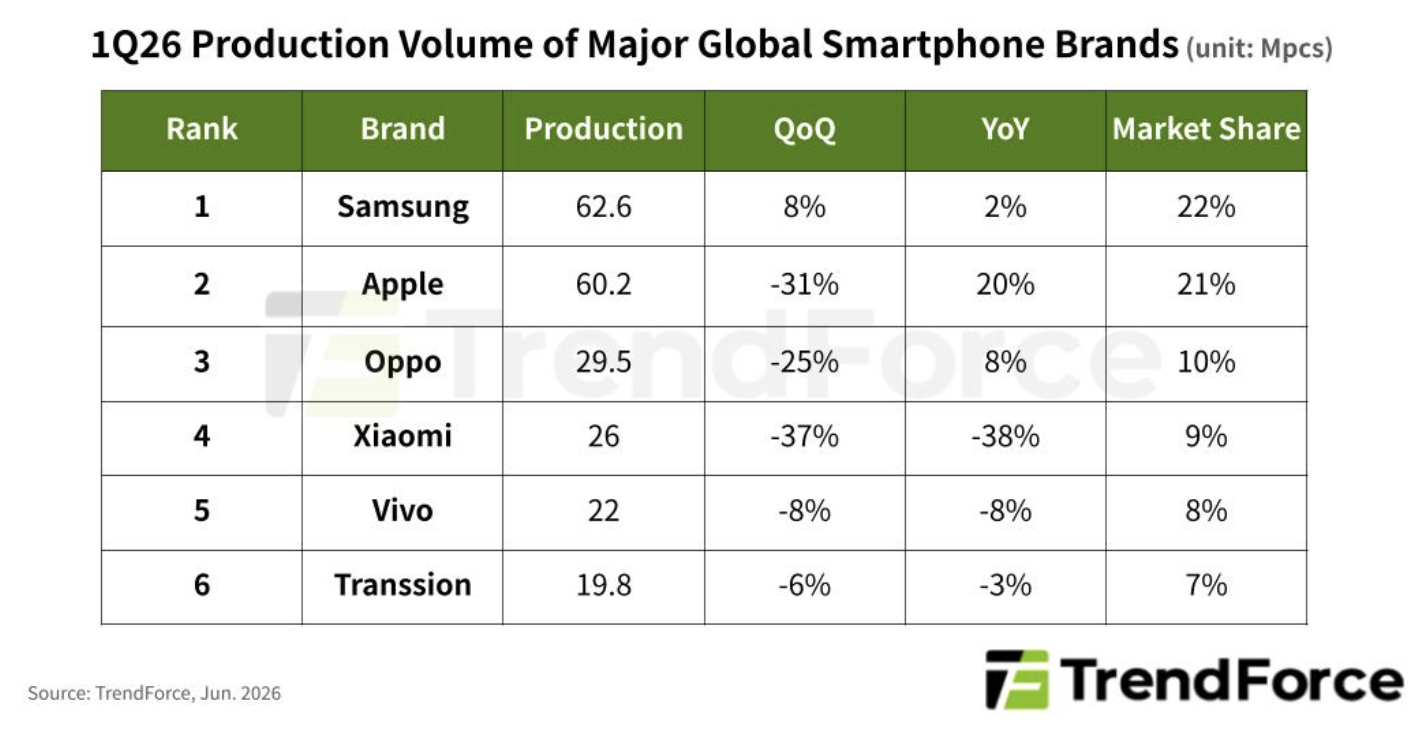
TrendForce’s latest figures reveal that global smartphone production reached around 284 million units in the first quarter of 2026, marking a 1.7% YoY decline. Despite a sharp rise in memory prices since the second half of 2025, the effect on production was minimal because brands still held inventories of cheaper memory components. Additionally, consumer expectations of higher prices in the future have helped sustain short-term demand, cushioning the impact of rising memory costs on production during the quarter.
However, as low-cost memory supplies are gradually exhausted and significant ongoing increases in memory prices reduce profits, most smartphone brands have begun adjusting production in the second quarter.
Looking ahead, TrendForce forecasts global smartphone production to decline approximately 16.2% YoY to 1.051 billion units in 2026. Under a more severe scenario, the annual decline could become even more pronounced if memory price increases remain elevated and brands are forced to raise retail prices repeatedly.
TrendForce notes that Samsung is relatively well-positioned to withstand the current cost inflation cycle thanks to strong financial backing from the broader Samsung Group and a sizable premium product portfolio. Nevertheless, its significant exposure to lower-end models remains a concern—particularly amid weakening consumer sentiment—making end-market demand a key factor to monitor.
Apple ranked second with its production of approximately 60.2 million units during the quarter. In addition to ongoing production ramp-up for new iPhone models, output was supported by the launch of the iPhone 17e, resulting in 19.7% YoY growth.
Compared with competitors that have already entered a margin-protection phase, Apple remains better positioned to absorb higher memory costs while maintaining profitability. TrendForce believes Apple is more likely to prioritize market share expansion during the current downturn as it lays the groundwork for future growth in recurring software and services revenue.
Xiaomi, Oppo, and Vivo focus on preserving profitability as production plans face greater uncertainty
First quarter production declined seasonally among the major Chinese smartphone brands, including Oppo (29.5 million units), Xiaomi (26 million units), and Vivo (22 million units). These three brands ranked third through fifth globally by production volume.
While all three delivered strong market share gains in previous years, surging memory costs are now weighing heavily on profitability, creating significant uncertainty around their 2026 production plans. As a result, production targets may be revised downward if cost pressures persist.
Transsion produced approximately 19.8 million units in 1Q26, roughly flat compared with the same period last year, placing sixth among global smartphone brands.
The brand has been particularly vulnerable during the current memory price supercycle given its smartphone portfolio is heavily concentrated in entry-level and budget segments—where profit margins are already thin. Limited access to low-cost component inventories has further amplified the impact.
NB: Counterpoint tracks sales, Trendforce tracks production. The production data may include inventory build-up not shown in sales while sales may include drawdowns not shown in production. The two analyses however agree on a market under significant supply-side stress. Profitability is a big concern and availability of components is critical. As noted previously in response to Counterpoint reports, the 2026 full year volumes will probably show the worst decline in decades.
The traditional computing "stack" is usually portrayed as a layered cake where the base is silicon, on top of which are system-level interfaces, followed by the operating system, then core services, and finally applications. The User interacts with the applications only. This is an app-based ecosystem which exposes "tools" for users to use as they try to accomplish tasks. This ecosystem for Apple is approaching $2 Trillion/yr in economic transactional value.
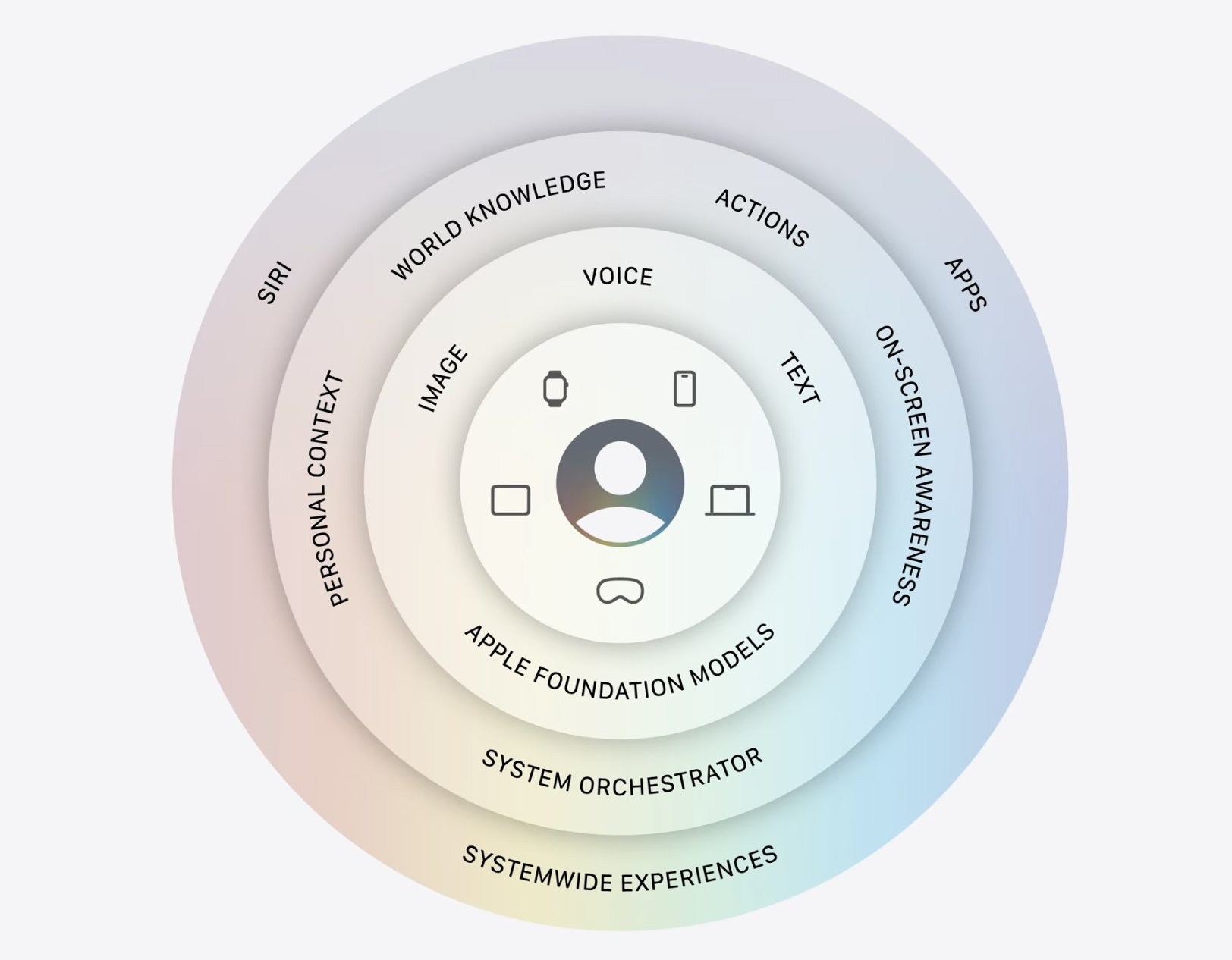
The diagram above, introduced as the new Apple Intelligence architecture, is quite different. The user is connecting using various devices via various input methods (image, voice, text) to prompt an orchestrator to tap various knowledge bases (local and remote) to initiate either Siri or an App to act on some intent.
The role of the operating system is now that of "orchestrator' that connects inputs to knowledge and decides how best to fulfill an intent. It sometimes connects to a chatbot (Siri) but also initiates apps to act.
This might be seen as moving from an app based ecosystem to an intent centric world. For the original Siri, queries were usually routed to apps (calendar, weather, stopwatch, music, etc.) In this new world Siri AI will resolve the intent directly and have the ability to construct & deconstruct interfaces / experiences on demand. There are many tasks that do not need third party applications.
However, the diagram still shows Apps as equal to Siri in terms of Systemwide Experiences. Apple announced a Foundation Models framework and expanded App Intents. Intent-centrism doesn't deprecate apps. It transforms them them from intent destinations to callable functions.
Using the nomenclature of integration/modularization and business model evolution, it modularizes what was integrated, subtly shifting the locus of value. The App Store becomes an API directory. That's a business model shift. Classic innovation theory suggests that as the value chain evolves, some profit will evaporate from one point and condense in another point in the chain; usually wherever the new point of modularization has been injected.
The old points of concentrations were the OS (where Apple captured profit) and the Apps (where developers did.) The new points might be in the orchestrator and in the foundation models.
But I don't think it's that simple.
Models might be commodities and orchestrators are not much different than OSs. Intent action requires access to private app data. bank accounts, calendars, messages. Authentication is an app responsibility and thus earned trust. Every app removed or disintermediated becomes a permission the orchestrator needs. Would banking credentials be granted directly to the device/OS? Much peril lurks there. This local data is where app control lies.
Where the threat for apps lies is in the possible loss of user interaction. It's also a great part of the cost of development. Shifting from a point of contact with the customer to a callable function comes with costs and benefits that are not easily predictable.
Transitioning the OS from a layer between hardware and applications to a layer between foundation models and experiences fundamentally shifts the architecture, but, in the case of Apple, it preserves its value as the agent of trust and discovery.
For this the value created and captured remains and perhaps increases.
It's clear to me that Apple has engineered this quite carefully and thoroughly.
René Descartes, who published the phrase I think, therefore I am" in Discourse on the Method, in 1637
Apple isn't measured by revenue or profit, at least not primarily. The measure is always satisfied customers. The application of services, software and computing hardware to improve lives has always been the modus vivendi and the resulting customer creation has always been the metric of success. Revenues and profits follow customer creation in a 1:1 relationship.
WWDC seems to attract attention as a catharsis for product and strategy announcements but it was never intended to be this. It's about developers (the D in WWDC) and what matters to them: APIs, operating system updates, languages, SDK, and other tooling. It's also a chance to reveal the economic value proposition for those developers who are following their part of the $2 trillion ecosystem.
And so the measure of WWDC should be how developers are created and satisfied. The products, which come later, are important but what matters more is developer opportunity, productivity and satisfaction.
So here is what I'm looking forward to:
New developer opportunity with AI. This is via easier integrations, more choices perhaps in terms of back ends and possible hooks into different parts of the ecosystem. To wit: Swift extensions, *Kit extensions with hooks to smart home, exercise/fitness, accessibility.
New developer productivity tools: How is AI going to improve the toolchain for developers.
New developer business models: how agents can be built and integrated into privacy and safety that only Apple can guarantee.
As Apple has shown with accessibility improvements (foreshadowing!), AI can be used to make people's lives better especially those who cannot perform due to disability. AI can lift those "below the median" in terms of many forms of ability: below median communications, below median health and below median mobility. Those with more limited ability can be "enhanced" into at least median ability. By definition, half of humans are below the median so helping them is as useful as helping those above the median.
This is in contrast to the narrative that AI makes supermen. The opportunity is not mainly about taking over high ability tasks and forcing human effort to be displaced. it's much more about making the less able become more abled. (Characteristic of GenAI output is the "averageness" of it. For those of exceptional ability it feels worse/erroneous and irritates. For those of less ability it's empowering. AI pushes toward the median, both from below and above.)
Below the median here does not necessarily mean below the median income or wealth. Ability is not always correlated with income. There are many Apple customers and potential Apple customers who can use help. I surely can use help in many areas of life.
WWDC is about the scaffolding upon which these grand problems can be solved. Scaffolding is not pretty to look at and most look away in disappointment if that's all that is revealed. But no matter how well regarded, no great building has ever been built without scaffolding.
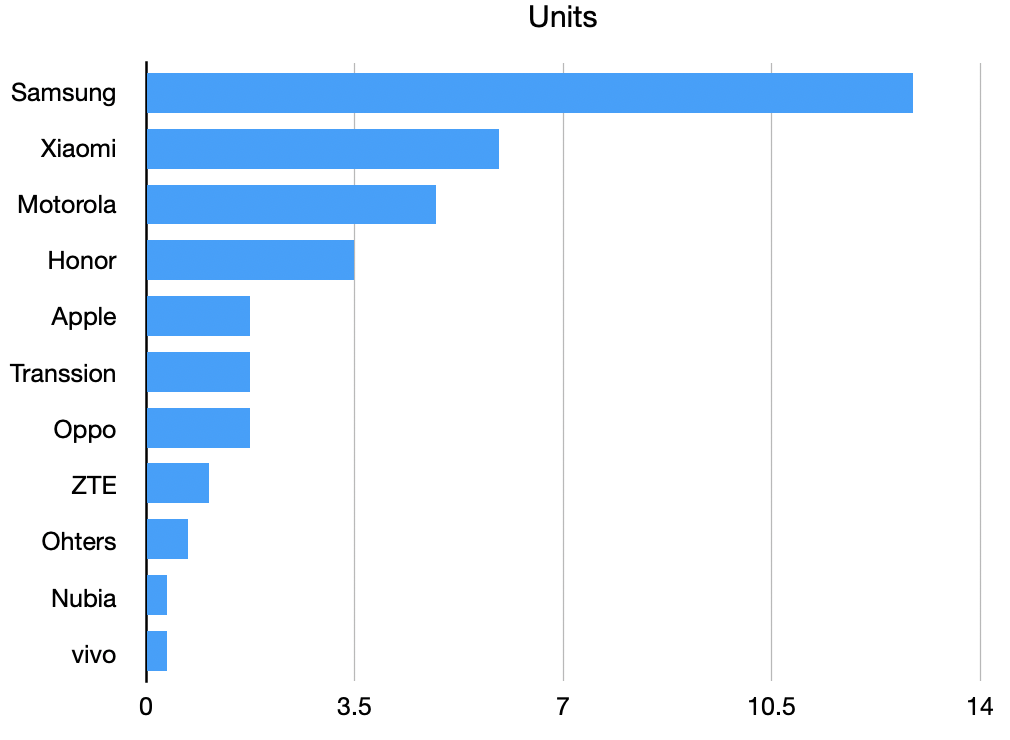
The Latin American smartphone market grew 3% year over year in 1Q 2026 to 34.8 million units, supported by proactive inventory accumulation and the delayed pass-through of rising memory costs. Omdia analyzes the market’s uneven vendor performance, as Samsung and Xiaomi strengthened their leading positions, while HONOR and Apple saw sharp growth supported by entry-level and premium demand, respectively.
Samsung led the region, shipping 12.9 million units (+9% YoY) and lifting share to 37%, its highest quarterly level since 1Q 2023, supported by strong performance of A‑series models across low‑end and mid‑high segments. Xiaomi held second, marking a sixth consecutive quarter of growth with 6.0 million units and 17% share, driven by double‑digit gains in Central America and Peru and solid traction of the Redmi Note 15 series in the mid‑high range. Motorola ranked third, contracting 5% YoY to 4.9 million units and 14% share, largely reflecting a 37% drop in shipments of US$100–US$200 devices, where G06 and G17 are key models. HONOR consolidated in fourth with 30% YoY growth to 3.4 million units and a 10% share, propelled by its Play 10 in the entry segment (below US$100), which approached half a million units sold for the first time.
Apple completed the top five with a 31% YoY increase, supported by an exceptional performance in Mexico (+80% YoY) and robust reception of the iPhone 17 series.
Fundamentals are breaking; Profits evaporate; Competitors flee; Android logic questioned
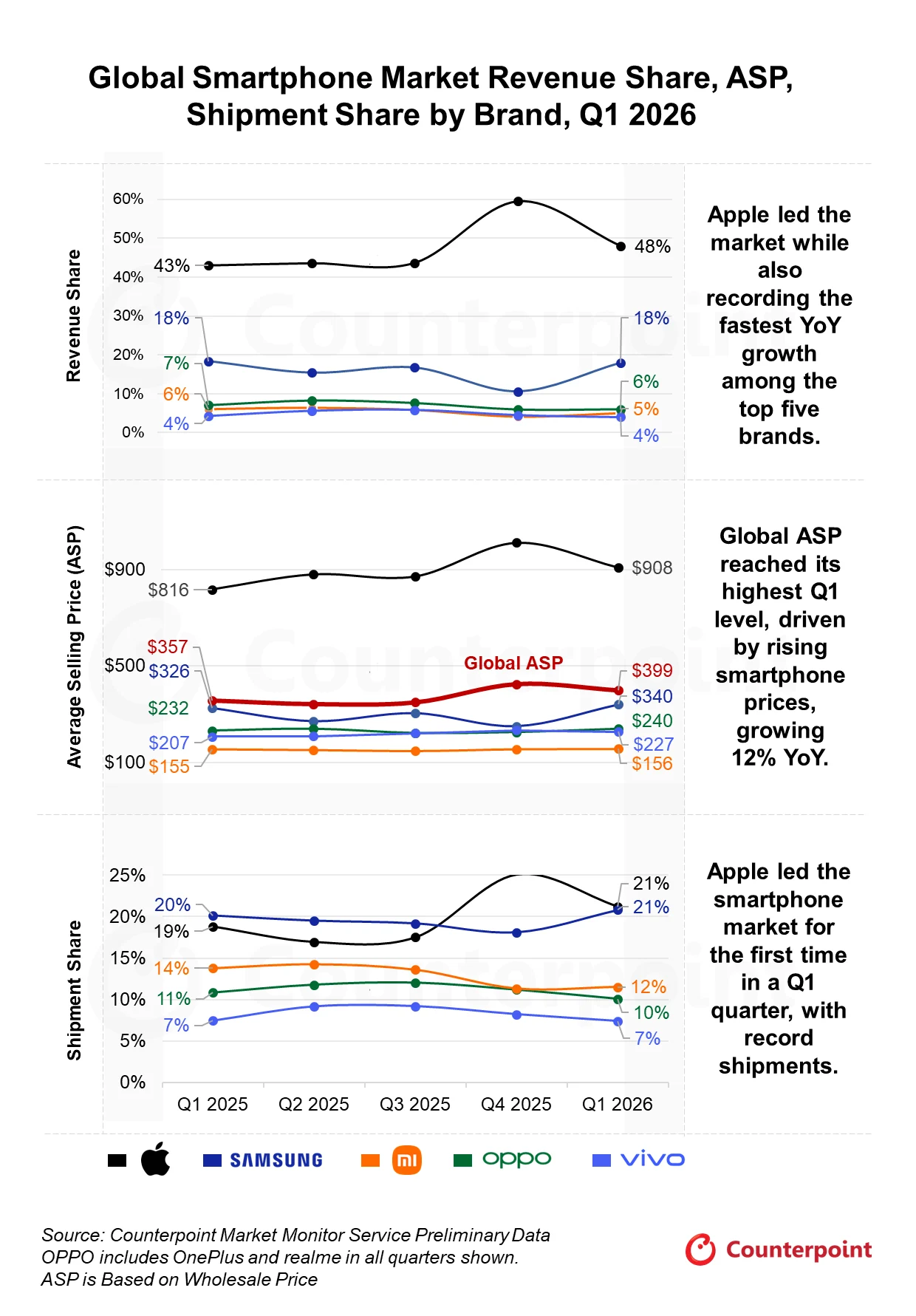
Apple’s revenue climbed 22% YoY in Q1 2026, registering the fastest growth among the top five smartphone brands while also hitting a first-quarter record high. Furthermore, the brand led the global smartphone market in terms of shipments for the first time in a first quarter, capturing a 21% share.
Commenting on Apple’s performance, Research Director Jeff Fieldhack said, “Apple’s growth was driven by sustained demand for the base iPhone 17 and iPhone 17 Pro Max, with a stronger mix of these models lifting Apple’s overall ASP by 11% YoY.
Unlike its peers, Apple mostly maintained stable pricing despite rising BOM costs, reflecting its ability to absorb cost pressures and remain insulated from the memory crisis, which helped strengthen its competitive position during the quarter. Regionally, Apple saw broad-based strength, especially across the Asia-Pacific region, driven by subsidies, promotions, and trade-in offers.”
The global smartphone market’s revenue grew 8% YoY in Q1 2026, driven by strong premium demand and pricing adjustments across major OEM portfolios amid rising Bill of Materials.
The average selling price (ASP) climbed 12% YoY to reach $399, supported by contraction in entry-level segments and price hikes across regions.
Apple led the global smartphone market in terms of value, recording its highest-ever first quarter revenue. Apple was the fastest growing brand with revenue up 22% YoY supported by relatively stable pricing compared to peers, despite broad-based price increases across the industry.
Samsung held an 18% revenue share in Q1 2026, with shipments reaching 21% of the total market, supported by portfolio optimization and strong response for the Galaxy S26 series.
The global smartphone market is expected to remain under pressure through 2026, and a substantial recovery is expected only in late 2027.
NB: The average sales price is up to $399 but Apple, with the largest share and fastest growth, reached $908? There's a lot more that does not make sense.
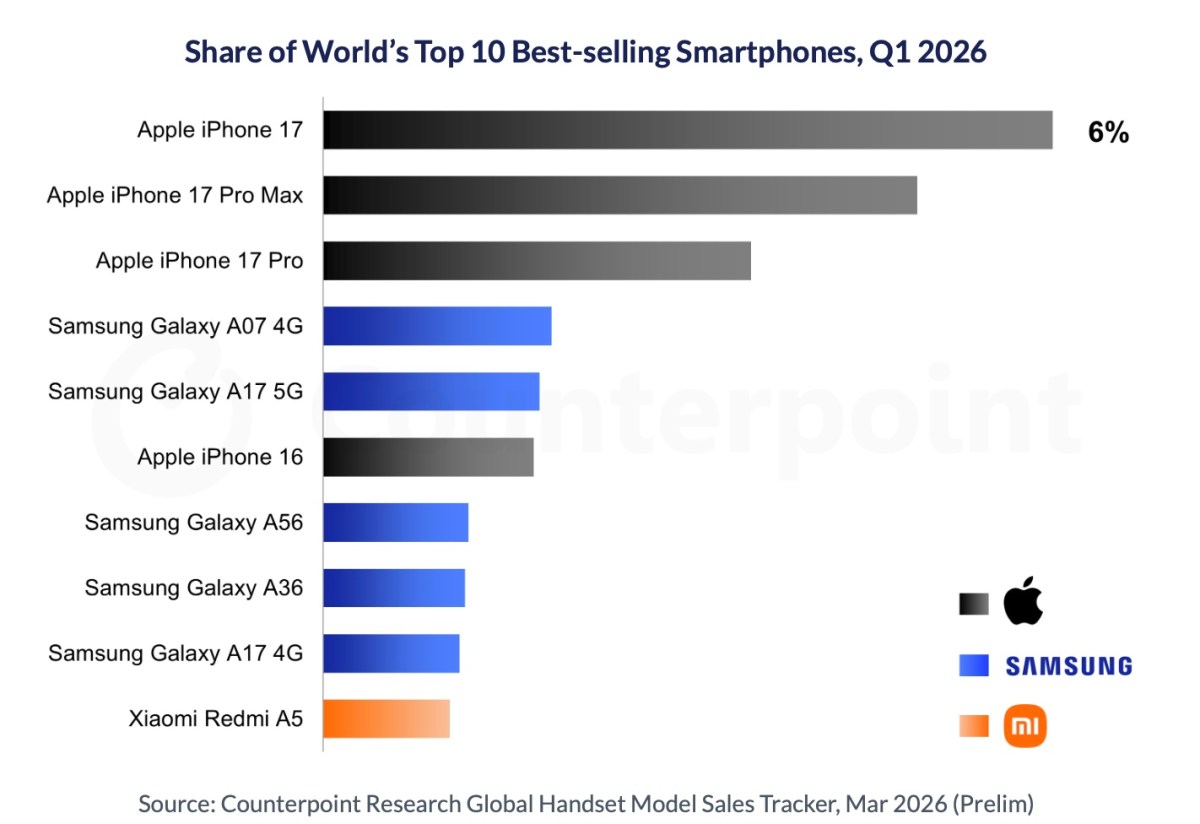
Apple’s iPhone 17 was the world’s best-selling smartphone in quarter one of 2026, capturing 6% of global unit sales, according to Counterpoint Research’s latest Global Handset Model Sales Tracker.
The iPhone 17 Series captured the top three spots, while Samsung Galaxy A Series was most represented with five models in the top 10. The top 10 smartphones contributed 25% of global unit sales, the highest quarter one concentration ever, according to Counterpoint. This was driven by sustained demand for the iPhone 17 series, alongside pressure on Android manufacturers in mass-market segments as the ongoing memory shortage pushes up component costs, adds the research group.
Asymco Bulletin is a digest of all the work we have published for the week ending May 3, 2026.
Editor's Note: Starting next week, we will be sending Asymco Bulletin to Asymco One subscribers only. You will still receive Updates when new posts are published per your notification settings.
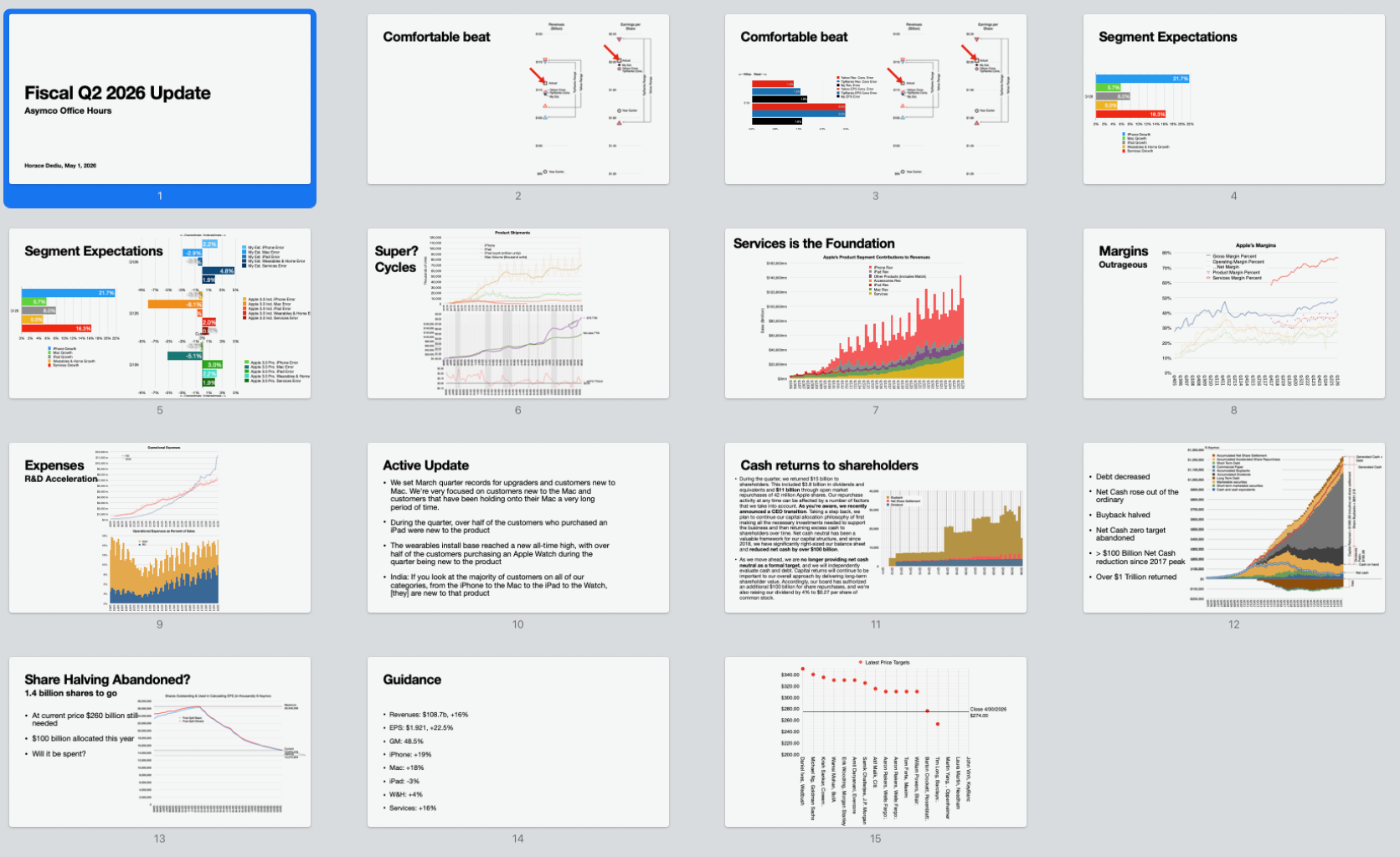
In Asymco One's May 1, 2026 Office Hours session, review of Apple's Q2 2026 earnings, segment growth: iPhone at 22%, Services at 16%, iPad at 8%, Mac at 5.7%, and wearables at 5%. Steady, foundational growth of Services, Gross margins reached nearly 50%, R&D spending surged, a shift in Apple's capital return strategy showing perhaps the hand of John Ternus. Guidance suggests 16% revenue growth, 22% EPS growth. Analyst sentiment turned positive post-earnings, with most price targets rising above $310. Apple's evolving identity as an engineering-centric company was the focus of many questions. →
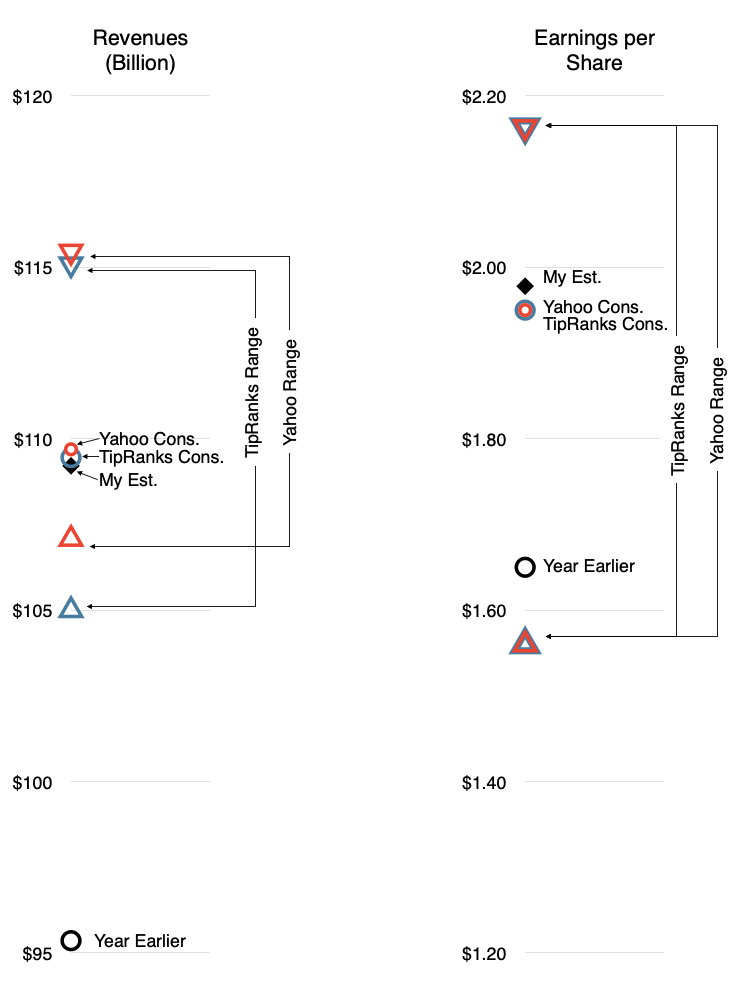
Revenue and EPS consensus, year-ago results and my expectations Yahoo Finance Yahoo Finance’s revenue estimate for Apple in Q2 stems from 31 analysts. As of April 25, the average estimate is $109.69 billion, with a low of $107.08 billion and a high of $115.37 billion. For the earnings per share estimate, 32 analysts put it at an average of $1.95. The low is $1.56 and the high is $2.16. TipRanks TipRanks also does its own analyst polling on Apple’s quarter. In its forecast as of April 19, its consensus is for a revenue of $109.45 billion, with a high of →
TD Cowen: 15% revenue growth, 10% growth guidance → Apple is projected to gain market share in both smartphones and PCs, driven by strong iPhone 17 demand and the new MacBook Neo, with anticipated revenue growth of over 15% in Q3 and positive sentiment ahead of earnings.
Morgan Stanley forecasts fiscal second-quarter EPS of $1.74→ Despite memory pricing pressures, Apple's strong iPhone sales, potential AI and foldable iPhone announcements, solid free cash flow, and favorable market conditions position it for better-than-expected earnings and a possible stock rise to $300 by September.
Is Apple borrowing Samsung’s Market Expansion Strategy?→ Bernstein SocGen maintains optimism on Apple's strategic pricing and ecosystem strength, forecasting EPS growth and potential market share gains, while Samsung faces smartphone profit challenges but thrives in memory.
Separately, it’s been reported that Samsung might see its first operation loss from its phone division, resulting in Apple capturing 100% (or more) of global smartphone profits. Simultaneously, Samsung is seeing huge profit gains from memory, even overtaking Nvidia’s profitability. This is remarkable…
Apple share of the smartphone SoC market grew from 15% to 19% in Q1 → In Q1 2026, global smartphone SoC shipments fell 8%, but Apple thrived in the premium market by leveraging its efficient supply chain and passing costs to consumers, boosting its market share from 15% to 19%.
Google to sell TPU chips as Gemini shows returns → Why pour cash into Nvidia when you can craft your own cutting-edge chips like Google, and then turn that innovation into a lucrative side hustle by selling them to tech giants like Meta and Anthropic?
The Vision Products Group Expanding → Gurman's 2025 dissolution claim clashes with 2026's active Vision Products Group hiring spree. The Vision Products Group posted 14 new senior roles last week.
On March 18, 2026, Bernstein SocGen Group reaffirmed its “Outperform” rating and $340 price target for Apple Inc.
Comparing it to Samsung’s 2009–2013 strategy, which saw Samsung increase its global smartphone share from 4% to 32% in Q3 2013, Bernstein emphasized Apple Inc.’s recent product launches as a strategy to widen portfolio price bands, driving share gains at the low end while raising prices at the high end to maintain margins. Although Samsung eventually lost market share to Chinese manufacturers, the firm said the stickiness of Apple’s iOS ecosystem will help it sustain long-term market share.
Bernstein projected a 12% increase in fiscal 2027 EPS from share gains, split equally between hardware and services, assuming Apple Inc. captures 10% of Chinese manufacturers’ smartphone market share amid their supply issues. Some noteworthy product developments include the introduction of the $549 AirPods Max 2, the App Store cost reduction in China from 30% to 25%, and plans for a foldable iPhone.
NB: Separately, it's been reported that Samsung might see its first operation loss from its phone division, resulting in Apple capturing 100% (or more) of global smartphone profits. Simultaneously, Samsung is seeing huge profit gains from memory, even overtaking Nvidia's profitability. This is remarkable…
Ben Thompson of the Stratechery interviews Horace on the Stratechery Plus Podcast to discuss Horace's journey to become an influential tech analyst: early career in research, business school under Clayton Christensen, and his time at Nokia during the rise of the iPhone.
The conversation further explores Disruption Theory in the context of both smartphones and AI, why Christensen misjudged Apple, and whether AI could challenge today’s tech giants. It also marks the launch of Dediu’s new paid service Asymco One and reflects his continued conviction in Apple Inc. at its 50-year milestone.