Asymco

Asymmetric Intelligence

Services

  1. Asymco Bulletin 008 - Apr 12, 2026

    Bulletin

    Asymco Bulletin is a digest of all the work we have published for the week ending Apr 12, 2026.

    Research

    Can a company outlive its founder? Microsoft at 51, Apple at 50 and The Auteur Theory of Business

    Much more was said of Jobs’ departure signaling the end of Apple than of Gates’ departure signaling the end of Microsoft. And much more was celebrated of Apple 50 than Microsoft 50. Why is that?

    If you were to structure an experiment to determine the influence of processes and personalities on the outcomes of a company, you would be hard pressed to find a better pair to study. Apple and Microsoft were founded almost at the same time, due to the same enabling technologies (microprocessors) and led by two iconoclastic founders of the same age acting out of similar impulses.

    The divergences were that one concentrated on software while the other on hardware. But rather than pairing up in a match made in heaven, both tried to outmaneuver the other in order to avoid dependency. →

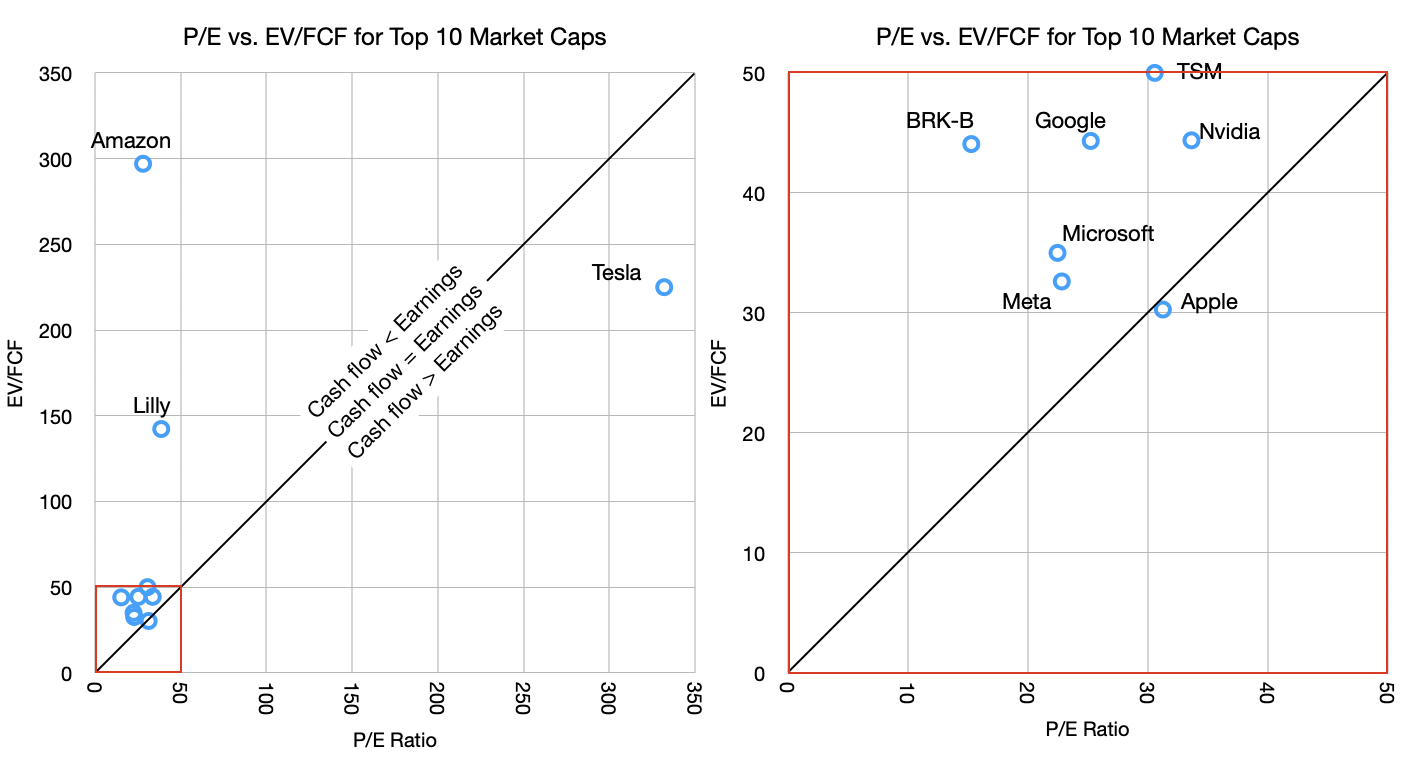
    Valuation in a time of AI
    Valuation in a time of AI

    Cash flow is a fact, earnings are an opinion and share price is a dream.

    A company’s total worth is the number of outstanding shares multiplied by their value. This product is called the market capitalization or Market Cap.

    That’s a simplification. If you want to be more accurate, you should take the Market Cap and net out cash and debt–these are not part of the future flows of cash that can benefit shareholders.

    More precisely, there is another measure called the Enterprise Value (EV) which is the total price tag of a company, representing what it would cost to buy the entire business and pay off its debts. EV = Market Cap + Total Debt + Preferred Stock + Minority Interest – Cash and Cash Equivalents.

    This is the precise and complete measure of the firm’s value but we use the shortcut of Market Cap since In most cases the Preferred stock and minority interest are negligible and if cash equals debt then the result is EV =~ Market Cap. it’s easier to calculate anyways as the shares outstanding and share price are easily available. Not so for EV. →

    What are the odds of Apple surviving?
    What are the odds of Apple surviving?

    A tale of two Apples

    What are the odds of it surviving another year, ten years, 50 years?

    Companies don’t last long. A recent study that analyzed thousands of European firms yielded a corporate life expectancy figure of 12.5 years. The Boston Consulting Group analyzed the entry, growth, and exit dates of 35,000 publicly listed companies and determined that one in ten of all public companies fail each year, a fourfold increase since 1965.

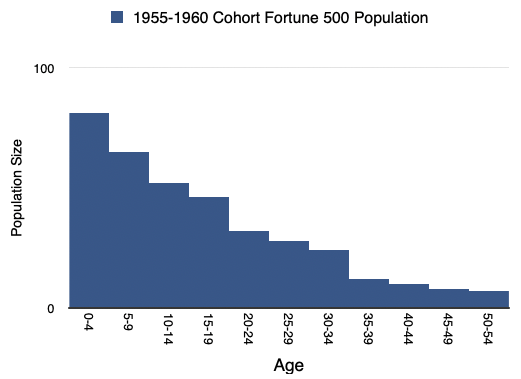
    As I illustrated many years ago in a talk titled “The Unfortunate 500” most companies die not long after adolescence. Of the Fortune 500 1955-1960 cohort, the 81 companies which joined the index in those years, only 7 remain there today. One third of the corporations on the 1970 Fortune 500 list were no longer in existence thirteen years later. Broadly speaking, as a population, large companies that make it to the Fortune 500 listing have life expectancy within that group of 17 years. →

    iPad at 16

    Redundant or Post-PC?

    Today marks the 16th anniversary of when Apple released the first-generation iPad.

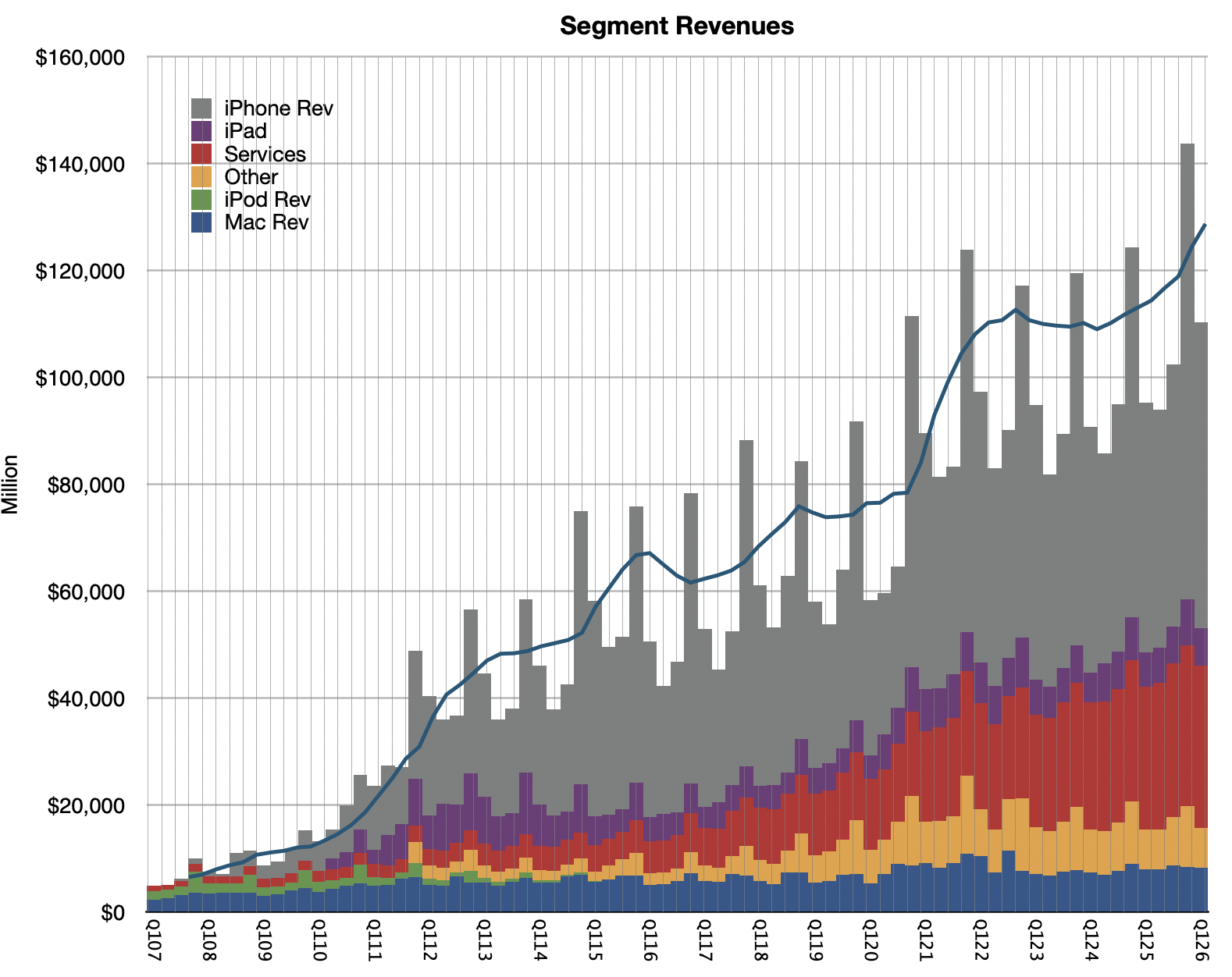
    To many, including Alan Kay, the tablet form factor makes much more sense than the PC form factor. It’s more approachable, more intuitive and certainly smaller and more portable. As the graph shows, quickly after launch, the iPad overtook sales of the Mac.

    The problem arose that whereas the iPad was smaller, the iPhone what smaller still–so much so that users would take phones with them everywhere. At the same time, the “PC” shrank as well so that many notebook (laptop) computers became thin, light and had day-long battery life. The Mac at least became no bigger a burden to carry than an iPad.

    So the iPad was stuck in the middle between an iPhone, that did more and more, and a Mac that was very portable. At this point many said that the iPad was a dead end form factor. →

    AI as Infrastructure

    ON September 3, 1821, 37 years after James Watt invented the concept of horsepower and started charging £5/horsepower/year for the use of his steam engine, the first demonstration of the production of a mechanical force by the interaction of an electric current and a magnetic field was given by Michael Faraday in the basement of the Royal Institution in London.

    1820 is, in many chronicles, noted as beginning of the industrial revolution. It marked the end of 50 years of war, whose conclusion unleashed pent-up demand. That demand was served by relatively free trade, guaranteed by British naval power, coupled with property rights and financial instruments which allowed inventions of the previous century to finally be harnessed for commercial gain. The steam engine is the canonical invention of the era and its implementation as a source of power for factories, shipping, rail and machinery is legend.

    Not usually noted as coincidental to this period is the electric motor. Yet not long after Faraday’s 1821 demonstration in London, the first DC electric motor capable of turning machinery was invented by William Sturgeon. In 1832 he built on Faraday’s electromagnet by incorporating a commutator which oscillated the direction of current to ensure continuous rotation.


    Nota Bene.

    The Motley Fool asks: Where Will Apple Stock Be in 5 Years? → Not reading this article is probably a wise decision. Shares could perform in line with the S&P 500’s long-term average Investors can follow a straightforward exercise to try and figure out where Apple’s stock price will be in late March 2031. It’s important to consider both the valuation and profit gains. We just released a […] →
    Apple’s services continue to see increased engagement, spending

    Apple’s services continue to see increased engagement, spending → The survey of 3,500 smartphone users reveals a significant rise in average monthly spend on Apple services to $13, driven by increased adoption of premium offerings like AppleCare/One, Apple TV+, and Apple Music, with notable shifts towards AI features despite muted upgrade intent, though potential US bias may affect overall accuracy. →

    KeyBanc maintains a lack of clarity of thought → The analyst's note on Apple is overly cryptic and lacks clarity, making it difficult to assess its validity or relevance. →

    iPhone sales continue to surge into February – Bernstein → February saw robust iPhone sales driven by the iPhone 17 line, with global unit sales up 26% and ASP climbing 6.9%, yet January-February revenue estimates oddly lag behind projections, sparking confusion. →

    Morgan Stanley has a stark message for investors in Apple → Morgan Stanley's survey indicates strong potential for Apple stock, highlighting record iPhone upgrade intentions, especially in China, improved switching rates, and significant interest in a future foldable iPhone. These factors support robust FY26 shipment forecasts and suggest a possible revenue boost from new products. Despite some concerns about declining willingness to pay for AI features, Morgan Stanley maintains an optimistic outlook with a $315 price target. The article criticizes TheStreet's editorial approach for misrepresenting the positive survey findings as negative news about Apple. →

    Mac mini and Mac Studio orders booming → Apple's Mac sales are surging due to the M5 chips' enhanced AI capabilities, outpacing other platforms and driving demand despite current shipping delays. →
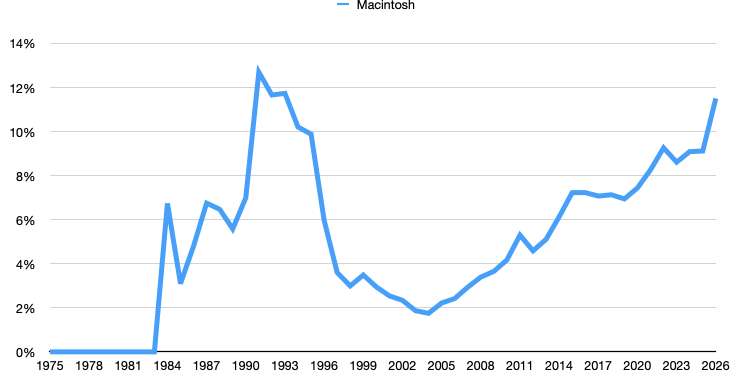
    Gartner adds their Mac Q1 estimate to the pile

    Gartner adds their Mac Q1 estimate to the pile → In Q1 2026, Apple's Mac sales surged impressively by 10.7% to 12.7% year-over-year, driven by the MacBook Neo's appeal, securing a 10.6% global market share and maintaining fourth place among PC vendors, amidst a 4% rise in overall PC shipments. →


    Office Hours
    Asymco Office Hours Live Q&A with Horace Dediu: April 8, 2026

    Asymco Office Hours Live Q&A with Horace Dediu & Gene Munster took place on April 8, 2026 → Topic dicsussed: Apple Topics discussed: 

    • Geopolitics: China concentration; Taiwan tail risk
    • Financials: Solid near-term growth
    • AI: Critical narrative shift; not yet proven
    • Growth Strategy: User expansion
    • Business Model Evolution
      hardware → services → Personal AI
    • Moat: Privacy + integration; trust;

    Consider subscribing to Asymco One gives you full access to our research, analysis, and commentary. Subscribe with code BULLETIN for a discount.

    Feedback: Have questions or comments? Reach out to us at contact@asymco.com. We’d love to hear from you.

  2. Asymco One Office Hours Live Q&A with Horace Dediu & Gene Munster: April 8, 2026

    Office Hours

    A lively discsussion of Apple topics such as:

    • Geopolitics: China concentration; Taiwan tail risk
    • Financials: Solid near-term growth
    • AI: Critical narrative shift; to be proven
    • Growth Strategy: User expansion
    • Business Model: Evolution: hardware → services → Personal AI platform
    • Moat: Privacy + integration; trust

    Non-Subscribers:

    Join Asymco One as a Subscriber to participate OR

    Just Register to Watch live.

    Contact us at events@asysmco.com if you have any questions.

    For most up-to-date information, see

  3. Apple's services continue to see increased engagement, spending

    Nota Bene · 1 comment

    3500 users surveyed

    In surveying roughly 3,500 smartphone users, the average monthly spend of a user has increased to around $13, up from the three-year average of roughly $9, “driven by broader application adoption and mix shift toward higher-value offerings,” analyst Amit Daryanani said. 

    Delving deeper, the survey indicated that roughly 63% of respondents now have AppleCare or Apple One, up from the three-year average of 44%. Apple Pay usage has increased as well, as roughly 40% of respondents said they use it, compared to roughly 30% for the three-year average. Other services also saw increases when compared to the three-year average, including iCloud (only 15% have no usage, down from the three-year average of 24%, while 28% say they now have 2 TB worth of storage, up from roughly 11%); Apple Music (roughly 61% compared to approximately 44%); and Apple TV, which roughly 54% of respondents said they used, compared to the three-year average of about 34%. 

    Additionally, Apple TV (formerly known as Apple TV+) is now the second most watched streaming service in the survey, surpassing Amazon Prime Video, Daryanani said.
    Aside from Apple's paid services, the survey indicated that Apple Intelligence is seeing some traction, though it was described as “muted.” 

    “Upgrade intent remained muted, with ~44% of users indicating willingness to upgrade for AI features, a ~2pt decline from our prior survey,” Daryanani added. “We think users are underappreciating the potential of Apple Intelligence 2.0 and 'AI Siri,' particularly as new capabilities are rolled out later this year, which will include Gemini model integration. Importantly, we see early signs of monetization, with underlying demand for premium features, as ~61% of respondents indicated willingness to pay for a personalized 'AI Siri' subscription.”

    Source: Seeking Alpha

    NB: The AppleCare number is interesting.…

  4. Asymco Bulletin 007 - Apr 5, 2026

    Bulletin

    Asymco Bulletin is a digest of all the work we have published for the week ending Apr 5, 2026.


    Podcast

    Apple at 50 – Ben Thompson interviews Horace Dediu

    Apple at 50: Ben Thompson of Stratechery interviews Horace Dediu → Horace describes his journey from Romania to becoming a leading tech analyst, highlighting his experiences at GTE Labs, business school under Clayton Christensen, and Nokia during the iPhone's birth. He emphasizes Apple's customer-centric approach and its potential to navigate AI challenges. Dediu also shares insights on his new paid service, Asymco One, and reflects on the importance of understanding market dynamics and customer satisfaction. He expresses optimism about Apple's future and underscores the value of deep, long-term analysis in tech forecasting. →


    Nota Bene

    Apple Maps Is Getting Ads. It’s Apple’s Riskiest Bet Yet → Apple streamlines business tools and cautiously enters Maps advertising. It's not Apple's riskiest bet yet. →

    Survey shows iPhone improved retention, purchase intent, growth in services, service pricing, product mix, foldable upside → Despite robust customer loyalty, service growth, and strategic hardware shifts bolstering margins, UBS's maintains neutral stance and $280 target. →

    Apple’s Business Strategy → Apple's enterprise growth is driven by its strong consumer base. Do new services like Apple Business suggest a new emphasis? →

    Melius highlights FCF while reiterating buy on Apple → In the AI era, valuation shifts from traditional P/E to EV/FCF, highlighting Apple's robust financial health and fair valuation amidst its significant product launches. →

    The iPhone 50 years from now – and why Apple won’t have AI execs → Rumors suggest the iPhone 70th anniversary edition might feature an innovative new camera system, while Apple CEO Tim Cook dismisses the idea of AI-led executives due to legal and functional constraints. →

    We know that Macs last longer in use. How much longer? → Macs and iPhones outlast Windows PCs and Android phones in enterprises, yet decisions are suboptimal. How long will that last? →

    Warren Buffett tries to justify his hypocrisy → Buffett's actions on Apple highlight a difference between his statements and his actions. →

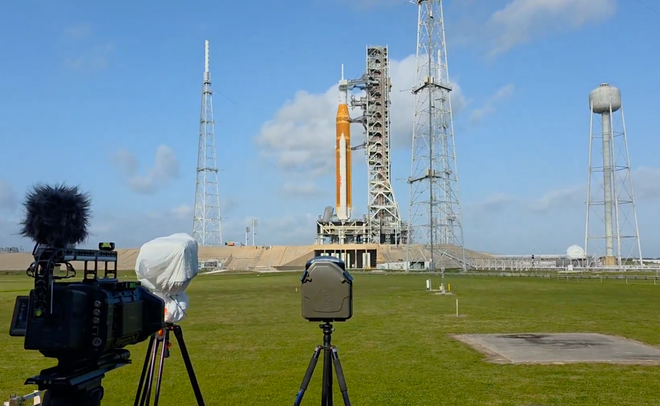
    Apple Vision Pro users will be able to experience NASA’s Artemis II launch in immersive video

    Apple Vision Pro users will be able to experience NASA’s Artemis II launch in immersive video → Immersive experiences redefine our connection to events such as space exploration. →

    Mac market share to grow from 9% to 12% in 2026 → "Apple defies the 2026 notebook market slump with a strategic shift, poised for its largest share gain since 1991." →

    Analysis: Mac grew 16% and iPad grow 15% in China in the fourth quarter of 2025 → In 2025, Apple's Mac and iPad sales in China saw notable year-over-year growth, while looming 2026 market contractions hint at challenges. Apple might defy trend with new launches. →


    Office Hours

    The next Asymco Office Hours Live Q&A will be held on:

    Wed April 8 at 12pm ET / 9am PT
    Asymco.com/live

    Asymco One subscribers can sign up to attend the live Q&A with our own Horacle of Helsinksi.

    Conference details will be sent to participants with ample time before the call. Watch asymco.com/live for latest updates.


    Asymco One gives you full access to our research, analysis, and commentary. Subscribe with code BULLETIN for a discount.

    We appreciate your feedback! Have questions or comments? Reach out to us at contact@asymco.com. Looking forward to hearing from you.

  5. Survey shows iPhone improved retention, purchase intent, growth in services, service pricing, product mix, foldable upside

    Nota Bene · 1 comment

    Attach rates for iCloud reached about 42%, while Apple Music stood near 30%

    The iPhone ecosystem is showing signs of increased customer loyalty and steady demand, while its high-margin services business remains a key support to profitability, according to UBS analysts.

    The bank, which maintains a 'Neutral' rating on Apple with a 12-month price target of $280, cited findings from its Evidence Lab survey of roughly 4,000 iPhone users globally. The data suggests that iPhone “stickiness” continues to improve, even as replacement cycles remain relatively stable.

    UBS said the average age of iPhones in use globally was largely unchanged year-over-year at about 33 months. Outside China, device age edged slightly higher to around 38 months, a trend the analysts said could push some upgrade demand into 2027.

    At the same time, customer retention strengthened, with the global iPhone retention rate rising about 200 basis points to roughly 74%. Gains were particularly notable in the United States and China, where retention increased by 200 and 700 basis points, respectively. UBS belives that this indicates Apple is maintaining share despite a competitive smartphone market.

    Purchase intent also improved across regions, with more surveyed users indicating their next smartphone would be an iPhone. The UK recorded the largest increase, while China also saw a meaningful rise despite what UBS described as a challenging competitive backdrop.

    The report highlighted continued growth in Apple’s services ecosystem, particularly iCloud and Apple Music. Attach rates for iCloud reached about 42%, while Apple Music stood near 30%, trends UBS said should help sustain services gross margins above 75% through fiscal 2026 and 2027.

    Higher-tier iCloud usage is also increasing, even as Apple raises base storage on newer devices. Among iPhone 17 users, 77% reported subscribing to mid- to high-tier iCloud storage plans, compared with roughly 60% across the broader installed base. UBS noted that additional services uptake carries incremental gross margins of at least 90%, helping offset potential pressure from rising memory costs.

    On the hardware side, consumers are also opting for higher storage configurations. UBS wrote that 56% of iPhone 17 users purchased models with more than the base storage, up about 800 basis points year-over-year. This shift could support product margins, with incremental storage estimated to generate gross margins of around 75% on roughly one-fifth of sales.

    Looking at the installed base, UBS estimates about 68% of iPhones in use are from the 14 through 17 series, while around 40% are Pro or Pro Max models. The analysts said this premium segment could be a target market for a potential foldable iPhone, though they expect the opportunity to be relatively limited given the anticipated price range of $2,000 to $2,500.

    UBS estimates a foldable launch could result in as many as 8 million units in fiscal 2026, contributing roughly 6 million incremental iPhone shipments, or about a 2% uplift to its forecast of 251 million units.

    Source: Yahoo Finance

    NB: Neutral rating. Let's summarize the findings.

  6. The Next 50

    Research · 2 comments

    Make no small plans

    50 already? It seems only a blink of an eye since I wrote Apple at 40. Let's try copy & paste.

    In Apple’s first 40 50 years it shipped 1,591,092,250 5,126,211,000 computers[1].

    This shipment total is higher than any other computer company in its first 40 50 years. Actually there are no other PC makers that are 40 50 years old. One computer maker (IBM) is older but they only sold PCs for 24 years and what they still sell they don’t sell in high numbers.

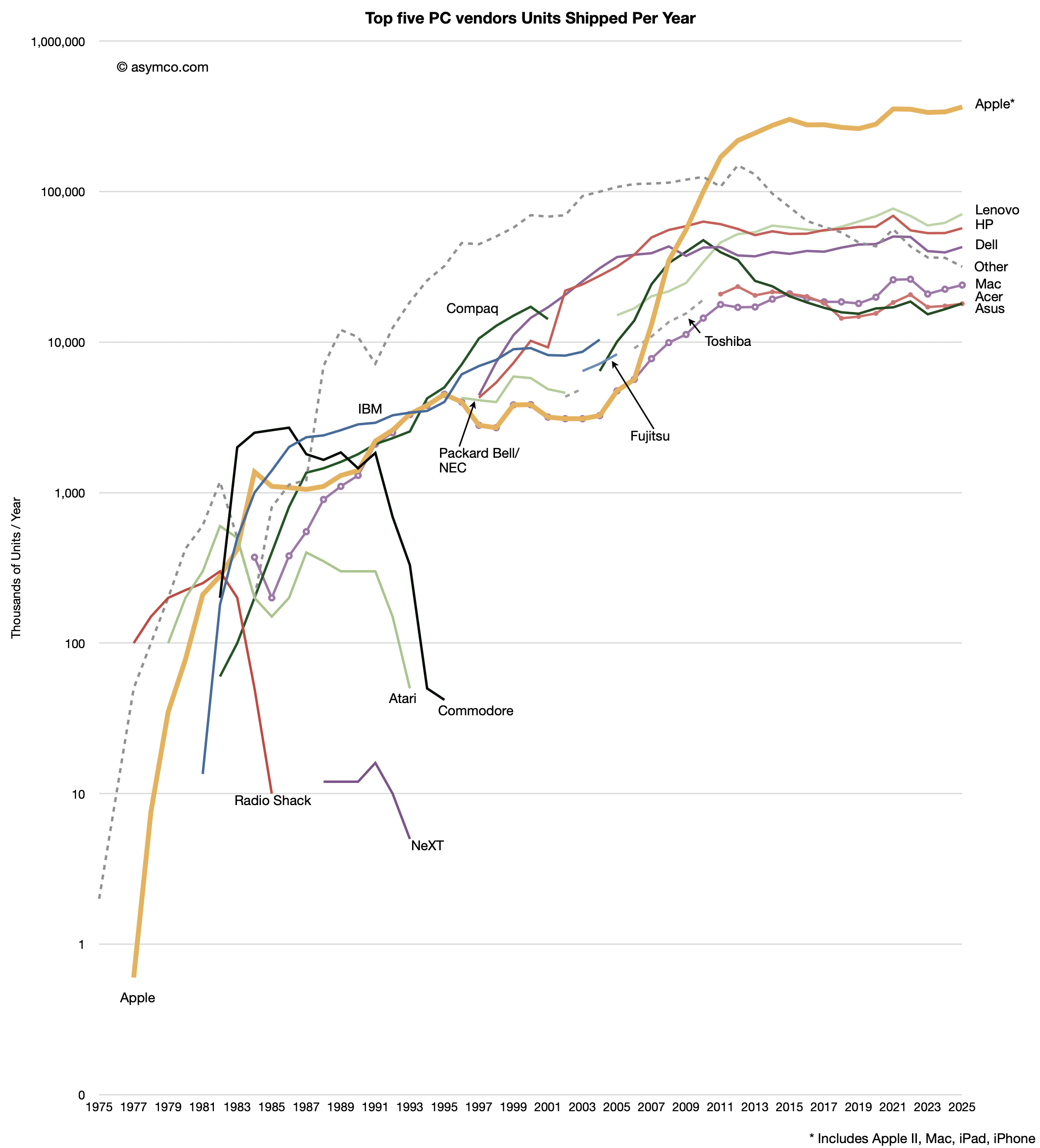
    That does not make Apple the top seller in a given year. Looking at only the Mac, Apple’s traditional form factor personal computer, Apple is fifth fourth in market share. If including the iPad, it was the top computer vendor in 2011 and, including the iPhone, it was first in 2009.

    The following graph shows the top computer makers by units sold since 1975, a year before Apple was founded. (Click on the graph to see a higher resolution.)

    Note that the graph is log scale and in multiples of 1000. Following the yellow Apple line we can see how it started with fewer than 1000 units shipped in its first year to today when it is shipping more than 1 million computers every day[2]. It's also quite remarkable to count how many other companies have come and gone in this top five list and imagine how many came and went in the "other" category.

    Who remembers Atari, Commodore, Packard Bell, Compaq? Few said that they were doomed while they were in the running. Going back to Apple at 40,

    After having a 40 50 year run and after selling more computers than all American and Japanese computer companies put together, how should we think about the next 40 50 years?

    First, clearly Apple shifted from being a “computer company”. It has already changed its name to exclude the word “Computer.” That [came to mean that] it sells devices (which happen to also include computers.) We don't use computers to compute anyway. We use them to make decisions, keep track of things, speed things up and to communicate and to entertain.

    After convincing the world that it's a not just a computer company, the next challenge has been to convince the world that it's also not just a product company. It did so by launching Services as a group (formerly known as iTunes Software and Services) and then separating the financial reporting so that Services can be measured with its own gross margin. Year after year management emphasized Services growth in its commentary. Services has grown into the second largest segment, 26% of total revenues ($112.8 billion out of 435.6 billion in calendar 2025.)

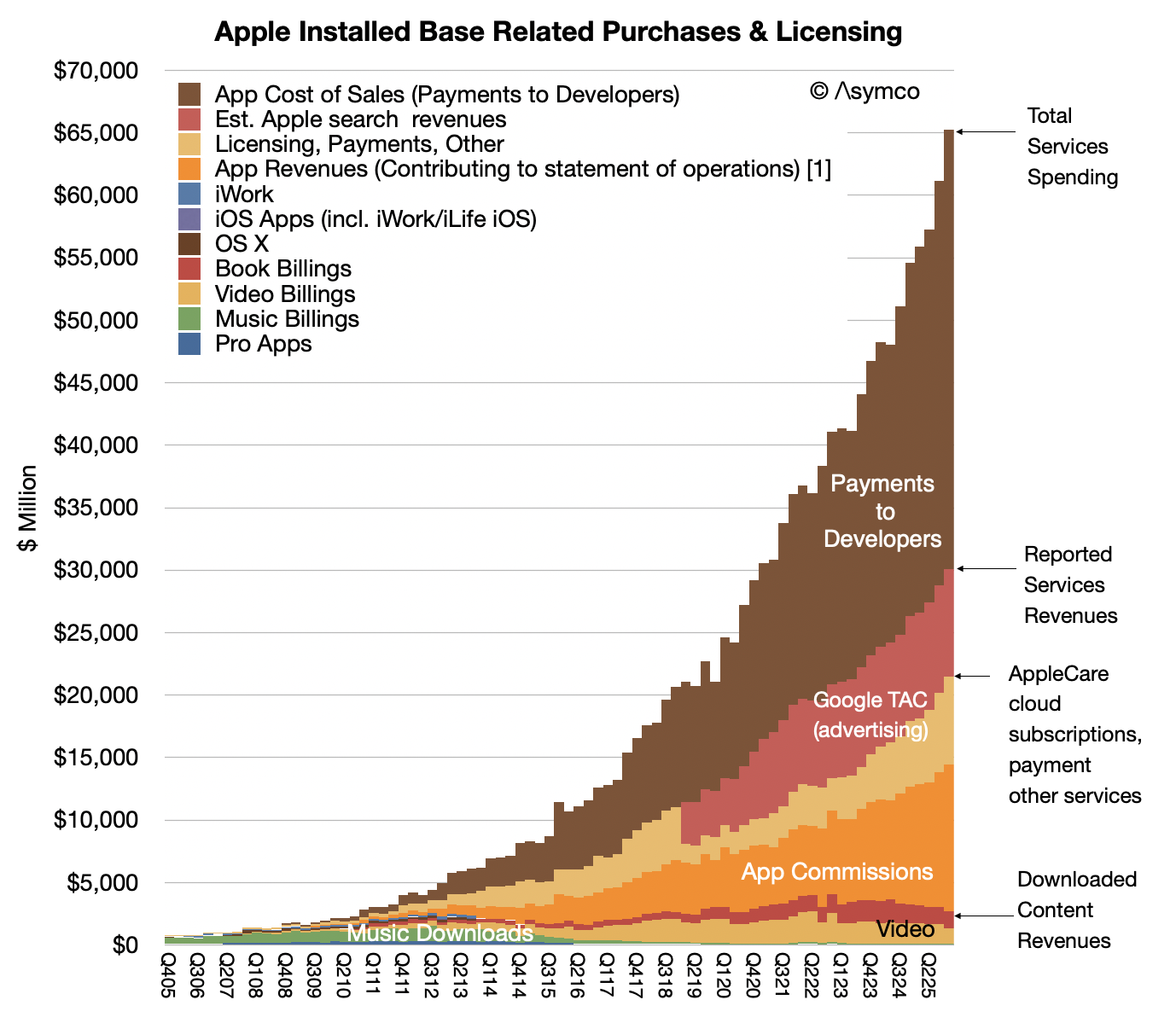
    Services, if it stood alone, would be number 40 in the Fortune 500 list of largest companies by sales. It has been impossible to ignore it. Considering how much customers actually spend on Apps, Content and Services, the total is even bigger at $240 billion last year[3]. As a result, some, perhaps most, recognize Apple as a Products & Services company.

    Apple’s services continue to see increased engagement, spending

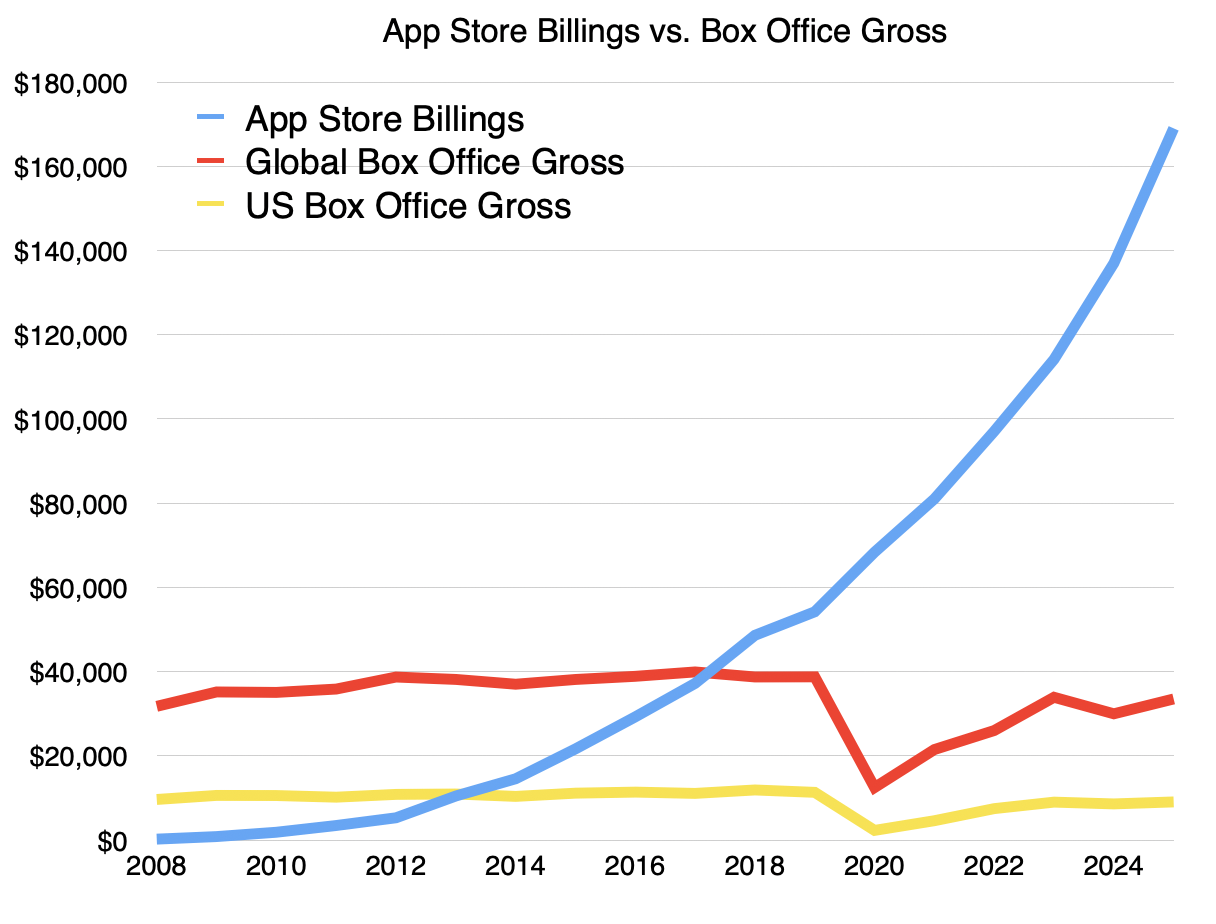
    The App store alone attracts $169 billion in spending per year (2025) and that is now 5x what theatrical movie sales bring in world-wide.[4]

    So if Apple is today at least a bundle of Products and Services then what will Apple be 50 years from now?

    Again from Apple 40:

    My simple proposal is to think of Apple as a customer creator. It creates and maintains customers. The more it creates, the more it prospers. The more customers it preserves the more it’s likely to persevere. This measure of performance for a company is not easy to obtain. It’s not a line item in any financial report.

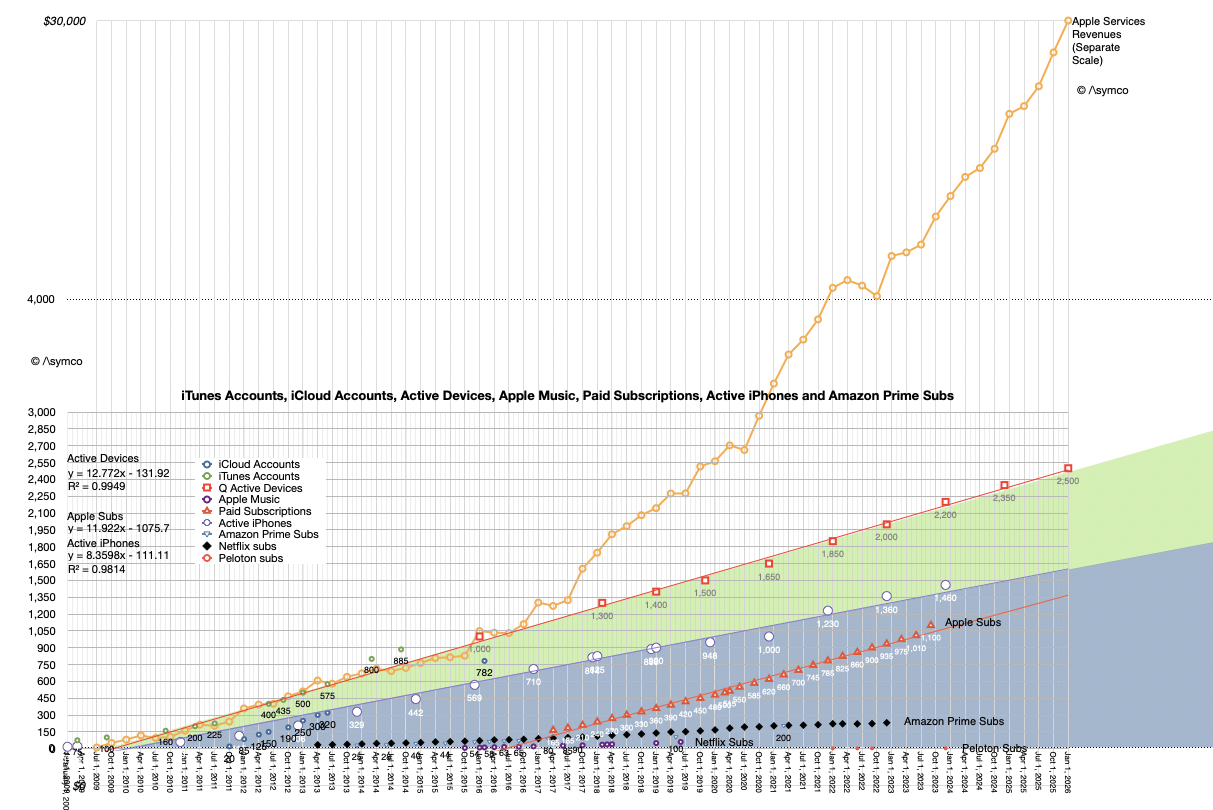
    The closest figure we have is that today Apple has one 2.5 billion active devices in use. It has around 1.1 billion users [5]. Using the devices as a proxy, we can say that this audience has more than doubled in the last decade.

    So we know that at least Apple has created a large number of customers. Knowing total devices sold and number in use means that we can be sure that 63% of all the computers Apple sold are still in use. This means that most customers are recent customers. Are they going to come back?

    If we then factor in the size and persistence of Apple’s audience (customer base) we might conclude that there are factors which will allow it to grow rather than shrink. My analysis based on public data shows that the customer base has been increasing steadily.

    And here is a graph showing the size of device base and implications for subscriptions. services and comparisons with other consumer aggregators. Note the forward looking nature of a linear extrapolation of the historical data.

    10 years ago, I continued:

    Combining the history of customer creation and customer preservation with the value obtained from each customer implies that the next 40 years will be about creating another large tranche of customers whose willingness to spend on whatever Apple creates will be relatively unchanged.

    We don’t know the limit. One billion was hard to imagine even one year ago. We might see two billion devices in short order. Perhaps not. Perhaps as we have a multitude of devices about us all day the number will become less meaningful. But if the number of middle class customers grows and as Apple keeps its products within their reach, there is no reason to think that there will be a reversal of the last 40 years in terms of customer acquisition.

    This analysis contradicts the current perception of the company as reflected by its stock price. That price assumes the audience will wither ((With a P/E ratio of 11, without a change in revenue per user, the only justification would be the audience shrinking by more than 90% over the next 20 years.)) That is not insanity. It is what we could expect if Apple were unexceptional.

    We did see 2 billion. We actually saw 2.5 billion. The assumption of a company in distress as reflected by the P/E ratio of 11 is gone. It's safe to say that Apple is exceptional.

    But note that we are only 10 years into that 40 year forecast from a decade ago. Do we still feel confident that the company can last 30 more years given what we've seen so far? If one company could get through the next 30 I would say it is Apple. And if it is so then I think it will get through the next 50.

    One more Thing

    So, the plan is to make more of the same. It's more than enough.

    1. Including Apple II, Mac, iPhone, iPad and iPod touch; excluding Apple Vision Pro, Apple TV and other iPods. Includes Q1 shipments estimated
    2. 2025 shipments were above 364.9 million excluding Apple Vision Pro, Apple TV, Apple Watch.
    3. A Fortune 15 ranking. This would be the case if payments to developers were counted as sales but that is not the case for accounting reasons. As a result Services margins are an extraordinary 76%, on the order of a software only business like Microsoft Office.
    4. As an aside, when I first started tracking this data it was early 2015. The App store had just overtaken US Box Office revenues and the outrage at my comparison and the skepticism that this sustainable was impressive. Much of the outrage was due to my choice of the headline "Bigger Than Hollywood". You can still read the 72 comments. App store billings are now nineteen times bigger than US Box office billings. I still stand by the idea that the App Store is Bigger than Hollywood. It is in fact bigger than many other forms of entertainment combined--more about this later
    5. Stay tuned for a detailed exposition of this audience
  7. Amazon developing a new phone more than a decade after its first

    Nota Bene · 2 comments

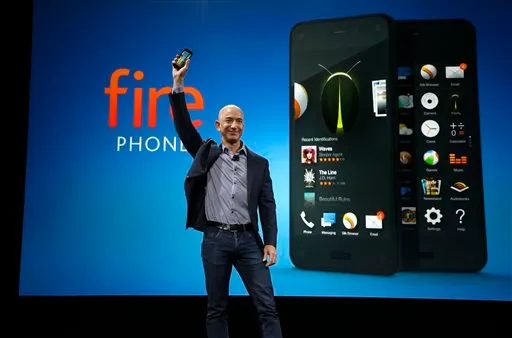
    Who remembers the Fire?

    The latest effort, known internally as “Transformer,” is being developed within its devices and services unit, according to four people familiar with the matter. The phone is ‌seen as a potential mobile personalization device that can sync with home voice assistant Alexa and serve as a conduit to Amazon customers throughout the day, the people said.

    The initiative is the newest chapter in a years-long effort to bring ‌to market Bezos’ long-held vision of a ubiquitous voice-driven computing assistant akin to the voice-controlled computer in science fiction series “Star Trek.”

    Bezos had envisioned a smartphone that had shopping at its core and could take on Apple by offering shipping convenience and discounts through the Prime membership. Along the way, Amazon could gain a wealth of ​new data about users only available through mobile phones combined with purchase history and content preferences.

    As envisioned, the new phone’s personalization features would make buying from Amazon.com, watching Prime Video, listening to Prime Music or ordering food from partners like Grubhub easier than ever, the people said. They asked for anonymity because they were not authorized to discuss internal matters.

    A key focus of the Transformer project has been integrating artificial intelligence ‌capabilities into the device, the people said. That could eliminate the need for traditional app stores, ⁠which require downloading and registering for applications before they can be used.

    The project is being led by a year-old group within Amazon’s devices unit called ZeroOne, whose mandate ​is to create “breakthrough” gadgets, the people said. ZeroOne is led by J Allard, a former Microsoft executive involved in such devices ​as the Zune music player and Xbox gaming console.

    The head of Amazon’s devices and services unit, Panos Panay, has been working to reverse years of unprofitability in the division. That includes a forthcoming tablet that ‌will—for the first time—run Android instead of Fire OS and could sell for around $400, which Reuters was ​first to report.

    One inspiration for the new phone has been the Light Phone, two of the people said, a $700 minimalist smartphone with a camera, map, calendar and not much else, such as an app store or web browser.

    A dumbphone or feature phone could also ​help Amazon market it as a potential second handset to accompany iPhones and Samsung Galaxies already ‌in customers’ pockets, the people said. Such handsets, like the Light Phone and flip phones, accounted for 15% of global handset sales in 2025, according to Counterpoint Research.

    Source: Yahoo Finance

    NB: The problem with any new phone, whether it's from Amazon or Google or Meta or OpenAI or Trump…

  8. Apple’s App Store growth is reaccelerating

    Nota Bene

    Services is much more than App Store

    Apple’s App Store revenue growth is strengthening in February, with Morgan Stanley saying the latest data points to a faster pace of expansion heading into the March quarter.

    The firm’s analyst, Erik Woodring, said in a note Monday that App Store net revenue is growing 9 percent year-over-year month-to-date, which represents “a 230bps acceleration from January off a 700bps easier Y/Y compare.”

    Woodring added that quarter-to-date revenue is now rising 7.5 percent, putting it “50bps behind our +8.0% Y/Y March quarter App Store forecast.”

    The bank kept its March-quarter App Store growth and Services growth forecasts unchanged at 8 percent and 13.5 percent, respectively.

    Morgan Stanley said the acceleration is broad-based across major markets. China’s App Store is growing 4 percent year-over-year after a decline in January, while the U.S. is rising 3 percent, a 40-basis-point improvement. Japan is down 1 percent, while the rest of the world is seeing 22 percent growth.

    The analysts also cited rising Mac lead times, noting they have “quickly inflected to multi-year highs” due to demand for the on-device AI tool OpenClaw.

    They said stronger Taiwan component supplier revenue in January is another positive indicator, pointing to “very robust strength in server demand coming from the largest global cloud service providers.”

    Source: Yahoo Finance

    NB:     With new products due in a few days...

  9. Dan Ives Says Apple's AI Alone Could Be Worth $1.5 Trillion

    Nota Bene

    What's the value of distribution?

    Dan Ives Says Apple's AI Alone Could Be Worth $1.5 Trillion — And Almost No One Is Pricing It In  Benzinga

    Apple's Biggest AI Advantage Is Its Installed Base
    Unlike most AI companies still searching for users, Apple already has them — more than 2.5 billion active devices and over 1.5 billion iPhones worldwide. That gives Apple an unmatched distribution engine to roll out AI-powered services instantly across its ecosystem.

    Ives expects Apple's long-awaited Siri overhaul and broader AI platform to begin rolling out in phases starting this summer, with more advanced capabilities arriving into 2026. The real opportunity isn't just smarter devices — it's monetization.

    Apple could introduce AI-driven subscription services, embedding recurring, high-margin software revenue into its ecosystem — a shift that would move Apple deeper into SaaS-like economics.

    Source: Benzinga

    NB: Modeling AI opportunities is an evolving problem. First we have the problem of costs which are changing rapidly and then there is adoption which is changing even faster. Revenues and cash flows are harder still as the business models are unclear. The products themselves are not necessarily stable and jobs-to-be-done questions abound.


  10. Teen Survey Update: What happens when teens grow up?

    Research

    What's the role of fashion in tech choice?

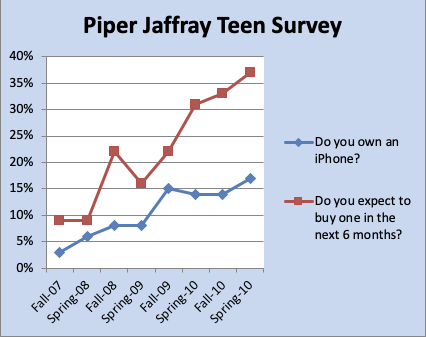
    Apple's iPhone continues to be incredibly popular with U.S. teens, according to Piper Sandler's latest biannual teen survey. 88 percent of teens surveyed said that they own an ‌iPhone‌, and 88 percent said they intend to purchase an ‌iPhone‌ as their next device.

    Teen ‌iPhone‌ ownership numbers have increased three percent since April 2024, and are near record highs. The ‌iPhone‌ has long been the most popular smartphone among teens in the United States, and there has been steady growth in teen ownership. 10 years ago in April 2015, 66 percent of teens surveyed owned an ‌iPhone‌.

    Though teen interest in the ‌iPhone‌ is high, other Apple products and services are not as popular. Apple has not made inroads with Apple TV+, and it continues to trail Spotify as the most popular music service among teenagers.

    45 percent of teens surveyed have a paid Spotify subscription, while Apple Music is the second most popular streaming service with 30 percent of teens reporting an ‌Apple Music‌ subscription. Because Spotify has a free tier, it's still the most popular service overall, with 65 percent of teens using it. ‌Apple TV‌+ is not popular with teens, and less than one percent say they watch ‌Apple TV‌+ shows. Netflix and YouTube were most popular with 31 percent and 26 percent of teens reporting usage, respectively.

    Approximately 31 percent of teens own a virtual reality device, but most of those have an Oculus (25 percent). Just one percent of teens have an Apple Vision Pro, which is not a surprise given the price of Apple's device. Of teens that have a VR device, 60 percent said that they seldom use it, with just four percent reporting being a frequent daily user.

    Piper Sandler surveyed 6,455 teens across 43 states for the spring 2025 report.

    This data was collected in the spring of last year.

    I found the above in my archives. Ownership in 2010 was about 18%, 2015 it was 66% and 2025 it was 88%. The saturation at 88% (for both ownership and intent) was achieved relatively quickly but most importantly, it remains steady.

    Now consider that the teens of 2007 are having kids of their own. A 15 year old in 2007 is now 34 and a 19 year old is now 38 and some have a teen of their own.

    At 19 years, the iPhone brand has transitioned across one generation with not only resilience but with deeper entrenchment. This cannot be said for other contemporary technologies, e.g. social media. While elders use Facebook the young have moved on. Perhaps to Instagram (25-34, 76% 18-29) or perhaps to TikTok (16-24) which has the strongest position for younger, Gen Z users.

    Here are some additional data points on predisposition for social media:

    Facebook (25-49): Largest group is 25-34 (31.1%), but also high usage among 30-49 year olds.
    LinkedIn (30-49): Professional focus, ideal for B2B and adults 30-49.
    YouTube (18-64+): Broad, with the highest usage (93%) in the 18-29 bracket.
    Pinterest (30-49): Popular with older, female audiences.

    There is quite a lot of divergence and only YouTube seems to be fairly steady across age groups.

    Moreover, as the Piper Sandler survey suggests, Apple Services is not the same as the iPhone. The adoption of Music and TV are not a broad-based and that has a lot to do with disposable income. The mechanism for adoption should be the family plan whereby teens are automatically enrolled through their parents in to Music and TV+. After all, teen iPhones are likely purchased by parents. That services bundling is where Apple must focus its effort.

  11. Does Apple's AI Opportunity Outweigh Component Cost Inflation?

    Nota Bene

    Apple's cost pressures are real, but the growth story is bigger

    Apple’s latest Wall Street price targets

    Wedbush:$350 (outperform).
    Goldman Sachs:$330 (buy).
    JPMorgan:$325 (overweight).
    BofA Securities:$325 (buy).
    Morgan Stanley:$315 (overweight).
    Sources: Yahoo Finance, Investing.com

    Despite memory cost inflation being a big deal, it still doesn't fundamentally impact Apple’s tremendous earnings power, Bernstein’s Mark Newman shared in a CNBC interview.

    That’s not to say he doesn’t expect iPhone production costs to rise, though.

    Heightened component costs could push iPhone prices up by as much as 15%, Newman added, while bumping the overall average selling price by nearly 12% as some customers trade down to cheaper models.

    That increase is substantial, and it comes down to a staggering 237% surge in mobile DRAM contract prices since Q2 2025, along with a 70% jump in NAND.

    Despite the pressures, Newman feels that Apple separates itself from the pack through its superb execution.

    He says Apple is “managing better than competition,” led by unmatched scale advantages, supplier leverage, product mix, and durable pricing power.

    To his point, Apple has evolved into a powerful platform company with a walled-garden ecosystem that locks users in.

    That matters a ton when costs spike.

    That’s why even with the memory pressures in play, Bernstein’s modeling points to iPhone gross margins dropping by nearly 1.5 percentage points by Q4 2027.

    Though that’s meaningful, Newman believes the EPS impact will be substantially offset by higher-margin services revenue, mix shift, and aggressive cost management.

    Apple’s AI ambitions outweigh rising costs

    Newman’s bullish take on Apple centers around AI.

    Instead of AI technology showing up just as a chatbot, Newman says Apple is deploying it as a system-level layer, making its ecosystem stickier.

    What makes this possible is a hybrid design that handles as many requests on the device and reroutes the heavier ones (advanced reasoning) through Private Cloud Compute using Google’s Gemini.

    That robust setup ensures Apple’s privacy positioning remains firmly intact, while delivering cutting-edge responses and features.

    Unlike many of its peers, Apple isn’t in the race to win AI benchmarks or translate those gains into tangible financial gains. It just needs those features to change behavior and pave the way for healthier services revenue.

    In fact, some of the earlier modeling supports that logic.

    Morgan Stanley’s April 2025 survey, as reported by Investing.com, was an early “tell” that Apple’s AI pitch would likely move the needle.

    At the time, 51% of iPhone owners said they were “extremely likely” to upgrade in the next 12 months. More importantly, those respondents, compared with those in the previous fall, showed a 12% higher willingness to pay $9.11 per month for Apple Intelligence.

    For perspective, the significant Siri 2.0 (the next phase of Apple Intelligence) is reportedly set to launch in spring 2026, according to Mac Rumors.

    Ironically, Apple stock was initially blasted for lagging in the AI realm. However, as we’ve gotten deeper into the cycle, Newman argues that investors have actually felt a lot “more comfortable” amid the AI wars.

    Source: TheStreet

    NB: A 237% surge in mobile DRAM contract prices since Q2 2025 is spot pricing. Apple does not buy on the current market but what is effectively on a futures market. It would behoove the reader to calculate the quantity of orders for e.g. SoC and Memory Apple places vs. hyperscalers. If "51% of iPhone owners said they were “extremely likely” to upgrade in the next 12 months" that's 850 million people worldwide.