Not reading this article is probably a wise decision.
Shares could perform in line with the S&P 500's long-term average
Investors can follow a straightforward exercise to try and figure out where Apple's stock price will be in late March 2031. It's important to consider both the valuation and profit gains.
We just released a brand-new report with the full story and the company’s name.
Apple shares current trade at a price-to-earnings ratio of 31.5. I believe it's reasonable that this multiple could drop to 30 in five years, which is still a premium valuation.
On the other hand, sell-side analysts hold a consensus view that diluted earnings per share will rise at a compound annual rate of 11.6% between fiscal 2025 and fiscal 2028. If we assume that this pace of growth continues in the years after this explicit forecast period, then Apple's stock price will be around $410 in five years. This translates to a 10.5% annualized gain.
This is obviously a very rough guide that may or may not prove to be correct. Apple's earnings could surprise to the upside or disappoint to the downside. And market sentiment is also extremely unpredictable, which will impact the stock's valuation. [Seriously?-ed]
That expected rate of return mimics the S&P 500's long-term average. But if the widely followed benchmark keeps up its performance from the past decade, then Apple will lag the market.
Asymco Bulletin is a digest of all the work we have published for the week ending Apr 5, 2026.
Podcast
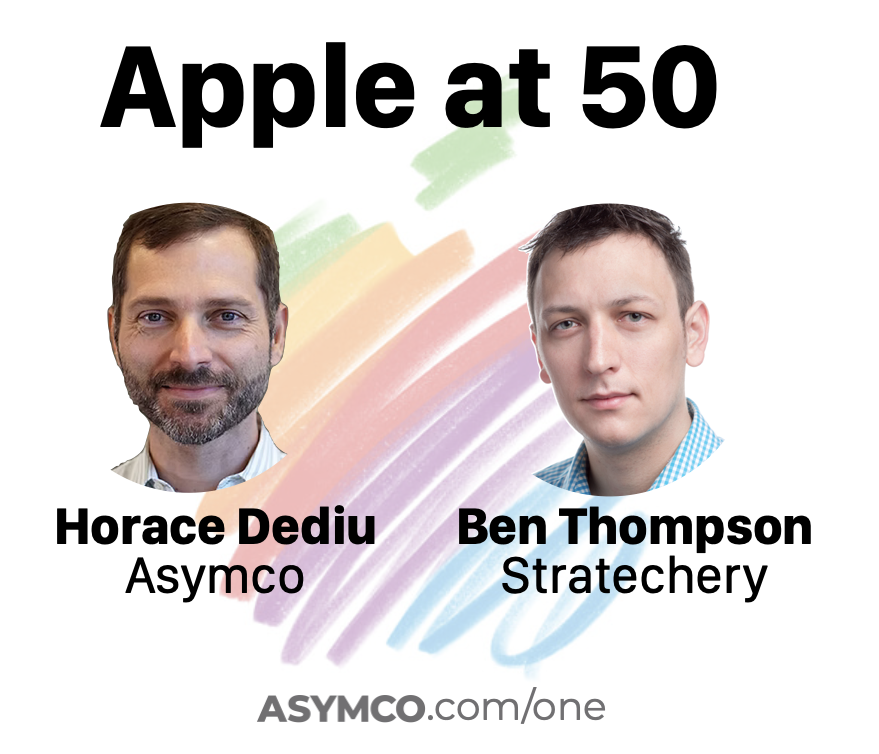
Apple at 50: Ben Thompson of Stratechery interviews Horace Dediu → Horace describes his journey from Romania to becoming a leading tech analyst, highlighting his experiences at GTE Labs, business school under Clayton Christensen, and Nokia during the iPhone's birth. He emphasizes Apple's customer-centric approach and its potential to navigate AI challenges. Dediu also shares insights on his new paid service, Asymco One, and reflects on the importance of understanding market dynamics and customer satisfaction. He expresses optimism about Apple's future and underscores the value of deep, long-term analysis in tech forecasting. →
Apple’s Business Strategy → Apple's enterprise growth is driven by its strong consumer base. Do new services like Apple Business suggest a new emphasis? →
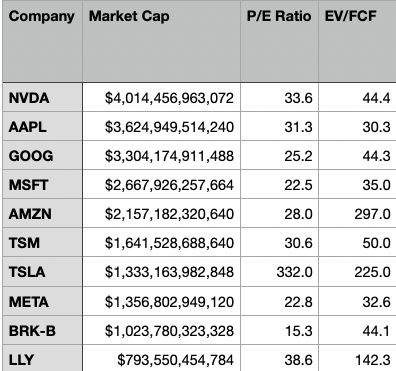
Melius highlights FCF while reiterating buy on Apple → In the AI era, valuation shifts from traditional P/E to EV/FCF, highlighting Apple's robust financial health and fair valuation amidst its significant product launches. →
The iPhone 50 years from now – and why Apple won’t have AI execs → Rumors suggest the iPhone 70th anniversary edition might feature an innovative new camera system, while Apple CEO Tim Cook dismisses the idea of AI-led executives due to legal and functional constraints. →
Both the Mac and iPad marketshare in China grew year-over-year in 2025, according to new data from the Omdia research group.
Apple sold 700,000 Macs in the fourth quarter of 2025 for 6% market share. That compares to sales of 600,000 Macs and 5% market share in the fourth quarter of 2024. That’s 14% annual growth.
Apple sold 2.3 million iPads in the fourth quarter of 2025 for 25% market share. That compares to sales of 2 million iPads and 24% market share in the fourth quarter of 2024. That’s 16% annual growth.
Looking ahead, China’s PC and tablet markets face significant headwinds. Omdia forecasts PC shipments in China will decline to 37.9 million units in 2026. This decline will be more pronounced in the consumer segment, which is expected to contract 12% compared to 2025. Tablet shipments are also projected to fall 11% to 32 million units in 2026, following elevated performance in 2025.
Global notebook shipments are showing clear signs of further weakening, according to TrendForce’s latest findings on the notebook industry. Subsequently, TrendForce has revised its 2026 full-year shipment forecast downward from -9.2% to -14.8% YoY amid expectations of deteriorating end-market demand and rising supply chain costs, reflecting a deeper industry correction.
TrendForce estimates that Apple’s notebook shipments will grow 7.7% YoY in 2026, outperforming the broader market trend. This is based on Apple’s ability to expand into lower price segments, adopt a proactive pricing strategy, and maintain stronger chain control than its peers.
Ben Thompson of the Stratechery interviews Horace on the Stratechery Plus Podcast to discuss Horace's journey to become an influential tech analyst: early career in research, business school under Clayton Christensen, and his time at Nokia during the rise of the iPhone.
The conversation further explores Disruption Theory in the context of both smartphones and AI, why Christensen misjudged Apple, and whether AI could challenge today’s tech giants. It also marks the launch of Dediu’s new paid service Asymco One and reflects his continued conviction in Apple Inc. at its 50-year milestone.
“Given Apple’s free cash flow and we are about to embark on one of its most lucrative product rollouts since the big screen iPhones in 2014 - there is a case for Apple’s stock regaining some ground,” Melius analysts wrote in a note to clients.
Lately, Apple has announced the iPhone 17e and a refreshed iPad Air, a new MacBook Air, a MacBook Pro, new Studio Displays, the MacBook Neo, and an updated version of its over-the-ear headphones, the AirPods Max 2.
Apple shares were modestly higher in premarket trading but have lost some 8% year-to-date. Over the past 12 months, shares have gained 12%.
NB: Free cash flow (FCF) is the amount by which a business's operating cash flow exceeds its working capital needs and expenditures on fixed assets (known as capital expenditures). It is that portion of cash flow that can be extracted from a company and distributed to creditors and securities holders without causing issues in its operations. As such, it is an indicator of a company's financial flexibility and is of interest to holders of the company's equity, debt, preferred stock and convertible securities, as well as potential lenders and investors. It has come recently into vogue when the bill for AI infrastructures has come due...
The table above shows the P/E ratios vs. the EV/FCF ratios of the top 10 largest market caps in the world.
In Apple’s first 50 years it shipped 5.13 billion computers. This shipment total is higher than any other computer company in its first 50 years. There actually are no other PC makers that are 50 years old. But all these things were true also 40 years ago. So what are we celebrating now that we did not celebrate at Apple 40? The answer is Services, the consistency in growth in user base and the potential trajectory of growth to never-before imagine audiences. The biggest change is a change of horizons. →
Says Neal Stephenson who first coined the term “metaverse” This revelation came soon after Meta canceled the Metaverse. Let’s look into Neal Stephenson’s mea culpa:
When I was working at Magic Leap, and people asked me why I thought that [Metaverse] was a good idea, I would ask the rhetorical question: “do you really think that twenty years from now everyone is still going to be going around all day staring at little rectangles in their hands?” →
How everyone is wrong about AI. The newspaper was an unexpected development It was not a product that anyone asked for. Like many innovations, it wasn’t an invention. It was not patented or discovered in a laboratory. It emerged as a result of the convergence of three disparate technologies: continuous roll printing presses, the telegraph, and the railroad. This convergence occurred by the 1830s, facilitated by a business model aptly named “the penny press”. Stepping back, the printing press was initially developed in the 1450s, 40 years before Columbus’ voyage. It went through numerous evolutions. The big change was moving →
Running a data-center AI model on a MacBook → Apple's MacBook Pro, with its unique Apple silicon architecture, could revolutionize personal AI by enabling powerful AI models to run locally without relying on cloud data centers, potentially shifting the competitive landscape in Apple's favor despite current perceptions of lagging behind in AI advancements. →
“There’s So Much Left” in iPhone: Tim Cook → Apple's relentless focus on user-centric innovation, epitomized by the ever-ascendant iPhone, underscores its enduring dominance and untapped market potential. →
Amazon developing a new phone more than a decade after its first → Amazon's renewed attempt at a smartphone, "Transformer," aims to integrate AI and deepen Prime ecosystem ties, learning from past Fire failures by addressing trust, scale, and developer engagement challenges. →
Mac fastest growing PC brand in India in Q4 2025 → In 2025, India's PC market soared to a record 15.9 million units, with Mac sales impressively up 24% year over year, hinting at a bright future despite looming 2026 challenges. →
Apple TV is a categorization failure → Apple TV, launched in 2007, struggled for 19 years as a misunderstood, underappreciated gateway to content, overshadowed by Apple's product-centric reputation. →
Apple’s Custom Silicon Opens up Potential for a Cellular MacBook → "Apple's C1X modem not only matches Qualcomm's performance but also reshapes the economic landscape for always-connected MacBooks, hinting at a future where seamless cellular integration redefines portable computing." →
Survey shows record upgrade interest for iPhones → Morgan Stanley forecasts Apple as the sole major smartphone vendor to gain market share in 2026, driven by strong upgrade intent and advanced features, while Android struggles with rising costs and declining loyalty. →
MacBook Neo Market Impact: Analysts weigh in → Market analysts predict the MacBook Neo will disrupt the low-end PC market, especially in education, by leveraging Apple's higher margins and user-centric design, despite challenges from price-sensitive K-12 sectors dominated by Chromebooks. →
World’s most respected Apple Analyst. —Macfilos
Like what you read? Get more from Asymco One: full access to Asymco's research, analysis, and commentary.
It was not a product that anyone asked for. Like many innovations, it wasn't an invention. It was not patented or discovered in a laboratory. It emerged as a result of the convergence of three disparate technologies: continuous roll printing presses, the telegraph, and the railroad. This convergence occurred by the 1830s, facilitated by a business model aptly named “the penny press”.
Stepping back, the printing press was initially developed in the 1450s, 40 years before Columbus' voyage. It went through numerous evolutions. The big change was moving from batch (page-at-a-time) to continuous (rotary) processes. In the 1600s, Gutenberg type presses could operate at the rate of 240 impressions per hour. By 1818, The Koenig press could reach 2400 impressions per hour.
The steam-powered rotary printing press, invented in 1843 in the United States by Richard M. Hoe, ultimately allowed millions of copies of a page in a single day. Mass production of printed works flourished after the transition to rolled paper, as continuous feed allowed the presses to run at a much faster pace. Hoe's original design operated at up to 2,000 revolutions per hour where each revolution deposited 4 page images, giving the press a throughput of 8,000 pages per hour. By 1891, The New York World and the Philadelphia Item were operating presses producing 90,000 4-page sheets per hour. -Wikipedia
By harnessing steam engine power, the marginal cost of printing approached zero and typesetting productivity was such that tens of these pages could be laid out in hours. The production problem was solved.
The telegraph gave rise to news services which could relay national or international news to local papers nearly instantly. Small towns did not need to employ correspondents to reside on assignment to report what was happening in any and all national capitals. New syndication business models represented by Reuters and the Associated Press would distribute to thousands of smaller papers and communicate the stories via the Victorian Internet. Local reporters could flesh-in the paper with the latest from the community. The content sourcing problem was solved.
Finally the railroad offered daily distribution from urban to rural populations. This meant the entirety of a country's population would have access to news and commentary and, “all that was fit to be printed” on a daily basis. The distribution problem was solved.
A Bundle and Institution
From the capital point of view, the greatest investment for a newspaper publisher was the printing plant. The bigger the plant, the bigger the circulation. And the bigger the circulation, the bigger the profit. Printing presses kept getting bigger and faster. An old newspaper man told me that a newspaper is nothing more than a mechanism for depreciating a printing plant.
In order to pay off this investment, publishers not only sold papers but also advertising. To appeal to more readers they added a variety of content types beside news. Sections emerged to cover sports, lifestyle, photographs, opinion, comics, serialized novels, financial information, entertainment/gossip (thus forming the Hollywood star system). This included style pages, advertising and serialized novels. Some of the greatest literature of the time by authors like Mark Twain and Charles Dickens was first published in newspapers. Weekend editions were an obvious product extension.
Thus an institution was born. The newspaper became the primary source of information for the world. It became highly influential and a political (and propaganda) instrument. It came to be the historical record. We still seek out old papers in archives to find out what happened day-to-day in history.
The bigger the bundle the better the business
What made it resilient was its continuous bundling of additional information types, catering to diverse audiences. There was something in a newspaper for everyone. For men and women, from youth to elderly and for rich and poor. Since the cost of adding pages to the paper was marginal, bundling ensured a growing audience. This audience attention could be monetized through newsstand sales, subscriptions and advertising.
Obviously nobody would read a newspaper cover-to-cover. There was far more information than could be consumed and also far more than was interesting to any one person. The style reader probably did not care much for sports. The Hollywood gossip reader did not probably check the finance pages. But most readers of newspapers bought the bundle because it offered optionality.
They did not need to read it all but they could if they wanted. Maybe a scandal in Wall Street would attract the gossip reader occasionally. Maybe a pennant race would attract the style reader. If something exciting happened, you could read all about it.
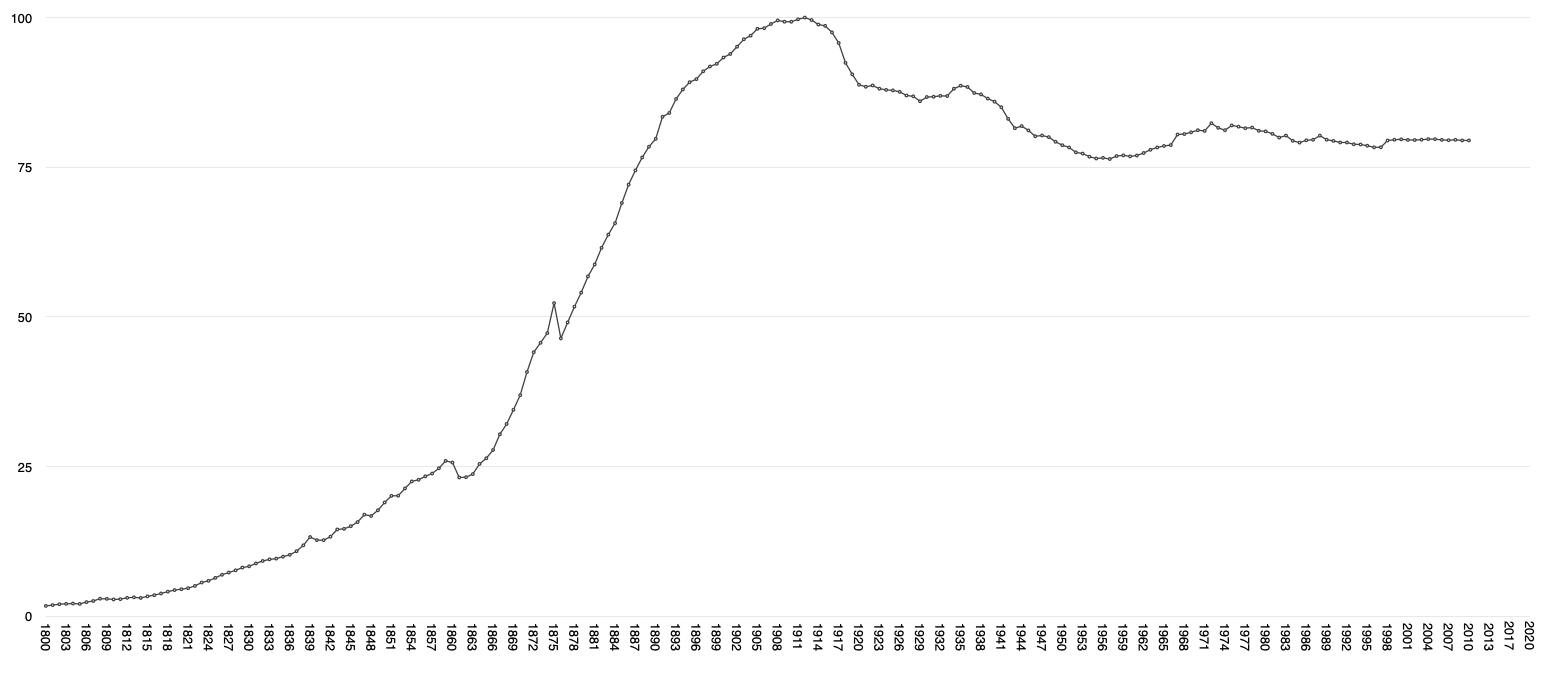
Consumers were happy with the bundle and the newspaper became a tentpole holding up the information a society needed to function. It swayed elections, influenced public opinion and investigated the bad and the ugly in society. By the turn of the century, more than 9000 newspapers were publishing daily or weekly in the US. A proliferation such that almost every one of the 3140 US counties had more than one.
Percent of communities in the US with published newspaper titles. Banks, Arthur (2004), “Cross‐National Time‐Series Data Archive,” via Diego A. Comin Bart Hobijn THE CHAT DATASET NBER Working Paper 15319
Unbundling the Newspaper
Then the internet arrived. Gradually, it became possible for every single piece of the bundle in a newspaper to be made available as a web page, free with some display ads. If you were interested in style, there were 1,000 style sites. If you were a sports fan, there would be 1,000 sports sites. News junkies could get the latest news faster online. Financial news was now real-time. No longer did you have to wait for the morning to find out what happened in the markets the day before.
As national and global news could be obtained on web sites, newspapers hoped to continue as sources of local information. That also gradually got peeled away by social media. The result was nothing short of catastrophic. Since 2004, the United States has lost one-fourth (2,100) of its newspapers. Weekday circulation declined 45%, from more than 122 million to 68 million. Consequently, half of the counties only have one newspaper, and two-thirds lack a daily newspaper. The loss of newspapers has resulted in the displacement of 36,000 journalists, including photographers, editors, comic strip artists, and copywriters.
The internet unbundled the newspaper but also the music album, the magazine, the TV channel and almost all forms of entertainment. Unbundling built new empires: iTunes/Apple Music, Netflix, Spotify, YouTube, Facebook.
This unbundling led to a new way of finding opportunities. You could actively look for bundles and once you found one you could ask when and how it would get unbundled. And vice versa. Jim Barksdale summarized it as: “i know of only two ways to make money: bundling and unbundling.”
So much so that if you found a huge bundle that somehow resisted unbundling you would have to investigate it for what's wrong with it. The classic example is the automobile. As a bundle of many types of trips and configurations into a simple but over serving business model clearly it was ripe for an unbundling. That is what ride sharing (with or without a human driver), and new modes represented by micromobility seek to do.
The AI Bundle
The iPhone is an enabler in this game, capable of either bundling or unbundling depending on the apps which are built for it. Wearables do some of the side quests but the phone is still the core of the personal network.
I would contend that AI is exhibiting a lot of bundling characteristics. We assume one model is good enough for all types of tasks even though there are pitfalls in privacy, security or complexity. Being a prompt mechanic feels like more of a DIY experience. But indications are out there that AI will be unbundled. According to The Information,
“Apple has complete access to the Gemini model in its own data center facilities. Apple can use that access to produce smaller models that power specific tasks or are small enough to run directly on Apple devices so they can run the tasks faster.”
This approach relies on a process called model distillation, where a larger AI model trains smaller versions that can run efficiently on-device. These smaller models reduce the need for cloud processing and improve speed, which fits Apple’s focus on privacy and performance.
“Since Apple has full access to Gemini, its student model can also learn to imitate the internal computations that Gemini uses to arrive at its answers.”
But it does not stop there. The implication of AI as a job destroyer is also challenged by bundling theory.
Jobs as Bundles
We have long been warned that AI would eliminate millions of jobs. One of many forecasts predicts that by 2030, approximately 10.4 million US jobs, 6% of the workforce, will be lost to AI. The underlying assumption behind these figures is simple: if AI can perform tasks that are currently performed by humans, the human workforce will be rendered obsolete.
A new paper by Luis Garicano, London School of Economics, Jin Li and Yanhui Wu, University of Hong Kong suggests it's not that simple.
The paper argues that jobs aren't tasks. They're bundles. For instance, radiologists don’t merely read scans; they interpret edge cases, collaborate with clinicians, and approve decisions that individuals make. Replacing the image-reading aspect doesn’t necessarily equate to replacing the Radiologist job.
Authors draw a line between “weak bundles” and “strong bundles” based on their ability to be split apart. Weak bundles can be easily separated, while strong bundles cannot be without losing their value. You can think of bundling strength as also the degree of modularity/integration. A weak bundle is more modular, a strong bundle is more integrated.
"In weak-bundle occupations, AI automates some tasks and narrows the boundary of the job… In strong-bundle occupations… AI improves performance inside the job, but does not remove the human from the bundle."
In jobs with weak bundles, AI doesn’t merely replace a task; it fundamentally reshapes the job. The human is left performing tasks that the AI cannot, often in a more specialized and limited capacity compared to the original role.
Once AI takes over a portion of the work, humans cease to divide their time. They dedicate themselves entirely to the remaining tasks, resulting in increased output per worker, i.e. higher productivity. Thus even weak bundles don't necessarily imply job reduction but increased output.
Artificial intelligence is transforming job roles, rather than eliminating them. While certain tasks may be reallocated and productivity could potentially increase, employment and working hours have remained relatively stable. In many instances, the bundle holds.
In a strongly bundled occupation, AI still improves task-performance, but the human retains both tasks and a larger revenue share. Whether the aggregate labor share rises or falls depends partly on the distribution of coordination costs between tasks within an occupations.
If most employment sits in strongly bundled jobs, the aggregate labor share is more resilient than the task-exposure models predict. The distribution of bundle strength across the occupational structure is therefore a first-order empirical question for understanding AI’s macroeconomic impact.
In other words, the doom/utopia AI outcome dichotomy is false. It depends on the potential for unbundling. If you're in an integrated (strong-bundle) job, blending judgment, context, and responsibility, AI is sustaining: it will make you faster and better paid. If you're in a modular (weak-bundle) job, it will shunt you into an integrated role, whereby productivity rises.
The degree of job displacement will depend on the degree of bundling in most jobs across the economy. It may turn out that integrated jobs will be added as the opportunities created by productivity will be market creating.
History is filled with examples of restructuring of ideas and the re-configuration of businesses due to technological change. AI is an example of both enabling and disabling of existing businesses and occupations. Very much the way the Internet turned out to be.
Displacement happens but innovation creates more opportunity and reallocation of effort to better (or at least more) outcomes. The newspaper and internet created markets and jobs. Will AI do the same? Modularity may hold the answer.
Apple the only major global smartphone vendor expected to gain share in 2026
A new global smartphone survey from Morgan Stanley points to record iPhone upgrade intent in 2026.
The AlphaWise survey shows next-12-month upgrade rates in the U.S. and China hitting “all-time highs,” which implies replacement cycles “accelerate to a 10-year low.”
Woodring writes that Apple is “the only major global smartphone vendor expected to gain share in 2026,” driven by “new and advanced features,” stronger device quality and broad upgrade eligibility.
He adds that iPhone switching rates are set to reach a 5-year high, underscoring the company’s relative strength.
By contrast, Android vendors face what Morgan Stanley calls “unprecedented memory cost inflation” that is likely to push device prices higher and “significantly dampen smartphone market demand.”
The bank says lower brand loyalty and greater price sensitivity will leave Android “more vulnerable vs Apple.”
As a result, Morgan Stanley cuts its 2026 global smartphone shipment forecast to 1.1 billion units, down from 1.3 billion previously, or -13% year-on-year.
It now expects Android shipments to fall 15% year over year, compared with just a 2% decline for Apple.
Explore how Apple’s C1X modem performs in the real world, with Ookla Speedtest data from Q4 2025 showing the iPhone Air matching Qualcomm’s X80 download speeds while setting new latency benchmarks.
iPhone Air marginalizes competing slim form-factors. The iPhone Air has largely eclipsed the Samsung Galaxy S25 Edge globally, out-sampling it 3-to-1 in the U.S. based on Speedtest data, while the Edge remains statistically negligible in terms of adoption across European markets. South Korea remains the primary competitive exception, driven by strong home-market bias.
In 2024, the iPhone 16 Plus was the clear laggard of the range, capturing a mere 2.9% of the launch mix. By sunsetting the iPhone Plus and replacing it with the design-centric iPhone Air, Apple more than doubled the share of this roster slot to 6.8%. This suggests that “Slim” as a category successfully resonates with a segment of the market that “Large” simply did not.
Apple’s newest hardware cycle centered on a key question: could Apple’s first high-performance modem, the C1X, improve upon the original C1? Furthermore, could it match the industry-standard Qualcomm X80, without the thermal headroom of a “Pro” chassis. Despite its slim form-factor, the iPhone Air does include a vapor chamber to aid cooling, while its titanium frame also aids heat dispersion. Qualcomm remains a formidable incumbent with its X85 modem, which alongside MediaTek’s M90, will feature in newer Android flagship devices this year. Based on comparisons with the X80, our data suggests that Apple’s silicon has reached a critical maturity point, shifting the conversation from a performance gap to a strategic “equalizer” in real-world performance.
In December, the company lost AI chief John Giannandrea, its top lawyer and a key design executive in a single week. Other recent headlines: “Apple faces unprecedented executive exodus”, “Apple rocked by executive departures, with chip chief at risk of leaving next.” “Apple home devices executive leaves for Finland’s Oura” “Lisa Jackson is set to retire late January 2026, while Kate Adams will retire in late 2026”. That’s just the names we hear about. They represent senior executives. But the harsh truth is that Apple lost tens of thousands of talented developers, marketers and mangers last year.
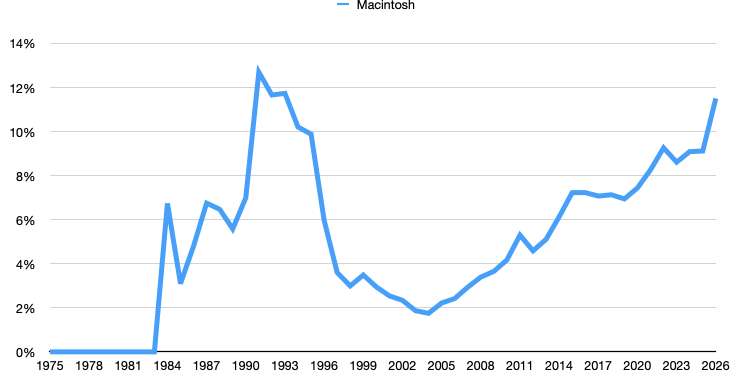
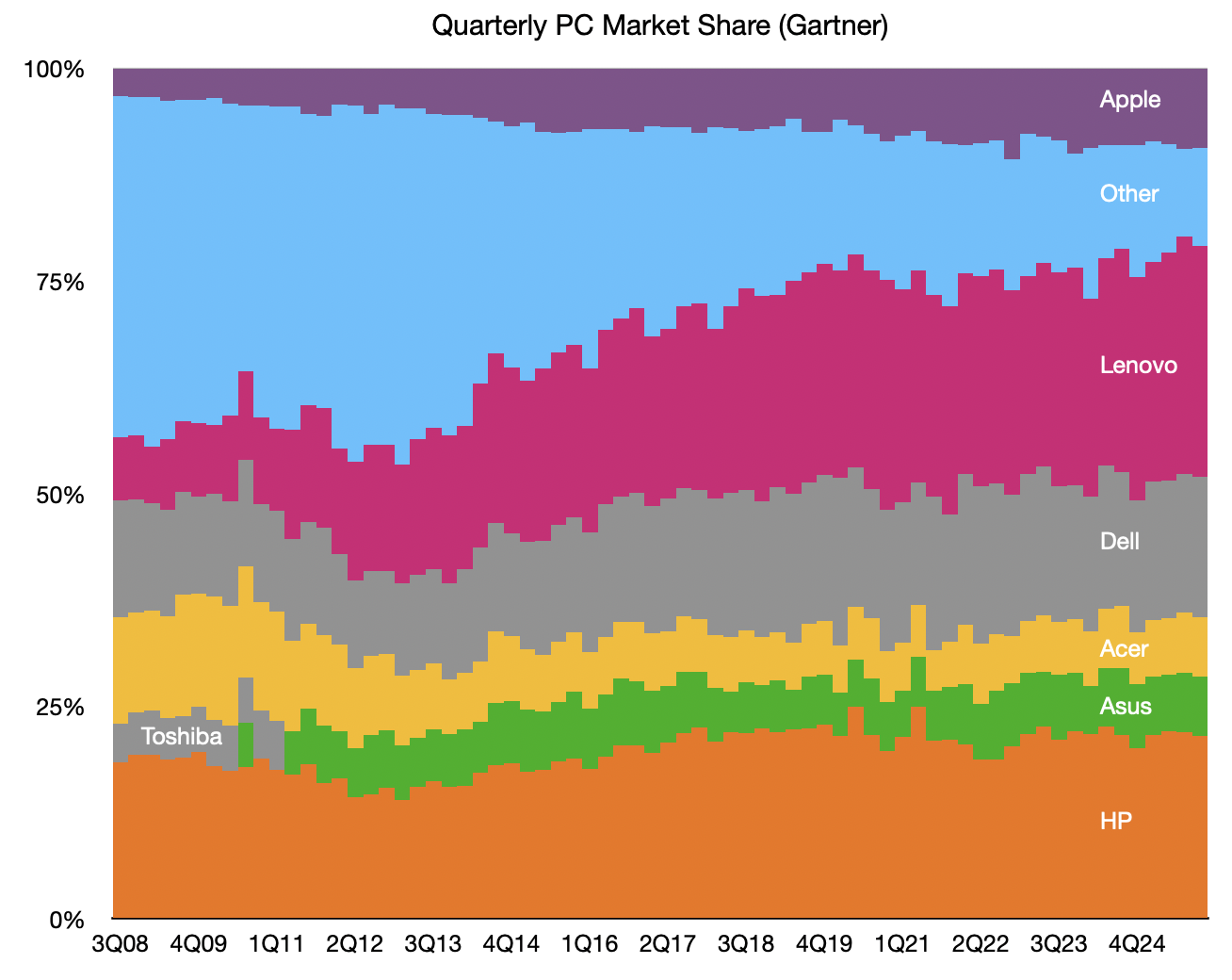
Almost 10 years ago I said “Managing the Mac product line must be one of the most challenging problems at Apple. That may not be obvious given the product’s success.” I pointed out that although the company grew the Mac into a redeemed and prosperous platform, “The big change in computing has not been a growing Mac vs. declining PC. It has been a huge surge in mobile device use vs. a decline in PC use overall.” It’s time to revisit this observation. First, a status update: The Mac is in its 42nd year...
How to read the history of the Mac and how to look at market share gains potential. Also: why the Mac has always been a cheaper alternative for buyers. →
Running a data-center AI model on a MacBook → The article discusses how Apple's MacBook Pro, with its unique Apple silicon architecture, could revolutionize personal AI by enabling powerful AI models to run locally without relying on cloud data centers, potentially shifting the competitive landscape in Apple's favor despite current perceptions of lagging behind in AI advancements. →
Lobster Boil → "OpenClaw, a revolutionary open-source AI agent by Peter Steinberger, transforms personal computing by autonomously managing tasks across platforms, sparking a Mac Mini craze and hinting at a future where AI agents are integral to daily life." →
‘No Near-Term Catalyst,’ KeyBanc on Apple Stock → Near-term catalysts may not sway long-term investors, but if Apple's valuation seems steep, critique the pricing, not its promising 14% revenue growth forecast. →
Harmful chemicals found in popular headphones → Apple's AirPods Pro 2 and JBL's Tune 720BT topped the safety charts, while budget brands like Temu raised red flags for hazardous chemical exposure. →
When does Apple split its stock? → Apple's stock split history shows a pattern of adjusting high share prices to maintain accessibility, with splits occurring around $100-$650 thresholds, potentially hinting at a $300 minimum for future splits. →