Asymco

Asymmetric Intelligence

smartphone

  1. HTC: How They Compare

    Research · 17 comments

    In the last mobile market update series I wrote of  the evolution of market share, the shift in where dollars are spent, the tale of ASP erosion, profitability ratios over time and EBIT share over time.

    I did not include all vendors for various good reasons. The first survey (market share) did include an "others" category that made the volume data complete, but in the financial data sets, I chose to include the top 7 vendors that make up 80% of device volumes.

    One noteworthy vendor that was not included was HTC. HTC is an important vendor for several reasons:

    • it's a pioneer in smartphones having made the first Windows Mobile devices and the first Android devices
    • at one point it sold 80% of all Windows Mobile devices
    • even if it did not brand its devices, it was the name behind many re-branded or white-label operator branded phones
    • it has a brand of its own today and is expanding its reach

    HTC has been around building devices since 2001 and so it would be a pity to exclude them from any analysis of the effect of iPhone on the market or any discussion on the effect of smartphone disruption on feature phones.

    The challenge with HTC was that historically their branded devices and white label devices were not reported by the company separately. This matters because white label devices are valued differently. Typically these devices are not marketed by the original manufacturer so SG&A is not applied to their cost base. Operating margins, ASPs and hence profitability is not directly comparable with other OEMs.

    But HTC has recently changed its reporting. Thanks to a reader I discovered that, since 2008, HTC has been listing its ASP and Operating Margin making direct comparisons possible. I still don't have all the data, but enough to add HTC to the analysis.

    So, here are the 5 industry performance criteria, now with eight vendors listed.

    Volumes
    Note that HTC volumes start in 2008.
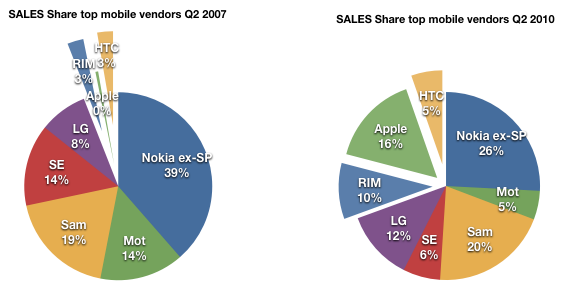
    The volume of units HTC sold has been increasing at about the rate of market growth.
    As a result, HTC's share has not increased as dramatically as those of the other smartphone entrants.

    Sales
    A similar story in the sales picture. Although a consistent performer, the growth has not matched that of RIM and Apple.
    ASP
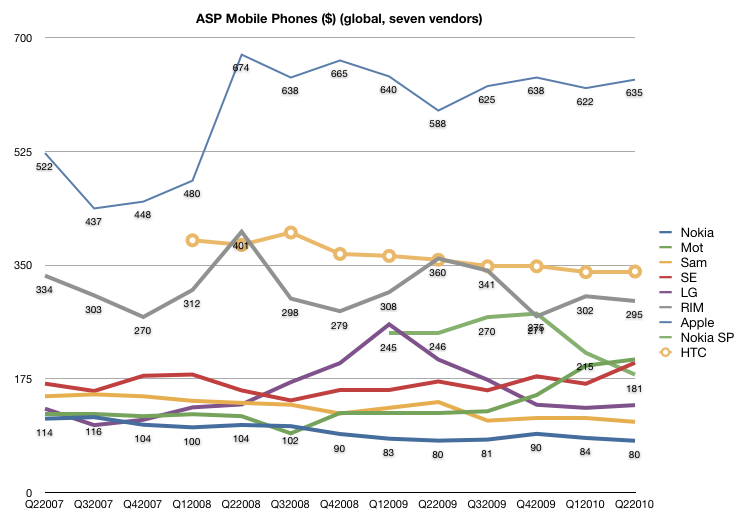
    The pricing story is also a mixed one. Although HTC lies between RIM and Apple in price, the erosion is more consistent with RIM and the rest of the industry.

    Margin
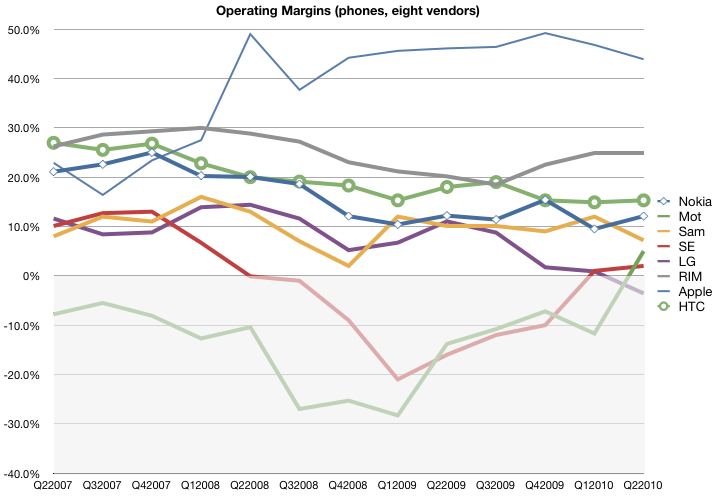
    The margin story is also not as positive as one might expect. The margins for HTC started out above Apple and RIM but have dropped to closer to industry average. This is not what one might expect from an exclusive smartphone vendor.

    Earnings
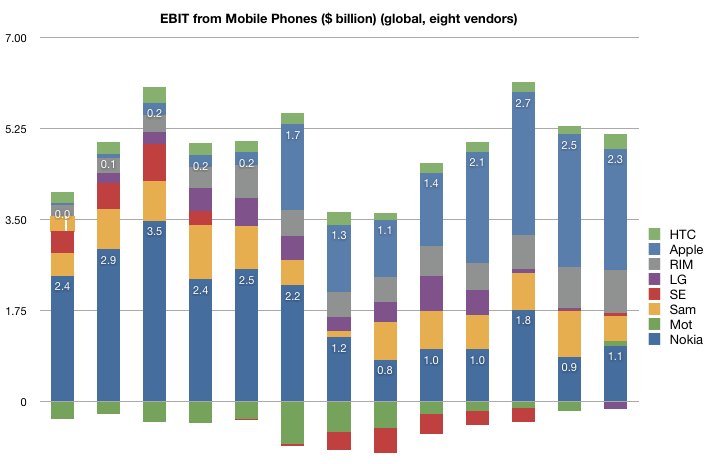
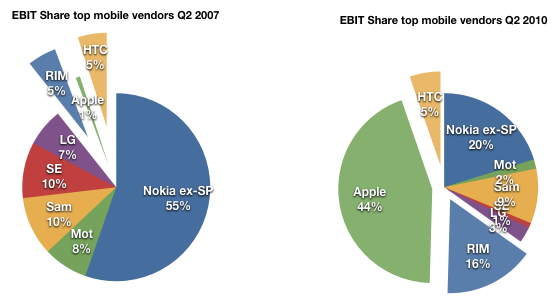
    The share of earnings has remained unchanged at 5% over the period of iPhone presence. It's perhaps a credit to HTC that they did maintain their position in the market with the massive change that has come to pass.

    However, here we also have to ask if HTC is riding a disruptive wave.

    When I wrote the last series, my definition of “loser” was a company that had faced a long series of operating losses and has no viable software assets of its own, making it vulnerable to Android (and Windows Mobile). Motorola first, Sony Ericsson second and LG now coming into the picture. Nokia is not a loser in this sense since it has remained profitable and does maintain an investment in software. Same with RIM and Samsung (now with Bada). When/if they do have the near death experience, they might opt for the Android lifeline (flimsy as it is).

    However HTC does not fit the mold of either "winner" or "loser". It's the Goldilocks company, not too hot, not too cold.

    But I would add that HTC is not an example of a winner because of its adoption of Android. HTC’s dependence on Windows Mobile made their move to Android the most desperate of all. Unlike the larger OEMs, who had their low end devices to fall back on, they are completely dependent on a smartphone OS vendor. When WinMo was showing the first signs of crisis in 2007, they were the first to flee to Android (think of why they would risk the wrath of Microsoft for something so fragile as Android in 07). They are also trying hard to escape the dependence by building up their own UI (SenseUI) and I would not be surprised if they move to their own OS in the future. Being associated with Android does not confirm them as "winners" but in fact, shows their vulnerability.

    What does this all say about Android?

    Again here my thesis is that Google chose to sustain the industry rather than try to upend it. I don't judge their motives, but the fact is that with Android, Google is not in a position to disrupt telecom. There were high hopes dashed with the Nexus One and hearts broken with net neutrality and now there are patent wars to be fought. Android, with its licensees, is still at the mercy of operators.
  2. LG dreams of smartphones [Updated]

    Research · 4 comments

    LG has decided to reduce its bloated mobile phone lineup by half to around 70 from last year's 145.

    It plans to release 20 sets of smartphones this year with 15 models being Android phones.

    He said that 4.2 million phones will be Android-based, while 1.8 million will use Microsoft's Windows Mobile operating system, the executive said.

    via LG jacks up smartphone sales target to 6 mil.

    LG's already thin margins were wiped out last quarter.

    As of the end of the second quarter, Samsung’s global smartphone share was 4.8 percent, according to IDC. But LG’s presence was negligible.

    [Update] From early 2009,

    LG, the third-biggest phone maker, will produce about 50 models that run Windows over the next five years, said Scott Rockfeld, a director in Microsoft’s mobile business. Seoul-based LG will use the software as its primary program for smart phones, devices that can send e-mail and browse the Web.

    Microsoft Signs LG Phone Deal, Updates Windows Mobile (Update1) - Bloomberg.

    Why does Microsoft and LG keep talking about how many phone models they will launch? Since when does a large portfolio make up for poor products?

  3. Phone incumbents' average operating margin: 4.5%. RIM and Apple: 34%

    Research · 10 comments

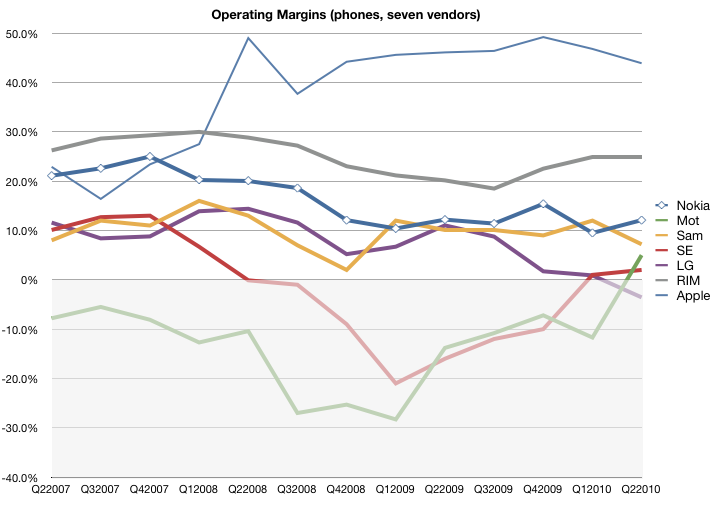
    After ASP, Sales, and Unit Volumes we look at the three year history of operating margins for the seven most significant mobile phone vendors (Nokia, Samsung, LG, Motorola, Sony Ericsson, RIM and Apple).

    The following chart shows the OM from mobile phone sales. These figures are as reported by the companies with the exception of Samsung and Apple. Samsung reports OM for its telecommunications unit as a whole and we have to assume that it's largely accurate for mobile phones. Apple does not report margins for its iPhone but it's possible to estimate gross margin percent for the iPhone and then subtract its overall OPEX as percent of sales. This assumes that OPEX is allocated to the iPhone in proportion to sales, which is the best assumption we can make at this time.

    The data shows that the iPhone has been considerably more profitable, due mostly to a high ASP, than other vendors. Motorola and Sony Ericsson have been "underwater" with respect to margin for much of the time period, with LG recently dipping into the red.

    Nokia's margin erosion is a source of significant angst but note that it has just reached Samsung's historic level (around 10%). LG, long seen as an up-and-coming vendor who took over the number three spot from Motorola is shown to have done so with moderate-to-low profit margins.

    Overall, the phone incumbents have an unweighted average operating margin of 4.5%, down from 8.6% three years ago. In contrast, RIM and Apple have an average OM of 34%, up from 24%.  In other words, profitability has halved for the volume leaders while it has increased nearly by half for the entrants.

    This goes a long way toward explaining the "smartphone gap" which is being filled by Android. As vendors see their unit growth, ASP and operating margins under pressure from low end disruptors, there is a tendency to flee to the high end that smartphones represent. Android offers an irresistible siren's song.

  4. The near-death experience prerequisite

    Research · 3 comments

    All phone vendors saw smartphones coming.  They hired all the right market research companies and spent lavishly on analysts to confirm that phones with operating systems were imminent.

    Nokia was one of the early movers, establishing its own software platforms group as early as 2002 while others like Samsung licensed Windows Mobile or PalmOS as early as 2003. Yet not much happened to sales. The number of smartphones units sold as percent of total has been fairly low.

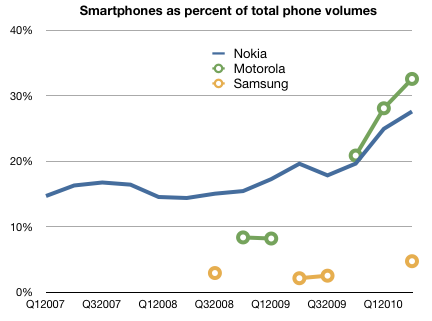
    The following chart shows the number of smartphones sold as a percent of all phones sold for the top three vendors (as of the time when the chart starts early 2007). Note that the percent of smart products shipped did not accelerate or grow dramatically for the largest two vendors even into last year.  It's still a pittance at Samsung (<5%) and even less at LG.

    The one vendor that did stage a shift was Motorola. (and Sony Ericsson, though later and softer) Both converts did this shift when faced with near-death experiences of sequential earnings losses and catastrophic market share collapses.

    Nokia is showing signs of a secular shift to smartphones but it's been a decade-long process so far, a slowness that ripped shareholder value to pieces.

    So is the precondition for a shift to smartphone focus a collapse in the core business?  It certainly seems so from the data. Motorola first, Sony Ericsson second, Nokia presently and Samsung and LG later.

    Each of these decision points reflect precisely the timing of pain points with the core businesses.

    Why this asymmetry? At first glance, the smartphone business should be sustaining and an attractive option to be exercised as soon as possible.  It offers better margins, better prices and a better return on capital.

    So why is there this disconnect? As regular readers of this blog can probably guess, my hypothesis is that the smartphone business is disruptive.  Incumbents are motivated to ignore this business because it makes money in ways they cannot control. More importantly, their best customers are signaling (in non-transparent ways) that they don't want their top vendors to participate in this market.

  5. In phone sales, RIM plus Apple equals Nokia

    Research

    Following up from the last article on the global phone units sold over the last three years (Visualizing the winners and losers of three years of smartphone share growth), we take a look at the sales in dollar terms over the same period.

    Remember that in the article on units, the pure-play smartphone entrants HTC, RIM and Apple grew from a combined unit share of 1.3% in Q2 2007 to a combined unit share of 7.7% in Q2 2010.  That's a 6 fold increase in volume share. Quite remarkable for companies lacking the vast resources and industry connections of the incumbents.

    However, when we look at their performance in value (dollar sales) vs. units sold, the performance of the entrants begins to look miraculous.

    The sales figures can be obtained from the company reports, though I caution that not all vendors publish data and data published is in local currencies. Fluctuations in exchange rates may lead to differences in reports of sales from different sources.  For the sake of consistency, I omit all "other" vendors and focus on the top seven: Nokia, Samsung, Motorola, LG, Sony Ericsson, RIM and Apple.

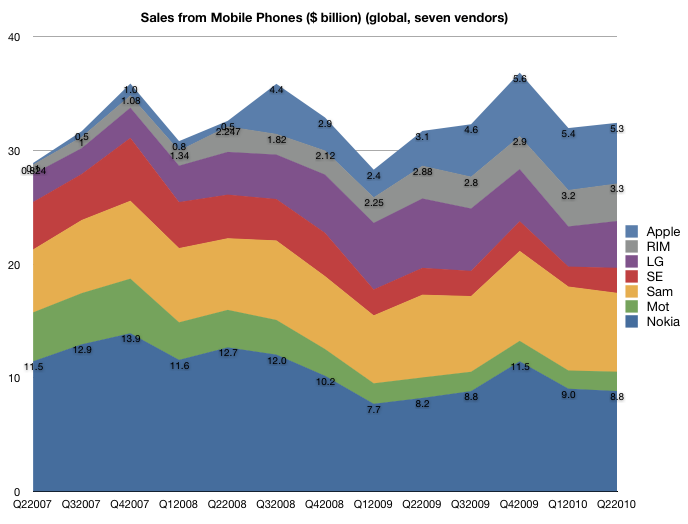
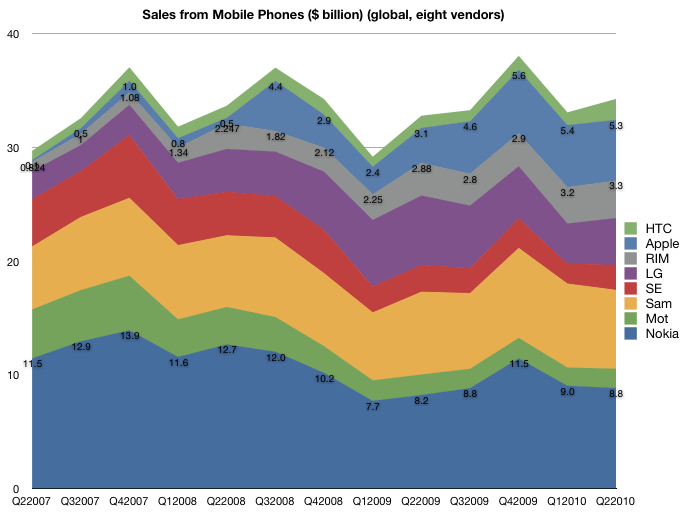
    First, the cohort's overall performance is shown in the following graph:

    I again annotated Nokia and RIM and Apple with actual sales (USD) figures for some perspective.

    The first thing to note here is that the whole industry sees a low rate of growth (unlike in the units picture). Total sales in Q2 2007 were $29 billion and total sales in Q2 2010 were about $32 billion. A mere 12% growth over three years and only 4% compounded over three years. Total units in Q2 2007 were 255 million and total units in Q2 2010 were 318 million, or 24% over three years and 6.2% compounded. This means industry-wide sales growth is half the units growth.

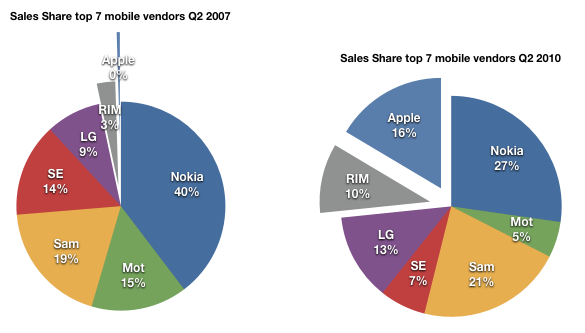
    The second thing to note is that the Apple+RIM group grew from 3.3% share of cohort to 26.6%.  That means that more than 1 in 4 dollars sent to these 7 companies was spent on Blackberries and iPhones!

    Jointly, Apple and RIM took $8.6 billion and Nokia took $8.8 billion.  Compare that with three years ago when Nokia took 40% of the income and RIM + Apple took 3%.

    So whereas the entrants increased units share by 6x in this time period, at least in this large subset of the market, they increased revenue share by 8x.

  6. Visualizing the winners and losers of three years of smartphone share growth

    Research · 2 comments

    Many consider June 2007 to have been a pivotal moment in the history of mobile phones. Apple's entry with the iPhone has re-defined the market in many ways. However, there was a smartphone market before then. About 28 million smartphones shipped the quarter when Apple launched out of an overall phone market of 265 million. Apple's entry with 270k phones was a drop in the bucket.

    I thought it would be instructive to chart what happened between that quarter, exactly three years ago and today. I collected the data from IDC, Gartner and Canalys and company reports to paint a few pictures.

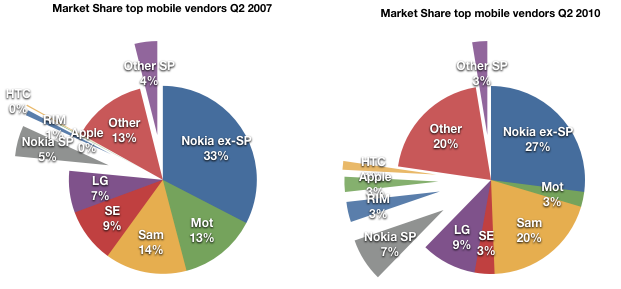
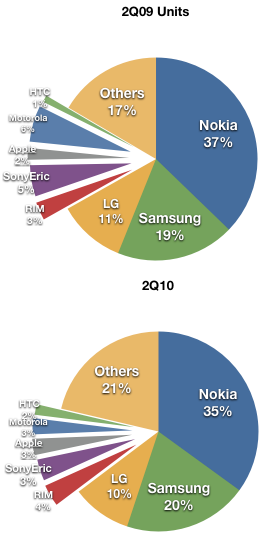
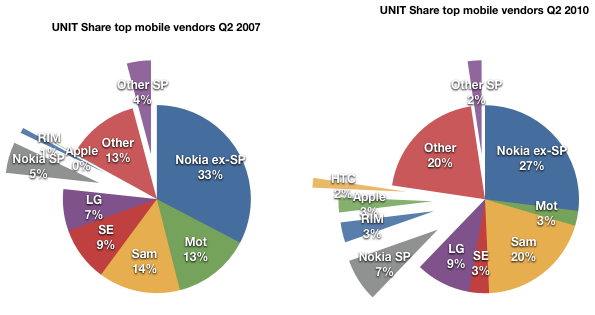
    First, the market shares (by units) of the top mobile vendors, Q207 vs. Q210. I highlighted the smartphone vendors by separating their wedges from the pie. Note that I also separated Nokia's smartphones from Nokia's regular phones as two separated wedges--Nokia ex-SP for no smartphones and Nokia SP as their "converged" units. I did the same with "other".

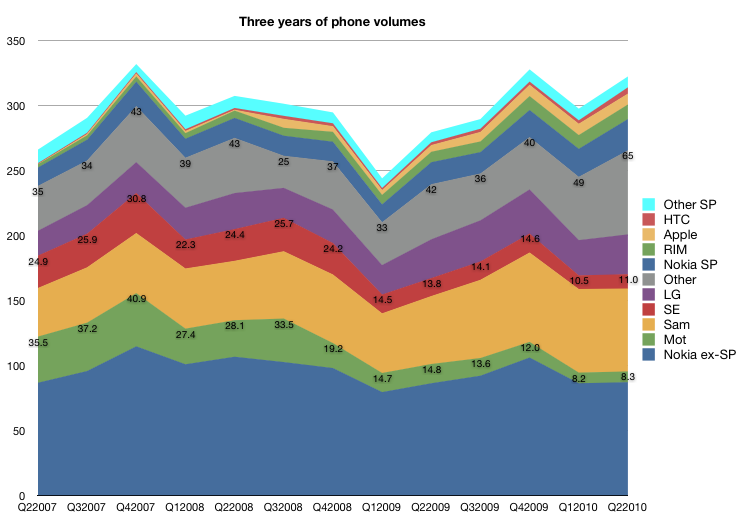
    The first thing to note (beside the large increase in smartphone share) is that "other" non-smartphones are a huge part of the pie. At 20%, the share of "other" is now equal to the share of Samsung. Other consists of a group of mostly low cost Chinese vendors. The growth of the low end "other" went from 35 million units in Q207 to 65 million in the last quarter. It's this competition that is driving profit out of the core businesses of Nokia, Samsung and LG and forcing a flight to smartphones (more about this later).

    The second thing to notice is that Motorola and Sony-Ericsson are highly visible victims of the last three years. Sony Ericsson shipped 25 million devices in Q207 and only 11 million three years later going from 9% share to 3%, on par with RIM and Apple. Motorola did even worse, shipping 35.5 million in Q207 and a mere 8.3 million last quarter, losing 10 out its 13 points of share.

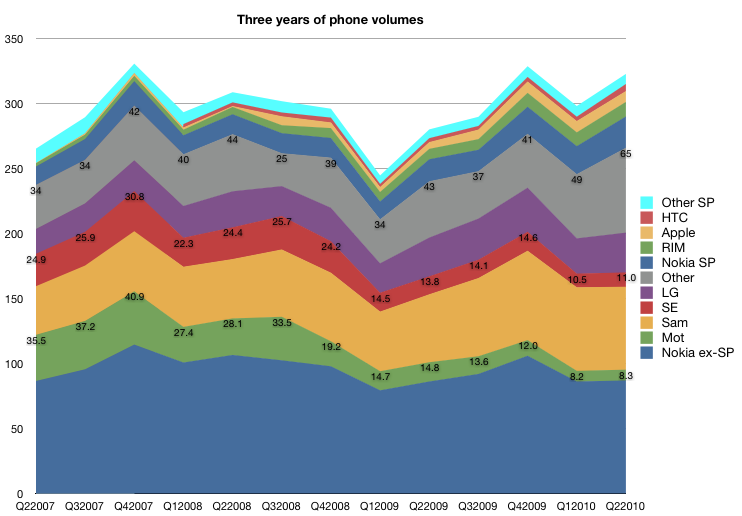
    Viewing the overall units market, one can see the gouge in units that the recession took out. The following graph shows three years of volumes by the top vendors with the smartphones separated at the top (Nokia SP, RIM, Apple, HTC and Other SP--everything above the grey band are smartphones).

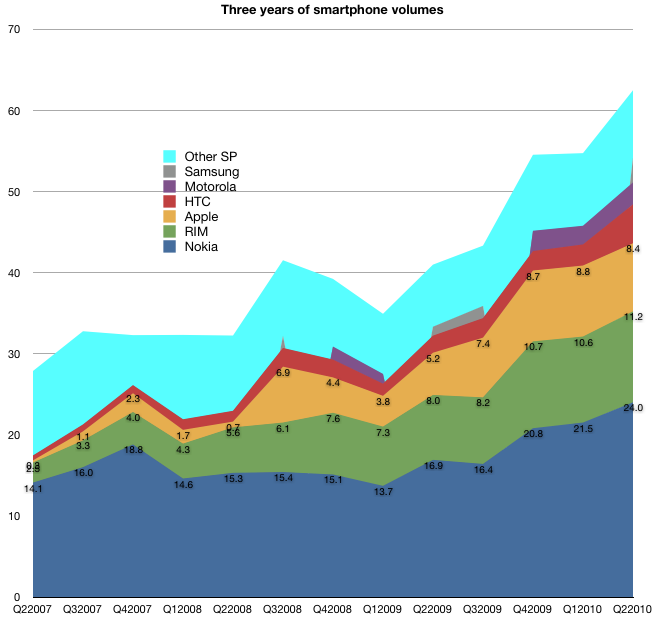
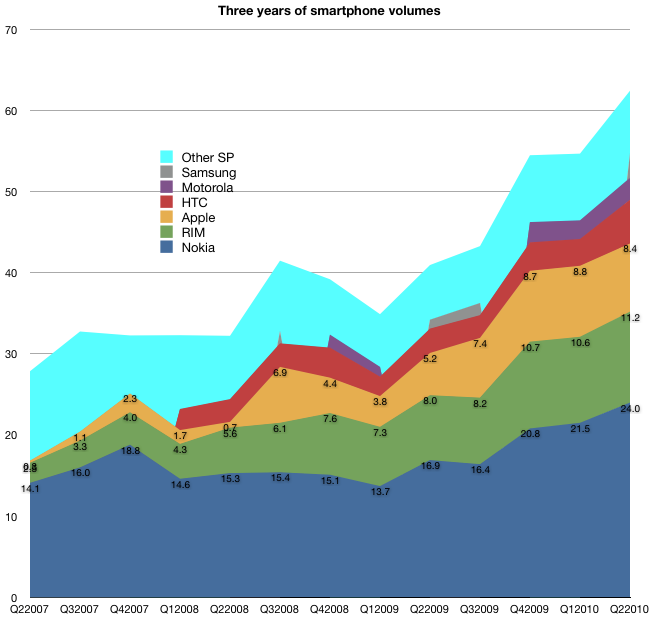
    However, separating out the smartphones, one can see their volume increased with barely a ripple during the recession. Although Nokia retains the top share spot, the entrants have jointly grown much faster.  I have annotated a few of the competitors' volumes with the actual values.

    One thing to note is that "other smartphones" has traditionally consisted of Windows Mobile licensees but that is quickly shifting now to Android. I also had only fragments of data for Samsung and Motorola, so their bands are incomplete.  However, one could note how minimal their participation has been in the market.  LG has been practically absent from this market.  For these latecomers to smartphones, it's clear what Android offers: a chance to stay in the game.

  7. Global mobile phone sales, the full picture

    Research

    After piecing together the global smartphone shares, it's time to take a look at global mobile phone shares. That's all phones from all vendors that matter.

    Unfortunately, just like there are only fragments available from Canalys about smartphones, there are only partial lists from IDC (IDC - Press Release - prUS22441510).  Missing are numbers from Apple, Motorola and HTC.  But fear not, those can be obtained from company earnings reports.

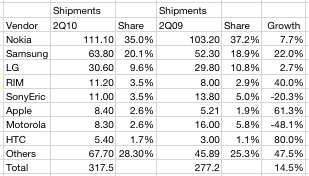
    So here is the full picture for 2Q10 vs. 2Q09

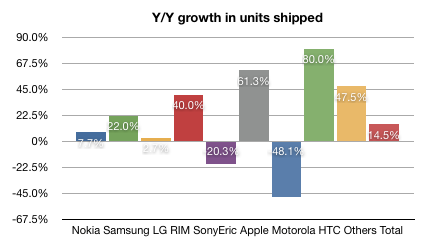
    The year-on-year growth for the vendors above is:

    The source data is:

    Observations:

    • The pure play smartphone vendors (HTC, Apple and RIM) are growing rapidly and capturing most of the profits.
    • LG and Samsung are taking share from Nokia but losing margins.
    • "others" are doing well at the low end.
    • Sony Ericsson and Motorola are transitioning from mass market vendors of commodity voice products to niche vendors of Android commodity data products.
  8. The deterioration of Nokia's core business

    Research · 5 comments

    The saga of Nokia's challenges has been well documented in this weblog.

    For this quarter, we take a look at the sequential deterioration in Nokia's bottom line and draw causal inferences to its lack of competitiveness in mobile operating systems.

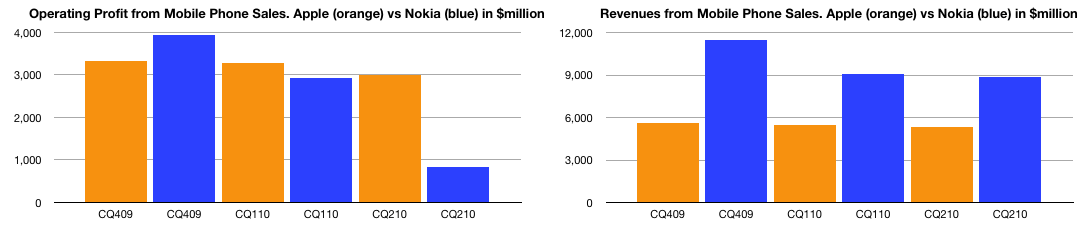
    First, the bottom and top lines are shown below (in blue) and compared with Apple (in orange):

    The charts show how Nokia's bottom line (left) collapsed while the top line (right) remained relatively solid. By comparison, Apple remained consistent in revenue with slight dip in profit as it transitioned to a new model.

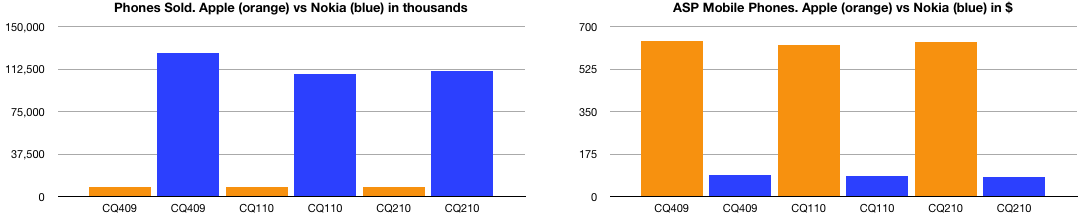
    The top line (sales) is the product of units sold and their average selling price (ASP). Here are these two quantities side-by-side:

    Note how Apple's units are hard to discern relative to Nokia's volume and how the opposite is true for the selling price. These values include all phones sold by the companies.

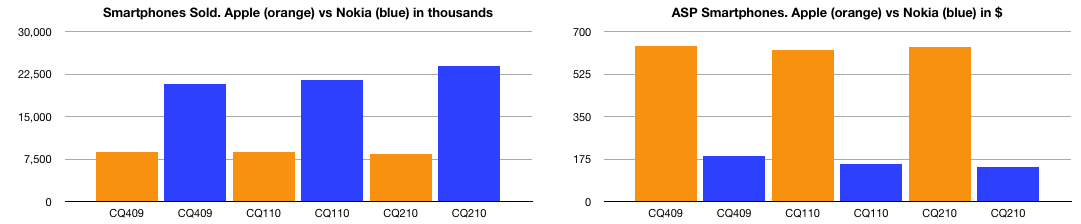
    The story is a bit more clear when comparing the smartphone part of Nokia's business, again with units and ASP:

    The story here is telling: even in smartphones, Apple's ASP is dramatically higher and much more resilient.

    The question has to be why: Why can Apple retain not only higher prices (and hence margins)? The answer is competitiveness. Margin is an indication of value created and value differential is competitive differentiation. All the user satisfaction surveys, the reviews and tests boil down to these hard numbers above. The deterioration of Nokia's business is directly traceable to its historic failure to embrace mobile software as a disruptive force and instead using it to sustain a hardware business.

  9. More than 20 percent of US wireless subscribers use smartphones

    Research

    According to a recent ComScore survey, 49.1 million people in the U.S. owned smartphones during the three months ending in May, up 8.1 percent from the corresponding February period. This is equivalent to 20.1 percent of total users. A previous survey from December showed 17 percent penetration.

    In a previous article I pointed out that more than 1 million Americans are switching to smart phones every month. This number is now 1.2 million per month. The number of non-smart devices in use is 185 million and at current rates smartphone users will outnumber non-smart users in 4.5 years. With a very small acceleration I reckon less than 4, or by 2014.

    (posting from my iPad)

  10. Nokia says the fightback starts now. Oh Really?

    Research · 1 comment

    2010.Realization that iPhone is a threat from new dimensions (user experience). Planning begins on reshaping the software base as a market-driven (not technology-driven) asset (5 year cycle). Apple begins to be evaluated as a competitor in devices and services, although still not compliant with current market definitions.

    via asymco | Assessing Nokia’s Competitive Response.

    I wrote these words a year ago based on observations made three years ago.  My expectation was and still is that Nokia does not quite understand what they are competing for and what the competition actually consists of.

    On Friday Anssi Vanjoki wrote that "The fightback starts now." He seems to contradict my timeline which has the "fightback" starting in 2014.

    How do we settle this?  Let's turn to the claims:

    In the article he says they sell 2 in 5 smartphones on the planet, yet, he turns around and says that Nokia is now the challenger in that space.  He says Symbian is the way forward on smartphones, yet he says MeeGo is the way forward on 'connected devices'. He writes that he is obsessed with getting Nokia to being number one in high-end devices (presumably by volume or sales or profit) but a recent survey by third-party tool developer Appcelerator shows 90 percent of developers surveyed said they were interested in the iPhone while 81 percent expressed interest in Android; for Symbian and MeeGo, the related figures were only 15 percent and 11 percent, respectively.

    I'm not ready to revise my timeline. The fightback begins in 2014.