
Asymco

Asymmetric Intelligence

smartphone

  1. YLE: Nokia's smartphone share crumbles in Finland

    Research

    Roughly translated:

    Nokia is rapidly losing share in the smartphone market in Finland. The iPhone is becoming a large part of the market.  Sales grew in the first quarter but a growing slice of revenues is going to Nokia's competition.  iPhone share of the Finnish smartphone market has not been previously disclosed but Sonera Sales Director Juha Koivuniuemi reveals it to be more than 20 percent.

    Nokian asema murenee huippupuhelimissa myös Suomessa | Talous ja politiikka | YLE Uutiset | yle.fi.

    I should mention that I had previously estimated iPhone share at 17% in January.

    Reminds me of another phenomenon: the iPhone in Japan.
  2. Why I think Apple wants everybody to have an iPhone

    Research · 15 comments

    In recent entries I asked: Can the iPhone reach 10% of the world’s 3G subscribers? and  Can iPhone reach 20% of global smartphone market?

    These were rhetorical questions designed to demonstrate that a growth rate of 50% (compounded) over three years was clearly possible through reduction to absurdity of alternative scenarios.

    The question of iPhone as iPod vs. iPhone as Mac businesses is at the crux of any investment in Apple today and the key strategic question facing Apple and all its competitors.  Anyone holding or considering buying AAPL shares should answer this question for themselves.

    To the top-down market share scenarios above I add the following, more direct, signals Apple has made regarding their iPhone-for-all strategy:

    1. The fact that they entered the market at all.  When they were building iPods, Apple came to understand that to be a device company means to be a phone company.  The device business is much more sensitive to volume (i.e. economies of scale) than the PC business. Nokia proves this point every day.  You can’t be in the device business with low volumes and stay profitable for long. This is because you can't get component pricing low enough to sustain margins that can afford you R&D sufficient to differentiate your product.  Therefore you cannot stay in the phone business with low volumes (see Palm).
    2. Apple repeatedly signaled that they will not permit a pricing umbrella for their products.  Although the product seems priced highly now it’s only because that’s what the market can bear and because of the possibility of taking a cut from service revenues.  The iPhone is not as expensive as it might seem relative to other smartphones, it just has a huge gross margin (50% at least).  Apple can keep their costs low through volume but they can also tweak pricing down if they need to.
    3. The platform approach.  Apple is putting in an enormous effort to orchestrating a mobile platform.  This is the most obvious signal.  Platforms are expensive to build. If the cost to build a mobile phone is x, the cost to build a mobile platform is 10x.  Platforms are expensive to maintain but generate enormous rents if volumes are built and users are retained.  The platform’s value grows as the n*log(n) of the number of users (Metcalfe’s law).
  3. Mobile phone companies consolidate while the smartphone market expands

    Research · 2 comments

    In Japan’s second cell-phone merger this month, Fujitsu and Toshiba said Thursday they will merge their handset operations ... NEC, Casio Computer and Hitachi merged their phone units earlier this month.

    via Fujitsu and Toshiba to Merge Cellphone Units - DealBook Blog - NYTimes.com.

    Mergers usually happen in a mature industry when there is excess capacity and decreasing growth.  In the mobile phone market we've seen several companies disappear or merge over the past decade:

    • Ericsson
    • Sony
    • Alcatel
    • Siemens
    • Casio
    • NEC
    • Hitachi
    • Fujitsu
    • Toshiba
    • Palm
    • Handspring
    • Motorola tried but failed to get itself acquired.

    But we've just seen forecasts where the smartphone market is growing and is expected to continue growing at 40%. Why is there consolidation in a growing market?

    The obvious answer is that none of the companies listed above had any significant smartphone businesses.  But that begs another question: why? Is the smartphone market so different than the mobile phone market?

    If the answer is yes, then there is an implied asymmetry.  Asymmetry is symptomatic of disruption. Disruption then leads one to ask how the other incumbents will cope?

  4. Can the iPhone reach 10% of the world's 3G subscribers?

    Research

    In a previous article I asked what it would take for the iPhone to reach 20% of the world's smartphone market? (answer: 50% growth).

    Now I take a look at the whole market measuring three underlying quantities:

    1. the number of total wireless subscribers world-wide
    2. the number of 3G subscribers
    3. the number of smartphones sold every year 2007 to 2013

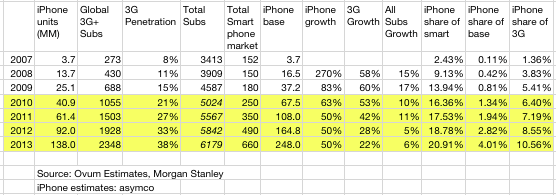
    The forecast for 2013 is:

    1. total subs: 6.2 billion
    2. total 3G subs: 2.4 billion (38% of all WW users)
    3. 660 million smartphones sold in 2013

    I also computed the installed base of iPhones based on units sold per year according to the following schedule: 100% of iPhones in use during first year, 75% in use after second year, 50% in use in the third year, 25% in the fourth and 0% in the fifth and after.

    If the iPhone can sustain 50% growth then the following are possible in 2013:

    1. 4% of world’s users using an iPhone (248 million iphone users)
    2. 10% of 3G users are using the iPhone
    3. 21% of smartphones purchased are iPhones
  5. 20% of American subs have a smartphone with 1.2 million switching every month

    Research

    According to The State of Mobile Apps | Nielsen Wire 21% of American wireless subscribers have a smartphone at Q4 2009, up from 19% in the previous quarter and significantly higher than the 14% at the end of 2008.

    A previous Comscore survey showed US smartphone penetration at about 17%.

    If we were to blend the data to a rough estimate, I would say it's fair to assume 20% penetration.  The total number of subscribers in the US is about 234 million, which makes for 46.8 million smartphone users.

    This still leaves 80% or 187.2 million non-smartphone users.

    The share gain of 6%/yr. means another 1.2 million Americans are switching into a smartphone every month.  Another decade and the non-smartphone market will simply be gone.

    With AT&T lowering the barriers of entry with data plan pricing and with other operators matching, don't be surprised if it happens sooner.

    As saturation begins around 50% to 60% penetration, price competition will intensify.  That takes the tipping point to about 2013.

  6. Does iPhone really have 72% of Japanese smartphone market?

    Research

    MM Research does not count Symbian as a smartphone platform. This makes them inconsistent with any other analyst for counting smartphones.  So shouldn't Symbian be included?

    In a comment to iPhone has 72% of Japanese smartphone market | Asymco it's been pointed out that 12 million Symbian sold in the same time frame as Apple sold 1.7 million phones in Japan.

    It would seem then that the correct market share for iPhone would be 12%, with Symbian having 83% and "others" having less than 5%.

    However...

    Symbian in Japan is not the same thing as Symbian elsewhere.  Symbian in Japan is used as a low level OS by Fujitsu, Sony Ericsson Japan, Mitsubishi, Sharp and others to provide devices running the MOAP(Symbian) software platform.  MOAP (Mobile Oriented Applications Platform) is the software platform for NTT DoCoMo's FOMA (Freedom of Mobile Multimedia Access) service.

    Unlike Series 60 and UIQ MOAP(Symbian) is not a open development platform.

    MOAP is also supported by Linux with Panasonic and NEC using it in something called MOAP(Linux).

    MOAP(Linux) is also not an open development platform.

    So the "72% share for iPhone" in Japan must be stated with this important caveat: that Symbian and Linux are not included because, due to not having exposed APIs, they are classified as feature phone platforms.

  7. NPD: iPhone is 65 percent of AT&T's smartphone volume

    Research · 4 comments

    Much ink is being spilled over Android outselling the iPhone in the US in Q1.  Here's what NPD survey data shows:

    • Q1 units for Android reached 28% vs. iPhone at 21%.
    • AT&T stated that they activated 2.7 million iPhones.  That is 31% of all iPhones sold by Apple.  Assuming NPD data is accurate, we can conclude that Android shipped 3.6 million units in the US or 65% of their total.
    • In a previous posting (Global smart phone OS shares « Asymco) I estimated, based on Canalys estimates, that global Android share reached 10% last quarter or about 5.5 million.
    • We can compute that Android captured only 4% of smartphone share outside the US while Apple obtained 14% share.
    • You can also observe that iPhone's US share increased y/y while every other platform except Android dropped (implying that Android took share from everybody but Apple.)
    • NPD claims AT&T accounted for 32% of the smartphone market, and even though AT&T carried both Android and WinMo and Blackberry devices, 21 out of every 32 phones or 65% of AT&T's volume were iPhones.
    • We can conclude that Android captured 34% of the non-AT&T US smartphone market.

    The table below combines the NPD, AT&T, and Canalys data to show units for iPhone and Android in the US, Global and non-US regions.

    One can only wonder what would happen if iPhone would be available non-exclusively.  Would iPhone achieve greater than 60% share as it did on AT&T?  Certainly that's what happened in France.

  8. RIM chief competing for "Most out of touch CEO" award

    Research

    RIM's co-chief Mike Lazaridis downplayed many of Apple's efforts today in a keynote at the TD Newcrest technology conference in Toronto. The executive was concerned that there wasn't necessarily a market for tablets like the iPad and that any devices would have to be put in the context of computers and smartphones. Many companies ask new hires to choose either a new smartphone or a new notebook, and if the tablet is simply a substitute for a notebook it may not have an easy answer, Lazaridis said.

    He added that smartphones are getting more powerful and more computer like, and by extension would reduce the need for a tablet.

    The company leader also dismissed the importance of touchscreen phones. While it's important to give customers what they want, touch-only phones like the iPhone aren't that popular, Lazaridis argued. He claimed that most of the people buying touchscreen phones are going back to phones with hardware QWERTY keyboards, like those that made RIM "famous."

    He pointed out that it was the experience and not the features that determined a phone's success, and that the most popular BlackBerry was actually the starter Curve 8520. It not only lacks touch but 3G and a high-resolution screen.

    via RIM chief: no market for tablets, touch-only phones | Electronista.

    Jobs must be thinking: with enemies like these, who needs friends.

  9. Smartphones taking over in mobile gaming

    Research

    Smartphones are upturning the mobile gaming market, comScore found in a study today. The number of players on iPhones and other smartphones has jumped 60 percent in the past year to almost 21.4 million and has cut deeply into the portion of those using regular cellphones. Their numbers dropped a sharp 35 percent over the same period to just 29.5 million.

    via Smartphones taking over in mobile gaming | Electronista.

    More data from Flurry analytics here.

    Other game platforms vs. iPhone catalogs here.

  10. Google and Microsoft swap mobile share

    Research

    according to a report published Monday. ComScore reported that Google's share of smartphone subscribers rose to 9%, compared to 3.8% at the end of November. Meanwhile Apple's share fell 0.1 points to 25.4%, while Microsoft's share fell 4 points to 15.1%.

    via Google's share of mobile market grows: report - MarketWatch.

    Seems Google's gain is Microsoft's loss.

    BlackBerry, saw its share rise 1.3 points to 42.1%, according to the data. The number of owners of smartphones rose 21% in the U.S. in the three months ended in February compared to the prior period.
